© 2014 Muchtaridi Muchtaridi et al. This is an open access article distributed under the terms of the Creative Commons Attribution License -NonCommercial-ShareAlikeUnported License (http://creativecommons.org/licenses/by-nc-sa/3.0/).
Journal of Applied Pharmaceutical Science Vol. 4 (01), pp. 052-056, January, 2014 Available online at http://www.japsonline.com
DOI: 10.7324/JAPS.2014.40108 ISSN 2231-3354
Chemical Composition and Locomotors Activity of Essential Oils from
the Rhizome, Stem, and Leaf of A lpinia malaccencis
(Burm F.) of
Indonesian Spices
Muchtaridi Muchtaridi
1*, Ida Musfiroh
1, Anas Subarnas
3, Ikhsan Rambia
1, Hokcu Suganda
2, M. Enas Nasrudin
41Department of Pharmaceutical analysis and Medicinal Chemistry, Faculty of Pharmacy, Universitas Padjadjaran, Bandung, Indonesia, 2Department of
Chemistry, Indonesia University of Education, Bandung, Indonesia, 3Department of Pharmacology and Clinic, Faculty of Pharmacy, Universitas PadjadjaranDepartment of Phramacy, Universitas Garut, Jl. Tarogong, 4 Department of Pharmacy, Universitas Garut, Garut, West Java, Indonesia.
ARTICLE INFO ABSTRACT
Article history:
Received on: 25/11/2013 Revised on: 02/12/2013 Accepted on: 16/12/2013 Available online:30/01/2014
The essential oils of three parts of the plant Alpinia malaccencis (Burm f.) (Zingiberaceae) collected from Sumedang, West Java Province has been studied. Determination of essential oil components from the rhizome, stem, and leaf of Alpinia malaccencis (Burm f.) was performed by confirmation of the linear retention index (LRI) and comparing the NIST library peak with data reported in the literature, the mass spectrum peaks with literature data. The essential oils obtained from rhizome, stem, and leaf of Alpinia malaccencis (Burm f.) by steam distillation was 1.22%, 0.25%, and 0.7%, (w/w), respectively. Rhizome oil composition was almost similar with stem oil with methyl cinnamate as the major component. Composition of leaf oil is different from rhizome and stem oil which dominated α-pinene (30.57%). The rhizome in doses 0.1 ml (47.09 %) had stronger locomotor inhibition activity compare than stem (26.97 %) and leaf oils (32.23 %) in doses 0.1 mL.
Key words:
Alpinia malaccencis (Burm
f.), methyl cinnamate, LRI, and α-pinene, 1.8-cineole.
INTRODUCTION
Alpinia malaccencis (Burm f.) (AM), Zingeberaceae, which in West Java that called Laja Gowah is a rhizomatous herbs that grow wild in Java and the island of Ambon of Indonesia. It also grows in Bangladesh, Malaysia, India, Myanmar, and Thailand. In Sumedang and Subang, West Java, the rhizomes are used in traditional medicine as an antiemetic or as a seasoning for meat processing, and sent to Central Java as an active ingredient in cosmetics (Oyen, 1999).
AM is commonly cultivated and grows wild in the forests of teak, bamboo groves and forests. It grows at a height 2-1500 m above sea level and enjoy under the shade, and the tall of AM
reach to 1-4 meters. All part of AM has aroma, especially the rhizome which has a stronger fragrance (Sastrapradja and Setijati, 1977; Heyne, 1987). Heyne (1987) explains that the fresh rhizome of AM contain 0.25% volatile oil. Laja gowah fruit often used traditionally as an antiemetic drug, whereas in Ambon leaf and fruit are used to freshen the mouth and perfect sound.
.
* Corresponding Author Emails: [email protected]
Laja gowah fragrant rhizome oil used for hair (van Valkenburg and Bungapraphatsara, 2001).
In Sumedang and Subang, West Java, the leaf is used in children as an anti-vomiting, and rhizome oil used as massage oil. According to the literature (Heyne, 1987), wet rhizome contains essential oils of 0.25%.
Fragrant essential oils of the rhizome is used as a cosmetic in traditional medicine. Dried and fresh rhizome contain essential oil to the extent of 0.25% and 1.33%, respectively. The essential oil the rhizome contains methyl cinnamate as the major component, 60 % (Muchtaridi et al., 2003).
All parts of the rhizome is a fragrance, but the interesting results of this study is that almost every part to provide a unique scent. Here we also show that our study is significantly different from previous studies from other countries (Malaysia) (Azah et al.,
MATERIAL AND METHODS
Materials
Plant Material
All parts (stems, leaf and roots) from AM were collected in November 2005 (rainy season) from Batugara, Ganeas, Sumedang (F 6 º 44'-70 º 83 ', 1,000 m) district. Specimens are identified by the Herbarium Laboratory, Department of Biology, Faculty of Mathematics and Natural Sciences, Universitas Padjadjaran and voucher specimens are stored in the Herbarium Biology Department, Faculty of Mathematics and Natural Sciences, Universitas Padjadjaran. Rhizome (6 kg), leaf (3 kg) and stems (3 kg) was dried in air for 14 days at room temperature to produce dry samples, each weighing 1 kg of rhizome, 0.5 kg of stems, and 1 kg of leaf, prepared for the distillation.
Animals
Male mice weighing 25 to 30 g and 2 to 3 months old were used. The mice were adapted for one week to the laboratory in which locomotor activity experiments were conducted and were selected for wheel rotations of between 150 to 300 rpm before the experiments were started.
Methods
Isolation of essential oil
All dry samples (1 kg roots, stems 0.5 kg, and 1 kg of leaf) on steam-distillation in Monaco Lembang, West Java, for 3 hours to isolate the essential oil fraction. Oil stored at -20 ° C after the addition of sodium sulfate.
Analytical Condition
Essential oils were analyzed on QP5050A GC/MS- (Shimadzu) equipped with a fused silica capillary DB-5ms 30 mm x 0.25 nm, 0.25 m, carrier gas helium 95.3 kPa, flow rate 1.7 ml were: interface temperature 240 C; electron impact ionization at 70 eV by scanning the mass range (m / z) of 40-350 daltons with a sampling rate of 1.0 scans / s. Identification of compounds is done by searching on a computer using a digital library of mass spectral data by a Class-5000 software and by comparison of retention indices and mass spectra library authentic (Strehmel et al., 2008; Ausloos et al., 1999; Babushok et al., 2007; Adams, 1995), relative to the C8-C20 and C21-C40 n-alkane series (Sigma) (Mijin et al., 1999) in temperature-programmed run.
Mouse Locomotor Activity Tests
Locomotor activity of mice was measured using a wheel cage, in which mice ran and the number of rotations was recorded by a meter. Cage inhalators contained a glass fiber (20 cm × 20 cm × 30 cm) and were equipped with an electric fan for the
evaporation and distribution of volatile compounds. The mice were selected by weight (25 to 30 g) and by their ability to rotate the wheel cage up to 300 times in 30 min; eligible mice were then divided into three groups: a control group, a lavender oil group as positive control group (using 0.1, 0.3, and 0.5 mL/cage), and a essential oils tested as treatment group (using 0.1, 0.3, and 0.5 mL/cage). The application of the doses were based on the preliminary examination in which those doses were reasonable to be used and based on Kovar et al. (1987). Each group consisting of five mice was tested three separate times. After 30 min of inhalation, the mice were placed into the wheel cage and after 5 min; the number of rotations was recorded for 75 min in 15-minute intervals.
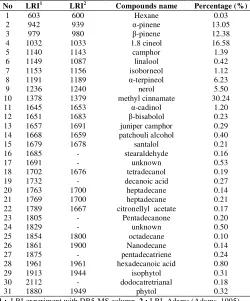
Table. 1: Constituents of rhizome essential oil from AM (Burm f.).
and α-ardinal (1.2%) as can be seen in Table 2. However, rhizome oil does not contain santalol, isoborneol, nerol, and phyitol as in stem oil, but there are some substances contained in the rhizome is not in the stem such as γ-caryophyilene, nerolidol, viridiflorol, and carotol. On the other hand, essential oils do not contain flavone and diterpenoid as submitted by Nuntawong (Nuntawong and Suksamrarn, 2008).
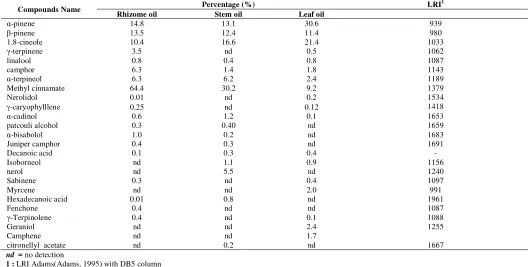
There were significant differences in the composition of leaf oil composition compared to oil in the rhizome and stem α -pinene (30%) is the main component in leaf oil, mint or donated coniferous smell while the rhizome and stem (Leffingwell, 1990) of AM has a balsamic odor.
This might be the reason the leaf are used as anti-emetics, and rhizomes are used as massage oil in Sumedang, where the sampling. However, these results differ significantly with that studied by Bhuiyan et al. (Bhuiyan et al., 2010). They assume that the elements of the leaf oils AM from Bangladesh has been dominated by α-phellandrene (31.80%), eucalyptol (13.76%), O-cymene (11.45%), β-pinene (11.34 %) and limonene (6.44%), even though methyl cinnamate has not been detected on leaf. Composition of leaf, stem and rhizome oils AM (Burm f.) in this study is significantly different from those reported by Azah et al. (Azah et al., 2005), which indicates that the methyl cinnamate was dominant in leaf, stems and rhizome oils, with α-pinene and 1.8-cineole accounted for less than 4%. However, our study used a different method of isolation of essential oils, steam distillation,
whereas they used distilled water, may affect the resulting compositions. In addition, the geographic and seasonal factors may be important in determining the chemical composition. Differences between the chemical
compositions of essential oil of three parts of the plant can be seen in Table 4.
Locomotors activity Inhibition of Rhizome, Leaf and stem oil from AM (Burm f.)
Our previous study, we evaluate the effect of the essential rhizomes oils from AM on locomotors activity in mice and identify the active components that may be responsible for the activity (Muchtaridi et al., 2011).
Here, we presented locomotors activity inhibition of the rhizome, stem, and leaf oils from AM as shown in Table 5. Inhibition of locomotors activity of rhizome oil showed stronger than leaf oil from AM. On the other hand, the third rizhome, stem, and leaf oils contain methyl cinnamate and 1,8-cineole that might be responsible on activity (Muchtaridi et al., 2011).
Further Discussion
In Indonesia, this plant is not cultivated, and did not receive serious attention by the government of Indonesia.
We recommend that AM (Burm f.) is given special attention because these plants have good prospects proved that all the major components in the essential oils of this plant has been used as a fragrance ingredient.
Methyl cinnamate can be found in fragrances used in decorative cosmetics, fine fragrances, shampoos, toilet soaps and other toiletries as well as product-non-cosmetic products such as household cleaners and detergents (Bhatia et al., 2007), even these compounds have antibacterial activity (Huang et al., 2009). α-pinene is categorized as a local irritant, and is used as a counter irritant, insecticides, and mild antiseptic. Industry, α -pinene have applications as a wax solvent, and raw materials for
camphor, perfumes, and pine oils. In addition, these compounds has anti browning in the food with inhibition monophenolase and diphenolase activity even it has antibacterial activity against Escherichia coli, Bacillus subtilis and Staphyloccocus aureus and antifungal activity against Candida albicans (Xia et al., 1999).1.8-cineol is a fragrance ingredient that occurs in eucalyptus oil, with the smell of fresh and used in large quantities in the aroma and taste (Surburg and Panten, 2006).
Locomotor activity inhibition of the third part of the laja gowah were almost the same, however specifically inhibitory activity of leaf oil has a softer locomotor. Leaf oil is recommended to use for SPA, while the rhizome and stems oil is recommended
for massage oil, balsamic odor because it is more dominant in both oils was compared leaf oils which predominant herbal
odors.
Table. 4: Chemical compositions of the rhizome, stem, and leaf oil in AM (Burm f.)
Compounds Name Percentage (%) LRI
1 : LRI Adams(Adams, 1995) with DB5 column
Table. 5: Average number of mice wheel cage rotations within 75 min of inhalation of Rhizome and leaf essential oils from AM.
Mean Instead of Number of Average %
Inhibitory
F6,35 = 3.30 P < 0.05, as compared with the control treatment. (by ANOVA followed by Duncan post hoc test). ** F6,35 = 14.10 P < 0.01, as compared with the
control treatment. (by ANOVA followed by Duncan post hoc test). *** F6,35= 26.10 P < 0.001, as compared with the control treatment. (by ANOVA followed by
ACKNOWLEDGMENT
We gratefully acknowledge the Rector of Universitas Padjadjaran and the Indonesian Ministry of National Education for funding this work through the DIPA research grant..
REFERENCES
Ausloos, P.; Clifton, C. L.; Lias, S. G.; Mikaya, A. I.; Stein, S. E.; Tchekhovskoi, D. V.; Sparkman, O. D.; Zaikin, V.; Zhu, D. The critical evaluation of a comprehensive mass spectral library. J Am Soc Mass Spectrom, 1999, 10, (4), 287-99.
Azah, N. M. A.; Mailina, S. J.; Chua, L.S.L. (E)-Methyl Cinnamate: The Major Component of Essential Oils of Alpinia Malaccensis Var. Nobilis. Journal of Tropical Forest Science, 2005, 17 (4), 631-633.
Adams, R. P. 1995. Identification of Essential Oil Components by Gas Chromatography/Mass Spectroscopy. Allured Publishing Corporation: Illinois.
Babushok, V. I.; Linstrom, P. J.; Reed, J. J.; Zenkevich, I. G.; Brown, R. L.; Mallard, W. G.; Stein, S. E. Development of a database of gas chromatographic retention properties of organic compounds. J Chromatogr A 2007, 1157, (1-2), 414-21.
Bhatia, S. P.; Wellington, G. A.; Cocchiara, J.; Lalko, J.; Letizia, C. S.; Api, A. M. Fragrance material review on methyl cinnamate. Food Chem Toxicol 2007, 45 Suppl 1, S113-9.
Bhuiyan, M. N. I.; Chowdhury, J. U.; Begum, J.; Nandi, N. C. Essential oils analysis of the rhizomes of Alpinia conchigera Griff. and leaves of Alpinia malaccensis (Burm. f.) Roscoe from Bangladesh. African J. of Plant Sc. 2010, 4, (6), 197-201.
Heyne, K. 1987. Tumbuhan Berguna Indonesia. Yayasan Sarana Wijaya: Jakarta.
Huang, Q. S.; Zhu, Y. J.; Li, H. L.; Zhuang, J. X.; Zhang, C. L.; Zhou, J. J.; Li, W. G.; Chen, Q. X. Inhibitory effects of methyl trans-cinnamate on mushroom tyrosinase and its antimicrobial activities. J Agric Food Chem, 2009, 57, (6), 2565-9.
Kovar, K. A.; Gropper, B.; Friess, D.; Ammon, H. P. Blood levels of 1,8-cineole and locomotor activity of mice after inhalation and oral administration of rosemary oil. Planta Med 1987, 53, (4), 315-8.
Leffingwell, J.C. Acyclic Terpenoid Odorants. http://www.lef fingwell.com/ (02 January 2005),
Mijin, D. Z.; Petrovic, S. D.; Antonovic, D. G. Gas Chromatography Retention Indices of 2-Phenyl- 2 Alkylacetonitriles on Packed Coloumns. The Sci. J. Fact. Univ. 1999, 2, (1), 1-8.
Muchtaridi; Diantini, A.; Subarnas, A. Analysis of Indonesian Spice Essential Oil Compounds That Inhibit Locomotor Activity in Mice. Pharmaceuticals 2011, 4, (4), 590-602.
Muchtaridi; Mukdan, N. A.; Musfiroh, I.; Sutasli, A. Characteristic of Essential Oils from Laja Gowah Rhizome (Alpinia malaccencic (Roxb)). J. Bionatura 2003, 6, (4), 33-40.
Nuntawong, N.; Suksamrarn, A. Chemical constituents of the rhizomes of Alpinia malaccensis. Biochem. Systematic and Ecology 2008, 36, 661-664.
Oyen, N., XD. Plant Resources of South-East Asia, Essential-oil Plants. Proscea: Bogor, 1999; Vol. 12.
Sastrapradja; Setijati, Laja Gowah Alpinia Malaccensis (Burm.f.)Roxb. . Lembaga Biologi Nasional-LIPI: 1977.
Strehmel, N.; Hummel, J.; Erban, A.; Strassburg, K.; Kopka, J., Retention index thresholds for compound matching in GC-MS metabolite profiling. J Chromatogr B Analyt Technol Biomed Life Sci 2008, 871, (2), 182-90.
Surburg, H.; Panten, J. 2006. Common fragrance and flavor materials: preparation, properties and uses. Wiley-VCH Verlag GmbH & Co. KGaA: Weinheim.
van Valkenburg; Bungapraphatsara, N. Plant Resources of South-East Asia, Medical and Poisonous Plants. Proscea: Bogor, 2001; Vol. 2.
Xia, Z.; Mao, X.; Luo, Y. Study on antifungal mechanism of alpha-pinene. [Article in Chinese] Hunan Yi Ke Da Xue Xue Bao 1999, 24, (6), 507-9.
How to cite this article: