AGRIVITA VOLUME 37 No. 2 JUNE - 2015 ISSN : 0126-0537
DUAL-PURPOSE ASSESSMENT FOR SWEETPOTATO
Sri Umi Lestari*) and Ricky Indri Hapsari
Faculty of Agriculture University of Tribhuwana Tunggadewi Jl. Telaga Warna blok C Tlogomas Malang 65144 East Java Indonesia
*) Corresponding author E-mail: [email protected]
Received: November 26, 2014/ Accepted: May 18, 2015
ABSTRACT
This study aimed to classify the types of sweet potato based on the ratio of total dry matter of roots to vine (R/V) in order to make the option available in integrating the crop-livestock systems. Seventeen sweet potato cultivars were planted in Randomized Complete Block Design
with three replications applied at two locations,
Malang and Blitar. Each cultivar planted in plot measures 2.5 m x 5 m in Malang and 3.0 m x 5 m in Blitar, and each consists of four rows with a spacing of 25 cm in rows. All cultivars gave a dose of 250 kg NPK fertilizer (15-15-15)/ha twice, one-third of dose given at planting and the remainder in a month after planting. Plants were harvested at four months after planting. Fresh weight and dry weight of storage root, fresh weight and dry weight of vines, harvest index, and
the ratio R/V are determined. There was different
performance of 17 cultivars planted at two locations. Cultivars planted in Malang were classified into four types, namely forage, which consists of three cultivars among 17 cultivars, low dual-purpose (3 cultivars), high dual-purpose (7 cultivars), and low root production (4 cultivars); while cultivars planted in Blitar turned into the forage type.
Keywords: dual-purpose, root/vine ratio, sweet potato
INTRODUCTION
Sweet potato can produce a large amount of forages to animal feed, but in Indonesia, the use of sweet potato vines for feed source has been limited. According to Peters (2008), sweet potato breeders in CIP-SSA estimated cultivars to produce a large amount of forages in East Africa, reached 35 t - 60 t/ha / season, or 70 t - 120 t/ ha/year. Many cultivars in Indonesia has not been evaluated its vines potential that should
be contributed to develop the potential use of sweet potato as an animal feed in this region.
According to Leon-Velarde et al., (1997), sweet potato cultivar was classified into five types, namely: (1) forage, (2) low dual-purpose, (3) high dual-purpose, (4) low root production, and (5) high root production. Cultivars belonging to the low or high-dual-purpose types and forage type were appropriate if integrated to crop-livestock systems. In addition, sweet potato vines is suitable for animal feed because the crude protein content is high, ranging between 16-29% based on the dry weight, comparable to forage leguminous (An et al., 2003). Similarly, according to Kaya and Yildirim (2011), sweet potato can be used to improve egg yolk color of layers, since the storage root and foliage of sweet potato are rich in -carotene and xanthophylls respectively, and they are not only important food for human but also for poultry.
According to León-Velarde (CIP Program Report, 1999-2000), a dual-purpose of sweet potato would have a comparative advantage over clones selected only for roots or forage production. It would provide food for human consumption and animal feeds for livestock, would be optimally integrated with livestock management system. The management system could utilize the sweet potato’s ability to regenerate by continually or sporadically harvesting the vines throughout the growing season before finally harvesting the roots. Many researchers have studied sweet potato used for dual-purpose, such as Larbi et al., (2007), Peters (2008), Etela et al., (2008), Claessens et al., (2008), Kaya and Yildirim (2011), Etela and Kalio (2011), and Ahmed et al., (2012). Those findings are correlated one another in using sweet potato forage to substitute animal fodder grass in crop-livestock system.
Accredited SK No.: 81/DIKTI/Kep/2011
Sri Umi Lestari and Ricky Indri Hapsari: Dual-Purpose Assessment for Sweetpotato………
MATERIALS AND METHODS
Seventeen cultivars were used in this study, consisting of nine released varieties, six improved clones varieties but have not been released (Lestari et al., 2012a; 2012b), and two local varieties namely Kuningan Putih and Kuningan Merah (Lestari and Basuki, 2013). All cultivars were collected at Brawijaya University Research Station, located in Jatikerto, Kromengan, Malang Regency. Sweet potato varieties released included Cangkuang, Ayamurasakhi, Sari, Jago, Papua Solosa, Sawentar, Beta 1, Beta 2 and Beniazuma. Improved clones were D67, 73-6 / 2, BIS OP-4, BIS OP-61, OP-73 5, and 73 OP-8. The experiments were conducted in two locations, respectively in Malang on May to September 2013, and in Blitar on September 2013 to January 2014. Randomized Complete Block Design with three replications were applied in these trials.
Each cultivar planted in each plot measuring 2.5 m x 5 m in Malang and 3.0 m x 5 m in Blitar consisted of four rows with a spacing of 25 cm in rows, so that there were 40 cuttings per plot in Malang and 48 cuttings per plot in Blitar.
Each cultivar was fertilized with 250 kg NPK fertilizer (15-15-15)/ha, twice, one-third dose at planting and the remainder at a month after planting. The plants were harvested at four months after planting. Fresh storage root weight, storage root dry weight, vines fresh weight, vines dry weight, harvest index (HI), and the ratio of total dry matter of roots to vines (R/V) were determined. The mean and the standard error for evaluation of sweet potato characteristics were determined in these trials as presented in Table 1. The ratio of total dry matter of root to vines
(R/V) was used to classify sweet potato types: (1)
forage (R/F 0 – 1), (2) low dual-purpose (R/F > 1 – 1.5), (3) high dual-purpose (R/F > 1.5 – 2.0), (4) low root production (R/F > 2.0 – 3.0), and (5) high root production (R/F > 3.0) (Leon-Velarde et al., 1997).
RESULTS AND DISCUSSION
Cultivar Classification Seventeen cultivars evaluated at two locations showed different performances (Tables 1 and 2). Cultivars planted in Malang can be classified into four types, namely (1) forage,
consists of three cultivars among 17 cultivars, (2) low purpose (3 cultivars), (3) high dual-purpose (7 cultivars), and (4) low root production (4 cultivars); while cultivars planted in Blitar turned into the type of forage. Among all cultivars evaluated in Malang, none of them was included as a high root production type.
Dual-purpose group consisting of a low dual-purpose and a high dual-purpose, each producing storage root for food and forage for animal feed were balanced. In low dual-purpose group, it had harvest index and ratio R/V ranging between 50-60% (HI) and 1.0-1.50 (R/V) respectively, whereas in high dual-purpose group, it had 60-67% (HI) and 1.50-2.0 (R/V). In these groups, both low- and high dual-purpose groups, they had fresh storage root yield ranged from 7-18 t/ha or 2-6 t/ha on dry weight based, while fresh vines ranged from 6-13 t/ha or 2-3 t/ha on dry weight based (Table 1).
Cultivars belonged to the sweet potato dual-purpose were 10 cultivars among 17 planted cultivars. Thus, there were many selected cultivars to implement in the crop-livestock systems. These cultivars should be able to develop the harvesting technology, the vines, and by periodically they are throughout the growing system without lowering the yield of storage root that can harvest. The use of dual-purpose sweet potato has been evaluated at some areas (Larbi et al., 2007; Peters, 2008; Etelä et al., 2008; Claessens et al., 2008; Kaya and Yildirim, 2011; Etelä and Kalio, 2011; and Ahmed et al., 2012). Those findings can be adapted to sweet potato development for farming systems in Indonesia in line with the agriculture concept of sustainable bio-industry.
125
Sri Umi Lestari and Ricky Indri Hapsari: Dual-Purpose Assessment for Sweetpotato………
Table 1. Fresh storage roots, dry weight storage roots, fresh vines weight, vines dry weight, harvest index (HI) and the ratio of total dry matter of roots to vines (R/V) of 17 sweet potatoes planted in Malang (Lestari and Hapsari, 2014)
No. Cultivar
Fresh storage root weight
(t/Ha)
Storage root dry weight
(t/Ha)
Fresh vines weight (t/Ha)
Vines dry weight (t/Ha)
Harvest Index (HI, %)
R/V Criteria
1. Cangkuang 4.83 + 0.16 1.82 + 0.08 12.39 + 1.89 3.18 + 0.54 38.56 + 2.83 0.57 Forage 2. BIS OP-61 8.04 + 0.34 2.18 + 0.07 14.64 + 2.08 2.95 + 0.31 43.32 + 2.57 0.74 Forage
3. Beniazuma 5.48 + 0.48 2.06 + 0.16 10.18 + 0.64 2.38 + 0.13 46.16 + 0.88 0.87 Forage
4.
Papua
Solossa 8.52 + 0.81 2.97 + 0.23 11.28 + 1.74 2.60 + 0.47 55.01 + 6.71 1.14 Low Dual Purpose
5. BIS OP-4 11.20 + 1.82 3.55 + 0.63 13.07 + 1.24 2.98 + 0.16 51.75 + 4.13 1.19 Low Dual Purpose
6. Beta 1 11.79 + 0.68 4.17 + 0.39 12.30 + 1.22 2.84 + 0.28 59.45 + 0.53 1.46 Low Dual Purpose
7. D67 6.63 + 0.68 2.20 + 0.24 5.95 + 0.56 1.45 + 0.15 60.26 + 0.28 1.52 High Dual Purpose
8. Ayamurasakhi 8.63 + 0.38 3.38 + 0.19 6.25 + 0.47 1.96 + 0.12 63.35 + 0.27 1.72 High Dual Purpose
9.
Kuningan
Merah 12.78 + 0.36 3.37 + 0.10 9.78 + 0.37 1.90 + 0.11 64.02 + 1.88 1.77 High Dual Purpose
10. Sawentar 12.04 + 0.70 4.66 + 0.29 12.21 + 0.94 2.61 + 0.24 64.19 + 2.03 1.78 High Dual Purpose 11. Jago 10.79 + 0.28 3.62 + 0.19 8.28 + 0.06 1.94 + 0.09 64.99 + 0.64 1.86 High Dual Purpose 12. Beta 2 13.76 + 0.53 4.41 + 0.44 9.05 + 0.63 2.30 + 0.29 66.10 + 1.09 1.91 High Dual Purpose 13. 73 OP-5 18.22 + 0.53 5.61 + 0.22 12.38 + 0.97 2.79 + 0.16 66.72 + 2.16 2.01 High Dual Purpose
14.
Kuningan
Putih 13.17 + 1.13 4.46 + 0.37 8.42 + 0.50 2.13 + 0.25 68.16 + 0.87 2.09 Low Root Production
15. Sari 12.27 + 0.78 3.88 + 0.24 6.78 + 0.63 1.82 + 0.16 68.34 + 0.70 2.13 Low Root Production
16. 73 OP-8 13.00 + 0.72 4.43 + 0.29 8.22 + 0.38 1.63 + 0.06 72.75 + 1.52 2.71 Low Root Production
17. 73-6/2 10.63 + 0.43 3.55 + 0.16 4.98 + 1.89 1.26 + 0.05 73.67 + 2.83 2.81 Low Root Production
Remarks: Ratio R/V 0 – 1.0 (forage); 1.0 – 1.5 (Low dual purpose); 1.5 – 2.0 (High dual purpose); 2.0 – 3.0 (Low root production); > 3.0 (High root production)
125
U
m
i L
e
st
a
ri
a
n
d
R
icky
In
d
ri
H
a
p
sa
ri:
D
u
a
l-Pu
rp
ose
A
sse
ssm
en
t fo
r S
w
ee
tp
ota
to
…
……
……
……
……
……
……
126
Sri Umi Lestari and Ricky Indri Hapsari: Dual-Purpose Assessment for Sweetpotato………
Table 2. Fresh storage roots, dry weight storage roots, fresh vines weight, vines dry weight, harvest index (HI) and the ratio of total dry matter of roots to vines (R/V) of 17 sweet potatoes planted in Blitar
Sri Umi Lestari and Ricky Indri Hapsari: Dual-Purpose Assessment for Sweetpotato………
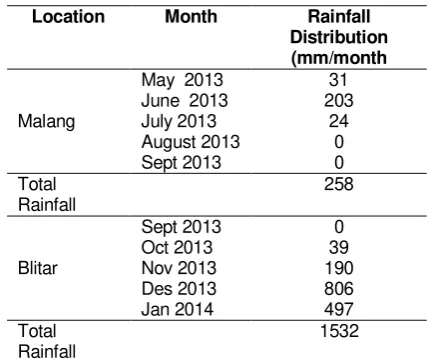
Type Change of Sweet Potato Performance Planting 17 cultivars in Malang and Blitar took at different periods of the season. The research in Malang was conducted in dry season, while in Blitar in rainy season. The difference was characterized by rainfall. Rainfall volume in Malang was different from Blitar (Table 3)
Table 3. Rainfall distribution during the trials in Malang and Blitar
Location Month Rainfall Distribution (mm/month
Malang
May 2013 31
June 2013 203
July 2013 24
August 2013 0
Sept 2013 0
Total Rainfall
258
Blitar
Sept 2013 0
Oct 2013 39
Nov 2013 190
Des 2013 806
Jan 2014 497
Total Rainfall
1532
Remarks: Karangploso Climatology Station, Malang (2014)
All cultivars planted in Blitar were classified to forage type (Table 2), whereas in Malang on the same cultivars showed four types, respectively forage, a low dual-purpose, a high dual-purpose and a low root production (Table 1). This suggests a change of an environmental condition, speci-fically on changes in the volume of excessive rainfall in the last 2 months affected the growth of sweet potato in Blitar, and as a result, vegetative growth was dominant compared to storage root formation. Fresh storage root yield of all cultivars only ranged between 0.13 - 4.92 t/ha or 0.02 - 1.64 t/ha on dry weight, whereas fresh vines reached 16-51t/ha or 2-7 t/ha on dry weight. Based on harvest index, they ranged between the lowest 2% and the highest 40% (Table 2). Thus, the sweet potato growth was strongly influenced by the changes of environmental conditions, especially by rainfall. Hartemink et al. (2000) showed that the rainfall has positive correlation (r = 0.866) with vines yield and negative correlation (r = - 0.601) with marketable storage roots yield and non-marketable storage roots yield (r = - 0.814). as the
trial conducted at Hobu PNG with altitude 405 m above the sea and with average rainfall 1897 mm. As Nedunchezhiyan et al., (2012) stated that sweet potato requires a moderately warm climate (21 – 260C) with soil pH 5.5 – 6.5. Heavy rainfall, high temperature and excess cloudiness encourage vegetative growth.
The range of storage roots of dual-purpose sweet potato types between 7-18 t/ha (Table 1). The yield was still relatively low compared to its potential yield (Saleh and Hartojo, 2003), since the potential yield of sweet potato ranged from 30 to 40 t/ha. The low yields of storage root was caused by availability of nutrients in the location as presented in Table 4.
One of the soil types in Malang is Alfisol which has a pH of acid, very low C-org and N, and also K and Ca, although the P-content of the soil is high (Table 4). For sweet potato, the availability of K is very low that is to say it can be a limiting factor in the formation of storage root, and it was caused by disturbed photosynthate translocation from source to zink. According to George et al., (2002), potassium is very much important in sweet potato production as it influences cell division, tuberous root initiation and thickening, photosynthesis – formation of carbohydrates and translocation of sugar.
Sri Umi Lestari and Ricky Indri Hapsari: Dual-Purpose Assessment for Sweetpotato………
Table 4. Soil analysis of location in Malang and Blitar Location Soil Type
pH 1:1
C-org (%)
N-total (%)
P (mg/kg) K Ca
H2O KCl 1N Bray1 Olsen NH4OAC 1 N pH 7 me/100 g
Malang Alfisol 5.4 4.5 0,59 0.05 12.65 - 0.09 0.06
Criteria*) Acid Very low Very low High Very low Very low
Blitar Vertisol 6.6 5.6 1.35 0.11 - 17.98 0.22 22.24
Criteria *) Netral Low Low High Low Very high
Remarks: *) Balittanah (2005)
Ten cultivars of sweet potato dual-purpose group produced fresh vines weight ranged from 6-13 t/ha and HI ranged between 51-67% (Table 1). It was expected that if it did not happen in a limiting factor of a low availability of potassium (Table 4), the potential of fresh vines yield could also be increasing, so that the availability of fodder source can be higher.
Table 1 shows that there is a type of a low root production, but none of them can be classified in the group of a high root production. Kuningan Putih and Sari cultivars, as well as, 73 OP-8 and 73-6/2 clones were included into the sweet potato of a low root production type. The four cultivars are more appropriate to cultivate for food, because the vines yield is only + 30% of biomass total or its HI ranged from 68 to 74% (Table 1).
Thus, the 17 cultivars planted and evaluated their storage root weight, vines weight, and harvest index, used the ratio of R/V are able to distinguish between cultivars suitable for forage, dual purpose or root production. Cultivar type in different groups was combined with each other to meet the crop-livestock systems in order to be appropriate to agricultural concept of sustainable bio-industry.
CONCLUSIONS
The results showed that there were 10 cultivars of dual-purpose types among 17 of sweet potato cultivars evaluated in Malang,
however all cultivars were turned into forage type
in Blitar. The change of rainfall and nutrient availability decreases the dual-purpose of sweet
potato’s ability to produce the storage roots for food and increasing to produce the vines for feed source of livestock.
ACKNOWLEDGMENTS
The authors thank to the Directorate General of Higher Education, the Ministry of National Education of The Republic Indonesia for financial support through the competitive research grants in 2012 and 2013; and to Balitkabi that has provided some released sweet potato variety used in this study.
REFERENCES
Ahmed, M., R. Nigussie-Dechassa and B. Abebie. 2012. Effect of planting methods and vine harvesting on shoot and tuberous root yields of sweet potato (Ipomoea batatas (L.) Lam.) in the afar region of Ethiopia. Afr. J. Agric. Res. 7 (7): 1129-1141.
An, L.V., B.E. Frankow-Lindberg and J.E. Lindberg. 2003. Effect of harvesting interval and defoliation on yield and chemical composition of leaves, stems and tubers of sweet potato (Ipomoea batatas (L.) Lam.) plant parts. Field Crops Res. 82 (1): 49-58.
Balittanah. 2005. Instructions technical analysis of soil, plants, fertilizer and water. Indonesian Agency for Agricultural Research and Development. Department of Agriculture. Bogor. (In Indonesian) Claessens, L., J.J. Stoorvogel and J.M. Antle.
2008. Ex ante assessment of dual-purpose sweet potato in the crop-livestock system of western Kenya: A minimum-data approach. Agricultural Syst. 99 (1): 13-22.
Sri Umi Lestari and Ricky Indri Hapsari: Dual-Purpose Assessment for Sweetpotato………
Proceedings of the National Seminar of PERAGI. Yogyakarta. p. 314-324. Etela, I. and G.A. Kalio. 2011. Yields components
and 48-h rumen dry matter degradation of three sweet potato varieties in n’dama steers as influenced by date of harvesting. J. Agr. Soc. Res. 11 (2): 15-21.
Etela, I., U.I. Oji, G.A. Kalio and G.O. Tona. 2008. Studies on sweet potato forage and dried
brewers’ grains as supplements to green
panic for bunaji cows. Trop. Grasslands 42: 245-251.
George, M.S., G. Lu and W. Zhou. 2002. Genotypic variation for potassium uptake and utilization efficiency in sweet potato (Ipomoea batatas L.). Field Crops Res. 77 (1): 7-15.
Hartemink, A.E., S. Poloma, M. Maino, K.S. Powell, J. Egenae and J.N. O’Sullivan. 2000. Yield decline of sweet potato in the humid lowlands of Papua New Guinea. Agr. Ecosyst. Environ. 79 (2-3): 259-269. Kaya, S. and H. Yildirim. 2011. The effect of dried sweet potato (Ipomoea batatas (L.) Lam.) vines on egg yolk color and some egg yield parameters. Int. J. Agric. Biol. 13 (5): 766-770.
Larbi, A., I. Etela, H.N. Nwokocha, U.I. Oji, N.J. Anyanwu, L.D. Gbaraneh, S.C. Anioke, R.O. Balogun and I.R. Muhammad. 2007. Fodder and tuber yields, and fodder quality of sweet potato cultivars at different maturity stages in the West African humid forest and savanna zones. Anim. Feed Sci. Tech. 135 (1-2): 126-138.
León-Velarde, C.U. 1999-2000. Using competing traits to select dual-purpose sweet potato in native germplasm. CIP Program Report 1999-2000. CIP and ILRI. Lima-Peru. p. 289-294.
León-Velarde, C.U., J. Roca, J. Arteaga, L. Quispe and A. Parraga. 1997. Perspectives on sweet potato: dual-purpose varieties. In: Program report 1995-1996. International Potato Center, Lima, Peru. p. 291–294.
Lestari, S.U., R.I. Hapsari and Sutoyo. 2012a. Improving storage root protein content in sweet potato through open-mating pollination. J. Agrivita. 34 (3): 225-232.
Lestari, S.U., R.I. Hapsari and R. Djoko. 2012b. Yield evaluation of protein-enriched sweetpotato. Buana Sains. 12 (2): 71-78. (in Indonesian)
Lestari, S.U. and N. Basuki. 2013. Variability iron content in some varieties of sweet potatoes in Indonesia. National Seminar of 3 in 1: Agronomy, Horticulture and Plant Breeding in Faculty of Agriculture, Brawijaya University, 21-22 August 2013. (in Indonesian)
Lestari, S.U. and R.I. Hapsari. 2014. Sweet potato potential as a feed source of livestock. National Seminar of PERAGI- University of Sebelas Maret. Solo. (in Indonesian)
Lu, J., F. Chen, Y. Xu, Y. Wan and D. Liu. 2001. Sweet potato response to potassium. Better Crops Int. 15 (1): 10-12.
Nedunchezhiyan, M., G. Byju and S.K. Jata. 2012. Sweet potato agronomy. Fruit Veg. Cereal Sci. Biotech. 6 (Special Issue 1): 1-10.
Paulus, J.M. 2011. Growth and yield of sweet potatoes in potassium fertilization and natural shading on intercropping system with maize. Agrivigor 10 (3): 260-271. (In Indonesian)
Peters, D. 2008. Assessment of the potential of sweet potato as livestock feed in East Africa: Rwanda, Uganda, and Kenya. A report presented to The International Potato Center (CIP) in Nairobi. pp. 64. Putra, S. and K. Permadi. 2011. Effect of
potassium fertilizer on improvement of sweet potato varieties yield of narutokintoki in wetland. Agrin. 15 (2): 133-142. (In Indonesian)