Objectives
After studying this chapter, you should be able to:
1. Explain the reasons behind passage of EEO legislation.
2. Prepare an outline describing the major laws
affecting equal employment opportunity. Describe bona fide occupational qualification and religious preference as EEO issues.
3. Discuss sexual harassment and immigration reform and control as EEO concerns.
Objectives (cont’d)
After studying this chapter, you should be able to:
5. Provide examples illustrating the concept of adverse impact and apply the four-fifths rule.
6. Discuss significant court cases impacting equal employment opportunity.
7. Illustrate the various enforcement procedures affecting equal employment opportunity.
Historical Perspective of EEO Legislation
•
Equal Employment Opportunity (EEO)
The treatment of individuals in all aspects of
employment—hiring, promotion, training, etc.—in a fair and nonbiased manner.
•
Changing National Values
•
Economic Disparity
The Legal Environment
Concerns
• Fairness issues
• Economic disparity
• Changing material values
• Interest group agendas
• Political party mandates
• Presidential executive orders
Type name here Type title here
• Federal agencies
• State agencies
• Independent commissions
• Rulings
• Written regulations
• Complaint investigations
• Formulating appropriate HR policies
• Briefing and training employees and managers
• Defending lawsuits
• Working with government agencies lobbying for policy changes
Opinions and Decisions
Laws Agencies Management Responses Regulatory
Action
Government Regulation of EEO
Government Regulation of EEO
Jurisdiction of the Civil Rights Act of 1964
• All private employers in interstate commerce who employ fifteen or more employees for twenty or more weeks per year
• State and local governments
• Private and public employment agencies, including the U.S. Employment Service
• Joint labor-management committees that govern apprenticeship or training programs
• Labor unions having fifteen or more members or employees
• Public and private educational institutions
Exemptions From Antidiscrimination
Regulations
•
Bona Fide Occupational Qualification (BFOQ)
Suitable defense against a discrimination charge only where age, religion, sex, or national origin is an actual qualification for performing the job.
•
Business Necessity
Age Discrimination Actions
• Excluding older workers from important work activities.
• Making negative changes in the performance
evaluations of older employees.
• Denying older employees job-related education, career
development, or promotional opportunities.
• Selecting younger job applicants over older,
better-qualified candidates.
• Pressuring older employees into taking early retirement.
• Reducing the job duties and responsibilities of older
employees.
What Is a “Disability”?
•
The Americans With Disabilities Act defines a
disability as:
A physical or mental impairment that substantially limits one or more of the major life activities.
A record of such impairment.
What Is a “Disability”? (cont’d)
•
The ADA does not cover:
Homosexuality or bisexuality
Gender-identity disorders not resulting from physical impairment or other sexual-behavior disorders
Compulsive gambling, kleptomania, or pyromania
Psychoactive substance-use disorders resulting from current illegal use of drugs
Current illegal use of drugs
ADA Suggestions for an Accessible Workplace
• Install easy-to-reach switches. • Provide sloping sidewalks and
entrances.
• Install wheelchair ramps.
• Reposition shelves for the easy reach of materials.
• Rearrange tables, chairs, vending machines, dispensers, and other furniture and fixtures.
• Widen doors and hallways.
• Add raised markings on control buttons.
• Provide designated accessible parking spaces.
• Install hand controls or manipulation devices.
• Provide flashing alarm lights. • Remove turnstiles and revolving
doors or provide alternative accessible paths.
• Install holding bars in toilet areas. • Redesign toilet partitions to
increase access space.
• Add paper cup dispensers at water fountains.
• Replace high-pile, low-density carpeting.
• Reposition telephones, water fountains, and other needed equipment.
• Add raised toilet seats.
Fair Employment Practice Laws
•
Fair Employment Practices (FEPs)
State and local laws governing equal employment opportunity that are often more comprehensive than federal laws.
Although Title VII of the Civil Rights Act exempts employers with fewer than fifteen employees, many states extend antidiscrimination laws to smaller
Sexual Harassment
•
Sexual Harassment (under Title VII)
Unwelcome advances, requests for sexual favors, and other verbal or physical conduct of a sexual nature in the working environment
An employer is considered guilty of sexual harassment when:
The employer knew or should have known about the unlawful conduct and failed to remedy it or to take corrective action.
The employer allows nonemployees (customers or
Sexual Harassment
Unwelcome advances, requests for sexual favors, and other verbal or physical conduct of a sexual nature in the working environment.
Hostile Environment Quid Pro Quo
Types of Sexual Harassment
Submission Rejection Uncomfortable Subjective Response
Sexual Harassment
•
Quid Pro Quo Harassment
Occurs when “submission to or rejection of sexual
conduct is used as a basis for employment
decisions.”
Involves a tangible or economic consequence, such as a demotion or loss of pay.
Oncale v Sundowner Offshore Services (1998)
Sexual Harassment (cont’d)
•
Hostile Environment
Occurs when unwelcome sexual conduct “has the
purpose or effect of unreasonably interfering with job performance or creating an intimidating, hostile, or offensive working environment.
Dirty jokes, vulgar slang, nude pictures, swearing, and personal ridicule and insult constitute sexual
harassment when an employee finds them offensive.
Courts use a “reasonable person” test for hostile
Immigration Reform and Control Act (1986)
•
Employers must comply with the Act by:
Having employees fill out their part of Form I-9.
Checking documents establishing an employee’s
identity and eligibility to work.
Complete the employer’s section of Form I-9.
Retain Form I-9 for at least three years.
Uniform Guidelines on Employee Selection
Procedures
•
Uniform Guidelines on Employee Selection
Procedures
Procedural document published in the Federal
Register to assist employers in complying with federal regulations against discriminatory actions.
Uniform Guidelines on Employee Selection
Procedures
•
Uniform Guidelines on Employee Selection
Procedures define
discrimination
as:
The use of any selection procedure which has an adverse impact on the hiring, promotion, or other employment or membership opportunities of
members of any race, sex, or ethnic group (protected class) will be considered to be discriminatory and
inconsistent with these guidelines, unless the
Validity
•
The requirement that, when using a test or other
selection instrument to choose individuals for
employment, employers must be able to prove
that the selection instrument bears a direct
relationship to job success.
Proof of validity is established through validation
Forms of Discrimination
•
Adverse Impact
The rejection of a significantly higher percentage of a protected class for employment, placement, or
promotion when compared with the successful, nonprotected class.
Possibly the unintentional result of an innocent act, yet the outcome is still discriminatory.
•
Disparate Treatment
An employer’s intentional unequal treatment or
Determining Discrimination
•
Adverse Rejection Rate, or Four-Fifths Rule
Rule of thumb followed by the EEOC in determining adverse impact for use in enforcement proceedings.
According to the Uniform Guidelines, a selection
program has an adverse impact when the selection rate for any racial, ethnic, or sex class is less than four-fifths (or 80 percent) of the rate of the class with the highest selection rate.
The four-fifths rule is not a legal definition of
Determining Discrimination
•
McDonnell Douglas Test to Establish a
Prima
Facie
Case of Discrimination:
1. The person is a member of a protected class.
2. The person applied for a job for which he or she was qualified.
3. The person was rejected,despite being qualified.
4. After rejection,the employer continued to seek other applicants with similar qualifications.
Determining Adverse Impact:
The Four-fifths Rule
Determining Adverse Impact
The Four-Fifths Rule
A rule of thumb followed by the EEOC in determining adverse impact for use in enforcement proceedings.
Employees Blacks (6) Hispanics (3) Whites (12)
Number Given Raise 2 2 9
Selection Ratio .33 .66 .75
Minority Selection Ratio/ Majority Selection Ratio
.33/.75 = .44 .66/.75 = .88
Workforce Utilization Analysis
•
Workforce Utilization Analysis
The process of comparing the composition by race and sex for jobs within an organization against
composition of the employer’s relevant labor market.
The workforce is at parity when its composition matches the relevant labor market.
Significant Court Cases
•
Griggs v Duke Power Company
(1971)
The Supreme Court ruled that employer
discrimination need not be overt or intentional to be present—employment practices having an adverse impact on protected classes can be illegal even when applied equally to all employees.
Employers have the burden of proving that employment requirements are job-related or
constitute a business necessity and are absolutely necessary for job success.
Significant Court Cases (cont’d)
•
Albemarle Paper Company v Moody
(1975)
Supreme Court strengthened requirements on
employers to demonstrate that tests used in hiring or promotion decisions are job-related and valid
predictors of job success.
•
Wards Cove Packing Co. v Atonio
(1989)
Supreme Court held that a statistical disparity among protected members of a workforce does not show
proof of discrimination—the proper comparison is to
qualified applicants in the employer’s relevant labor
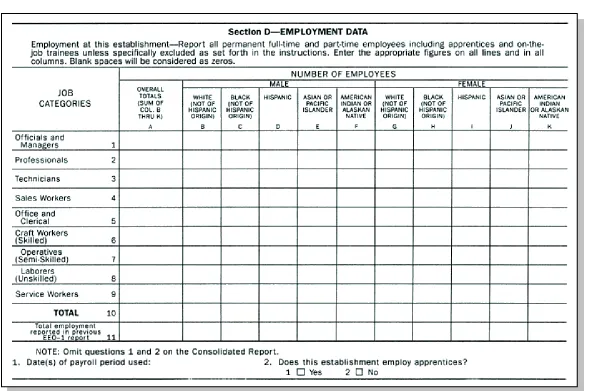
U.S.Equal Employment Opportunity Commission
Section D, EEO-1 Report
Internal Discrimination Complaint Procedure
Presentation Slide 2–6
Employee discrimination
charge
Reported to manager or
supervisor
Organizational EEO officer or
designated HR staff person
Investigation
Decision on charge No basis for
charge: charge dismissed
Appeal to organizational EEO grievance committee
Charge upheld
Accused:
Oral or written reprimand Suspension Discharge
Harmed Employee:
Restore all lost
How to Achieve Fairness in EEO
1. Correct stereotyped thinking.
2. Eliminate irrelevant job requirements.
3. Open job and promotion opportunities to all protected classes.
4. Promote on the basis of merit rather than seniority.
5. Provide equal pay for equal work.
6. Modify employee benefits to needs of women, minorities, and working families.
Filing a Charge of Employment Discrimination
Affirmative Action Issues
•
Affirmative Action
Policy that goes beyond equal employment
opportunity by requiring organizations to comply with the law and correct past discriminatory practices by increasing the numbers of minorities and women in specific positions.
•
Reverse Discrimination
The act of giving preference to members of protected classes to the extent that unprotected individuals
Affirmative Action Court Cases
•
University of California Regents v Bakke
(1978)
The Supreme Court ruled that:
Applicants must be evaluated on an individual basis.
Race can be one factor used in the evaluation process as long as other competitive factors are considered.
The Court stated that affirmative action programs
Affirmative Action Court Cases (cont’d)
•
United Steelworkers of America v Weber
(1974)
The Supreme Court held that voluntary affirmative action programs are permissible where they attempt
to eliminate racial imbalances in “traditionally segregated job categories.”
Managing Diversity: Affirmative Action
•
Challenges to Affirmative Action (AA):
AA has not improved protected groups employment.
Individuals hired under AA feel prejudged as inferior
performers, and are often viewed as “tokens.”
AA programs have failed in assimilating protected classes into the workforce.
Basic Steps In Developing An Effective Affirmative
Action Program
1. Issue a written equal employment opportunity policy and affirmative action commitment.
2. Appoint a top official with responsibility and authority to direct and implement the program.
3. Publicize the policy and affirmative action commitment.
4. Survey present minority and female employment by department and job classification.
5. Develop goals and timetables to improve utilization of
minorities and women in each area where underutilization has been identified.
6. Develop and implement specific programs to achieve goals.
Court Decisions on Affirmative Action
•
Adarand Constructors v Peña
(1995)
The Supreme Court ruled that federal programs that use race or ethnicity as a basis for decision making must be strictly scrutinized to ensure that they
promote “compelling” governmental interests.
•
Hopwood v State of Texas
(1996)
The Court ruled in a decision affecting admission standards at the University of Texas law school that diversity could not constitute a compelling state