A Transport Layer Protocol for Uplink WiMAX Video Streaming
Suherman Suherman
1, Marwan Al-Akaidi
2and Naemah Mubarakah
31,3
Electrical Engineering Department
University of Sumatera Utara, Medan-Indonesia
2
Arab Open University, Safat-Kuwait
[email protected]
Abstract
There are many ways to improve unreliable datagram protocol (UDP) for video streaming applications. One of them is by using negative acknowledgement (NACK). This paper proposed UDP enhancement by using both NACK-based retransmission and medium access (MAC) layer support for uplink video streaming application in WiMAX networks. Mathematical models and analysis are presented to compare protocol performances in relation to delay and packet loss. The analysis is then confirmed through simulations using the ns-2 simulator. The results show that by reducing the number of NACK packets within one video frame and utilizing MAC support could reduce effective loss rate and delay significantly.
Keywords: WiMAX, transport layer protocol, acknowledgement, cross-layer
technique
1. Introduction
WiMAX (Worldwide interoperability for Microwave Access) is a wireless broadband technology that offers higher capacity than WiFi network and wider coverage than cellular network. WiMAX experiences intensive standard development from fixed broadband wireless application [1], mobile WiMAX [2] up to standard with 4G capabilities[3]. This makes WiMAX a promising technology for video streaming application, such as IPTV (Internet Protocol Television) and surveillance applications. IPTV uses WiMAX downlink channel, while video surveillance is an uplink terminal-based video streaming that maximizes uplink channel. This paper focuses on the uplink video transmission application, where mobile terminal or subscriber station (SS) is the source of video traffic s.
High performance link provided by WiMAX will not be optimal if the chosen transport layer protocol is poor. TCP (Transmission Control Protocol) provides high reliability data transfer which ensures that each packet is received successfully and sequentially. It guarantees the quality of delivered video. However, routine acknowledgements and retransmissions in TCP generate significant delay which is not suitable for real-time applications. Furthermore, interferences and signal disruption in the wireless channel may cause TCP experience significant delay as it keeps trying to resend the lost packets. Traditionally, video streaming uses UDP as the transport protocol [4]. UDP does not perform retransmission and error recovery, both of which are attractive for delay sensitive applications. However, UDP does not respond to network conditions which potentially makes the congested network even worse.
unreliable protocol. For instance, RUDP (Reliable UDP) [5], which uses congestion control mechanism, acknowledgement and re-transmission services, often experiences as high a delay as TCP [14]. DCCP (Datagram Congestion Control Protocol) [6] implements two types of congestion control; TCP-like and TFRC (TCP Friendly Rate Control)-like. DCCP relies on client feedback to perform congestion control. Loss of feedback packets may reduce DCCP throughput as the DCCP Sender assumes packets are not received by the Receiver and the Sender adjusts the sending rate to half. Misperception of DCCP rate control can underutilize networks.
Conversely, CRC-based protocols such as UDP-lite [8] may pass unacceptable error packets to the upper layer [15]. Although it preserves the unreliability of UDP, UDP-lite is not compatible with traditional UDP applications and error packets may exert problem in the application layer. Other CRC-based improvement is CUDP (Complete UDP) [16]. The protocol integrates error information in the link and transport layers. However, the protocol is bound to the link layer and is sensitive to network congestion.
Although retransmission was abandoned in CRC-based UDP improvement, NACK-based protocols, such as BVS (Broadband Video Streaming) [2] and IR (Inter-frame Retransmission) [13] are compatible with existing UDP applications. Moreover, video streaming applications are frame dependent, which means the frame decoding may require other frame(s) to decode. Therefore, retransmission delay could be neglected. The main problem of existing NACK-based protocols is that not all are designed for video transmission. Only BVS and IR are intended for media streaming. BVS protocol uses multiple retransmission requests for separated packet loss in one video frame, which makes retransmission ineffective. IR populates packet loss indices within one frame video and sends a single NACK at the end frame reception. However, IR experiences increasing retransmission traffics which potentially impose high delay. This paper focuses on IR improvements. The paper addresses traffic increment problem caused by retransmission in IR protocol. Additional bandwidth is allocated by utilizing MAC support. The effectiveness of the proposed improvement is analyzed mathematically and experimentally.
The main contributions of this paper are as follows. The paper presents a preliminary survey of various UDP improvements, proposes a more effective scheme for uplink mobile terminal based video streaming in WiMAX and demonstrates its effectiveness through mathematical analysis and simulations. The studies show that the proposed protocol successfully increasing the received video quality and reducing transmission delay.
The remainder of this paper is organized as follows. Section 2 surveys existing work on NACK-based UDP improvement. Section 3 describes the proposed protocol. Section 4 presents models, assumptions and mathematical analysis. In Section 5, the proposed protocol is evaluated through simulations. Finally, Section 6 concludes the work.
2. NACK-based Protocol
protocol [12] was intended for media streaming over WiMAX networks. It also employs NACK to inform the sender that packet retransmission is required. BVS applies retransmission only to prioritized packet(s). IR [13] works as BVS, except it populates packet loss indices within one video frame and sends a NACK packet after at the end of a frame reception. Further, Fox [17] implements NACK as an option for providing a more efficient TCP operation over a network with a high bandwidth-delay product, such as satellite networks. TCP with the NACK option sends the NACK packet to the sender when the packet sequence is incomplete. Tezcan et al., [18] surveys various acknowledgement-based protocols in wireless sensor networks. Work by Pajouhesh et al. [19] combines ACK and NACK to provide reliability in point-to-point data transfer in wireless sensor networks. NACK has also been used intensively in multicast networks. The NORM (NACK Oriented Reliable Multicast) protocol [20] provides a reliable transport protocol from one or more senders to a group of receivers in multicast networks. The protocol employs both ACK and NACK. NACK is sent to request missing or repaired data. The NORM protocol employs NACK in two ways; spontaneously, when loss is detected, and scheduled by using timer.
The MAC support on transport layer protocols has been explicitly used in some existing reliable protocols which employ congestion control. Ye et al., [21] used the MAC cross-layer method to provide fairness for some TCP flows. Zhai et al., [22] proposed WCCP (Wireless Congestion Control Protocol) which is effective only for static ad hoc network. WCCP adjusts sending rate based on channel utilization. Although those MAC-assisted transport layer protocols perform better than the basic ones, the reliability of transport layer protocols with congestion control is not suitable for real-time video transmission as those protocols still exert tremendous delay. This paper introduces a MAC-assisted transport layer protocol through an early bandwidth request mechanism to accommodate the retransmitted packet. The MAC support is applied on existing IR protocol. Since the proposed protocol is intended for uplink video streaming in WiMAX networks, practically, only UDP, BVS and existing IR protocols are worth assessing.
3. The Proposed Protocol
The enhancement of a NACK-based transport layer protocol, IR, is proposed using an early bandwidth request mechanism which is performed by WiMAX MAC layer. The proposed protocol is referred to as Transport-MAC cross-layer (TMC) protocol.
Figure 1. Inter-frame Retransmission (IR) Protocol
The sender sends video frames 1 and 2. The first video frame contains packets with sequence A, B and C. When the receiver detects that packet B is lost, it sends the NACK packet after receiving packet C, which is the last packet within frame 1. The time distance between the last packet in one frame and the first packet of next frame is called Inter-Frame Gap Time (TIFG). In the best case, when Round Trip Time (TRTT) is less than TIFG
(Figure 1.a), NACK and the retransmitted packets could be sent during the inter-frame gap when the sender is idle. This condition may reduce network congestion. In case TRTT
is higher than TIFG, as shown in Figure 1b; IR interrupts the sender only once. In the worst
case, if the last packet within one video frame is lost, the receiver sends the NACK packet
as soon as receiving the next frame’s packet.
As shown in Figure 1, when the sender receives a NACK packet, traffic in the sender increases. For instance, initial traffic in the second frame of Figure 1b is 3 packets. Retransmission scheme adds 1 packet to transmit. If each packet, for instance, is 1024 bytes, then additional 1024 bytes bandwidth should be added. In WiMAX, each SS should
request bandwidth based on data queuing in SS’s MAC buffer. WiMAX periodically
provides K-slots of its uplink sub-frame for bandwidth request. If the SS’s request is not granted, then SS should request in the next opportunity. If the total downlink and uplink frame is 5 ms, then the failed bandwidth request leads to additional delay of at least 5 ms.
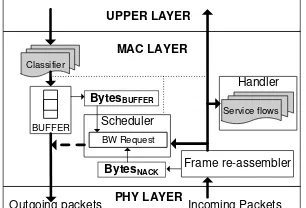
Figure 2 illustrates the early bandwidth request implementation in NIST WiMAX module [23]. The frame re-assembler in the MAC layer reads NACK packet and notifies the scheduler to add the amount of the requested bytes (BytesNACK) in bandwidth request.
In turn, scheduler sends bandwidth request based on data size on MAC buffer (BytesBUFFER) and the retransmission request (BytesNACK).
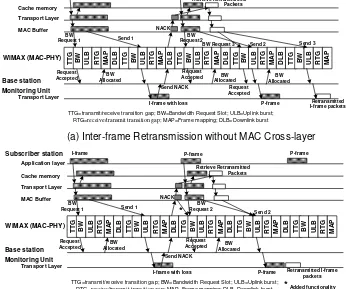
(a) Inter-frame Retransmission without MAC Cross-layer
(b) Inter-frame Retransmission with MAC Cross-layer
Figure 3. The Impact of MAC Cross-layer Support
The comparison of simplified layer interactions of the IR protocol without and with MAC support is described in Figure 3. In Figure 3a, the bandwidth for the retransmitted packets is separately requested as the packets are not available in buffer by the time the SS sends a bandwidth request (BW request 2) to BS. Consequently, instead of sending the retransmitted data in the nearest uplink burst (send 2), SS will allocate it in the uplink burst after the next burst (send 3). This postponement increases delay. On the other hand, IR with MAC support accelerates retransmission as the earliest bandwidth request accommodates the retransmitted packets. The retransmitted and the current data are sent within the same burst (send 2).
4. Model, Assumptions and Analysis
4.1. Application Layer Model
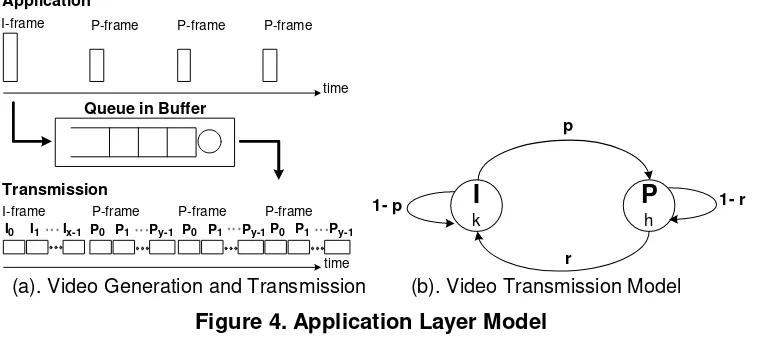
Unlike the research by Zhao et al., [24] which considered that the application sends a video frame at once, this paper approaches the real situation where frames are fragmented and sent in several packets, as shown in Figure 4a. I frame is fragmented into x packets and P frame to y packets. It is assumed that there are two states, sending I or P frames. By
WiMAX (MAC-PHY)
TTG=transmit/receive transition gap; BW=Bandwidth Request Slot; ULB=Uplink burst; RTG=receive/transmit transition gap; MAP=Frame mapping; DLB=Downlink burst
WiMAX (MAC-PHY)
TTG=transmit/receive transition gap; BW=Bandwidth Request Slot; ULB=Uplink burst;
using this assumption, video transmission can be modelled using a two-state Markov chain (Figure 4b). Modelling the MPEG4 stream with IPP frame sequence using a two-state Markov chain model is also performed in [24]. However, analysis in this paper combines link and upper layers.
(a). Video Generation and Transmission (b). Video Transmission Model
Figure 4. Application Layer Model
The probability of sending I and P packets are denoted respectively as k and h. Besides the transmission states, the application layer has an idle state where no packet is sent. However, packets sent by application layer are stored in the MAC layer buffer before transmission, which means that packets remain in sending node during idle state in application layer. Therefore, the idle state is skipped from the model. As a result, probability k is the percentage of I packets within 1 GOP and probability h is the percentage of P packets within 1 GOP. Variables and are the probability of sending P packets after sending I packets, and vice versa. The probability of sending sequential packets is denoted as (1 − p) and (1 − r).
4.2. Transport layer Model
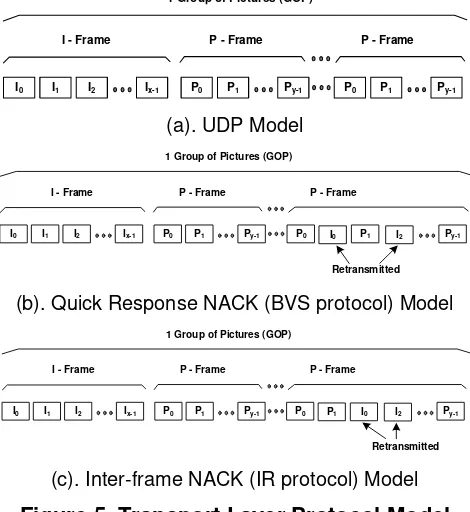
Since the traffic sources are known, each variable probability is determined by the transport protocol model as presented in Figure 5. For the UDP model, from x sequence of I packets, only one packet is followed by P packet. Likewise, after sending y sequence of P packets, only one packet is followed by I packets. Therefore, p = 1 x⁄ and r = 1 y⁄ . The stationary state probabilities of the two-state Markov chain model in Figure 4b are expressed as:
πI= p+rr (1)
πP= p+rp (2)
The probability of error (PE) is calculated according on the fact that an error occurs when a receiver receives a packet that is neither I packet nor P packet. PEis given by:
PE = (1 − k − h) ∗ (πI + πP) (3)
In Equation 3, if the channel is lossless, then PE= 0 because k + h = 1.
time I-frame P-frame P-frame P-frame
Queue in Buffer Application
Transmission
I-frame P-frame P-frame P-frame
time
I0 I1 Ix-1 P0 P1 Py-1 P0 P1 Py-1P0 P1 Py-1
I
k
P
h
p
r
(a). UDP Model
(b). Quick Response NACK (BVS protocol) Model
(c). Inter-frame NACK (IR protocol) Model
Figure 5. Transport Layer Protocol Model
In UDP, the packet arrival rate in transmission (λt) is equal to that of the traffic source (λs). Both quick response and inter-frame scheduling experience rate increments as the senders should also retransmit the lost packet(s). Since retransmission is applied only to prioritized packets, the retransmission rate (ret) is determined by the probability of error of I packet. Let δbe the loss rate of I packets, then the retransmitted packet is δ. x where x is the average number of packet of I frames, as demonstrated in Figure 5. The loss rate (δ) is taken from the UDP probability of error. The number of the NACK packet in quick response is equal to or θ times higher than in inter-frame as its receiver may generate more than one NACK for multiple lost packets in one frame. Each NACK interruption results in an additional load to the receiver and the sender. If the additional load is proportional to the retransmitted content, then the retransmission rate is tripled (3δx). The total arrival rate, λ t = λs + ret, where ret = (1 + θ) 3δx. θ = 0 for inter-frame andθ ≥ 0 for quick response.
Since I frame size (LI) is often much higher than P frame size (LP), the arrival rates of traffic source (λs) for both frame types are different. In order to obtain a more precise result, the arrival rates are calculated for both packet types separately. The arrival rates depend on the maximum transfer size (byteMAX) of the WiMAX network for each SS. Let frame rates of the source be fps, the arrival rates of I packet (λI) is given by:
λI =
(fps(LI + retREQ)GOP )
byteMAX (4)
The arrival rate for P packets (λP) is:
λP = fps(1 − GOP1 )LP
byteMAX (5)
The value of retransmission request (retREQ) depends on the type of the transport layer protocols. For UDP, retREQ = 0 as UDP does not retransmit the lost packets. IR requires maximum one additional request for the retransmitted packet as it retransmits lost packet
I0 I1 I2 Ix-1 P0 P1 Py-1 P0 P1 Py-1
I - Frame P - Frame P - Frame
1 Group of Pictures (GOP)
I0 I1 I2 Ix-1 P0 P1 Py-1 P0 P1 Py-1
I - Frame P - Frame P - Frame
1 Group of Pictures (GOP)
I0 I2
Retransmitted
I0 I1 I2 Ix-1 P0 P1 Py-1 P0 P1 Py-1
I - Frame P - Frame P - Frame
1 Group of Pictures (GOP)
I0 I2
in a frame at once; retREQ = 1. BVS protocol requires at least one request for the retransmitted packets if NACK packets for the same frame arrive at the same WiMAX frame. Otherwise, multiple NACKs for multiple losses in a frame result different requests. The BVS retREQ = 1 + φ, where φ is the request increment caused by multiple NACKs. It is assumed that φ = 0.001, which means only 1 out of 1000 multiple NACKs produces multiple requests. This assumption is considered as downlink traffic mainly consists of NACK packets. The φ value increases significantly when downlink traffic is busy.
The author has applied the aforementioned application layer, UDP, BVS and IR models in previous research [25] for 802.11 networks. The proposed TMC protocol uses IR in upper layer. However, since bandwidth for the retransmitted packet is appended to the nearest request, the arrival rate for the retransmitted packets is 0 (retREQ = 0).
4.3. WiMAX Network Model
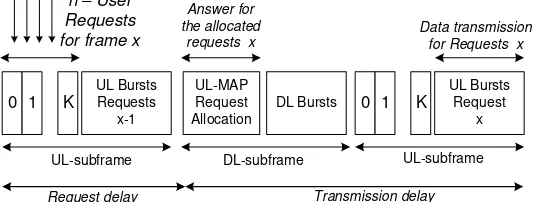
WiMAX frame provides K-slots for bandwidth requests. The SSs contend in order to get bandwidth allocation. As shown in Figure 6, contention slots are located in uplink subframe. BS informs SSs the successful request through uplink UL-MAP in downlink subframe. Then, the SS with successful request sends its data in the respected UL burst of uplink subframe.
Figure 6. Request Slots and its Allocation
Successful request determines the transmission successfulness. Contention request analysis given by [26] shows that the probability of one transmission is successful expressed as [27]:
psucc = nπ(1 − π) n − 1
1 – (1 − π) n (7)
If the arrival rate (λt) of each mobile node in random access environment is known, then the probability π that a node transmits a packet can be expressed as π = λt n⁄ , where n is number of mobile nodes. The Equation has been used in [26] for random access in WiMAX environment analysis. Equation 7 can be rewritten as:
psucc = λt(1 − λt / n) n − 1
1 − (1 − λt / n)n (8)
4.4. Packet Loss
If every error packet is considered as packet loss, then the total packet loss can be projected using Equations 3 and 8. The probability of error (PE) becomes:
PE = (1 – k . psucc(I)− h . psucc(P)) ∗ (πI + πP) (9)
Packet loss can be calculated as:
Loss = (fps GOP⁄ ) . x . (1 + δ) . PE(I)+ (fps – fps GOP⁄ ) . y . PE(P) (10)
0 1 K
UL Bursts Requests
x-1
UL-MAP Request Allocation
DL Bursts 0 1 K
UL Bursts Request
x
UL-subframe DL-subframe UL-subframe
Answer for the allocated
requests x
Data transmission for Requests x
n – User Requests for frame x
The first component is I packet loss and the latter is P packet loss.
4.5. Packet Delay
We consider two main delay components: the delay that a packet suffers on the buffer of the mobile node, and medium access delay. Since buffer in SS is assumed to be large enough to store the generated video, a simple M/M/1 system is used to calculate delay in SS. The waiting time (WT) is given by:
WT =
λ ⁄μ
μ − λ (11)
The service rate (μ) is determined by number of maximum request allocated by network. As shown in Figure 6, the access delay contains the request delay (d) and transmission delay (txTMC). The request delay is computed based on the probability of the successful request. When number of SSs is higher than contention slots, delay is given by [27]:
d = (1 − (n1⁄ ) K fd
n
⁄ )n − 1, n = iK, i = 1,2, .. (12)
Otherwise,
d=(1−1fd
K
⁄ )n−1,n< K (13)
Constant fd is wimax frame duration. For UDP, BVS and IR, the transmission delay (tx) is equal to one WiMAX frame duration. For TMC protocol, when receiving NACK packet, MAC in SS requests bandwidth even though regular data is not available. As a result, there is a transmission delay reduction. The TMC transmission delay is given by:
txTMC = fd . (fps − GOPfps ) (14)
4.6. Result of the Analysis
In order to analyze the proposed protocol mathematically, assumptions are made for some variables. The application layer and MAC layer variables are obtained from simulation parameters in Section 5. The number of contention slot (K) is set to one, with frame duration 4 ms. First, Traffic with group of pictures (GOP) 30 is considered to obtain the performance for increasing number of SSs. The number of SSs is chosen based on the fact that withK = 1, the maximum arrival rate should be less than K
frame_duration to avoid frequent collision. This selection is sufficient to compare the performance of the proposed protocol.
All protocols have the same PE for P packets as no retransmission applied to these packets. The PE of P packets is higher than I packets because when using GOP = 30, the average number of P packets (87packets) is higher than of I packets (16packets).
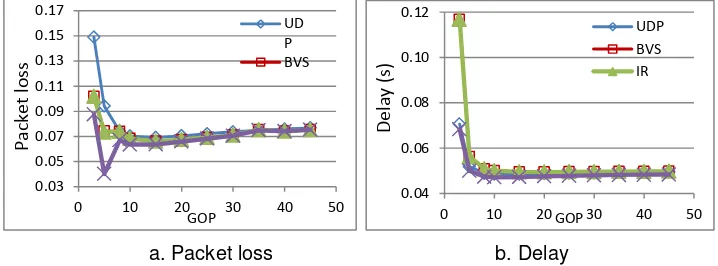
Packet loss and delay increase when SSs transmit more bandwidth requests. BVS yields the higher packet loss than IR as its bandwidth request increases by addition1 + φ while IR by factor 1. The TMC protocol achieves the lowest packet loss and delay as
a. Packet loss b. Delay
Figure 9. Transport Layer Protocol Performances
Figure 9 plots the behavior protocols for various GOPs. The lower GOP generates the higher bytes as I frames is more frequent. PE of I packets decrease as the higher GOP, the number of I packets lower. On the contrary, PE of the P packets increase when GOP increases. The proposed TMC protocol outperforms other protocols.
5. Simulation Evaluation
capability, 7Mbps. Initially, WiMAX uses a round-robin scheduler and contention request. Then, the proposed protocol is examined using various WiMAX schedulers. The simulated uplink video transmission has 4 mobile nodes with video sources generated using an MPEG video: akiyo_cif.yuv which has 300 frames of 30 fps and with GOPs set from 3 to 45. The number of SSs was selected based on total bandwidth consideration and MPEG4 codec was chosen simply for the readily-available MPEG4 traffic generation, reconstruction and evaluation framework from [28, 29].5.2. The Impact of MAC Cross-layer
Transport layer packets queue in the MAC buffer of the SS before being transported by the physical layer. MAC layer transfers the data to the uplink sub-frame based on the duration allocated by BS in UL-MAP. The duration itself is decided by BS based on SS bandwidth request and the available bandwidth. Since the main feature of the MAC cross-layer is an additional bandwidth allocation for the retransmitted packets, the proposed protocol gains higher bandwidth than the basic IR protocol.
Table 1. Allocated Bandwidth Comparison (GOP 30)
Protocol IR TMC
bytes more than IR. From those requests, BS allocates in average 2430 bytes / uplink transmission for TMC and 2419 bytes / uplink transmission for IR. TMC uses network better than IR. Since the frame duration is 5ms and the maximum throughput is 7 Mbps, the utility of the TMC protocol is equal to (2430 X 8 / 0.005) / 7000000 X 100 % = 55.54 %. IR utility is 55.29 %.
a. Packet Loss b. Video Quality c. Delay
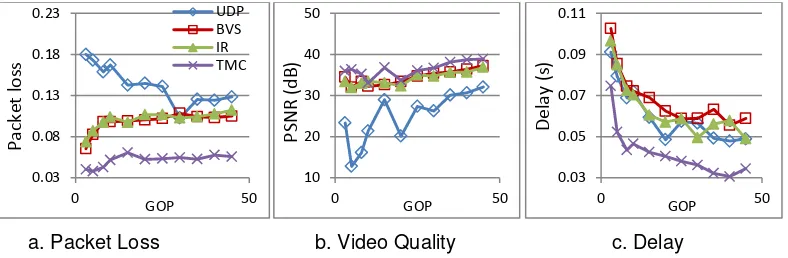
Figure 10. Performance Comparison between IR and TMC
Figure 10 shows the performance comparisons between IR and TMC. TMC consistently reduces packet loss for all GOPs. As a result, video quality is improved. Although the PSNR value decreases for GOP 30, this is probably caused by the undecodable subsequent error frames. Further, TMC reduces the transmission time much lower than the original IR protocol.
5.3. Performance Comparisons
TMC was compared to existing protocols as shown in Figure 11. TMC is able to reduce UDP delay up to 18 - 37 %, achieving PSNR improvements around 14.3 - 149.5 %, 12.6 - 150.2 %, and 21.3 - 184.3 % over IR, BVS, and UDP respectively. Other existing protocols such as DCCP, SCTP and RBUDP are not presented as they have been compared in [12, 13]. The results prove that TMC outperforms the existing protocols for WiMAX uplink video streaming.
a. Packet Loss b. Video Quality c. Delay
Figure 11. Performance Comparison between TMC and other Protocols
5.4. Protocol Performance Over Various Schedulers
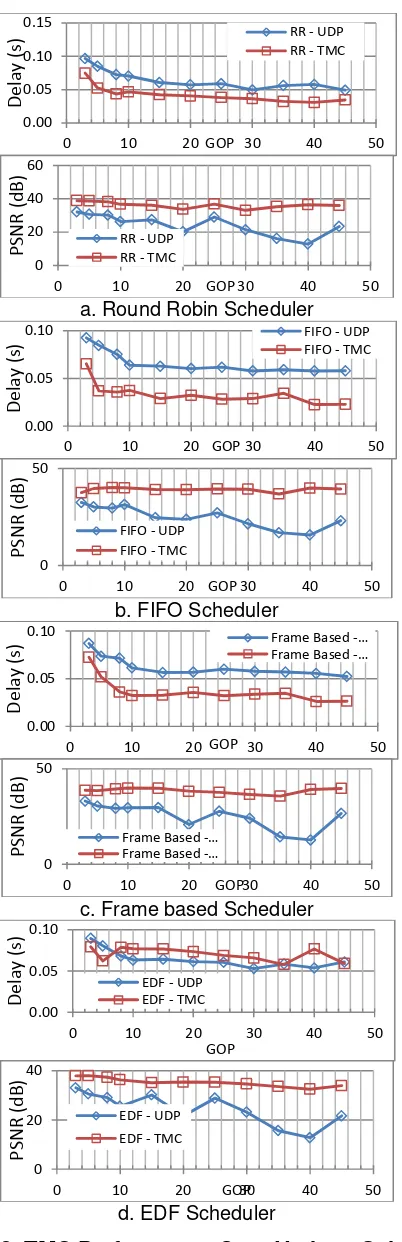
Figure 12. TMC Performance Over Various Schedulers
The proposed protocol applied on RR, FIFO and frame based schedulers experiences significant delay reduction and PSNR improvement. On the other hand, protocol implementation on the EDF scheduler experiences irregular delay. The reason is that the
EDF is not suitable for applications in which all SSs transmit uniform video traffics as the traffics have similar behavior and deadlines, while EDF classifies the allocated data based on traffic deadlines. As a result, BS performs unnecessary sorting which imposes unnecessary delay. Although TMC failed to reduce the delay in all GOPs, the protocol consistently increased the PSNR values.
6. Conclusion
This paper has proposed an enhancement to an existing NACK-based protocol: IR protocol. Transport-MAC cross-layer (TMC) protocol provides high performance mobile terminal based video streaming in WiMAX environment. The proposed protocol uses an early bandwidth request scheme which is provided by MAC layer to accommodate the retransmitted packet(s) within IR protocol. The proposed protocol was analyzed through mathematical model and evaluated through simulations using the NS-2 simulator. The mathematical analysis and simulation evaluation show the superiority of the proposed protocol over existing protocols, in term of packet loss, video quality and delay.
The integration of the proposed protocol into more complex protocols could be the subject of future work. Finally, it is concluded that the inter-frame retransmission NACK with MAC layer support outperforms the existing unreliable protocols for terminal-based video transmission in WiMAX environments.
References
[1]. IEEE, “Local and Metropolitan Area Networks, Part 16: Air Interface for Fixed Broadband Wireless Access Systems”, Std. 802, vol. 16,(2004).
[2]. IEEE, “Local and Metropolitan Area Networks, Part 16: Air Interface for Fixed and Mobile Broadband Wireless Access Systems”, Std. 802, vol. 16e,(2005).
[3]. IEEE, “IEEE Standard for Local and metropolitan area networks Part 16: Air Interface for Broadband Wireless Access Systems Amendment 3: Advanced Air Interface”, Std 802, vol. 16m,(2011).
[4]. J. Postel, “User datagram protocol”, Request for Comments, RFC 768, ISI, (1980).
[5]. T. Bova and T. Krivoruchka, “Reliable UDP protocol”, IETF draft, Network Working Group, (1999). [6]. E. Kohler, M. Handley, S. Floyd and J. Padhye, “Datagram congestion control protocol (DCCP)”,
Request for Comment (RFC) 4340, IETF, (2006).
[7]. R. Wirz, R. Marin, M. Ferre, J. Barrio and J. M. Claver, “Bidirectional transport protocol for teleoperated robots”, IEEE Trans. on Industrial Electronics, vol. 56, no. 9, (2009), pp. 3772-3781. [8]. L. A. Larzon, M. Degermark and S. Pink, “UDP Lite for real-time multimedia applications”, in Proc. of
the IEEE International Conference of Communications, (1999).
[9]. P. P. K. Lam and S. C. Liew, “UDP-Liter: An improved UDP protocol for real-time multimedia applications over wireless links”, in Proc. of the IEEE international symposium on Wireless Communication Systems, (2004), pp. 314-318.
[10].Y. H. Gu and R. L. Grossman, “UDT: UDP-based data transfer for high-speed wide area networks”, Elsevier Journal of Computer Networks, vol. 51, no 7, (2007), pp. 1777-1799
[11].E. He, J. Leigh, O. Yu and T. A. Defanti, “Reliable Blast UDP: predictable high performance bulk data transfer”, in Proc. of the IEEE International Conference on Cluster Computing, (2002), p.317.
[12].I. Ali, S. Al-Majeed, M. Fleury and M. Ghanbari, “Semi-reliable transport protocol for IPTV over mobile WiMAX”, in Proc. of the IEEE International Conference on Computer as a Tool, vol. 1-4,
(2011).
[13].S. Suherman and M. Al-Akaidi, “Improving real time video surveillance performance using inter-frame retransmission”, in Proc. 4th International Conference on Imaging for Crime Detection and Prevention,
(2011), pp. 1-5.
[14].T. Le, G. Kuthethoor, C. Hansupichon, P. Sesha, J. Strohm, G. Hadynski, D. Kiwior and D. Parker, “Reliable User Datagram Protocol for airborne network”, in Proc. of the IEEE conference on military communications, (2009), pp. 1-6.
[15].M. Welzl, “Passing corrupt data across network layers: an overview of recent developments and issues”, EURASIP Journal on Applied Signal Processing, vol. 242-247, (2005).
[16].H. Zheng and J. Boyce, “An Improved UDP Protocol for Video Transmission over Internet-to-Wireless Networks”, IEEE Trans. on Multimedia, vol. 3, no. 3, (2001), pp. 356-365.
[17].R. Fox, “TCP big window and NAK operations”, IETF RFC1106, (1989).
[19].M. Pajouhesh, A. M. Bidgoli and M. H. Yektaie, “A New Reliable Data Delivery Protocol in Wireless Sensor Network”, Journal Basic App. Science Research, vol. 2, 1, (2012), pp. 132-137.
[20].B. Adamson, C. Bormann, M. Handley and J. Macker, “NACK-Oriented Reliable Multicast (NORM) Transport Protocol”, Network Working Group, RFC 5740, (2009).
[21].J. Ye, J. X. Wang and J. W. Huang, “A cross-layer TCP for providing fairness in wireless mesh networks”, Int.l Journal of Communication Systems, vol. 24, no. 12, (2011), pp. 1611–1626.
[22].H. Zhai, X. Chen and Y. Fang, “Improving Transport Layer Performance in Multihop Ad Hoc Networks by Exploiting MAC Layer Information”, IEEE Transaction on Wireless Communications, vol. 6, no. 5,
(2011), pp. 1692-1701.
[23].National Institute of Standards and Technology, “The Network Simulator ns-2 add-on, IEEE 802.16 model (MAC+PHY)”, (2007).
[24].J. Zhao, B. Li, C. Kok and I. Ahmad, “MPEG-4 video transmission over wireless networks: A link level performance study”, Journal of Wireless Networks, vol. 10, no. 2, (2004), pp. 133–146.
[25].S. Suherman and M. Al–Akaidi. "An efficient negative acknowledgement–based transport protocol in 802.11 media streaming", International Journal of Ad Hoc and Ubiquitous Computing 16.3, (2014), pp.161-171.
[26].Q. Ni, L. Hu, A. Vinel, Y. Xiao and M. Hadjinicolaou, “Performance Analysis of Contention Based Bandwidth Request Mechanisms in WiMAX Networks”, IEEE Systems Journal, vol. 4, no. 4, (2010), pp. 477-486.
[27].A. Vinel, Y. Zhang, M. Lott and A. Tiurlikov, “Performance analysis of the random access in IEEE 802.16”, in Proc. IEEE Int. Symp. Pers., Indoor Mobile Radio Communication, (2005), pp.1596-1600. [28].J. Klaue, B. Rathke and A. Wolisz, “EvalVid, - A Framework for Video Transmission and Quality
Evaluation”, in Proc. of the Int. Conf. Modelling Techniques and Tools for Computer Performance Evaluation, (2003), pp. 255-272.
[29].C. H. Ke, C. K. Shieh, W. S.Hwang and A. Ziviani, “An Evaluation Framework for More Realistic Simulations of MPEG Video Transmission”, Journal of Information Science and Engineering, vol. 24, no. 2, (2008), pp. 425-440.
[30].P. Dhrona, N. A. Ali and H. Hassanein, “A performance study of scheduling algorithms in Point-to-Multipoint WiMAX networks”, in the Proceedings of Local Computer Networks Conference, Montreal, Quebec, (2008), pp. 843-850.
[31].S. H. Kang and A. Zakhor, “Packet scheduling algorithm for wireless video streaming”, in Proc. International Packet Video Workshop, Pittsburgh, PY, (2002).