Beyond WordsVol.3, No.1, May 2015 Widya Mandala Catholic University Surabaya, Indonesia Reflection as the Homebase of Teacher Education
Andrias Tri Susanto [email protected]
Graduate School
Abstract
Reflection is widely accepted as a process to support, or even underlie, teacher education. However, the concept holds several confusions among education experts and practitioners. This article would then attempt to explain some confusing terms by reviewing relevant literature on this issue and to provide discussions on the benefits and challenges of reflection manifested in various options of reflective practicum.
Reflection as the Homebase of Teacher Education
In theory, Dewey’s seminal work is considered as the cornerstone in attempt to grapple with the term reflection(see in Farrell, 2007 & 2008; Hatton & Smith, 1995; Korthagen, 2001). Reflection is introduced as the process in which “teachers become active, persistent, and carefully consider any belief in teaching” (Dewey, 1904, in Korthagen, 2001, p. 54). Reflection is supposed to promote student-teachers to become (more) aware of and engaged in teaching. Dewey (1933, in Farrell, 2008a, p. 1) further suggests “three important attributes to be reflective individuals: open-mindedness, responsibility, and wholeheartedness”. In this regard, reflection supposedly gives a way to student teachers to critically analyse problems and find the solutions by questioning what has so far been completed as the basis of the investigation and what possible ways to improve the teaching performance coupled with the eagerness of the student-teachers to be open-minded, responsible and wholehearted in completing the process. Reflection is conceptually a manifestation of student teacher’s efforts in solving practical teaching problems raised.
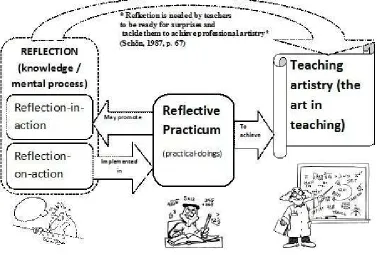
Reflection-in-action
Schön (1987) remarks that reflection-in-action takes place when “we can execute smooth sequences of activity, recognition, decision, and adjustment without having to think about it” (p. 26) although it closely “hinges on the experience of surprise and focuses interactively on the outcomes of action, the action itself, and the intuitive knowing implicit in the action” (p. 56). It is completed “by consciously describing the present situation in the light of a tacit reference to the other” (p. 67). Additionally, Dadds (1997, in Field et al., 1997: 9) states that reflection-in-action may happen when “teachers try to apply their new professional knowledge to an immediate and urgent practical problem”. In other words, reflection-in-action requires the student-teachers to tacitly overcome any (un)predictable surprises based on the reflection of previous experiences. Also, it can be understood that the experiences learned may be from personal, other colleagues’ and/or teacher educators’ experiences from available sources of information such as observation, literature reading, collegial sharing, or else.
Similarly, the concept of reflection-in-action can also be illustrated from the work of Argyris and Schön (1975, in Harrison & Lee, 2011, p. 204) of double loop learning which represents teacher’s ability to “question ways of working and underlie values of perceptions that might drive the particular action during the incident”. In other words, the main focus here is the value of perception expected to be immediately changing and developing in search of professional standard that one has. This happens dialectically; meaning that it is uniquely different in every person and based on one’s own experiences without any limitation whether the source of the experiences is personal or from others.
conscious intention”. Both are similar, but not the same, one another as they require student-teachers to be unconsciously and instantaneously able to overcome surprises or problems that happen in the classrooms but one significant difference is that Schön’s reflection-in-action does not limit the source of experience at the personal level only while Ur’s limits it at the personal level only.
Interestingly, the concept of reflection-in-action, double loop learning, and personal reflection are linked in a way that professional development can be achieved through spontaneously employing a mental process and applying it through learning the available experiences. However the difference fundamentally lies on the source of experiences that the student-teachers may draw upon since reflection-in-action does not limit the sources of experience while personal reflection and double loop learning employ personal experience as the only source.
Reflection-on-action
Reflection-on-action refers to the “thinking back on what we have done in attempt to discover how our knowing-in-action may contribute to an unexpected outcome” (Schön, 1987, p. 26). It is “the result of the previous reflections that can make new sense of the situations of uncertainty or uniqueness” (Schön, 1983, p. 62). It can be understood that reflection-on-action sources are all sorts of experiences from any sources including a collection of reflection-in-actions.
an action” (Jonas-Dwyer et. al., 2012, p. 64) while “reflection-in-action happens in an action-present circumstance” (Schön, 1987, p. 28) or “during an action is taken” (Argyris & Schön, 1975, in Harrison & Lee, 2011: 204), reflection-on-action does not have to be completed outside the classroom when the class is dismissed even it may be completed both during and after the teaching as long as it is conducted after an action is completed (Lange, 1990 & Schön, 1983). In other words, both types of reflection are conducted through acknowledging what has been learned or experienced and making future judgements manifested in a reformed way of teaching or solving certain issues in the classroom but they are different in a way that reflection-on-action is completed after an action has been taken while reflection-in-action is completed during the action is taken. This causes overlaps as it is certainly hard to define the length of time for this matter but as long as the teachers reflect upon the completed actions it is considered as reflection-on-action while it is considered to be refection-in-action if the teachers think about what to do next through inferring from what is being completed at the moment.
taking decisions on what to do and not to do in the future. All in all, these understandings initiate the practical approach of reflection called reflective practicum (Schön, 1987) or reflective practice (Day, 1991; Farrell, 2007; 2008 & 2011; Harrison & Lee, 2011; Otienoh, 2011) or reflective action(Burton, 2009; Fullan, 2007;Hatton & Smith, 1995).
Reflective practicum
microteaching (Hatton & Smith, 1995).
Teaching artistry
Reflection is employed for “promoting the art in teaching” (Schön, 1987, p. 67). Schön (ibid.) further remarks that “practitioners, including teachers here, need to cope with different situations requiring them to use their tacit knowledge attained from experiences in achieving professional artistry”. He adds that professional artistry could be referred to as “the kinds of
competence practitioners sometimes display in unique, uncertain, and conflicted situations of practice ... featured by a high-powered, esoteric variant of the more familiar sorts of competence exhibited every day in countless acts of recognition” (p. 22).
From the citation above, it is conclusive that professional artistry, or teaching artistry, is the ultimate goal of professional development. Here, I would disagree with that as teaching artistry is only half of the ultimate goal since the other half is possessed by the craft of teaching as proposed by Eisner (1983) and Lange (1990). Eisner (1983) suggests that artistry in teaching involves “the craftand artof teaching”. The former is “repertoire and is a skill enabling teachers to perform well” while the latter is “the invention of modes of teaching practices which are not plentiful and require ingenuity involving teachers’ other skills” (p. 9). Similarly, Lange (1990) also explains that “the craft of teaching is teachers’ specific knowledge of the subject matter, knowledge on teaching that subject matter, and knowledge in teaching in general...and the art of teaching involves the combination of knowledge and experience in the many decisions that teachers make as they interact with learners” (p. 248).
Figure 1. The Illustration of Reflection according to Schön (1983, 1987)
The Value of Reflection in Teacher Education
that reflection sharpen the student-teachers’ mental and rational state (manifested in the decisions, attitudes and behaviours) so that the decisions made be deliberately and responsibly succinct. In short, reflection is then strongly suggested to be the answer for both personal and professional development. In accordance to this, the following paragraphs represent how reflection can be beneficial for both experienced and novice language teachers.
There are many examples of successful implementation of reflection in TE worldwide conducted by experienced language teachers: such as those in the USA (Brown, 2002; Cormany et al., 2005, in Tedick, 2005; Freeman & Johnson in Tedick, 2005; Spalding & Wilson, 2002), in Taiwan (Hsu, 2008), in the Netherlands (Korthagen & Vasalos, 2005), and in Australia (Swan, 1993). Additionally, there are also some reported successful attempts in promoting reflection to novice teachers. Farrell (2008b) investigated a Singaporean teacher who “reflected on his teaching methods and on the socio-historical contexts by conducting action research and class discussions” (p. 53). The teacher became “better prepared to make a smooth transition from his teacher education programme into the real world of language classroom” (p. 54). Next, Feiman-Nemser (1990) reported how apprenticeship programmes in Alaska had a good impact for novice teachers. “Student-teachers were able to analyse the cases from different vantage points and imagine a range of possible actions and their consequences” (p. 11).
Teachers may collect some points on the spots provided by the surprises happening in the classroom and put them into consideration in the future to avoid “impulsive decisions which may bring unexpected outcomes” (Farrell, 2007, p. 9). This is by nature is in the same path of reflection under a different term.
like nursing education (Grant, 2007; Jonas-Dwyer et al., 2012; Kuiper & Pesut, 2004; Vachon & LeBlanc, 2011).
The Challenges of Reflection in Teacher Education
introducing reflection to them. This is relevant to what is implied in the Dewey’s statement that reflection could only be suitable for teachers who are “active, persistent, and carefully consider any belief in teaching” (Dewey, 1904, in Korthagen, 2001, p. 54). Furthermore, Farrell (2008b) claims that “research in general education has indicated that the professional culture of each school can present many challenges for first-years teachers thus ... these novice teachers require support from teacher education programmes and the schools where they are placed.” (p. 53)
From the citation above, it is obvious that one possible factor that may promote the failure of introducing reflection to novice teachers is, in fact, the institution where they work.
References
A’Dhahab, S. M. (2009). EFL teachers’ perceptions and practices regarding reflective writing. In S. Borg (Ed.). Researching English language teaching and teacher development in Oman. Muscat: Ministry of Education, Sultanate of Oman.
Al-Jabri, N. (2009). Secondary school teachers’ attitudes towards reflection. In S. Borg (Ed.). Researching English language teaching and teacher development in Oman. Muscat:
Ministry of Education, Sultanate of Oman.
Borg, S. (2006). Teacher cognition and language education. London: Continuum
Brown, B. L. (2002). Improving teaching practices through action research. Downloaded version. Retrieved from http://scholar.lib.vt.edu/theses/available/etd-04152002-182022/unrestricted/BethBrownDissertation.pdf
Burton, J. (2009). Reflective practice. In A. Burns & J. C. Richards (Eds.), The Cambridge guide to second language teacher education. Cambridge: Cambridge University Press
Calderhead, J. (1989). Reflective teaching and teacher education. Teacher & Teacher Education (5)1, 43-51
Day, R. (1991). Models and the knowledge base of second language teacher education. Retrieved from www.hawaii.edu/sls/sls/wp-content/uploads/2011/06/Day.doc
Donnelly, R & Fitzmaurice, M. (2011). Towards productive reflective practice in microteaching. Innovations in Education and Teaching International (48)3, 335-346
Eisner, E. W. (1983). The art and craft of teaching. Downloaded version. Retrieved from http://www.ascd.org/publications/educational-leadership/jan83/vol40/num04/toc.aspx
http://etheses.nottingham.ac.uk/1458/1/whole_thesis_final_june_2010.pdf
Farrell, T. S. C. (2007). Reflective language teaching: from research to practice. London: Continuum.
Farrell, T. S. C. (2008a). Reflective practice in the professional development of teachers of adult english language learners. CAELA Network Brief. Retrieved from http://www.cal.org/caelanetwork/resources/reflectivepractice.html
Farrell, T. S. C. (Ed.). (2008b). Novice language teachers: insights and perspectives for the first year. London: Equinox
Farrell, T. S. C. (2011). 'Keeping SCORE': reflective practice through classroom observations. RELC Journal, (42)3, 265-272. doi: 10.1177/0033688211419396
Feiman-Nemser. (1990). Conceptual orientations in teacher education. Downloaded version. Retrieved from http://education.msu.edu/NCRTL/PDFs/NCRTL/IssuePapers/ip902.pdf Field, J., Graham, A., Griffiths, E. & Head, K (Eds.). (1997). Teachers develop teachers
research 2. Kent: IATEFL
Fullan, M. (2007). The new meaning of educational change. New York: Teacher’s College
Grant, M. J. (2007). The role of reflection in the library and information Sector: a systematic review. Health Information and Libraries Journal (24)3, 155-166
Handal, G. & Lauvås, P. (1987). Promoting reflective teaching. Milton Keynes: SRHE
Harrison, J. K., & Lee, R. (2011). Exploring the use of critical incident analysis and the professional learning conversation in an initial teacher education programme. Journal of Education for Teaching (37)2, 199-217
Hayes, D. (Ed.). (1997). In-service teacher development: international perspectives. Hemel Hempstead: Prentice Hall.
Hsu, P. Y. (2008). Using videotaping and reflective journal writing to improve student-teachers’ performance in classroom. Downloaded version. Retrieved from http://ir.lib.cyut.edu.tw:8080/bitstream/310901800/8931/1/05%E6%8A%95%E7%A8%B
F%E4%BA%BA%E6%96%87%E5%AD%B8%E5%88%8A.pdf
Jonas-Dwyer, D. R. D., Abbott, P. V. & Boyd. N. (2012). First reflections: third-year dentistry students’ introduction to reflective practice. European Journal of Dental Education (17), 207-213
Korthagen, F. A. J. (2001). Linking practice and theory: the pedagogy of realistic teacher education. Mahwah, N. J.: Lawrence. Erlbaum Associates
Korthagen, F. A. J. & Vasalos, A. (2005). Levels in reflection: core reflection as a means to enhance professional growth. Teachers and Teaching: Theory and Practice (11)1, 47-71 Kuiper, R. A. & Pesut, D. J. (2004). Promoting cognitive and metacognitive reflective reasoning
skills in nursing practice: self-regulated learning theory. Journal of Advanced Nursing (45)4, 381-391
Lange, D. L. (1990). A blueprint for a teacher development program. In J. C. Richards & D. Nunan (Eds.), Second language teacher education(pp. 245-268). Cambridge: Cambridge University Press
Loughran, J. (1996). Developing reflective practice. London: Falmer
Malderez, A. & Bodóczky, C. (1999). Mentor courses: a resource book for trainer-trainers. Cambridge: Cambridge University Press
Continuum
Moon, J., & Lopez, R. (1997). Reluctance to reflect: issues in professional development. In D. Hayes (Ed.), In-service teacher development: international perspectives. Hemel Hempstead: Prentice Hall.
Otienoh, R. O. (2011). Teachers' lack of deeper analytical reflections: who is to blame? Reflective Practice (12)6, 733-747
Richards, J. C. (2001). Curriculum development in language teaching. Cambridge: Cambridge University Press
Roberts, J. (1998). Language teacher education. London: Arnold
Schön, D. A. (1983). The reflective practitioner: how professionals think in action. London: Temple Smith
Schön, D. A. (1987). Educating the reflective practitioner.San Francisco: Jossey-Bass
Spalding, E. & Wilson, A. (2002). Demystifying reflection: a study of pedagogical strategies that encourage reflective journal writing.Teachers College Record (104)7, 1393-1421
Swan, J. (1993). Metaphor in action: the observation schedule in a reflective approach to teacher education. ELT Journal (47)3, 242-249
Tedick, D. J (Ed.). (2005). Second language teacher education: international perspectives. Mahwah, N.J.: Lawrence Erlbaum Associates
Ting, S. H. (2007). Is teacher education making an impact on TESL teacher trainees’ beliefs and practices of grammar teaching?. ELTED (10), 42-62
Tsui, A. B. M. (2003). Understanding expertise in teaching. Cambridge: Cambridge University Press
Vachon, B & LeBlanc, J. (2011). Effectiveness of past and current critical incident analysis on reflective learning and practice change. Medical Education (45), 894-904. doi: 10.1111/j.1365-2923.2011.04042.x
Wallace, M. (1991). Training foreign language teachers: a reflective approach. Cambridge: Cambridge University Press
White, R. V. (1988). The ELT curriculum. Oxford: Blackwell
Wilson, G. (2013). Evidencing reflective practice in social work education: theoretical uncertainties and practical challenges. British Journal of Social Work (43)1, 154-172. doi: 10.1093/bjsw/bcr170