Improving Skills of Candidate Teachers of Children with Visual
Impairment as Sighted Guide
By: Sari Rudiyati
Lecturer of Special Education Department of Faculty of Education Yogyakarta State University;
Email: [email protected]& [email protected]
Abstract
This study aims to improve the skills of candidate teachers of children with visual impairment as a sighted guide/companionfor blind peoplethrough training and mentoring. The subjects of this study were the students of the Department of Special Education of Faculty Education Yogyakarta State University that takes concentration education of children with visual impairment.Data analysis using descriptive analysis. The results showed that the training and mentoring is proven to improve skills of candidate teachers ofchildren with visual impairmentas a sighted guide/companion for blind people have done with two cycles of action. Results cycle 1 of actions undertaken by the practice as a sighted guide/companion for blind people accompanied by a pre-test as a baseline, seven candidate teachers of children with visual impairment cumulatively reached an average score of 2.47 and a post-test achieving an average score of 3.24; 31.17% have been able to improve the skills of the sevencandidate teachers of children with visual impairment as a sighted guide/companion for blind people. The results of the actions undertaken by cycle 2 had done with exercises and mentoring as a sighted guide/companion to look out for blind people , the seventh candidates teacher of children with visual impairment cumulatively reached an average score of 3.24 increased 29.63% to an average score of 4.2 with a good rating and has exceeded the target minimum standard score/weight percentage value of 3.5 or better stated, reaching 76%, but has not reached the predicate is very good because it has not reached a score of> 4.2 to 5.0 or 86% -100%, so it has reached the target action and not there needs to be action cycle 3.
Key Words: Blind people, sighted guide/companion.
INTRODUCTION
Skills as a sighted guide/companion is required of candidate teachers of children with visual impairment.Students majoring in Special Education that takes concentration compulsory education of children with visual impairment have the skills as a sighted guide/companion for blind people, which is one method of orientation mobility.
Based on the observation of the researcher that the student Special
blind peoplein the lecture orientation and mobility. Lack of motivation of candidatesteachers of children with visual impairment in the practice being physically blind sighted guide/companion. Besides mentoring opportunity in practice be alert sighted guide/companion for blind people who do professors still lacking due to limited lecture time orientation and mobility.
Teachers as the lead actor and the most critical learning orientation and mobility of blind children become the focus in this study. Teachers are expected to accept, adapt and develop strategies appropriate to the conditions and needs of blind children in the study. It became a strong foundation in improving skills of candidatesteachersof children with visual impairment to be alert sighted guide/companion for blind people. This study seeks to help candidates teachers of blind children in meeting the needs of children with visual impairment with a lot of studying the problems associated with the skills to be alert sighted guide/companion for blind people.
Implementation of quality education for children with visual impairment is a challenge, interests and issues in education. Therefore, the skills become alert sighted guide/companion for blind people need to be owned by candidates teachers of children with visual impairment. In the future Department of Special Education must be able to prepare teachers to teach orientation and mobility to find the needs of blind students. One attempt to overcome the problems of sighted guide skills of candidatesteachers of children with visual impairment is through training and mentoring.
Learning methods of a traveling with a sighted guide/companion an integral part of the learning orientation and mobility of people with visual impairment, however, whether the candidates teachers of children
with visual impairment to have the skills to be alert for guiding blind people. Phenomenon suggests that not allcandidatesteachers of children with visual impairment have had the skills to be a sighted guided alert for blind people. Based on the observations of researchers this is caused by various factors, among others, thatcandidatesteachers children with visual impairment have less real experience as a sighted guide/companion to watch out for blind people. Therefore, research on improving the skills become alert sighted guide/companion for blind people through training and mentoring is important to do.
Visual impairment person is someone who for some reason experienced a vision condition that is not working properly. As stated by Sasraningrat (1981: 169) as follows: "blind is the condition of visionaries who are not working properly. The condition is caused by damage to the eye, and the optic nerve or brain that processes visual stimuli". So personwith visual impairment is someone who has a condition of visionaries is not working properly. The condition is caused by damage to the eye, and the optic nerve or brain that processes visual stimuli.
Hallahan and Kauffman (1978: 337) limits the definition of blind people by reviewing the terms of education as follows: "for educational purpose, the blind are those who are so Severely impaired that must be thought to read by the Braille while the partially sighted can read the print event though they need to use a magnifying devices or books with large print."
be divided into two groups, namely those who suffered total damage to the eye, optic nerve or part of the brain that processes visual stimuli. They are called blind people are totally blind.Media read blind peopleis Braille. The other group is the one who suffered partial damage to the organ of sight is the so-called less-blind people see or "low visioned". Most of the less-seen people use visual media posts read/print enlarged, but do not rule out thepossibility for some reason they use the media read Braille.
In accordance with the opinion of the Lowenfeld in Scholl (1986: 315): Blindness imposes three basic limitation on the individual:(1) In the range and variety of concept; (2) In the ability to get about; (3) In the control of the environment and the self in relation to it. Therefore a blind person needs orientation and mobility lessons, in order to overcome the limitations in question held as it bears the impact of blindness.
A teacher of children with visual impairment, the Orientation and Mobility primary teacher or gym teacher should be able to provide learning techniques Orientation and Mobility, in particular running techniquea traveling with a sighted guide/companion alert. Requirements for teachers of blind children in teaching engineering a traveling with a sighted guide/companion, among others, is concerned must be a skilled pilot/escort watch out for blind people. Therefore the aim of this research is to improve the skills of candidate teachersof children with visual impairment as a sighted guide/companion of blind people through training and mentoring.
Learning activities on engineering a traveling with a companion/guide sighted "sightedtravel guidetechniques" for persons with visual impairment include: techniques to make contacts, reject or accept the invitation techniques, or solid
through the narrow streets, walking through the doors closed technique, the technique up and down stairs , sitting in a chair technique, technique get in the car, move the handle technical, engineering reverse direction (Hadikasma, 1987: 21), as well as the advantages and disadvantages engineering a traveling with a companion/guide sighted "sightedtravel guidetechniques".
In doing traveling blind people can use the technique of"sighted Travel Guide Techniques".However, there is still wary that the accompanying companion /sighted guide of blind people there is a tendency blind people holding arm, and pulled the lead to where want to go. This will make it uncomfortable from both, as well as unsightly by others.
In ways that are comfortable, safe and easy, both for sighted guide /companions and for persons with visual impairment in performing traveling is the way, that blind children companion's arm slightly above the elbow, but this technique can also vary ( Hadikasma, 1987: 21 ). It depends on who accompanied by the led, adult or a kid, or even people who are.With the technique of blind people in the position where blind people can follow and feel the movements companion, so that blind people can know the state of the road surface, up or down, passing through the narrow streets, past the vacant lot, or stop. Blind people will follow the movement with a companion and not disrupt or dependent, so that the companion does not need to tell if the past state of the road as mentioned above.
METHODS
Type of research is action research. Actions performed by training and mentoring for candidateteachersof children with visual impairment in improving skills as a sighted guide/companion for blind people, because these actions are expected to study the problems is not-skilled of candidate teachers for children with visual impairment as sighted guide blind people can be overcome.
The designs are designed in this study is action research design, with the main points of the adopted activity model developed by Kemmis and McTaggart (1990:14) as follows:
1. Planning
In this planning problem identification and determination of alternative solutions, and then do the things as follows:
a. Exercise plan that will be applied in practice for the actions that candidate teachers of children with visual impairment in improving skills as a sighted guide/companion for blind people.
b. Determine the subject matter of exercise include: techniques to make contacts, reject or accept the invitation techniques, techniques or solid through the narrow streets, walking through the doors closed technique, the technique up and down stairs, sitting in a chair technique, technique get in the car, move the handle engineering, reversed engineering. Developing exercise scenario following actions:
1) Opening as an introduction to exercise
2) Pre-test on running technique sighted guide/companion.
3) Provision of training materials about running technique sighted guide/companion for blind people
4) Exercise traveling technique with sighted guide/companion for blind people.
5) Evaluation of training and technical assistance to traveling with a sighted guide/companion watch out for blind people. 6) The post-test on running technique
sighted guide/companion for blind people
7) Closing as a summary of the technical training runs with sighted guide/companion watch out for the blind people.
c. Candidates Master Worksheet compile d. Candidateteachers worksheets compiled based on the results of preliminary studies and a review of the theory used in carrying out the task of running technique drills with a sighted guide/companion for blind people. e. Preparing learning resources on
running technique training with sighted guide/companion for blind people f. Develop formats and instruments
observation implementation of technical training develop an evaluation instrument format and the resulting increase in candidate teachers of visual impairment children's skills as a sighted guide/companion for blind people.
2. Actions and observations
In this action refers to the scenarios that have been prepared and “candidate teachers worksheet” as well as by observing the following explanation: a. Observations were carried out
using the observation formats b. Assessing the results of actions by
using“candidate teachers worksheet” format.
3. Reflection"reflect”
b. A meeting to discuss the results of the evaluation of the scenario, and the results candidate teachers worksheet action has been taken. c. Implementation of appropriate
measures to fix the results of the evaluation, to be used in the next cycle
d. Evaluation of the first cycle
The study subjects were selected purposively, to determine the characteristics of candidate teachers, students majoring in Special Education who took the Faculty of Education of Yogyakarta State University, Children with Visual Impairment Education concentration. Collecting data in this study conducted by the engineeringperformance tests, participate observation, in-depth interviews and document analysis. Activity data analysis in this study conducted two phases, namely during and after data collection. The data obtained were then analyzed using descriptive.
RESULTS
Before the action had performed a pre-test to determine the baseline skills of candidate teachers of children with visual impairment as a companion/ guide look out for blind people with the following results:
Table 1
Recapitulation of the pre-test (baseline) skills of candidate teachers of children with visual impairment as a sighted guide/companion look out for blind people
1-7 A-G 2.47 Less Not meet the standard criteria
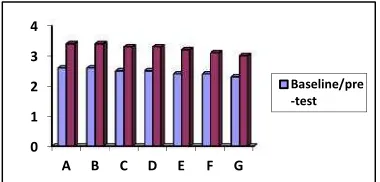
Pre-test results from seven candidate teachers of children with visual impairment cumulatively achieve skills as sighted guide/companion for blind people with lowest scores were achieved 2.3 by G, and 2.6 is the highest score achieved by A. Both scores lowest, and the highest average score of 2.47 is included in the category of less, because it has not reached a score/weight 3.5 or meet the minimum standard targets otherwise good value percentage is at 76%, so there should be no remedial action. Therefore there needs to be action skills training as a sighted guide/companion for blind people to candidate teachers of children with visual impairments.
After the action is taken in the form of skills training as a companion to look out for people with visual impairment, post-test given to candidate teachers of blind children with the following results:
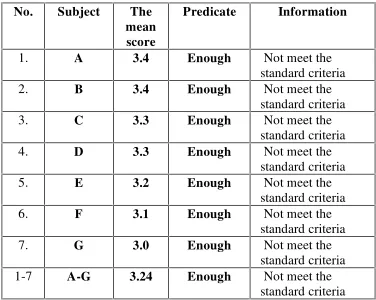
Table: 2
Recapitulation of the results of the post-test candidate teachers about the skills to become alert sighted guide/companion for blind people
No. Subject The 1-7 A-G 3.24 Enough Not meet the
standard criteria
included in the category and have not quite reached the score / weight 3.5 or not meet the minimum standard targets otherwise good value percentage is at 76%. Cumulatively skills of candidate teachers of children with visual impairment as a sighted guide/companion for blind people has increased 31.17% from an average score of 2.47 to 3.24 are included in the category of enough. However, these skills have not met the minimum standard target scores / weights 3.5, or better stated percentage is at 76%, so there should be no remedial action at cycle 2.It can be observed in the following graph:
Figure 1: Graph skill enhancement candidate teachers of childrenwith visual impairmentas a sighted guide/companion for the blind people of
the baseline(pre-test) to practice (post-test)
In reflection action cycle 1 has done the following things: (1) To evaluate the action taken in the form of skills training as a sighted guide/companion to look out for blind people, (2) Conduct a meeting with the Principal Yaketunis Special SchoolYogyakarta to discuss the results of the evaluation of training actions for candidate teachers of children with visual impairment on their skills as a sighted guide/companion for blind people; (3) Fix the implementation of appropriate measures of evaluation results, to be used in the next cycle.
Evaluation of cycle 1. Results 1 cycle of actions performed by the action on skills training as a sighted guide/companion for blind people, preceded by a pre-test that reaches an average score of 2.47 and ended with a post-test that reaches an average
score of 3.24. Although it has increased 31.17%, but do not meet the minimum standard target scores / weights of 3.5 or better stated percentage reaching 76%, so it is still necessary remedial actions in cycle 2.
In the second cycle of action have done the following things: 1. Planning. In this planning is to identify a problem that is still not fulfilled the minimum standard of skill as a sighted guide/companion for the blind people and sighted determination of alternative solutions, ie with assistance in skills training as a sighted guide/companion for blind people, then do the following things: (a) Plan facilitation measures that will be applied in cycle 2. In planning assistance that will be put into action, researchers conducted a field study to Yaketunis Special School Yogyakarta to obtain input from principals and teachers Orientation and Mobility of material assistance needed by the candidate teachers of children with visual impairment; (b) Determine the subject matter mentoring. From the results of field studies mentioned above can be determined subject matter mentoring candidate teachers of children with visual impairment as a sighted guide/companion to alert blind people as follows: (1) Mentoring training techniques to make contact, (2) facilitation exercise techniques reject or accept the invitation; (3) Assistance exercises techniques through the narrow streets or congested; (4) Assisting technical training through a closed door; (5) Assisting technical training up and down the stairs; (6) Assisting technical training to sit in a chair; (7) Mentoring training techniques into cars and buses; (8) Mentoring training techniques to move the handle; (9) Mentoring reversed engineering practice; (c) Develop a mentoring action scenario exercise.
Scenario 2 Cycle mentoring has been structured as follows: (1) Meet with the Principal and Teacher Orientation and Mobility Yaketunis Special School
0 1 2 3 4
A B C D E F G
Yogyakarta to determine material assistance, (2) Conduct training and mentoring in the field of observation, (3) Reforming the implementation of exercise as a sighted guide/companion to look out for blind people; (4) Discussion and reflection implementation sighted guide/companion technical training assistance forblind persons, (5) Cover and giving a summary of the technical implementation tasks for the physically blind sighted guide/ companion; (d) Preparing Prospective Candidate Teachers Worksheets. Worksheets candidatesteacher based on rigorous field study and a review of the theory used in carrying out the task training/practice skills as a sighted guide/companion to look out for blind people; (e) Setting up source of learning about engineering a traveling/ walk with a sighted guide/companion watch out for blind people; (f) Develop observation format implementation training / practice a traveling / walk with a sighted guide/companion alert for blind people; (g) Develop a mentoring training outcome evaluation format a traveling / walk with a sighted guide/companion alert for blind people.
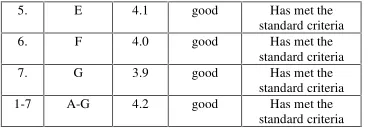
After the action is taken in the form of skills training assistance as alert sighted guide/companion for blind people, have made observations on candidate teachers of blind children with results as listed in Table 7 as follows:
Table: 3
Recapitulationdata results in an increase in facilitation skills training candidate teachers of children with visual impairment as a sighted
Action results in cycle 2 mentoring skills training as a sighted guide/ companion to watch out for blind people from seven candidate teachers of children with visual impairment have achieved a cumulative score of 4.2, so the score has increased from 3.24 to 4.2, or an increase of 29.63%. Score 4.2 included in both categories, and has exceeded the target of a minimum standard score / weight of 3.5, or better stated percentage reaching 76%, thus achieving predicate though not very good, the action was considered sufficient and do not need to act improvement in cycle 3. This increase can be observed in the following graph:
Figure 2: Graph Improved skills of candidate teachers of blind children as a sighted
guide/companion for the blind people of workout / post-test and mentoring
In reflectionaction cycle 2 do the following things: (1) To evaluate actions taken in the form of mentoring skills training as a sighted guide /companion to look out for blind people, (2) Conduct a meeting with the Principal and teachers Orientation and MobilityYaketunis Special School Yogyakarta to discuss the results of the evaluation of the actions mentoring future teachers of blind children in skill as a sighted guide/companion to look out for blind people, (3) Evaluation of cycle 2.
The results of the implementation of the action mentoring training candidate teachers of children with visual impairment in skill as a sighted guide/companion for blind people in cycle 2 skills cumulatively seven candidate teachers of children with visual impairment in skill as a sighted guide/companion for blind people has increased. This is evidenced by the increase in the indicator score of score of 3.24 to 4.2, or an increase of 29.63%. Score 4.2 has exceeded the target minimum standard score / weight percentage values of 3.5 or better stated, reaching 76%, but has not reached the predicate is very good because the score has not exceeded a score of 4.2. Cumulatively seven candidate teachers ofchildren with visual impairment have the skills as a sighted guide/companion for blind people to achieve a good rating, the researchers decided to take no action on cycle 3. This can be checked in the following graph:
Figure 3: Graph Improved skills of candidate teachers of children with visual impairment as a sighted guide/companion to look out for blind
people from baseline/pre-test, training/mentoring and post-test
DISCUSSION
Results of pre-test as a baseline before the first cycle of the action performed, the seven candidates teacher of children with visual impairment skills as sighted guide/companion for blind people achieve a cumulative score of 2.3 is achieved by G the lowest and highest score of 2.6 achieved by A. The mean score of the subjects A, B, C, D, E, F and G reaches 2.47 which is still included in the category of less, because it has not reached a score / weight 3.5 standard or meet the target of at least a good percentage stated that reached 76%, so there is still need remedial action.
Cumulatively, all subjects had not reached the standard criteria of skills as sighted guide/ companion for blind people is the lowest score of 2.3, and the highest score of 2.6. Both scores lowest and highest scores are all still included in the category of less, because it has not reached a score / weight 3.5 standard or meet the target of at least a good percentage value declared, reaching 76%. Therefore, it is necessary to act as a sighted guide/companion training for blind people watch out for seven candidate teachers of children with visual impairment.
After training as a sighted guide/companion action alert for blind people, do the post-test to determine the presence of increasing skills candidate teachers of children with visual impairment as a sighted guide/companion to watch out for blind people.
The results of the post-test measures one cycle after the act of exercise as a sighted guide/companion for blind people, the cumulative skills of seven candidate teachers of childrenwith visual impairment as a sighted guide/companion for blind people has increased by 31.17%, from an 0
1 2 3 4 5
A B C D E F G
average score of 2.47 increased to 3 , 24 in category enough. From the lowest score of 2.3 is achieved by G increased to a score of 3.0 is achieved also by G and from 2.6 the highest score achieved by a rise to 3.4 is achieved by A and B. However, still does not meet the minimum standard target scores / weights 3.5, or achieving the stated percentage of the value of good, reaching 76%, so there should be no remedial action at cycle 2. The action in the form of mentoring candidate teachers of children with visual impairment in the exercise as a sighted guide/companion for blind people.
After the mentoring of candidate teachers of children with visual impairment in the exercise as a sighted guide/companion for blind people, subjects A, B, C, D, E, F, and G are the cumulative have attained skills as a sighted guide/companion to watch out for blind people with the lowest score is 3.9 achieved by G, and the highest score achieved by the subjects 4.5 A. Lowest scores are still included in both categories, having already achieved a score / weight 3.5 standard or has met the target minimum percentage value declared good, reaching 76%. Have achieved the highest score category very well because it has exceeded a score of 4.2 or have achieved> 86%.
Action results in cycle 2 skills mentoring seven candidate teachers of children with visual impairment as a sighted guide/companion for blind people has achieved an average score of 4.2 was included in both predicates, because although it has been more than the target minimum standard score / 3.5 weight percentage or value stated . Subjects A, B, C, D, E, F and G are the cumulative have attained skills as a sighted guide/companion to watch out for blind people with average-good category, although the scores achieved by subjects A is 4.5, B = 4.4 subject , and subject category C = 4.3 is very good. Scores achieved by subjects D = 4.2, E = 4.1 subjects, subjects F = 4.0 and G
= 3.9 are included in both categories. However, achieving an average score of 4.2, so it is still included in either category, because it has not reached an average score of more than 4.20 to 5.0 or meet the criteria very good with the value of the predicate is otherwise very good percentage that began 86 % -100%. Thus it can be said that the training and mentoring to improve the skills of candidate teachers of children with visual impairment as a sighted guide/companion to alert blind people.
Conclusion
Through proven training and mentoring candidate teachers of children with visual impairment to increase the skills as a sighted guide/companion to look out for blind people and has been performed with two cycles of action.
1. Results 1 cycle of actions undertaken by the practice as a sighted guide/companion for blind people accompanied by a pre-test as a baseline , seven candidate teachers of children with visual impairment cumulatively reached an average score of 2.47 and a post-test achieving an average score of 3.24; 31.17% have been able to improve the skills of the seven candidate teachers of children with visual impairment as a sighted guide/companion for blind people. However, although the cumulative have increased by 31.17% but do not meet the minimum standard target scores / weights of 3.5 or better stated percentage reaching 76%, so there is still need to cycle the action 2
reached the predicate is very good because it has not exceeded a score of 4.2 or> 86%, so there is no need to cycle the action 3.
Thus training and mentoring as a sighted guide/companion for blind people has been shown to improve the skills of candidate teachers of children with visual impairment as a sighted guide/companion for blind people.
REFERENCES
Ashman, Adrian and John Elkins. (L994). Educating Children With Special Needs. Victoria, Australia: Prentice Hall of Australia Pty. Ltd.
Ministry of Education and Culture. Classroom Action Research "Action Research". Jakarta: Directorate General of Secondary Education, Directorate General of Primary and Secondary Education Department of Education
Hallahan, DP & Kauffman, JM. (1988). Exceptional Children, Introduction to Special Education.(4thEdition). New Jersey: Prentice-Hall, Inc.
Horton, Kirk. (1986).Community-Based Rehabilitation of the Rural Blind.New York: Helen Keller International Inc.
Irham Hosni. (1995).orientation and mobility. New York: Workers Education Project Teacher Dikjen Higher Education Ministry and the custom.
Kemmis, S. & NMcTaggart, R. (1988). The Action Research Planner. 3nd. ed. ed. Victoria, Australia: Deakin University.
Lowenfeld, Berthold. (1979). Visual Impairment in School Children. Frans Translation. Harsana Sasraningrat. London: Department of Education and Culture BP3K.
Lydon, T. William, and M. Loretta McGraw. (1973). Development Conception for Blind Children.New York: American Foundation for the Blind, Inc.
Miles, BM., & Huberman, AM. (1994).Qualitative data analysis.Beverly Hills: SAGE Publications.
Purwanta Hadikasma. (1987) Orientation and Mobility for the Blind.Yogyakarta: Enhanced Project Development / Higher Education Teacher Training Institute Yogyakarta. Saifuddin Awar. (1996).Achievement Test.Yogyakarta: Pustaka Student Publisher.
Sasraningrat, F. Harsana. (1995).Draft Integrated Education of Children with Disabilities. Surakarta: Prof. PPRBM.Dr. Dr. Soeharso.
Scholl, Geraldine. (L988). Foundation of Education for the Visually Impaired Children and Youth.New York:American Foundation of the Blind.
Sudjana. (1988). statistical method.York: Publisher Tarsito.
Suharsimi, AK. (1989). Management research: A practical approach. Jakarta: PT Bina Literacy.
______. (1996).Procedure research(Tenth Printing) Jakarta: PT Rineka Reserved.
______, Suhardjono, and Supardi. (2007).Classroom Action Research. Jakarta: Bumi Aksara. London: Earth Literacy.
Suwarsih Associate. (2006). research action "Action Research". New York: ALFABETA, CV.
Syamsudin.(2002).descriptive statistics. Surakarta Muhammadiyah Uiversity Press.
Widoyoko, EP (2008).Development of evaluation model of teaching social science courses in high school.Dissertation (unpublished). London: UNY Graduate Program,