Product-service system design concept development
based on product and service integration
Agus Sutanto*
Department of Mechanical Engineering, Faculty of Engineering,
Andalas University, Padang, Indonesia
Email: [email protected] *Corresponding author
Berry Yuliandra
Department of Industrial Engineering, Faculty of Engineering,
Andalas University, Padang, Indonesia
Email: [email protected]
Benny Tjahjono
Supply Chain Research Centre, School of Management, Cranfield University, UK
Email: [email protected]
Rika Ampuh Hadiguna
Department of Industrial Engineering, Faculty of Engineering,
Andalas University, Padang, Indonesia
Email: [email protected]
Keywords: product-service system; PSS; added values; design concept; design requirements; consumer needs; PSS design methodology; integration; mobile phone; product concept; service concept.
Reference to this paper should be made as follows: Sutanto, A., Yuliandra, B., Tjahjono, B. and Hadiguna, R.A. (2015) ‘Product-service system design concept development based on product and service integration’, J. Design Research, Vol. 13, No. 1, pp.1–19.
Biographical notes: Agus Sutanto is currently working as a Senior Lecturer in the Department of Mechanical Engineering at Andalas University, Padang, Indonesia. He received his Doctor’s degree (Dr.-Ing) from Institute for Factory Automation and Production Systems, University of Erlangen-Nuremberg Germany in 2005. He also received his Master’s degree (MT) in Mechanical and Production Engineering from Bandung Institute of Technology in 1996. He has more than 15 years of teaching/research interests in the area of manufacturing processes and systems. His research interests presently are web-based planning tools, product-service systems and cloud manufacturing.
Berry Yuliandra received his Bachelor’s degree in Industrial Engineering and Master’s degree in Mechanical Engineering with focus on the area of manufacturing systems engineering, both from Andalas University in Padang, Indonesia. He is currently a non-permanent Lecturer in the Department of Industrial Engineering, Andalas University. His research focuses on the design, development and implementation of product-service systems.
Benny Tjahjono is a Senior Lecturer at the Supply Chain Research Centre, Cranfield University. His research is in the area of supply chain operations. He establishes a recognised research theme in the contemporary simulation and modelling featuring a combination of discrete-event simulation, system dynamics and agent-based modelling and has applied these techniques into many emerging research areas such as ‘servitisation’ of manufacturing and product-service systems. He has been working closely with global companies on a number of industrially funded projects associated with the decision making process and analysis/design of supply chain operations.
Rika Ampuh Hadiguna received his PhD in Agro-Industrial Technology from Bogor Agricultural University (IPB), Indonesia in 2010. Since 1999, he has been a Lecturer at the Department of Industrial Engineering, Faculty of Engineering, Andalas University, Indonesia. His research areas include logistic, supply chain management and multi criteria decision-making.
1 Introduction
Feinberg (2001) states, if the products in the market are not significantly differentiated then customer satisfaction will be a determining factor in the business competition. For that reason, in order to survive in the global competition, companies should increase their competitiveness by improving customer satisfaction. One possible way is to offer added value to the product, which can be done by shifting their paradigm from the product-oriented into the service-oriented economy (Geng et al., 2010). Shikata et al. (2013) argued that it is difficult for manufacturing companies nowadays to succeed by selling only product. The concept of product-service systems (PSSs) integrates products and services which can lead to a better value proposition, revenue generation opportunities and sustainable customer value (Roy and Cheruvu, 2009). Shifting from the production-based model to the PSS-based model also means that the manufacturers are required to diversify services around the products (Phumbua and Tjahjono, 2012).
Although PSS offers various benefits through increased added value, the analysis conducted by the sustainable product development network (SusProNet) showed that the PSS application is not always a win-win solution and sustainability is still questionable; in some cases it failed or simply gave a slight profit margin (Tukker, 2004). To avoid failure in the PSS implementation, the design process clearly needs to be improved. In this way, the implementation of PSS concept will be enhanced.
The research described in this paper aims to provide a new PSS design methodology based on the integrated product and service design requirements. Customer preferences will become the basis for the requirements. The integration process will focus on the product-oriented service. It is expected that the integration can facilitate the companies to shift from product-oriented enterprises to service-based enterprises and improve their competitiveness through the synergy between the product and services offered.
2 State of the art
2.1 Product-service systems
PSS can be defined as the integration between products and services to generate higher added value and fulfil the specific needs of consumers (Goedkoop et al., 1999; Mont, 2000; Erkoyuncu et al., 2009; Chirumalla et al., 2011; Wallin and Kihlander, 2012). In the context of PSS, a product is a tangible commodity manufactured to be sold, while a service is an activity with economic value often done on a commercial basis. A combination of products and services can expand the functionality offered to consumers, both in terms of improving the quality of products and services as well as reducing the total cost (Goedkoop et al., 1999).
• The economic dimension means the integration of products and services will offer new functionality, open up opportunities for products and service customisation as well as improve product quality and customer satisfaction (Goedkoop et al., 1999). Furthermore, it will expand the market for producers, increase the company’s reputation from the consumer point of view (Wimmer and Kang, 2006) and can reduce the cost of investment and production (Goedkoop et al., 1999; Wimmer and Kang, 2006).
• The environment dimension emphasises the integration of products and services that will reduce material waste by shifting the company’s business from selling only products to providing functionality (Mont, 2002; Maussang et al., 2006). In addition, the combination of products and services that complement each other in providing the needs of the consumers can reduce energy consumption and use of aggregate materials.
• Thesocial dimension shows the integration of service activities in manufacturing companies that will grow the employment. This integration will also affect the consumption patterns in the society so it can reduce the impact of the rebound effect. However, the relationship between the PSS concept with the social aspect is
somewhat reciprocal. This is due to the effective implementation of PSS that also requires corresponding social structures (such as social infrastructure, community structure and organisational layout) (Mont, 2000).
2.2 Design approaches in PPS
Design aspect has a critical role in the efficiency, visibility and usability of PSS (Morelli, 2002). McAloone and Andreasen (2004) found that design in PSS ideally combines various disciplines by considering the product life cycle and consumer acceptance. The same opinion is expressed by Mont and Plepys (2003). They claimed that the PSS design should be able to connect the consumer perceptions and behaviour as well as the concept of sustainability development. Moreover, the collaboration between product (tangible) and services (intangible) in PSS design needs to be considered in order to increase the value. Therefore, the design process of products and services in PSS should be conducted jointly so as to maximise the potential profit of the resulting design. Design requirement is determined before the design process done and it is based on the perspective of products and services. Both perspective of requirements are then processed together to generate the optimal PSS design.
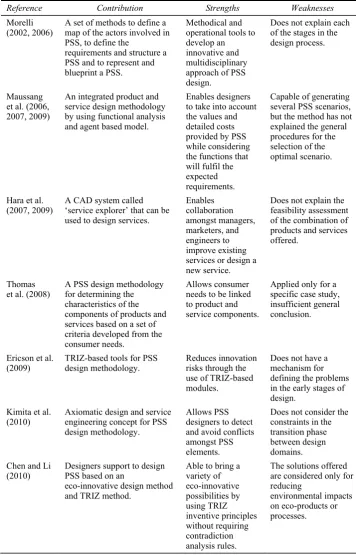
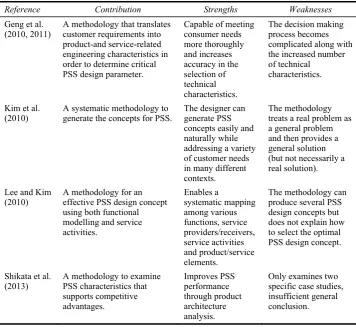
Vasantha et al. (2012) revealed that the design process to integrate products and services into primary goal is widely discussed in PSS literature. Some PSS design methodologies that appeared in the literature are summarised in Table 1.
Table 1 PSS design methodologies in literature
Reference Contribution Strengths Weaknesses
Morelli (2002, 2006)
A set of methods to define a map of the actors involved in PSS, to define the
requirements and structure a PSS and to represent and blueprint a PSS.
Methodical and operational tools to develop an innovative and multidisciplinary approach of PSS design.
Does not explain each of the stages in the design process.
Maussang et al. (2006, 2007, 2009)
An integrated product and service design methodology by using functional analysis and agent based model.
Enables designers to take into account the values and detailed costs provided by PSS while considering the functions that will fulfil the expected requirements.
Capable of generating several PSS scenarios, but the method has not explained the general procedures for the selection of the optimal scenario.
Hara et al. (2007, 2009)
A CAD system called ‘service explorer’ that can be used to design services.
Enables services or design a new service.
Does not explain the feasibility assessment of the combination of products and services offered.
Thomas et al. (2008)
A PSS design methodology for determining the characteristics of the components of products and services based on a set of criteria developed from the consumer needs.
Allows consumer needs to be linked to product and service components.
Applied only for a specific case study, insufficient general conclusion.
Ericson et al. (2009)
TRIZ-based tools for PSS design methodology.
Reduces innovation risks through the use of TRIZ-based modules.
Does not have a mechanism for defining the problems in the early stages of design.
Kimita et al. (2010)
Axiomatic design and service engineering concept for PSS design methodology.
Allows PSS designers to detect and avoid conflicts amongst PSS elements.
Does not consider the constraints in the transition phase between design domains. Chen and Li
(2010)
Designers support to design PSS based on an
eco-innovative design method and TRIZ method.
Able to bring a
The solutions offered are considered only for reducing
Table 1 PSS design methodologies in literature (continued)
Reference Contribution Strengths Weaknesses
Geng et al. (2010, 2011)
A methodology that translates customer requirements into product-and service-related engineering characteristics in order to determine critical PSS design parameter.
Capable of meeting consumer needs more thoroughly and increases accuracy in the selection of technical characteristics.
The decision making process becomes complicated along with the increased number of technical
characteristics.
Kim et al. (2010)
A systematic methodology to generate the concepts for PSS.
The designer can generate PSS concepts easily and naturally while addressing a variety of customer needs in many different contexts.
The methodology treats a real problem as a general problem and then provides a general solution (but not necessarily a real solution).
Lee and Kim (2010)
A methodology for an effective PSS design concept using both functional modelling and service activities.
The methodology can produce several PSS design concepts but does not explain how to select the optimal PSS design concept.
Shikata et al. (2013)
A methodology to examine PSS characteristics that supports competitive
Only examines two specific case studies, insufficient general conclusion.
Muller et al. (2010) developed a checklist of criteria to determine the needs of consumers in PSS design. The criteria can serve as a basis for developing a PSS design methodology. Using these criteria, the PSS design process which incorporating more systematic measures and structured should theoretically better reflect the consumer needs.
3 PSS design methodology
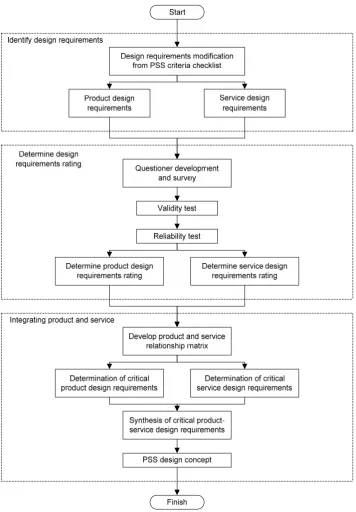
A methodology for product and service integration suggested by this research (Figure 1) consists of three distinct stages as follows:
• Stage 1 is to identify design requirements. This stage aims to determine the PSS core requirements for designing the products and services. This criterion is general in nature and can be further divided into product and service criteria. The PSS criteria checklist developed by Muller et al. (2010), especially technical artefacts and service criteria, are used as a basis for this stage.
• Stage 2 is to determine design requirements rating. A survey is conducted to rate various design requirements for a product that reflects the customers’ desires. As noted by Thomas et al. (2008), characteristics of product and service components can be systematically derived on the basis of customer requirements. For that reason the summated rating method (also known as Likert scale) developed by Likert (1932) is used to obtain ratings from the respondents on a symmetric important-not important scale for a series of design requirements. Compared to other methods such as the equal-appearing interval (also known as Thurstone scale), the summated rating method is relatively simpler and easier to apply.
• Stage 3 is to integrate product and service design requirements. This stage aims to generate the PSS design concept from product and service requirements in order to fulfil customer’s satisfaction. Product and service relationship matrix can be used for this purpose.
4 Case study
A case study of mobile phones design has been chosen for testing the developed methodology. This section describes the mobile phone design process, the product-service integrated design for mobile phones and the result analysis.
4.1 Mobile phone design
The design of mobile phones has numerous challenges that have to be considered to ensure the marketing success. These challenges may come from external as well as internal perspectives. The challenge from external marketing perspective has a slightly different technological mastery level from that of the competing manufacturers. This causes at least two problems namely the lack of products variation and the shorter product life cycles. From the perspective of the mobile phone design process other problems also emerged. The mobile phone design has evolved into a series of communication, knowledge and new innovative entertainment features (Ling et al., 2007; Ziefle et al., 2006). This makes the design process more complicated than ever before and reduces the usability of mobile phones (Ling et al., 2007).
different from other countries around the world, where the mobile phones are sold to the consumers through contract and the payment is made essentially for the service offered by the network provider. The illustrations in this research will therefore focus only on mobile phones design and do not deliberately address the relationships between mobile phone manufacturers and network operators or the network operator as a service. Product-oriented service design will focus on producing a better product and product support service by mobile phones manufacturers. To test the applicability of the models that have been developed, an illustrative case study of a product-oriented service design for consumers in West Sumatra, Indonesia has been chosen.
4.2 Product-service integrated design for mobile phone product
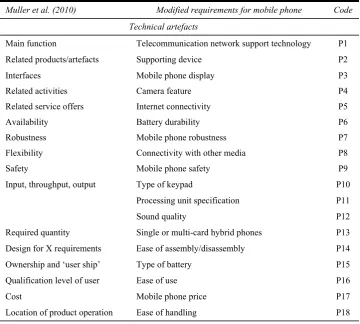
As mentioned in Section 3, the development activity begins with the identification of the design requirements. This stage is done by using PSS checklist criteria developed by Muller et al. (2010), especially the technical artefact and service criteria. The technical artefact criteria are related to the physical form of a mobile phone which will be designed. Service criteria are related to the characteristics of the service support offered by the manufacturers. Checklist criteria from Muller et al. (2010) have been modified to suit the design requirements for mobile phones (Table 2).
Table 2 Product and service design requirements for mobile phone
Muller et al. (2010) Modified requirements for mobile phone Code
Technical artefacts
Main function Telecommunication network support technology P1
Related products/artefacts Supporting device P2
Interfaces Mobile phone display P3
Related activities Camera feature P4
Related service offers Internet connectivity P5
Availability Battery durability P6
Robustness Mobile phone robustness P7
Flexibility Connectivity with other media P8
Safety Mobile phone safety P9
Input, throughput, output Type of keypad P10
Processing unit specification P11
Sound quality P12
Required quantity Single or multi-card hybrid phones P13 Design for X requirements Ease of assembly/disassembly P14 Ownership and ‘user ship’ Type of battery P15
Qualification level of user Ease of use P16
Cost Mobile phone price P17
Table 2 Product and service design requirements for mobile phone (continued)
Muller et al. (2010) Modified requirements for mobile phone Code
Services
Required resources Ease of repair S1
Related activities Duration of product delivery S2 Estimated result Reliability of service result S3
Required information Early warning system S4
Facultative services Product upgrade S5
Additional services Diagnosis and repair S6
Supplemental services Product warranty S7
Location of service applications Availability of service centre S8
The second stage is to determine the critical design requirement using the summated rating method developed by Likert (1932). This method employs respondents’ assessments. In order to determine the importance for each requirement, the respondents are selected from the societies who are deemed to be ‘savvy’ and possess reasonable know-how about the object under study (in this case a mobile phone). Assessment is done through surveys, and respondents were selected using the following two criteria:
1 respondent’s level of education is at least Bachelor
2 respondents have used mobile phones for at least five years.
Seventy-five respondents rated each of design requirements. Each design requirement was transformed into a question of the requirement function in order not to confuse the respondent. For example:
• design requirement: telecommunication network support technology
• questionnaire item: ‘How important is the speed of internet access from your mobile phone?’
• description: type of telecommunication network support technology (2G, 3G and 4G) has a significant impact on internet speed.
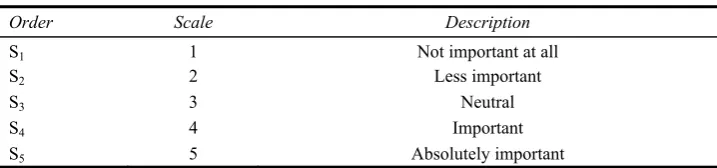
Rating scales used are listed in Table 3. Table 3 Rating scales used
Order Scale Description
S1 1 Not important at all
S2 2 Less important
S3 3 Neutral
S4 4 Important
S5 5 Absolutely important
(
) (
)
(
)
2(
)
22 2
N XY X Y
r
N X X N Y Y
− =
⎡ − ⎤ ⎡ − ⎤
⎢ ⎥ ⎢ ⎥
⎣ ⎦ ⎣ ⎦
∑
∑ ∑
∑
∑
∑
∑
(1)where
N number of samples
X score of each design requirement Y total score from all design requirements.
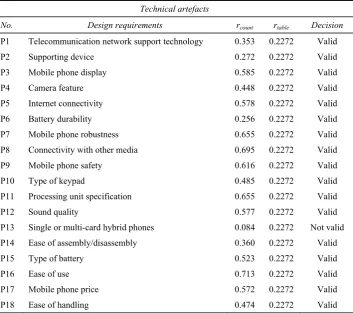
By using equation (1), the value of rcount for each of mobile phone design requirements
can be calculated. This value was then compared to the value of rtable. If rcount≥rtable, then
the questionnaire item was deemed valid. The value of rtable for the number of sample of
75 can be obtained by using the Pearson Product Moment coefficient table (rtable) with the
significance of 0.05 and 2 tailed. From the table (Bishop, 2008), the rtable value is 0.2272.
The calculation of validity test is carried out using SPSS 20 software. The validity test result can be seen in Table 4. The result showed that only item P13 was deemed not valid.
Table 4 Validity test results for each of mobile phone design requirements
Technical artefacts
No. Design requirements rcount rtable Decision
P1 Telecommunication network support technology 0.353 0.2272 Valid
P2 Supporting device 0.272 0.2272 Valid
P3 Mobile phone display 0.585 0.2272 Valid
P4 Camera feature 0.448 0.2272 Valid
P5 Internet connectivity 0.578 0.2272 Valid
P6 Battery durability 0.256 0.2272 Valid
P7 Mobile phone robustness 0.655 0.2272 Valid P8 Connectivity with other media 0.695 0.2272 Valid
P9 Mobile phone safety 0.616 0.2272 Valid
P10 Type of keypad 0.485 0.2272 Valid
P11 Processing unit specification 0.655 0.2272 Valid
P12 Sound quality 0.577 0.2272 Valid
P13 Single or multi-card hybrid phones 0.084 0.2272 Not valid
P14 Ease of assembly/disassembly 0.360 0.2272 Valid
P15 Type of battery 0.523 0.2272 Valid
P16 Ease of use 0.713 0.2272 Valid
P17 Mobile phone price 0.572 0.2272 Valid
Table 4 Validity test results for each of mobile phone design requirements (continued)
Technical artefacts
Services
No. Design requirements rcount rtable Decision
S1 Ease of repair 0.713 0.2272 Valid
S2 Duration of product delivery 0.764 0.2272 Valid
S3 Reliability of service result 0.789 0.2272 Valid
S4 Early warning system 0.705 0.2272 Valid
S5 Product upgrade 0.603 0.2272 Valid
S6 Diagnosis and repair 0.776 0.2272 Valid
S7 Product warranty 0.662 0.2272 Valid
S8 Availability of service centre 0.571 0.2272 Valid
Reliability test was conducted only to validate the questionnaire items. The value of Cronbach’s alpha, a coefficient to measure the internal consistency, is determined to estimate the reliability of a test. The value of Cronbach’s alpha is obtained using (Bishop, 2008):
2 2
x i
2 x
s s
K
K 1 s
⎛ − ⎞
⎛ ⎞⎜ ⎟
α = ⎜⎝ − ⎟⎜ ⎟
⎠⎝ ⎠
∑
(2)where
K number of design requirement
2 x
s the variance of the observed total design requirement scores
2 i
s the variance of design factor i for the current sample.
The result is acceptable if the value of α > 0.70 (Tavakol and Dennick, 2011). Computation of the reliability test was also done using SPSS 20 software. The reliability test results can be seen in Table 5. The reliability results showed that the alpha value of both design requirements >0.70. This suggests that all questionnaire items are reliable and internally consistent.
Table 5 Reliability test results
Design requirements Cronbach’s alpha Decision
Technical artefacts 0.883 Reliable
Service 0.904 Reliable
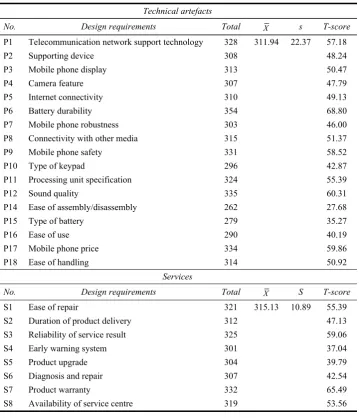
The design requirement rating was determined by using the summated ratings method developed by Likert (1932). The results of summated ratings are then transformed into T-scores by using the equation (Kreyszig, 2011):
X X
T 50 10 s
⎛ − ⎞
= + ⎜ ⎟
where
X the total value of the scale that would be converted into T-score X the average of the group scale total value
s the standard deviation of the group scale total value. Design requirements rating and T-score can be seen in Table 6. Table 6 Mobile phone design requirements rating and T-score
Technical artefacts
No. Design requirements Total X s T-score
P1 Telecommunication network support technology 328 311.94 22.37 57.18
P2 Supporting device 308 48.24
P3 Mobile phone display 313 50.47
P4 Camera feature 307 47.79
P5 Internet connectivity 310 49.13
P6 Battery durability 354 68.80
P7 Mobile phone robustness 303 46.00
P8 Connectivity with other media 315 51.37
P9 Mobile phone safety 331 58.52
P10 Type of keypad 296 42.87
P11 Processing unit specification 324 55.39
P12 Sound quality 335 60.31
P14 Ease of assembly/disassembly 262 27.68
P15 Type of battery 279 35.27
P16 Ease of use 290 40.19
P17 Mobile phone price 334 59.86
P18 Ease of handling 314 50.92
Services
No. Design requirements Total X S T-score
S1 Ease of repair 321 315.13 10.89 55.39
S2 Duration of product delivery 312 47.13
S3 Reliability of service result 325 59.06
S4 Early warning system 301 37.04
S5 Product upgrade 304 39.79
S6 Diagnosis and repair 307 42.54
S7 Product warranty 332 65.49
S8 Availability of service centre 319 53.56
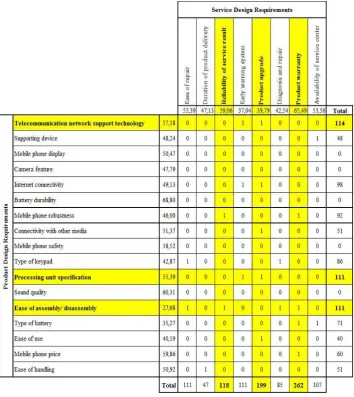
Figure 2 Product and service relationship matrix (see online version for colours)
Notes: 1 – relationship between product and service design requirement exist, 0 – no relationship between product and service design requirement.
The total score of each product and service design requirement was calculated by multiplying the design requirement score and the existence of the relationship between product and service design requirements (the value is 1, if the relationship exists and 0, if no relationship). For example, the score of ‘supporting device’ can be calculated as:
‘Supporting device’ score (48.24 0) (48.24 0) (48.24 0) (48.24 0) (48.24 0) (48.24 0) (48.24 0) (48.24 1)
48.24 48
= × + × + ×
+ × + × + ×
+ × + ×
Three product design requirements with the total highest values will be nominated as the critical product design requirements. A similar method was also applied for the service design requirements. Product and service design requirement in ‘yellow’ (namely ‘telecommunication network support technology’, ‘processing unit specification’, ‘ease of assembly/disassembly’ for product design requirement and ‘reliability of service result’, ‘product upgrade’, ‘product warranty’ for service design requirement) are the critical design requirements. These will then become the basis for PSS design concept development.
Table 7 Developed product-service design concept
Critical design requirements Product design concept Service design concept
Telecommunication network support technology
Mobile phone with high specification component
Software upgrade service
Processing unit specification Mobile phone with high specification component
Software upgrade service
Ease of assembly/disassembly Modular design Mobile phone repair service Product warranty Mobile phone with high
specification component
Mobile phone repair service
Product upgrade Mobile phone with high specification component
Software upgrade service
Reliability of service result Modular design Mobile phone repair service PSS design concept Modular mobile phone with
high specification component
Software upgrade and mobile phone repair service provision
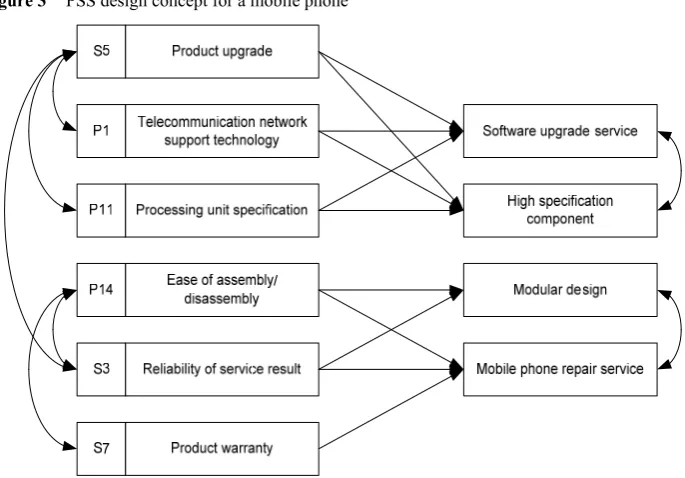
According to Sundin et al. (2007), the integrated product and service engineering can be achieved by developing the functional design which then breaks down into product functions and service functions. Based on this approach, a set of critical design requirements which reflect the PSS concept was then synthesised into a set of product and service design concepts (Table 7). Finally, PSS design concepts were elaborated from both product and service design concepts.
Figure 3 shows the approach to elaborate the PSS design concept from a set of critical design requirements and the product and service design concept. The PSS design concept suggested by product and service integration is a modular mobile phone featuring high specification components. This product design concept is supported by mobile phones repair and software upgrade services.
5 Conclusions
This research proposes a new way of developing the PSS design concept based on the integrated product and service requirements. There are three stages involved namely: identification of design requirements, determination of design requirements rating and integration of product-service into the PSS design concepts for a product. A mobile phones design case has been used to test the proposed model. Results suggest the development of modular mobile phones featuring high specification components supported by mobile phones repair and software upgrade services. This research solely attempted to develop the design concept for PSS without necessarily developing a detailed specification for the design. Future research needs to be focused on the development model for transforming a PSS design concept into a PSS design specification.
Acknowledgements
The authors gratefully acknowledge the assistance rendered by the Faculty of Engineering, Andalas University for partially funding this research in DIPA FT Unand 2013 (Contract No. 019/PL/SPK/PNP/FT Unand/2013). The authors would also like to thank Hairul Abral (Dean of Engineering Faculty, Andalas University) for his supports and motivations.
References
Bishop, A.P. (2008) MeasurementandEvaluation:CalculatingandEvaluatingValidity, Holcomb Hathaway, Publisher, Inc., New York.
Chen, J.L. and Li, H-C. (2010) ‘Innovative design method of product service system by using case study and TRIZ method’, Proceedingsofthe2ndCIRPIPS2Conference, Linköping, Sweden, pp.299–305.
Ericson, Å., Bertoni, M. and Larsson, T. (2009) ‘Needs and requirements – how TRIZ may be applied in product-service development’, Paper presented at 2nd Nordic Conference on ProductLifecycleManagement–NordPLM ‘09, 28–29 January, Göteborg, Sweden.
Erkoyuncu, J.A., Roy, R., Shehab, E. and Wardle, P. (2009) ‘Uncertainty challenges in service cost estimation for product-service systems in the aerospace and defence industries’ Proceedingof the 1st CIRP Industrial Product-Service Systems (IPS2) Conference, Cranfield University, Bedford, England, pp.200–206.
Feinberg, R.A. (2001) ‘Customer service and service quality’, in Salvendy, G. (Ed.): Handbookof IndustrialEngineering, 3rd ed., pp.651–664, John Wiley & Sons, Inc., New York.
Geng, X., Chu, X., Xue, D. and Zhang, Z. (2010) ‘An integrated approach for rating engineering characteristics’ final importance in product-service system development’, Computers & IndustrialEngineering, Vol. 59, No. 4, pp.585–594.
Geng, X., Chu, X., Xue, D. and Zhang, Z. (2011) ‘A systematic decision-making approach for the optimal product-service system planning’, ExpertSystemswithApplications, Vol. 38, No. 9, pp.11849–11858.
Goedkoop, M.J., van Halen, C.J., te Riele, H.R.M. and Rommens, P.J.M. (1999) ProductService Systems, Ecological and EconomicBasics, Dutch Ministries of Environment (VROM) and Economic Affairs (EZ), Report, No. 1999/36.
Hara, T., Arai, T. and Shimomura, Y. (2009) ‘A CAD system for service innovation: integrated representation of function, service activity, and product behaviour’, Journalof Engineering Design, Vol. 20, No. 4, pp.367–388.
Hara, T., Arai, T., Shimomura, Y. and Sakao, T. (2007) ‘Service/product engineering: a new discipline for value production’, Paper presented at the 19th International Conference on ProductionResearch, 29 July–2 August, Valparaiso, Chile.
Kim, K., Proctor, R.W. and Salvendy, G. (2012) ‘The relation between usability and product success in cell phones’, Behaviour&InformationTechnology, Vol. 31, No. 10, pp.969–982. Kim, K-J., Lim, C-H., Lee, J., Lee, D-H., Hong, Y.S. and Park, K-T. (2010) ‘Generation of concept
for product-service system’, in Proceedingsofthe 2ndCIRP IPS2 Conference, Linköping, Sweden, pp.203–209.
Kimita, K., Akasaka, F., Hosono, S. and Shimomura, Y. (2010) ‘Design method for concurrent PSS development’ in Proceedings of the 2nd CIRP IPS2 Conference, Linköping, Sweden, pp.283–290.
Kreyszig, E. (2011) AdvancedEngineeringMathematics, 10th ed., Wiley, London.
Lay, G., Copani, G., Jager, A. and Biege, S. (2010) ‘The relevance of service in European manufacturing industries’, JournalofServiceManagement, Vol. 21, No. 5, pp.715–726. Lee, S.W. and Kim, Y.S. (2010) ‘A product-service systems design method integrating service
function and service activity and case study’, in Proceedings of the 2nd CIRP IPS2 Conference, Linköping, Sweden, pp.275–282.
Likert, R. (1932) ‘A technique for the measurement of attitudes’, ArchivesofPsychology, Vol. 22, No. 140, pp.5–55.
Ling, C., Hwang, W. and Salvendy, G. (2007) ‘A survey of what customers want in a cell phone design’, Behaviour&InformationTechnology, Vol. 26, No. 2, pp.149–163.
Mateu, A.G.I., Li, Z. and Tyson, P. (2012) Cocreating a Sustainability Strategy in a Product/Service-System Value-Based Network of Stakeholders, Unpublished master thesis, School of Engineering, Blekinge Institute of Technology, Karlskrona, Sweden.
Maussang, N., Zwolinski, P. and Brissaud, D. (2006) ‘A representation of a product-service system during its design phase – a case study of a Helium liquefier’, in Proceedingsofthe13thCIRP International ConferenceonLifeCycleEngineering, International Institution for Production Engineering Research (CIRP), Leuven, Belgium, pp.555–562.
Maussang, N., Zwolinski, P. and Brissaud, D. (2009) ‘Product-service system design methodology: from the PSS architecture design to the products specifications’, Journal of Engineering Design, Vol. 20, No. 4, pp.349–366.
McAloone, T.C. and Andreasen, M.M. (2004) ‘Design for utility, sustainability and societal virtues: developing product service systems’, in Design2004:ProceedingoftheInternational DesignConference, Cavtat, Croatia, pp.1–8.
Mont, O. (2000) Product-ServiceSystems, The International Institute of Industrial Environmental Economics (IIIEE), AFR-Report 288.
Mont, O. (2002) FunctionalThinking – TheRoleofFunctionalSalesandProductServiceSystems for a Function-Based Society, The International Institute of Industrial Environmental Economics (IIIEE), Rapport 5233.
Mont, O. and Plepys, A. (2003) CustomerSatisfaction:ReviewofLiteratureandApplicationtothe Product-Service Systems, Final Report to the Society for Non-traditional Technology, The International Institute of Industrial Environmental Economics (IIIEE), Japan.
Morelli, N. (2002) ‘Designing product/service systems: a methodological exploration’, Design Issues, Vol. 18, No. 3, pp.3–17.
Morelli, N. (2006) ‘Developing new product service systems (PSS): methodologies and operational tools’, JournalofCleanerProduction, Vol. 14, No. 17, pp.1495–1501.
Muller, P., Schutz, F. and Stark, R. (2010) ‘Guideline to elicit requirements on industrial product-service systems’, in Proceeding ofthe CRIP IPS2 Conference, CRIP, Linköping, Sweden, pp.109–116.
Phumbua, S. and Tjahjono, B. (2012) ‘Towards product-service systems modelling: a quest for dynamic behaviour and model parameters’, International Journal ofProduction Research, Vol. 50, No. 2, pp.425–442.
Roy, R. and Cheruvu, K.S. (2009) ‘A competitive framework for industrial product-service systems’, International Journal of Internet Manufacturing and Services, Vol. 2, No. 1, pp.4–29.
Shikata, N., Gemba, K. and Uenishi, K. (2013) ‘A competitive product development strategy using modular architecture for product and service systems’, InternationalJournalofBusinessand SystemsResearch, Vol. 7, No. 4, pp.375–394.
Shikata, N., Gemba, K. and Uenishi, K. (2013) ‘A competitive product development strategy using modular architecture for product and service systems’, InternationalJournalofBusinessand SystemsResearch, Vol. 7, No. 4, pp.375–394.
Sundin, E., Lindahl, M., Comstock, M., Shimomura, Y. and Sakao, T. (2007) ‘Integrated product and service engineering enabling mass customization’, Paper presented at the 19th InternationalConferenceonProductionResearch, 29 July–2 August, Valparaiso, Chile. Tan, A.R., McAloone, T.C. and Gall, C. (2007) ‘Product/service-system development – an
explorative case study in a manufacturing company’, Paper presented at International Conference ON Engineering Design, ICED ‘07, 28–31 August, Cite des Sciences et de L’industrie, Paris, France.
Tavakol, M. and Dennick, R. (2011) ‘Making sense of Cronbach’s alpha’, InternationalJournalof MedicalEducation, Vol. 2, pp.53–55 [online] http://www.ijme.net/archive/2/.
Thomas, O., Walter, P. and Loos, P. (2008) ‘Design and usage of an engineering methodology for product-service systems’, JournalofDesignResearch, Vol. 7, No. 2, pp.177–195.
Vasantha, G.V.A., Roy, R., Lelah, A. and Brissaud, D. (2012) ‘A review of product–service systems design methodologies’, JournalofEngineeringDesign, Vol. 23, No. 9, pp.635–659. Wallin, J. and Kihlander, I. (2012) ‘Enabling product-service system development using creative
workshops: experiences from industry cases’, in DESIGN 2012: Proceeding of the InternationalDesignConference, The Design Society, Dubrovnik, Croatia, pp.321–330. Wimmer, R. and Kang, M.J. (2006) ‘Product service systems as a holistic cure for obese
consumption and production’, in Workshop of the Sustainable Consumption Research Exchange(SCORE!)Network:ProceedingofPerspectivesonRadicalChangestoSustainable ConsumptionandProduction(SCP), SCORE!, Copenhagen, Denmark, pp.401–410.
Country Rankings Country Search Compare Map Generator Help
About Us
Display journal title
Just copy the code below and paste within your html page:
<a href="http://www.scimagojr.com/journalsearch.php?q=5900152897&;tip=sid&;exact=no" title="SCImago Journal &; Country Rank"><img border="0" src="http://www.scimagojr.com/journal_img.php?id=5900152897&;title=true" alt="SCImago Journal &; Country Rank" /></a>
R e l a t e d p r o d u c t
@scimago
SJR is developed by:
Exact phrase
J o u r n a l o f D e s i g n R e s e a r c h
Country: United Kingdom
Subject Area: Computer Science | Engineering
Subject Category:
Category Quartile (Q1 means highest values and Q4 lowest values)
1999 2000 2001 2002 2003 2004 2005 2006 2007 2008 2009 2010 2011 2012 2013
Computer Graphics and Computer‐Aided Design
Engineering (miscellaneous)
Publisher: Inderscience Enterprises Ltd.. Publication type: Journals. ISSN: 15691551, 17483050
Coverage: 2011‐2013
H Index: 4
Charts Data
SJR indicator vs. Cites per Doc (2y)
The SJR indicator measures the scientific influence of the average article in a journal, it expresses how central to the global scientific discussion an average article of the journal is. Cites per Doc. (2y) measures the scientific impact of an average article published in the journal, it is computed using the same formula that journal impact factor ™ (Thomson Reuters).
Journal of Design Research
Home For Authors For Librarians Orders News
Journal of Design Research
Home For Authors For Librarians Orders News
Editorial View Expanded List View Condensed List View 5 Articles