EFL LEARNERS
’ AND TEACHERS’ POSITIVE ATTITUDES TOWARDS
LOCAL COMMUNITY BASED INSTRUCTION
Budsaba Kanoksilapatham
1Paweena Channuan
2 Silpakorn University, Thailand1 Naresuan University, Thailand 2[email protected]; [email protected]2
First received: 10 September 2017 Final proof received: 31 January 2018
Abstract
The new status of the English language as an international language (EIL) in the age of globalisation has contributed to a cultural change of focus in English language teaching (ELT). Instead of paying attention to cultural aspects of native English speakers as in traditional English instruction, cultural diversity now plays a key role in the teaching of culture in order to enhance
leaners’ intercultural awareness. To fill this need, this study aims to document EFL learners’ and teachers’ attitudes towards local community instruction in which young Thai students learned
English whilst being encouraged to take pride in their local culture. In this study, a set of local community-integrated lessons for elementary English education were constructed and subsequently implemented in Grade 4 classes at schools in the northern region of Thailand. Questionnaires were then administered to the students, and semi-structured interviews were also conducted with the school English teachers to elicit their attitudes towards the integrated lessons. The results indicated that young Thai students, along with their English teachers, have highly positive attitudes towards the local community based instruction. This lead to significant implications related to integrating aspects of local cultural identity into ELT practices.
Keywords: local community-based lessons; Thai-ness; local culture; young learners
The advent of the Thai English Language basic education core curriculum B.E. 2551 (Ministry of Eductaion [MoE]. 2008) introduced the important role of culture in language classrooms and defined culture as a fundamental part of the foreign language learning process. Culture is one of the four focused elements of the foreign language policy of Thailand: communication, culture, connection, and community (MoE, 2008). Many researchers and educators have given precedence to cultural learning
“as an instructional objective equally as important as communication” (Moore, 2006, p. 4). In addition, there has been a recent interest in intercultural citizenship in the foreign language classroom, with an emphasis on critical awareness and involvement
of the ‘local/regional community’ (Byram, 2008, 2010, 2014; Byram, Golubeva, Han, & Wagner, 2017). This trend has promoted the development of intercultural communication skills for people from diverse linguistic and cultural backgrounds to interact and engage in intercultural communication (Canagarajah, 2013 p. 222). It could be said that cultural learning is a crucial element that should not be overlooked in language classroom. Despite the
language teachers’ recognition of the need to integrate more cultural activities in an effort to increase
students’ cultural awareness and understanding of their role as members of a community, the question
remains how effective cultural teaching in the classrooms could be conducted.
In Thailand, the teaching of English with a focus on the relationship between language and culture has been implemented for decades, yet
integrating ‘local culture’ into language pedagogy
has received little attention, resulting in insufficient supplementary language instruction. English
teachers have the dilemma of teaching the ‘target language culture’ or the ‘local culture’, and this
decision is often more difficult to make, considering that English is an international language. Moreover, particularly in urban communities, Thai people are surrounded with popular culture coming from English-speaking countries (Snodin, 2016). In this regard, it is a grave concern among scholars
(Simpson & Thammasathien, 2007) that ‘local culture’ seems to be threatened. Consequently, attempts to revive and incorporate local cultural features into education are urgently needed.
As far as English education is concerned, Thai ELT practitioners are confronted with the dilemma
of developing Thai learners’ English competence
may affect choices made during syllabus design.
The teachers’ limited knowledge and lack of
confidence to teach local culture are also key issues that may hinder the success of local cultural integrated teaching in Thai language classrooms.
Most commercial English textbooks are based in American or British cultural contexts (Willis & Willis, 2001; Nomnian, 2013, Sherlock, 2016; Dinh & Sharifian, 2017), however, the incorporation of multicultural aspects in English textbooks is required for enhancing learners’ awareness of cultural diversity in response to the current role of English as a global language. The significant roles of culture-based materials in language classrooms and of culture in language instruction have long been recognised and focused on by a large number of language pedagogy (Mahabadi, 2013) with the belief in the inextricable intertwining of culture and language. Therefore, teaching language involves not only the knowledge of structure, syntax, phonology, and lexis, but also the features and characteristics of particular cultures. Kusumaningputri and Widodo (2018) note that both language and culture are mutually intertwined, as language use is socially tied to the context of a situation (e.g., daily conversation, personal chats, professional and academic settings) and the context of a culture (e.g., ideas, perspectives, values, social practices, and artifacts). Peck (1998) asserted that “without the study of culture, foreign language instruction is
inaccurate and incomplete” (p. 1). The need to integrate cultural elements into materials used for foreign language instruction is evident, and as Tang (1999) adds, the place of ‘culture’ in EFL classrooms is that the language itself is already culture, and therefore language and culture cannot be treated separately in a foreign language curriculum. Materials and textbooks serve as some of the main instruments for building knowledge, attitudes, and principles of learners (Nooreen & Arshad, 2010). In addition, culturally rich materials focusing on the target language may have an effect
on learners’ cultural identities, and hence the
cultural norm of learners may be distorted due to the influence of the embedded culture in existing foreign language learning materials.
With regard to English language textbooks and other supplementary materials used by teachers and students in Thailand, most are likely to be commercially ready-made international textbooks, equipped with multimedia resources such as audio CD, PowerPoint files, software, and workbooks. They are regarded as an operational kind of instructional material that leads to time and cost savings for instructors, who will then have more time to concentrate on their teaching instead of spending time creating in-house materials. However, cultural contexts found in those materials mainly focus on
native English speakers’ culture. Despite their
suitability for those who wish to understand and
learn about native English speakers’ cultures, they may be unsuitable to serve as the principal learning materials in Thai education because they may not prepare Thai learners for learning situations in their own culture. The internalisation of native speakers’ cultural norms may not be essential for non-native learners. Therefore, the provision of an opportunity for Thai EFL learners to use English language to reflect on their own cultural experiences and the promotion of an understanding of Thai cultural heritage is crucial (Ratanaphruks, 2012; Nomnian, 2013).
Apart from the intrusion of cultural ideologies found in language learning materials, Thai learners are at risk of losing their local culture from other factors too. One of the risks is the global expansion of the digital world, especially the Internet and social media, which has had a significant influence on Thai
people’s lifestyles. The Internet has transformed the lives of young people; for example, texting and online communications have a powerful impact on the evolution of language. Online interactions have
affected people’s self-perception leading to a changed attitude towards the status and identity of individuals. In addition, extraneous environments, such as entertainment, business, and education has shaped the way people think and live, with the possibility of causing a decline in local knowledge. Consequently, an effort to revive, revitalise, and maintain Thainess has been exerted (Kanoksilapatham, 2016).
In the ASEAN Economic Community era, where every nation involved is hoped to adapt and present its local wisdom context worldwide, EFL teaching has adjusted itself to this context as well (Arifani, 2016). Similarly, Canagarajah (2007) also states that English language learners around the globe are bringing their own culturally conditioned pragmatic strategies with them in order to achieve
‘alignment’ with their interlocutors. However, pertaining to the Thai EFL context, available localised materials are limited (Kaewla & Bunyean, 2015; Kanoksilpatham, 2015a, 2015b, 2016); therefore, the EFL localised and Thai-culture-integrated learning materials should be developed for Thai students in order to prepare them to become competent global citizens in multicultural societies.
The purpose of this study is to assess Thai
METHOD
This study focuses on the promotion of value and awareness of local culture among young Thai learners, and the improvement of their English language competence. Based on the set of the local community community-based English learning instructional materials developed, this study aims to investigate the students and teachers’ attitudes towards the implementation of this instructional innovation. The following procedures were pursued in this study.
Participants and research sites
Grade 4 elementary students were targeted in this study for a number of reasons. First, they have been exposed to English instruction since Grade 1, and it is expected that their prior knowledge of English, though limited, allows them to be ready for the set of instructional materials developed. Moreover, these Grade 4 students are free from the commitment to preparing for a national test of ONET (Ordinary National Educational Test), which is a nationwide examination required by Grade 6 students.
Four classes of Grade 4 elementary students in four different provinces of northern Thailand were randomly selected for this study for the following implementation of integrative instruction, in terms of the arrangements of the class, for a 2-hour period each week over a total of eleven weeks (one week of introduction, eight weeks of instruction, and two weeks for mid-way and final assessments). Second, schools with a multimedia classroom equipped with computers and projectors were preferred in order that the developed multimedia materials were fully utilised during the integrated lessons to maximise the benefit of English learning and the appreciation of northern culture. Third, the schools should be in a nearby area that the researchers could manage to travel safely to and from during the study implementation phase. Finally, the schools should be small to medium size, as large schools may have larger class sizes making it difficult to facilitate a student centre-based classroom.
With the collaboration of the school principals, a total of 139 students were selected from Grade 4 classrooms in four public elementary schools,
located in Thailand’s northern provinces:
Phitsanulok, Sukhothai, Uttaradit, and Phrae (henceforth Schools 1, 2, 3, and 4, respectively). These were small to medium sized schools in the districts of the aforementioned provinces. The schools offered classes ranging from kindergarten to Grade 9 level and had one or two classes for each grade level. The class sizes were approximately 20
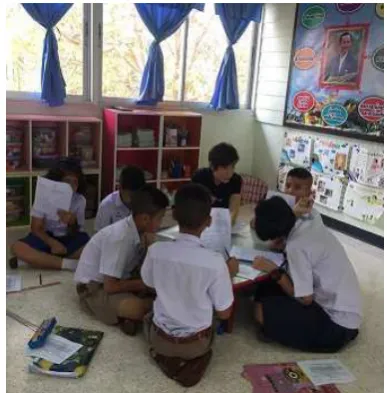
to 35 students with the exception of a school in Phitsanulok which had a larger sized class of 50 students. The students had comparable background knowledge as many of them came from the countryside where they had limited or no access to certain English learning resources, such as English teachers, opportunity to learn with native speakers, and technology aids for language learning. In addition, financial support from their parents for education was limited since most of them had a low income. The implementation of the project was managed in classrooms equipped with computers and multimedia tools. The integrated lessons were scheduled to be conducted during the afternoon session when students were assigned to do extra-curricular activities in accordance with the new policy from the Ministry of Education. In order to facilitate the understanding of the participants and the school setting, Table 1 depicts the information of the students from each school and their English school teachers who observed the project regularly. Figure 1 shows an example of the classroom setting.
Instruments
Eight local community-based lessons
In order to construct a set of local community-based English learning materials, the Internet search was conducted for a list of prominent tourist attractions from 17 provinces in the northern region of Thailand, resulting in a list of 32 sites. Thereafter, a questionnaire which consisted of the 32 randomised places was created, consisting of three parts. The first part was personal information, such as province currently living in and occupation. The next part was the focal point of the questionnaire which was the list of 32 local sites. The respondents were asked to select eight sites that they thought young students from the northern region of Thailand should be knowledgeable of or familiar with. Lastly, an opened-ended section for comments was provided for suggestions on any additional sites.
eight sites with the highest popularity and frequency rates were Phra That Doi Suthep Temple, Chiang Mai Province (955); Rong Khun Temple, Chiang Rai Province (944); Sukhothai Historical Park, Sukhothai Province (879); Thai Elephant Conservation Center, Lampang Province (774); Bhumibol Dam, Tak (691); Phra Si Rattana Mahathat, Phitsanulok Province (688); Borapet
Lake, Nakhon Sawan Province (650); and Khao Kho, Phetchabun Province (592). The eight most popular sites became the topics for the instructional materials or lessons, and these sites were verified by elementary teachers and social science teachers for their appropriateness in terms of how well they represented the northern region.
Table 1. Number of students and English teachers
School
Number of students Total number of students
Number of English Teachers Male Female
School 1 (Phitsanulok ) 23 27 50 2
School 2 (Sukhothai) 19 14 33 1
School 3 (Uttaradit) 11 13 24 1
School 4 (Phrae) 16 16 32 1
Total 69 70 139 5
Figure 1. Classroom setting and students of School 2
Once the eight topics were endorsed, content information was initially obtained from various sources in Thai; those were Internet, books, and tourism pamphlets. The contents were then translated into English with certain linguistic modifications made in a suitable manner to
accommodate Grade 4 students’ English proficiency
level. In addition, names of places were accompanied by their equivalent Thai translations in parentheses. The eight lessons were also verified by English school teachers as to whether the language used in
the lessons was suitable for the students’ English
proficiency level. Finally, a set of integrated instructions consisting of eight lessons were checked for language accuracy by a native speaker of English.
In order to have students engage in classroom practice and appreciate local culture, the researchers created supplementary multimedia including slides and video clips corresponding to the lessons. It is commonly acknowledged that young learners are likely to benefit from multimedia instructional
settings with pictorial form as multimedia stimulates interaction and collaboration in the classroom (Mayer, 2001; David & Dan, 2002).
of the most recognisable tourist attractions in northern of Thailand.
Apart from the lessons, accompanying multimedia materials were created to provide scaffolding for young students during the learning tasks. PowerPoint slides decorated with animations were produced for students to enjoy, and the slides were distributed as black and white handouts to the students in the classroom. In addition, video clips
corresponding to the lessons recorded at the actual sites were used to make the lesson more interesting and to acculturate students to local Thainess. The video clips were presented in the Thai language for young students to understand clearly.
In conclusion, this section demonstrates the
integration of the community’s involvement to formulate the local community-based lessons and to ensure an alignment with their actual needs.
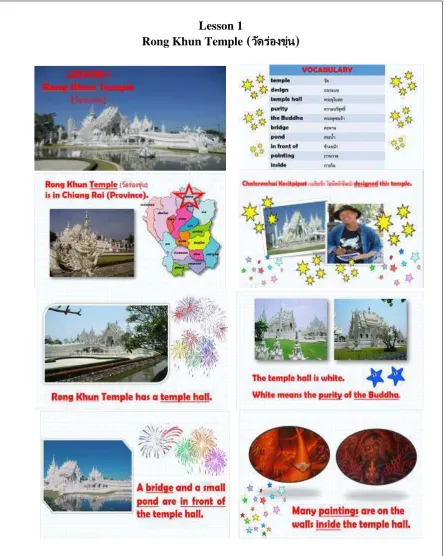
Figure 2. Lesson on Rong Khun Temple
Lesson 1
Rong Khun Temple
(
วัดร่องขุ่น
)
Attitude questionnaire and interview
The questionnaire and interview questions were the instruments used to investigate the attitudes of the young Thai school students and the English school teachers towards the local community-based integrated lessons and instruction. For students, a questionnaire was designed to elicit their attitudes towards the activities, instruction, and materials of the project. The questionnaire was carefully validated by three experts in university-level English teaching to make sure of content and linguistic accuracy. The Item Objective Congruence (IOC) indexes were calculated, yielding a grand mean score of 0.88. This indicates that overall, the experts were satisfied with the questionnaire. Based on feedbacks obtained (such as wording, question repetition, re-ordering statement, etc.), some modifications were made, and the questionnaire was finalised (as shown in Table 2.) The students were asked to give their opinions on nine statements in the questionnaire based on a five-point Likert scale consisting of Strongly Agree (5), Agree (4), Neutral (3), Disagree (2), and Strongly Disagree (1). The questionnaires were distributed to the students during the last week of the instructional period.
The qualitative section consisted of feedback through a semi-structured interview from the school teachers who regularly observed the classroom practices. It consisted of five questions that would conducted by the researchers in the last week of the
project’s implementation. To ensure validity, the index of Item Objective Congruence (IOC) of interview questions was verified by three experts who were university-level English lecturers. A score of 0.86 was found.
Procedures
Classroom implementation
In accordance with the new educational policy
‘Teach less, learn more’ set by the Thai Ministry of
Education, the study load of core courses for elementary and secondary students must finish by 2 p.m., and the afternoon session must focus more on extra-curricular activities that were divided into three categories: encouraging learning capability, cultivating attributes and good values, and enhancing working and living skills (Mala, 2015). Thus, this project was in alignment with the policy
by tutoring students’ English language and thereby
encouraging learning capability, whilst simultaneously acculturating students to local culture.
The classes were conducted over a period of eleven weeks, whereby meetings lasted for two
consecutive hours per week with a 15-minute break in the middle (as mentioned previously, one week of introduction, eight weeks of instruction, and two weeks for mid-way and final assessments). All activities of the lessons took place in a classroom that had a computer and a projector, so that multimedia could be utilised properly. University students with a major or minor in English assisted as
‘student helpers’ in order to ensure not only the
seamless implementation of the integrated instruction, but also it provided the university students with an opportunity to use existing knowledge learned at university for the benefit of the community. Their availability on the instruction day was the only requirement for their participation as assistants in this study. In particular, their assistance aimed at the fulfilling several purposes. Firstly, the differing English proficiency levels among the elementary students were reported by a school teacher. As a result, the close attention of the student helpers was indispensable to ensure that no school students became confused due to some of them being slower learners than their classmates. Secondly, some of the support provided by these assistants to the researcher was as follows: marking dictation tests, keeping score records, and monitoring the pronunciation of each student.
the English words and sentences through various classroom activities such as language games, watching VDOs, discussion, and role-plays. During the mid-way and final weeks, students were assigned to do a tour-guide task, which was an individual role-play activity, for the examination of
their ability to integrate their individual English skills and regional knowledge. The task allowed them to take the role of a young tour guide presenting their local community sites. Figures 3 and 4 illustrate the classroom setting and the supervision of the student helpers, respectively.
Figure 3. Class in action Figure 4. University student helper
RESULTS
This section presents the analysis of the data collected from the teachers and students regarding their attitudes toward the set of the northern Thainess-based materials and instruction.
In order to investigate young Thai EFL
students’ attitudes towards the local community-based integrated lessons, the questionnaires distributed to them on the last day of the project’s implementation, asking them to rate their opinions relative to the nine statements pertaining to the effectiveness of the integrated lessons, in terms of improving English comprehension, enhancing English learning motivation and confidence, and cultivating regional Thainess. The questionnaire data were analysed by means of descriptive statistics, including means and standard deviations. The interpretation of a five-degree Likert scale for the results obtained from the questionnaire were 1.00-1.80, 1.81-2.60, 2.61-3.40, 3.41-4.20, and 4.21-5.00, which were interpreted as strongly disagree, disagree, neutral, agree, and strongly agree, respectively.
According Table 2, the overall mean score shows that the students had a highly positive view
towards the integrated instruction (X̅ = 4.04, SD = 1.01). For example, they highly rated items such as “the instructional materials and the accompanying multimedia increased the English learning motivation” (X̅ = 4.44, SD = 0.83), “the students know the tourist attractions in the northern region of Thailand through the instructional materials” (X̅= 4.24, SD = 0.92), and “the students benefit from the
instructional materials, and wish to learn from them again in the future” (X̅ = 4.11, SD = 0.95). One possible explanation behind these findings is that the local community-based integrated lessons allowed students to learn English within familiar contexts and to use their existing background knowledge as a resource for English language acquisition.
As mentioned earlier, the semi-structured
interview in this study aimed to elicit teachers’
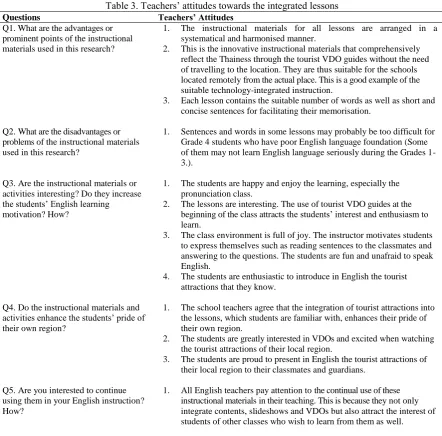
attitudes towards localised materials within the context of the northern region of Thailand and to evaluate the effectiveness of the lessons. The data were transcribed and coded in order to develop common points regarding the teachers’ opinions on the local community-based integrated lessons. The interviews were translated into English and are summarised in Table 3.
Students and teachers were satisfied with the integrated instruction. Results from the questionnaire indicate that students agreed that they gained a more substantial knowledge of the English language and of the cultural aspects, and they wished to learn with this kind of instruction again in the future. Similarly, the teachers were also interested in incorporating the integrated lessons into their regular English class in the future for the promotion of a better English learning environment and for an increase of pride in their local culture. In conclusion, the success of the local community-based integrated lessons was found after their
implementation over eleven weeks, while learners’
Table 2. Students' attitudes towards the instruction
Statement Mean Std. Level of
Agreement
1. The instructional materials (content, vocabulary, and sentences) and activities are suitable for learners' level.
3.85 1.08 Agree
2. The instructional materials enhance the students’ confidence in English usage.
4.05 0.91 Agree
3. The instructional materials and the accompanying multimedia increase the English learning motivation
4.44 0.83 Strongly Agree 4. The students become more knowledgeable of English words and
sentences related to the tourist attractions in the northern region of Thailand.
3.44 1.22 Agree
5. The students are able to introduce in English the tourist attractions in the northern region of Thailand.
4.07 0.95 Agree
6. The students have better knowledge of tourist attractions in the northern region of Thailand through the instructional materials.
4.24 0.92 Strongly Agree 7. The instructional materials reflect the Thainess and uphold Thai
regionality.
4.04 1.00 Agree
8. The students are proud of their own region. 4.10 0.98 Agree 9. The students benefit from the instructional materials, and wish to learn
from them again in the future.
4.11 0.95 Agree
Average 4.04 1.01 Agree
Table 3. Teachers’ attitudes towards the integrated lessons
Questions Teachers’ Attitudes
Q1. What are the advantages or prominent points of the instructional materials used in this research?
1. The instructional materials for all lessons are arranged in a systematical and harmonised manner.
2. This is the innovative instructional materials that comprehensively reflect the Thainess through the tourist VDO guides without the need of travelling to the location. They are thus suitable for the schools located remotely from the actual place. This is a good example of the suitable technology-integrated instruction.
3. Each lesson contains the suitable number of words as well as short and concise sentences for facilitating their memorisation.
Q2. What are the disadvantages or problems of the instructional materials used in this research?
1. Sentences and words in some lessons may probably be too difficult for Grade 4 students who have poor English language foundation (Some of them may not learn English language seriously during the Grades 1-3.).
Q3. Are the instructional materials or activities interesting? Do they increase
the students’ English learning
motivation? How?
1. The students are happy and enjoy the learning, especially the pronunciation class.
2. The lessons are interesting. The use of tourist VDO guides at the beginning of the class attracts the students’ interest and enthusiasm to learn.
3. The class environment is full of joy. The instructor motivates students to express themselves such as reading sentences to the classmates and answering to the questions. The students are fun and unafraid to speak English.
4. The students are enthusiastic to introduce in English the tourist attractions that they know.
Q4. Do the instructional materials and
activities enhance the students’ pride of
their own region?
1. The school teachers agree that the integration of tourist attractions into the lessons, which students are familiar with, enhances their pride of their own region.
2. The students are greatly interested in VDOs and excited when watching the tourist attractions of their local region.
3. The students are proud to present in English the tourist attractions of their local region to their classmates and guardians.
Q5. Are you interested to continue using them in your English instruction? How?
DISCUSSION English language has permeated all aspects of life of those in urban communities, including business, education, entertainment and tourism. Clearly, without the international language of English, activities in these areas are difficult and almost impossible to execute. However, along with the influx of the English language and westernisation is the concern and worry that the increasing hegemony of the English language may not exert only positive impacts (Turnbull, 2017). A number of scholars pertaining to Asian countries are concerned that national identity is vulnerable (Fujimoto-Adamson, 2006; Simpson & Thammasthien, 2007), for example, Thailand is one Asian country that has long standing historical and cultural traditions, and according to these scholars, the pressures of globalisation and westernisation are so intense that national Thai culture, if not properly maintained and revitalised, will be threatened and subjugated. In short, Thai identity is being challenged by English hegemony.
Meanwhile, English language education has been identified as an effective tool for national development. Thai citizens’ English skills needs to be ameliorated if they are to be able to compete with those in regional and international contexts. According to the most recent international assessment of English conducted by English First or EF, Thai learners’ English proficiency has been categorised as low (Kanoksilapatham, in press). A variety of hindering factors are perceived to be responsible for this unsatisfactory outcome, however, in relevance to this paper, a scrutiny of English commercial textbooks is revealing. For basic elementary education in Thailand, commercial English textbooks are prescribed by the Ministry of Education. As known, these commercial English textbooks are written for international use, and thus the contents of these textbooks are prevalently based on the cultures of English speaking countries, thereby not accommodating individual learners’ national cultural needs. Therefore, the positive effects of the northern community based lessons and instruction demonstrated by this study highlight the benefits of the integration of national cultural features into English pedagogical practices, particularly in elementary English education. In this research, elementary school teachers and students were strongly motivated when exposed to the constructed set of the lessons and instruction. Pedagogically, it is believed that motivation provides a crucial driving force for academic accomplishment. If this proposition holds true, it is
expected that the students are likely to be more successful in English learning.
At this juncture, the findings of this study represent how the role of national culture can be successfully extended and integrated in the realm of English language teaching and learning. In retrospect, the concern that national culture is being challenged by English hegemony might be no longer valid. As shown in this study, the two forces of English hegemony and national culture are not two competing forces, but actually can be pedagogically manipulated to be mutually and reciprocally beneficial. Based on this conclusion, it is time for Thai ELT practitioners nationwide to exert their concerted efforts in producing their own English textbooks which can be based on national culture. In this scenario, English language proficiency can be developed and Thai national culture can be maintained and revitalised.
The integration of Thai culture into English lessons is pivotal for a number of reasons. For young learners who have relatively limited perspectives of the world due to their age, giving them an opportunity to express their local culture in English provides them with a number of crucial life skills. First, these young learners in the northern region of Thailand can realise that the English language is not an entity that they cannot connect with. In fact, the English language can be used as a device to express their own identity. Second, through the lessons and instruction, they are likely to develop a sense of belonging and appreciation of their own identity. Third, once their own identity has been formed and strengthened, they will be more ready to be exposed to other cultures and appreciate the existence of being knowledgeable of the multicultural nature of the world.
CONCLUSION
This study has demonstrated the impacts of the set of northern community based instructional materials constructed for young Thai learners of English. As shown, through the administration of questionnaires and semi-structured interviews, both young students and school teachers of English displayed positive attitudes toward the constructed lessons and instruction. However, a number of caveats potentially resulted in some limited generalisations from this study. First, the students were required to perform a tour guide task, where no assessment of linguistic knowledge or northern community knowledge was formally conducted. Therefore, it
remains to be elucidated whether these learners’
positive attitudes lead to or contributed to their enhanced knowledge of linguistic abilities and northern content. By extension, if such association was found, it would be interesting to observe the extent of the association. Second, the learners’ and
triggered by a novelty effect, due to the presence of the researchers with whom the students were unfamiliar. It would thus be illuminating to examine whether the same set of instructional materials and instructional procedures implemented by English school teachers would yield similar results. Despite these limitations, this study provides a wake-up call for an urgent need to integrate local community features into English language instruction across the entire educational paradigm as a channel to boost Thai learners’ English proficiency and maintain Thainess. Obviously, a myriad of additional tasks and activities need to be devised to address
spectrum of learners’ needs and to satisfy the
challenges of actual communication in English in the 21st century.
ACKNOWLEDGEMENTS
The authors would like to thank for the financial support of the Thailand Research Fund (Grant No. RTA 5880007). The success of this research would not be achieved without the kind assistance and
co-operation of numerous participants in Thailand’s
northern region, namely, educational administrators, school teachers, and community members. Last but not least, the authors also wish to express the sincere and heartfelt gratitude to Grade Level 4 students who participated in this study with the expectation to acquire language skills so that they could proudly talk about their own region in English.
REFERENCES
Arifani, Y. (2016). Optimizing EFL leaners’
sensitizing reading skill: Development of local content-based textbook. English Language Teaching. 9(5), 1-7.
Byram, M. (2008). From foreign language education to education for intercultural citizenship. Bristol: Multilingual Matters. Byram, M. (2010). Linguistic and cultural education
for Bildung and citizenship. Modern Language Journal, 94, 318-321.
Byram, M. (2014). Twenty-five years on: From cultural studies to intercultural citizenship. Language, Culture and Curriculum, 27, 209-225.
Byram, M. Golubeva, I. Han, H., & Wagner, M. (Eds.) (2017). From principle to practice in education for intercultural citizenship. Bristol: Multilingual Matters.
Canagarajah, S. (2007). Lingua franca English, multilingual communities and language acquisition. Modern Language Journal, 91(5), 923-936.
Canagarajah, S. (2013). Agency and power in intercultural communication: Negotiating
English in translocal spaces. Language and Intercultural Communication, 13, 202-224. David, E., & Dan, B. (2002). A collaborative and
interdisciplinary computer animation. The MIT Press Course Leonardo, 35(1), 83-86.
Dinh, T.N., & Sharifian, F. (2017). Vietnamese cultural conceptualisations in the locally developed English textbook: a case study of
‘Lunar New Year’/ ‘Tet.’ Asian Englishes, 19(2), 148-159.
Dorjiss. (2013, May 5). Activity based teaching method [Blog post]. Retrieved from
http://dorjigss.blogspot.com/2013/05/normal-0-false-false-false-en-us-x-none.html Fujimoto-Adamson, N. (2006). Globalisation and
history of English education in Japan. Asian EFL Journal, 8(3), 259-282.
Kaewla, W., & Bunyean, O. (2015). Skill development for using English learning of pupils in elephant community tourism place. Journal of People and Society in Local Culture, 6(1), 1-14.
Kanoksilapatham, B. (2015a). Integrated instructional innovation for elementary education. Proceedings of SOCIONT15-2nd International Conference on Education, Social Science and Humanities (pp. 343-352). Istanbul, Turkey.
Kanoksilapatham, B. (2015b). Developing young
learners’ local culture awareness and global
English: integrated instruction. International Journal of Information and Education Technology, 5(9), 676-682.
Kanoksilapatham, B. (2016). Promoting global English while forging young northeastern Thai
learners’ identity. 3L: The Southeast Asian Journal of English Language Studies, 22(3), 127-140.
Kanoksilapatham, B. (in press). A new paradigm for English language teaching in the 21st century:
Asian context. In 2016 Fifth International Symposium on Foreign Language and Literature Teaching -Feng Chia and
Southeast Asia. Feng Chia University, Taiwan.
Kusumaningputri, R., & Widodo, H. P. (2018).
Promoting Indonesian university students’ critical
intercultural awareness in tertiary EAP classrooms: the use of digital photograph-mediated intercultural tasks. System, 72, 49-64. Mahabadi, S. (2013). The role of localized materials
in learning of EFL students. Journal of Languages and Culture, 4(5), 65-74.
Mala, D. (2015, October 5). Teaching less, so pupils learn more. Bangkok Post. Retrieved from http://www.bangkokpost.com/print/717792/ Mayer, R. E. (2002). Multimedia learning. In
Psychology of learning and motivation (Vol. 41, pp. 85-139). Academic Press.
2008). Retrieved from
http://www.skn.ac.th/kan2551.htm
Moore, Z. (2006). Technology and teaching culture: What Spanish teachers do. Foreign Language Annals, 39(4), 579-594.
Nomnian, S. (2013). Thai cultural aspects in English language textbooks in a Thai secondary school. Veridian E-Journal, 6, 13-30.
Nooreen N., & Arshad, A. A. (2010). Examining the importance of EST and ESL textbooks and materials: objectives, content and form. [Online] Available:
http://www.esp-world.info/Articles_9/textbooks.htm (January 23, 2011)
Peck, D. (1998). Teaching culture: Beyond language. Yale: New Haven Teachers Institute.
Ratanaphruks, K. (2012). Heritage accommodation in Bangkok: Development and important of culture. Veridian E-Journal Silpakorn Univerisity, 5(2), 1-18.
Sherlock, Z. (2016). Japan’s textbook inequality:
How cultural bias affects foreign language acquisition. Power and Education, 8(1), 73-87. Simpson, A., & Thammasathien, N. (2007).
Thailand and Laos. In A. Simpson (Ed.), Language and National Identity in Asia (pp. 391-414). Oxford: Oxford University Press. Snodin, N. S. (2016) Rethinking culture teaching in
English language programmes in Thailand. RELC Journal, 47(3), 387-398.
Tang, R. (1999). The place of ‘culture’ in the
foreign language classroom: A reflection. The Internet TESOL Journal, 5(8). Retrieved from http://iteslj.org/Articles/Tang-Culture.html Turnbull, B. (2017). Learner perspectives on
national identity and EFL education in Japan: Report of a questionnaire study. The Journal of Asia TEFL, 14(2), 211-227.