1
2016 Third-Party Logistics Study
The State of Logistics Outsourcing
6
10
16
26
36
42
48
52
54
56
Executive Summary
Current State of the 3PL Market
Aligning 3PL Relationships
3PL Competitive Landscape
Workforce Innovation and Agility
Strategic Assessment
About the Study
About the Sponsors
Credits
Contacts
©2015 C. John Langley, Jr., Ph.D., and Capgemini. All Rights Reserved. No part of this
document may be reproduced, displayed, modified or distributed by any process or
means without prior written permission from Capgemini. Rightshore® is a trademark
3
Executive Summary
1996
Study launched with an eight-page report, which highlights that the most frequently outsourced service was
freight transportation
and that U.S. logistics costs were reportedly$773 billion
in the previous year.The use of third-party services continued to increase with the most frequently outsourced activity being
freight bill auditing
andpayment.
The study documented how
information
technology
had become increasingly viewed as a key to the success of third-party operations with increased roles for information technology executives in the implementation stage of the third-party relationship.2005
2007
2006
2008
2014
2015
The survey celebrated its
10-year
anniversary
and the study continued to expand its global reach, adding respondents fromSouth Africa.
Researchers expanded their scope and addedworkshops in
Chicago, Illinois; Paris,
France; and Shanghai, China.
Forthe first time, the study looked at the use of 3PL services in emerging markets, particularly China. Top five countries where 3PLs were
expanding activities included
China, India, Russia,
Brazil and Poland.
Having a green supply chain takes on more importance with
98%
of respondents saying thatgreen supply chain initiatives
are somewhat or very important to their companies’ futures.
The report began surveying 3PLs in addition to shippers. The economic downturn challenged shippers to contend with
unpredictable
demand
, excess inventory, and volatility in fuel costsand currency valuation.
Shippers report using the downturn to assess their supply chains’ strengths and weaknesses and make changes designed to increase agility, be more responsive and reduce costs.
Shippers and 3PLs identified the increased volume of cross-border trade with international companies that are increasingly investing in Africa. Opportunities in omni-channel increased, with customers demanding a
seamless experience
across retail sales channels. 97% of shippers and 93% of 3PLs agreed that improved, data-driven decision making is essential to the future success of their supply chain activities and processes.Omni-channel
continued to grow in importance, but33%
of respondents said they have no capability to handle omni-channel retailing.
Supply chain talent
remained a concern, with44%
of respondents saying they experienced difficulty in finding or attracting talent.A number of companies turned to
Mexico
as a near-shore manufacturing destination. Innovative mobile and cloud technologies helped to align 3PL-customer relationships.1997
1998
2009
10
Years
20
Years
5
The market for
3PL services
grew by18%-22%
annually with the percentage of companies usingwarehousing
services
growing to63%
from56%
in the previous year.2001
2002
2003
2004
2013
2012
2011
2010
Shippers
began to meaningfully involve3PLs
as key elements in their ability to meet the needs of their own customers with businesses becoming global.Study began asking shippers which 3PL characteristics stand out
multiple
activities, integration of
activities
andprovides solutions
to logistics/supply chain
problems
top the list.Study expanded to include respondents from Western Europe in addition to North America with 3PL users reporting reductions in their
cash-to-cash
cycles, suggesting 3PL involvement may lead to reductions in this supply chain metric. Study added respondents from Asia-Pacific.
Security began to take on greater importance with nearly half of respondents citing
security
as “very important.” Study added respondents from Latin
America. U.S. logistics costs were reportedly
U.S. $1,015 billion.
3PL global revenues reached
$542 billion.
(As reported in the 2013 study). Nearly half of shipper respondents reportconsolidating the number of 3PLs they use.
3PL global revenues reached
$616 billion
.
(as reported in the 2013 study).Economic losses from supply chain disruptions increased 465% between 2009 and 2011.
Electronics products increased in popularity, increasing demands for a fast and nimble supply chain. 80% of shippers and 77% of 3PLs reported doing business with or within an
emerging country.
Analysts declared 2013 to be the start of theBig
Data era in supply chain.
Near-shoring—shippers’ moves toward rebalancing supply chains—suggest that global economic conditions change preferred sourcing locations. The study found 3PLs offer more services than most shippers use.1999
2000
Current State of the 3PL Market
The 2016 20th Annual Third Party Logistics Study shows continued collaborative and positive relationships between shippers and third-party logistics providers, which have been developing since the study began 20 years ago. This year’s survey suggests 3PLs and their customers are becoming more proicient at what they do, individually as well as together, which is improving the quality of their relationships. Both parties—93% of 3PL users and 94% of 3PL providers—reported that their relationships are successful and that their work is yielding positive results.
The 2016 3PL Study showed that 70% of those who use logistics services (shippers) and 85% of 3PL providers said the use of 3PL services has contributed to overall logistics cost reductions, and 83% of shippers and 94% of 3PL providers said the use of 3PLs has contributed to improved customer service. Moreover, the majority of both groups—75% of shippers and 88% of 3PL providers—said 3PLs offer new and innovative ways to improve logistics effectiveness.
Gainsharing and collaboration remain important to many relationships, and 46% of shippers and 81% of 3PL providers agree that collaborating with other companies, even competitors, to achieve logistics cost and service improvements holds value.
As seen in recent years, the most frequently outsourced activities continue to be those that are more transactional, operational and repetitive. Activities that are strategic, IT-intensive and customer-facing tend to be outsourced to a lesser extent.
Although relationships between shippers and 3PLs are successful overall, there are some areas in which they could improve. Many shippers are still working to shift management structures to better relect the role supply chains play in the business.
Shippers continue to rely heavily on the IT services 3PLs provide, and the ability to manage the provision of IT-based services is a necessary core competency of 3PL providers. While the IT Gap—the difference between what shippers feel is important and their ratings of their 3PLs’ current IT capabilities—has stabilized, further opportunities for improvement remain.
Aligning 3PL Relationships
Relationships are central to the success of 3PLs and their customers, and 3PLs may be thought of as having two critical responsibilities— managing customer relationships that focus on the availability of capable supply chain services and providing or managing the provision of these services. For 3PLs, this means they are not only managing relationships with their direct customers but also with those organizations that have the assets to provide the needed services.
Of relevance to how these relationships are structured and how they progress is whether the shippers view themselves as strategic or tactical buyers of logistics services, or some combination of both. Tactical buyers have developed solutions but utilize 3PLs’
operational services and fulillment. This year’s survey shows 43% consider their organization to be a strategic buyer, 37% to be a tactical buyer and 20% to be a combination of these.
For partnerships between 3PLs and shippers to be successful, both parties are expected to invest in the relationships. Information, services and inancial resources central to these relationships must low back and forth between the two parties. When asked whether they had a formal plan for managing relationships with their 3PLs, 74% of shippers indicated they have a formal plan, but 26% said they did not. Among this year’s respondents, 87% of shippers and 96% of 3PLs have agreed-upon performance expectations, and 80% of shippers and 81% of 3PLs have formal performance reviews, including the measurement of and feedback on results.
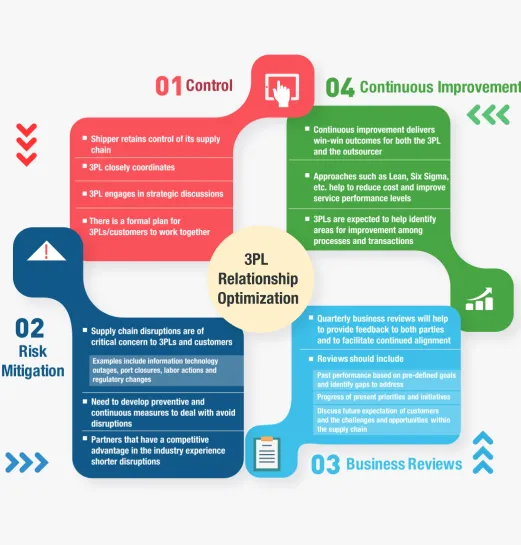
Participants at this year’s workshops identiied key elements for the successful onboarding of new relationships, including mapping out a clear process, creating a formal plan for managing relationships, drafting mutual agreements, and understanding the roles and relationships with asset-based service providers. They also identiied key strategies that can optimize the 3PL relationship, including control, risk mitigation, regular business reviews and a continuous improvement process.
7
and 3PLs are aligned is the frequency of interaction between these two parties—73% of shippers interact with their 3PLs on a daily or hourly basis, while 80% of the 3PLs responded similarly.
As we look to the future, we should also be thinking about the impacts on 3PL-shipper relationships that may result from disruptive innovations, such as drone deliveries, driverless vehicles and next generation cloud-based collaboration solutions. Also, as we review the evolution of technologies, it is apparent that we are seeing a movement from CRM systems, many of which are of limited focus, to multi-enterprise collaboration systems that have much more pervasive capabilities.
3PL Competitive Landscape
Competition within the logistics industry is ramping up due to tightened capacity along with increased consolidation within the supply chain arena that has resulted in fewer partners for 3PLs and increased prices.
The changing landscape is altering how 3PLs and shippers work together. The majority of respondents—44%—have enhanced relationships to guarantee shipping lanes and on-time shipments, 40% have increased rates, and 29% said assets have not been available to move shipments when needed. Similarly, 29% have engaged with a larger number of 3PLs to get access to gain capacity.
3PLs are working to differentiate themselves by providing sustained value, innovative solutions and information to facilitate data-driven decisions. Information sharing between 3PLs and shippers is increasing, and shippers are more willing to make adjustments to improve carriers’ eficiency and possibly obtain a better rate.
Logistics providers are driving innovation in a number of areas, particularly within the last mile. A successful last-mile fulillment process utilizes route optimization, incentivized scheduling, and real-time electronic tracking
and communication. Globally, companies are turning to crowd-sourcing solutions, on-demand deliveries and value-added delivery services.
Technology is improving operations within the supply chain—60% of respondents are using technology to increase visibility within orders, shipments and inventory; 40% are using it for planning within transportation management and 48% are using it for scheduling within transportation management. 3PLs are also utilizing technology to choose the most proitable and eficient shipping lanes and modes.
To meet increasing customer requirements, 58% of respondents said they are investing in new capabilities for themselves, 40% said they are leveraging new capabilities from other companies in different industries, and 15% said they are leveraging new capabilities from competitors.
Workforce Innovation and Agility
The logistics industry is facing an unprecedented labor shortage, which will bring both challenges and opportunities. To meet demand, 3PLs will need to leverage their employees in a new way, providing added value to shippers and giving them a competitive
advantage. More than half of shippers—52%— feel they can rely on their 3PLs to address the labor shortage’s affect on their business.
With 79% of 3PLs reporting that they feel unprepared for the labor shortage’s impact on their supply chain, providers will need to re-think their strategy for attracting and retaining employees. Innovative and dynamic employee development and hiring strategies will play a critical role in most organizations’ response to the anticipated labor shortage. Built-in succession programs and training programs will help employers develop their existing talent pool and cross training will take on greater importance.
While the labor shortage spans the whole supply chain, shortages among warehouse workers and truck drivers are expected to be the worst. To help bridge the gap, the industry is already recruiting within several existing, under-represented labor pools, including women and military veterans.
Automation, both within the warehouse and on the road, could help lessen the impact of a workforce shortage, and the industry has looked at a number of technologies, including driverless trucks, drones and crowd-sourced package deliveries, as options.
Industry Representation
Manufacturing
Health Care &
Pharmaceuticals
Telecommunications,
Internet & Electronics
Automotive
Food & Beverage
Retail & Consumer
Products
Utilities, Energy
& Extraction
Business Support
& Logistics
2%
Other
Construction &
Machinery
Domestic transportation
Warehousing
International
transportation
Freight forwarding
Customs brokerage
Reverse logistics
(defective, repair, return)
Cross-docking
Freight bill auditing
and payment
Transportation planning
and management
Inventory
management
Product labeling,
packaging,
assembly,
kitting
Order management
and fulfillment
Service parts
logistics
Fleet
management
Information
technology (IT)
services
Supply chain
consultancy
Customer
service
Logistics Services Provided by Users
48%
12%
40%
User
Non-User
3PL/4PL
7%
11%
11%
12%
12%
19%
22%
25%
28%
31%
33%
34%
45%
48%
60%
66%
80%
Respondents
18%
14%
11%
8%
8%
5%
5%
10%
18%
About the Study Respondents…
LLP / 4PL services
9
Transportation sourcing
Customer order management
Supply chain planning
CRM (Customer relationship management)
Distributed order management
Advanced analytics and data mining tools
Cloud-based systems
Yard management
RFID
Transportation management (Planning)
Visibility
Transportation management (Scheduling)
Network modeling and optimization
Bar coding
Global trade management tools
Electronic data interchange (EDI)
Web portals for booking, order tracking, inventory
management and billing
3PL Users Say…
Tools a 3PL Needs to be Sucessful
Study Findings at a Glance…
2016 Third-Party Logistics Study
29%
27%
24%
22%
21%
17%
16%
64%
60%
60%
60%
54%
48%
42%
41%
39%
36%
35%
73%
Overall, we are increasing our use of outsourced
logistics services.
Warehouse / DC management
75%
3PLs provide new and innovative ways to improvelogistics effectiveness.
83%
Our use of 3PLs has contributed to improving service to our customers.
93%
Relationships we have with 3PLs generally have been successful.
70%
Our use of 3PLs has contributed to reducing our overall
Current State of the 3PL Market
11
Among the evolving areas where both 3PLs and shippers need to be core competent is change management. Currently, the global and domestic markets for outsourced logistics services are continuously changing, so it is essential that both users and providers of 3PL services arm themselves with the very best in terms of people, processes and technology.
In addition to diligence relating to costs, investments and service levels, everyone involved in either the supply or demand side of the 3PL business is focused on major concerns such as supply chain security, regulatory requirements, compliance and sustainability. They are also dealing with prevailing shortages of asset-based services that are needed to be an effective player in the industry.
On the global front, there continues to be great concern for the economies of certain countries and regions of the world and interest in comparative wage levels and the continuing evolution of emerging markets. There also is continued interest in global freight balances and imbalances due to trading patterns and available capacity, particularly of ocean and international air service as they may be needed.
Due to a number of factors, it is not dificult to identify volatility in certain economies, and users of 3PL services generally will need to deal with higher prices for the services they need. So, the imperative for 3PLs and shippers to be at the “top of their game” should be obvious.
Findings from this year’s 20th Annual Third-Party Logistics Study reinforce the suggestion that both 3PLs and shippers are becoming more proicient at what they do to enhance the quality of 3PL relationships. Most 3PLs are achieving a better focus on what they do best, and on what core competencies they can provide to enhance the functioning of customers’ supply chains.
Conversely, customers generally exhibit a greater understanding of their organizations’ core businesses, and how improved supply chain capabilities can help to achieve overall organizational objectives. This includes the ability to determine when and for what reasons the use of outsourced logistics services may be desirable, and how best to work with commercial providers to create the best results for their organizations and their supply chains. These observations are supported by the fact that the 2016 study conirms that high percentages of 3PLs and shippers view their relationships as successful.
The results and indings of the 2016 20th Annual Third Party Logistics Study provide current perspectives on the nature of these relationships, why they are generally successful and some of the ways in which they could be improved. Aside from these generally complementary perspectives, discussions at some of the global workshops conducted this year suggested that management structures in some shipper organizations have not yet been transformed to relect how core the supply chain is to the business.
There is a clear path forward that will include the replacement of legacy systems and processes with greater use of leading-edge approaches. This is already evident in the adoption of transformative supply chain software, greater use of mobile technologies in key supply chain processes at both shipper and 3PL organizations, and greater movement toward the use of “cloud-based” systems to facilitate management of supply chain processes and activities.
This year’s Third-Party Logistics Study will provide useful perspectives and insights relating to the 3PL sector and how 3PLs and customers may position themselves to be as successful as possible in the future. For further insight into the details of the study and the key elements of the research process, please see the section titled “About the Study.”
3PL Usage Reflects Global Economic
Trends
Global markets and global trade needs continue to evolve, and this translates directly into demand for logistics and supply chain services.
Figure 1 provides global 3PL revenues by region for 2013 to 2014 from Armstrong & Associates, a summary of percentage changes in these revenues reported for 2013 to 2014 (along with the two previous years) and compounded annual growth rates (CAGR) by region for 2006 to 2014. While the CAGR igures for Asia-Paciic and South America are around or near 10%, results for North America are 4.3% and those for Europe are slightly in the positive. Looking at the percentage changes in global 3PL revenues by region from 2013 to 2014, and particularly in comparison with the percentage changes reported in the two previous years, positive growth rates were evident in North America, Europe and Asia-Paciic, whereas a decline of 6.7% was reported for South America. With the exception of the most recent results in South America, the growth rates in the other regions are consistent with modest improvement in other global economies.
3PL User Spending Patterns on
Logistics and 3PL Services
According to this year’s study results, 3PL users report an average of 50% of their total logistics expenditures are related to outsourcing. This compares with an average of 36% reported last year and 44% reported in the previous year. Total
logistics expenditures include transportation, distribution, warehousing and value-added services. Considering Armstrong & Associates’ estimated and projected global 3PL revenues cited in Figure 1, these percentages reinforce the notion that the modestly improving global economic conditions have had a positive impact on aggregate shipper spending on 3PL services as a percentage of total logistics expenditures.
Increased Use of Outsourcing
Continues to Outpace Moves to
Insourcing
Two consistent observations throughout the 20 years of Annual Third-Party Logistics Studies are that some portion of shippers will report having increased their use of outsourced logistics services while others will indicate a return to insourcing some or all of these same services. Movements to either increased or decreased use of outsourcing may be measured in terms of funds expended on outsourced logistics services or the percent of overall logistics spend represented by outsourcing or number of activities outsourced.
Outsourcing: 73% of shippers indicate they
are increasing their use of outsourced logistics services this year, which compares to a igure of 68% reported last year. In comparison, 85% of 3PL providers agreed their customers evidenced an increase this year in their use of outsourced logistics services. These igures are consistent with the generally positive growth rates for 3PL services in the global logistics marketplace, as discussed above.
Insourcing: Although only 35% of shippers
indicate they are returning to insourcing many of their logistics activities, this igure is higher than the 26% reported last year. Also, the same number, 35%, of 3PL providers agree that some of their customers are returning to insourcing.
Reducing or Consolidating 3PLs: The ongoing trend toward strategic sourcing by many shippers is evident in the number who report reducing or consolidating the number of 3PLs they use, an average of 57%. This igure is slightly higher than the previous year’s reported 53% and provides continuing evidence that more than half of shippers place a priority on tightening up their rosters of 3PLs.
One observation that we identiied in recent years is that the percentage of 3PL users (shippers) reporting increased use of outsourced logistics services has outstripped the percentage of 3PL users indicating they have returned to insourcing many of their logistics activities by 3:1. This year, the ratio is closer to 2:1 (73% divided by 35%).
Figure 1: Global 3PL Revenues Exhibit Modest Growth for 2013 to 2014
13
Shipper Experiences with 3PLs:
Measures of Success
Among this year’s survey indings is that 93% of shippers report their relationships with 3PLs generally have been successful, and this is mirrored by a slightly higher 94% figure from 3PLs that indicate their relationships with shippers have generally been successful. Looking deeper into these igures, several survey results are insightful:
• 75% of 3PL users and 88% of 3PL providers agree that 3PLs provide new and innovative ways to improve logistics effectiveness;
• 70% of 3PL users and 85% of 3PL providers agree that the use of 3PLs has contributed to reducing overall logistics costs; and
• 83% of 3PL users and 94% of 3PL providers agree that the use of 3PLs has contributed to improving services to the (ultimate) customers.
This year the study team did not ask shipper respondents about measurable beneits they have derived from the use of 3PLs. Examples typically include impacts on average logistics costs, average inventory costs and average ixed logistics costs, as well as improvements in order ill rates and order accuracy. The decision to at
Figure 2: Shippers Continue to Outsource a Diversity of Logistics Services
least temporarily reduce the number of questions was based on shortening the survey and making it easier to complete. As the team begins the planning process for next year’s Annual Third-Party Logistics Study, researchers will review the status of these questions to determine which are the most insightful to include.
Expectations in Shipper-3PL
Relationships
In the seven years that this study has included both 3PL users (shippers) and 3PL providers in the survey process, researchers have found in most instances that 3PLs rate their own capabilities higher than do shippers, and 3PLs tend to have a lesser perception of problems in relationships, etc. Although there are likely a number of reasons for this disparity, the study is always seeking to better understand the extent to which 3PL users and providers are in agreement on matters of importance to the overall relationship.
One of the relevant concepts relating to 3PL-shipper relationships is that of alignment, in that 3PLs and customers need to be in agreement on the ways they view their goals and objectives, roles and responsibilities, and a wide range of strategic and operational matters. Among the key takeaways from this year’s three global
Outsourced Logistics Services Percentages of Users
Reverse logistics (defective, repair, return) 34%
Cross-docking 33%
Freight bill auditing and payment 31%
Transportation planning and management 28%
Outsourced Logistics Services Percentages of Users
Inventory management 25%
Product labeling, packaging, assembly, kitting 22%
Order management and fulfillment 19%
Service parts logistics 12%
Fleet management 12%
Information technology (IT) services 11%
Supply chain consultancy 11%
Customer service 7%
LLP / 4PL services 6%
Current State of the 3PL Market
workshops was reinforcement of the importance of openness, transparency and effective communication between 3PLs and shippers; and the ability of both parties to be suficiently agile and lexible to accommodate current and future business needs and challenges.
Also, the use of “gainsharing” and “collaboration” are still thought of highly by 3PLs and shippers as being useful activities in many relationships. Survey results this year suggest that 46% of 3PL users and 81% of 3PL providers agree that collaborating with other companies, even competitors, can achieve logistics cost and service improvements.
89%
IT Capabilities Necessary Element of 3PL Expertise
Shippers Satisfied with 3PL IT Capabilities
IT
“Gap”
What Shippers Outsource and What
3PLs Offer
Figure 2 shows the percentages of shippers
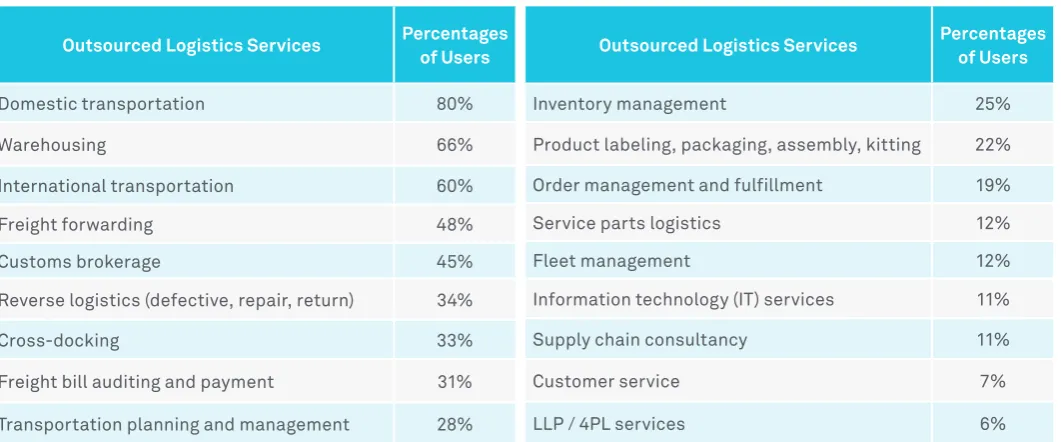
outsourcing specific logistics activities. Essentially, and with some relatively minor variations, this year’s results are numerically and directionally similar to those from recent years. Among the general observations are the following:
• Again this year, the most frequently outsourced activities are domestic transportation (80%), warehousing (66%), international transportation (60%), freight forwarding (48%) and customs brokerage (45%).
• The less frequently outsourced activities continue to be those that are more strategic, customer-facing and IT intensive. Examples include: service parts logistics (12%), leet management (12%), IT services (11%), supply chain consultancy services (11%), customer service (7%) and lead logistics partner/4PL services (6%).
Although it is not fair to draw conclusions based on one year’s supply of new survey results, we will need to look carefully at the reasons why
3PL users generally reported lesser percentages in terms of utilizing many of the logistics services and processes than they did in the previous year’s study. Among the reasons that bear some relevance are: impacts of lagging global economies; decisions made by providers of logistics services that have impacts on pricing and availability of those services; responses to shippers feeling pressure to reduce costs wherever and whenever possible; and changing purchasing patterns among users of 3PL services.
3PL’s IT Capabilities: Which Types of
IT Capabilities Are Most Necessary
for 3PLs?
Each year researchers ask shippers and providers “which information technologies, systems or tools a 3PL must have to successfully serve a customer in your industry classiication.” This question always produces interesting and insightful indings, and this year is no different. Overall, the most frequently cited technologies needed by 3PLs are those that have more execution and transactional-based capabilities. Examples include warehouse/distribution center management (WMS), transportation management planning and scheduling (TMS), visibility, EDI, and the use of web portals for
updates and relevant shipment information. Essentially, these types of technologies tend to parallel the types of logistics services that were proiled in the preceding section.
Alternatively, there are IT-based services that fewer 3PL users would suggest are “must haves” for 3PL providers. Typically, these tend to be more strategic and customer-facing. Some examples include network modeling and optimization, global trade management, transportation sourcing, customer order management, CRM and supply chain planning. Also in this category are some very contemporary services of interest to supply chain managers, such as advanced analytic and data mining tools, cloud-based systems, mobile phone apps, distributed order management and yard management.
Regardless of how many 3PL users rate these individual types of IT capabilities as ones that 3PLs must have, it is clear that they all are essential to the effective management of supply chain processes and activities. In a more general sense, it continues to be clear that the ability to provide or manage the provision of IT-based services is fast becoming a necessary core competency of 3PL providers.
15
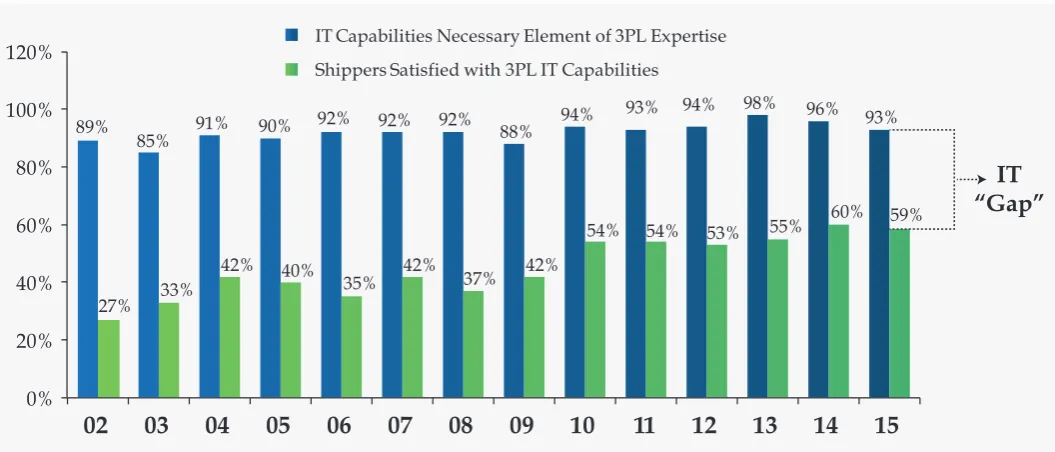
For 14 years this study has tracked measurable differences between shipper’s opinions as to whether they view information technologies as a necessary element of 3PL expertise and whether they are satisied with their 3PLs’ IT capabilities. This has been referred to as the
“IT Gap.” While Figure 3 reveals that over the
long term this gap has narrowed signiicantly, recent years’ data questions whether the IT Gap is narrowing or beginning to stabilize. As indicated, 93% of this year’s shipper respondents agreed that IT capabilities are a necessary element of 3PL expertise and 59% agreed that they were satisied with 3PL IT capabilities.
A white paper titled “Closing the 3PL Technology Gap,” which was published in the summer of 2015 by JDA Software, drew on data from annual third-party logistics studies, including this report, and asked the question, “Why aren’t 3PLs investing in information technology to close this IT Gap?”
As a result, JDA created a roadmap to guide 3PLs in their efforts to combine a vision of strategic partnerships to the realities of having the necessary capabilities in place. The steps, courtesy of JDA, are:
• First, gain as much information as possible about what systems, technologies and cloud platforms are available in the marketplace.
• Second, hold executive-level meetings with customers to learn what their strategic objectives are and not just their tactical needs. Look for synergies between their objectives and what you can potentially provide, and sound them out for their willingness to consider outsourced options to support their strategies.
• Third, do an honest assessment of internal capabilities and capacities and compare this with what is needed to support customers’ strategic objectives. This assessment should include: processes, people, expertise, equipment and technology.
• Fourth, engage outside experts and/or technology vendors to identify options, costs and timeframes for illing the gap between current capabilities and customers’ strategic visions. Include customers in these discussions to ensure proposed solutions will actually fulill customer expectations.
• Fifth, implement the new solutions as quickly as possible, considering the best inancial arrangements and deployment options, such as cloud platforms, that meet both your inancial objectives and customers’ strategic needs.
• And inally, repeat these steps on a regular basis, at least annually, to make sure your capabilities continue to support customers’ strategic objectives.
Key Takeaways
Key indings about the Current State of the Market for the 2016 20th Annual Third-Party Logistics Study include:
• Although economic conditions vary
signiicantly among countries and regions of the world, modest improvements have been experienced in many key areas. Armstrong & Associates reported aggregate global revenues for the 3PL sector grew by 9.9% from 2011 to 2012, 2.7% from 2012 to 2013 and by 6.5% from 2013 to 2014.
• Users of 3PL services report an average of 50% of their total logistics expenditures are related to outsourcing compared to an average of 36% reported last year. This increase helps to explain how improving economic conditions have impacted aggregate shipper spending on 3PL services as a percentage of total logistics expenditures.
• This year’s Annual Third-Party Logistics Study reports that 73% of the shippers surveyed are increasing their use of outsourced logistics services, while 35% report a return to insourcing many of their logistics activities. This ratio of slightly more than 2:1 (73% increased outsourcing divided by the 35%
that indicated some return to insourcing) is modestly lower than we have seen in recent years. Also, 57% of shipper respondents indicate they are reducing or consolidating the number of 3PLs they use.
• Strategic and operational alignment between 3PLs, customers and asset-based service providers is viewed as essential to success of the overall 3PL supply chain. Relationships that meet this imperative also exhibit openness, transparency and effective communications between these parties, along with agility and lexibility to accommodate current and future business needs and challenges. Gainsharing and collaboration initiatives are also consistent with the objective of creating alignment between the organizations that are involved.
• Consistent with results from recent studies, transactional, operational and repetitive activities tend to be the most frequently outsourced, while those that are strategic, IT-intensive and customer-facing tend to be outsourced to a lesser extent. The ability to provide or manage the provision of IT-based services is fast becoming a necessary core competency of 3PL providers.
• For the past 14 years, this study has been tracking the “IT Gap,” which is deined as the difference between the percentage of 3PL users indicating that IT capabilities are a necessary element of 3PL expertise (93% in the current study) and the percentage of the same users who agree that they are satisied with 3PL IT capabilities (59%). The results from this year’s study also raise a logical question as to where the IT Gap is headed in the future.
• Generally, the 3PL sector is growing on a global basis, and 3PL providers are reining and expanding their core competencies. Similarly, customers and potential customers are heightening their ability to effectively manage relationships with 3PL providers and
Aligning 3PL Relationships
17
When viewed from a high level, 3PLs may be thought of as having two critical responsibilities. The irst is to develop and manage customer relationships that focus on the availability of capable supply chain services and the second is to provide or manage the provision of these services. Considering that 3PLs commonly engage asset-based service providers to fulill customers’ needs, they need to be core competent in terms of managing relationships with these service providers.
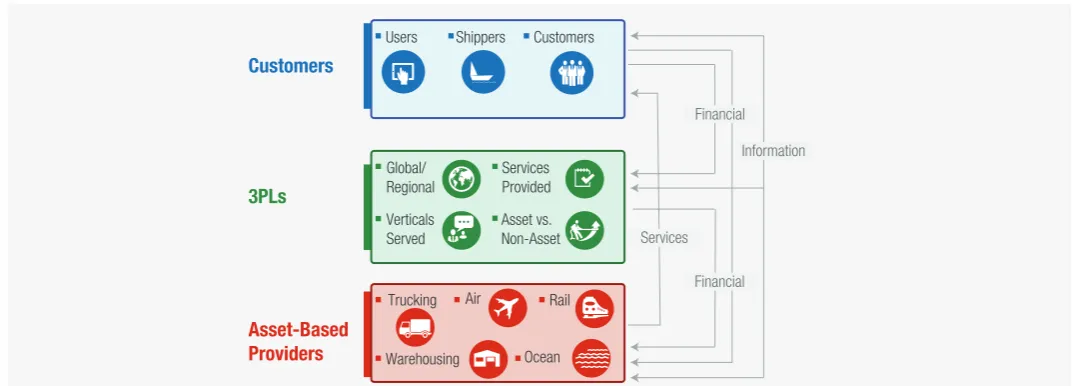
With this in mind, Figure 4 provides a visual
of the role and positioning of 3PLs with respect to their customers (shippers) and service providers, and also recognizes the lows of information, services and inancial resources that are central to these relationships. This suggests a supply chain perspective on the provision of supply chain services where the 3PL identiies the needs of the customers and then selects appropriate combinations of service providers to fulill those needs.
A primary objective of this special topic is to examine these relationships to learn about the extent to which “alignment” is apparent in the strategy and operations among 3PLs, shippers and service providers. The sections examine the types of relationships, optimizing 3PL relationships, aligning 3PLs and customers, aligning service providers with 3PLs and customers and the role of 4PLs in aligning 3PLs with needs of customers.
Users Shippers Customers
Strategic vs. Tactical/Operational
Relationships
Of initial interest to the research team was to learn from users of 3PL services whether they thought of their organization as a strategic or tactical buyer of 3PL services, or some combination of the two. Respondents were asked to consider a strategic buyer as one who expects its 3PLs to provide solutions to its logistics/supply chain problems, whereas a tactical buyer already has developed its own solutions and is asking only for operational services and fulillment from its 3PLs.
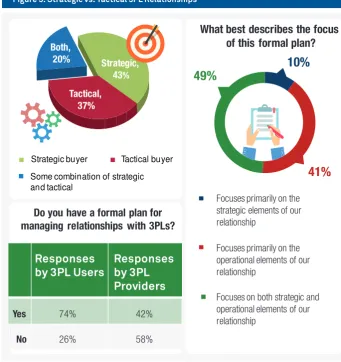
As indicated in Figure 5, 43% consider their organization to be a strategic buyer, 37% to be a tactical buyer and 20% to be a combination of both. Interestingly, when asked what percentages of their customers are in each of these categories, participating 3PLs indicated 31% are strategic, 26% are tactical and 43% are a combination of both.
When asked whether they had a formal plan for managing relationships with their 3PLs, 74% of shippers indicated they have a formal plan and 26% said they did not. Of those having a formal plan, 10% indicated the plan focused primarily on the strategic elements of the relationship, 41% on the tactical/operational elements and 49% on both. It is worth noting that whereas 43% of shippers consider themselves strategic
buyers, their management of the relationships with 3PLs generally focuses more on tactical/ operational elements rather than strategic elements.
Figure 6 provides another perspective on the types of 3PL relationships. This approach suggests three ways in which 3PLs can work with their customers: tactical partner, service partner and strategic partner.
In the role of strategic partners, customers treat 3PLs as key strategic resources, and both parties are expected to invest in the relationship and share the returns on their investments. Additionally, shippers view their 3PL providers as critical elements of their businesses and competitive positioning, and are willing to share their long-term plans with 3PLs that manage the functioning of its supply chain. It is this type of relationship where both 3PLs and customers make sure there is alignment of business and operational goals.
Strategies to Help Optimize the 3PL Relationship
Successful 3PL-customer relationships do not happen by accident. Participants at each of the workshops, held in Chicago, Rio de Janeiro and Sydney, identiied and discussed six key elements that help achieve this objective, as shown in
Figure 7.
Figure 4: 3PLs Need to be Aligned With Their Customers and Service Providers
Some combination of strategic and tactical
Strategic buyer Tactical buyer
Strategic,
What best describes the focus
of this formal plan?
Focuses primarily on the
operational elements of our
relationship
Focuses primarily on the
strategic elements of our
relationship
Focuses on both strategic and
operational elements of our
relationship
managing relationships with 3PLs?
1. Mapping Out a Clear Process. Expectations
of the relationship need to be discussed and agreed to by all parties. Both partners need to agree on what beneits or results are to be achieved and how to make decisions that are best for the relationship.
2. Meeting with Senior Management. There is a need for 3PL users to have internal alignment with senior management regarding value to be derived from the 3PL relationship. Meetings between senior management within the 3PL user and provider irms are essential to successful onboarding.
3. Creating a Formal Plan for Managing Relationships. There should be a clear understanding of what is to be expected by which party and when, along with plans and priorities for managing relationships between executive, management and operational representatives of involved parties.
4. Having the Capabilit y to Scale Operations to Demand. Shippers need to test 3PLs’ ability to scale their operations up and down based on demand. 3PLs with prior experience in scalability can produce great beneits for their clients.
5. Drafting Mutual Agreements. Non-disclosure agreements should be understood and agreed to by all parties, and dispute resolution procedures should be agreed to by all and used when necessary.
6. Understanding Roles and Relationships with Asset-Based Service Providers.
Those using non-asset owning 3PLs need to fully understand how asset-based providers will be used to execute logistics activities that are central to the use of a 3PL. Ideally, 3PLs should have a formal plan for managing their relationships with asset-based providers.
Figure 5: Strategic vs. Tactical 3PL Relationships
Tactical Partner
Tactical relationship is more focused on short-term goals and operational performance, while service and strategic partner relationships focus on long-term aspirations, improved functioning of the customers’ supply chains, and improvement of competitive positions
Highly focused on cost Equates logistics with expenses
Service in this category is viewed as a commodity Outsourcing of operations to gain better efficiency and accurate execution
Service Partner
Focused more on getting the right solutions Cost is not considered to be a deciding factor The shipper is looking for expert advice and willing to pay for the right solution
Benefits
low medium high
Strategic Partner
3PL player is treated as a key strategic resource to its customers Both parties invest in the relationship and share the returns on their investments
3PL partner is viewed a crucial part of the business and competitive position of the outsourcer Outsourcer shares its long-term plans with 3PLs that manage the functioning of its supply chain Both parties make sure that there is alignment to business and operational goals
19
Understanding Roles and Relationships
with Asset-Based Service Providers
Mapping Out a Clear Process
Meeting with Senior Management
Creating a Formal Plan for Managing Relationships
Drafting Mutual Agreements
Having the Capability to Scale Operations to Demand
1
2
3
4
6
5
Figure 7: Suggested Elements for Successful Onboarding of 3PL-Customer Relationships Another perspective on optimizing 3PL-customer
relationships and forging successful partnerships is illustrated in Figure 8, which suggests a high level of importance to four general types of capabilities.
1. Control. Over the years, research has supported the need for shippers to have control over their relationships with 3PLs and that the best relationships are guided by formal plans that are agreed to by both parties. Interestingly, some non-users of 3PL services have said they feel turning to 3PLs may result in a lack of control over their supply chain, whereas many current users suggest that a primary beneit of their decision to outsource is to gain control.
2. Risk Mitigation. This is a key area in
which customers and 3PLs need to be aligned, particularly to facilitate collective responses, when necessary, to try to mitigate or eliminate the impacts of a particular risk factor. The development of response management plans also should be a key element of a sound risk mitigation process.
3. Business Reviews. Regular business reviews that provide a checkpoint to examine whether or not the relationship is proceeding as intended should be part of a formal plan, which will provide value to both parties. Effective business reviews include feedback from customers to 3PLs, but the most useful reviews also provide feedback from 3PLs to customers.
Ways to Optimize 3PL Relationships (Emphasis on Operations)
Control
Continuous Improvement
Shipper retains control of its supply chain
Supply chain disruptions are of critical concern to 3PLs and customers
Need to develop preventive and continuous measures to deal with avoid disruptions
Partners that have a competitive advantage in the industry experience shorter disruptions
Continuous improvement delivers win-win outcomes for both the 3PL and the outsourcer
Quarterly business reviews will help to provide feedback to both parties and to facilitate continued alignment
Reviews should include
Approaches such as Lean, Six Sigma, etc. help to reduce cost and improve service performance levels
3PLs are expected to help identify areas for improvement among processes and transactions 3PL closely coordinates
3PL engages in strategic discussions
There is a formal plan for 3PLs/customers to work together
Business Reviews
Past performance based on pre-defined goals and identify gaps to addressExamples include information technology outages, port closures, labor actions and regulatory changes
Progress of present priorities and initiatives Discuss future expectation of customers and the challenges and opportunities within the supply chain
Risk
Mitigation
!
3PL
Relationship
Optimization
21
Figure 9: Facilitators of Alignment in 3PL-Customer Relationships
4. Continuous Improvement. Given the pace of change in today’s business world, nothing stands still for very long, and supply chains are no exception. This heightens the need for continuous improvement processes to be a regular part of 3PL-customer relationships.
While it is helpful to have a plan that takes into account the strategic and tactical elements of the relationship, it is also necessary that the plan be supported by systems and technologies that inluence the daily worklows of both shippers and 3PLs. Essentially, shippers and their 3PLs need to collectively determine what types of resources are needed to meet the objectives of their relationships and then to jointly agree on them.
Aligning 3PLs and Customers
Included in Figure 9 are a number of elements
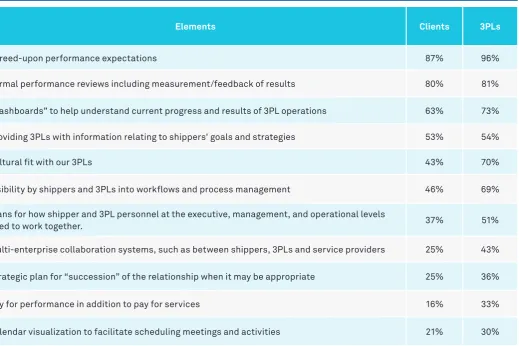
that may facilitate alignment between shippers and 3PLs. The data shows the percentages of respondents from each of these categories who indicate their relationships generally include each of these elements. Not surprisingly, the most prevalent relate to having agreed-upon performance expectations (87% of shippers and 96% of 3PLs) and formal performance reviews, including measurement/feedback of results (80% of shippers and 81% of 3PLs). Next in terms of importance is the use of performance dashboards, the exchange of information between 3PLs and shippers, cultural it, visibility into worklows and process management, and plans for how 3PL and customer organizations may work together.
Of great beneit to the accomplishment of these objectives is the use of KPIs and scorecards that are related to the shipper’s service-level agreements, and that may then be embedded in the 3PL’s CRM systems.
Of particular note are the relatively low percentages of strategic plans related to the “succession” of the relationship when it may be appropriate (25% of shippers, 36% of 3PLs), and pay for performance in addition to pay for services (16% and 33%, respectively). Aside from these survey indings, results from the workshops indicated a growing importance of multi-enterprise collaboration systems, such as those between shippers, 3PLs and service providers, and the use of calendar visualization to facilitate scheduled meetings and activities.
Elements Clients 3PLs
Agreed-upon performance expectations 87% 96%
Formal performance reviews including measurement/feedback of results 80% 81%
“Dashboards” to help understand current progress and results of 3PL operations 63% 73%
Providing 3PLs with information relating to shippers' goals and strategies 53% 54%
Cultural fit with our 3PLs 43% 70%
Visibility by shippers and 3PLs into workflows and process management 46% 69%
Plans for how shipper and 3PL personnel at the executive, management, and operational levels
need to work together. 37% 51%
Multi-enterprise collaboration systems, such as between shippers, 3PLs and service providers 25% 43%
Strategic plan for “succession” of the relationship when it may be appropriate 25% 36%
Pay for performance in addition to pay for services 16% 33%
Calendar visualization to facilitate scheduling meetings and activities 21% 30%
20%
53%
15%
7%
5%
15%
65%
16%
3%
1%
0.0%
10.0%
20.0%
30.0%
40.0%
50.0%
60.0%
70.0%
Hourly
Daily
Weekly
Monthly
Quarterly
Which of the following best describes the frequency of your organization’s interactions
(e.g., phone, email, in-person, etc.) with a typical customer?
Customers
3PLs
Figure 10: Reported Frequencies of Interactions Among 3PLs and Customers
Figure 11: Communications Between 3PLs and Shippers
Initiative
(Assessments by 3PLs and customers of helpfulness of specific initiatives) 3PL Providers 3PL Customers
Automated way for clients to log in and see requests from our 3PLs for approvals
of decisions, activities, documents, and other “to-do’s” 80% 84%
Real-time news feed (such as Twitter or Facebook) of everything that is
happening across all 3PLs used by a client 49% 57%
In communicating with our 3PLs/clients, we find that most of the time email
provides the needed types of functionality 59% 70%
Our plans for working with 3PLs/clients focus on people, processes, and
23
Another key indicator of the extent to which shippers and 3PLs are aligned is the frequency of interaction between these two parties.
Figure 10 reports the results of a question that asked about the frequency of interaction, and the results suggest that 73% of shippers interact with their 3PLs on a daily or hourly basis, while 80% of the 3PLs responded similarly. While a small percentage of shippers indicate either monthly or quarterly contact with their 3PLs, this most likely refers to reporting and feedback activities instead of continuing operational coordination.
Referring back to the section of this report titled “Current State of the 3PL Market,” it is clear that a very signiicant percentage of users of 3PL services agree that IT capabilities are
a necessary element of 3PL expertise. Since the selection of necessary IT capabilities is of critical importance to both shippers and 3PLs, the approaches and solutions need to be agreed upon by both parties. In essence, it is of great signiicance that both parties take whatever steps and diligence are needed to assure the likelihood that IT systems and capabilities will be well-aligned between the organizations involved. While internal IT departments at both shipper and 3PL organizations frequently have involvement in identifying and approving needed commitments and enhancements to information technologies, those who are leading and operating the 3PL-customer relationships should be key players in any decisions relating to needed technologies.
As the industry looks to the future, those within the supply chain should be thinking about the impacts on 3PL-customer relationships that may result from disruptive innovations, such as drone deliveries, driverless vehicles and next generation cloud-based collaboration solutions. Also, as we look at the evolution of technologies, it is apparent that we are seeing a movement from CRM systems, many of which are of limited focus, to multi-enterprise collaboration systems that have much more pervasive capabilities.
A topic of growing interest is the perceived helpfulness of a few types of communications initiatives to the objective of aligning customers
(shippers) and 3PLs, as shown in Figure 11.
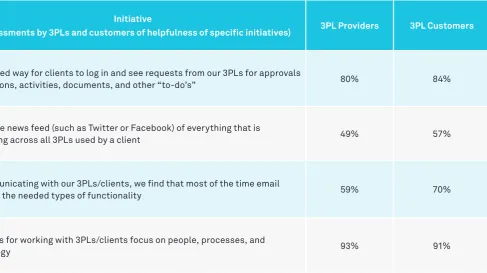
• Real-Time Customer Access to 3PL Administ rative Requests. A strong consensus of 3PLs (80%) and customers (84%) agreed that it would be helpful to have an automated way for shippers to log in and see requests from their 3PLs for approvals of decisions, activities, documents and other “to-do’s.” In effect, this would provide a means for real-time alignment between these parties, facilitating enhanced operational and strategic consistency. As CRM and worklow process technologies continue to become more prevalent, particularly with the use of mobile and tablet devices, the value of this capability will become increasingly apparent.
• Real-Time News Feeds. This provides shippers with up-to-the-minute status reports on the activities of their 3PLs, and would enable signiicant improvements for shippers in the areas of visibility and responsiveness. As indicated in the phrasing of this initiative in Figure 11, the capability would be similar to a Twitter, Facebook or Google resource that could disseminate key information on a real-time basis. With 49% of 3PLs and 57% of customers expressing agreement, these mobile technologies are becoming increasingly well suited to help facilitate implementation of this concept, and it is one that should be viewed as having high potential.
• Use of Email. When asked about the
helpfulness of email, 59% of providers and 70% of shippers felt that most of the time email provides the needed types of functionality. Subtracting these percentages from 100% suggests there should be a great interest in the use of newer technologies to facilitate communications processes between 3PLs and shippers.
• Focus on People, Process and Technology.
It is reassuring to see that 93% of 3PLs and 91% of shippers indicate their plans for working with each other focus on people, processes and technology. While this triad is sometimes viewed as over-used terminology,
it suggests that both 3PLs and shippers understand that a wide range of resource types are needed to effectively work together to align the activities and processes of 3PLs and their customers.
Additionally, a major factor in improving overall communications will be the extent to which shippers and 3PLs invest in cloud-based collaboration solutions to speed response times and increase visibility with 3PLs and the extended supply chain. Ultimately, this is likely to eliminate much of the need for the use of email as primary means of communications between 3PLs and customers.
Aligning Service Providers with 3PLs
and Customers (Shippers)
A critical issue to the success of 3PL - customer relationships is the extent to which asset-based service providers are aligned with the 3PLs and their customers. A look back at Figure 4 in this chapter provides a reminder of how essential it is that these three organizations be on the same page with respect to supply chain goals and objectives, and operational and strategic performance.
• Formal Plans. Earlier in this section we
addressed the importance of 3PLs and shippers having agreed-upon, formal plans for working with each other, and this same priority is apparent in the context of 3PLs working with their service providers. As reported in our global survey, and shown in Figure 12, 77% of the 3PLs and 91% of shippers agreed that 3PLs are expected to have formal plans to help manage relationships with their service providers.
• Selection of Providers. Survey responses indicated that 80% of 3PLs and 63% of shippers agree that 3PLs either select or help to select service providers. This suggests a degree of collaboration by both 3PLs and shippers on these important decisions, and results in both parties experiencing a sense of accountability for acceptable performance by service providers.
• Sharing and Use of Information. As discussed in the “Current State of the 3PL Market” section, the availability and use of capable information technologies is viewed as essential in most 3PL-customer relationships. Based on the content of Figure 12, 81% of 3PLs and 71% of customers agree that there is a meaningful sharing of information between customers, 3PLs and service providers.
• Operational Visibility. Interestingly, 80%
of 3PLs and 71% of shippers agree that 3PLs have visibility into the performance and daily status of the service providers. While these percentages suggest that operational visibility is present in a clear majority of 3PL-service provider relationships, of signiicant concern are those relationships where this may not be the case.
• Service Failures. This observation is similar to the previous one in that 81% of 3PLs and 79% of shippers agree that a service failure by a service provider also represents a service failure by the 3PL. If there are instances where 3PLs are not thought to bear this responsibility, this needs to become a topic of discussion.
• Need for Improvement. Aside from the
positive aspects of some of the above results, 83% of 3PLs and 80% of shippers agree that improvement is needed in how shippers, 3PLs and service providers manage relationships with one another.
25 Aligning 3PL Relationships
Role of 4PLs in Aligning 3PLs with
Needs of Customers
While the functioning of a 4PL/lead logistics provider may take on many different forms, the concept of a lead logistics provider (LLP) is one that can assist greatly with the objective of aligning 3PLs, shippers and service providers. Essentially, a LLP represents a single party in charge of a customer’s 3PL relationships that is responsible for managing the portfolio of 3PLs to help achieve the strategic goals of the customer organization.
Some of the capabilities of a 4PL/LLP organization include: integrating various operations and third-party engagements, responding to increased service demands, delivering value through new or additional service offerings, providing seamless supply chain services across disparate geographies, and addressing and responding to IT-based needs and problems that may be present in the relationships between shippers, 3PLs and service providers.
0% 20% 40% 60% 80% 100%
3PLs Shippers
In the case that your organization engages service providers to physically provide services to your customers, please indicate whether you agree or disagree with each of the following.
3PLs are expected to have formal plans to help manage relationships with their service providers
3PLs select or help to select the service providers that are used to serve our customers
There is a meaningful sharing and use of information between our organization, service providers and customers
3PLs have visibility into the performance and daily status of the service providers
A service failure by one of the service providers is considered a service failure of our 3PL organization
Improvement is needed in how customers, 3PLs and service providers manage relationships with one another
77%
80% 79% 71% 71% 63%
91%
83% 81% 80% 81% 80%
Figure 12: Relationships Between 3PLs and Asset-Based Service Providers
Alignment and Collaboration – Disruptive Trends Abound
An article in the Harvard Business Review in 1996 suggested that “balanced scorecards” could be of signiicant value in aligning individual, team and departmental goals. While this approach was met with success, today’s supply chains are exponentially more complex and alignment is even more elusive. As a result, there has been increased collaboration among supply chain participants, such as shippers, carriers and warehouse operators. To further help with these efforts, a new wave of cloud-based collaboration technologies has become available.
“Success lies in understanding and constantly improving your internal processes, especially those that impact customers,” said Elijah Ray, executive vice president of client solutions at Sunland Logistics, a South Carolina-based provider of logistics services that does close to half of its business in the retail sector. “As Dr. W. Edwards Deming explained, you can’t manage what you can’t measure.”
Ray is one to know with his accomplishments including a Six Sigma Master Black Belt and extensive ASQ Certiied Quality Manager training. “Sunland makes a point to align its processes with its customer commitments, so the customer is always irst in every worklow, scorecard and process,” Ray added.
Bill Fisher, a board member at Gap Inc., diptyque and Lanetix, said, “With the costs of deploying cloud-based collaboration solutions lower than ever, shippers can work more closely with their logistics service partners to bring their common goals, plans and teams into even greater alignment.”
Many supply chain innovators, such as Sunland Logistics, rely on cloud-based scorecards that include individual and team key performance indicators modeled after customer service-level agreements. They publish operational dashboards on devices ranging from desktops to smartphones, which map tasks to individuals based on their expertise.
Ray said, “Our own ‘internal LinkedIn’ helps us identify the best person to work with our customers. This helps to assure the most relevant expertise is called upon to resolve a particular customer issue.”
Fisher applauds the early work of supply chain innovators. “The most successful retailers and manufacturers will be those that align their supply chains—from logistics service providers to carriers—in a uniied plan, supported by agile, cloud-based collaboration apps.”
Key Takeaways
• The relationships between 3PLs, shippers and service providers may be envisioned as a supply chain for the provision of integrated supply chain services.
• Generally, 3PL-customer relationships may be termed strategic, tactical/operational or a combination of both. Most 3PL users indicate they have a formal plan for dealing with 3PLs.
• The process of initiating (or onboarding) 3PL-customer relationships includes several key steps. These include: mapping out a clear process, meeting with senior management, drafting a formal plan for managing
relationships, having the capability to scale operations to demand, reaching mutual agreements, and understanding roles and relationships with asset-based service providers.
• Although there are a number of factors that may lead to success in 3PL-shipper relationships, principal among these are: control over supply chain operations, risk mitigation, business reviews and dedication to continuous improvement.
• Regular communication between 3PLs and shippers is an attribute of successful relationships, and survey results evidence a high frequency of daily and/or hourly contact between these parties.
• There are a number of established and emerging strategies for improved communications between 3PLs and shippers. Among these are: real-time customer access to 3PL administrative responses, real-time (3PL) news feeds, use of email, and focus on people, process and technology.
• There is a growing importance of multi-enterprise collaboration systems between shippers, 3PLs and service providers.
• Both 3PLs and shippers agree that the challenges of strategic and operational alignment need to extend to the service providers.