INTERNATIONAL MONETARY FUND Safeguards Assessments—Review of Experience
Prepared by the Finance Department In consultation with the other Departments
Approved by Andrew Tweedie July 1, 2010
Contents Page
Executive Summary ...3
I. Introduction and Background ...5
II. Developments Since the Previous Review ...7
A. Activities ...7
B. Evolving Modalities ...9
C. Recent Misreporting and Emerging Governance Cases ...12
III. Taking Stock ...14
A. Safeguards Findings ...14
B. Lessons Learned ...18
C. Staff Resources ...21
IV. Looking Ahead: Options for Change ...23
A. The Scope and Focus of Safeguards Assessments ...23
B. Budget Financing ...27
C. Confidentiality of Safeguards Reports ...31
V. Issues for Board Discussion ...33
Figures: 1. Assessments Completed 2001–March 2010 ...8
2. Key Vulnerabilities Identified in Central Banks ...15
3. Safeguards Activity ...22
Boxes: 1. Description of the Safeguards Policy ... 6
2. Sharing Reports with the World Bank ...13
4. Changes to the ELRIC Framework ...25
5. Criteria for a Possible Targeted Assessment Covering the State Treasury ...30
Annexes: I. Assessments Completed by Country (Calendar Years 2001–2010)...35
II. The Safeguards Monitoring Framework...36
III. High Profile Safeguards Cases: Experience and Remedies...40
IV. Implementation of Safeguards Recommendations as at end March 2010...45
V. Staff Resources...46
EXECUTIVE SUMMARY
This review marks the 10th anniversary of the safeguards policy. Introduced in March 2000, the policy’s main objective is to mitigate potential risks of misuse of resources, including Fund resources, and misreporting of monetary program data. The policy was last reviewed in 2005, when the Executive Board re-affirmed the effectiveness of the policy, and its application to central banks. In keeping with previous reviews, a panel of experts was invited to provide advice for the Executive Board on the implementation of the policy, and recommendations to guide the focus and application of the policy going forward.
Experience over the past 10 years has shown that as the policy has matured so too have the safeguards frameworks of central banks. As of end-March 2010, 165 safeguards assessments of 75 central banks had been completed. Data from these assessments and ongoing safeguards monitoring shows a general move towards greater transparency and improved control systems by central banks. At the same time, however, experience has also shown that while safeguards assessments have helped to identify emerging governance and misreporting issues at central banks, control overrides can still occur. Strong governance and independent oversight mechanisms are necessary to ensure that controls are working properly and are not subject to abuse.
The application of the safeguards policy has also evolved. In the context of the emergency financing cases in 2008-09, safeguards procedures were adapted to ensure that potential significant safeguards risks were identified as early as possible, drawing on the staff’s monitoring framework. Also while safeguards assessments apply only to the central bank, an increase in the number of budget financing cases saw greater attention to ensure that
appropriate controls are in place for timely servicing of member obligations to the Fund. Safeguards modalities were also modified to accommodate new lending instruments, specifically the Rapid Credit Facility (RCF), and the Flexible Credit Line (FCL). The latter involves limited safeguards procedures focused on discussions with external auditors of central banks who play an important role in the safeguards policy.
Looking ahead, changes to the policy could be considered. While staff believes that the policy continues to serve the Fund well and helps to maintain the Fund’s reputation as a prudent lender, developments in governance and transparency more generally point to a number of measures that would ensure continuous improvement in the application of the policy. Input from the panel has been particularly important in framing these measures, the key ones being:
Adapting safeguards modalities in response to issues identified by stakeholders during this review, including harnessing technology to make the safeguards relationship with central banks more open and collaborative, and to improve interaction with the large external audit firms to help address audit quality issues.
Possible establishment of a mandate for safeguards assessments in the context of budget financing. Mindful of the issues and practicalities identified previously, staff has identified a possible approach to assessing fiscal safeguards risks at the level of the state treasury in part based on information from recent fiscal ROSCs. If Directors see merit in such targeted assessments of state treasuries, staff could revert with a specific proposal.
Wider dissemination of safeguards findings as a part of a phased move to enhanced transparency. Staff believes that, given the prime due diligence focus of assessments, safeguards reports should remain confidential at this time. That said, transparency would be well served through enhanced dissemination of safeguards information to the Executive Board, donors, and the public more generally.
I. INTRODUCTION AND BACKGROUND
1. This paper reports on the experience of the safeguards policy since 2005, when the policy was last reviewed. In keeping with previous reviews, a panel of experts (the panel) was invited to provide advice for the Executive Board on the implementation of the policy, including through a review of safeguards reports (which are not circulated to the Executive Board).1 The panel’s report is being circulated concurrently to the Executive Board with this
paper and the Chair of the panel is expected to attend the Executive Board discussion. 2. The safeguards policy (Box 1) was first introduced on a two-year trial basis in 2000 in the wake of allegations of misuse of IMF resources by recipient countries. In 2002 the Executive Board declared the experimental phase an “unqualified success” and safeguards assessments of central banks became an integral part of most types of Fund financial support. The Executive Board’s 2005 review, which involved a panel of experts that surveyed the views of central banks, re-affirmed the effectiveness of the policy in helping to prevent misuse of IMF resources and reduce misreporting. The key outcomes of the 2005 policy review were as follows:
Communications with central banks on safeguards issues should be improved, and the modalities for assessing and monitoring safeguards at central banks should remain flexible.
The existing scope of the policy, which does not cover fiscal activities, the framework for assessing central bank operations, and the deadline of the first program review for the completion of a safeguards assessment remained appropriate.
The confidentiality of safeguards assessment reports was stressed. Subsequent to the review, it was agreed that safeguards assessments reports could be shared with other international financial institutions on the basis of strict criteria to maintain
confidentiality, and with the authorities’ consent.
1
3.
Box 1. Description of the Safeguards Policy
The safeguards policy was introduced to provide reasonable assurances to the Fund that central banks of member countries using Fund resources have control, accounting, reporting and auditing systems in place to manage resources, including Fund resources, and that are adequate to ensure the integrity of operations. The policy’s main objective is to mitigate potential risks of misuse of these resources and misreporting of monetary program data. The principal instrument in achieving this objective is the conduct of safeguards assessments of five key areas of control and governance within central banks of borrowing countries, namely the external audit, legal, financial reporting, internal audit and control mechanisms (under the acronym ELRIC). If an assessment concludes that the ELRIC framework is inadequate, recommendations to alleviate confirmed weaknesses are agreed with the central bank authorities and implementation is monitored in the context of the member’s financing arrangement with the Fund.
The safeguards policy serves as a complement to the Fund’s other safeguards, which include limits on access, conditionality and program design, measures to address misreporting, and post-program monitoring. A cornerstone of the safeguards policy is that central banks of member countries borrowing from the IMF publish financial statements that have been independently audited by external auditors in accordance with International Standards on Auditing. Safeguards assessments are distinct from audits in that they entail high-level diagnostic reviews of the structures and mechanisms in place rather than a detailed test of transactions or verification of assets. Safeguards assessments are conducted at central banks, which are typically responsible for managing Fund resources and reporting on key statistics used for program monitoring.
The main output of a safeguards assessment is a report that establishes recommendations prioritized to address key vulnerabilities in a central bank’s safeguards framework. The authorities’ comments are included in the safeguards report. The Executive Board receives summaries of the main findings and recommendations of individual member safeguards
assessments, but confidentiality requirements limit the circulation of the reports themselves. Since 2005, safeguards reports can be shared with World Bank staff, subject to strict confidentiality restrictions and with the consent of the concerned central bank.
3. The current review has been conducted in wide consultation with various
stakeholders. Staff from the Finance Department (FIN), which has the primary responsibility for the conduct of safeguards assessments, engaged at an early stage with area and functional department staff on the appropriate scope and focus of the review. In this context, an issues note to guide the conduct of the review was prepared in early 2010, and circulated to the Executive Board in conjunction with a visit to headquarters by the panel of experts in March 2010.The panel has sought the views of Executive Directors, central bank officials, and staff from area and functional departments on the effectiveness and implementation of the
safeguards policy. The panel also held informal discussions with senior representatives of some of the international accounting firms on how best to address the perceived
inconsistencies in the audits of central bank financial statements.
4. This paper is organized as follows. Section II outlines developments since the previous review. Section III takes stock of policy implementation, including trends in safeguards findings since 2000, the lessons learned over the past five years, and the staff resource envelope. Section IV takes up options for change in the areas of: (i) the scope and focus of safeguards assessments; (ii) instances of budget financing; and (iii) the
confidentiality of safeguards reports. Section V outlines issues for the Executive Board’s discussion.
II. DEVELOPMENTS SINCE THE PREVIOUS REVIEW
A. Activities
5. As of end-March 2010, 165 safeguards assessments of 75 central banks have been completed.2 There are two distinct phases in safeguards work: (i) the conduct of
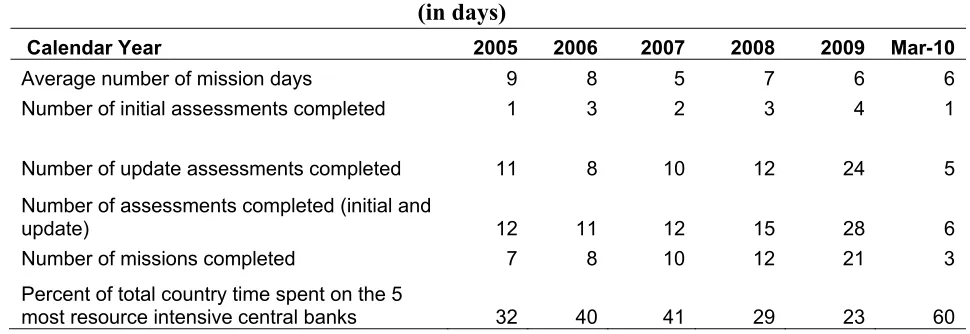
first-time and update assessments in respect of new arrangements, and (ii) the monitoring of the safeguards framework at central banks while credit is outstanding. As reflected in Figure 1, the focus of safeguards work has shifted over the last decade from first-time (initial)
assessments towards the conduct of update assessments in respect of successor arrangements. The number of central banks subject to monitoring has been relatively unchanged over the last five years, except for a drop in 2007 reflecting the low credit environment at the time. 6. Assessment activity has varied in line with both the volume and nature of financing arrangements. The annual output of completed assessments declined from 2005 in line with a lower level of IMF arrangements, but recently increased sharply in response to
2
Figure 1. Assessments Completed, 2001-March 20101/
Source: FINSA da ta bases.
1/ Excludes 27 tra nsitional a ssessments completed during 2000-02.
0 10 20 30 40 50 60 70 80
0 5 10 15 20 25 30 35 40
2001 2002 2003 2004 2005 2006 2007 2008 2009 2010
By Type of Assessment
Initia l Assessment Upda te Assessment
FCL Procedures Centra l Banks Monitored (right hand scale)
0 5 10 15 20 25 30 35 40 45 50
0 5 10 15 20 25 30 35 40
2001 2002 2003 2004 2005 2006 2007 2008 2009 2010
By PRGT Eligibility
Non PRGT eligible countries
PRGT eligible countries
renewed lending by the Fund. In 2005-2008 a greater proportion of safeguards work was focused on PRGT financing arrangements, where capacity constraints sometimes present a challenge to addressing identified weaknesses in the safeguards frameworks of central banks. Recently there has been a more balanced mix of PRGT and GRA financing arrangements, which has also contributed to an uptick in the number of initial assessments. While the update assessment process is typically more streamlined than that for an initial assessment, the intensity of work for update assessments does vary according to the time elapsed since the initial assessment, the outcome of the monitoring process, and developments at the central bank. Six voluntary assessments were conducted in the last five years.
7. Monitoring activity is closely linked with assessment outputs. Safeguards
assessments provide a diagnostic snapshot of a central bank at a point in time. The objectives of monitoring are to follow up on the findings and recommendations of an assessment, and to identify any emerging vulnerabilities at the earliest possible time. A risk-based monitoring methodology was put in place following the 2005 policy review, whereby the intensity of monitoring varies according to the underlying safeguards risks (Annex II). At a minimum, central banks are subject to annual desk reviews of financial statements and related external audit reports, and staff contacts the area department team and relevant officials from the central bank. The results of the monitoring work are a key input into the conduct of update assessments.
B. Evolving Modalities
8. While the core objective of the safeguards policy—reducing the risk of misuse and misreporting—is unchanged since inception of the policy ten years ago, the application of the policy has evolved in keeping with the Executive Board’s guidance from prior policy
reviews, the emerging findings of safeguards assessments, and the need to adapt to developments in the Fund’s lending toolkit.
9. Flexibility. The way the staff conducts the various operational aspects of assessment work has been adapted in light of experience and in response to emerging issues and new lending instruments. In particular:
Assessments are phased for some countries in light of their post-conflict
circumstances. Under this approach, an interim assessment is conducted for the most important elements of the safeguards framework, notably the external audit
mechanism and the controls over the management of foreign reserves and monetary program data reporting. Once the central bank’s operations have returned to more normal levels, a full assessment is conducted.
for update assessments and have enabled a streamlining of the safeguards process. In particular, update missions and reports are typically shorter and more targeted than those for initial assessments, and staff has increased the use of headquarters-based work to complete update assessments for lower-risk cases.
Known safeguards risks are being addressed at the earliest opportunity in program negotiations. Safeguards monitoring information and discussions with external auditors have proven useful to ensure that any known and high priority safeguards measures are incorporated in Fund arrangements, even when an update assessment has not been completed at the time of Board approval of an arrangement.3
Similarly, and in the context of the emergency financing cases in 2008-09, safeguards procedures were adapted to ensure that potential significant safeguards risks were identified as early as possible, even before the formal initiation of a safeguards assessment.
10. New lending instruments. Safeguards modalities have been modified to
accommodate new lending instruments, specifically the Rapid Credit Facility (RCF) and the Flexible Credit Line (FCL).
A member’s request for assistance under the RCF requires a commitment to undergo a safeguards assessment and an authorization for Fund staff to have access to the central bank’s most recently completed external audit reports and to hold discussions with the auditors. The timing and modalities of the assessment under the RCF are determined on a case-by-case basis; it is presumed, however, that the safeguards assessment would have been completed before Executive Board approval of any subsequent arrangement to which the Fund’s safeguards policy applies.
Safeguards assessments are not conducted for FCL arrangements on the grounds that eligible countries have strong institutional arrangements in place that would mitigate risks of misuse and misreporting. Instead, staff is authorized to hold discussions with the central bank’s external auditors with the objective of ensuring that recent external audit reports do not raise significant issues that could place FCL purchases at risk.4
3
A recent example is the SBA for Iraq where known safeguards measures were addressed at an early stage, including through conditionality at the time of the approval of the arrangement, and before completion of the update safeguards assessment.
4
11. Budget financing.5 Since the last review there has been an increasing number of
cases in which IMF resources were disbursed to provide budget financing. In such cases the central bank serves as: (i) the government’s banker and the custodian of the country’s official foreign exchange reserves, which will be a source for servicing IMF obligations, and (ii) the Fund’s depository for its own currency holdings.6 While safeguards assessments apply only
to the central bank and in cases of budgetary financing have not been extended to other government entities, they have sought to ensure that appropriate controls are in place for timely servicing of member obligations to the Fund. In particular, safeguards assessments have:
Looked for a clear framework between central bank and government for the servicing of IMF lending so that their respective roles and obligations are transparent and understood. In all such cases, the authorities have also agreed that Fund resources be deposited with the central bank.7 The objective has been to replicate as far as possible
the situation where Fund resources are on-lent to the government by the central bank.
Sought external assurances of the integrity of components of NIR and NDA
performance criteria that are sourced outside the central bank. In the absence of well-defined government balance sheets, safeguards assessments have also called for the transparent disclosure of Fund transactions in the notes to the central bank’s financial statements.
12. Communications. Staff has taken several initiatives to strengthen awareness and improve communications on safeguards issues. Specifically:
Raising awareness of safeguards work in a variety of fora. Over 500 representatives from 122 central banks and 125 countries have participated in
semiannual safeguards seminars, which are case-study based and equip participants to conduct a self-assessment of their own central bank. The seminars have been adapted in recent years to include presentations from external parties, such as the international
5
The term “budget financing” in this paper is used to refer to cases in which a member uses the domestic counterpart of resources received from the Fund to finance the budget deficit of the government. This type of use of Fund resources is consistent with the Fund’s legal framework to the extent that the member has balance of payment problems and it is implementing a program that will assist it in resolving such problems.
6
In previous safeguards policy reviews, the Executive Board has re-affirmed the focus on central banks, even though Fund lending can involve budgetary financing. Section IV B (below) takes up this issue in the context of the current review.
7
accounting firms, professional bodies, and the World Bank. Central banks have also welcomed staff’s guidance notes, including templates, for the implementation of safeguards measures that draw on the staff’s multilateral experience across regions. In partnership with central banks and the international accounting firms, information about the safeguards program has also been disseminated at occasional regional workshops and in ad hoc publications.
Regular communication with central banks through a variety of channels (email, tele- and video-conferencing), especially in the periods after a safeguards mission and throughout the monitoring phase. Use of video-conferencing, in particular, can enable central banks to maintain close links with staff. Central banks now provide a
designated contact person for safeguards issues, which has facilitated continued outreach, generally timely official responses to safeguards assessment reports, and the follow-up of safeguards findings.
Publication on the IMF website. A range of safeguards related material is published, including the annual safeguards activity reports, a summary of findings and
recommendations for individual assessments (where the respective staff reports are published), and a Fact Sheet. In addition, staff operational guidelines are now posted on the intranet.
Stronger and early collaboration with area department teams. Early notification to FIN staff of potential new arrangements has ensured that any deviation from key safeguards requirements, such as the non-publication of audited financial statements that may become an obstacle for approval of an arrangement, are signaled to the authorities at the earliest opportunity.
Increasing interaction with external auditors throughout both assessment work and ongoing monitoring. Experience has shown that regular contact maintains auditor awareness of staff’s interest in central bank safeguards, and allows more frequent and open exchanges of views on safeguards related audit issues and practices observed during assessments.
13. Sharing Reports. Safeguards reports have been confidential documents since inception of the policy. The reports are prepared for an internal purpose and contain confidential information that would not ordinarily be made available to a broad audience. Since 2005, reports have been shared with World Bank staff, subject to certain
confidentiality criteria and the consent of the central bank (see Box 2). A total of 44 reports have been shared with World Bank staff, and to date 3 central banks have withheld consent for such sharing.
C. Recent Misreporting and Emerging Governance Cases
14. The preventive, ex ante nature of safeguards assessments precludes definitive
avoided. To reduce the risk of misreporting, safeguards assessments typically recommend a combination of preventive measures (e.g., data reconciliations with the accounting records) and ex post controls (e.g., data audits) to ensure data integrity. However, there is no counter factual on the extent to which misreporting is being avoided by the effectiveness of
preventive measures. Also, safeguards assessments are distinct from audits; in particular, the assessments are diagnostic tools, and unlike audits, not a means to provide assurances on the verification of assets and liabilities, or on the effectiveness of controls.
15. Safeguards assessments have continued to play a role in the detection and resolution of cases involving misreporting and governance abuse. Since the last policy review, three instances of misreporting of central bank monetary data have been reviewed by the Board and governance abuses have arisen in three other cases. Safeguards measures played a key role in the detection of two of the misreporting cases and in one of the
governance abuse cases. In all cases, safeguards measures were core elements of the action plans to address the weaknesses that gave rise to the incidents.
16. The misreporting cases saw inaccurate reporting of data on international
reserves, credit to government, and reserve money. In the case of Mauritania, a safeguards assessment identified significant data issues initially in respect of foreign exchange reserves. A subsequent review of reported program data also led to the authorities notifying the IMF of adjustments to data on net domestic assets of the central bank and net domestic financing of the budget. In the DR Congo, a safeguards assessment found significant safeguards risks and inaccuracies in the reporting of government balances to the Fund due to ongoing weaknesses
Box 2. Sharing Reports with the World Bank
As follow up to the 2005 review, the Executive Board decision in December 2005 (12/1/05) authorized the sharing of reports with the World Bank staff.
This decision requires that the Managing Director obtains, in particular: (i) satisfactory assurances from the Bank that the report will be kept confidential, its internal distribution restricted and the report will not, either in whole or in part, be quoted from, cited or used in publications; and (ii) the consent of the central bank concerned to the transmittal of the report. In practice, World Bank staff requests for reports are coordinated by, and routed though the office of the Head of the Financial Management Sector Board, Operations Policy and Country Services, and forwarded to the Finance Department, which then seeks the consent of the relevant member central bank to release the report to World Bank staff.
in the central bank’s financial reporting and controls framework. In the case of Tajikistan (2007) the authorities notified the IMF of inaccuracies in data reported on net international reserves and reserve money that stemmed from central bank financing of the cotton sector. Key elements of remedial safeguards measures in these cases centered on: (i) improving accounting systems, with guidance from Fund-supported technical assistance advisors; and (ii) independent review by external auditors of monetary data as at program test dates. 17. The governance abuses involved fraudulent transactions (Annex III). In Tanzania, the central bank’s external auditors raised a concern with staff about a potential serious fiduciary issue, but client confidentiality prevented them from disclosing the details.
Subsequent forensic investigations confirmed significant fraudulent transactions through an account that was administered by the central bank on behalf of government, which were facilitated by high-level override of controls, and weakened central bank Board oversight and internal audit. In Burundi, the Inspector General investigated allegations of misappropriation of government resources and found that fraudulent payments had been made based on false documents submitted by the Minister of Finance and the central bank Governor. In this case controls at both the central bank and Ministry of Finance were overridden, and the earlier safeguards recommendation for the establishment of an independent audit oversight body had not been implemented. In the CEMAC region,8 following media reports of fraud in its Paris
Office, the BEAC (the region’s central bank) initiated some special audits, including one by the Audit Committee and another by an external audit firm. The investigations confirmed misappropriation in the period 2004-07 and revealed a deliberate high-level override and breakdown of controls in both the Paris Office and BEAC headquarters, as well as an absence of effective oversight by headquarters. A subsequent special audit of budgetary and accounting practices at BEAC headquarters indicated significant risk that unauthorized outflows from BEAC’s reserves could occur due to poor oversight and inadequate internal controls.
III. TAKING STOCK
A. Safeguards Findings
18. The findings of safeguards assessments have evolved over the last 10 years, as central banks have strengthened their ELRIC frameworks.9 The initial findings of
safeguards assessments revealed significant vulnerabilities in all areas. Notably, some 14 central banks were found to have no external audit at all, while relatively few had adopted a recognized set of accounting and financial reporting standards. In other areas, governance oversight was found to be weak and internal audit often inadequate. Staff has continued to
8
CEMACis the Central African Economic and Monetary Community, whosemembership comprises Cameroon, Central African Republic, Chad, Republic of Congo, Equatorial Guinea, and Gabon.
9
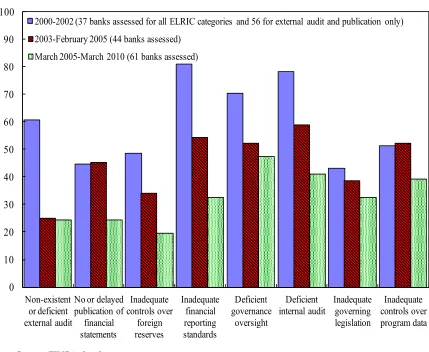
track the findings in eight key areas of vulnerability (Figure 2) and the trends corroborate the general move towards greater transparency and improved control systems by central banks over the last ten years.10 In particular:
Figure 2. Key Vulnerabilities Identified in Central Banks
Source: FINSA databases. 0
10 20 30 40 50 60 70 80 90 100
Non-existent or deficient external audit
No or delayed publication of
financial statements
Inadequate controls over
foreign reserves
Inadequate financial reporting standards
Deficient governance
oversight
Deficient internal audit
Inadequate governing legislation
Inadequate controls over program data 2000-2002 (37 banks assessed for all ELRIC categories and 56 for external audit and publication only)
2003-February 2005 (44 banks assessed)
March 2005-March 2010 (61 banks assessed)
10
Almost 60 per cent of the central banks assessed through end-2002 were found to have no or deficient external audit mechanisms; deficiencies included a lack of auditor independence and inadequate audits conducted by local auditing firms. In contrast, these deficiencies have been identified in only about 25 percent of the central banks assessed since 2002, although the trend is flat.
Around 75 percent of central banks are now completing and publishing their full set of financial statements, compared with about 55 percent earlier in the decade.
Significant improvements in the adoption of benchmark accounting standards are evident. Recent findings reveal deficiencies in this area in around 30 percent of central banks assessed, compared with 80 percent at inception of the policy.
Internal audit practices at central banks are being modernized, and while
improvements are still needed at about 40 percent of the central banks assessed, this is markedly less than earlier findings.
Reserves management practices and controls continue to strengthen. Staff has seen a more structured approach to reserves management at central banks, drawing on the IMF’s Reserves Management Guidelines. Also, staff has partnered with the World Bank’s Reserves Advisory Management Program (RAMP), which has significantly improved the control and management of reserves through building capacity at a number of central banks.
Data management processes have been strengthened more recently. A key development here is that, as internal audit practices improve, program data compilation and reconciliations are increasingly subject to internal audit at key milestones, such as test dates under IMF-supported programs. This development provides added assurances to central bank management on the accuracy and completeness of program data.
19. However, recent findings also show that challenges remain. In some areas, the improvements appear to have plateaued, while progress has slowed in others. Specifically:
importance of adequate oversight by central banks to ensure the quality of the external audit process.
Governance oversight is often provided for through appropriate organizational structures, but is not fully effective in practice. Oversight bodies such as independent audit committees and investment committees are increasingly in place at central banks, but these bodies are not always supported by a substantive work plan and agenda for overseeing the areas covered by safeguards work. Deficiencies are being found in close to half of all assessments, which now focus increasingly on the scope and professional underpinnings of oversight committees, rather than their formal mandate.
Slower progress has been made in strengthening governing legislation, mainly because of the practical difficulties in enacting new laws. Where feasible, staff addresses this safeguards risk through temporary measures, such as a Board
resolution pending changes in the law, or by a MOU between the government and the central bank that could, for example, clarify an ambiguity in the enabling legislation. 20. The changing nature of safeguards findings has required adaptation of the analysis within the ELRIC framework. With the preponderance of update assessments, where central banks must have an external audit in place, the focus in this area is on developments and any emerging risks since the last assessment. For example, an update assessment may have to review practices of a new audit firm that has been appointed, as well as reviewing the measures adopted by the auditors to ensure the quality and consistency of the audit work and compliance with international standards. In other areas, notably the modernization of the internal audit and financial reporting functions, progress towards the ELRIC benchmarks runs along a spectrum. Update assessments focus, therefore, on the extent to which reliance can be placed on these functions; e.g., is the internal audit function ready to provide assurances in data reporting and if not, does this weakness need to be mitigated by other measures? Furthermore, the controls and audit procedures reviewed under the “C” component of ELRIC now include currency and banking operations in light of staff’s evolving experience with the findings of fraud investigations.
21. The implementation rate of safeguards recommendations has remained high (Annex IV). The overall implementation rate for some 1006 recommendations as at end-March 2010 was 77.1 percent, while implementation of priority safeguards recommendations has averaged around 95 percent.11 Safeguards monitoring plays an important role in this
regard through the follow-up of prior recommendations. Safeguards reports typically
11
recommend that conditionality is warranted for high priority findings, but the need for conditionality varies according to country specific circumstances and the timing for implementation of safeguards measures. Formal conditionality also becomes moot when central banks have already addressed a safeguards finding prior to the time of program approval (or the first review).
22. The introduction of conditionality reforms in March 2009 does not appear to have had a significant impact on implementation rates. Early indications are that implementation rates have not declined despite the removal of structural performance criteria. While the absence of any needed waivers may somewhat reduce the visibility of delayed implementation of safeguards measures, the introduction of review-based
conditionality is helping to promote country ownership. It also provides greater flexibility in elevating commitments to structural benchmarks, as needed, in a later stage of an
arrangement. Critical safeguards recommendations can continue to be considered for inclusion as prior actions under program conditionality.
23. There has been some limited interest in a wider dissemination of safeguards findings. In 2008 staff received requests in two country cases from the donor community for details about the findings of safeguards assessment mission teams. Staff could point towards the expected publication of summary findings through the publication of staff reports and the annual activity papers prepared for the Executive Board, but was not in a position to provide a comprehensive briefing on the mission’s detailed findings due to the confidentiality of the reports.
B. Lessons Learned
24. The conduct of safeguards assessments provides an important signal to both member country central banks and other IMF stakeholders, including the general public, that the IMF views the basic due diligence of safeguards assessments as an essential component of
overall program design. The underlying premise is that strong governance and control frameworks at central banks should a priori help to better safeguard Fund resources and reduce opportunities for misreporting. Against this background, this section looks at the lessons learned through the safeguard experiences of the past five years.
governance framework that sets an ethical tone at the top of an organization, and governs the entire organization.
26. Update assessments are showing that challenges remain in sustaining the
effectiveness of ELRIC frameworks at central banks. Progress has been somewhat uneven across countries and areas covered by safeguards assessments; for example, improvements in internal controls have generally lagged behind the progress made in strengthening financial reporting frameworks. Also, experience has shown that new measures, such as the
introduction of an internal audit function, have proven vulnerable to the departure of key personnel. Similarly, audit committees are not always adequately equipped to conduct effective oversight of the system of internal controls and to ensure that external and internal audit findings are being adequately addressed. These challenges point towards the need for continued vigilance, highlighting the importance of the risk-based monitoring framework. Technical assistance from the Fund, and other sources, that is tailored to match specific safeguards priorities can also play an important role in implementing and sustaining necessary reforms.
27. Ownership of safeguards measures is key for sustaining their effectiveness. Beyond the Fund’s narrow objectives, central banks themselves see advantages in
strengthening their safeguards framework because of the positive impact across the broader institutional setting of a central bank. As indicated in the feedback received by the panel of experts, central banks continue to welcome safeguards findings, especially when they see the recommendations as helpful for achieving their own reform objectives. The official responses
Box 3. Observations from the High Profile Governance Abuse Cases
It is important that the substance of governance and control measures is present, and not just the legal form. For example, oversight bodies need to be effective, and not just exist in form. The control environment is dynamic and may deteriorate over time. No control framework can
guarantee against the willful override of controls, but it may facilitate earlier detection. Ex-ante and ex-post controls are important, especially over government accounts and accounts
maintained abroad.
Frauds can be perpetrated in a non-core function of the central bank, where transactions are rare or exploitation of gaps in controls may go unnoticed.
Central bank staff needs to have access to appropriate channels to report fraud or questionable behavior.
A quality external audit can play a key role in uncovering the fraud. Staff needs to remain vigilant to identify cases where external auditors face any restrictions of scope.
from central banks to safeguards assessments, which are included in the reports, are also generally positive. However, not all central banks have fully embraced safeguards findings. A very few object to policy requirements, such as an external audit or publication of financial statements, while others sometimes question the prioritization and urgency of a report’s recommendations. Area department teams sometimes echo these sentiments, noting that safeguards reports should remain tightly focused on critical vulnerabilities for safeguarding Fund resources, and resist drifting in the direction of technical assistance.
28. External auditors remain important partners in the safeguards process, provided quality is maintained. External audits provide an independent “first line of defense” in obtaining assurances on the integrity of a central bank’s financial reporting processes. A significant benefit of the annual external audit is the independent verification of a central bank’s assets and liabilities. Issues identified in this work by external auditors have exposed deliberate and inadvertent misreporting cases, and have provided indicators of potentially fraudulent activities. However, external audits do not provide a guarantee against fraud due to their relatively narrow scope.12 The BEAC case, for example, involved
fraudulent payments that were well below the materiality thresholds for an audit of the financial statements, and hence were not readily detected by audit sampling of transactions. Also, as noted earlier, audit quality is sometimes uneven and can deteriorate quickly (e.g., through appointment of a new audit firm or changes in key personnel), and auditors can avoid accountability by long delays in releasing signed audit opinions, even though the audit work and the draft audit opinion have not identified significant issues. While central banks have primary responsibility for audit oversight, these issues point towards the importance of continued vigilance by staff over the status and timing of external audits, including through periodic follow up with the central banks and the auditors.
29. Raising awareness of safeguards risks among a variety of stakeholders is a key driver in meeting the policy’s objectives. Previous policy reviews have emphasized the importance of stronger communications on safeguards issues across all stakeholders. Central bank staff is now more aware of the importance of accurate program data, as evidenced by the increasing number of central banks that have introduced data reconciliations with the audited financial statements as a standard operating procedure. Raised awareness by external auditors of the importance that the IMF places on central bank audits has played a role in their bringing issues to staff’s attention, which can then be addressed in partnership with the authorities. Equally, raised awareness of safeguards risks among area department teams can help avoid or deflect subsequent issues, especially misreporting.13 The publication of the
12
The scope of external audits is restricted to controls surrounding the preparation of financial statements, and the audit evidence collected by auditors does not necessarily require a testing of those controls.
13
special investigations into high-profile cases has also raised awareness of the unfortunate consequences of fraudulent activities, which may help deter such events in the future. 30. The emergence of high profile governance abuse cases can both harm and enhance the Fund’s reputation as a prudent lender. Fast, decisive action by country authorities, with assistance and advice from the Fund, to: (i) diagnose the problem;
(ii) publish the findings of investigative reports; and (iii) take remedial actions, positions the Fund as a respected partner for the international community in identifying and resolving such issues. In contrast, the unexpected emergence of such issues into the public domain, without direct IMF involvement in the identification and resolution, can create the impression that the Fund was “asleep at the wheel.” A key consideration for the Fund, therefore, is to stay
engaged as far as possible in a trusted advisor role with central banks on safeguards issues. On the latter point, central banks also acknowledged to the panel that safeguards findings have enabled them to better align with best practices.
31. In summary, experience has shown that safeguards assessments have helped to identify emerging governance abuse and misreporting issues at central banks, but cannot be a panacea for control overrides. While improved capacities in areas such as operating controls, internal audit review, and external audit and financial reporting help mitigate safeguards risk, they need to be complemented by sound and effective governance oversight and independent mechanisms to help deter control override. Other factors that have become evident during the conduct of safeguards assessments include the importance of: (i) the monitoring framework to help ensure the sustainability of safeguards measures
implemented by central banks; (ii) maintaining a focus on the underlying objectives to ensure ownership by the various stakeholders; (iii) raising awareness of safeguards issues to help deter and detect opportunities for misreporting and misuse of IMF resources; and (iv) remaining vigilant on external audit quality and reacting to emerging indicators of vulnerability.
C. Staff Resources
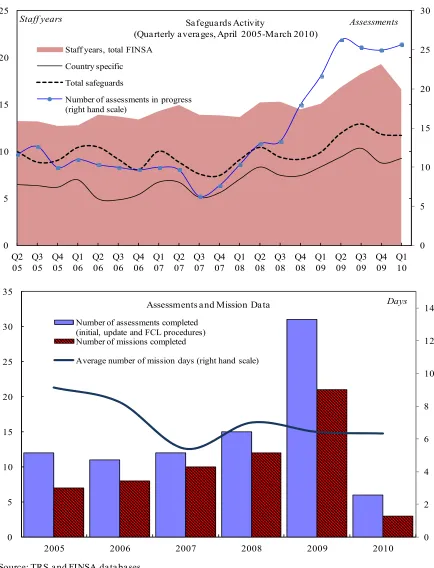
32. Safeguards assessments work is mainly conducted by a specialized staff team of 8-10 professional accountants (Annex V).14 Staff resources are not easily scalable in light of
the specialized expertise needed, but the overall resource envelope has stayed quite stable over the last 5 years (Figure 3). This reflects the continuum of the safeguards work, whereby update assessments are an off-shoot of monitoring rather than de novo assessments. Also, the relatively high demand on staff time for missions requires a minimum resource base to ensure operational flexibility is retained. The recent increase in assessment volume was
14
Figure 3. Safeguards Activity
Source: TRS a nd FINSA da ta ba ses.
0 5 10 15 20 25 30 0 5 10 15 20 25 Q2 05 Q3 05 Q4 05 Q1 06 Q2 06 Q3 06 Q4 06 Q1 07 Q2 07 Q3 07 Q4 07 Q1 08 Q2 08 Q3 08 Q4 08 Q1 09 Q2 09 Q3 09 Q4 09 Q1 10 Sa fegua rds Activity
(Qua rterly a vera ges, April 2005-Ma rch 2010)
Staff years, total FINSA
Country specific
Total safeguards
Number of assessments in progress (right hand scale)
Staff years Assessments
0 2 4 6 8 10 12 14 0 5 10 15 20 25 30 35
2005 2006 2007 2008 2009 2010
Assessments a nd Mission Da ta
Number of assessments completed (initial, update and FCL procedures) Number of missions completed
Average number of mission days (right hand scale)
accommodated by hiring two additional accountants on limited term positions, internal redeployment on a temporary basis from OIA, and a significant increase in uncompensated overtime.
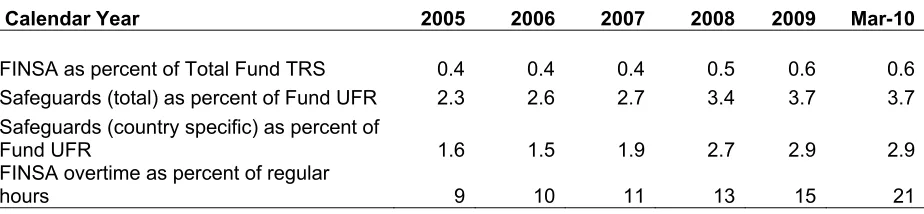
33. Safeguards work continues to be a relatively small portion of Use of Fund Resources (UFR) work. Overall, and using data in the Time Recording System (TRS), direct safeguards assessment work by the staff team represented less than three percent of total staff time allocated to UFR over 2005-2009. In dollar terms, and using FY11 standard costs, the direct annual personnel cost of the safeguards team is around $3m, or about $45,000 per central bank monitored. On a country basis, the resource needs can vary substantially, especially for the high profile cases. The information in the monitoring database has also enabled a larger number of assessments to be undertaken at headquarters and has therefore reduced travel costs.
IV. LOOKING AHEAD:OPTIONS FOR CHANGE
34. The foregoing discussion suggests that the safeguards policy continues to serve the Fund well and helps to maintain the Fund’s reputation as a prudent lender. The strengthened governance and control frameworks at central banks de facto help to mitigate misuse of Fund resources. Central banks have generally embraced the safeguards findings and continue to benefit from the diagnostic assessments and monitoring process. The resource cost is relatively modest in relation to the total investment of staff resources in all lending activities. The panel has also affirmed the usefulness and value of the policy, noting that they found among stakeholders broad approval for the policy and acknowledgement of its value.
35. Nonetheless, some changes to the safeguards policy could be considered. Against the background of the evolving findings of safeguards assessments and lessons learned in applying the policy, staff has examined: (i) the appropriateness of possible changes in the scope and focus of safeguards assessments at central banks; (ii) options for providing safeguards assurances of fiscal fiduciary risks in cases of budget financing; and (iii) issues surrounding the confidentiality of safeguards reports. These aspects and the corresponding views of the panel are discussed below.
A. The Scope and Focus of Safeguards Assessments
37. The descriptions of the five ELRIC pillars could be updated for general
developments in control frameworks. The ELRIC pillars were developed in 2000, drawing on standards and codes in place at that time. The past 10 years have seen an evolution in corporate governance and control frameworks, and a marked trend towards increased transparency and accountability. The Sarbanes-Oxley Act of 2002, for example, introduced the requirement for public companies in the U.S. to maintain systems of internal controls, and for management to certify and the independent auditor to attest to the effectiveness of those systems. National legislations have strengthened corporate governance through increased responsibility and independence of audit committees. The scope and coverage of international auditing and accounting standards have also increased over the past ten years. Most recently, the OECD and Group of 30 have released further guidance on governance principles in the wake of the global financial crisis. The UK Walker Report of July 2009 also has a number of important recommendations that will come to impact good governance practices of central banks.
38. In its report, the panel calls for a sharpened focus on governance in the ELRIC framework. Staff notes that the framework already captures the various attributes of governance within each of the five separate pillars, but does not explicitly emphasize
governance as a common theme transcending the pillars. Mindful of the control overrides in the high profile cases and the importance of effective oversight, staff believes that explicitly defining governance principles enunciated by the panel as overarching the ELRIC pillars would help in better focusing the diagnostic analysis of the governance structures at central banks. Further, these governance principles are cross-cutting elements that can be found in each of the ELRIC pillars. To reflect recent developments and the panel’s recommendation, staff proposes updating the description of the five ELRIC pillars and adding the key
principles of governance as a chapeau (Box 4).
40. In the context of the goal of continuous improvement in the safeguards framework that underlies the panel’s recommendations, staff sees merit in giving greater prominence to risk management. Safeguards assessments could explicitly consider how central banks are embarking on, or progressing along, the path towards an IRMF.
Depending on the stage reached, assessments could ascertain how well central banks manage their own risks. This could include analysis of whether a central bank has established a benchmark and methodology for assessing risk and, if so, whether the risk management system operates effectively. For the immediate future, staff believes that central banks’ approach to, and progress with, risk management can be assessed within the “C” pillar of the ELRIC framework.
Box 4. Changes to the ELRIC Framework
The description of the five ELRIC pillars (Annex VI) has been updated to reflect key external developments and ten years of safeguards experience as follows:
The descriptions of the external audit (“E”) and financial reporting (“R”) refer to International Standards on Auditing (ISA) and International Financial Reporting Standards (IFRS) as accepted international benchmarks, which remain appropriate. The description of the internal audit mechanism ( “I”) has been revised to reflect the emergence of International Standards for the Professional Practice of Internal Auditing issued by the Institute of Internal Auditors.
The description of the legal structure and autonomy (“L”) has been revised to reflect improved central bank governance and autonomy and lessons learned on common avenues for limiting outside interference in central bank operations, besides government credit. Improved central bank transparency and accountability has reduced the need to focus on statutory audit, financial reporting, and publication requirements. The shift towards monetary policy as the principal objective of a central bank has enabled greater independence and reduced the role of credit to government as a source of impaired autonomy.
The description of the system of internal controls (“C”) has been updated to reflect evolution in control models and good governance. Newer control models consider the control environment established by top management as the most important component in a robust system of internal control. Accordingly, the assessment of the “C” pillar places greater emphasis on assessing the quality of the control environment and the degree of governance and oversight exercised from the highest level.
41. Looking ahead, the existing modalities for conducting safeguards assessments at central banks need to remain flexible, within the policy’s existing mandate. The lessons learned from experience so far emphasize the importance of continued vigilance in the monitoring process, quick and appropriate reaction to emerging issues, maintaining a focus on those areas that are critical to safeguarding Fund resources, and adapting remedial measures to country circumstances to ensure ownership. At the same time, policy
requirements such as: (i) the publication of financial statements that have been independently audited in accordance with international standards; and (ii) the deadline of the first program review for completion of a safeguards assessment remain appropriate and should continue to be applied consistently.
42. The monitoring modalities remain broadly appropriate. The panel has affirmed the effectiveness of the risk-based monitoring framework, which is largely dependent on the continued cooperation of central banks and their external auditors. Monitoring continues for as long as Fund financing is outstanding, but staff has sometimes found that it is difficult to obtain the required monitoring documentation once an arrangement has concluded.15
Shortening the monitoring period (e.g., to one year after the conclusion of an arrangement) or adjusting the monitoring period based on the underlying risk could help address this
difficulty, but would also negate the advantages of staying engaged to facilitate potential update assessments for successor arrangements. On balance, staff proposes that central banks should continue to provide monitoring information in accordance with current requirements, but that instances of non-receipt of such information be explicitly flagged in staff reports. 43. Safeguards modalities also need to be adapted in response to issues identified by stakeholders during this review. In particular, and as reported by the panel, stakeholders have emphasized the importance of collaborating more closely with central banks and addressing more systematically the concerns identified in the quality of external audits. In this context:
Opportunities for harnessing technology to make the safeguards process more open and collaborative could be explored. The improved communication with central banks since the 2005 policy review has helped raise awareness and reduce misperceptions of the safeguards policy, but feedback from central banks to the panel suggest a renewed appetite for additional information and knowledge sharing,
especially on cross-country experience, and more frequent dialogue between central bank officials and the safeguards team. New technology platforms for collaboration, such as extranet websites and social networking tools could help achieve these objectives and contribute towards more effective and efficient monitoring. They
15
could also play a role in promoting self-assessment techniques, as recommended by the panel.
Improved interaction with the large external audit firms at the global level to discuss audit quality issues. Staff sees merit in complementing the existing “bottom up” approach in dealing with these issues with a “top down” approach by conducting an annual forum at the global firm level, as proposed by the panel.
44. Safeguards policy requirements may also have to be adapted for possible developments in the Fund’s future financing role. The limited safeguards procedures applied for FCL cases appear to have been effective in the context of an insurance-type facility and the presumptive strong institutions. Similar adaptations in scope may prove feasible for further lending reforms, depending on the nature of the underlying instruments and the practical challenges in conducting a safeguards assessment.
45. Finally, staff believes existing modalities can be adapted in several other areas noted by the panel. These include (i) improving internal collaboration, particularly through raising staff awareness of the relevance of safeguards activities to program issues and technical assistance work; (ii) examining peer review or regulator’s reports in the assessment of the quality of external auditors, and (iii) incorporating in the safeguards toolkit an assessment of the need for, and appropriateness of, a “whistle blowing” mechanism.
B. Budget Financing
46. The current safeguards framework does not provide assurances about entities beyond the central bank. Safeguards assessments were introduced to demonstrate a level of due diligence, but the mandate of the policy has never covered entities other than the central bank. Therefore, in cases where IMF resources are provided directly to the government, the safeguards assessment does not provide the same level of assurance about minimizing the risk for misuse of IMF resources and about the quality and reliability of fiscal data and other information related to performance criteria used in IMF-supported programs. The panel notes that the shift in the volume of cases of budget financing has come with an associated shift in the nature of the risk to Fund resources.
47. Consideration was given in past reviews of the safeguards policy to extending the mandate beyond the central bank. In the 2002 review, the Board noted that safeguards assessments should not be applied to fiscal issues since that would require a new mandate for staff; this view was reaffirmed in the 2005 review. The main obstacles for replicating
safeguards assessments in the whole of government sector identified by these reviews were practical:
Obtaining safeguards assurances beyond the central government to the activities of state enterprises and lower tiers of government would not be feasible. Public
Financial Management (PFM) systems in developing countries, especially at the line ministry and agency level, are often very weak; many countries with which the Fund engages in program support would not meet criteria for reasonable assurances for the whole of government. The attainment of such standards would require a multi-decade development effort.
48. A safeguards assessment of the whole of government remains unfeasible. The practical considerations from past policy reviews remain relevant. While many countries have strengthened their PFM systems, an assessment across the whole of government would be time and resource consuming, which could lead to long delays in its completion and thereby negate the objective of providing assurances at an early stage of program engagement. Also, such assessments would overlap to some extent with PFM work conducted by other multilateral partners, notably the World Bank.
49. Limited assurances on fiscal safeguards risks are already provided by existing practices. In 1998, the IMF introduced a Code of Good Practices on Fiscal Transparency (“the Code”), which led to a voluntary program of fiscal transparency assessments, called fiscal transparency modules of the Reports on the Observance of Standards and Codes (“fiscal ROSCs”), covering now more than 90 countries. The first version of the Manual on Fiscal Transparency (“the Manual”) was issued the same year. The Code and its
corresponding manual were updated in 2007. With a particular focus on tracking of aid funds (and debt relief benefits), the multi-donor Public Expenditure and Financial Accountability (PEFA) Performance Measurement Framework published in 2005 includes a series of 28 high level performance indicators covering public financial management effectiveness. Unlike fiscal ROSCs, PEFA evaluations are quantitative assessments, scoring the
performance of the country against the 28 indicators. Program design is also a key safeguard in the case of budgetary support. IMF budget support is for financing the fiscal deficit and not linked to a specific developmental policy or expenditure. Elements of program design are therefore focused on the quality of budgetary processes, including fiscal transparency and accountability, rather than the quality of budgetary spending.
50. Building on existing practices and information, additional steps could become a standard part of budget financing cases:
The existing practices for central bank involvement in budget financing arrangements could be explicitly incorporated under the umbrella of the safeguards policy by formalizing requirements as follows: (i) the maintenance of a specific government account at the central bank to receive Fund resources;16 (ii) the government should
16
hold foreign exchange balances only with the central bank; and (iii) the establishment of a clear framework agreement between central bank and government on
responsibilities for servicing obligations to the Fund. As noted earlier, these
arrangements seek to replicate, as far as possible, the situation where Fund resources are on lent to governments by central banks.
In addition to current practices, a more explicit reporting approach to the Board could be considered whereby staff reports in a new arrangement involving budget financing would specifically report on known fiscal safeguards risks (drawing on available information, such as ROSC reports and other diagnostic instruments (PEFA)). It would be important to recognize that these diagnostics do not go into the depth needed to assess risks at the entity level. Accordingly, care would be needed to avoid creating an expectation (in the Board and elsewhere) that such procedures provide safeguards assurances.
51. A more far reaching change would be to initiate an assessment of fiscal safeguards risks at the level of the state treasury. The treasury is the recipient of Fund resources and is responsible for control of budgetary and spending processes. Staff has identified an approach for a narrow assessment, which could focus on criteria (Box 5) derived from the Fiscal Code. Evaluating the state treasury and the core budget/spending process would provide some additional but still limited assurances on the appropriate use and reporting of government resources, including Fund resources. It should be emphasized, however, that the proposed framework for state treasuries and its implementation would need to be further developed and piloted to ensure that the value-added from injecting safeguards assessments is not outweighed by the costs. Many Fund members, particularly low-income countries, may face difficulties complying fully with the criteria, and remedial actions may not always be easy to implement. Also, while the Fund is clearly the lead institution among the donor community on central banking issues, this is not the case in PFM work.
52. Almost all of the information needed for a targeted assessment should be
Box 5. Criteria for a Possible Targeted Assessment Covering the State Treasury
The criteria below should be seen as a first, tentative outline of an assessment framework for state treasuries. It would require further development and piloting in countries receiving budget financing. The criteria would be used as end-point objectives, which most countries would gradually and progressively achieve.
1. Does the State Treasury operate a main bank account at the central bank, through which all government transactions are processed? There should be a legal requirement that enforces the use of such an account, and the legal basis should be followed in practice. If there are alternate central government bank accounts from which budget expenditure takes place, these accounts should also be under the control of the state treasury, be consolidated on a regular basis, and also held at the central bank. If there are commercial bank accounts through which budget expenditure is executed in part, these should preferably be zero-balanced, but at least consolidated on a regular basis.
2. Is all central government expenditure authorized by the budgetary appropriation or other law? The annual budget and its formal amendments, as approved by parliament, should define all uses of resources from the main central bank account. This principle may be enshrined in the Constitution or Financial Management Act, and applied in practice.
3. Isthe main bank account at the central bank (and other possible authorized accounts) reconciled regularly? Reconciliation of expenditure, revenues and financing flows with account statements would provide assurances on the accurate accounting of transaction over the government’s bank accounts.
4. Are all central government transactions executed through the state treasury properly accounted for using clearly defined nationalaccounting standards that are on major issues aligned with international standards such as International Public Sector Accounting Standards, and are all final accounts under the responsibility of the state treasury produced in a timely fashion? Where there are departures from
international standards are the relevant circumstances and the effects of such departures fully disclosed in the accounts? The accounting framework should in any case record both above and below the line transactions. A minimum standard for timely preparation final accounts of developing countries could be, for example, within 6 months of the end of the year.
5. Are the final accounts prepared by the state treasury audited by an independent commercial or state audit institution, according to national standards aligned (on major issues) with international standards such as the International Standards on Auditing (ISA) and/or standards issued by the International Organization of Supreme Audit Institutions (INTOSAI), and are audit reports on the final accounts provided to parliament in a timely manner? This would provide reasonable assurance on the qualitative characteristics of government accounts and their consistency with the financial reporting framework. A minimum timeliness standard for developing countries providing audited final accounts could be, for example, twelve months.
6. Are observations by the commercial and/or the state auditor addressed to the state treasury to improve financial management processes taken onboard systematically? Deficiencies in budget management and accounting process should be addressed by the State treasury as necessary. This process should be monitored by the external auditor or Public Accounts Committee.
include an official response from the central bank. Adding the state treasury would raise new issues, including how best to engage with other parties such as government auditors, and whether staff would be given the requisite access to relevant information and documentation. Given the confidentiality of safeguards reports and their coverage on one entity only,
separate reports would also likely be needed. The key findings of both would need to be consolidated in the relevant country paper prepared for the Executive Board. From the staffing perspective, the existing FIN team of accountants would not have the requisite expertise.
54. The panel supports adoption of a framework for targeted assessments of state treasuries. The panel, in particular, found merit in the proposed criteria for conducting such assessments, and noted that existing data could be leveraged so long as due diligence by staff ascertains the quality of data. It also notes that, consistent with existing practices for central banks, the assessments would need to be performed independently from other IMF
operations with the state treasury.
55. If Directors see merit in targeted assessments of state treasuries, staff will revert with a specific proposal. The next steps could be to develop a prototype assessment, identify gaps in the availability of fiscal ROSCs and other information relative to recent budget support financing, propose specific modalities for the conduct of targeted assessments, and estimate the resource implications.
C. Confidentiality of Safeguards Reports
56. Staff believes that the confidentiality of the reports has been a key factor in the successful implementation of the policy. In particular, staff has been freely granted access to sensitive information (including those classified as state secrets in some countries), secured physical areas at central banks, and confidential client information contained in external auditor management letters. Further, the limited availability of safeguards reports encourages candor in assessment reports that might not otherwise be possible if reports were more widely disseminated. Publication could also undermine the Fund’s role as a
confidential advisor.
57. The Fund’s transparency policy (recently amended) calls on the Fund to
disclose documents unless there are “strong and specific reasons” not to. As noted by the panel, some central banks see publication as potentially beneficial, especially since
transparency surrounding the actions taken by central banks to strengthen their ELRIC frameworks could enhance their accountability more generally. As noted, there has also been some limited interest shown by outside parties in the safeguards process and the results of safeguards assessments.
to the top” among central banks. Publication would also help promote accountability for the reports themselves and fulfill a need for the public good element of the reports. However, the benefits need to be weighed against the primary due diligence focus of assessment reports, which reflect staff appraisals used as internal inputs for IMF decision making. Also, some downside risks for publication of full reports remain:
Redactions would be needed for potentially market sensitive information. Reaching agreement on such deletions would deflect attention from the underlying objective of the assessments, and require an additional round of discussions with country
authorities, which could delay reports and unnecessarily consume staff resources.
The reports are quite candid and include precise risk assessments by ELRIC category, which could be misinterpreted by external readers, who have different needs and objectives from the Fund.
Equivalent comparator reports (e.g., the “management letters” issued by external auditors and due diligence reports produced in the private sector for investment decision m