ISBN No. 9987 - 680 - 09 - 7 Photo Credit: Juzar Sachack - SEEGAAD
THE UNITED REPUBLIC OF TANZANIA
MINISTRY OF NATURAL RESOURCES AND TOURISM
SEAWEED DEVELOPMENT STRATEGIC PLAN
PREFACE
Over the past decade, seaweed farming in Tanzania has been highly successful (especially in Zanzibar) as a means of providing an economic opportunity to the coastal community. However, low returns have discouraged farmers and some have decided to stop seaweed farming all together. The claims and complaints from many Tanzanian seaweed producers that seaweed farming does not pay has become a concern for government, scientists, seaweed farming villages and developers of seaweed who have always viewed seaweed farming as an important opportunity for social and economic development of coastal areas. In many of the Asian countries such as the Philippines and Indonesia, experience does show, in contrast, that seaweed farming does pay.
During the 1st Seaweed Investors Forum in April 2003, there was widespread agreement that the small quantity of cottonii produced by seaweed farmers is the main problem. The forum proposed and agreed to embark on the preparation of a Seaweed Development Strategic Plan (SDSP) to guide future growth, production (especially cottonii) and sustainable management of the industry together with all key stakeholders. The Strategy of the Ministry of Natural Resources and Tourism and the National Integrated Coastal Environmental Management Strategy have strongly pointed out that seaweed farming is one of the best uses of coastal marine resources for improving the well being of coastal villages. The Ministry of Natural Resources and Tourism regards the Seaweed Development Strategic Plan as a useful guide for development of the seaweed industry in Tanzania and for alleviating poverty in coastal communities. The plan outlines the strategies and actions that each stakeholder needs to take in order to achieve dramatic growth of
Guidelines have provided information to clarify the importance of and procedures for seaweed development. While some policies have been and are currently being developed to address the existing problems, much that remains to be done is addressed in this plan.
The Seaweed Development Strategic Plan was prepared over a period of about one and a half years and involved careful research and consultation with all key stakeholders: government, producers, developers and donor-funded programs. The Fisheries Division will rely upon this document to guide its activities in seaweed development and management and supports the targeted growth of production of cottonii from 1,500 tons (in 2003) to 5,000 tons (by 2007).
The Ministry of Natural Resources and Tourism appreciates the financial support from the US Agency for International Development and technical support from the Coastal Resource Center of the University of Rhode Island (CRC/URT), National Environment Management Council (NEMC), Tanzania Coastal Management Partnership (TCMP) and ACDI/VOCA’s SEEGAAD Project.
The Ministry of Natural Resources and Tourism will also review progress toward the strategies and goals of this document on a continuing basis and make revisions and improvements based on the successes and failures encountered. The government appreciates this opportunity to work and plan together with producers, private stakeholders and donor funded programs and promises to continue this collaboration for the benefit of Tanzanians.
G.F. Nanyaro Director
Fisheries Division,
TABLE OF CONTENTS
Executive Summary ... iv
Acronyms ... vii
1. Introduction ... 1
2. History of Seaweed Production in Tanzania ... 3
3. Social and Equity Considerations of Seaweed Farming ... 8
4. Economic Forces Driving Seaweed Production ... 9
5. Goals and Objectives of the Seaweed Development Strategic Plan ... 14
6. Implementation Strategies, Activities, and Roles ... 16
7. Periodic Review and Institutional Oversight ... 39
References ... 40
Sample Farming Agreement for Development of Seaweed Farming ... 41
Appendix A ... 44
Appendix B ... 46
EXECUTIVE SUMMARY
The Seaweed Development Strategic Plan (SDSP) is intended to provide a framework in which the seaweed industry in Tanzania can expand and prosper in a way that is financially, socially and environmentally sustainable. It covers the five-year period from January 2005 to December 2009. The plan will play a role in reducing poverty though the improvement of livelihood of coastal communities and stewardship of marine and coastal resources.
This plan was developed in an inter-sectoral manner with the involvement of all stakeholders of the seaweed industry in Tanzania including: 1. The Government of Tanzania
2. Ministry of Natural Resources and Tourism (Fisheries Division) 3. The Ministry of Local Government
4. The Commission of Fisheries in Zanzibar
5. The U.S. Agency for International Development (USAID) 6. Tanzania Coastal Management Partnership (TCMP)
7. ACDI/VOCA’s Smallholder Empowerment and Economic Growth through Agribusiness & Association Development (SEEGAAD) Project 8. University of Dar es Salaam Faculty of Aquatic Sciences and
Technology and the Institute of Marine Science 9. ZASCOL (Eucheuma Resources Ltd.)
10.C-Weed Corporation (Mwani Mariculture Ltd.) 11.BIRR Company Ltd.
12.ZANEA Seaweed Company, Ltd. 13.Seaweed producers.
A main goal of this strategy is to raise the levels of production of the carrageenophyte seaweed Kappaphycus alvarezii, commonly known as
Photo Credit: F. Urio SEEGAAD
Kilwa farmer’s daily harvest of seaweed
the industry expands more rapidly. The targeted growth for the cottonii
industry is from the current level of 1,500 metric tones (MT) (2003) to over 5,000 MT by 2009.
As seaweed farmers become more productive and generate more income, it is anticipated that they will have the ability to become independent producers, negotiate better prices, and either self-finance or secure microcredit loans from financial institutions. Currently, almost all producers are dependent on buyers for farming inputs.
Industry growth will also come from expanding cottonii development to new locations along the Tanzanian coastline. In new locations, it is anticipated that seaweed development partners will provide services such as extension services and technical training so that producers will be independent of exclusive contracts from the start, and experiment with an alternative model for future growth of the industry.
farming agreements has increased cottoniiproduction to about 10,000 MT per year in Indonesia. These agreements legally bind producers and developers1 through technical production assistance, input supply and sales contracts. In the current system of farming agreements, developers provide producers with inputs including 4 mm rope, tie-ties2, floats, as well as extension assistance. In turn, producers agree to sell their entire seaweed harvest exclusively to the same developers. With farming agreements, producers only bear the costs of labor and bags; developers bear all other costs and risks of production. The price is determined mainly by the costs incurred by developers in production.
This plan offers mechanisms that would allow seaweed farmers to eventually become independent of farming agreements and self-reliant on inputs and other needs, if that is the development path selected by the seaweed farming community. The Fisheries Division, in collaboration with NGO’s and donors, need to play a role in creating awareness and increased capacity among farmers of the opportunities and benefits of self-reliance, strong small business management skills and quality post harvest handling. The plan also recognizes that the most effective way to significantly increase income of cottonii farmers is to increase productivity of farmers and introduce new and efficient production methods. At present, Tanzanian farmers are producing far less per farmer than in other parts of the world. Within the next 1-2 years, a quadrupling of production per experienced cottonii farmer to approximately 200 kilograms (kg) per fortnight (for about 40 hours work) will make seaweed production an extremely attractive option when compared to other income opportunities in rural coastal communities. With the successful implementation of this strategic plan, it is anticipated that by 2015 Tanzanian farmers will be equally productive when compared to farmers in the Philippines and Indonesia, producing about 500 kg per fortnight. 1
‘Developers’ refers to the seaweed exporters, all of whom have invested in the development and promotion of seaweed production in Tanzania.
2
ACRONYMS
EIA Environmental Impact Assessment
FAST Faculty of Aquatic Science and Technology, University of Dar es Salaam
FINCA Foundation for International Community Assistance GIS Geographic Information System
ICMU Integrated Coastal Management Unit, National Environment Management Council
IMS Institute of Marine Sciences, University of Dar es Salaam MWG Mariculture Working Group
MNRT Ministry of Natural Resources and Tourism
PRIDE Promotion of Rural Initiatives and Development Enterprises
SDSP Seaweed Development Strategic Plan
SEEGAAD Smallholder Empowerment and Economic Growth through Agribusinesses and Association Development TCMP Tanzania Coastal Management Partnership
TIC Tanzania Investment Centre
TIRDO Tanzanian Industrial Research and Development Organization
TSH Tanzanian Shilling
UDSM University of Dar es Salaam
USAID United States Agency for International Development ZANEA Zanea Seaweed Company Limited
Photo Credit: F. Urio SEEGAAD
Bailing seaweed for export Photo Credit: SEEGAAD
1.0 INTRODUCTION
At the First Seaweed Investor’s Forum held on April 1, 2003, in Dar es Salaam, Tanzania, the Mariculture Working Group (MWG) of TCMP, the Ministry of Natural Resources and Tourism, the Fisheries Division and developers met to discuss prospects for the development of Tanzania’s seaweed industry. At this forum the MWG and the Fisheries Division were given the task of leading the preparation of the SDSP. A second Investor’s Forum in November 2003 was convened in Zanzibar to review and revise a first draft of the Strategic Plan.
With the goal of promoting cottonii production as an income generating activity for Tanzania’s coastal inhabitants, reduce poverty of coastal communities, and improve stewardship of marine and coastal resources, the SDSP marks the first coordinated effort to support seaweed and mariculture development in Tanzania and represents a year long planning and consultative process involving all of Tanzania’s seaweed industry stakeholders. The SDSP development process focused on addressing the constraints to the growth of the industry and embodies the foundation for addressing the industry’s complex, multifaceted issues. The SDSP aims to progressively ameliorate seaweed development issues in a cooperative and comprehensive manner. The plan now becomes the principle reference document for seaweed development and provides a plan of action for how to increase the efficiency of seaweed production, quality and marketing of seaweed products, particularly cottonii.
Implementation of the SDSP will benefit the producers and coastal communities involved, the investors developing and exporting the seaweed product and the various bodies and authorities associated with mariculture development.
Statement3 and the Tanzania Mariculture Guidelines (2001). The strategy is consistent with the Government of Tanzania’s poverty reduction strategy that promotes economic development through involvement of the poor and formulation of poverty reduction policies. It offers both short-term and long-term guidance for seaweed industry stakeholders in a 5-year vision where implementation will improve the livelihood of coastal communities through the use of mariculture opportunities in an environmentally sustainable manner.
The government is primarily responsible for providing guidance in the implementation of the strategies and actions in this SDSP. However, industry, donors, NGO’s and community groups will need to coordinate efforts to implement specific actions. This document is also intended to attract investment, support and participation from the private sector, other institutions and donors.
Map of Tanzania Coastal District.
3
2.0 HISTORY OF SEAWEED PRODUCTION IN TANZANIA
Globally, the seaweed industry continues to expand as new applications, technologies and markets are discovered. Although natural stocks continue to be harvested in some regions of the world, seaweed cultivation now constitutes a major portion of farmed marine resources. As seaweed production expands into more areas, scientific research will play a more important role in developing improved strains for production and expansion of the seaweed industry.
In Tanzania, seaweed was first harvested in the early 1950’s, when native seaweed species were collected from the intertidal zone of coral reefs. The collected species were Eucheuma denticulatum, commonly known as ‘spinosum’ andKappaphycus striatum andK. alvarezii, which are naturally abundant on Tanzania’s coastline (Mshigeni, 1973 and Jaasund, 1976). Although no data was collected on the seaweed harvesting activities at that time, it is estimated that total collection was in the range of 400 to 800 MT per year.
Photo Credit: Juzar Sachak SEEGAAD
Seaweed was found to have a high content of carrageenan, a polysaccharide material found in seaweed’s cell walls used as a gelling, thickening and emulsifying agent in foods, cosmetics, paints, manufacture of soap and pharmaceutical products. Tanzania’s seaweed was collected for export to France and Denmark, where the carrageenan was extracted for commercial purposes.
In 1976, Professor Mshigeni of the University of Dar es Salaam introduced the idea of seaweed farming in Tanzania. His idea was to supplement the wild stock, thereby improving production, particularly focusing on seaweed quality and quantity. Professor Mshigeni established the first seaweed farming trials in 1982-1983 in Kigombe Village in Tanga, Fumba Bay in Unguja and Fundo Island in Pemba. At that time, farming focused on the native strains of cottonii andspinosum.
In 1989, a second trial involving exotic strains of Kappaphycus alvarezii and
Eucheuma denticulatumwas conducted on Zanzibar by Zanea Seaweed Co Ltd. Its success in commercial seaweed production paved the way for the subsequent entry of other seaweed ventures such as ZASCOL and C-Weed Corporation. This second trial generated growth rates of 6-7 percent per day (Mtolera, 1995), demonstrating these exotic strains were suitable for commercial cultivation.
Finally in 1994, commercial developers began promoting seaweed farming on Tanzania’s mainland. Using the two exotic strains of cottonii and
In the last decade, the seaweed industry has rapidly expanded both in Zanzibar and on the mainland. In the early 90’s, production on the mainland was mainly confined to Muheza and Pangani Districts; however, in recent times, it has expanded to Tanga Municipality, Mtwara, Kilwa, Lindi, Temeke, Bagamoyo, Mafia, Mkuranga and Kinondoni Districts.
Today, small-scale seaweed farming is one of the most important socio-economic activities along Tanzania’s coast, (Table 1) playing a particularly important role in coastal communities by providing informal employment opportunities, especially for women. Nevertheless, some very suitable sites have yet to attract commercial development and investment from the seaweed farming industry.
Table 1: Exported seaweed (kg) from mainland Tanzania From 1998 – 2003
Year Tanga Tanga Mtwara Lindi Coast Total kilograms
Cottonii Spinosum Cottonii Cottonii Cottonii Cottonii Spinosum
1998 59,900 7,600 13,400 73,300 7,600
1999 87,300 - 20,600 107,900
-2000 - 7,600 33,800 33,800 7,600
2001 21,600 7,200 15,000 36,600 7,200
2002 13,900 77,500 20,250 4,500 48,650 77,500
4
For more information on carrageenan, please refer to McHugh, D.J., “A guide to the seaweed industry”. FAO Fishers Technical Paper, No. 441, (2003)
http://www.fao.org/documents/show_cdr.asp?url_file=/DOCREP/006/Y4765E/Y4765E00.HTM
At present, the Philippines is the leading seaweed producer worldwide, producing about 110,000 MT per year total production of which 100,000 MT is
cottonii. However,
Tanzania (including Zanzibar) has also marked itself on the world map of the industry with total seaweed production
of approximately 7,000 MT per year (FAO, 2001). Photo Credit: F. Urio SEEGAAD
Cottonii tied ready for planting
Photo Credit: J. Kreag SEEGAAD
3.0 SOCIAL AND EQUITY CONSIDERATIONS OF SEAWEED FARMING
Coastal communities rely on coastal resources for their livelihood. Their economy is dependent upon small-scale farming, subsistence forestry, mangrove harvesting, artisanal fishing, lime and salt production, seaweed farming, livestock husbandry, small-scale trade and handicrafts.
Due to the intensive and sustained exploitation of coastal resources, the natural resources of some areas can no longer support their growing population, resulting in increasing vulnerability to food shortages and poverty. Consequently, sustainable use of coastal resources and the development of income-generating activities are critical to poverty alleviation and to improving the well-being and livelihood of coastal inhabitants.
Photo Credit: F. Urio SEEGAAD
Socially and economically the farming of seaweeds represents an environmentally sustainable opportunity for coastal villagers, especially women, to earn money. Seaweed farming has increased the standards of living in coastal communities, with the most notable impact to date being on Zanzibar.
Seaweed farming is an effective strategy for poverty alleviation for several reasons. First, starting a farm is a relatively inexpensive proposition. Secondly, the farming process is relatively simple, requiring no intensive technology. Finally, seaweed farmers enjoy a stable cash flow not shared by most seasonal farmers who are often only able to harvest once a year. Seaweed offers steady income and enhanced economic security. Because seaweed farming is usually led by women in coastal communities, it also increases gender equity and empowers women and their decision-making role over spending choices in the family.
4.0 ECONOMIC FORCES DRIVING SEAWEED PRODUCTION
Developers that provide inputs and extension advice to the seaweed industry have historically been, and continue to be, the driving force in its development. The challenge therefore is for the industry to provide adequate returns to producers, while also providing attractive returns to private developers, potential bank lenders and seaweed export companies.
The Production of Cottonii and Spinosum
during six months of the year, whereas spinosum is produced throughout the year. If the farmer is able to harvest four times a year the total revenue would be 560,000 Tsh, and for the part time work over a 42 day period, this is well above the normal returns of other income generating activities at the coastal village level. Assuming eight 42 day harvests ofspinosum, total revenue would be 392,000 Tsh, thus, the return per labor unit forspinosumis significantly lower considering the fact that the farmer is working year round. In areas where cottoniidoes not grow well, farmers may switch to spinosum.
This rough cost accounting shows why in villages where cottonii farming is successful, villagers show a strong preference for it as an income generating activity. After a few years in areas where seaweed farming has been established, generally at least one adult per household, in most families in the village farms cottonii. The village also tends to increase in size as additional people move to the village to take advantage of the
cottoniifarming opportunity.
Transition from Monopsony to an Open Market
In Tanzania, seaweed farmers do not currently buy their own inputs (ropes, tie-ties, floats and seedlings) because all inputs are provided by developers. In this arrangement, the seaweed farmers get free inputs in exchange for agreeing to adopt the production and quality assurance measures recommended by the developer and sell all of their harvest to the developer at a fixed price. In economic jargon, this situation in which there is only one buyer with the power to set price, is known as monopsony.
producer price of seaweed is about $0.25/kg whereas in Tanzania it is currently $0.19/kg or a difference of more than 20%.
When comparing the potential earning of farmers under the current sys-tem of farming agreements and an alternative open market, considerations should be on the net revenues to the farmer under the two scenarios. With the farming agreements system, farmers do not incur any of the business management costs and only sell their labor. If they were to work independently, without an exclusive sales contract, the farmer would also bear the input costs for ropes, tie-ties, and floats. The independent farmer would also be responsible for maintaining equipment, seed stock, and making production decisions which are currently supported with extension services provided by the developers. Under the independent farmer model, the farmer will also be responsible for negotiating sales with buyers. If they have credit they will have to plan a repayment schedule with the lending organization. The higher price under the free market model could spark increased production in the village. Thus, by subtracting the above costs from the higher price under an open market it gives a real comparison between the benefits under farming agreements and independent farming.
The present system of farming agreements does not draw on the business talents of seaweed farmers. Developers sign farming agreements for village development rights with the village and district government and promote seaweed farming in the village with anyone interested. Thus, they do not specifically target those farmers that are most productive and entrepreneurial. This has created a situation where there are many
cottonii producers, but the vast majority are producing little and averaging earnings of less than 10,000 Tsh per month. In countries where producers are independent and provide their own inputs, they typically take a much more proprietary interest in their farming, with many producing a ton a month, and earning the equivalent of 200,000 Tsh or more per month.
Photo Credit: J. Kreag SEEGAAD
There are also problems with the operation of the system of village farming agreements, especially enforcement and in some cases overlap of agreements. In some cases, predatory buying may occur whereby a developer buys seaweed from farmers whose crop is bound to another developer. These companies are able to accept slightly lower quality seaweed, and/or offer slightly higher prices, as they do not incur the seaweed development costs e.g. farming inputs and extension assistance. Conflicts of buying agreements are more complicated where villages sign agreements with more than one developer, as in Songosongo. An overlap of village farming agreements should not be permitted under the current system. By addressing the weaknesses in current enforcement abilities and the overlapping roles of stakeholders in seaweed development, the implementation of this strategy should be mainstreamed in the district integrated coastal zone management action plan developed by respective districts.
The SDSP recommends a transition period of five years whereby developers and farmers may continue to work under farming agreements. During the five years
all stakeholders should work toward building the capacity of producers to become self-reliant especially increased production capacity combined with training in small business management. As current farm agreements with developers expire over the transi-tion period or in the case of new sites, villages will need to choose their own development path and decide whether they prefer farm
Meanwhile the local government through the district executive directors and the district fisheries officers should help to ensure that the system of farming agreements operates as intended and agreements are not violated. Any breach should call for review and if necessary cancellation of the agreements
5.0 GOALS AND OBJECTIVES OF THE SEAWEED DEVELOPMENT
STRATIC PLAN
The SDSP provides the framework for the expansion and prosperity of the Tanzania’s seaweed industry. It complements the National Integrated Coastal Environment Management Strategy and Fisheries and Environment Policies. Covering the period from January 2004 to December 2009, the plan also compliments government efforts to reduce poverty by improving coastal community livelihood and stewardship of marine and coastal resources.
The primary goals of the SDSP is to promote cottonii production as an income generating activity for Tanzania’s coastal inhabitants, reduce poverty of coastal communities, and improve stewardship of marine and coastal resources.
Specific objectives:
• Create an investment environment that encourages new investment and maintains confidence of all seaweed industry stakeholders;
• Build the capacity of producers to become self-reliant; • Expand extension and research in the seaweed industry; • Increase farmer productivity by promoting better farm
• Increase awareness about cottonii farming as an attractive income generating business.
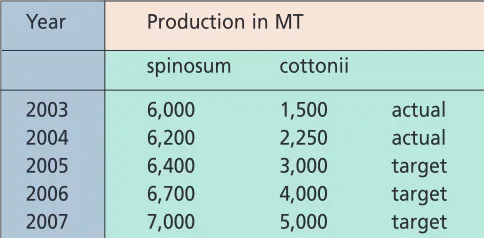
The success of the SDSP will be measured against the cottonii
production target of 5,000 MT of exports per year by 2007, as well as the extent to which the strategies in the SDSP have been implemented. A further measure of success will be indicated by the production of spinosum. The target of the SDSP in spinosum
production is to slightly increase current levels of production over time and to expand in those areas that are not suitable for cottonii
production. Tanzania currently produces about 20% of the
spinosumin the world market. By 2013, the goal is to increase world market share to 33%, or an increase of approximately 6% per year.
Table 2: Seaweed Production Target in Million MT
Year Production in MT spinosum cottonii
2003 6,000 1,500 actual
2004 6,200 2,250 actual
2005 6,400 3,000 target
2006 6,700 4,000 target
2007 7,000 5,000 target
6.0 IMPLEMENTATION STRATEGIES, ACTIVITIES, AND ROLES
In the following pages, 15 strategies for developing the seaweed sector in Tanzania are organized in seven thematic areas:
1. Empower Seaweed Farmers and Seaweed Producer Groups 2. Applied Research, Training and Extension
3. Site Selection
4. Enhancing Social Benefits 5. Environmental Sustainability
6. Enabling Environment
7. Post-Harvest Handling and Processing
Specific activities are outlined for each strategic area and the institutions most relevant to the activities are indicated. Although specific institutions are listed in the following strategies, those or other implementing institutions may require additional resources and/or financing to realize the activities.
Photo Credit: J. Kreag SEEGAAD
Strategy 1
Form Producer Groups In Villages
In general, the cottoniiindustry is typical of a relatively new industry with only individual farmers and no producer or exporter associations. Secondly the government, while creating a generally favorable environment for the industry, has played only a minor role in supporting its development. As the industry is poised to expand much more rapidly, there is a need for more and better dialogue between all seaweed industry parties.
When seaweed farming first starts in a coastal village there may be 10-30 farmers involved in production, therefore, it is relatively easy for a developer or the local government to communicate with groups of this size. However, as seaweed production expands, developers will have to communicate with 100-700 or
more farmers in the same area, thus supporting the need for association development. An increase in production area may also result in territorial disputes and issues such as access, as well as other resource conflicts. By creating organizations, associations, or groups, members will be well - represented at meetings and other forums to address problems and find solutions as situations arise.
Theme 1: Empower Seaweed Farmers and Seaweed Producer Groups
Photo Credit: F. Urio SEEGAAD
Therefore, SDSP recommends the establishment of Village Seaweed Producer Groups in seaweed farming areas to facilitate communication among producers, developers and all other relevant seaweed industry participants. For example Mlingotini village has formed two seaweed farming groups with formal structures and officers including chairperson, secretary, and treasurer. Such groups would be particularly beneficial when dealing with farming agreement renewals. Each group should be a community-based group or cooperative organization recognized by the Village and District government. In the future, such groups could be organized as a cooperative, limited liability partnership, association or other legally recognized group.
Strategy 2
Increase Seaweed Farmer Access To Micro-Credit
Very few Tanzanian producers have the financial means to begin seaweed farming on their own, and even if they had, they would generally feel overwhelmed by the high-risk involved. Tanzanian producers therefore need financial support.
Although bank financing is available for Tanzanian micro enterprises, most financial institutions prefer to provide credit to established individuals or groups of producers. Therefore, there is a need to encourage farmers to establish their own associations where they are producing consistent quality and quantity and then are ready to approach various credit facilities which are available in Tanzania. When producers become self-financing, the increased competition to buy seaweed should result in higher prices. The price increase might be in the range of 25 percent.
Activities:
Establish Seaweed Producer Groups in villages.
Experiment with organizations that offer innovative micro credit schemes and willingness to lend to individual farmers or to producer associations. Guidance may be requested from the Fisheries Division & local government, Ministry of Marketing and Cooperatives, Ministry of Home Affairs.
Strategy 3
Support Effective and Equitable Farming Agreements Between Producers and Buyers
At present all of the cottonii in Tanzania is grown by producers under exclusive agreements with developers (usually for five years) who are providing them with the materials and extension assistance. Such an agreement with the village is considered essential as it takes one or two years to develop a new area to a level of production that generates net profits. Where such agreements exist, and when new ones are signed, they should continue to be honoured and enforced. The SDSP anticipates that the Government of Tanzania will play a more active role in ensuring that both developers and producers meet their reciprocal obligations under such agreements.
Villagers, producers, and developers should be aware of the farming agreement option, reasons for it, benefits from it and responsibilities under it. Each entity should also understand that the agreement places equal weight on all parties to exercise their best efforts to perform. The District Fisheries Officer should provide oversight to ensure that developers work closely with village and village officials to help guarantee that the
Activities:
Photo Credit: J. Sachak SEEGAAD
Farmers negotiating agreement with developers
content of the agreement is appropriate and modify it accordingly. The District Fisheries Officer should provide assistance in reviewing the agreement before signing. Also, prior to signing, a meeting should be held in the village with all current and potential seaweed farmers to explain the proposed agreement and emphasize the responsibilities of each party involved.
• A new agreement can be drawn up with the same developer or with a different developer with the terms revised according to the desire of all parties concerned
• Village producers may decide to operate independently, i.e. self-finance
Developers have indicated they cannot afford to invest, under an agreement, in a number of producers in a village and at the same time buy at a higher price from self-financing producers. Experience has shown that the farmers under farming agreements quickly, and illegally, find a way to sell most of their production outside of the farming agreement making it impossible for the developer to recover development costs. Perhaps any one village must either be fully financed by developers or fully independent. Villages should establish a committee/cooperative of seaweed producers to explore available options when agreements expire.
Activities:
1. Promote a standard format for farming agreements between developers and producers(see farmer agreement template in Appendix 1). (Fisheries Division, Developers, Farmers, local
government)
2. Validate farming agreement language before signing and implementation and disseminate said documents to all legal bodies at the district level. (Fisheries Division legal officers & Local Government Attorney and Attorney General)
Strategy 4
Promote better seaweed production technologies
In order to establish credibility in the world market and maintain industry standards, periodic training for both developers and producers is required. The Fisheries Division and district officials should conduct periodic
assessments to identify required training skills. To improve seaweed farming production, training and technology courses should be available to producers, developers and coastal fisheries extension officers. The following themes are relevant in seaweed production and are appropriate for training and technology courses: site selection, seedling selection and retention, planting and cultivation, harvesting, drying, packing and storing, quality control, and business planning and economics.
Theme 2: Applied Research, Training and Extension
Activities cont’d:
4. Introduce a conflict resolution procedure for cases in which developers improperly purchase cottonii from producers (e.g., without a farming agreement with the producer) (District Fisheries Officers. Local Government, Fisheries Division)
5. Provide advice and guidance to villages during negotiations between developers and producers when agreements expire.
(District Fisheries Officers & Cooperative Officers & District Community Development Officers)
Photo Credit: J. Sachak SEEGAAD Harvesting seaweed in
Strategy 5
Demonstration and extension
“Model seaweed farms” are individual farms that demonstrate effective seaweed farming production techniques. Model farms should produce at least 200 kg of cottonii (dry weight) per fortnight and ideally there would be at least one in each village. Model farms are essential for demonstrating efficient production techniques and showing farmers that generating significant income from cottonii farming is a realistic ambition and can be supported by both public and private sector.
To facilitate the
1. Conduct training needs assessments for producers, local developers and Fisheries extension personnel. (Donor, Local Government and Fisheries Division)
2. Implement and evaluate appropriate training courses.(Donor, Local Government and Fisheries Division)
Photo Credit: F. Urio SEEGAAD
Strategy 6
Improved post-harvest handling of cottonii
In general, the quality of cottoniiexported from Tanzania is as good as or better than the average quality of the world market supply. Constant supply and the ability to meet industry quality standards will benefit both developers and producers. Quality standards include the followings:
Activities:
1. Select two model seaweed farms per village (1 woman and 1 man) in 10 villages. (District Fisheries Officers)
2. Guide model farmers in “best management practices.” (District Fisheries Officers, Developers, International seaweed processors, and Donor) Provide training on basic business skill to producers Local Government in collaboration with Development NGO’S
Photo Credit: J. Kreag SEEGAAD
1. Moisture content of the seaweed to meet the requirements of the buyer, currently it is 30%, but from some areas buyers will accept up to 35% moisture;
2. Minimal amounts of foreign matter; 3. Salt and sand thoroughly shaken off;
4. Dried under hygienic conditions (e.g. free from animal excrement); 5. Not exposed to water (e.g. rain) during the drying process;
6. Limited storage time prior to sale.
Producing consistent quality seaweed at industry standards is important for two main reasons: 1) it attracts better prices; and 2) in times of excess supply, the highest quality products are sold over less high quality products. Some actions that will further improve the quality of Tanzanian seaweed: • Encourage and insist that producers do not dry seaweed on the
ground
• Use of screening trays at all buying stations to ensure that excess sand and salt is shaken off the seaweed before it is weighed
Photo Credit: J. Sachak SEEGAAD
• Ensuring that producers have access to plastic sheeting or other means of keeping their seaweed dry (particularly during rains) • Display posters at all buying stations, detailing quality requirements
and procedures for attaining such quality as well as explaining the reasons for such requirements. Full cooperation and support of buyers, the government and development projects are essential to improving seaweed quality.
Currently in Tanzania, the price paid for seaweed by the a developer is significantly lower than global beach price. Additionally, there is no price differentiation for higher quality seaweed – the same price is paid everywhere which is a disincentive to farmers to invest in improved post-harvest handling techniques. Producers understand that the more they clean and dry their seaweed harvest, the smaller their profit. Therefore, to earn the greatest profit, producers do the least amount of drying and cleaning of the seaweed possible; drying and cleaning the seaweed just enough to satisfy buyers.
In locations where there is more than one buyer, the problem is amplified as buyers who are known to allow the poorest quality seaweed tend to get the greatest fraction of the seaweed production.
Photo Credit: J. Kreag SEEGAAD
Soon buyers are competing to accept the poorest quality to in turn get the greatest fraction of the total seaweed production. If such a situation is allowed to persist, it will hurt Tanzania’s seaweed farming industry, resulting in lower prices to producers and a negative effect on Tanzania’s seaweed farming industry’s reputation world-wide, ultimately affecting prices of other exporters.
Designating a certification system for Tanzanian’s seaweed will establish quality requirements and guarantee oversea buyers the quality they pay for, for example, if a higher price is paid for higher quality seaweed, there will be an incentive for producing higher quality. Therefore, buyers should be encouraged to pay higher prices based on good quality and lower price for poor quality, rather than one price for any quality. A conference with the government and industry representatives should be held to agree on seaweed standards, i.e. the certification system grading process and design of an implementation plan.
Activities:
1. Encourage the promotion of best practices including buying standards and prices. (District Fisheries Officers, developers, research institutions)
2. Establish a seaweed quality certification system. (Fisheries Division, developers)
3. Encourage the use of drying racks and plastic sheeting. (District Fisheries Officers, developers)
4. Equipment buying stations with screening trays. (Developers)
Strategy 7:
Support research on cottonii
Seaweed industry stakeholders have identified numerous areas of research that are potentially beneficial to Tanzania’s cottoniiindustry. For example, research is needed to identify strains of cottoniiwhich are more resistant to variation in temperature and salinity which are the main causes of die off.
Monitoring of sea and weather conditions in relation to seaweed growth would enable producers to take preventive actions to reduce production losses from warm water, low salinity, high winds, and other weather related issues. Information on the effects of certain conditions on seaweed production is available at, for example, www.oceanweather.com.
The site provides only general information, and therefore needs to be supplemented with local information. For local information, data on local
Photo Credit: J. Kreag SEEGAAD
weather and corresponding crop data needs to be monitored, as well as the time of year and sea conditions under which pest weeds and Epiphytic Filamentous Algae (EFA) flourish and clear preventive measures farmers can take to prevent seaweed crop loss.
Research is needed to understand EFA, to determine which conditions trigger attacks and whether all cottonii strains are equally susceptible. Another research priority involves breeding and strain selection programs to develop more hardly and rapid growing strains of cottonii, possibly also with other characteristics deemed most desirable by end user. Cross breeding requires growth chambers and knowledge on how to get many algae to bloom concurrently, which may be available at the Institute of Marine Sciences.
Additionally, herbivory studies are needed to understand the habits of fish that feed on seaweed and reduce harvest. The information from these studies could help producers take actions to mitigate losses.
Activities:
1. Convene periodic multi-stakeholder meetings to identify research priorities and improve collaboration on seaweed research. (Fisheries Division, developers, research institutions and processing companies).
2. Pilot fish farming practices (such as cages) that reduces herbivory.(Institute of Marine Sciences)
3. Encourage graduate and post-graduate theses’ on applied seaweed research(Faculty of Aquatic Science and Technology and Institute of Marine Science, University of Dar es Salaam; Tanzania Fisheries Research Institute)
Strategy 8
Create database of existing seaweed farming sites and identify new suitable sites for cottonii cultivation
A suitability study and for a process of zoning and would be a key well as key biophysical characteristics of optimal cultivation conditions (e.g. current, salinity, water quality, etc.). An inventory of undeveloped and suitable seaweed farming sites should be kept on record in all coastal districts and regional and national offices.
Theme 3: Site Selections
Photo Credit: J. KREAG SEEGAAD
Strategy 9
Establish and demarcate seaweed farming areas
The seaweed industry is constantly expanding, therefore farms continue to expand and sea user conflicts inevitably arise with fishers, and other users of the reefs flats. To avoid conflicts, areas reserved for seaweed farms should be officially established by the village and demarcated. A participatory approach involving all users should be used in the demarcation process.
Demarcation, in this case, does not mean that individual farmers will obtain ownership of the reef areas where they are farming.
Village government in collaboration with Village Seaweed Producer Groups (see Strategy 2) should also establish rules as to when an area previously being used by a seaweed farmer is considered abandoned and available for another farmer to utilize.
Activities:
1. Develop a database and map of current cottonii production sites including information on current and past production, other relevant information and whether the site is governed by farming agreements. (Fisheries Division & Local Government)
2. Conduct suitability studies of new sites and create a digital database and map of suitable sites (Fisheries Division & Local Government)
Photo Credit: C - Weed Corporation
Strategy 10
Gender considerations
In most coastal communities, labour is generally divided between men and women. When it comes to fishing, men are primarily involved. The role of women in fisheries is mainly limited to the intertidal collection of sea urchins, gleaning for shells and squids in the reefs, and the processing and marketing of fish products. Women are also the primary producers of intertidal farmed seaweed. Also apart from engaging in fisheries, women have other income generating activities which include weaving hats, mats and coconut leaves and roofing materials, ‘makuti’.
The introduction of seaweed farming has brought changes in rural coastal socio-economics. Women are now able to gain income independently, and thus contribute to the household economy, such as paying for children’s school fees, medicine, etc. Nearly 90% of seaweed farmers on Zanzibar are women, the dynamic is much the same on the mainland, perhaps due to the fact that most do not regard it as a profitable business. However, through
Theme 4: Enhancing Social Benefits
Activities:
1. Conduct coastal resource use assessment (beginning with high seaweed cultivation areas) and prepare resource use map
(Local Government, ICMU)
2. Demarcate seaweed-farming areas and provide producers with demarcation materials (e.g. buoys).(Village Assembly, Local Government, Fisheries Division)
the implementation of the SDSP and the expected expansion of the seaweed farming industry, men may come to realize the relatively high-profit available in the seaweed farming business, and eventually seek to dominate it. Therefore, all parties involved with the SDSP must exercise sensitivity to gender issues to ensure that both women and men have equal opportunities.
Photo Credit: J. Kreag SEEGAAD
Seaweed farm in Mtwara Photo Credit: F. Urio SEEGAAD
Dragging seaweed to shore in Kilwa
Photo Credit: F. Urio SEEGAAD
Strategy 11
Protect the coastal environment
Seaweed farming is believed to be relatively environmentally benign. Possible positive impacts include: nutrient sink, primary production, marine life habitat and a sense of ownership/stewardship over the coastal area instilled in farmers. Potential negative impacts include clearing of seagrass and marine organisms in the intertidal area of production. The magnitude of both positive and negative impacts in our coastal water is not well known. However in experienced countries such as the Philippines and Indonesia these issues are well documented.
Environmentally damaging activities, such as dynamite fishing, cyanide fishing, coral harvesting, and over fishing, should be addressed through education posters are just a few examples of the
Photo Credit: J. Kreag SEEGAAD
Photo Credit: J. Kreag SEEGAAD
Extension staff discussing with farmers
Activities:
2. Education on environmental pollution prevention.
Photo Credit: Lugazo Zuberi SEEGAAD
Improved method of cultivation - Kijijini Muheza
Photo Credit: J. Kreag SEEGAAD
Strategy 12
Increase awareness of the benefits of cottonii production
Within the government, private sector and foreign assistance community the seaweed industry’s potential is often under appreciated. Much of the reluctance of these three bodies towards rural coastal community business opportunities and particularly towards the seaweed industry is due to the relatively modest spinosum prices, the seaweed predominantly produced in Tanzania. However, in areas where cottonii grows well, such as on the Southern Coastline and other selected areas, it produces attractive returns for both producers and developers. Therefore, to promote cultivation of
cottonii, awareness raising campaigns are needed.
Strategy 13
Clarify taxation issues
The system of import and export tariffs on seaweed inputs and export of dried seaweed products should be clarified. In addition, the national system of royalty fees on seaweed purchases needs to be reviewed and standardized. In some cases, developers are paying 5 percent royalty fees on the value of seaweed purchased at multiple levels of government (village, district and national).
Activity:
1. Raise awareness of the benefits of cottoniiproduction through the use of media and other communication tools. (Fisheries Division)
Strategy 14
Provide technical and marketing information
Providing seaweed stakeholders with technical and market information is essential to the expansion of the industry. The Fisheries Division should establish a Market Information Centre (MIC) where such information is available. The Fisheries Division should also establish other schemes to ensure the technical and market information reaches producers and developers.
Information can be accessible in a variety of manners such us radio programs (at the start of the cottonii production season), articles for newsletters/newspapers, posters, seaweed calendars, and information leaflets. Community development organizations, politicians and other influential people should be involved in creating technical and marketing information awareness.
Activities:
1. Establish a MIC to provide technical and market information to seaweed stakeholders in areas where no trade associations exist.(Fisheries Division)
2. Coordinate email relationships with counterparts in other cottonii and Spinosum producing countries for the purpose of sharing international information on seaweed markets.
(Fisheries Division) Activities:
1. Provide regular follow-up to ensure seaweed production inputs are duty and VAT free. (Fisheries Division, TIC)
Strategy 15
Semi processing plants
In countries with successful seaweed industries, there is usually an interest in exploring the possibility of establishing semi-processing plants. However, Tanzania does not yet have sufficient production of seaweed to make a plant cost-effective. In fact, the semi-processing carrageenan industry is currently lagging in Indonesia, a country that has a relatively large number of plants, where several lie idle.
It is estimated that processing plants cost around US$ 1 million and are viable at a minimum of 2,000 MT of seaweed production per year.
With the implementation of the SDSP, the intermediate goal of 5000 MT by 2007 is a realistic goal. The minimum production levels to make semi-processing feasible may decline over time with technological improvements.
Once semi-processing plants become sound business venture care will need to be taken to ensure international price competition yet also ensure an adequate supply of local product is available at the plant.
Activities:
1. Improve understanding of the economics and technology of seaweed processing, especially in terms of the potential to create value added (IMS, College of Engineering and other UDSM Departments; Fisheries Division; TIRDO)
2. Follow new developments in semi-processing plant technologies and economics.(IMS, College of Engineering and other UDSM Departments; Fisheries Division; TIRDO)
7.0 PERIODIC REVIEW AND INSTITUTIONAL OVERSIGHT
The Intersectoral Task Force that prepared this Strategic Plan (the Mariculture Working Group under the leadership of the Fisheries Division) will continue to provide oversight and guidance on the successful implementation of the Plan. A meeting of the Task Force will be convened bi-annually to review the Plan and assess progress achieved. The Plan will be evaluated, adopted and improved on a continuing basis by the Task Force cognizant of the successes and failures encountered. The Fisheries Division with other partners (e.g. ICMU) will also actively seek the financial and in-kind assistance of local and external donors, seaweed companies, and other groups to successfully advance the strategies and actions of the SDSP. In this capacity, the Task Force will play a role in defining and promoting common key guidelines for development assistance to the seaweed industry in Tanzania. For example:
1. Interventions should support this SDSP and be consistent with its objectives and strategies;
2. Avoid subsidies that create an unsustainable dependency on the part of producers;
3. Ensure that there are provisions for extension advice after development projects end; and
References
FAO. 2001. Fishery Country Profile –Tanzania. United Nations Food and Agriculture Organization, Rome.
FAO. 2003. A Guide to the Seaweed Industry. FAO Fisheries Technical Paper 441, United Nations Food and Agricultural Organization, Rome. 105pp.
Jaasund, E. (1976). “Intertidal Seaweeds in Tanzania: A Field Guide,” Bot. Mar., 20: 415-425.
Mshigeni, K.E. (1973). “Exploitation of Seaweeds in Tanzania: the Genus Eucheuma and other Algae,” Tanzania Notes Rec. 72: 19-36. Mtolera, M.S.P. (1995).“Photosynthesis, Growth and Light-induced Stress
Responses in the Red Algae Eucheuma denticulatum,” Ph.D.Thesis. URT. 1997. National Fisheries Sector Policy and Strategy Statement.
Government of Tanzania, Dar es Salaam.
SAMPLE FARMING AGREEMENT FOR DEVELOPMENT OF SEAWEED FARMING
This agreement is made this ……...…..… day of …….…...…... 2005
BETWEEN
__________________ VILLAGE GOVERNMENT of P. O. Box ______________ (hereinafter called the VILLAGE GOVERNMENT) of the one part.
AND
……… ………...……… ………...…
of P.O. Box ………...….. (hereinafter called the DEVELOPER) of the other party.
WHEREAS the VILLAGE GOVERNMENT is desirous of being supplied with inputs to grow cottonii/spinosum by the DEVELOPER and of being provided with a market for the same, and;
WHEREAS the DEVELOPER is willing to supply the said inputs and market.
NOW THIS AGREEMENT witnesses and the VILLAGE Government and DEVELOPER agree as follows:
1. That the VILLAGE Government (being the governing body) will use its authority to ensure that its farmers will keep the same for their intended purposes.
2. That the village Government will represent all the seaweed farmers in anything pertaining to the growing of cottonii/spinosum.
3. That the DEVELOPER will be the sole purchaser of seaweed from producers.
5. That the VILLAGE will assist the DEVELOPER in insuring that the farmers they represent in this agreement understand the aim and contents of the contract and that they accept and participate with honesty and diligence in progress that will come out of this agreement.
6. That the inputs (rope, tie-tie, floats, etc) will remain the property of the DEVELOPER and the DEVELOPER has the right to demand the return of all the inputs from any farmer who may be selling to other purchasers using inputs for purposes other than seaweed farming, or who sell to the DEVELOPER less than half the amount of seaweed per line that other producers in the village are selling.
7. That the DEVELOPER will have the right to refuse to provide farming materials to interested producers whom have in the past been provided with materials and have failed to produce and sell to the DEVELOPER an annual minimum of 5 kg per 20 meters line provided. Likewise the DEVELOPER may refuse to provide materials to additional farmers if the DEVELOPER has met the minimum requirements of this agreement and has insufficient supplies of materials or seed stock to meet requirements for additional farmers.
8. That the VILLAGE GOVERNMENT and the DEVELOPER together
agree that the price of seaweed can rise or fall at any time, as it does with other produce, depending on the conditions of the market at that particular time.
9. That the VILLAGE GOVERNMENT will assist the DEVELOPER in making sure that production of high quality seaweed is achieved, and using standard industry hygiene practices in the drying process as elaborated in appendix ‘B’.
10. That appendices ‘A’ to ‘C’ in this agreement shall be deemed to form and be read as part of this agreement.
11. That this agreement may be amended, renewed or replaced at any time upon the mutual consent in writing of the DEVELOPER, VILLAGE GOVERNMENT and witnessed by the District Fisheries Officer (acting on behalf of the District Executive Director).
13. That this agreement may be terminated in the events stipulated /stated in appendix ‘C’ of this agreement.
14. That the duration of this agreement will be five (5) years, or other mutually agreed period of time, commencing from the date of signing this agreement.
IN WITNESS WHEREOF the parties hereto have executed this agreement the day, month and year as follows:
SIGNED AND DELIVERED
BEFORE ME: ... ADVOCATE/MAGISTRATE
SIGNED AND DELIVERED
APPENDIX A
The DEVELOPER agrees to support development cottonii/spinosumseaweed farming with the following actions representing a minimum level of development considered acceptable to remain in compliance with the agreement.
Price:
• The DEVELOPER agrees to pay a price commensurate with the beach price of dried seaweed in the world market taking into consideration the cost of inputs given to the farmers for producing the seaweed, acknowledging that prices may increase or decrease over the duration of this agreement..
• In addition, with reference to any declines in the price, the DEVELOPER agrees that the farmers are entitled to information and explanations as to the cause of the price decrease. In the event the farmers are not satisfied with the explanations given to them, they have a right, through their representative and /or the VILLAGE to complain to the District Fisheries Officer (acting on behalf of District Executive Director) who will investigate the validity of the explanations offered to the farmers and report back to them.
• The DEVELOPER agrees to display the current buying price/s for seaweed at the buying station.
Development Assistance:
• In the first year the DEVELOPER will conduct trials to determine if cottonii/ spinosumseaweed grows well on the reef areas of village; and
• In the first year the DEVELOPER will assist a minimum of ………. farmers to enter into cottonii/spinosumfarming with the intention that as the farmers multiply their seed stock they will be provided with additional materials and extension advise needed to operate on average (ninety) 20 metres lines of growing seaweed; and
• In the second, third, fourth, and fifth years the DEVLOPMER will assist additional farmers to enter into cottonii / spinosum farming with the intention that as the farmers multiply their seed stock they will be provided with additional materials needed to operate on average (ninety) 20 meters lines for growing seaweed, so that there are minimum
Buying schedule:
The DEVELOPER, the sole purchaser of seaweed from the producers of ……… village, agrees to purchase for cash all seaweed meeting quality standards according to the following schedule.
1. At least once a week when the amount is more that 4 tons. 2. At least once a fortnight when the amount is between 1 – 4 tons 3. At least once a month when the amount is between 500 – 1000 kg 4. At least once every two months when the amount is less than 500kg
Procedures in situations where the DEVELOPER fails to purchase the seaweed in accordance with the agreed schedule above.
• It is put to order that if the DEVELOPER fails to buy the seaweed within 15 days from the last date allowed under the schedule above, the VILLAGE will complain in writing to the District Fisheries Officer (acting on behalf of District Executive Director) who in turn will inform in writing the DEVELOPER and ask him to purchase the seaweed within 15 working days. In the event the DEVELOPER still fails to purchase the seaweed, the District Fisheries Officer (acting on behalf of District Executive Director) will issue an emergency permit valid for 30 days to permit the farmers to sell the crop to another buyer, who will be mentioned in this permit for the aforementioned period only.
• If the permit is issued by the District Fisheries Officer (acting on behalf of District Executive Director) with reference as above, it will show amount of crop that has been authorized for sale to the other buyer, who will be mentioned, and the validity of the permit. It should be openly known that this permit will not allow the farmers to sell their crops to the other buyer after the expiration of the permit, these farmers will still be under this contract with the DEVELOPER and the terms of this agreement will be binding.
• When the permit is issued, the DEVELOPER must be issued with a copy seven days before the starting of the use of permit and that the developer will not be allowed to protest.
Appendix B
Quality Standard
• The DEVELOPER agrees to clearly set fourth required quality standards at the buying station including the use of photographs and a fact sheet of requirements.
• VILLAGE recognizes that the seaweed is used in many food and other products that are eaten by people. Thus the Village Government recognizes the need for hygiene in the drying process and will assist the DEVELOPER and the farmers to achieve high quality for the seaweed. This will include encouraging all producers to dry their seaweed on drying racks off the ground. However if some farmers are not using drying racks, the VILLAGE Government will use its authority to ensure that such seaweed is not dried directly on the bare ground and that no livestock or other animals (such as chickens, ducks, pigs, goats, cows, dogs, etc) are allowed in the drying areas.
• VILLAGE Government recognizes that water, such as rain can spoil the seaweed when it is drying as the water can wash the carrageenan (the extract from seaweed) out of the seaweed. Thus the VILLAGE Government will encourage all farmers to be quick to cover or remove seaweed so that it will not get wet from rain.
Appendix C
Termination
• In the event that the DEVELOPER fails to meet the minimum levels of development established in this agreement, VILLAGE, through the Director of Fisheries (on behalf of the Ministry of Natural Resources and Tourism) and with the approval of the said Director may terminate this agreement under the following conditions:
• The DEVELOPER must be given a minimum of 60 days notice of intent to terminate the agreement stating the reasons for the proposed termination. During the notice period the DEVELOPER may rectify the deficiencies or appeal to the Director of Fisheries (on behalf for the ministry of Natural Resources and Tourism) stating his reasons why the termination should not be granted.
• Should the termination be granted the DEVELOPER shall have the right to demand that all inputs supplied to producers and still in use, be returned to the DEVELOPER.
• In the event that there are insufficient qualified farmers who are interested in producing seaweed so that the DEVELOPER is unable to meet the minimum levels of development set forth in this agreement, the DEVELOPER may either terminate the agreement and withdraw support for the growers or the DEVELOPER may apply to the VILLAGE Government, District Fisheries Officer (for District Executive Director), Director of Fisheries (for the responsible ministry) for an amendment to the agreement.
Published by Tanzania Coastal Management Partnership
in collaboration with ACDIVOCA SEEGAAD project