Full Terms & Conditions of access and use can be found at
http://www.tandfonline.com/action/journalInformation?journalCode=vjeb20
Download by: [Universitas Maritim Raja Ali Haji] Date: 11 January 2016, At: 22:01
Journal of Education for Business
ISSN: 0883-2323 (Print) 1940-3356 (Online) Journal homepage: http://www.tandfonline.com/loi/vjeb20
Implementing Mission-Driven Assurance of
Learning: Improving Performance Through
Constructive Collaboration
Joan Marques & Nathan Garrett
To cite this article: Joan Marques & Nathan Garrett (2012) Implementing Mission-Driven Assurance of Learning: Improving Performance Through Constructive Collaboration, Journal of Education for Business, 87:4, 214-222, DOI: 10.1080/08832323.2011.593588
To link to this article: http://dx.doi.org/10.1080/08832323.2011.593588
Published online: 29 Mar 2012.
Submit your article to this journal
Article views: 97
ISSN: 0883-2323 print / 1940-3356 online DOI: 10.1080/08832323.2011.593588
Implementing Mission-Driven Assurance of
Learning: Improving Performance Through
Constructive Collaboration
Joan Marques and Nathan Garrett
Woodbury University, Burbank, California, USA
Assurance of Learning (AoL) practices can be implemented in a variety of ways, as long as they are geared toward business schools’ missions and curricula. The authors first address the purpose of implementing AoL, and briefly evaluate the ongoing debate about the pros and cons of the Association to Advance Collegiate Schools of Business’s policies regarding AoL procedures in business schools. The authors then report how a small-sized, private business school implemented the AoL process in its bachelor of business administration program in a manner that satisfies accreditation requirements without losing its institutional or disciplinary distinctiveness. The authors end with lessons learned about how an assessment program can satisfy accountability needs while still encouraging flexibility and innovation.
Keywords: advantages, assessment, assurance of learning, concerns, education, improvement, measures
Education’s purpose is to replace an empty mind with an open one.
–Malcolm S. Forbes (n.d.)
Assurance of Learning (AoL) can no longer be labeled as an insignificant, unnecessary, or redundant practice in the continuously interconnecting and transforming world of higher education. Yet, while AoL has become a crucial com-ponent of verifying whether an institution is achieving its purpose, the practices involved in gathering AoL data are not always warmly received in academia. The Association to Advance Collegiate Schools of Business (AACSB), one of the largest accreditation agencies for business schools world-wide, mandates its members and aspiring members to formu-late AoL practices tailored to their mission statements. This adaptable requirement substantially differs from the agency’s pre-1990 approach, and is applauded as well as criticized by different groups of scholars for different kinds of reasons.
Correspondence should be addressed to Joan Marques, Woodbury Uni-versity, School of Business, 7500 N. Glenoaks Boulevard, Burbank, CA 91504, USA. E-mail: [email protected]
In this article we first present some highlights from the ongoing debate regarding advantages and concerns of AACSB-instructed AoL procedures in business schools. Sub-sequently, we present the AoL process of a small-sized busi-ness school to suggest an truly bottom-up method to assess-ment and curriculum developassess-ment. This approach has the advantages of aligning with the AACSB AoL requirement for continuous improvement and external accountability, but also allows for innovation and experimentation. Last, a num-ber of methods to building faculty buy-in are summarized with lessons learned. The results presented are useful for any school attempting to move to the broader program fo-cus required by AACSB accreditation, as well as for those attempting a rapid pivot in assessment focus during a short timespan.
ASSURANCE OF LEARNING: ADVANTAGES AND CONCERNS
To ensure that what an institution intends to teach is also actu-ally learned by its students, the AACSB requires rigorous and continuous AoL. Beard, Schwieger, and Surendran (2008) said that “[a]ssessment should be consistent with the mis-sion of the university, college, program, and fields of study and should be integrated into accountability and continuous
IMPLEMENTING MISSION-DRIVEN ASSURANCE OF LEARNING 215
improvement of learning and teaching” (p. 238). Beard et al. further recommend identifiable, measurable, nonintrusive, and reasonable goals, objectives, and standards for student performance; the development and use of a broad range of measures to demonstrate assurance of learning; and instate-ment of experiential learning opportunities, in which col-laborative projects with cutting-edge business practitioners, business organizations, student groups, and multiple faculty members are involved.
With the modified guidelines offered by AACSB since 2006, there is an ongoing debate regarding the role and ef-fects of the AoL process for business schools. While some scholars (e.g., Kelley, Tong, & Choi, 2010; Martell, 2007; Romero, 2008; Sampson & Betters-Reed, 2008; Treleaven & Voola, 2008) applaud the increased flexibility and poten-tial of the new AoL approach, others (e.g., Kilpatrick, Lund Dean, & Kilpatrick, 2008; Scott & Ofori-Dankwa, 2006) feel that AACSB’s reporting and measuring requirements still re-sult in excessive rigidity, narrow focus, and inhibit schools’ flexibility. Yet others (e.g., Francisco, Noland, & Sinclair, 2008; Lowrie & Willmott, 2009) criticize exactly the flex-ibility that some praise in AACSB’s modified approach. In the next section, we briefly review the reasoning behind these opposing perspectives.
Perceived Advantages of AoL
Authors who advocate the implementation of AoL in business programs list factors such as transparency, consistency, clar-ity, and increased faculty collaboration. Kelley et al. (2010), for example, underscored that the AoL process does not only benefit students, but educators as well, as they obtain clar-ity in the effectiveness and usefulness of what they teach. Kelley et al. elucidated that assessment can serve as a for-mative evaluation of actual learning between students and instructors and a summative review, useful to the student, the institution, and outside stakeholders. Pointing out the multi-tude of ways in which AoL can be measured, thus revealing its flexibility, Kelley et al. affirmed, “AACSB recommends assessment measures should be embedded in a course but may include competency outcome measures that cut across the curriculum” (p. 300). Zooming in on possible ways of conducting AoL, Kelley et al. set out to examine the AoL practices of 49 AACSB-accredited schools, and found that the measures varied widely, from written, course-embedded, and oral assignments graded with rubrics to cases, field tests, and common school exams. Indirect assessment was imple-mented through another range of instruments such as sur-veys, mostly taken from graduating students, alumni, and their employers; exit interviews with graduating students; and evaluations of supervisor findings in internships.
Sampson and Betters-Reed (2008) took a different road in highlighting the advantages of AoL by focusing on the multiplicity of AACSB-approved measuring topics through-out the business curriculum. They list learning through-outcomes
such as communication, ethics, analytical skills, use of in-formation technology, multicultural understanding, organi-zational dynamics, local and global environments, and other management specifics. Sampson and Betters-Reed stressed, however, that the specific AoL topics should be determined by the respective institutions, and serve to demonstrate ac-countability and alignment between educational quality and goals, as well as to satisfy requirements for accreditation, le-gal standards, improvement, and decision-making. Treleaven and Voola (2008) also presented a number of learning out-comes, but arrived at their selection by focusing on business students’ perceptions of important learning outcomes. Tre-leaven and Voola’s list included leadership, communication, a global perspective, and future-oriented critical reflection, which includes greater awareness and enhanced scrutiny of accepted truths.
Some of the proponents of the AoL procedure, such as Martell (2007), have warned that it may not be welcomed with equal enthusiasm among faculty members, specifically because it poses challenges and greater attunement amongst course contents, measuring principles, and techniques. To demonstrate that ongoing implementation and increased fa-miliarity with the process improve faculty buy-in, Martell presented the findings of a longitudinal study in which mul-tiple business schools were involved. The study revealed that the experience of having a well-formulated learning focus for graduating students and the opportunity to debate with other faculty members about learning goals consistently led to greater collaboration and satisfaction for administrators and faculty members.
Concerns About Implementing AoL
Many sources challenge this AoL approach. Scott and Ofori-Dankwa (2006), for example, considered performance of business schools from a strategic angle, and argued that the core process characteristics of accreditation may hinder these institutions from performing optimally in the rapidly evolv-ing competitive business environment of the 21st century. Scott and Ofori-Dankwa contended that there is a simul-taneous surge of two opposing trends. First, technological innovations call for more flexibility and speed in strategic al-terations in order to stay abreast in a hypercompetitive busi-ness climate. Second, accreditation practices (also described as the movement of accreditocracy) require business schools to change their faculty demands, research requirements, and curriculum, as well as increase their monitoring processes to be in conformance with the process expectations and require-ments of accrediting bodies. Scott and Ofori-Dankwa further explicated that meeting accreditation requirements demands a continuous cycle of four major, time-consuming actions: (a) a formalized assessment process; (b) conscientious record keeping for external accountability; (c) accumulation of hard data, which needs to be gathered and represented through “quantifiable, numerical, and presumably “objective”
measures” (p. 228); and (d) continuous improvement, which demands incremental progress, and inhibits any possibility of making surprising leaps to gain a competitive advantage. They also warned that a strict demand on quantitative mea-sures may cause business schools to feel pressured in manip-ulating their numbers in order to meet or surpass standards.
Also among those who express concerns are also Kilpatrick et al. (2008), who asserted that AACSB’s AoL requirements drastically oppose the 21st century trend of liberal arts–based education, involving the whole mind in the learning process. These authors stress that AoL measures require increasing strictness and uniformity in course structuring, thus inhibiting the rich, creative, and interactive teaching that today’s ever-changing business environment demands. Kilpatrick et al. expressed specific concern about the increasing reliance that seems to be placed on quan-titative measurements and standardized assessment tools. They warned that the current AoL requirement may result in exactly the opposite of AACSB’s claims to provide business schools freedom in determining their AoL practices, simply because the demands of proving uniformity in learning calls for increased rigidity. In addition, Kilpatrick et al. brought up an interesting point regarding AACSB’s demands for business school faculty:
Bennis and O’Toole indicated that legal and medical educa-tion require practical experience—and is taught by practicing lawyers and physicians. Business education, though, is left to scholars whose work is published in top journals with no dis-cernable connection to real organizational practice. (p. 203)
In response, Romero (2008) asserted that AACSB accred-itation in and of itself provides business schools a competi-tive advantage, through the quality this accreditation assures. He argued that AACSB accreditation is to business schools what TQM and ISO standards are to production-oriented or-ganizations. Accreditation is also responding to the U.S. De-partment of Education Commission on the Future of Higher Education report in recent years that demanding comparabil-ity among business schools performance measures and stan-dards. Particularly focusing on Scott and Ofori-Dankwa’s (2006) previously presented statements, Romero admitted that the concerns about AACSB’s feared negative effect on business school’s strategic performance might have been caused by insufficient reporting of the progresses made thus far, but adds that AACSB has created several support mecha-nisms in helping business schools attain strategic excellence, such as the accreditation and maintenance process, participa-tion in AACSB networking resources, and encouraging them to be more mission-driven. Romero also responded to allega-tions that AACSB accreditation inhibits creativity by point-ing out that many of the most innovative business schools are AACSB-accredited, because the agency allows a wide variety of operation modes and measuring strategies, which allows these schools to develop progressive curricula and a
wide array of nontraditional educational approaches. Romero compared the reporting requirement of business schools to AACSB with corporate reporting to shareholders, but em-phasizes that reporting to AACSB is less cumbersome.
While some scholars are concerned about the confin-ing uniformity of the AoL requirement, others have called into question the increased flexibility, which Romero (2008) praised. Francisco et al. (2008), and Lowrie and Willmott (2009) are among those who felt that allowing each univer-sity to establish its own standards infringes on the proclaimed quality of AACSB’s accreditation, as well as the ability to measure the quality of member schools. The criticism of these authors starkly opposes the ones from Scott and Ofori-Dankwa (2006) and Kilpatrick et al. (2008), who worried about the creativity-inhibiting act of uniformity. Contradic-tory to the other AACSB critics, Francisco et al. felt that the seal of quality has been tarnished since AACSB’s removal of uniform standards in the early nineties. Using Romero’s qual-ity standard comparison with the business world, Kilpatrick et al. argued, “In a business world of Total Quality Manage-ment (TQM) and International Standards Organization (ISO) standards, it seems ironic that business schools do not want a minimum uniform standard of quality” (p. 26). Lowrie and Willmott based their criticism of AACSB’s mission-driven AoL requirements on the fact that this approach was not only instated to accommodate diversity, innovation, and in-clusion, as AACSB claims, but perhaps even more to fulfill expansionary ambitions of this organization.
Francisco et al. (2008) also questioned the academic qual-ification (AQ) and professional qualqual-ification (PQ) criteria for faculty in AACSB-accredited business schools, asserting that each school can basically determine its own requirements re-garding what constitutes AQ or PQ. They claimed that the in-creased number of AACSB-accredited institutions indicates an erosion of the overall standard of education. They sug-gested for AACSB to consider instating three categories of accredited institutions, each with its own standards, so that the lack of uniformity that they perceive as reduction of edu-cational quality, can be halted. Francisco et al. finally warned that AACSB’s present mission-driven accreditation and in-congruent AQ–PQ standards may be commercially more at-tractive, but are devastating to the reputation of the brand.
IMPLEMENTING AoL: SOME OPTIONS
There are various ways in which the AoL measuring pro-cess can be implemented. LaFleur, Babin, and Lopez (2009), for example, felt that direct assessment should be the main focus in AoL efforts from business schools, as AACSB re-quires “direct educational achievement” (p. 132). LaFleur et al. explained, “To do this, each degree program must iden-tify mission-based learning goals, operationalize the goals, and demonstrate attainment of the goals” p. 132). LaFleur et al. referred to a three-step plan, consisting of (a) formulating
IMPLEMENTING MISSION-DRIVEN ASSURANCE OF LEARNING 217
mission-based learning goals, (b) measuring those goals, and (c) continuously improving as a result of the assessment pro-cess, as the key indicator of AoL.
Another team that considered AoL and its implementation consisted of Gardiner, Corbitt, and Adams (2009), who con-ducted an extensive review of assessment based literature and developed a six-step plan toward successfully implementing AACSB’s AoL requirement: (a) develop program learning goals, (b) plan assessment activities, (c) manage assessment execution, (d) analyze assessment data (to be included in ac-creditation reports), (e) identify possible program improve-ments, and (f) execute approved improvements.
Regardless of the assessment strategy a school develops, Pritchard, Saccucci, and Potter (2010) recommended fre-quent analysis of assessment data, and inclusion of “more than one measure of teaching effectiveness in a process de-signed to demonstrate continuous improvement in teaching” (p. 283). They concluded this from a longitudinal case study, which demonstrated that the use of a single assessment mea-sure and the limitation of analyzing findings to only three times over a six-year period, did not realize the goal of con-tinuous improvement.
In summary, the extensive literature available provides the advantages and disadvantages of an AoL program, and the range of opinions presented illustrates the difficulty of im-plementation. While many good models of assessment are available, and models similar to Gardiner et al. (2009) are broadly used, research on methods and change management for such a shift are scarce. Simply introducing resistant fac-ulty to a model, or understanding the AACSB requirements, does not lead to sustainable change.
In the next section of this article we present the implemen-tation of an AoL program at a private, small-sized business school. The methods provided and general approach deal primarily with the difficulty of enacting rapid change in an academic environment. The methods and processes used fill a gap in the literature available that are useful for any school dealing with a similar change.
CASE STUDY: AoL AT A PRIVATE, SMALL-SIZED BUSINESS SCHOOL
The college studied had around 1,500 students in a number of professionally oriented bachelor of arts (BA), bachelor of science (BS), and master’s degree programs. Located in a major metropolitan area, it was a Hispanic Serving Institu-tion (HSI), and only 40% of incoming freshmen had a parent who had graduated from college. As a result, it had encour-aged a small family feel, and had a heavy emphasis on the acquisition and development of professional skills. While al-ready accredited by the Accreditaion Council for Business Schools and Programs, the business school has been signif-icantly strengthening its business curriculum over the past five years as part of an AACSB application process.
After the initial review for application, the business school was advised to ensure greater coherence through a common core program. This required a multipart process. First, the school dean held a number of meetings with key stakeholders. Faculty meetings were able to unanimously conclude that the prior mission statement was inadequate. Second, a number of significant meetings were held by faculty to build a consen-sus on a new statement that would align with a streamlined curriculum and the university mission. Third, a draft state-ment was informally circulated among staff, administrators, and the School of Business Advisory Board. After their ap-proval, it was formally adopted and placed into the university catalog. During this planning process, the business faculty were also able to eliminate a number of concentrations and the information technology (IT) major. The revised mission and streamlined program was intended to help the school fo-cus on a common core approach, encapsulated by the 12 core bachelor of business administration (BBA) courses. Instead of receiving a BA or BS degree, students are awarded BBA degrees with majors in either management, accounting, mar-keting, or fashion marketing. The BBA degree represents the common core business curriculum taken by every student in the school of business.
This move toward increased alignment between majors re-quired a paradigm shift among administrators and faculty, en-tailing an elevation of perspectives beyond individual majors. Previously, even though some courses were shared across de-partments, the focus of the administrators and assessments were primarily on each separate major. Refocusing on a com-mon shared core was intended to support the following goals: create stronger bonds between students throughout their dif-ferent majors, increase faculty collaboration and maximize overall faculty effectiveness, and create a unified platform for performance measurement and continuous improvement.
Creation of the BBA Degree Program
The revised mission led to the development of the follow-ing four key learnfollow-ing outcomes: (a) ethics, (b) leadership, (c) globalism, and (d) communication. These core outcomes were specified at a very high level to ensure alignment with the university liberal arts focus and to ensure the outcomes aligned with each major’s goals.
These are similar to the common outcomes noted by Treleaven and Voola (2008). They respond to the argument (Kilpatrick et al., 2008) that business schools have been moving away from their traditional liberal arts focus. The high-level goals encourage alignment, but do not enforce uniformity by being overly prescriptive.
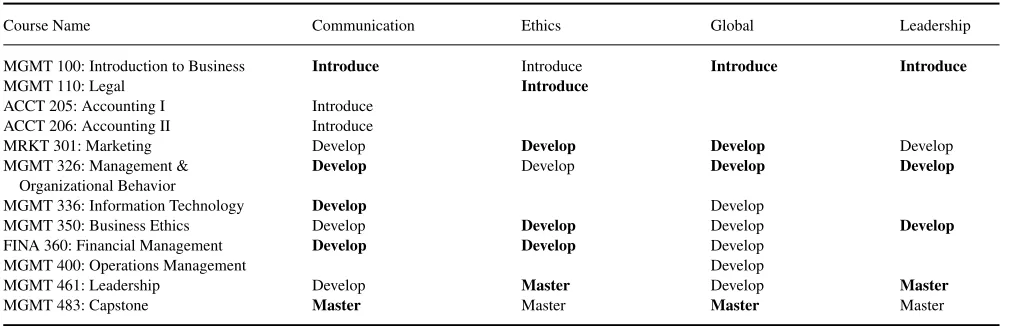
Twelve core courses were chosen to act as the shared BBA core program. While each of the school’s four majors maintains its own, fully developed curriculum, all business undergraduate students are required to take these courses (see Table 1).
TABLE 1
Measuring Levels of the Four Standards in the Bachelor of Business Administration Core Courses
Course Name Communication Ethics Global Leadership
MGMT 100: Introduction to Business Introduce Introduce Introduce Introduce
MGMT 110: Legal Introduce
ACCT 205: Accounting I Introduce ACCT 206: Accounting II Introduce
MRKT 301: Marketing Develop Develop Develop Develop
MGMT 326: Management & Organizational Behavior
Develop Develop Develop Develop
MGMT 336: Information Technology Develop Develop
MGMT 350: Business Ethics Develop Develop Develop Develop
FINA 360: Financial Management Develop Develop Develop
MGMT 400: Operations Management Develop
MGMT 461: Leadership Develop Master Develop Master
MGMT 483: Capstone Master Master Master Master
Note.Items in bold are designated as key learning experiences.
AACSB AoL Requirements
One of the major shifts required by AACSB is an assess-ment focus on the entire program, instead of individual ma-jors. As AACSB formulated it, “[t]he review will address
...assurance of learning processes for the entire program”
(Association to Advance Collegiate Schools of Business In-ternational, 2010, p. 10). This requires a broader focus than has historically been required by accrediting agencies.
The business school adopted its new BBA program in fall 2009. In its 2009–2010 assessment report, a number of problems with its historical approach were identified. Pri-marily, these dealt with the problems in shifting from a chair-directed, major-focused assessment program to one that focused on the school learning outcomes for all business stu-dents. It was decided that a rapid realignment, or pivot, of the school assessment program was required. The goal was to re-align the assessment plan during summer 2010 to have a com-pletely new program in place for the 2010–2011 school year. As a result, the school’s administration created two new faculty roles: an assessment coordinator and a BBA direc-tor. The two individuals (recently hired full-time business faculty) filling the position created the following plan for creating a schoolwide approach to assessment:
1. Define outcomes. While all faculty had agreed on the four program-wide outcomes, the historical focus on majors meant that they were not emphasized in the curriculum. The outcomes needed to be better defined, simplified, and structured to be more compatible with each department’s educational approach.
2. Develop a shared progressive curriculum. Each stu-dent needed to have introductory, developmental, and mastery experiences with each outcome. Outcomes needed to build on each other, even if delivered in different disciplinary areas. Each course with in the curriculum map (see Table 1) needed to target its
learn-ing outcomes in a way that let students build expertise in the core learning outcomes.
3. Gather work in key courses through the use of stan-dardized assignments and rubrics. These standardized assignments needed to be aligned with the learning goals, shared among all faculty, and have rubrics and detailed guidelines. They follow the course-embedded approach suggested by Kelley et al. (2010).
4. Create a few key externally validated assessments for public accountability. These included value-added tests given to freshmen and seniors, as well as external reviewers.
5. Maintain the BBA focus through the creation of an As-sessment Committee to monitor, expand, and validate the shared curriculum. This committee would be re-sponsible for validating any new standardized assign-ments that might be presented by individual faculty. As a result, it could encourage creativity and innova-tion, as well as ensuring alignment with the quality standards. It would also be responsible for analyzing student work, providing data for internal improvement efforts and external validation.
Faculty Working Group Strategy and Implementation
A faculty working group was created to coordinate and de-velop a schoolwide approach to assessment. This group had a number of key elements in its composition:
• Bottom-up: The group was composed of 6 teaching faculty (full-time and adjunct), the assessment coordinator, and the BBA director. No chairs or deans were included in the process. At least one faculty member had taught each of the core cores being enhanced, and, cumulatively, the group represented almost 90 years of teaching experience.
• Multidisciplinary: The working group had representatives from each of the four departments. In its work, faculty did
IMPLEMENTING MISSION-DRIVEN ASSURANCE OF LEARNING 219
not just work on the assessments for the course offered by their department, but instead as a single group on every outcome. While this approach took longer, it resulted in definitions and assignments that fit all majors, and not just the one offering the course.
• Workload and compensation: The group met every two weeks for four months (May–August). Members were paid the same rate as if they were teaching an overload section. This allowed each member to designate the time required for the success of the group, and emphasized the importance of the task.
• Diversity: Members chosen for the group had radically different backgrounds. While all had taught before, the de-gree of industry experience, college teaching experience, knowledge domain, assessment knowledge, and curricu-lum development experience all varied widely.
Curriculum Development Process
After designing the process, the working group met biweekly during the summer to develop the curriculum that would act as the backbone of the new focus on the BBA program learning outcomes.
The group began by examining each standard in detail to translate and simplify the definition of each program learn-ing outcome. For example, the communication outcome was given the following description: communication, (a) give public presentations and speeches, (b) write different types of documents, (c) conduct research.
Refocusing the outcomes was key in that it balanced two contrasting needs. On one hand, the description had to be precise enough to allow for good assessment. However, it also needed to be flexible enough for each department to offer their own operationalization (or definition) of the con-cept. While each discipline values communication, the way the marketing faculty defined it was very different from the accounting faculty. The outcomes were also deliberately kept succinct to help faculty remember the definitions of each.
The refocusing of the outcomes served as a key formation point for the group. Most faculty served only in their own department, and almost none had ever discussed curriculum with people in other departments. Faculty had radically dif-ferent teaching areas and methods. After the initial definition process brought to light differing interpretation and disci-plinary approaches, the process of finding common ground proved an important gelling experience for the group. Having members with different levels of assessment expertise also proved important; it enabled the group to hone their message for justifying the revised approach and assessment strategy to the wider faculty body.
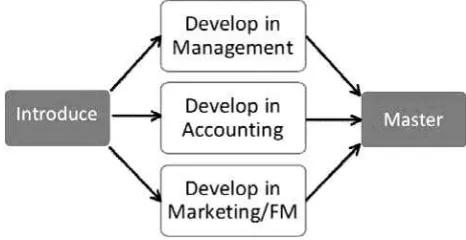
After redefining each outcome, the group then created a corresponding IDDDM (I=Introduce, D=Develop, M=
Master) progressive set of activities (see Figure 1). This meant that each student would have an introduction to the outcome, at least three developmental activities, and a
FIGURE 1 Introduction, development, and mastery activities.
single mastery point. The three developmental activities were intended to provide an opportunity for each discipline to present the outcome through its own disciplinary lens. As a result, each student, no matter which major, would develop communication skills in management, accounting, and marketing–fashion marketing. This multidisciplinary ap-proach was a key element of the group’s strategy to create well-rounded BBA students.
Further, the group emphasized that the activities devel-oped were genuine learning experiences. The goal was not assessment; the goal was that each student be developed through the curriculum. However, once a key learning activ-ity was created and common guidelines established, course-embedded assessment proved relatively simple.
One of the important reasons behind a curriculum-focused assessment process was to enable alignment with the core learning outcomes while still promoting flexibility and in-novation. As a result, it was decided fairly early that any assignment targeting the learning outcome would be accept-able, and that faculty would not have to just take the ac-tivity developed by the working group. However, any new activities would have to be vetted through the Assessment Committee to ensure alignment. This peer-review approach provides flexibility and standardization.
After creating the exercises, the group then uploaded com-mon shared resources, assignments, rubrics, and samples to the university Moodle course management system. All items were loaded into a Moodle course with all business faculty set as the instructor. As a result, each professor had access to all of the material (even if not teaching a core course), and could easily import selected activities into their own sections. Beyond uploading the minimum required materials for each assignment, the group also provided articles, videos, rubrics, and other items relating to each outcome. As a result, by the end of the summer, there were over 100 individual resources available to instructors.
Fall 2010 Implementation
At the beginning of the fall 2010 semester, the working group expanded the curriculum process beyond the initial group and into the entire business faculty.
First, the working group obtained dean’s and chairs’ buy-in to the draft BBA curriculum. While all of these buy-individuals had bought into the theory and general approach, getting them familiar with the process and material was crucial to their selling the idea to the rest of the faculty.
Second, a significant part of the faculty opening in-service day was spent introducing the process, material, and assess-ment plan to the rest of the business faculty (including a number of part-time instructors). This provided an important opportunity for some of the more non-assessment-focused faculty to express their opinions and feel heard. As a normal reaction to new assessment demands (Martell, 2007), faculty resistance to changing a successful program is an expected and normal reaction. Providing a forum to bring the conver-sation into the foreground allowed the validation of potential issues, and a way to clearly explain the necessity for a mod-ified approach. The strong support of the deans and chairs helped clarify to individual faculty that this was not just an accreditation requirement, but something that their imme-diate supervisor believed would improve the program. The buy-in of all chairs significantly improved the perception that this approach was owned by the entire business school, and not just a single department or committee.
Following the larger discussion, breakout groups for each department reviewed their BBA courses and curriculum. A number of departments decided to standardize all assign-ments to ensure that all students taking their courses had the same learning activities. However, it was important that this standardization decision was made by individual depart-ments, and was not seen as a mandate of the assessment process.
Third, each member of the working group was assigned one or more of the core courses as a personal responsibility. They members then made contact with any adjunct faculty members teaching BBA core courses, and coordinated with all faculty to ensure that each was able to understand the requirement of the new process and to provide any technical help with Moodle. A number of departments also made the new assessment focus part of their regular meetings, which gave more time for adjuncts to buy into the new approach.
Fourth, faculty members began importing assessment ex-ercises into their Moodle courses. Basing the curriculum entirely through Moodle had a number of logistical advan-tages. All instructors simply had to import the assignment and any supporting items into their course. All students then submitted work in Moodle, and faculty were required to use the provided rubric to grade all student work online. As a re-sult, the Assessment Committee would not need to manually gather any student data or instructor ratings, but could just sample work submitted in individual sections as needed.
Next Steps
The following steps were not yet implemented, but were part of the strategy toward closing the loop and
meeting the AACSB continuous assurance of learning requirements:
1. Faculty members would be encouraged to submit ex-ercises to the assessment Moodle database. Through these expected submissions, the number of exercises to choose from in each category (I, D, M) will expand. a. Throughout the semester an assessment team, de-rived from the faculty working group, would con-tinue to assist other faculty teaching in the BBA core with the implementation of required exer-cises. This group will also ensure that the data gathered from the learning activities would be available in Moodle.
b. The BBA assessment–AoL team planned to ana-lyze the data and create a report during the win-ter break. The early assessment results would al-low them to revise curriculum for the spring term. The report would also provide evidence to submit for any accreditation reports due before the sum-mer assessment program analyzed work submitted during the spring term.
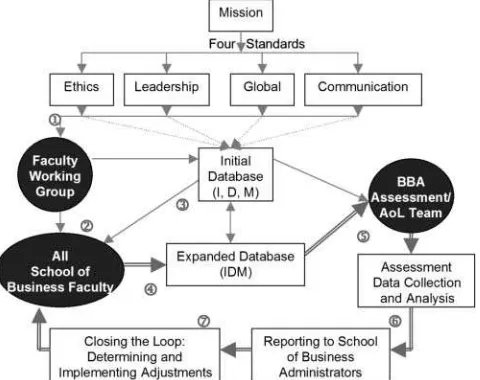
Figure 2 illustrates the overall assessment plan.
DISCUSSION
A number of key points were noted that might have broader application for any university considering a transition to a program-wide AACSB-driven assessment program.
Transition From Majors to a BBA
Transitioning from the individually operating majors to a unifying BBA program is not an easy task. In a change
FIGURE 2 The bachelor of business administration assurance of learning process including closing the loop.
IMPLEMENTING MISSION-DRIVEN ASSURANCE OF LEARNING 221
process there will always be opponents for a variety of rea-sons, some of which were captured previously in this article when discussing the concerns about AACSB’s AoL process and its related requirements. This opposition is understand-able and needs to be addressed rationally and professionally. In this particular transition there was an extra dimension to deal with, perceived loss of identity through the unifi-cation of formerly independently functioning departments, which slowed down the adaptation process. However, the in-clusion of members from all majors in the working group turned out to be a successful strategy to ultimately overcome hesitance and opposition. Getting a significant portion of the overall faculty body bought in through smaller meetings was a major way in which enthusiasm for the project was developed.
Staffing Requirements
It was important there be a designated faculty member in charge of the unified program. Without a dedicated person supporting integration, it fell to the individual chairs to coor-dinate the BBA in addition to their own major. Furthermore, it was important to carefully select who taught the BBA core courses. Faculty needed to be those who had bought into the assessment approach and were familiar with the over-all refocusing of the program. Adjunct faculty in particular needed to be deliberately involved, as many do not attend the meetings that keep full-time faculty informed.
Change Management
Many of the individual processes and methods discussed could easily be replaced with other approaches. However, they were essential in that they provided a safe place for indi-vidual faculty to discuss assessment and the overall program approach. Even faculty on the working group periodically had to ask themselves if they were doing the right thing. Providing repeated, low-threat, and supportive opportunities for faculty to become engaged with the new approach was essential.
Shared Educational Focus
The last key lesson learned was to turn the discussion from “What does AACSB require?” to “How can we improve stu-dent learning?” Once the focus is on the outcomes instead of the time required to modify a course, the discussion becomes profitable. Building a shared understanding of the overall program outcomes was vital. Framing assessment as a total quality management, and enhancing buy-in from all faculty members was crucial for ongoing program success.
Limitations
There are a number of limitations to the process proposed in this study. While some are a result of the methodology, others are integral to the AoL process.
First, this AoL process may not be appropriate for a gradu-ate master of business administration (MBA) program. While a formal alignment process is useful in a program combining a number of highly compartmentalized undergraduate ma-jors, it is less useful when a department can use informal processes to ensure alignment. The smaller curriculum of a 1-year MBA program (36 units, as opposed to 120 units for an undergraduate degree) means that faculty may find the suggested approach unduly burdensome.
Second, the case approach used means that the results may not be generalizable to all programs. Having the context of a small liberal arts university allowed great depth in un-derstanding, but means that larger schools may not find this approach workable.
Third, AACSB’s AoL guidelines allow flexibility, but that flexibility does require additional work. The simplicity of the pre-AoL approach has been replaced with a process that requires significant faculty buy-in and major new processes. While doable, faculty should carefully consider the value of this approach when considering applying for an AACSB accreditation.
Fourth, ensuring alignment and integration may result in decreased flexibility. While some degree of standardization is required, faculty running an assessment program need to ensure that they do not implement overly burdensome pro-cesses. Individual faculty should have significant control and ownership over their courses, and evaluators should be care-ful about valuing consistency over quality.
Lessons Learned and Conclusion
The BBA transition process at the school reviewed in this article is ongoing. The BBA assessment–AoL team has set up a structure to analyze assessment data at the end of every semester, and to suggest strategies for continuous improve-ment (see Figure 2). Some broader lessons learned in the process were the following: (a) Continuous improvement in-volves not only the individual course level, but also in the major and program. Coordination of multiple levels of goals is difficult, but faculty tend to focus on the course at the ex-pense of the program if alignment is not a priority. (b) A rich and dynamic teaching environment require transparency and an open communication flow. Faculty members must take ownership, share best practices, and understand the common goal. Success breeds success, and setting up the conditions for individual faculty to talk about assessment and curricular change results in changing minds.
In conclusion, the advantages and concerns that have been noted in this article about AACSB’s revised AoL require-ments are worthy of reflection because they enhance aware-ness on important accreditation matters. Every development is applauded by some and crucified by others with equally sensible motivations. Whatever AACSB’s ultimate reasons may have been to expand and build increased flexibility in its accreditation standards: there is no denying that these
motivations mirror the trend of the 21st century. In a time when humanity slowly gravitates toward greater inter-connectedness and awareness, AACSB’s outreach strategy should not necessarily be seen as a devaluation of the accred-itation, but could also be considered a commendable global effort toward overall elevation of business education.
REFERENCES
Association to Advance Collegiate Schools of Business International. (2010). Eligibility procedures and accreditation standards for busi-ness accreditation. Retrieved from http://www.aacsb.edu/accreditation/ AAACSB-STANDARDS-2010.pdf
Beard, D., Schwieger, D., & Surendran, K. (2008). Integrating soft skills assessment through university, college, and programmatic efforts at an AACSB accredited institution.Journal of Information Systems Education, 19, 229–240.
Forbes, M. (n.d).Education’s purpose. Retrieved from http://thinkexist. com/quotation/education-s purpose is to replace an empty mind/11451. html
Francisco, W., Noland T. G., & Sinclair, D. (2008). AACSB accreditation: Symbol of excellence or march toward mediocrity?Journal of College Teaching & Learning,5, 25–30.
Gardiner, L. R., Corbitt, G., & Adams, S. J. (2009). Program assessment: Getting to a practical how-to model.Journal of Education for Business, 85, 139–144.
Kelley, C., Tong, P., & Choi, B. (2010). A reviewofassessmentofstudent learningprograms atAACSBschools: A dean’s perspective.Journal of Education for Business,85, 299–306.
Kilpatrick, J., Lund Dean, K., & Kilpatrick, P. (2008). Philosophical con-cerns about interpreting AACSB assurance of learning standards.Journal of Management Inquiry,17, 200–212.
LaFleur, E., Babin, L., & Lopez, T. (2009). Assurance of learning for prin-ciplesofmarketing students: A longitudinal studyofa course-embedded direct assessment.Journal of Marketing Education,31, 131–141. Lowrie, A., & Willmott, H. (2009). Accreditation sickness in the
consump-tion of business educaconsump-tion: The vacuum in AACSB standard setting. Management Learning 40, 411–420.
Martell, K. (2007). Assessing student learning: Are business schools making the grade?Journal of Education for Business 82, 189–195.
Pritchard, R. E., Saccucci, M. S., & Potter, G. C. (2010). Evaluating a program designed to demonstrate continuous improvement in teaching at an AACSB-accredited college of business at a regional university: A case study.Journal of Education for Business,85, 280–283.
Romero, E. J. (2008). AACSB accreditation: Addressing faculty concerns. Academy of Management Learning & Education,7, 245–255.
Sampson, S. D., & Betters-Reed, B. L. (2008). Assurance of learning and outcomes assessment: A case study of assessment of a marketing curricu-lum.Marketing Education Review,18, 25–36.
Scott, J., & Ofori-Dankwa, J. (2006). Is accreditation good for the Strategic decision making of traditional business schools?Academy of Management Learning & Education,5, 225–233.
Treleaven, L., & Voola, R. (2008). Integrating the development of graduate attributes through constructive alignment.Journal of Marketing Educa-tion 30, 160–173.