Archive | Feedback | Links | Contact Us | Site Map
Welcome to ARPN Journal of Engineering and Applied Sciences
Home Archive Submit Paper Author Guidelines Editorial Board Publication Fee Status of upcoming papers Upcoming ConferencesARPN Journal of Engineering and Applied Sciences (ISSN 1819 6608) is an online peerreviewed International research journal aiming at promoting and publishing original high quality research in all disciplines of engineering sciences and technology.
All research articles submitted to ARPNJEAS should be original in nature, never previously published in any journal or presented in a conference or undergoing such process across the globe. All the submissions will be peer reviewed by the panel of experts associated with particular field. Submitted papers should meet the internationally accepted criteria and manuscripts should follow the style of the journal for the purpose of both reviewing and editing. Our mission is ...
In cooperation with our business partners, lower the worldwide cost of research publishing operations.
Provide an infrastructure that enriches the capacity for research facilitation and communication, among researchers, college and university teachers, students and other related stakeholders.
Reshape the means for dissemination and management of information and knowledge in ways that enhance opportunities for research and learning and improve access to scholarly resources.
Expand access to research publishing to the public.
Archive | Feedback | Contact Us | Links | Site Map
ARPN Journal of Engineering and Applied Sciences
Home Archive
Submit Paper Author Guidelines
Editorial Board
Publication Fee
Editorial Board
EditorinChief: Engr. J. K. Tarakzai (PAKISTAN)
# Editors Country
1 Prof. Dr. R. J. Godwin KINGDOMUNITED
2 Prof. Dr. Erik Valdemar Cuevas
Jimenez GERMANY
3 Prof. Dr. Hamou SADAT FRANCE
4 Dr. Mohammad Aminul Islam JAPAN
5 Prof. Dr. Kui Fu Chen CHINA
6 Prof. Dr. M. Ashraf Chaudhry NEW ZEALAND
7 Prof. Dr. A. Sermet Anagun TURKEY
8 Prof. Dr. Ashraf Mohamed Hemeida Saudi Arabia
9 Prof. Dr. Krishna Murari Pandey INDIA
10 Prof. Dr. Magdy A. Ezzat EGYPT
11 Prof. Dr. Roberto Brighenti ITALY
12 Dr. Anurag Misra INDIA
13 Prof. Dr. Adel M. ALIMI TUNISIA
14 Prof. Dr. Arun Kumar Gupta INDIA
15 Prof. Demetrios V. Bandekas GREECE
16 Prof. Dr. Bensafi AbdElHamid ALGERIA
17 Dr. Rajanish K. Kamat INDIA
18 Prof. Dr. Asma Thamir Ibraheem IRAQ
19 Prof. Dr. Sylejman Hyseni KOSOVO
20 Prof. Dr. Haider Zaman Saudi Arabia
21 Prof. Dr. Debojyoti Mitra INDIA
22 Prof. Dr. Pandian VASANT MALAYSIA
23 Prof. Dr. Prakash MMS Kinthada INDIA
Associate Editors
1 Dr. Dongning Li USA
2 Dr. Suheyla Yerel TURKEY
3 Dr. Guoxiang Liu USA
4 Dr. Nadeem Anjum PAKISTAN
5 Engr. Malini Sarah Philip NORWAY
6 Dr. K.V.L.N. Acharyulu INDIA
7 Engr. Mohammad Khalily Dermany IRAN 8 Dr. Lamyaa Gamal Eldeen Taha EGYPT
9 Dr. OM Prakash Singh INDIA
10 Engr. Seyyed Mohammad Reza IRAN
Farshchi
11 Dr. Muhammad Imran Din PAKISTAN 12 Dr. José Carlos Páscoa Marques PORTUGAL 13 Engr. Fawwaz Jinan Jibrael Jabri IRAQ
14 Dr. Kanad Ray INDIA
15 Dr. Shamsuddin Shahid MALAYSIA
16 Engr. Naveenji Arun INDIA
arpnjournals
.com
WELCOME TO ARPN JOURNALS
Home
Submit Paper
Author Guidelines
Subscribe to ARPN
ARPN JOURNALS
ABSTRACTING/INDEXING
ARPN Journals are abstracted/indexed in the following databases:
DOAJ
(Lund
University, UK)
SCOPUS
(Elsevier,
USA)
EBSCO
Publishing
(USA)
Chemical
A
bstracts
Service
(a division of
The American
Chemical
Society, USA)
INSPEC
(The Institution
of Engineering
and
Technology,
England, UK)
Intute
(HeriotWatt
University
Library
Edinburgh,
UK)
Socolar
(China
Educational
Publications
Import and
Export
Corporation
CEPIEC)
Open JGate
(Informatics,
India)
Scimago Journal & Country Rank
Home Journal Rankings Country Rankings Viz Tools Help About Us
ARPN Journal of Engineering and Applied
Sciences
Country Pakistan
12
H Index Subject Area and Category EngineeringEngineering (miscellaneous)
Publisher Asian Research Publishing Network (ARPN)
Publication type Journals
ISSN 18196608
Coverage 2011-ongoing
Enter Journal Title, ISSN or Publisher Name
Quartiles
The set of journals have been ranked according to their SJR and divided into four equal groups, four quartiles. Q1 (green) comprises the quarter of the journals with the highest values, Q2 (yellow) the second highest values, Q3 (orange) the third highest values and Q4 (red) the lowest values.
Category Year Quartile
Engineering (miscellaneous) 2012 Q4 Engineering (miscellaneous) 2013 Q3 Engineering (miscellaneous) 2014 Q3 Engineering (miscellaneous) 2015 Q3
SJR
The SJR is a size-independent prestige indicator that ranks journals by their 'average prestige per article'. It is based on the idea that 'all citations are not created equal'. SJR is a measure of scientiꈌ�c in䮥�uence of journals that accounts for both the number of citations received by a journal and the importance or prestige of the journals where such citations come from It measures the scientiꈌ�c in䮥�uence of the average article in a journal, it expresses how central to the global
Citations per document
This indicator counts the number of citations received by documents from a journal and divides them by the total number of documents published in that journal. The chart shows the evolution of the average number of times documents published in a journal in the past two, three and four years have been cited in the current year. The two years line is equivalent to journal impact factor ™ (Thomson Reuters) metric.
Cites per document Year Value Cites / Doc. (4 years) 2012 0.247 Total Cites Self-Cites
2012 2013 2014 2015 Engineering (miscellaneous)
2012 2013 2014 2015 0.1
Cites per document Year Value Cites / Doc. (4 years) 2013 0.303 Cites / Doc. (4 years) 2014 0.431 Cites / Doc. (4 years) 2015 0.601 Cites / Doc. (3 years) 2012 0.247 Cites / Doc. (3 years) 2013 0.303 Cites / Doc. (3 years) 2014 0.431 Cites / Doc. (3 years) 2015 0.606 Cites / Doc. (2 years) 2012 0.247 Evolution of the total number of citations and journal's
self-citations received by a journal's published documents during the three previous years.
Journal Self-citation is deꈌ�ned as the number of citation from a journal citing article to articles published by the same journal.
Cites Year Value
External Cites per Doc Cites per Doc
Evolution of the number of total citation per document and external citation per document (i.e. journal self-citations removed) received by a journal's published documents during the three previous years. External citations are calculated by subtracting the number of self-citations from the total number of citations received by the journal’s documents.
Cites Year Value
% International Collaboration
International Collaboration accounts for the articles that have been produced by researchers from several countries. The chart shows the ratio of a journal's documents signed by researchers from more than one country; that is including more than one country address.
Year International Collaboration 2012 7.24
2013 9.29 Citable documents Non-citable documents
Not every article in a journal is considered primary research and therefore "citable", this chart shows the ratio of a journal's articles including substantial research (research articles, conference papers and reviews) in three year windows vs. those documents other than research articles, reviews and conference papers.
Documents Year Value Non-citable documents 2012 0
Cited documents Uncited documents
Ratio of a journal's items, grouped in three years windows, that have been cited at least once vs. those not cited during the following year.
Documents Year Value Uncited documents 2012 73 Uncited documents 2013 246 Uncited documents 2014 329 Uncited documents 2015 604
←
Show this widget in
your own website
Just copy the code below and paste within your html code:
<a href="http://www.scimagojr.com/journalsearch.php?q=21100200825&;tip=sid&;exact=no" title="SCImago Journal &; Country Rank"><img border="0" src="http://www.scimagojr.com/journal_img.php?id=21100200825" alt="SCImago Journal &; Country Rank" /></a>
0.45 0.54 0.63 0.72 0.81
2012 2013 2014 2015 0
250 500
2012 2013 2014 2015 0.2
0.4 0.6 0.8
2012 2013 2014 2015 6
8 10
2012 2013 2014 2015 0
400 800
2012 2013 2014 2015 0
Developed by:
Powered by:
Follow us on
Archive | Feedback | Contact Us | Links | Site Map
ARPN Journal of Engineering and Applied Sciences
ISSN 18196608
Home Archive
Submit Paper
Author Guidelines Editorial Board
Publication Fee
Archive of ARPN Journal of Engineering and Applied Sciences
Volume 12 (2017)
Issue 1 (10th January) Issue 2 (20th January) Issue 3 (10th February) Issue 4 (20th February)
Volume 11 (2016)
Issue 1 (10th January) Issue 2 (20th January) Issue 3 (10th February) Issue 4 (20th February) Issue 5 (10th March) Issue 6 (20th March) Issue 7 (10th April) Issue 8 (20th April) Issue 9 (10th May) Issue 10 (20th May) Issue 11 (10th June) Issue 12 (20th June) Issue 13 (10th July) Issue 14 (20th July) Issue 15 (10th August) Issue 16 (20th August) Issue 17 (10th September) Issue 18 (20th September) Issue 19 (10th October) Issue 20 (20th October) Issue 21 (10th November) Issue 22 (20th November) Issue 23 (10th December) Issue 24 (20th December)
Volume 10 (2015)
Issue 1 (January) Issue 2 (10th February) Issue 3 (20th February) Issue 4 (10th March) Issue 5 (20th March) Issue 6 (10th April) Issue 7 (20th April) Issue 8 (10th May) Issue 9 (20th May) Issue 10 (10th June) Issue 11 (20th June) Issue 12 (10th July) Issue 13 (20th July) Issue 14 (10th August) Issue 15 (20th August) Issue 16 (10th September) Issue 17 (20th September) Issue 18 (10th October) Issue 19 (20th October) Issue 20 (10th November) Issue 21 (20th November) Issue 22 (10th December) Issue 23 (20th December)
Volume 9 (2014)
Issue 1 (January) Issue 2 (February) Issue 3 (March) Issue 4 (April) Issue 5 (May) Issue 6 (June) Issue 7 (July) Issue 8 (August)
Issue 9 (September) Issue 10 (October) Issue 11 (November) Issue 12 (December)
Volume 8 (2013)
Issue 1 (January) Issue 2 (February) Issue 3 (March) Issue 4 (April)
Issue 5 (May) Issue 6 (June) Issue 7 (July) Issue 8 (August) Issue 9 (September) Issue 10 (October) Issue 11 (November) Issue 12 (December)
Volume 7 (2012)
Issue 1 (January) Issue 2 (February) Issue 3 (March) Issue 4 (April)
Issue 5 (May) Issue 6 (June) Issue 7 (July) Issue 8 (August)
Issue 9 (September) Issue 10 (October) Issue 11 (November) Issue 12 (December)
Volume 6 (2011)
Issue 1 (January) Issue 2 (February) Issue 3 (March) Issue 4 (April) Issue 5 (May) Issue 6 (June) Issue 7 (July) Issue 8 (August) Issue 9 (September) Issue 10 (October) Issue 11 (November) Issue 12 (December)
Volume 5 (2010)
Issue 1 (January) Issue 2 (February) Issue 3 (March) Issue 4 (April)
Issue 5 (May) Issue 6 (June) Issue 7 (July) Issue 8 (August) Issue 9 (September) Issue 10 (October) Issue 11 (November) Issue 12 (December)
Volume 4 (2009)
Issue 1 (February) Issue 2 (April) Issue 3 (May) Issue 4 (June)
Issue 5 (July) Issue 6 (August) Issue 7 (September) Issue 8 (October) Issue 9 (November) Issue 10 (December)
Volume 3 (2008)
Issue 1 (February) Issue 2 (April) Issue 3 (June) Issue 4 (August) Issue 5 (October) Issue 6 (December)
Volume 2 (2007)
Issue 1 (February) Issue 2 (April) Issue 3 (June) Issue 4 (August) Issue 5 (October) Issue 6 (December)
Issue 1 (June) Issue 2 (August) Issue 3 (October) Issue 4 (December)
arpnjournals.com Publishing Policy Review Process Code of Ethics
Archive | Feedback | Contact Us | Links | Site Map
ARPN Journal of Engineering and Applied Sciences ISSN 18196608 (Online)
Search Custom Search Home Archive Submit Paper Author Guidelines Editorial Board Publication Fee ARPN Journal of Engineering and Applied Sciences February 2017 | Vol. 12 No. 4 Title: The effects of particle size and pressure on the combustion characteristics of Cerbera Manghas leaf briquettes Author (s): Sutrisno, Willyanto Anggono, Fandi Dwi Suprianto, Andreas Wijaya Kasrun and Ian Hardianto Siahaan
Abstract: Cerbera Manghas is a plant that is often used as urban greening so that this plant has the potential to be developed into a source of alternative fuel in Indonesia. The material of solid fuel briquette is waste leaves of Cerbera Manghas tree and tapioca flour are used as binder material. The composition of this briquette is 10% mass of tapioca flour and 90% mass of Cerbera Manghaswaste leaves. The highest heating value (HHV) of this briquette is 4167 Kcal/kg. The particle size of this briquette affects the physical and burning characteristics. This optimizes research particle size and pressure of the press machine during the briquette forming process. The two parameters were evaluated for the combustion characteristics include Flame temperature, Ignition timing, Burning time, and Combustion rate. The higher value of flame temperature, ignition time and burning time are caused by the greater the hydraulic pressure. Besides better the briquettes’quality are obtained the smaller of combustion rate, so that the briquettes are more durable and required the ignition time length. The best briquettes of Cerbera Manghas leaves are those with particle size of 60 mesh and forming pressure of 2 MPa, which have a flame temperature of 522°C, an ignition time 268 second, a burning time of 7293 second, and a combustion rate of 0.0026 gr/s.
Full Text
Title: Comparison of selected methods for measurement of the concrete electrical resistance to chloride penetration
Author (s): Petr Lehner, Martina Turicova and Petr Konecny
Abstract: The paper compares selected experimental measurement techniques for evaluation of concrete ability to resist chloride penetration. There are three procedures of evaluation of concrete diffusion coefficient compared. The paper is aimed at the comparison of diffusion coefficient based on the chloride profiling and electrical properties of concrete, namely electrical conductivity and resistivity. There are discussed methods of rapid chloride penetration test as well as surface measurement of electrical resistivity using Wenner probe. The comparison aim is to obtain input data for a finite element numerical model for probabilistic calculation of durability of reinforced concrete bridge deck exposed to the chloride laden environment.
Full Text
Title: Simulation model of traffic operations on single carriageway roads: Model calibration and validation
Author (s): Zamri Bujang and Othman Che Puan
Abstract: The current Malaysian procedure for a detailed evaluation of the capacity and effects of various road and traffic characteristics for single carriageway roads, which is adopted directly from the American Highway Capacity Manual, is inadequate and inaccurate since several aspects used in the method such as the consideration of the recreational vehicles and trucks are not directly applicable to the Malaysian traffic characteristics. The validity of the analysis is debatable since the way in which the effect of motorcycles on overall performance of the roadways is considered is not clear. The existing simulation models of traffic operations on single carriageway roads also suffer from a similar weakness. Therefore, there is a need to develop a comprehensive traffic simulation model to carry out this task. Such a model must be capable of simulating traffic behavior for a range of road layout and geometry, at junctions and compositions of traffic which include motorcycles. This paper describes the development of a simulation model of traffic operations on single carriageway roads to assess and evaluate the speed/flow relationships and hence the road capacity from the simulation model for a given road geometry and traffic demand.
Full Text
Title: Spectrum occupancy measurement: A case for cognitive radio network in Lagos, Nigeria
Author (s): Paulson E. N., Adedeji K. B., Kamaludin M. Y., Popoola J. J., Jafri B. Din and Sharifah Kamilah S. Y.
Abstract: The proliferation in technologies and with the recent introduction of new paradigm for wireless communication, the demand for wireless devices has increased drastically in recent years. This therefore, posed a major threat on the
VOL. 12, NO. 4, FEBRUARY 2017 I SSN 1819- 6608 ARPN Jour nal of Engineering and Applied Sciences
© 2006- 2017 Asian Resear ch Publishing Net w or k ( ARPN) . All right s reser ved.
www.arpnjournals.com
931
THE EFFECTS OF PARTICLE SIZE AND PRESSUREON
THE COMBUSTION CHARACTERISTICS OF CERBERA
MANGHASLEAF BRIQUETTES
Sutrisno1,2, Willyanto Anggono1,2, Fandi Dwi Suprianto1,2, Andreas Wijaya Kasrun1 and Ian Hardianto Siahaan1
1Mechanical Engineering Department, Petra Christian University, Surabaya, Indonesia 2Centre for Sustainable Energy Studies, Petra Christian University, Surabaya, Indonesia
E-Mail: [email protected]
ABSTRACT
CerberaManghas is a plant that is often used as urban greening so that this plant has the potential to be developed
into a source of alternative fuel in Indonesia. The material of solid fuel briquette is waste leaves of CerberaManghas tree
and tapioca flour are used as binder material. The composition of this briquette is 10% mass of tapioca flour and 90% mass
of CerberaManghas waste leaves. The highest heating value (HHV) of this briquette is 4167 Kcal/kg. The particle size of
this briquette affects the physical and burning characteristics. This optimizes research particle size and pressure of the press machine during the briquette forming process. The two parameters were evaluated for the combustion characteristics include Flame temperature, Ignition timing, Burning time, and Combustion rate. The higher value of flame temperature, ignition time and burning time are caused by the greater the hydraulic pressure. Besides better the briquettes’quality are obtained the smaller of combustion rate, so that the briquettes are more durable and required the ignition time length. The best briquettes of Cerbera Manghas leaves are those with particle size of 60 mesh and forming pressure of 2 MPa, which have a flame temperature of 522 °C, an ignition time 268 second, a burning time of 7293 second, and a combustion rate of 0.0026 gr/s.
Keywords: cerbera manghas, briquettes, renewable energy, green energy.
1. INTRODUCTION
Green energy is an energy source that has potential to be developed as future energy. Green energy for power generation is always done in a natural process, so as to prevent environmental damage. This energy is used raw materials derived from nature, such as waste oil, natural gas, animal waste, organic material, solar energy, tidal energy, wind energy, and sea wave energy. During the dry season in tropical climate zones, the wastes leaf scattered on the road and has potential to become urban waste. This brings the idea to utilize the wastes, since the waste leaf could potentially use as briquettes raw material.
CerberaManghas/Odollamor Sea mango leaf is non
edible, the costs of the non-edible waste cannot be obtained as they are currently not traded in the open market Gui et al.[2]
.
The usage of non-edible waste as a raw material for briquette cause production costs to be cheap, other than that the Cerberamanghas, especially in urban
Indonesia is widely used as a plant green lining. Co this
material is potentially to be used as one of raw material for briquette. Researchers have made the development of briquettes for household and industrial [5]. Raw materials used are such as almond leaves, ash wood and coconut fibers.
Several previous studies in briquette, employed edible materials such as those developed by Sellin et al[7].
The sections of banana tree which can be used as raw material for briquettes are leaf and presudostem. The utilization of edible material could be directly used by humans, while for non-edible needed detail analysis of the substances. The High Heating Value (HHV) for that briquette is (HHV) 17.7 MJ/kg and 14.9 MJ/kg.
The chemical structures in the Sea mango leave contain toxins. According to Po et al. [4], the chemical
structures of CerberaManghas leaves are
p-Hydroxybenzaldehyde, Benzamide, n-Hexadecane acid Monoglyceride, Oliolide, β-Sitosterol, Cerberin, Neriifolin, Cerleaside A, Daucosterol. Of the nine content of the above, there is a toxic substance namely Cerberin. The chemical formula of Cerberin has the same chemical formula as alcohol, and its configuration is C32H48O9. A
study conducted by Chopra 0 was experimenting with the effect of Cerberin consumption by living things. It turned out that with a certain dose as much as 1.8 mg / kg in dogs and 3.1 mg / Kg in cats, Cerberin could cause death to the creatures. If a small dose of Cerberin can cause death to animals, then cerberin could also cause death if consumed by humans
According to the Regional Fruit Research Station, [6], the production of CerberaManghas needed operational costs between 360-690 (USD / ha) which is almost equivalent to the production of Jatropha 620 (USD/ ha). The production of jatropha oil in Indonesia is still not effective because the energy used during extraction process is greater than the amount of oil produced; therefore this oil is still not feasible for mass production.
Improvement in briquettes combustion process could be done by reducing the amount of CO2 that acts as
an inhibitor in external premix combustion [8]. In addition, increasing the turbulence of the flow could reduce energy loss in the flow [9]so as to improve the combustion process. This method is similar to increasing the flow swirl into the combustion process.
Research on Cerberamanghasas one of the
VOL. 12, NO. 4, FEBRUARY 2017 I SSN 1819- 6608 ARPN Journal of Engineering and Applied Sciences
© 2006- 2017 Asian Research Publishing Net w ork ( ARPN) . All r ight s r eser ved.
www.arpnjournals.com
932
green energy, which is one component of renewable energy. In addition to that, this research seeks the extent of utilization of Cerberamanghas other than as green line
plants in urban areas, and explores its potential to become one of alternative raw materials for Briquetting. The part of CerberaMang has that is mostly used is the fruit only. Fruit of the CerberaManghas is used as the raw material.
The utilization of Cerberamanghas as the
briquette raw material has been raised by Anggono et al.
[10].This briquette has a Higher Heating Value (HHV) of 4287.53 Kcal / kg or 17.95MJ / kg. This value is slightly higher than the HHV of banana leaves obtained by Sellin
et al. [7]. This research would optimize particle size and
pressure of the press machine during the briquette forming process. The two parameters were evaluated for burning characteristics includesFlame temperature, Ignition timing, Burning time, and Combustion rate.
2. METHODOLOGY
The flowchart in Figure-1 shows the research methodology. This research starts from literature review about briquette and Cerberamanghas leaves as the base
material. Then the research collects fallen leaves on the urban road. The process is continued by drying
Cerberamanghas leaves to remove their water content.
The results of this process are followed by the grinding process in accordance with the size of wire mesh. The particle size of the powdered Sea mango leaves depends on the size of wire mesh.
Figure-1. Research methodology flowchart.
Figure-2 shows the particle size variation of
CerberaManghas leaves. The material particle size is
smaller when used with large wire mesh. Third different particle sizes are prepared, i.e. more than 60 mesh (smaller than 250 μm), 40 mesh (smaller than 425 μm), and 30 mesh (smaller than 600 μm).
Variations in the size of the mesh were used to determine the right particle size, which would yield the best briquette quality in terms of its physical strength and its burning characteristics. Figure-2 shows the difference in particle size from the size of 30, 40 and 60 mesh. Before the forming process was performed, each powder of different mesh had been tested using proximate and ultimate analysis.
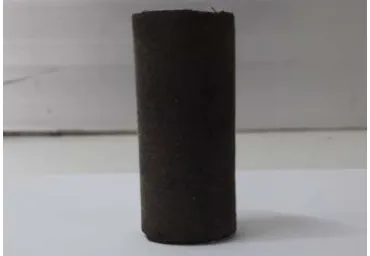
The process of forming briquettes made by mixing the raw material with adhesive. The material mixture is then inserted in the briquettes mold shown in Figure-3. Briquette’s mold size has a diameter of 25 mm. Once the briquette is inserted into the mold, then it is pressed with a hydraulic machine. The hydraulic pressure was set with a variety of 1 and 2 MPa. It was observed that if the hydraulic pressure is more than 2 MPa, then the mold would be damaged.
Figure-2.Particle size variatoin of Cerberamaghas leaves.
Furthermore, these briquettes are evaluated for their burning characteristics. Burning temperature is the surface temperature reached by the time of burning briquettes. Measuring instruments used were thermocouples and infrared laser. Ignition time is the time needed to ignite each briquette from the start of ignition until it is burned continuously. The time duration was recorded using a stopwatch. Burning time is the time taken for each briquette to burn completely to ashes. The two parameters were measured using stopwatch. Combustion rate is defined as how quickly or slowly the reaction takes place. The reaction is expressed by the change in mass of briquettes from beginning to end, where the final mass equal to the mass of ash.
VOL. 12, NO. 4, FEBRUARY 2017 I SSN 1819- 6608 ARPN Jour nal of Engineering and Applied Sciences
© 2006- 2017 Asian Resear ch Publishing Net w or k ( ARPN) . All right s reser ved.
www.arpnjournals.com
933
Figure-3. Briquettes mold.
3. RESULTS AND DISCUSSIONS
The most effective briquettes are those with a composition of 90% raw material and 10% binder. The HHV of briquettes form CerberaManghas leaves without
carbonization process is 4164 Kcal / Kg with 12.2 wt.% of water content. If the briquettes have been through the carbonization process, then the heating value will increase. The decrease in water content will also affect the flame speed of the briquettes, because the lower the moisture content in the briquettes, the faster the ignition process will be. The moisture content had a significant influence on the composition’s proximate analysis results. In Table-1 above, there are two columns, As Received and Dried Basis. As Received testing means the proximate analysis based on materials that have been received at the time of the test, without applying the drying process in the first place. Whereas in Dried Basis, the drying process was applied to remove moisture (Moisture Content) on the material, before the proximate analysis was done. The analysis result shows that the heating value in As received and Dried basis are consecutively 4164 Kkcal / Kg and 4742 KKcal / Kg. Comparison of the heating values resulted from proximate analysis with different basis indicates that the moisture content affects the proximate results.
Volatile matter in the leaves is 66.8% of the total mass. The highly volatile matter content in dry
Cerberamanghas leaves indicates that the material can be
burnt easily. In fact, this value is relatively high compared to the value of fixed carbon. So it can be said that dry CerberaManghas leaves are flammable material, as the fixed carbon is a component that is difficult to burn. The briquettes of CerberaManghas leaves have a value of only 12.4 wt.% fixed carbon. The ash content is the ash that
remains after the combustion process. Ash content contained in the leaves are not too high, it even can be said that they have relatively low ash content. Having a small number of ash content is one of the criteria of a good fuel.
Table-1.Proximate analysis [10].
Proximate
analysis Unit Value Test method
Total Moisture %wt 12.2 ASTM D 2961-11 Ash Content %wt 8.6 ASTM D 3174-12 Volatile Matter %wt 66.8 ASTM D 3175-11 Fixed Carbon %wt 12.4 ASTM D 3172-13 Total Sulfur %wt 0.19 ASTM D 4239-14e1
Gross Heat
Value Kcal/kg 4164 ASTM D 5865-13
The results of ultimate analysis obtained levels of the chemical elements such as C, H, O, N and S. The most important elements in combustion are element of C and H. In the chemical reaction, the C elements together with oxygen act as a reactant to produce CO2. CO2 is a
combustion product which is released back to the surrounding air after the combustion process. The higher the percentage of C content in Fuel, the heating value will also be higher. Element H together with oxygen acts as reactant will produce H2O after the combustion process.
Element H is also used as a parameter of heating value calculation and a parameter in calculating the moisture content. O element in the fuel indicates the oxygen content in the fuel, and it is used as an indicator of how easy to ignite the fuel. While elements N and S, are elements which cause pollution in combustion because these elements can react with the surrounding air and producing NOx and SOx. The amount of elements N and S from the
result of laboratory analysis are consecutively 0.45% and 0.19%. The results of ultimate analysis are shown in table 2. In an experiment conducted by Raju et al[5], it was said
that the pollution of fuel combustion would not be dangerous if the amount of N and S in the fuel does not exceed 1 wt.%. This is due to the lesser amount of NOx
and SOx produced from combustion when there are not
much N and S in the reactant.
Table-2.Ultimate analysis[10].
Ultimate
analysis Unit Value Test method
VOL. 12, NO. 4, FEBRUARY 2017 I SSN 1819- 6608 ARPN Journal of Engineering and Applied Sciences
© 2006- 2017 Asian Research Publishing Net w ork ( ARPN) . All r ight s r eser ved.
www.arpnjournals.com
934
Briquettes are formed by pressure and a certain particle size. Raw materials are sifted to particle size of 30 mesh 40 mesh, and 60 mesh. Hydraulic pressure variation begins with 1 MPa (10 bar) up to 2 MPa (20 bar). Smaller particle size gives benefit in increasing physical strength of the briquette. This is due to the greater ability of additive to bind the smaller sized particles. Figure-4 shows the physical appearance of briquettes, each with hydraulic pressure 2Mpa. Based on the figure, the briquettes with particle size of 20 Mesh cannot be formed completely because the structure is too fragile. Raw materials with particle size of 20 mesh cannot be used as briquette because they will be crumbled, both in hydraulic pressure 1 and 2 MPa. The Briquettes are produced with a pressure of 2 MPa have a better shape compared to those with a pressure of 1 MPa.
Figure-4.Briquette from Cerberamanghas leaves.
Figure-5 shows that the smaller the particle size, the higher the flame temperature of briquettes. Thus, a higher forming pressure will correspondingly increase the flame temperature. Experimental data with a particle size of 60 mesh and a pressure of 2 MPa shows the highest the flame temperature of 522 ° Celsius.
Figure-5. Flame temperature characteristics.
Figure-6 shows the effect of particle size on the ignition time. Based on the figure, the smaller the particle
size of raw material, the longer the ignition time of briquettes. The pressure also affects the duration of briquettes’ ignition time. The higher the pressure, the longer the ignition time of briquettes. It can be seen in the figure that briquettes with a particle size of 60 mesh and hydraulic pressure of 2 MPa have the longest ignition time, which is 268 seconds.
Figure-6. Ignition time characteristics.
Figure-7 shows the effect of particle size to the burning time value. Raw materials with a smaller particle size will have a longer burning time. Similarly to the pressure, the greater the hydraulic pressure than the combustion duration will be longer. In the figure, briquettes which have the longest burning time of 5821 seconds are those with a particle size of 60 mesh and the hydraulic pressure of 2 MPa.
Figure-7. Burning time characteristics.
VOL. 12, NO. 4, FEBRUARY 2017 I SSN 1819- 6608 ARPN Journal of Engineering and Applied Sciences
© 2006- 2017 Asian Research Publishing Net w ork ( ARPN) . All r ight s r eser ved.
www.arpnjournals.com
935
lowest firing rate is produced by briquettes with a particle size of 60 mesh and with the hydraulic pressure of 2 MPa.
Figure-8.Combustion rate characteristics.
This CerberaManghas of leaves briquettes have a
reasonably high heating value that can be compared with other briquettes. Figure-9 shows a HHV comparison chart of Cerberamanghas leaves briquettes and other briquettes made of different materials. All data other than the CerberaManghas leaves briquettes are based on research conducted by Lela et al[3]
Figure-9. Compore HHV with others briquette [3].
The heating value of CerberaManghas leaves briquette has the potential to be a good quality briquette. This is due to the relatively high value of its HHV compared to the HHV of other briquettes. The HHV of CerberaManghas leaves briquette is approximately equal to the HHV of sawdust and coconut coir. Sawdust has a value of 4161 HHV Kcal / kg, and coconut coir has HHV
value of 4146 Kcal / kg. While the medium quality briquettes such as rice straw and sugarcane that has a value HHV of 3927 and 3903 Kcal/gr. Therefore, the results suggest that the CerberaManghas leaves briquettes
have good quality and have the potential to be developed into mass production.
4. CONCLUSIONS
The highest HHV result of briquettes made of
Cerbera manghas leaves was obtained at the composition
of 90% mass of Cerbera Manghaswaste leaves and 10%
mass of tapioca flour. The particle size of more than 30 Mesh (smaller than 600 μm) has been failed to be molded and hence could not be used as briquette material. The effect of particle size on the briquette was found that the smaller the particle size, the better the briquettes’ quality. The effect of the hydraulic pressure in the briquette was found that the greater the pressure, the better the briquettes’ quality. The effect of hydraulic pressure that occurs is opposite to the particle size.The higher value offlame temperature, ignition time and burning time are caused by the greater the hydraulic pressure. Besides better the briquettes’quality are obtained the smaller of combustion rate, so that the briquettes are more durable and required the ignition time length. The best briquettes of CerberaManghas leaves are those with particle size of 60 mesh and forming pressure of 2 MPa, which have a flame temperature of 522 °C, an ignition time 268 second, a burning time of 7293 second, and a combustion rate of 0.0026 gr/s.
ACKNOWLEDGEMENTS
The authors wish to thanks to the Ministry of Research, Technology and Higher Education, Republic of Indonesia through the Research Grant Programs and Faculty of Industrial Technology, Petra Christian University Surabaya for their supports.
REFERENCES
[1] Chopra R.N. and I.C. Chopra. 1933. Indigenous Drugs of India, Kolkata, India: Academic Publishers. pp. 316-318, ISBN 818508680X,
[2] Gui M. M., Lee K. T., Bhatia S.2008. Feasibility of edible oil vs. non-edible vs. waste edible oil as biodiesel feedstock. Energy. 33, pp.1646-1653.
[3] Lela B., Barišić M., Nižetić S.2016. Cardboard/sawdust briquettes as biomass fuel: Physical–mechanical and thermal characteristics, Waste Management: Refuse Derived Fuel/Solid Recovered Fuel. 47: 236-245.
VOL. 12, NO. 4, FEBRUARY 2017 I SSN 1819- 6608 ARPN Jour nal of Engineering and Applied Sciences
© 2006- 2017 Asian Resear ch Publishing Net w or k ( ARPN) . All right s reser ved.
www.arpnjournals.com
936
[5] Raju Ch. A. I., Jyothi K. R., Satya M. and Praveena U. 2014. Studies on Development of Fuel Briquettes for Household and Industrial Purpose. International Journal of Research in Engineering and Technology Vol. 3, ISSN :2319-1163, 54-63.
[6] Regional Fruit Research Station, Vengurle. PJ. Kshirsagar, G.M. Waghmare.Mango varieties in Konkan region. Report, March 1999. http://www.indiaagronet.com/indiaagronet/Research% 20Update/contents/mango_varieties_in_konkan_regio n.htmS.
[7] Sellin N., Bianca. G, Marangoni C., Souza O., Pedro N., Novais T. M. 2013. Use of Banana Culture Waste to Produce Briquettes. Chemical Engineering Transactions. Vol. 32. ISSN 1974-9791, 349-354.
[8] Suprianto F.D., Anggono W., Tanoto M.S.C.2016. Effect of carbon dioxide on flame characteristics in biogas external premix combustion, International Journal of Applied Engineering Research. Vol. 11. ISSN 0973-4562, pp. 2240-2243.
[9] Sutrisno Mirmanto H., Sasongko H., Noor D.Z. 2015. Study of the secondary flow structures caused the addition forward facing step turbulence generated: Case study: Horseshoe vortex between 9C7/32.5C50 body and endwall, Advances and Applications in Fluid Mechanics. 18: 128-144.