Professor BustariMuchtar (Universitas Negeri Padang) Professor. Z. Mawardi Efendi (Universitas Negeri Padang)
Professor Julio Alejandro Sarmiento Sabogal (Pontificia Universidad Javeriana - Sede Bogotá – Colombia)
Professor Yasri, MS. (Universitas Negeri Padang) Professor Chris Patel (Macquaire University)
Professor. Syamsul Amar, B. MS (Universitas Negeri Padang) Professor. Hasdi Aimon (Universitas Negeri Padang)
Doctor Idris, MSi. (Universitas Negeri Padang)
Doctor Efrizal Sofyan, SE, MSi, Ak, CA. (Universitas Negeri Padang) Doctor Erni Masdupi (Universitas Negeri Padang)
Doctor AimatulYumna (Universitas Negeri Padang) Doctor Sany Dwita, CA. (Universitas Negeri Padang) Doctor Syahrizal (Universitas Negeri Padang)
Doctor Takefumi Ueno (Associate Professor, The School of Administration and Informatics, University of Shizuoka, Japan)
Doctor Nicholas Boamah Addai(University for Development Studies, Ghana) Doctor Zahra Borghei (Macquarie University, Australia)
Doctor Rangga Handika (Abu Dhabi University, United Arab Emirate)
Doctor Sigit Triandaru(Faculty of Economics, University of Atma Jaya Yogyakarta) Doctor Ade Palupi, MPPH, CA.( FEB, UniversitasAirlangga)
Published by : Faculty of Economics UniversitasNegeri Padang
Proceeding International Conference
“Local Wisdom for Re-thinking Global Solutions” ©2016, Faculty of Economics Universitas Negeri Padang Address :Jalan Prof. Dr. Hamka Air Tawar Padang 25131 Telp / Fax :Fax. (0751) 447366
PREFACE
This Conference Proceedings contains the written version of most of the contributions presented during the First International Conference On Economics, Business And Accounting (The 1st ICEBA 2016). The ICEBA 2016 is the First International Conference on Economics, Business, and Accounting organized by Faculty of Economics State University Of Padang (Universitas Negeri Padang—UNP), West Sumatera, Indonesia. This conference’s objective is to raise awareness on important issues related to the field of economics, business, accounting and economics education and as research discussion forum among academicians in those fields . This years’ conference will be held on 21st to 23rd September 2016 in Pangeran Hotel Padang West Sumatera.
The main theme of the 1st ICEBA 2016 is "Local Wisdom for Re-thinking Global Solutions." The focus is to raise the importance of invoking local values, cultures, religiousity, and traditions in carrying out a rigorous and holistic in the field of economics, business, accounting and economics education.
Proceeding. We’d also like to acknowledge the financial supports from Bank Indonesia, Bank Nagari and Pegadaian. We hope that all the participants can optimally contribute to the discussion and enjoy the whole conference programs.
Padang, 21stSeptember 2016
CONTENTS
Reviewer...i Peference...ii Contents ...iii Comparison of The Goodwill Impairment Situation From Japan, European, and U.S.
Data
Takefumi Ueno... 1-10
Graduate Capabilities as a Drive for Curriculum Change
Snimna Shakeeb... 11-18
Consumer Perceptions of Smartphone Advertising in Indonesia: a Linguistic Attitude
Vidyarini Dwita ... 19-26
Analysis of The Regional Economic Performance West Sumatera
Syamsul Amar ... 27-34
Do Slack Resources Affect Sustainability Performance?
Uptala Rani ... 35-46
Human Capital and Economic Convergence Between Regency and City in West Sumatera Province
Taosige Wou ... 47-58
BusinessManagement Students’ Attitudes Toward Business Ethics and Social Responsibility
Dyah Purwanti and Edy Purwanto ... 59-68
Ownership Structure and Company Performance from Agency Perspective
Erni Masdupi...69-92 The Effect of Compensation and Work Discipline on The Employee’s Performance
With Motivation as an Intervening Variable at The Region Company Petisah Market in Medan City
Rini Astuti ... 93-100
Analysis on The Effectiveness Of Local Revenue Collection and Their Contribution to South Nias District Revenue
Jhon Firman Fau... 101-106
The Effect of Green Business Practices on SMEs Performance in West Sumatera
Optimal Portfolio Analysis Using Single Index Model
Rayna Kartika and Desi Handayani ... 127-136
The Influence of Moslem Society, Business Banking Competition and Shari'a System to Opening Shari'a Banking Business in Jambi Province
Usdeldi ... 137-148
The Private Cost in Education as a Determinant Factor of The Academic Quality: a Case Study of States High School in Urban Area of West Sumatera Province
Efni Cerya...149-154 Value of Islam as a Moderating Variable on The Influence of Marketing Mix of Service
and Service Quality to Customer Satisfaction Students
Dedek Kurniawan Gultom and Jufrizen ... 155-164
Influence of Services Tax Authorities and Tax Sanctions on Compliance Taxpayers at Tax Office West Medan
Herry Wahyudi ... 165-178
Influence of Communication and Work Environment of Employees Performance on The BPJS Branches Belawan
Willy Yusnandar ... 179-188
The Development of The Work Ethics Based on Islamic on The Private Universities in Medan
Jufrizen, Roni Parlindungan Sipahutar and Hazmanan Khair Pasaribu ... 189-196
The Influence of Trust Perceived Value Towards Purchase Intention of PPC Cement PT.Semen Padang in Dumai City
Dabitha Wise Maliha, Yasri and Rini Sarianti... 197-206
Porter’sFive Force Model for Superiority of Micro Small and MediumEnterprise (SME’s) in Face The Asean Economic Community (MEA)
Julita and Nel Arianty... 207-214
Cooperative Learning Method Type Numbered Heads Together (NHT) Student in Efforts to Increase Liveliness and Materials Management Marketing Mastery in Economics Faculty Muhammadiyah University of North Sumatera
Nel Arianty ... 215-222
Measuring Price Image: an Empirical Assesment of Low Price Store
Influence of The Return on Assets and Return on Equity to Debt to Assets Ratio at PT Pembangunan Perumahan (Persero) Tbk
Hade Chandra Batubara ... 231-242
Counting the Perception of Taxpayers Pph Payable Under The Individual Books and Norms in the Calculation of Tax Service Office Medan Barat
Zulia Hanum ... 243-250
Exploration Concept of Economic Growth in Thinking Islamic Scholars
Jasman Saripuddin ... 251-258
The Influence of Perceived Trust, Perceived Risk and Perceived Ease of Use on Online Purchase intention to Consumers in Padang
Rifdathul Melyani, Rahmiati and Gesit Thabrani... 259-266
The Relationship Between External Environment and Business Performance at Small and Medium Enterprises (SMEs): a Literature Review
Fisla Wirda, Tuti Azra, Imelda M.Nur and Herizon ... 267-274
The Competency Improvement of Small and Medium Enterprises Through The Human Resources Capacity Development
Purnamie Titisari ... 275-278
Determinant of Entrepreneurial Orientation: an Empirical Investigation on SME
Yunia Wardi, Dika Saputra and Hendri Andi Mesta ... 279-288
Influence of Monitoring Political Constellation on The Performance of Regional Government
M.Khoiru Rusydi, Hilda Rossieta and Lindawati Gani... 289-300
Multiple Large Shareholder, Tax Avoidance and Cost of Equity
Zumaratul Meini and Sidharta Utama ... 301-310
Production, Preference’s and Market of Soy Productin Solok Regency
Hasdi Aimon, Melti Roza Adry and Elida... 311-326
The Influence of Event Atmosphere (Ambience and Layout) on Tourist’ Loyalty Toward Sport Events in West Sumatera
Heru Aulia Azman ... 327-334
Model Development of Customer Loyalty Using The Customer Relationship Management (CRM) in Bank Customers in The Province of Lampung
Syahrizal, Hani Handoko, BM Purwanto, and Fathul Himam... 341-354
Organization And Professionalism Commitment Against Auditor Performance
Widia Astuty ... 355-364
Implementation Practices of Public Procurement Plans and Policies in Bitung City of North Sulawesi Provience
Jufri Jacob and Aswir Hadi ... 365-376
Economic Price And Purchasing Power Analysis Of The Trans Padang Bus Service
Novya Zulva Riani ... 377-384 Internal Marketing and Orientation to Costumer Service Quality
Fajar Pasaribu ... 385-400
Using Learning Media in Improving Students’Learning Independency and Motivation
Ijah Mulyani Sihotang... 401-406
The Influence of Perceived Organizational Support on Work-Life Balance with Transformational Leadership as The Moderating Variable
Muthia Roza Linda and Yuki Fitria ... 407-418
The Performance of Account Representative Officials at Padang Primary Tax Office in Taxpayers’ Perspective
Charoline Cheisviyanny, Herlina Helmy and Sany Dwita...419-430 Influence of Capital Adequacy Ratio, Operational Efficiency Ratio and Loan to Deposit
Ratio Toward Retun on Asset (ROA) at General Bank National Private Listed on Indonesia Stock Exchange Period 2010-2014
Sri Fitri Wahyuni ... 431-442
The Influence of The Discipline And Effectiveness of The Use of Computer Technology to The Performance of an Employee of PT Pegadaian (Persero) Regional Offices of 1 Medan
Radiman ... 443-452
Effect of Organizational Culture on The Performance of Employees Moderated Competence Human Resources in PT. National Gas Company (Persero) Tbk SBU III Medan
Zulaspan Tupti ... 453-464
Socio-Economic Determinants of Age at First Marriage Among Women and Early Marriage Woman in West Sumatera
Performance-Based Budgeting Institutionalization : Case Study Budgeting Arrangement in The Ministry of Finance
Adhi Widhianto and Ade Palupi... 479-488
Analysis Of Equilibrium Phenomena Short Term And Long Term Fluctuations Current Account Balance In Indonesia
Alpon Satrianto and Ali Anis ... 489-494
The Impact of Domestic Direct Investment and Foreign Direct Investment on GDP–an Empirical Study of indonesia
Devi Oktiani... 495-502
The Shifting Ethics Paradigm of The Economy Faculty Students of Padang State University
Armiati and Rose Rahmidani ... 503-510
Impact of Aggressive Working Capital Policy on Firms’ Profitability:a Case of Manufacturing Companies Listed Indonesia Stock Exchange
Rosyeni Rasyi, Muthia Rozalinda ... 511-518
The Influence Of Organizational Commitment, Human Resource Competence, Communication And Accounting Information Systems On The Readiness Of Accrual Based Accounting Implementation
Wiwik Supratiwi and Rizqi Irma Oktavi ... 519-532
Understanding Voter Behaviour as Political Marketing Strategy in Local Election in West Sumatera
Yesi Elsandra, Yofina Mulyati and Meivalinda... 533-540
The Implementation of Team Games Tournament Through Blended Learning
Rani Sofya 541-548
Effect of Conservatism to Value Relevance of Earnings Information
Nurzi Sebrina ... 549-560
The Re-Branding of IKIP Padang to UNP: How The Changes in Brand Awareness and brand Image Would Affect Student’s EnrollmentInterest?
Susi Evanita, Chici Andriani and Okki Trinanda ... 561-568
The Development of Project Based Archive Textbook to Improve The Competence of The Students of Vocational School Management Business in Medan City
Graduatestudents Academic Year 2013 UNIMED
Noni Rozaini...575-582 The External Transaction Cost Of Tax Compliance On Institutional Change Of Tax
Regulation
Darwanto, Edy Yusuf Agung Gunanto and Clara Palupi... 583-592
Study of Public Perception on Islamic Banking for Improved Market
Jon Kenedi and Helmi Ali ... 593-602
Analysis Of Macro Variable And Human Capital On Poverty And Economic Growth In Indonesia
THE INFLUENCE OF MOSLEM SOCIETY, BUSINESS
BANKING COMPETITION AND SHARI'A SYSTEM TO
OPENING SHARI'A BANKING BUSINESS
IN JAMBI PROVINCE
Usdeldi
Islamic Business and Economic Faculty IAIN Sulthan Thaha Saifuddin Jambi, Indonesia
usdeldi@gmail .com
Abstract
This research is based on Law number. 07 Year 1992 about, enables banks to run their business with a dual system that is conventional and sharia. The Islamic financial industry has experienced unprecedented growth. Base on Law No.21 Year 2008 about sharia Banking stated that Islamic banking is anything that concerns about the Islamic banks and sharia business unit, covering institutional, business activities, as well as the manner and process of carrying out its business activ ities. The aim of this research was to analyze the influence of Moslem society, banking business competition, and sharia system to a decision on opening the sharia banking business in Jambi Province. The population of this research was taken from the whole of banking management in Jambi Province. The sampling used quota sampling technique while the method of collecting data used questionnaire. The data then processed by descriptive statistical and regression analysis. The independent variables in this research were Moslem community, banking business competition and sharia system. The dependent variable was the opening sharia banking business. This research proves that Moslem society and banking business competition partially no significant effect to opening sharia banking in Jambi Province. While the sharia system is partially significant effect to opening sharia banking business in Jambi Province. But simultaneously all independent variables (Moslem society, bankingbusiness competition and sharia system) significantly influence to opening sharia bankinga business in Jambi Province. The contributions of this research for Regional Government in Jambi Province have an importance role for taking policies about sharia banking in Jambi Province.The suggestion from this research will be given to Financial Services Authority, Regional Government in Jambi Province, Professional Organizations, and Academician to socialize sharia banking businessKeywords: Moslem Society, Banking Business Competition, Sharia Systems, Opening Sharia Banking Business.
I. Introduction
Competition in the era of globalization has become very tight. This phenomenon is caused by the increasing number of financial institutions that have sprung up. Financial institutions are one factor driving the economic growth of a country, hence a very important role and a much needed presence. Law number 07 Year 1992 on banking allows banks to run their business with a dual system that is conventional and sharia.
Birth of sharia banking in Indonesia itself driven by the desire of the people of Indonesia (especially the Islamic society) which holds the bank interest is haraam. However, the actual principle of sharing in the financial institutions have been widely recognized in both the Islamic and non-Islamic. Thus, sharia banking is not necessarily associated with religious rituals (Moslem), but rather the concept of revenue sharing venture between the owners of capital with the manager of the capital.
Transactions conducted in conventional banking based on interest, which the borrower must return the loan and interest to the bank. In business, the results of each company are always uncertain, could make a profit and can also be a loss. The borrower must pay the agreed interest rate even though the company might lose. This is clearly contrary to the norms of justice. While in sharia banks, the transaction is based on the results or the profit / loss, so if the company huge profits, the bank can be a big profit, if the company's losses, banks also bear the burden of these losses.
The development of sharia banking in the reform era marked by the approval Law number 10 Year 1998. In The law are the detailed legal basis as well as the types of businesses that can be operated and implemented by sharia banks. The legislation also gives direction to the conventional banks to open Islamic branches or even convert himself totally into a sharia bank. The opportunity was greeted enthusiastically by the banking society.
Islamic finance industry has experienced unprecedented growth. Based on Law number 21 Year 2008 concerning Sharia Banking stated that sharia banking is anything that concerns about the sharia banks and a sharia business unit, covering institutional, business activities, as well as the manner and process of carrying out its business activities.
The growth of sharia banking in Indonesia is quite rapid is the hard work of Bank Indonesia in order to carry out the vision that has been established since 2010 to make the Indonesian sharia banking industry became prominent in ASEAN. Determination of the vision strongly supports the rate of development of sharia banking in Indonesia, because right in 2015, the ASEAN countries into the global economic system, or the so-called ASEAN Economic Community (AEC).
Sharia principles intended as a rule according to Islamic law agreement between the bank and other parties to deposit funds or financing business activities, or other activities stated in accordance with sharia values macro and micro. A number of banks began to provide of sharia banking training for its staff. Most banks want to explore the open division or branch of sharia in its institutions, and others are even planning to convert themselves fully into sharia banking.
Development of sharia banking in Jambi Province is not much different from banking conditions in Indonesia in general. The most conventional commercial bank opened sharia unit to anticipate the development of sharia banking in Jambi province. Their motivation conventional banks to open a sharia banking business became the basis for the research. Is the condition of Moslem society, banking business competition and sharia system in Jambi Province will influence the decisionon opening sharia banking business.
II. Teoritical Framework
Usdeldi,The Influence of Moslem Society ... 139
in the business associated with the production of food or drink haram, business or entertainment media are not Islamic, and others.
Sharia banking is a financial institution that operates using the principles of sharia, that is where there is no interest. The system used is a profit and loss sharing (PLS). With PLS paradigm, the assets and liabilities of integrated of sharia banking which means profits and losses among recipients of financing, banks, and depositors.
Although these principles may be applied in the economic history Islamic, but only at the end of the 20th century began to stand by Islamic banks that apply for commercial establishments private or semi-private in the Muslim community in the world.
The Influence of Moslem Society to Opening The Sharia Banking Business In Jambi Province.
Islamic society is a society that is shaped and guided by the norms of Islam, the only religion Allah. Islamic society is a society that identified Islam is a religion, faith, faith that believes in the truth Islamic. With faith or belief as that, they can change history and change the world. They have succeeded in removing the human race than the darkness to bright light. They are people fighters in the cause of Allah, spirited struggle and life are full of struggles. Such communities also return all affairs to Allah.
H1.Moslem societyis significant effectto the decision on opening the sharia banking business in Jambi Province.
The Influence of Banking Business Competition to Opening The Sharia Banking Business In Jambi Province.
Competition is also often associated with market power despite the fact that these two things are different. Market power refers to the behavior of individual companies in managing strategy while price competition is more related to the interaction of market members or more are aggregate.
H2.Banking Business Competition is significant effect toopening the sharia banking business in Jambi Province.
The Influence of Sharia System to Opening The Sharia Banking Business In Jambi Province.
Sharia system a banking system based on the implementation of Islamic law (sharia). The formation of this system is based on the prohibition of the Islamic religion to lend or collect any loans with the loan charging interest (riba), as well as the prohibition to invest in businesses categorized as forbidden (haram). The conventional banking system can not guarantee the absence of these things in investments, for example in the business associated with the production of food or drink unclean, business or entertainment media are not Islamic, and others.
H3.Sharia Systemis significant effect toopening the sharia banking business in Jambi Province.
III. Research Methods
Subject and Object Research
The number of samples of this research is the top management of bank in Jambi province are 60 people.
Operational Variables Defenition
Operationally variables need to be defined which aims to explain the meaning of the study variables. The definition of a variable is something that can be given a variety of grades while understanding the operational definition is a contruct determination to become a variable that can be measured (Indriantoro, 2002).
The variable is an attribute or the nature or value of a person, object or activity which may have certain variations defined by the researchers to be learned and conclusions drawn (Sugiyono, 2007). Variables can be measured with a wide range of values depending construct it represents (Indriantoro, 2002). Variable values can be numeric or be an attribute that uses the size or scale within a range of values.
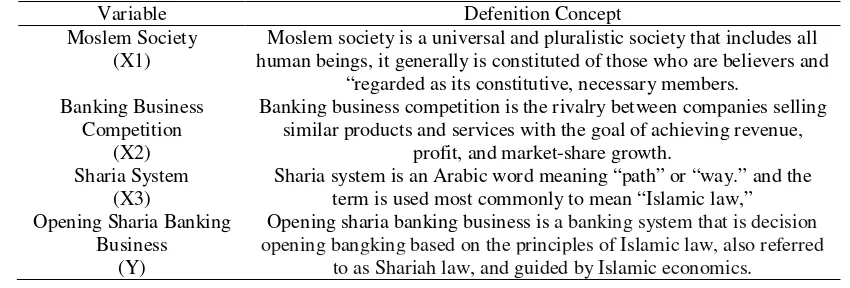
Table 1. Variable Defenition
Variable Defenition Concept
Moslem Society (X1)
Moslem society is a universal and pluralistic society that includes all human beings, it generally is constituted of those who are believers and
“regarded as its constitutive, necessary members. Banking Business
Competition (X2)
Banking business competition is the rivalry between companies selling similar products and services with the goal of achieving revenue,
profit, and market-share growth. Sharia System
(X3)
Sharia system is an Arabic word meaning “path” or “way.” and the term is used most commonly to mean “Islamic law,” Opening Sharia Banking
Business (Y)
Opening sharia banking business is a banking system that is decision opening bangking based on the principles of Islamic law, also referred
to as Shariah law, and guided by Islamic economics.
Data Analysis Method
The data analysis used is multiple linear regression analysis with the help of a computer through software SPSS 16:00 For windows.
Statistical equations used in this peneitian is described as follows: y= a+b1x1+b2x2+b3x3+ e appropriately and have high validity, the high and low validity of the instrument indicates the extent to which the data collected does not deviate from the description of the variables in question (Indiantoro, 2002). To test the validity can be calculated correlations between each statement with a total score correlation techniques product moment of pearson (Ghozali, 2009). Calculation used is the product moment correlation technique which can be obtained by the formula:
Usdeldi,The Influence of Moslem Society ... 141
Information: r = correlation coefficient, x= independent variable, y= dependent variable, n= number of samples.
Test Reliability Data
Reliability test is a test used to measure the questionnaire which is an indicator of the variables. Measurements were performed only once and the results are then compared with any questions. Reliability testing is performed to determine the extent to which an instrument can provide consistent measurement results. Reliability testing is done by using Alpha Cronbach Test.
Weight calculation assessment questionnaire for the top management of banks in Jambi province is using a Likert scale is a method used to measure attitudes to agree or disapproval of the subject, object or specific events (Indriantoro, 2002). Likert scales with five levels of answers with the following options.
Table 2. Likert Scale
Level Agree Score
Very Disagree 1
Disagree 2
Neutral 3
Agree 4
Very Agree 5
Classic Assumption Test
Multiple regression models were used in hypothesis testing is said to be a good model if it meets the normality of the data and free from classical assumption, namely normality, multicollinearity, autocorrelation and heteroscedasticity (Ghozali, 2002). In this study, not in the classic assumption autocorrelation test data collected on the grounds and in it were a cross-section, while the autocorrelation problem often occurs in the time series data. Classic assumption test used including normality test, test and test multicollinearity heterostasis.
Multiple Regression Test
Multiple regression methods was developed to estimate the value of the dependent variable (Y) by using more than one independent variable (X). The regression equation is as follows:
Y = + 1X1 + 2X2 + 3X3 + e
Information: Y= Opening Sharia Banking Business, X1= Moslem Society, X2= Banking
Business Competition, X3= Sharia System, 1, 2, …= Regression coefficients,
=Constants, e= Error.
Partial significance test was conducted to test the effect of independent variables on the dependent variable partially. To test the significance of individual parameter t-test was used. To be able to decide whether thein dependent variables have a significant effecton the dependent variable or not, by analyzing the significant value generated from the output of SPSS Version 16.
3 and n2 = 50; = 5%) of 2.79 or significance value> 0.05, it can be concluded that all the independent variables tested were incorrect variables in predicting the dependent variable.
IV. Result and Discussion Validity test
Validity test is done with the aim to determine the level of ability of an instrument to express something that became the main targets of measurement are born with the instrument. Of the 60 questionnaires sent, but the questionnaires that are returned are as many as 54 questionnaires. Testing the validity of this research is done by using Product Moment Correlation test
Table 3. Validity of Test Results Instrument
Number
Based on the validity of the test results performed with SPSS version 16.0 indicates that the Moment Pearson correlation coefficient for each item statement items with a total score variable Moslem Society (X1), Banking Business Competition (X2), Sharia System
(X3), and Opening Sharia Banking Business (Y) is significant at the 0.05 level. So that it
can be interpreted that each item indicators for accountability instrument are valid. In summary, the results of the validity test of variables can be seen in the following table
Test Reliability
Reliability testing is performed to determine the extent to which an instrument can provide consistent measurement results. Reliability testing is done by using Cronbach Alpha test Here are the results of reliability testing on each of the variables shown in the Table 4.
Based on the reliability of the test results shown in the tables above, it is known that the questionnaire used had alpha coefficient values greater than 0.60 so it can be concluded that the questionnaire in this study revealed reliable.
Table 4. Reliability Test Results
Variable Cronbach’s Alpha Based on Standardized Item N of Items
Moslem Community 0,862 8
Perbankan Bussines Competitive 0,776 6
Sharia System 0,823 7
Opening Sharia Perbankan Business 0,818 9
Source: Primary data processed, 2016
Classic Assumption Test
Usdeldi,The Influence of Moslem Society ... 143
Normality Test
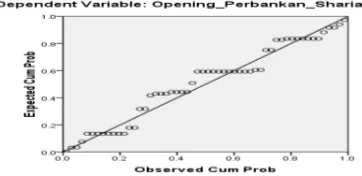
The result of normality test probability plot graphs can be seen in the picture below:
Figure1. Normality Test Results
Based on the above chart, we can see that the data is spread around the diagonal line and follow a diagonal line. Thus regression models were used with modern assumption of normality.
For the histogram graph can be illustrated below:
Source: Primary data processed, 2016
Figure 2. Graph Histogram.
Viewing the displayed histogram graph above we can conclude that the histogram graph gives approximately normal distribution patterns. The second graph shows that the regression model unfit due to meet the assumptions of normality.
Test Multicollinearity
Multicollinierity test results can be seen in the following table: Table 5. Test Results Multicollinearity
Independent Variables Collinearity Statistics Decision
Tolerance VIF
Moslem Society 0,527 1,897 No Multicollinearity
Banking Business Competition 0,965 1,036 No Multicollinearity
Sharia System 0,536 1,866 No Multicollinearity
Source: Primary data processed, 2016
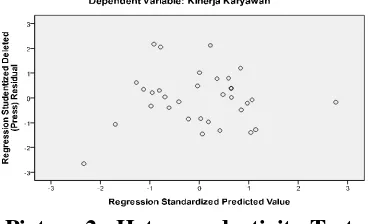
Heteroscedasticity Test
The test results heteroscedasticity with scatterplot graph, as the following
Source: Primary data processed, 2016
Figure3.Scatterplotgraph
Based on the scatterplot graph above, we see that the distribution of the data does not form a clear pattern, the data points spread above and below zero on the Y axis This indicates that there is no heteroscedasticity in the regression model.
Multiple Regression Test
After the classic assumption test results carried out and the results overall showed regression model to meet the assumptions of classical, then the next stage is the evaluation and interpretation of multiple regression models. Multiple regression models in this study was to test the effect of independent variables Moslem Society (X1), Banking Business
Competition (X2), and Sharia System (X3) on dependent variable Opening Sharia Banking
Business (Y).
The following is a description of the test results and regression testing output table by using SPSS version 16.0 in the form of the model output summary, ANOVA (F-test), as well as the coefficient (t-test) as follows:
Test Coefficient of Determination
The coefficient of determination (R2) was conducted to see the huge variety of independent variables together in influencing the dependent variable. According to Ghozali (2006) fundamental flaws using the coefficient of determination (R2) is biased against the number of independent variables were entered into the model. Each additional one independent variable, then R2 is definitely increasing and no matter whether these variables significantly influence the dependent variable. Therefore it is recommended to use the Adjusted R Square when evaluating which best regression model.
Usdeldi,The Influence of Moslem Society ... 145
Table 6. Coefficient Determination Test Results Model Summary
Model R R Square Adjusted R Square
Std. Error of the Estimate
1 .660a .435 .402 .48153
a. Predictors: (Constant), Sharia_
b. Dependent Variable: Opening_Sharia_Banking
Source: Primary data processed, 2016
Partial Test (t-test)
Assessment of the effect of partial or research hypothesis testing is done by analyzing the t value or significance value to the following criteria: (1)If the t count> t table at df (54-4 = 50; alpha = 0.05) is equal to 1,676 or significance value <0.05 it can be concluded that the independent variables are statistically proven effect on the dependent variable. (2) If t <t table at df (n - 3 = 32; alpha = 0.05) amounted to 1,676, or a significance value> 0.05 then we can conclude that the independent variable is not statistically proven effect on the dependent variable.
Table 7. Partial Test Results (Test T) Coefficients
Model
Unstandardized Coefficients
Standardized Coefficients
T Sig.
B Std. Error Beta
1 (Constant) .956 .417 2.292 .026
Moeslim_Society .199 .124 .219 1.598 .116
Banking_Bussines_Competition -.016 .140 -.016 -.112 .911
Sharia_System .460 .152 .510 3.022 .004
a. Dependent Variable: Opening_Sharia_Banking Source: Primary data processed, 2016
Based on the results of tests performed on variable recognition, measurement, presentation, and accountability so multiple regression equations can be formulated as follows:
Y = 0,956 + 0,199 X1 +(- 0,016) X2 + 0,460 X3
Information: Y = Opening Sharia Banking Business, X1= Moslem Society, X2=
Banking Business Competition and X3= Sharia System
By using the regression equation regression models above it can be described as follows: (1) Constant of 0.956 gives the sense that if the Moslem Society (X1), Banking
Business Competition (X2) and Sharia System (X3) assumed = 0, then the Opening Sharia
Banking Business (Y) is constantly worth 0.956. (2) The regression coefficient variable Moslem Society (X1) is approximately 0.199 gives the sense that with the addition of one
unit of Moslem society, there will be an increase in the opening sharia banking business amounted to 0,199, assuming other variables remain.(3) The regression coefficient variable Banking Business Competition (X2) is approximate -0.016 gives the sense that with the
The regression coefficient variable Sharia System (X3) is approximately 0.460 gives the
sense that with the addition of one unit Sharia System, there will be an increase in the opening sharia banking business amounted to 0,460, assuming other variables remain.
To test the hypotheses proposed, then tested the t statistic to determine whether these variables affect. Basis for decision-making to determine Ho and Ha accepted is with the following criteria:
Ho accepted or Ha refused, when t < t table Ho refusedor Ha accepted, when t < t table.
Another alternative t-test can be done through tests of significance ( = 0.05), with criteria:
Ho accepted or Ha refused, when Sig t> Ho refused or Ha accept, when Sig t <
The following describes the effect partially test results for each independent variable:
Testing the influence of Moslem Society to Opening The Sharia Banking Business (H1)
The first hypothesis testing was conducted to test the influence of Moslem society to opening the sharia banking business. The test results showed that both variables regression coefficient of the influence of Moslem society decision to opening the sharia banking business amounted to 1,598, with a t value of 1.598 and a significance of 0.116. Therefore t value (1.598) <t table (1.676) and the resulting significant value is> 0.05, it can be concluded that Ho is accepted and Ha rejected. These test results show that the Moslem society proved to be statistically no significant effect to opening the sharia banking business.
Testing The influence of Banking Business Competition toOpening The Sharia Banking Business (H2)
Second hypothesis testing was conducted to test the variables banking business competition to opening the sharia banking business. The test results showed that both variables regression coefficient of the influence of banking business competition to opening the sharia banking business amounted -0.016, with at value of -0.112 and significance of 0.911. Therefore t value (-0.112) <t table (1.676) and the resulting significant value is> 0.05, it can be concluded that Ho is accepted and Ha rejected. These test results indicate that the banking business competition proved to be statistically no significant effect on opening decision the sharia banking business.
The influence of Sharia System to Opening The Sharia Banking Business (H3)
Third hypothesis testing was conducted to test thevariable sharia systemtoopening the sharia banking business. The test results showed that both variables regression coefficient of the influence of sharia system toopening the sharia banking business amounted to 0.460, with a t value of 3.022 and a significance of 0.004. Therefore t value (3.022)> t table (1.676) and a significant value generated is <0.05, it can be concluded that Ho is rejected and Ha accepted. These test results indicate that the Sharia System proved to be statistically significant and positive impact toopening the sharia banking business.
Simultaneous Test (Test F)
Usdeldi,The Influence of Moslem Society ... 147
variable. (2) If the value of F arithmetic <F table at df (4; 54; 0.05) is equal to 2.79 or significance value> 0.05 then it can be concluded that all independent variables were tested simultaneously has no effect on the dependent variable.
To test the hypothesis 4, that is, whether the variable Moslem society, banking business competition, and sharia system influence toopening the sharia banking business in Jambiprovince, then tested together against the regression coefficients by using F test method used to test this hypothesis in a way:
Ho accepted or Ha refused, if f < t table
Ho is rejected or Ha receives, if f count > t table
Another alternative t-test can be done through tests of significance ( = 0.05), with criteria:
Ho accepted or Ha refused, when Sig f> Ho refused or Ha accepts, when Sig f <
Here is the F-statistic test results are presented in the table below. Table 8. Simultaneous Test Results (Test F)
ANOVAb
Model Sum of Squares Df Mean Square F Sig.
1 Regression 8.943 3 2.981 12.857 .000a
Residual 11.594 50 .232
Total 20.537 53
a. Predictors: (Constant), Sharia_System, Moeslim_Society, Perbankan_Bussines_Competitive
b. Dependent Variable: Opening_Sharia_Banking Source: Primary data processed, 2016
From the test results of the simultaneous test or ANOVA F test as shown in the table above, the value of F count equal to 12.857, while the F table at 2.79, so Ho rejected or receive Ha. The next test was to see the level of significance of variables Moslem Society (X1), variable Banking Business Competition (X2) and Sharia System (X3) is
0.000. Since the probability is much smaller than the significant value of 0.000 (<0.05), so Ho rejected and Ha accepted. These test results indicate that the Moslem society, banking business competition, and sharia system significantly and positively influence to opening the sharia banking business.
V. Conclusion
Based on the results of research and discussion that has been done, it can be concluded as follows: (1) Moslem society no significant effect toopening the sharia banking business, so that Moslem society in Jambi Province does not guarantee to open the sharia banking business. (2) Banking business competition no significant effect on opening decision the sharia banking business, so the banking business competition in Jambi Province does not guarantee opening the sharia banking business. (3) c. Sharia system a significant effect toopening the sharia banking business, so that the application of sharia system is the reason for opening the sharia banking business. (4) d. Moslem society, banking business competition, and sharia system a significant effect toopening the sharia banking business, so that Moslem society, banking business competition, and sharia system jointly be the reason to opening the sharia banking business.
Implication
institutions in Jambi Province to consider factors that affect toopening the sharia banking business, in the form of Moslem society, banking business competition, and sharia system. (2) Suggested for further research in order to expand beyond the model of independent variables in this study.
References
Antonio, Muhammad Syafi’i. 2001. Bank Syariah Dari Teori Ke Praktik. Jakarta: Gema Insani Press
Ghozali, Imam. 2011. Aplikasi Analisis Multivariate Dengan Program IBM SPSS 19. Semarang: Badan Penerbit Universitas Diponegoro.
Indriantoro, Nur dan Bambang Supomo.2012. Yogyakarta: BPFE UGM.
Karim, Adiwarman A. 2006. Bank Islam Analisis Fiqih & Keuangan. Jakarta: Raja Grafindo Persada.
Sugiyono. 2009. Metode Penelitian Pendidikan Pendekatan kualitatif, Kuantitatif, dan R&D. Bandung: Alfabeta.
THE PRIVATE COST IN EDUCATION AS A DETERMINANT FACTOR OF THE ACADEMIC QUALITY: A CASE STUDY OF STATES HIGH SCHOOL IN
URBAN AREA OF WEST SUMATERA PROVINCE
Efni Cerya
Economic Faculty, State University Of Padang, Indonesia [email protected], [email protected]
Abstract
This study aimed to measure the influence of private cost to the academic quality of States High School in urban area of West Sumatera province. The population of this study are state high schools in urban areas of West Sumatra. Samples were purposive sampling reduced it to be 32 schools with criteria that had the national exams score for one year and financing by social and individual. The research proved that private cost influence on the academic quality with 0,602 determinant. This study suggests to use the private cost as one input to improve the quality of academic.
Keywords: Private Cost, Academic Quality
I. Introduction
The quality in educational context refers to the process and educational outcomes. The quality process involves a variety such as teaching materials, teaching methods, school facilities, administrative support, and infrastructure and other resources to the creation of a favorable atmosphere in school.
The academic quality either qualitatively or quantitatively is a function of a number factors input, process and output. In other words, an academic quality is a specific target from educational objectives such quality outputs and outcomes of students as the primary education stakeholders. This quality is determined by several factors: the quality of inputs (number of teachers, number of teachers who attended the training, and the number of textbooks available), the quality of the process (the amount of time on learning and active learning level), and the quality of the curriculum. It is these factors that will be collaborating in the form of a quality learning process.
This is consistent with the idea from Supriadi (2001) and Irianto (2010) that the quality learning process occurs if coordinating, harmonizing and blend harmoniously school inputs performed and integrated highly dependent from teaching staff, equipment and learning resources. he availability of qualified teaching staff, equipment and learning resources that itself depends on the amount of financing or funds held by educational entities for the provision of the learning.
Costs in education had a broad scope, namely all kinds of expenses relating to the provision of education, either in cash or in kind and labor (which can be priced in money). Cost is a very important element although not the only component that is most important. However invisible curriculum design, educational planning ripening, but when it comes to the operational stage and collided their limitations, the cost of good planning will have little meaning, which means, perhaps even planned educational programs difficult to be realized.
There is no consensus of opinion in the literature as regards the relationship between expenditure and academic achievement. Hanushek (1981) found that there no significant relationship between school expenditure and students’ academic achievement. A World Bank report (1988) pointed out that one explanation for the low quality of education in Africa is that expenditure per student is very low by world standards.
Government Regulation No. 48 of 2008 on education funding; the provision of financial resources required to the implementation and management education is a responsibility shared responsibility between government, local governments and communities.
Subsequently, the purpose of cost sharing of this is when financing from government sources is insufficient in accomplishment the needs of the school, it may be assisted by the learners parties. This cost is called by the private cost.
Suhardan (2012) and Irianto (2011) states that the private cost is the total cost incurred by the learners parties or all costs to be borne, and expense by the students family to support their children’s learning success either such fees from school or such cost of living and supporting studies. Bastian (2007) stated that the number of private cost is calculated by the difference of direct cost and routine cost of school which are divided equally to each student. With the Government Regulation No. 47 Year 2008 Article 9 states that "the government bears the full funding of education for the basic education (primary and secondary) as one of the implications of 9-year compulsory education program". Then the cost of an individual such fees collected by the new school began to be seen in secondary education. With the sharing of education financing is expected to be more optimally organized learning that results in improved academic quality nationally.
In the context of the analysis of an individual education financing costs to increase the academic quality, researchers selected urban areas of West Sumatra province as the study area. Based on data from National Survey in 2012, the urban areas of West Sumatra province has a high commitment to improve the quality of education in a sustainable and enthusiastic people in education are also high.
II. Theory Development And Hypothesis Formulation
In order to examine the issue of how did the private cost influenced the academic quality States High School in urban area of West Sumatera province, our basic hypothesis is that academic quality is constructed by four factors in general, namely input, process, output and outcomes factors. (Adams, 2001). The input would be qualified if it ready to be processed. Process would be qualified if it is able to apply an effective learning. Output is declared qualified if the result of academic and non academic learning of students is high. Whereas, when outcome is said to be qualified graduates quickly find work, salaries are reasonable or appropriate, and all parties recognize the severity of graduates and feel satisfied with the competency of graduates.
In line with this, Suhardan (2012: 74-76) states that academic quality is the outcome of the human quality of the educational process, tools, curriculum and facilities, which is reflected in the quality of teaching and teachers, the quality of teaching materials, and the quality of learning outcomes, so that eventually forming a set of capabilities.
Efni Cerya, The Private Cost in ... 151 framework of the academic quality of an education as a system as follows:
Figure 1. The Map Of Educational Component As A System
Private cost” correspondence to to the part of expenditures/investments which are incurred either by the parents or students or both (McEwan, 1999) (Supriadi, 2003) and (Yahya, 2011). In this discuss, private cost derived to tuition fees, living cost, studying supporting cost, and additional cost other. (Irianto, 2011).
In specific, the costs incurred by the family can be categorized as an investment in education. In which the return value of this investment can be demonstrated by increased academic quality of the students. Sunario (2014) stated that economic condition of the parent that implied by private cost will be influence pupil achievement motivation. The adequacy of facilities will impact their motivation in studying, then will increase their academic quality as specifically or generally for a school.
Based on the above issues and theoretical framework, it can be formulated hypotheses as follows: The private cost has significantly influence the Academic Quality of State High School in Urban Areas of West Sumatra Province.
III. Research Methods
Sample and Sampling Techniques: in order to select the sample of the study from 41 State High School in Urban Area of West Sumatera Province, the researcher adopted purposive sampling procedure that sampling based on a particular consideration. Main consideration was schools had been followed the National Examination least once and there is sharing of financing with the students. From the to population is obtained eight schools is no sharing of financing and one schools did not yet sat the national examination. Initially, the data were collected from 32 schools.
Instruments used in the study.
Documentation: Document analysis performed to gather data from archives and documents either in school or are out of school, that are related with the research. Documentation in the research is used to gather data on the private cost contained in the School Activities and Budgetary Plan and the academic quality of education high schools in urban areas of West Sumatra province in the form of National Test Scores.
IV. Result and Discussion Data Analysis :
Descriptive Analysis
The average of private cost incurred by the parents of high-school education in year 2012/2013 is IDR. 1,663,800 with the lowest amount of individual fee is Rp 280,000 and IDR 5,260,000 with a high of IDR 1,337,010 standard deviation from the average. The highest number of individual charges obtained by SMAN 1 Padang and lowest individual fees obtained by the city of Pariaman but partially by SMAN 4 Bukittinggi. By seeing a standard deviation that is large, it can be said that the individual costs between state high schools in the cities of West Sumatra province had a high gap. For more details the distribution of the individual cost of high school education in urban areas of West Sumatra province can be seen from the table 1 below:
Tabel 1. Descriptive Data The Private Costs Of State Senior High School In Urban Areas Of West Sumatra Province
Private Cost Frequencies Percentage
Rp 282.013 - Rp 1.110.893 11 34
Rp 1.110.894 - Rp 1.939.773 12 38
Rp 1.939.774 - Rp 2.768.654 5 16
Rp 2.768.655 - Rp 3.597.535 1 3
Rp 3.597.536 - Rp 4.426.416 1 3
Rp 4.426.417 - Rp 5.255.298 2 6
Amount 32 100
From the Table 1 above it can be seen that the private cost of education high schools in urban areas more are in the second class, namely the range IDR 1,110,894 – IDR 1,939,773 and positive distributed data (skewed to the right).
Reseach Question: Do the private cost influence the Academic Quality of State High School in Urban Area of West Sumatera Province?
Table 1 shows the direct impact of individual cost analysis on academic quality.
Table 2. shows the impact of private cost analysis on the academic quality.
Variabel Standardized Coeficient
Sig R
Square Independent Beta
Private Cost
(X₁) 0,612 0,000 0,3745
Efni Cerya, The Private Cost in ... 153
Based on the results of hypothesis testing showed that the coefficient of private charges against academic quality shown by the Standardized coëficient / Beta is equal to 0,612. Level of significance is 0.000 < 0.05 (at = 0.05). Hence the significance level smaller than 0.05, then the alternative hypothesis that says the private cost in education effect on the academic quality of State High School in Urban Area of West Sumatera Province accepted. It can be concluded that the private cost significantly influence academic quality of schools.
Discussion
Statistical analysis showed the private cost has a strong influence and significant impact on the academic quality, by the coefficient of 0.612 while contributing 37.45%. This contribution can be categorized as are great and can be interpreted that the increase in the private cost will be able to improve the academic quality of education high schools in urban areas of West Sumatra province.
The significant effect between the private cost and the academic quality shows that part of the learners as well as consumer education and educational inputs must also take responsibility in ensuring the success of educational goals. Participation of parents is managed by the board of the school committee. Through this committees, students parties also participated in contributing to education, provide a feedback, consideration (advisory agency), and recommendations on the educational unit with the principle of encouraging an increase in the academic quality and the quality of learning services of those school. Parents of learners should come to allocate a proportion of revenue for education expenses of their children so that the achievement of the required the provision of schools resources could improve the academic quality of the educational entities (Syamwil, 2013; Elfindri, 2010; Carter; 2006; 16).
Participation of parents in the education of high schools in urban areas of West Sumatra in the year 2012/2013 showed a big number, namely 64% of the total funding of schools. This figure is quite high and implies that funds for improving the quality of high school to be very dependent on the contribution of the student's family. The results of this study reinforce the the findings of previous researchers (Hulsmann, 1997; Perraton, 2000,2003, Psacharopoulus, 1978) who said that “on the issue of private costs of education - that students who are engaged in educational activities also bear a significant proportion of the expenditure associated with their studies.” This finding also in line with Supriyadi (2010) states that "the absence of families awareness to bear most of the cost of education, national education will not run properly."
With reference to the above results, the cost issue is an issue that fairly fundamental. Because all components of education is closely related to the cost component, although not entirely a matter of costs will affect the quality of education. Other factors should also be considered to improve the academic quality of education, including: 1) internal factors such as the level of students' IQ and motivation 2) the interaction of learning; with regard to the approach and the way teachers in managing the learning, professional competence and pedagogical teacher, and 3) he curriculum as a reflection of education about the desired graduate as well overview of the process and its resources.
V. Conclusion
References
Bastian, I. 2007. Akuntansi Pendidikan. Jakarta: Erlangga.
Cerya, Efni. 2014. Pengaruh Biaya Sosial dan Biaya Individu terhadap Penyelenggaraan Pembelajaran dan Mutu Akademik Siswa SMA di Daerah Perkotaan Provinsi Sumatera Barat.Thesis. Universitas Negeri Padang
Fattah, N . 2004. Ekonomi dan Pembiayaan Pendidikan. Bandung: Rosdakarya.
Hulsman. 1997. Literature Review on Cost Effectiveness in ODL Systems. IRFODL: Cambridge
Irianto, Agus. 2011. Pendidikan Sebagai Investasi Dalam Pembangunan Suatu Bangsa. Jakarta: Kencana.
Khandagale, Vidyanand S. 2014. Private Costs of Education and Academic Achievement of Students: An Analysis by School Types. IOSR Journal of Humanities And Social Sciences, Page 39-43.
Mc Ewan, P. J. 1999. Private Costs and The Rate Of Return to Primary Education. Applied Economics Letters , 759-760.
Nicholas Barr. 2005. Financing higher education. Volume 42 Number 2 June 2005.
Suhardan, D., Riduwan, & Enas. 2012. Ekonomi dan Pembiayaan Pendidikan. Bandung: Alfabeta. Sukmadinata,NS.dkk. 2006. Pengendalian Mutu Pendidikan Sekolah Menengah. Bandung: Refika
Aditama.
Sunario, Besti Aulia. 2014. Hubungan Biaya Pendidikan dan Motivasi Belajar Siswa dengan Hasil Belajar. Skripsi. Universitas Pendidikan Indonesia
Supriadi, Dedi. 2010. Satuan Biaya Pendidikan; Dasar dan Menengah. Bandung: Remaja Rosdakarya.
Yahya. 2011. Ekonomi dan Pembiayaan Pendidikan; Sebuah Pendekatan Akumulatif. Padang: Sukabina Press.
VALUE OF ISLAM AS A MODERATING VARIABLE
ON THE INFLUENCE OF MARKETING MIX
OF SERVICE AND SERVICE QUALITY TO CUSTOMER
SATISFACTION STUDENTS
Dedek Kurniawan Gultom1 and Jufrizen2
Department of Management,University of Muhammadiyah Sumatera Utara (UMSU) [email protected]
Abstract
This research aims to prove empirically the influence of the marketing mix of service and quality of service partially and simultaneous to student satisfaction and prove empirically the influence of moderation Islamic values on the relationship between the services marketing mix and quality service to customer satisfaction Economic Faculty student Private Islamic University in the City of Medan. The type of this research is a descriptive quantitative. The location of this research is in the Management Studies Program Faculty Of Economics Private Islamic University in the City of Medan. The population in this research is all students Study Program Management of the Faculty of Economy Muhammadiyah University of North Sumatera Medan and Muslim Universities Nusantara host 2012. In this research model and data analysis techniques using approach multiple regression on stilts.
Keywords: Marketing Mix Services, Quality of Service, Student Satisfaction and values of Islam I. Introduction
Education is an important factor for the survival of the life of the nation and supporting factors that play an important role in all sectors of life, for the quality of life of a nation is closely connected with the level of education. The development of education is one of the main priorities in the national development agenda. The development of education is very important because a significant role in achieving progress in various areas of life: social, economic, political and cultural.
Therefore, the government has the obligation to fulfill the right of every citizen to obtain educational services in order to improve the quality of life of the people of Indonesia as mandated by the Constitution, which require that the government is responsible for the intellectual life of the nation and create the public welfare. Education is a strong basis that is needed to achieve the progress of the nation in the future even, more important a provision in the face of the global era is replete with unquestionable competition held very tight. Thus the education is the requirement that must be met because he was the factor determination for a nation to be able to win the global competition.
In line with the Act No. 20/2008 on National Education System, Article 5 paragraph (1) stated that "Every citizen has the same rights to obtain a quality education", and Article 11 paragraph (1) stated that "The government and local governments are required to provide the services and convenience, and guarantee the holding of a quality education for every citizen without discrimination".
In general target market college students that some will continue to higher education. High school graduate General (SMU) who will continue their education to higher education of course want so that later finished quickly and then easily find jobs. In the current conditions, seen that the capacity of the students of public universities is very limited, then all private universities (PTS), especially in North Sumatra has the same opportunity to choose candidate students that are not collected in the PTN in continued her study.
Therefore every PTS must perform a special strategy that is different from other public universities. How big or small the ability to obtain the students depending from the dissemination of information about the corresponding PTS, which clearly visible from the services marketing mix strategy applied by every PTS. In addition to the services marketing mix strategy, accreditation status also affects student satisfaction as a place of study..
Private universities (PTS) is one of the social organizations are engaged in the education sector toward the creation of the human resource personnel in all dimensions of life. PTS such as with public universities, trying to develop an advanced and high-quality education institutions. In terms of business, the quality of a college to pull power for the community and provide great benefits both for the student and for the labor of the educators in the education institutions.
Enhanced ability to manage and develop the college very required, including to use the principles of modern oriented on the quality of the service. Quality Management System is fact means on continuous improvement to strengthen and develop the quality, to give satisfaction to learners who are in it.
Management Study Program private Islamic University seeks to improve the quality of service such as the improvement of the physical facilities of the building, equipment to support the teaching and learning, empowerment of lecturers to continue their education to a higher level. In addition to the student satisfaction, the improvement of the quality and performance of education is done in order to remain competitive with various private universities (PTS) which more and more popping up in the city of Medan.
Education institutions under the umbrella of Islam is a private educational institution that is not only the conduct of education and teaching only, but there is a dharma other Muslim religious education. In addition to education and teaching, no one dharma again carried out by the Islamic Universities namely Al-Islam.
II. Teoritical Framework
The Perceived Role of Ethics and Social Responsibility (PRESOR)
Instruments of the Perceived Role of Ethics and Social Responsibility (PRESOR) was developed in the USA by AnushornSinghapakdi, et al, (1996) to meet the needs scale a reliable and valid to measure managers' perceptions about the role of business ethics and social responsibility in achieving organizational effectiveness. The instrument consists of items that reflect the different dimensions of business ethics and social responsibility of the organization and the importance of ethics and social responsibility relative to serve as criteria for measuring the effectiveness of the organization.
Dedek Kurniawan Gultom and Jufrizen,Value of Islam As a Moderating ... 157
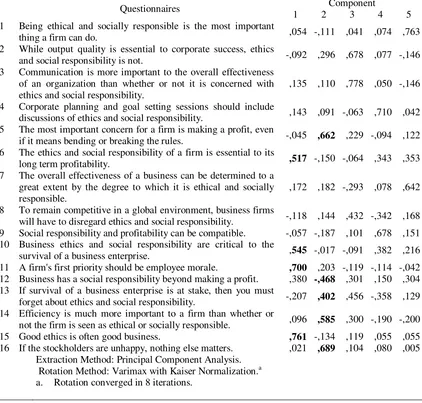
principle of rotation varimaxwith respondent of Master Businessstudentsof the Business School, USA.Singhapakdi et al., (1996) identified three groups of factorial subscales, namely Social Responsibility and Profitability (item 8, 9, 13, 15), Gain Long Term (item 1,6,7, 10, 11, 12) and the Short-Term Gain (item 5, 14, 16). Then Singhapakdi assess the validity of the instrument by using two-dimensional PRESOR ethical ideology as measured by Forysth's (1980) Ethics Position Questionnaire (EPQ) and also instrument of Attitudes Toward Business Ethics Questionnairre (ATBEQ) (Preble and Reichel, 1988).
Research conducted by Singhapakdi et al., (1996) to undertake the development of instruments of measurement scale, confirming the factorial structure of the instrument and to assess the reliability and validity of the instrument, using the population of managers in Hong Kong where the culture and ethics of business in Hong Kong is different from other Asian countries. The final aim of the study Singhapakdi et al., (1996) is to get a conceptual and structural definition of instruments and validation of alternative forms of culture Hongkong as an instrument of measurement of perceived role of business ethics and social responsibility in achieving organizational effectiveness.
Wong (1983) hypothesized that the ideology of industrialists in Hong Kong is the meeting between the ideology of business East with the ideology of Western business, where they dispose of laissez faire, the interests of long-term, ideologies manifest in beliefs that laying off workers is worth the effort to protect the viability of the company , which the company exists simply to make a profit and the manager should not be dealing with the moral and social consequences, also not involved in social and political relations.
Attitude Towards Business Ethics Questionnaire (ATBEQ)
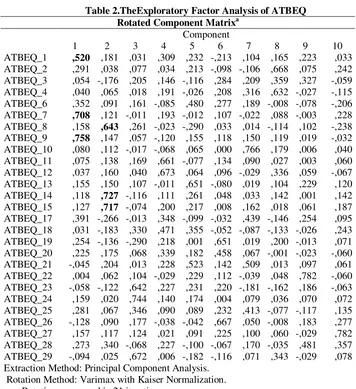
ATBEQ is an instrument developed by Preble and Reichel (1988) to exercise ethical values clarification related businesses such as the business philosophy of Social Darwinism, Machiavellianism, Objectivism, and Ethical Relativism (Meising and Preble, 1985). This ATBEQ was used by Preble and Reichel (1988) to evaluate the behavior of American students and students of Israel associated with business ethics. ATBEQ consists of 30 items of questions prepared by developing business philosophy as Social Darwinism, Machiavellianism, Objectivism, and Ethical Relativism.
The first ATBEQ subscale clearly proposes that ethics and morality are irrelevant in business. This Machiavellian business philosophy is very similar to the view that ethics and social responsibility should be subordinated in achieving organizational effectiveness. For this reason a strong positive relationship is expected between the first ATBEQ subscale and the second PRESOR subscale. Clearly, however, the view that ethics and social responsibility are irrelevant in business must be expected to be negatively related to the view that ethics and social responsibility are important.
The second ATBEQ subscale has been described as reflecting an objectivist business philosophy based on rational self-interest which values economic growth, profit, and efficiency. This position accepts the need for ethics and social responsibility in principle but, as in Friedman's (1970) classical view, believes that managers should conduct business in the interest of the shareholder. Accordingly, a positive relationship is expected with the view that ethics and social responsibility should be subordinated to competitiveness, profitability, survival and efficiency as indicated by the second PRESOR subscale.
Ethics Position Questionnaire (EPQ)
of attitudes and moral behavior into two dimensions, Idealism and relativism, both linked to the difference in moral judgments, attitudes towards issues of contemporary moral, attribution of responsibility to err resistance to temptation moral, individual differences in Machiavellianism and ethical responsibility and attention.
Forsyth (1980, 1992) conceptualized Idealism as reflectinga concern for the welfare of others and the avoidance of negative consequences for others, and the belief that morally "right" behavior leads to desirable consequences. Highly Relativistic individuals are seen as rejecting moral universals and endorsing an ideology based on ethical scepticism, a point of view which recognizes that there are many different ways to look at morality and which criticises those who attempt to formulate or rely on specific ethical principles (Forsyth, 1980, 1981, 1992). High Relativists are likely to take a more moderate or neutral position in moral judgment than those who are low on Relativism (Forsyth, 1981). This does not mean that Relativism is negatively related to the perceived importance of ethics and social responsibility as proposed by Singhapakdi et al., (1996b). On the contrary, Relativists are likely to agree that ethics and social responsibility are important in principle. At the same time, their scepticism makes them likely to agree that there are situations in which ethics and social responsibility may have to be subordinated if competitiveness, profitability, survival or efficiency are to be maintained.
Hypotheses Development
Hypothesis 1 : Idealism is positively associated with the perception that ethics and social responsibility is important in achieving organizational effectiveness (Presorsubscale 1).
Hypothesis 2 : Relativism is positively associated with the perception that ethics and social responsibility is important in achieving organizational effectiveness (Presorsubscale 1) and against the view that ethics and social responsibility should be subordinated to the achievement of organizational effectiveness (Presorsubscale 2).
Hypothesis 3 : The view that ethics and morals are not relevant (irrelevant) in the business (ATBEQ subscale 1) was negatively related to the perception that ethics and social responsibility is important in achieving organizational effectiveness (Presor subscale 1).
Hypothesis 4 : The view that ethics and morals are not relevant (irrelevance) in the business (ATBEQ subscale 1) was negatively related to the perception that ethics and social responsibility is subordinated to the achievement of organizational effectiveness (Presor subscale 2).