EFFECT OF MULCHING, SANITATION AND YELLOW FLUORESCENT
STICKY TRAP APPLICATION ON POPULATION FLUCTUATION AND
CRITICAL ATTACK PERIOD OF THRIP ON MANGOSTEEN
Affandi*)and Deni Emilda
Indonesian Tropical Fruits Research Institute
Jl. Raya Solok - Aripan Km 8 P.O. Box. 5 Solok 27301 West Sumatera, Indonesia *)
Corresponding author Phone: +62-0755-20137 E-mail: [email protected]
Received: August 29, 2009/ Accepted: January 9, 2010
ABSTRACT
This research aims to know the effect of mulching, sanitation and yellow fluorescent sticky trap application on population fluctuation and critical attack period of thrip on mangosteen which was carried out in a farmer mangosteen orchard in Lima Puluh Kota district, West Sumatra, Indonesia from October 2007 to February 2008. Twenty of plants were used as sampling units. Four plants were used to elucidate the critical period of mangosteen thrip attack that was assessed based on parameter of scar intensity, and sixteen plants were used to study the effects of mulching, sanitation and yellow fluorescent sticky trap on population fluctuation of mangosteen thrips. Each treatment was replicated four times. A completely randomized design was applied and continued with Lowest Significant Different to identity the differences among the treatments. The result showed that critical period of mangosteen thrip was at the 3rd - 10th weeks after fell of calyx. Sanitation combined with application of yellow fluorescent sticky trap reduced percentage and intensity of scars value by 32.83 % and 5.99 %, respectively. The present study implies that knowledge of mangosteen thrip critical attack period and suitable controlling technique are important for the success of thrip control.
Keywords: Mangosteen, thrips, critical period, control
INTRODUCTION
Mangosteen (Garcinia mangostana L.), also known as ‘Queen of Fruit’, is one of
potential fruits originated from tropical South East Asia. The unique and distinctive taste of fleshy edible aril inside the exocarp can be described as sweet, tangy and citrusy with peach flavor and texture. Due to climate circumstances, however, the production was bounded in a few limited areas, such as Indonesia, Malaysia, Thailand and Philippines (Osman and Milan, 2006). In international market, high demand of the product can not still be supplied by producing countries up to this moment and only less than 60 % from fruit market share (Winarno, 2002).
In Indonesia, mangosteen is a strategic commodity. In 2000, the mangosteen export from Indonesia reached US$ 5,885,035, that contributed to 45% of the total fruit exports values (Winarno, 2002). Therefore, through the Ministry of Agriculture, the government has defined mangosteen as one prime commodity, a status that granted the priority development to increase the productivity. In the last five years, however, the exportable mangosteen from Indonesia has diminished. One of the main problems of the product is the incidence of scar on peel. This fruit damage caused significant losses and only 9.6 % of the fruit production is acceptable for the international market standard (Indonesian Department of Agriculture, 2007).
Affandi and Emilda (2009) found that Scirtothrips dorsalis (Hood) and Selenothrips rubrocinctus (Giard) were the insect pest responsible for scars on mangosteen fruit. The insect was found to have wide host range and could attack several alternative host, such as pepper, mango, citrus, strawberry, grapes, cotton, tea, peanuts, blueberry and roses (Morse and Hoddle, 2005), and gave significant losses of pertinent crops.
Efforts have been made to encounter the technical problem related to thrip control in mangosteen. Many articles have reported successful control in several plants, yet none is available in mangosteen as far as these concerned. The capability of insect that could complete its life cycle on both canopy and ground has made insect difficult to be controlled by single method. The University of California Statewide Integrated Pest Management Program (2006) suggested that in controlling invasive insect pest like thrip, several comprehensive applications should be conducted such as sanitation by removing all weeds under the canopy to eradicate its alternative hosts, application of fluorescent yellow sticky trap and reflective mulch to disturb host plant orientation of the thrip.
The paper elucidated the effect of mulching, sanitation and yellow fluorescent sticky trap application on population fluctuation and critical attack period of thrip on mangosteen. Better understanding of critical period of thrip attack is important to be proposed and communicated along the farmers to enable efficient pest control.
MATERIALS AND METHODS
Location of the Research
The research was conducted in a farmer mangosteen orchard in Lima Puluh Kota, West Sumatra, from October 2007 to February 2008. The mangosteen trees were planted by farmer in a polyculture planting system with cacao and coconut trees. The planting distance among mangosteen trees was 8-9 m x 9 m. The cacao and coconut trees were planted randomly throughout the orchard. The mangosteen trees are 10-15 year-old and approximately 4-7 meters high. Fruit scar intensity in the orchard was high reaching almost 100% and endemic. Critical Period of Attacking
Four trees were randomly sampled and used for the experiment. The observation of the critical period of mangosteen thrip attack was calculated using the parameter of scar intensity. In each tree there were three treatments, namely: 1). All mangosteen fruits were bagged since fell down of calyx until harvesting of fruits.
Selected fruits were individually bagged using a double layer 38.7 cm x 29.5 cmfood paper (one
side was paper; the other side was plastic layer). This treatment was meant that there was no chance for mangosteen thrip pest to be in contact with mangosteen fruit as early as possible during fruit development stage. 2). All mangosteen fruits were bagged since fell down of calyx and then, opened biweekly. The bagged fruit was opened in the first of two weeks (week one and two) and then bagged again. The others were bagged and opened in the second of two weeks (week three and four) and then bagged again, and it was done successively until it was opened in the fifth of two weeks (week nine and ten). This treatment was meant that mangosteen thrips pest was allowed to be in contact with fruit at a certain time. This method was used to ascertain the exact period of thrip attack to mangosteen fruit. 3). Mangosteen fruits were not bagged all times during development of fruit which means that thrips were allowed to be in contact with mangosteen fruit all the time (control treatment). All the treatments were replicated four times. The data series of scar intensity were recorded periodically every two weeks until fruit harvesting period.
Mulching, Sanitation and Yellow Fluorescent Sticky Trap
Mangosteen trees were sampled and used for the experiment as sampling units. The experiment was designed in a completely randomized design with four treatments and four replications. Four treatments in this study were 1). Application of yellow fluorescent sticky trap (YST), 2). Combination of sanitation and yellow fluorescent sticky trap (SNT + YST), 3). Mulching and yellow fluorescent sticky trap (MLS + YST), and 4). Control.
Yellow fluorescent sticky trap tube (YST) was made of aluminum zinc that was formed like tube with 10 cm in diameters then nailed on a woody stick as long as 3 meter. A transparent rat glue “Ultra Super” was smeared on one side of the surface of a transparency overhead projection (OHP) plastic “Yashica” (21 cm x 33 cm). The plastic, with the glue part outside, was then put on the YST tube.
one every two weeks. Then, the thrips trapped on the plastic were counted under binocular microscope.
Sanitation was applied by removing all weeds under the canopy of mangosteen tree, followed by tillaging the surface of soil as deep as 3 cm. The sanitation practices were monthly repeated until harvesting time. Mulching was applied by putting paddy hay under the canopy of mangosteen tress as thick as 30 cm. Sanitation was meant to remove the alternative host for mangosteen thrips in the surrounding mangosteen plantation. Furthermore, mulching was addressed to provide breeding habitat for natural enemies such as predators.
The combination treatments of SNT + YST and MLS + YST were performed by combining both procedures as mentioned above. Control treatment meant no treatment started from early bloomy until harvesting of mature fruits.
Parameters Observed
(a) Percentage of the fruit scars. The percentage of scarred fruit was defined as the number of scarred fruits divided by total number of observed fruits, and then multiplied by one hundred percent. The typical symptoms of scar on mangosteen peel is silvering of fruit skin, pale yellow/brown discoloration, elongated and patchy scars or hardened scars, and “alligator skin”-like scars that may cover the entire fruit surface.
(b) Percentage of fruit scars intensity. The intensity of scarred fruit was observed directly to a certain fruit. If all of surfaces of the fruit peel were covered by scars as defined above, the fruit scar intensity reaches 100 %. Hence, the value of scars on a certain fruit could be estimated and ranged from 1-100. The estimation of scar intensity value was done by dividing the mangosteen fruits to eight parts in comparable portion (a stand up mangosteen fruit, from middle to upper part
divided into four parts and from middle to lower were also divided into four parts), meaning each part contained 12.5 percent toward all portions of a mangosteen fruit. All treatments were observed six to nine times during early fruit growth stage until harvesting time. Complete formula of percentage of scar was as follow,
% x N n
P 100
where:
P = Percentage of scars n = Number of scarred fruits N = Total number of observed fruits (c) The number of thrips caught by sticky trap
(21 cm x 30 cm) was also observed six times during fruit growth stage.
(d) Average daily rainfall, rainy days, temperature and relative humidity were recorded.
Experiment data was analyzed by ANOVA and significant differences among the treatments were tested using the Least Significant Different (LSD) test.
RESULTS AND DISCUSSION
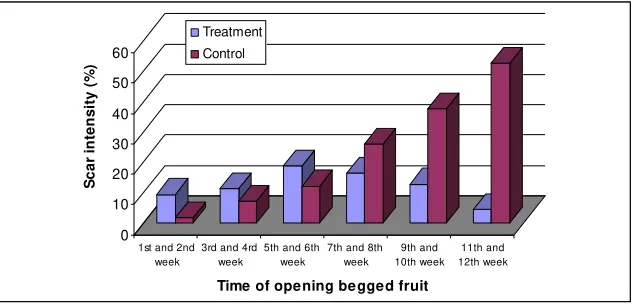
Figure 1. Mangosteen thrip attack derived based on the parameter of scar intensity at the different time of opening bagged fruit
Table 1. Scar intensity based on the opened period of bagged fruit on mangosteen
Scar intensity (%) Time of opening bagged fruit
Treatment Control
1st and 2nd week 9.47 1.75
3rd and 4rd week 11.35 7.13
5th and 6thweek 18.83 12.2
7th and 8th week 16.59 26.2
9th and 10th week 12.90 37.7
11th and 12th week 4.52 (Bagged all time and opened at a certain time)
52.8 (Opened all time)
Immediately after mangosteen trees bloom, thrips moved from shoot leaves to mangosteen flower. The movement is due to the effort of thrips to obtain pollen. Pollen is a prominent source of protein for phytophagous thrips to produce eggs (Tsai et al., 1996). Nation (2001) added that protein is a very important dietary for insects. Restriction of protein dietary less than 20 % resulted in low growth and high mortality of nymph. Adult females require source of protein to mature their ovaries and eggs. In part, protein deprivation may manifest itself in the failure to secrete juvenile hormone which is needed for ovary and egg development. Thrips that consume pollen have a wide range of host plants, including the pollen of grass species that grow adjacent to mangosteen trees (Chellemi et al., 1994). Adult thrips consume cell dilution of shoot leaf if the availability of pollen was limited (Teulon et al., 1993; Toapanta et al., 1996). Meanwhile, stadium of larvae prefers cell dilution of shoot
leaf, a very abundance source feed and is almost available through all the times (Funderburk et al., 2002). On avocado, Hoddle and Morse (2003) revealed that when 3-5 thrips were consistently found per leaf for 97 days, 75-36 days before fruit set, and during fruit set, feeding will cause 26-38%, 18-28%, and 6-15% economic scarring respectively.
Based on Table 1, opened mangosteen fruit (without bagging) at 1st - 2nd and 11th- 12th was resulted in scar intensity of lower than 10 %. It means that late bagging or protecting fruit from attacking of thrips was still tolerated until early two weeks after the fell down of calyx. Most probably, in the early flowering stage, adult female thrips did not produce eggs massively yet due to the availability of pollen functioning as source of protein. Protein is important dietary for ovary and egg development of thrips (Nation, 2001). On the other hand, bagging or protecting since the fell down of calyx until week of 9th and 10th week was better. Both treatments resulted
0 10 20 30 40 50 60
S
c
a
r
in
te
n
s
it
y
(
%
)
1st and 2nd week
3rd and 4rd week
5th and 6th week
7th and 8th week
9th and 10th week
11th and 12th week
Time of opening begged fruit
Treatment
in intensity of scar lower than 10 % whereas those intensity of scar is still accepted by exporters. Indonesian Directorate of Fruit Crop cultivation (2007) stated that scar intensity of mangosteen fruit which is lower than 10 % still fulfills the standard for export and will be accepted by exporters. Hence, it could be concluded that 3rd - 10thweeks after the fell down of calyx was the most critical period of mangosteen fruit toward the attack of thrips whereas control action is an evitable need. Effect of Mulching, Sanitation and Yellow Fluorescent Sticky Trap
Table 2 shows that all treatments promoted significant differences in their ability to decrease the percentage and intensity of scars compared to the control. The application of YST reduced the percentage of scarring by as much as 35.44 % and decreased the intensity of scarring by 10.82 % compared to control. Like the YST treatment, application of paddy hay mulching combined with the use of YST also reduced the percentage (35.11 %) and intensity (8.44 %) of scarring. A combination of SNT+YST showed the best ability to reduce both the percentage and intensity of scarring (43.96 % and 15.81 %, respectively) at the end of experimental period compared to control. However, there was no significant difference between YST and the MLS+YST treatment. Table 2. Percentage and intensity of scars on
mangosteen fruits from different treatments at the end of observation Treatments Percentage of
scarring
Intensity of scarring Control 76.79 a 21.80 a YST 41.35 b 10.98 ab SNT+YST 32.83 c 5.99 b MLS+YST 41.68 b 13.36 ab Remarks: Mean values in each column with the same
letter are not significantly different (p=0.05) based on Least Significant Difference (LSD)
Sanitation treatment by removing weeds and cultivating the surface of soil as deep as 3 cm is effective in reducing thrip infestation. Removing weed will eradicate alternative food for thrips. Furthermore, cultivating the soil surface under the canopy will expose the pupa for predator or other antagonistic organism.
Hence by the time the population of thrips decreases gradually it is expected that the remain population is below economic threshold. Various weeds had been used as alternative breeding habitats, food and refuge by thrips (Rethwisch et al., 1998; Kuepper, 2004). In addition, the effectiveness of the treatment was also added by application of YST. The thrips that were still alive were due to sanitation and mulching treatments and emergence as adult then trapped by YST. In a similar study, it was reported that yellow sticky trap with tangle trap glue was an effective management technique for thrips on Avocado (Hoddle and Morse, 2003), citrus (Hasyim et al., 2003) and chili peppers (Chu et al., 2006). However, the use of transparent rat glues to substitute tangle trap glue enable the modification of YST to be effective and efficient controlling equipment. Recalling that the price for transparent rat glues is much cheaper than tangle trap glue, this modification should be adopted by the most small mangsoteen farmers in Indonesia. The application of paddy hay mulch was able to reduce thrip population numbers by encouraging the development of the endemic population of predator arthropods as the mulch decomposed (Brown and Tworkoski (2007). One of the phytophagous thrip life cycles is on the surface of soil (prepupa and pupa) (Hoddle and Morse, 2003) where arthropod insects have a greater natural abundance. Similar research conducted by Larentzaki et al., (2008) showed that the application of straw mulch on onion reduced the emergence of Thrips tabaci by 54% compared to bare soil.
thrips caught by yellow fluorescent sticky trap in relation to the average amount of rainfall and day of rainfall is presented in Figure 2.
Fluctuation number of mangosteen thrips captured by yellow fluorescent sticky trap was mostly influenced by weather, especially rainfall (Figure. 2). The correlation analysis of weather factors and mangosteen thrips trapped by yellow fluorescent sticky trap showed that abiotic factors such as rainfall, rainy days, temperatures and relative humidity negatively correlated with the average number of thrips trapped by yellow fluorescent sticky trap. However, the number of rainy days was the most correlated factor with the fluctuation population of thrips caught by yellow florescent sticky (Table 3). This suggests that during dry periods (low number of rainy days), farmers should pay extra attention to sanitation. Fennah (1965) similarly found that dry weather favoured thrip population growth.
Franssen and Huisman (1958) and Kirk (1997) added that infestation by Thrips angusticeps Uzel during the rainy and cool season was significantly lower than that during the dry and hot season, presumably because of high larval mortality and slower population growth rate. So, it is surely that there is no single even that influences the population fluctuation of mangosteen thrips. However, all of the factors such as abiotic and biotic factors afore-mentioned could be used as indicators whether the population of thrips will increase or decrease in certain time further. Those indicators are useful for farmer to do the need to make the thrips population always below the economic threshold. Due to those better preparations to control population fluctuation of mangosteen thrips, it is expected that those control techniques will work efficiently and effectively.
Figure 2. Average number of thrips on yellow fluorescent sticky trap (YST), combination of sanitation and yellow fluorescent sticky trap (SNT+YST) and combination of paddy hay mulch and yellow fluorescent sticky trap (MLS+YST) in relation to average day and value of rainfall during the study
Table 3. The correlation between abiotic factors and the number of mangosteen thrips trapped by yellow fluorescent sticky trap
Abiotic factors Mean Correlation Regression Equation R2
Rainfall (mm) 26.76 - 0.222 Y = 11.49 - 0.054 X 0.044
11/06/2007 11/20/2007 12/05/2007 12/20/2007 01/07/2008 1/22/2008
CONCLUSIONS
Based on the parameter of scar intensity, the attack of mangosteen thrips was discribed as parabolic curve. The 3rd - 10thweeks after the fell down of calyx was the most critical period of mangosteen fruit toward the attack of thrips.
Application of sanitation in combination with yellow flourescent sticky trap drastically decreased the thrip population in the orchard. Furthermore, treatment of SNT+YST showed the best result in reducing percentage (32.83 %) and intensity of scars value (5.99 %). This intensity was still tolerable and acceptable for exporting by exporters.
ACKNOWLEDGEMENTS
My deepest thanks go to the following researchers for their help during this study: Ir. Nurhadi, M.Sc Director of the Indonesian Tropical Fruit Research Institute, for generously permitting me to use all the Indonesian Tropical Fruits Research Institute, for his support during the study, and to Mr. Rahimi and Mr. Rahimun for allowing us to use their mangosteen orchards for research purposes.
REFERENCES
Affandi, D. Emilda and M. Jawal A.S. 2008. Application of fruit bagging, sanitation, and yellow sticky trap to control thrips on mangosteen. Indonesian Journal of
Agricultural Science 9(1): 19-23
Affandi and D. Emilda. 2009. Mangosteen thrips: collection, identification and control. Journal of Fruit and Ornamental Plant Research 17(2): 219-233.
Bailey, S.F. 1933. The biology of bean thrips. Hilgardia 7: 467-522.
Bailey, S.F. 1934. A winter study of onion thrips in California. CADA Bulletin 23: 149-152. Brown, M.W. and T. Tworkoski. 2007. Pest
management benefits of compost mulch in apple orchards. Journal Agriculture, Ecosystems & Environment 103(3): 465-472.
Center for Agricultural Data and Information. 2004. Agricultural statistics. Ministry of Agriculture Republic of Indonesia. pp.280.
Chellemi, D.O., J.E. Funderburk and D.W. Hall. 1994. Seasonal abundance of flower inhabiting Frankliniella species (Thysanoptera : Thripidae) on wild plant host. Environmental Ecology 23: 337-342. Chu, C.C.,. M. Ciompelik., M.A. Chang., N.
Richards and M. Henneberry. 2006. Developing and avaluating traps for monitoring Scirtothrips dorsalis (Tysanoptera: Thripidae). Florida. Entomology 89(1): 47-55.
Fennah R.G. 1965. The influence of environmental stress on the cacao tree in predetermining the feeding sites of cacao thrips, Selenothrips rubrocinctus (Giard), on leaves and pods. Bulletin Entomological Research 56: 333-349.
Franssen C.J.H. A. and P. Huisman. 1958. The biology and control of Thrips angusticeps Uzel. Verslagen Landbouwkundige Onderzoekingen 64: 1 – 104.
Funderburk, J.E., J. Stavisky., C. Tipping., D. Gorbet., T. Momol and R. Berger. 2002. Infection of Frankliniella fusca (Thysanoptera : Thripidae) in peanut by the parasitic nematode Thripinema fuscu (Thylenchidae : Allantonematidae). Environmental Entomology 31, 342-346. Hasyim, A., Syamsuwirman and K. Mu’minin.
2003. Critical period and control threshold of thrips (Scirtothrips sp.) on citrus. Jurnal Farming 3: 33-38.
Morse, J.G and M.S Hoddle. 2005. Invasion biology of thrips. Annual Reviews of Entomology 51: 67 – 89
Hoddle, M.S. and J.G. Morse. 2003. Avocado thrips, biology and control. AvoResearch. Special Edition. pp.8.
Indonesian Department of Agriculture. 2007. Agricultural statistic. Center for Statistical Data. Department of Agriculture. pp.302. Indonsian Directorate of Fruit Crop Cultivation.
2007. Vademekum of mangosteen. Directorate of Fruit Crop Cultivation, Directorate General of Horticulture. Jakarta. pp.73.
Kuepper, G. 2004. Thrips management alternative in the field. www.attra.ncat.org. 6 p. Accessed date: January 21st , 2006. Larentzaki, E., J. Plate., B. A. Nault and A. M.
Shelton. 2008. Impact of straw mulch on populations of onion thrips (Thysanoptera: Thripidae) in Onion. Journal Economic Entomology 101(4): 1317-1324.
Lewis, T. 1963. The effect of weather on emergence and take-off of averwintering Limothrips cerealium Haliday (Thysanoptera). Annual Applied Biology 51: 489-502.
Morsello, S.C., R.L. Groves., A.B.A. Nault and G.G. Kennedy. 2008. Temperature and precipitation affect seasonal patterns of dispersing tobacco thrips, Frankliniella fusca, and onion thrips Thrips tabaci (Thysanoptera : thripidae) caught on sticky trap. Environmental Entomology 37 (1): 79 – 86.
Nation, J.L. 2001. Insect physiology and biochemistry. CRC Press, Florida, USA. pp.485.
Osman, M.B. and A.R. Milan. 2006. Mangosteen, Garcinia mangostana. Southamptom Center for Underutilised Crops, University of Southamptom, Southamptom, UK. pp.179.
Pearsall, I. A. and J. Myers. 2001. Spatial and temporal patterns of dispersal of western flower thrips (Thysanoptera: Thripidae) in nectarine orchards in british columbia. Journal Economic Entomology. 94(4): 831–843.
Rethwisch, M.D., C. McDaniel and M. Peralta. 1998. Seasonal abundance and field testing of a citrus thrips temperature development model in Arizona citrus. College of Agriculture. Univ. of Arizona. Tucson, Arizona. pp.13.
Teulon, D.A.J., T.E. Kolb., E.A. Cameron., L.H. McCornick and G.A. Hoover. 1993. Pear thrips, Taeniothrips inconsequens (Uzel) (Tysanoptera : Thripidae). New Zealand Entomologist 20: 67-69.
Toapanta, M., J.E. Fanderburk., R.J. Beshear., S.M. Olson and T.P. Mack. 1996. Abundance of Frankliniella spp. (Tysanoptera : Thripidae) on winter and spring host plant. Environmental ecology 25: 793-800.
Tsai, J.H., B.S. Yue., J.E. Funderburk and S.E. Webb. 1996. Effect of plant pollen on growth and reproduction of Frankliniella bispinosa. Acta Horticulture. 431: 535-541.
Winarno M. 2002. Pengembangan usaha agribisnis manggis di Indonesia. Disampaikan pada seminar Agribisnis manggis. Bogor, 24 Juni 2002. Direktorat Jenderal Bina Produksi Hortikultura. Departemen Pertanian, pp.12.