Titis Kurniawan, Kurniawan Yudianto Faculty of Nursing, Universitas Padjadjaran
Email : [email protected]
Abstarct
Self-management is essential in preventing complications among patients with Diabetes Mellitus. The behaviour of patients to implement Diabetes Self-Management (DSM) is influenced by several factors which needs further study. This descriptive study aimed to identify factors contributing to DSM among patients with Type 2 Diabetes Mellitus (DMT2). 94 respondents were recruited using randomized sampling obtained from an inpatient unit in one hospital in West Java province. Self-rating instruments were used to identify demography data, knowledge about DSM, self-efficacy scale, and DSM questionnaire. Descriptive analysis was conducted to explain demography data, knowledge, self-efficacy and DSM. Findings indicated respondents demonstrated moderate level of knowledge (M=7,53), and self-efficacy (M=34,8), and high level of DSM (M=89,28). Post-hoc analysis demonstrated a significant relationship between age (r=-0,209); p=0,043), education level (p=0,008), and self-efficacy (r=0,214; p= 0,038). No significant relationship was not identified with DSM (r=0,317; p=0,187). It is concluded that age, level of education, and self-efficacy were contributed to DSM.
Keywords : Contributing factors, diabetes mellitus, self-management.
Manajemen Diabetes dan Faktor-Faktor yang Memengaruhi
Abstrak
Self-management adalah komponen penting dalam pengelolaan dan pencegahan komplikasi pada pasien diabetes mellitus. Perilaku pasien dalam menjalankan DSM dipengaruhi oleh banyak faktor. Penelitian ini ditujukan untuk mengidentifikasi faktor yang berkontribusi terhadap DSM pada pasien dengan diabetes mellitus tipe 2 (DMT2). Penelitian diskriptif ini melibatkan 94 pasien DMT2 yang direkrut secara random di Poli DM salah satu rumah sakit daerah di Jawa Barat. Responden diminta untuk melengkapi kuesioner yang mencakup data demografi; kuesioner singkat pengetahuan tentang DSM (15 item; skor 0 – 15); self-efficacy scale (12 item; skor 12 – 48); dan kuesioner DSM (29 item; skor 29 – 116). Analisis deskriptif diterapkan untuk menjelaskan data demografi pasien, tingkat pengetahuan, self-efficacy, dan DSM. Adapun analisis hubungan diterapkan untuk mengidentifikasi faktor DSM. Hasil penelitian mengindikasikan bahwa secara umum responden menunjukkan pengetahuan (M = 7,53) dan self efficacy (M = 34,8) tingkat sedang, serta melaporkan tingkat DSM yang tinggi (M = 89,28). Analisis lanjut menemukan adanya hubungan yang bermakna antara usia pasien (r = -0,209; p = 0,043), tingkat pendidikan (p = 0,008), dan self-efficacy (r = 0,483; p = 0,000) dengan DSM. Tingkat pengetahuan secara bermakna berhubungan dengan self-efficacy (r = 0,214; p = 0,038), namun tidak menunjukkan hubungan yang bermakna dengan DSM (r = 0,137; p = 0,187). Disimpulkan bahwa usia pasien, tingkat pendidikan, dan self-efficacy berkontribusi terhadap DSM.
Introduction
The high prevalence of diabetes mellitus (DM) and its’ related complications suggest that DM is a serious health problem worldwide
and in Indonesia. One report suggested that diabetes prevalence in Indonesia almost 7% of total population and caused 6% of all death in all age (World Health organization [WHO],
2016). The Ministry of Health of the Republic
of Indonesia [MOHRI] (2014) reported that the percentage of cases in Indonesia increased from 1.1% in 2007 to 2.4% in 2013.
Diabetes related complications such as retinopathy, nephropathy, peripheral neuropathy (PN), coronary heart diseases, peripheral vascular diseases (PVDs), amputation and psychological impairment are also considered to be serious problems. The accumulated problems produce high
financial burdens and reduce the quality of life of diabetes patients (Abdelgadir, Shebeika, Eltom, Berne, & Wikblad, 2008). An effective
strategy to minimize DM related complication involves improving patients’ ability in performing diabetes self-management (DSM) and includes diet, exercises, foot care, and
medication (Williams & Pickup, 2004). It has
been widely reported that the improvement of DSM positively enhances patients’ clinical
condition and their quality of life (Fan &
Sidani, 2009).
Unfortunately, many Indonesian diabetic
patients only partly perform the expected DSM. They partially disobey the diet program, foot care, medication or physical activity and
exercise (Primanda, 2011; Sae-Sia, Maneewat,
& Kurniawan, 2013).
Studies found that there were many factors
contributing to DSM. It suggested that patients
with older age, higher self-management
knowledge, self-efficacy, and higher social
support as well as had experience on foot care education program were performed
better diabetes self-management. Oppositely,
longer diabetes duration and hospitalization
experiences were identified as inhibiting factors (Huang, Zhao, Li, & Jiang, 2014; Mahfouz & Awadalla, 2011; Kurnia, Amatayakul, & Karuncharernpanit, 2015; Sonsona, 2014). One literature review also revealed that age,
social support, educational level, economical status, and duration being diagnosed DM as
contributing factor of DSM (Abrahim, 2011).
Preliminary study in one district hospital
in West Java which develop specific Diabetes Out-Patients services found that hospital
developed regular services supported program including health education regarding DSM, develop diabetes patients support group
(PERSADIA – Persatuan Diabetes Indonesia),
weekly diabetes exercise, etc. Unfortunately, some patients reported that they had been hospitalized twice/year because of DM complications. Some patients also reported that they strictly consumed or injected insulin as programmed and disobey the diet however. Therefore, it is essential to identify the current degrees of patients’ competence in DSM and the factors that contribute to it among diabetic patients who attend in this out patients department.
Methods
This descriptive-correlational study was conducted with 94 patients with Type 2 Diabetes mellitus (T2DM) who visit the out-patients department of a district hospital in West
Java Indonesia 2012. They were approached
and recruited accidentally during one month
data collection conducted. Informed consent
was sought and obtained from all patients. The researcher talked with each patient prior to their participation to explain the purpose and details of the study. They were reassured about
confidentiality by explaining that all data were kept confidentiality by applying anonymity..
The patients were allowed to make a free, independent choice concerning informed consent and could refuse to take part and make an informed choice without coercion. The patients were also allowed to ask any
questions related to the study and ask question
at any time and had the right to withdraw from the study at any time without penalty.
The data were collected using questionnaires
that sought patients’ demographic data, brief
DSM knowledge, self-efficacy, and DSM behaviors. All questionnaires were developed
by the researcher based on relevant references.
The brief DSM knowledge questionnaire
consisted of 15 items asking about patients' knowledge related to DM and its management.
12 items that asked about patients’ confidence
in performing some abilities related to DSM.
The DSM questionnaire consisted of 29 items based on the Indonesian consensus of T2DM control and prevention 2011 (PERKENI, 2011). The questionnaire has been tested and revealed inter-item correlation score as 0.385-0.797 and Alpha Chronbach 0.93 (Handayani,
Yudianto, & Kurniawan, 2013). The letter of permission from the RSUD Sumedang hospital
(a district hospital in West Java, Indonesia)
was received. The data collector then approached the patients and explained how
to complete the questionnaires; the completed questionnaires were collected after. All the
completed data were coded and analyzed. Descriptive analysis was used to describe the patients’ demographic data and each variable
identified. The normality test suggested that
the data relating to DSM, age, knowledge, and
self-efficacy were normally distributed,. Then
a parametric test (Pearson product moment) was applied to test the relationship between these variables. However, the duration of diagnosed DM was not normally distributed,
therefore the Rank Spearman test was applied to analyze the relationship between DSM and the duration patients’ had been diagnosed with DM.
Results
Patients’ Characteristic
Generally, patients reported that they had already received information about DM and
its management (91.5%); most were married (84%) and female (81.9%). More than half of them (61.7%) were younger than 60 years old and just over a half (57.4%) had middle and
high educational levels.
Knowledge, Self Efficacy, Diabetes
Self-Management (DSM)
Compared to the maximum total score for each variable, patients showed intermediate levels of DM knowledge (M = 7.53, SD =
2.61) and self-efficacy (M = 34.8, SD = 3.98). A high level of DSM (M = 89.28, SD = 10.20)
was reported.
Table 1 Patients’ Characteristic (n = 94)
Patients’ Characteristic (f) (%)
Age < 60 years old 58 61,7
≥ 60 years old 36 38,3
Gender Male 17 18,1
Female 77 81,9
Marital Status Married 79 84
Divorce/Single 15 16
Level of Education Elementary 40 42,6
Junior High School - University
54 57,4
Acquired DM Information Acquired Information 85 90,4
Never acquired DM information
9 9,6
Table 2 Mean and Standard Deviation of Age, Self Efficacy, Knowledge, and SMDM Behaviors (n = 94)
Indicators Mean ()SD Min-Max
Duration of being diagnosed DM (years)
5,96 () 5,93 0,3 – 26
Knowledge (Score 0 – 15) 7,53 () 2,61 0 – 14
Self Efficacy (Score 12 – 48) 34,8 () 3,98 21 – 46
Contributing Factors to DSM
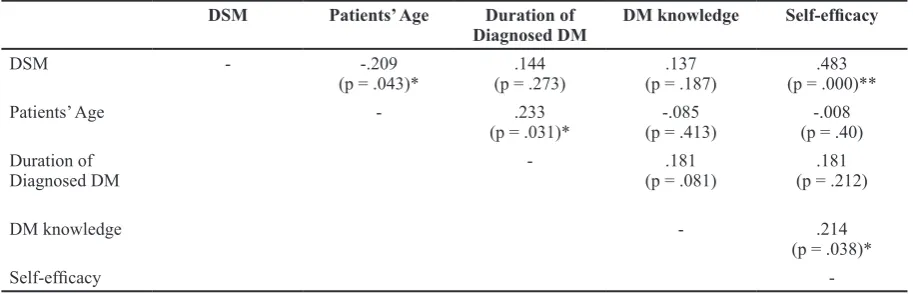
The analysis found that DSM behaviors
were significantly correlated with patients’ age (p = .043) and patients' self-efficacy
(p = .000). The analysis also reported that
there was significant negative relationship
between DSM behaviors and patients’ level of
educational (p = .008).
Discussion
Generally Diabetes Self-management (DSM) is the ability of diabetic patients to manage their daily life activities. These include adjustment of life styles, symptom management, medication, and the prevention
of diabetic related complications. It is also includes: monitoring blood glucose levels; managing hyperglicemia or hypoglicemia; determining food types and amount eaten; following proper duration and frequency of exercise; adherence to medication doses and times; performing regular foot care; and early
detection of the risk of complications.
In this study, patients generally reported that they performed good DSM. One of the
factors that may affect this result is the setting this study conducted. Patients who attend
in Out-Patients Department mostly showed
good conditions that support them performed
expected DSM. Another factor is patients’
knowledge related to DM and its management
(Huang, Zhao, Li, & Jiang, 2014; Kurnia, Amatayakul, & Karuncharernpanit, 2015;
Sonsona, 2014). Furthermore, previous studies have noted that lack of knowledge related to the disease and its management was the main barrier to effective self-management behaviors
(Bayliss, Ellis, & Steiner, 2007). In this study
it was found that patients with knowledge
scores higher than 8 reported higher/better
DSM mean scores (M = 90.07) compared to those with lower knowledge scores (M
=88.58). Another factor that may contribute
to the results in this study is the patients’ experience in receiving information related
to DM and its management. As mentioned
before, most of the patients reported that they received information about or attended some activities providing information about DM and its management. Patients who received such information showed higher knowledge mean scores (M = 7.55) and DSM mean
scores (M = 89.61) compared to those who
did not receive DM information (M = 7.33
and M = 86.11). However, these differences were not statistically significant. This was so between knowledge and DSM (p = .187) or
the experience of receiving information and
DSM (p = .330). It is of interest that patients’ knowledge significantly correlated with self-Table 3 Relationship between DSM and patients’ Age, Duration of DM, Knowledge, and Self
Efficacy
DSM Patients’ Age Duration of
Diagnosed DM
(*) Statistically significant at p < .05, (**) Statistically significant at p < .01
Table 4 Relationship between DSM and Patients’ Educational Level
Variable p
Patients’ level of education DSM
efficacy (r = .214; p = .038). These findings
strengthen previous statement suggested that knowledge is necessary for behavioral change, but knowledge alone cannot lead to improve the self-care behaviors (Bandura,
1982; Knight, Dornan, & Bundy C, 2006).
Respondents in this study were mainly females and they showed better DSM (M
= 90.21) than the males (M = 85.06). This result was different to previous findings
that suggested that female patients reported lower DSM scores since they faced many barriers and time limitations because of their responsibilities as housewives (Whittemore, Melkus, & Grey, 2005). Moreover, female
patients reported difficulties in scheduling
their exercises and determining their own and their families’ meals.
The patients’ age also seemed to be one factors contributing to DSM. Patients’ age and ones with a longer duration of diagnosed DM were more vulnerable to develop many of the complications either related to DM or the aging processes. The vision problems, cognitive impairment, musculoskeletal and joint problems that usually follow the aging process automatically reduced patients’ ability
to perform some activities related to DSM. A
previous study reported that younger patients with a shorter duration of diagnosed DM performed better DSM, particularly in diet
management (Mahfouz, & Awadalla, 2011). This study noted there was a significant
(negative) correlation between patients’ age and DSM (p = .043). This meant that patients with younger age showed better/ higher mean scores for DSM. However, this
present study found different findings to the
previous study where patients with a longer duration of being diagnosed DM reported
better DSM (M = 90.68) compared with them with shorter one DM (M = 87.87). However, there was no significant correlation between
the duration of being diagnosed (DM) and DSM (p = .273). This difference may cause by the way the researcher categorized the duration of being diagnosed DM, which is
more/less than 5 years. In fact the DM-related
complication mostly occurred in patients with
longer durations of DM. In addition, this study
only involved patients from an out-patients' department where the patients mostly enjoyed relatively good physical conditions without
any serious complications.
The patients’ levels of education were also considered as one of DSM contributing
factors. A higher educational level gives
broader opportunities to access information compared to those who had lower educational
levels. In contrast, this study noted there was negative significant correlation between DSM and the level of educational (p = .008); this
meant that patients with lower educational
levels showed better DSM. This finding is
supported by a previous study that suggested that patients with lower educational levels showed better DSM, especially in managing
a diabetic diet (Mahfouz, & Awadalla, 2011). In the Indonesian context, a higher level of
education commonly produces greater chances to enter better occupations. This automatically
enhances their financial status and has a
further impact on their dietary behaviors. With
better finances they would have greater access
to the many diets compared with those of a lower economic status. For diabetic patient, many choices of diets sometimes emerge as
temptation that more difficult to be managed.
Therefore, it is more challenging for richer patients to adhere to diet management.
The patients’ self-efficacy is another factor
that potentially contributes to better DSM. The
level of self-efficacy describes the degree of confidence how patients show in performing the expected behaviors in DSM. In this study found the positive significant correlation between patients’ DSM and self efficacy score, meant that patients with higher self-efficacy (higher confidence) reported better DSM
behaviors. Previous studies have suggested
that patients with higher self-efficacy (that is confidence) performed relatively better in DSM (Huang, Zhao, Li, & Jiang, 2014; Kurnia, Amatayakul, & Karuncharernpanit, 2015;
Lanting, Joung, Vogel, Bootsma, Lamberts,
& Mackenbach, 2008). Additionally, it also found that patients’ self-efficacy score 34,8 + 3,98 was almost 75% compared to maximum score (48). This result strengthen the previous finding noted that patients’ with self-efficacy score equal or more than 7 (0 -10) were more
likely to performed the expected behaviors successfully (Bodenheimer, Davis & Holman, 2007).
Further analysis found there was a positive
self-efficacy and patients’ knowledge. It meant
that patients who had better understanding regarding how to manage DM reported higher
self-efficacy (confidence) to perform the
expected behaviors. This fortify previous result
reported that self efficacy was significantly
correlated to knowledge (Taha, Zaton, & Elaziz, 2016). They also emphasize the important of education program in improving
patients’ knowledge and self efficacy.
With regards to this factor this current study
showed a significant relationship between self-efficacy and patients’ DSM (r = .483; p = .000). In addition, this study found that patients’ self-efficacy level was significantly correlated with knowledge (r = .214; p = .038).
Conclusions
DSM is an important element in controlling diabetes related complications. This study
identified the degree of DSM competence
and its contributing factors. Most patients in this study reported high degrees of DSM
competence. In addition, it also emerged
that patients’ age, level of education, and
self-efficacy level were identified as factors
contributing to DSM. Therefore, it nurses and other healthcare professionals should pay more attention to older diabetic patients, their
educational levels and self-efficacy. However, it must be borne in mind that these findings
may have a limited application as they involve patients in a one area only in Java.
Acknowledgements
The author is deeply grateful to all patients who participated in this study for giving their valuable time and the precious information that they shared. The author thanks to Dwi Siwi Ratriani Putri, Kurniawan Yudianto, and
Imas Rafiyah for their contribution in data collection during this study. Additionally I
thank to the Director of the Sumedang district general hospital for permission to conduct this
study, the Indonesian Ministry of Education and Culture for financial supporting, and all
other contributors.
References
Abdelgadir, M., Shebeika, W., Eltom, M.,
Berne, C., & Wikblad, K. (2009). Health
related quality of life and sense of coherence
in Sudanese diabetic subjects with lower limb amputation. The Tohoku Journal of
Experimental Medicine, 217(1), 45–50.
doi:10.1620/tjem.217.45.
Abrahim, M. (2011). A systematic literature
review on factors contributing to self-care
among type 2 diabetes mellitus patients
(Unpublished master’s thesis). Linneaus University - Sweden.
Bandura A. (1982). Self efficacy mechanism
in human agency. American Psychologist, 37,
122–47.
Bayliss, E.A., Ellis, J.L., & Steiner, J.F. (2007). Barriers to self-management and quality of life
outcomes in seniors with multimorbidities.
Annals of Family Medicine, 5, 395–402. doi:
10.1370/afm.722.
Bodenheimer, T., C. Davis and H. Holman, 2007. Helping patients adopt healthier behaviors. Clin. Diabet., 25: 66–70. DOI: 10.2337/diaclin.25.2.66
Fan, L., & Sidani, S. (2009). Effectiveness of diabetes self-management education
intervention elements: A meta-analysis.
Canadian Journal of Diabetes, 33(1), 18–26.
doi:10.1016/s1499-2671(09)31005-9.
Handayani, D. S., Yudianto, K., & Kurniawan, T. (2013). Perilaku Self-Management Pasien Diabetes Melitus (DM). Jurnal Keperawatan
Padjadjaran, 1(1).
Huang, M., Zhao, R., Li, S., & Jiang, X. (2014). Self-Management Behavior in Patients
with Type 2 Diabetes: A Cross-Sectional
Survey in Western Urban China. PLoS ONE, 9(4), e95138. http://doi.org/10.1371/journal. pone.0095138.
concentrate more on behavior. Diabet Med., 23, 485–501.
Kurnia, A.D., Amatayakul., A
Karuncharernpanit, S., (2015). Factors related to Diabetes Self-Management among
Adult with Type 2 Diabetes in Malang City, East Java, Indonesia. The Asian Network for Public Opinion Research (ANPOR) ANNUAL
Conference. retrieved from https://www.
researchgate.net/publication/301232087 Lanting, L.C., Joung, I.M.A., Vogel, I., Bootsma, A.H., Lamberts, S.W.J., & Mackenbach, J.P. (2008). Ethnic differences in
outcomes of diabetes care and the role of self-management behavior. Patient Education and
Counseling, 72(1), 146–154. doi:10.1016/j.
pec.2008.03.008.
Mahfouz, E.M., & Awadalla, H.I. (2011).
Compliance to diabetes self-management in rural El-Mina, Egypt. Central European
Journal of Public Health, 19(1), 35-41.
Ministry of Health of Republic Indonesia [MOHRI]. (2014). Riset Kesehatan Dasar
Tahun 2013 [Basic health research by year
2013].
Perkumpulan Endokrinologi Indonesian
(PERKENI) [Indonesian Endocrinologist Association]. (2011). Consensus of
management and complication prevention for
Type 2 Diabetes Mellitus in Indonesia. Jakarta. Konsensus Pengelolaan dan Pencegahan
Diabetes Mellitus Tipe 2 di Indonesia. Jakarta.
Primanda, Y. (2011). Self-management support
program on dietary behaviors in patients with type 2 diabetes mellitus in Central-Java,
Indonesia (Unpublished master’s thesis).
Prince of Songkla University, Thailand.
Sae-Sia, W., Maneewat, K., & Kurniawan, T., (2013). Effect of self-management support program on diabetic foot care behaviors
in West-Java, Indonesia. International
Journal of Research in Nursing, 4(1), 14–21.
doi:10.3844/ijrnsp.2013.14.21.
Sonsona, Jocelyn B. (2014). Factors
Influencing Diabetes Self-Management of Filipino Americans with Type 2 Diabetes
Mellitus. Dissertation for the Degree of Doctor
of Philosophy. Walden University.
Taha, N.M., Zaton, H.K., & Abd-Elaziz, N.A. (2016). Impact of a health educational
guidelines on the knowledge, self-management
practice and self-efficacy of patients with
type-2 diabetes. Journal of Nursing Education and
Practice, 6(9). DOI: 10.5430/jnep.v6n9p46.
Whittemore, R., Melkus, G.D., & Grey, M. (2005). Metabolic control, self-management and psychosocial adjustment in women with type 2 diabetes. Journal of Clinical
Nursing, 14(2), 195–203.
doi:10.1111/j.1365-2702.2004.00937.x.
World Health Organization [WHO]. (2016).
Diabetes country profiles. Retrieved from
http://www.who.int/diabetes/country-profiles/
idn_en.pdf?ua=1.
Wild, S., Roglic, G., Green, A., Sicree, R.,
& King, H. (2004). Global prevalence of diabetes: Estimates for the year 2000 and projections for 2030. Diabetes Care, 27(5),
1047–1053. doi:10.2337/diacare.27.5.1047.
William, G., & Pickup, J.C. (2004). Handbook
of Diabetes (3rd ed.). Blackwell Publishing: