INFLUENCE OF MIXING AND DETENTION TIME IN ELECTRO COAGULATION
PROCESS TO TREAT RAW WATER AT BADAK SINGA WATER TREATMENT
PLANT
Hary Pradiko
*, Evi Afiatun, Evan Fabian
Department of Environmental Engineering, Faculty of Engineering, Universitas Pasundan, Bandung, 40112, Indonesia weather. In the drinking water supply system, turbidity is the important factor affecting the water treatment efficiency, for several reasons such as aesthetic factor, burden to filtration, and interfere the disinfection process. Electro coagulation is one of water treatment method that combines the process of coagulation, flotation, and electrochemical.
1.
INTRODUCTION
The increase of population and rapid economic growth results the increasing of need for clean
water (BPLHD Prov. Jabar, 2006). Clean water as main supporting for good health and public
welfare is getting more difficult to obtain. An imbalance between the availability of water that
tends to decline in quantity and the increasing of water demand coupled with poor water
quality is the main cause of the difficulty of getting clean water.
Perusahaan Daerah Air Minum (PDAM) Tirta Wening is a company that handles drinking
water needs in Bandung City. One of the company's installation is the Badak Singa Water
Treatment Plant (WTP). The raw water used at Badak Singa WTP comes from surface water that
are Cikapundung River and Cisangkuy River. Those sources of raw water are affected by
conditions in the upstream, pollution along the stream, climate and weather. From time to time
those conditions changes affect the surface water quality so that water treatment is required
before the water can be used daily. Turbidity is one of the contaminants which becomes the
major concern because it often exceeds the quality standards (Alaerts & Santika, 1987).
According to Sawyer and McCarty (1978), in the drinking water treatment systems,
turbidity is one key factor for several reasons, such as: aesthetically the water must be free of
turbidity, raw water is more difficult to filter when it is turbid and the treatment cost will high if
the turbidity is high, and beside the facts that turbidity water contains many harmful organisms
that could not be destroyed in the disinfectant process.
To process raw water, WTP Badak Singa requires coagulant (PAC) to bind the turbidity in
large amounts, but since there is an uncertainty in raw water quality, the quality of processed
water becomes decreased. Therefore, it needs alternative replacement of PAC coagulant with
the same efficiency or even more with more affordable cost.
Electro coagulation is an emerging technology that combines the function and advantages
of conventional coagulation, flocculation, and electrochemistry in water and waste water
treatment (Riyanto, 2013). Electro coagulation mechanisms follow the basic principles used in
electrolysis cell systems, where the anodes and cathodes play an important role in the process
of oxidation-reduction reaction (Mitiasari, 2015). The electrical energy applied to the anode
dissolves the aluminum into the solution which then reacts with the hydroxyl ion from the
cathode to form aluminum hydroxyl (Effendi, 2014). Hydroxyl coagulates and flocculates
treated (Kuokkanen et.al., 2013).
This research will examine the ability of electro coagulation method in decreasing turbidity
in raw water as an alternative to conventional coagulation system using PAC. The purpose of
this research is to analyze the effect of mixing process and detention time on electro
coagulation process using aluminum plate electrode to decrease the concentration of turbidity
parameters on raw water from Cisangkuy and Cikapundung River which is used by PDAM Tirta
Wening Bandung as raw water sources.
2.
RESEARCH METHODOLOGY
2.1
Tools and Materials
Component of the research tool consists of: a reactor made of glass with dimensions of 12 cm x
9 cm x 12 cm with a working volume of 1 liter; alumunium plate dimension 7.5 cm x 12 cm x
0.15 cm with plate dimension immersed 7.5 cm x 7.5 cm x 0.15 cm; DC power supply with
output voltage 0 - 30 volts; cable and crocodile clip for connecting PSU with plate; Magnetic
Stirrer at speed up to 100 RPM which placed in the bottom of the reactor; and flocculator with
speeds up to 60 RPM.
The water used in this research is water sourced from Cikapundung and Cisangkuy River
water collection pond which has been mixed and taken as raw water. From the laboratory
examination obtained an average turbidity value of 100 NTU, so for further research used initial
turbidity of 100 NTU of raw water.
2.2
Method
Experiment conducted in the form of determination of current density, influence of mixing, and
length of detention time.
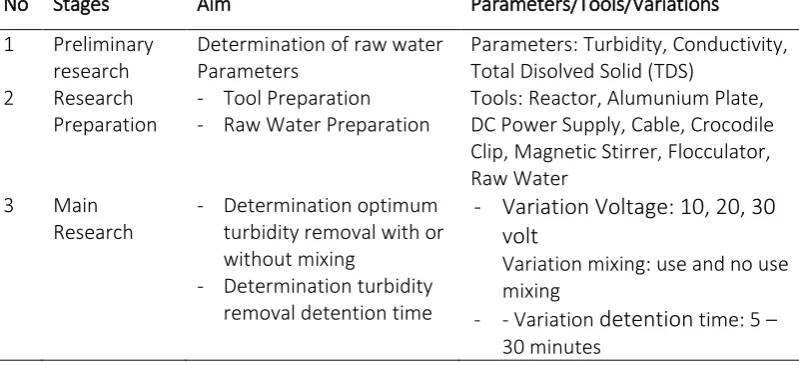
Table 1 Research stages
No Stages Aim Parameters/Tools/Variations
1 Preliminary DC Power Supply, Cable, Crocodile Clip, Magnetic Stirrer, Flocculator,
-
Variation Voltage: 10, 20, 30
volt
Variation mixing: use and no use mixing
- - Variation detention time: 5 – 30 minutes
2.2.1
Reactor Design
The sketch of sequence of electro coagulation reactor design can be seen in Figure 2.
Figure 2 Electro coagulation reactor design
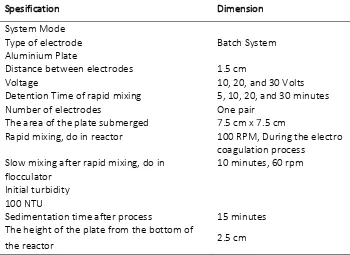
Overall, the design of the reactor to be operated is as follows:
Table 2 Reactor operations
Spesification Dimension
System Mode
Type of electrode Batch System
Aluminium Plate
Distance between electrodes 1.5 cm
Voltage 10, 20, and 30 Volts
Detention Time of rapid mixing 5, 10, 20, and 30 minutes
Number of electrodes One pair
The area of the plate submerged 7.5 cm x 7.5 cm
Rapid mixing, do in reactor 100 RPM, During the electro coagulation process
Slow mixing after rapid mixing, do in flocculator
10 minutes, 60 rpm
Initial turbidity 100 NTU
Sedimentation time after process 15 minutes The height of the plate from the bottom of
The main research mechanisms are: Perform electro-coagulation process with and without
mixing during variation 5 - 30 minutes in reactor. Furthermore the treated water is transferred
to the flocculator (jartest) for slow mixing. After that, the water left for the sedimentation
process.
2.2.2
Data Collection
Samples are taken at a height of ½ - ⅔ from the bottom of the reactor and approximately 5 cm
from the edge of the reactor using a pipette. Samples are taken every 5 minutes in the range of
5 - 30 minutes. Turbidity Samples were tested using a Lutron turbidity meter TU-2016 model.
Samples were taken as much as 10 ml with pipettes to measure the level of turbidity, with
aquadest as comparative solution (calibration). The samples were tested for their conductivity
using conductivity/TDS meter of Lutron Yk-22Ct model, by dipping the conductivity/TDS meter
probe into the reactor at a depth of approximately 5 cm. The value of conductivity is obtained
after the digital number reaches a constant value.
2.2.3
Data Analysis
The results of the turbidity of the sample treated by electro coagulation were then compared
with the initial turbidity values before the treatment. Electro coagulation performance can be
known from efficiency percentage in decreasing turbidity level to meet drinking water quality
standard of Indonesian Ministry of Health Regulation No. 492 / MENKES / PER / IV / 2010.
Meanwhile, the effectiveness of pollutant removal can be calculated by the formula (Nasrullah
et.al., 2012) :
R% = (Cin − Cef)/Cinx 100% (1)
Where :
R = Removal efficiency (%)
C in = Influent concentrations (NTU)
3.
RESULTS AND DISCUSSION
The electro coagulation studies consisting of: determining the current density, the usage of
agitation for mixing process; and the duration of detention.
3.1
Determining The Current Density
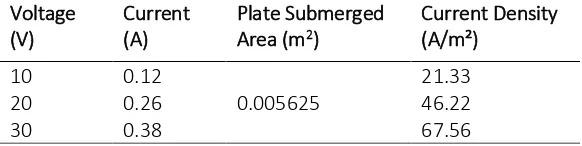
By using one pair of aluminum plate with dimension of plate submerged 7.5 cm x 7.5 cm that
powered by electricity with 10, 20 and 30 volt variations of voltage and distance between
electrode 1.5 cm, obtained current and current density as follows:
Table 3 Current and current density result of each voltage variation
Voltage (V)
Current (A)
Plate Submerged Area (m2)
Current Density (A/m²)
10 0.12
0.005625
21.33
20 0.26 46.22
30 0.38 67.56
3.2
Influence of Mixing
In the trial without mixing, the sample in the reactor was electrified with a certain detention
time. For the trial with mixing, a series of mixing consisting of two parts, i.e. a rapid mixing
during the electro coagulation process with a magnetic stirrer placed in the bottom of the
reactor with a certain detention time followed by slow mixing for 10 minutes using a flocculator
at 60 rpm (Rezka, 2008). In rapid mixing, the particles will move quickly and provide a great
opportunity to come into contact with the electrodes. Whereas in slow mixing, the charged
particles will congregate to form flock.
Table 4 Comparison efficiency of electro coagulation with and without mixing
Current Density (A/m2)
Without Pre-Sedimentation With Pre-Sedimentation
Final Turbidity
reactor, but also appear to float on the surface and hover in the center of the reactor. While in
electro coagulation with mixing conditions, flock is settled evenly at the bottom of the reactor.
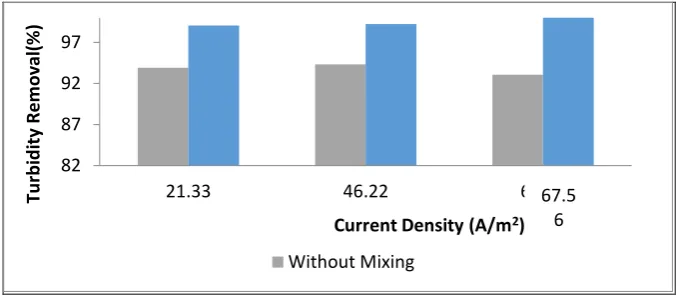
In addition, the results of electro coagulation trials using stirrer has already meet the quality
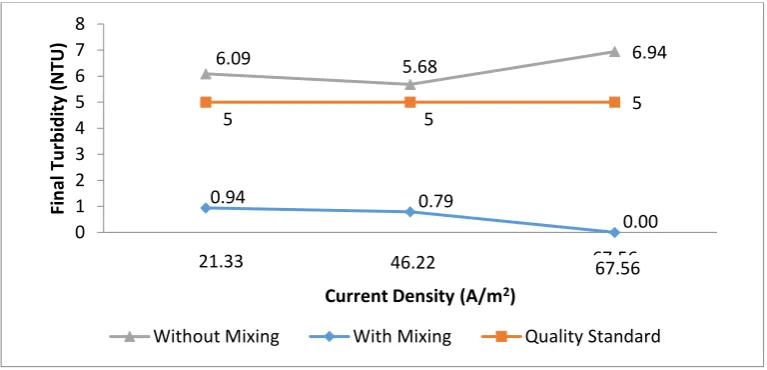
standard whereas those without mixing still not meet the quality standard. Graphically, the
comparison of turbidity removal with mixing and without mixing can be seen in Figure 3.
Figure 3 Comparison chart of turbidity removal with mixing and without mixing
Based on Figure 3, it can be seen that the final turbidity of the process with mixing is
getting better as the current density increases. However, in without mixing treatment, the
effluent turbidity appears random, decreasing at the second current density, and then rising at
the third current density.
6.09 5.68 6.94
Without Mixing With Mixing Quality Standard
without mixing can be seen in Figure 4.
Figure 4 Graph the efficiency of turbidity removal with and without mixing at 100 NTU initial Turbidity
From Figure 4 it can be seen that the electro coagulation efficiency with mixing is better
than electro coagulation without mixing to reduce the 100 NTU initial turbidity. Although in the
implementation, the time required for electro coagulation with mixing takes longer because of
the addition of 10 minutes of slow mixing time and the required energy is also larger (Novita,
2012). Mixing can speed up the electro coagulation process because turbidity particles will
have a great chance to contact with the electrode, so that the formation of charged particles
can run faster.
3.3
Determination of Detention Time
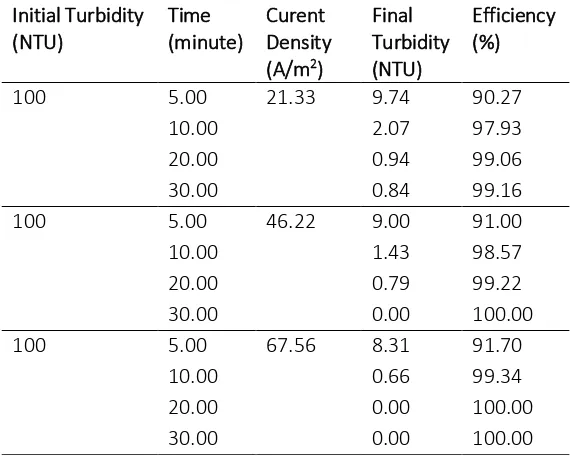
This research was also conducted to find the shortest detention time with the best results, both
in turbidity removal as well as the quality of flocks that formed. The best efficiency of turbidity
removal is seen by comparing the decrease of turbidity in each variation of detention time. The
quality of flock formation is seen by measuring the volume of sediment formed at each variation
of detention time. The results of this trial will be used as the standard of detention time in the
detention times of 5, 10, 20, and 30 minutes. After the research, the results obtained as follows:
Table 5 Efficiency of electro coagulation for every variation time
Initial Turbidity
Conditions inside the reactor, it can be said that the coagulation process has worked much
better, started at the detention time of 10 minutes. Flock precipitation is formed evenly leaving
only a small amount of solids floating in the reactor.
Electro coagulation trials at each detention time meet the quality standards starting at the
10 minutes. Graphically, the turbidity removal at each detention time can be seen in Figure 5.
Based on Figure 5, it can be seen that the result of final turbidity of the electro coagulation
process is getting better along with the increasing of detention time used. Turbidity effluent
values did not meet the quality standard at 5 min detention time. The turbidity effluent meets
the quality standard begins at detention time of 10 minutes. In the 10 minutes until the 30
minutes, the result of turbidity effluent showed no significant difference.
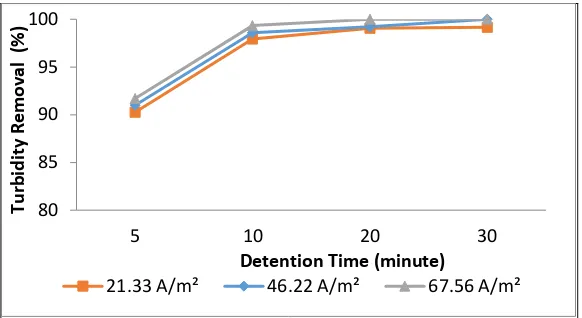
Graphically, the percentage of the treatment efficiency can be seen in Figure 6.
Figure 6 Efficiency of Turbidity removal at each current density
From Figure 6 it can be seen that the treatment efficiency already high when starting at the
detention time of 10 minutes using the current density from the lowest to the highest. The
higher the current density given and the longer the detention time used, the higher the result of
treatment efficiency (Al-Abdalaali, 2007), although the difference is not so significant at the 10
to 30 minutes. Electrical voltage affects the formation of a particle charge. The higher the
electrical voltage the larger the particle charge. This causes a large charged particle to bind
more particles than a particle with a small charge. This is what causes the higher the electrical
voltage, the higher the removal of turbidity.
3.3.2
Volume of Sediment
The turbidity used in this trial used a turbidity variation of 100 NTU. The turbidity is treated
using any variation of current density generated by 10, 20, and 30 Volt voltages with detention
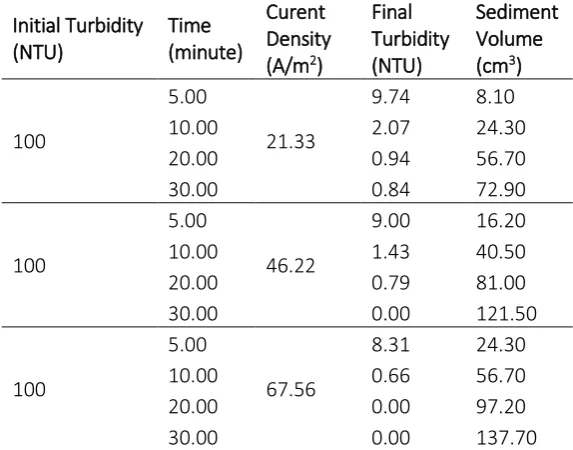
times of 5, 10, 20, and 30 min. After the trial, the results obtained as follows: 80
Table 5 Volume of sediment for each variation time
detention time. Suspended solids are seen still hovering in the reactor. The longer the detention
time, the formation of the flock looks much better (Sihotang, 2010). It can be seen from the
speed of flock formed, stability, and thickness sediment are formed. Optimum conditions began
to appear at the detention time of 10 minutes. Graphically, the volume of sediment can be seen
in Figure 7.
Figure 7 Comparison graph of sediment volume at each detention time
From Figure 7 it can be seen that the longer the detention time and the higher the current
density used, the higher the volume of the formed flock is settled. Therefore, based on the two 0
factors, such as the efficiency of turbidity removal and the thickness of the sediment, it is
determined that the detention time is 10 minutes to be used in the main research. The
detention time will also affect the level of turbidity removal. The longer the detention time, the
greater the likelihood of the particles to join and form the floc, so the better the removal of
turbidity reached.
4.
CONCLUSIONAfter testing the effect of mixing and detention time on electro coagulation method for
standard water treatment of Tirta Wening PDAM Badak Singa Bandung, can be drawn
conclusion: the final turbidity of the treatment results with the mixing is better along with the
increasing current density used, while the processing without mixing looks random; Electro
coagulation process by using mixing already meet the quality standard whereas if without
mixing still not meet the quality standard; efficiency of electro coagulation with mixing is better
than electro coagulation without mixing to lower initial turbidity parameter 100 NTU; the final
turbidity values of the processing result is improved along with the increase of detention time
used and meet the quality standard from detention time of 10 minutes; the higher the current
density given and the longer the detention time are used the higher the processing efficiency
and the formed flock volume is deposited.
5.
REFERENCESAl-Abdalaali, A. A. Removal of Borong from Simulated Iraqi Surface Water by Electro Coagulation Method. Thesis. University of Baghdad, Republic of Iraq, 2007
BPLHD Prov Jabar, Buku Pegangan Manajer Pengendalian Pencemaran Air (EPCM), BPLHD Prov Jabar, Bandung, 2006, p.50
C.N. Sawyer, P.L. McCarty, Chemistry for Environmental Engineering, 4th ed., McGraw-Hill, New York, 1978, p.213
Effendi, A.J. Daur Ulang Air Buangan Domestik (Grey Water) Hotel menggunakan Elektrokoagulasi Pasangan Elektroda Alumunium. Institut Tenologi Bandung. Bandung. Indonesia. 2014.
Coagulation Treatment of Water and Wasterwater. Green and sustainable Chemistry. 89-121.
Mitiasari, K. Pengolahan Lignin dengan Metode Elektrokoagulasi Menggunakan Elektroda Besi dan Alumunium. Skripsi. Universitas Pendidikan Indonesia. Bandung, Indonesia. 2015.
Nasrullah, M. Singh, L. & Wahid, Z.A. 2012. Treatment of Sewage by Electro Coagulation and the Effect of High Curent Density. Energy and Environmental Journal. Vol. 1
Novita, S. Pengaruh Variasi Kuat Arus Listrik dan Waktu Pengadukan pada Proses Elektrokoagulasi untuk Penjernihan Air Baku PDAM Tirtanadi IPA Sunggal. Skripsi. Departemen Fisika Fakultas Matematika dan Ilmu Pengetahuan Alam. Universitas Sumatera Utara, Medan, Indonesia, 2012
Rezka, M.F. Pengaruh Waktu Detensi dan Tegangan Listrik Terhadap Efektivitas Penurunan Warna Pada Air Gambut Dengan Proses Elektrokoagulasi. Skripsi. Universitas Pasundan, Bandung, Indonesia, 2008
Riyanto, Elektrokimia dan Aplikasinya,Graha Ilmu, Semarang, 2013, p.54