Licensed under Creative Common Page 240
http://ijecm.co.uk/
ISSN 2348 0386
EFFECT OF SOCIAL CAPITAL ON ENTREPRENEURIAL
ORIENTATION AND TRANSACTION COST TO IMPROVE FIRM
PERFORMANCE IN WOODEN CRAFT SMEs IN
BALI PROVINCE
–
INDONESIA
I Gusti Ayu Wimba
Department of Management Science, Economic Faculty,
Hindu Indonesia University, Denpasar, Bali, Indonesia
I Made Kembar Sri Budhi
Economic of Development Department, Economic & Business Faculty,
Udayana University, Denpasar, Bali, Indonesia
I G W Murjana Yasa
Economic of Development Department, Economic & Business Faculty,
Udayana University, Denpasar, Bali, Indonesia
Ida Ayu Nyoman Saskara
Economic of Development Department, Economic & Business Faculty,
Udayana University, Denpasar, Bali, Indonesia
Licensed under Creative Common Page 241
Abstract
The small medium enterprise (SME) gives contribution as the work field provider, to reduce
unemployment and social gap, as well as making equal income distribution. SME is also
acknowledged as the institution for seedling the entrepreneurship idea. The government has
conduct various empowering programs to improve the SME performance, but the
implementation is still constrained by still low entrepreneur culture and social dysfunction. Both
fundamental obstacles cause not optimal SME development in Bali Province. This study aims to
reveal how the Social Capital directs effect on the Entrepreneurial Orientation; the
Entrepreneurial Orientation to the Firm performance, Social Capital on Firm performance. By
surveying 333 entrepreneurs of wooden crafts in Bali Province, data analysis by Smart PLS-30,
it is obtained that the Social Capital affects significantly and directly on the Entrepreneurial
Orientation; directly, the Entrepreneurial Orientation and social Capital affects insignificantly on
the Firm performance; By being mediated by Transaction Costs, Social Capital and
Entrepreneurial Orientation affect significantly to the Firm performance. By being mediated by
Entrepreneurial Orientation, the Social Capital affects significantly on transaction Cost
efficiency. In this case, the Cost Transaction is willing to mediate overall the effects of social
capital and Entrepreneurial Orientation to improve the firm performance, so that in this case it is
acknowledged as the key mediator to improve the firm performance. While, the Entrepreneurial
Orientation is found to mediate the partial effect of Social Capital on the Transaction Cost
efficiency.
Keywords: Social capital, entrepreneurial orientation, transaction cost, firm performance, SMEs
INTRODUCTION
Various empowering programs have been conducted by the government to optimize the SME
performance in Bali province. Among others are accompaniments, partnership, revolving fund
programs, but in fact these programs as if are not in target. The empowerment is intended for
the SME independency, but it becomes dependency. Yet solid inter-agency coordination of
SME builders is suspected as the institution failure to trigger yet optimal government
empowerment program implementation.
SME in Bali province are stated to have still low entrepreneurship spirit. Although it has
the ability to grow and develop, but it can not absorb investment, because it is still constrained
by social culture considering that it is such embarrassing to operate loan capital (Suhartono,
2008). The SME actors in Bali province still believe in cultural and religious values in doing
Licensed under Creative Common Page 242 spiritual demand that “everything has one to regulate”. This value commonly bases the
entrepreneurship culture of SME actors in Bali (Suyatna Yasa, 2012). Though so far it is
acknowledged that there are some common problems by SME such as the weak management,
marketing, design, production, capital and strategy. From the social capital perspective, SME is
not organized optimally, and if this can be done, SME should unite the full resources and this
can be used as the lobbying power in coding the collective actions more efficiently and
effectively. Meaning, the social dysfunction also can be the constraint for the SME development
of wooden craft in Bali Province. (Azzan Manan, 2012).
This study brings the problems: 1) how the effects of Social Capital on Entrepreneurial
Orientation are?, 2) How the effects of Entrepreneurial Orientation on Firm Performance are?;
3) How the Social Capital effects on the Firm Performance are?; 4) How the effects of
Entrepreneurial Orientation mediated by the Transaction Cost on the Firm Performance are?;
5) How the effects of the Social Capital mediated by the Transaction Cost on the Firm
Performance are; and 6) How the effects of Social Capital mediated by the Entrepreneurial
Orientation on the Transaction Cost? All processes are applied by SME businessmen of
wooden craft in Bali Province. This study goal is to get the answers on the study problems.
Mainly for the causality relationship of inter-concept study. The final finding is the recommended
information as the theoretical basic for the researchers willing for the further study, mainly in the
causality relationship between social capital, Entrepreneurial Orientation, transaction cost and
business performance, especially in the SME’s scale. Practically, this study finding is useful to
sharpen the insights on Entrepreneurial Orientation for the wooden craft businessmen, while, for
the government, it is useful to give the same understanding on the studied concepts in the
study, which can be the basic to take further policies in order to empower the SME sector in Bali
Province.
LITERATURE REVIEW
This study conceptualizes the Social Capital, Entrepreneurial Orientation, Transaction Costs
and Firm Performance into a research model, so that a series of underlying theory was adapted
to the concept of causality and relationships. That is, a set of theories will be used as the basis
for formulating hypotheses to be tested in the study. These concepts are defined as follows.
Social capital
Indeed, the social capital is still ambiguous. There is still disagreement among economists as
disclosed by Putnam, (1993) with the sociologist such as, Delia Giusta & Sarageldin, (2000).
Licensed under Creative Common Page 243 social capital developed theoretically by Delia Giusta, (1999); Casson & Delia Giusta, (2004);
and empirically by Knack and Keefer (1997), stated that the Social Capital can improve
economic performance.
Some experts gave a definition of Social Capital. Social Capital is a social aspect
structure making it easier for the individual actions or business actors in the social structure.
Social capital is not a single entity but a plural entity, which is productive. Putnam (1993), said
that Social Capital is the social organization appearance with trust, reciprocity, and networking
which can improve efficiency by facilitating coordination and cooperation for the benefit of
society. Fukuyama (1995), said that social capital is the ability of the community arising from the
trust in community. The Social Capital is a set of informal values or norms spread among
members of a group allowing the cooperation based on honesty making mutual trust at the end.
Thus, the nature of social capital is as improved economic performance of the network obtained
from high trust which the emphasis is on two fundamental aspects, namely the network as a
social aspect enables elaborate the performance of the larger economy and emphasis on value
in the future as capital aspect.
Eva Cox, (1995) stated that the Social Capital is a series of inter-men relationship
processes supported by networks, norms and social trust allowing for efficient and effective
coordination and cooperation for mutual benefit and virtue. Narayan (Edi Suharto, 2007) said
that social capital is the rule, norm, obligation, reciprocity and trust binding in social relations,
social structures and institutional arrangements of society allowing the members to achieve
results as individual targets and society. Adler and Kwon (2000), stated that Capital Social is
internal linkages characterizing the collective structures and providing cohesiveness and mutual
benefit from social dynamic process in the community. Ancok (2003), said that Social Capital is
an institutional dimension in the created relationship and norms forming the quantity and quality
of social relationships as well as a social glue which maintains the unity of the group members
together. From the definition by the experts above, it can be summarized that Social Capital is a
resource of social interaction which can improve the economic performance of a society.
Hasbullah, (2006) said that Social Capital is a resource which can be seen as an
investment to acquire new resources. In this case, the Social Capital is seen very close to the
terminology of the social virtues. Suharto, (2007), Social Capital is a resource arising from the
interaction between people in a community who deliver emotional binding. Cohen & Prusak
(2001) said that Social Capital is the capital stock of active relationships in society, which is
bound by the trust, mutual-understanding and share value binding the group members to create
the possibility of joint action which can be done efficiently and effectively. Inayah, (2012) said
Licensed under Creative Common Page 244 individuals and institutions who deliver an emotional bond as trust, reciprocity relationship,
social networks, values and norms forming the useful society structure for coordination and
cooperation to achieve common goals. The Social capital will grow and flourish if used together
and will become extinct if it is not institutionalized together. Inheritance value of social capital
should be done by adaptation, learning process and experiences into real practice.
In this study, the Social capital is presented as exogenous latent variable supported by
reflective indicators, namely: participation in the networking; reciprocity; trust; norms; values and
proactive, according to Hasbullah (2006) conception.
Entrepreneurial Orientation
Venkataraman, (1997) said that entrepreneurship is the activity involving the discovery,
evaluation and exploitation of the opportunity to introduce a new product both as goods or
services, by organizing, marketing and by various processing methods, so there is a product
which previously does not exist, to bring in the market. Along with what is stated by Penrose
(1959) that entrepreneurship is a resource which can provide additional capability resources
giving diversity resources owned by the company. Also by Alvares & Busenitz, (2001) said that
‘entrepreneurial action can create and combine resources to produce company's new
combination of resources, thus making the company to be different with a competitor, potentially
worth and contribute to the company's competitive advantage."
Lumpkin and Dess (1996), about the differences of the entrepreneurship concept with
entrepreneurial orientation said: Orientation Entrepreneurship refers to the entrepreneurial
process and answer 'how' business activities can run. While entrepreneurial relates to the
entrepreneurial decision content by answering 'what' is done to achieve the company's goals.
Meaning that Orientation Entrepreneurship refers to the behavioural aspects. In this case,
Brown and Davidson (1998), state ‘Entrepreneurial orientation relates to specific, aspects both
at decision-making styles, methods, and practices in the company's operations, causing an
increase in business performance."
Lyon et al (2001), stated that ‘Entrepreneurial Orientation further highlights the decision
making and the strategic making processes." In contrast to what stated by Atuahene- Gima and
Ko (2001), which stated that the Entrepreneurial orientation forms a company reflecting the
managerial skill phenomenon using initiative, proactive and aggressive to change the
company's competitiveness. Miller (1983), said that dichotomous recommends that there are
two types of companies: Entrepreneurial is a company actively in the market product
innovations, dare to make a risky business and proactive in its efforts to defeat its competitors.
Licensed under Creative Common Page 245 risk, and just waits or imitates the competitor manoeuvres. Then, it is recommended that the
entrepreneurship is formed by three dimensions: the ability to innovate (innovativeness),
proactive and risk-taking.
Entrepreneurial orientation leads to the strategic orientation of the company, including
the aspect of style, methods and practices which are very specific decision (Lumpkin & Dess,
1996). Entrepreneurial orientation can be an important measurement of how a company is
organized and the entrepreneurial is an important contribution for the company performance
(Mc Grath, et al 1996). Entrepreneurial orientation can enrich the company knowledge-based
resources performance benefits by giving attention to the utilization of these resources to
uncover and exploit business opportunities (Wiklund & Shepherd 2003).
Wiklund, (1999) stated that although there are differences in the instrument designs
used by experts to measure the Entrepreneurial orientation and the consensus on
Entrepreneurial Orientation measurements, but it is recognized substantially the interpretation of
those instruments are not different and do not preclude the use of appropriate instruments to
measure important aspects of entrepreneurship orientation. The presented measurements here
can be expressed as strategic orientation reflection from entrepreneurial and should be
regarded as the philosophy of the entrepreneurial actors to guide the companies in managing
their business environment. The strategy use and implementation will always follow the
character's entrepreneur actors (Mc. Carthy, 2003) Therefore, the strategic orientation can be
understood as an entrepreneur strategy reflecting the company's desire to commit to
entrepreneurial behaviour or orientation Entrepreneurship. This is supported by Brown (1998)
statement which stated that the Entrepreneurial Orientation relates to the company's desire to
commit to entrepreneurial behaviour. Thus, the measurement scale used in the study is
generally associated to the "perception" of people who are responsible for corporate strategy
(Ferreira & Azevado, 2007).
In this study, the Entrepreneurial Orientation is expressed as 1 endogenous latent
variable, which will be measured by reflective indicators recommended by Miller (1993) as well
as Lumpkin and Dess (1996) namely autonomy, innovativeness, risk-taking, initiative and
proactive and aggressiveness.
Transaction Cost
Ronald Coase, [45] he is the first economist making the foundation on economic theory of
Transaction Costs. According to him, the company's pricing mechanism is largely determined by
the inter-company coordination by Transaction Costs. Furthermore, it is by negotiation and
Licensed under Creative Common Page 246 contract terms have been followed. This process requires cost called as Transaction Cost. As a
result of the mutual agreed transaction, it leads to a change of ownership (property rights) which
must be respected by parties to a transaction.
The transaction is the transfer of goods, services, information, knowledge, and others
from the producer to the consumer (Williamson, 1998). Furubothn & Richter (1998), said that
the transaction is the transfer of goods, services, information, knowledge and others from
producers to consumers. North (1990) explained that the Transaction costs are all costs
required to specify and enforce contracts underlying the exchange, so that the Transaction
Costs include: cost of negotiations, measure, and imposing the exchange. Transaction costs
arise from asymmetric information. The imperfection of information and intellectual capacity
constraints (bounded rationality) to process information and the willingness to take a chance
(opportunistic behavioural) cause big Transaction cost.
Some factors affecting the amount of Transaction cost are disclosed by Zang (Yustika,
2008) namely; what is the identity and rights as a result of the transaction (what the identity of
the bundle of rights); who is handling the transaction (who, to identity of agents Involved in the
exchanges); How, the institution, technical and social, governing the exchanges and how to
organize the exchange. Backman (Yustika, 2012) recommended four determinants of the
transaction cost, as the analysis unit namely: behavioural attributes of actor; attributes of the
transaction; governance structure; and institution environment. Furubotn & Richter (1998)
recommended the types of transaction costs: market transaction costs, managerial transaction
costs and political transaction costs.
In this study, the Transaction cost is expressed as 2nd endogenous latent variable, as
measured by reflective indicators namely: information costs, negotiation costs, the agreement
enforcement cost, the coordination cost and exchange coercion cost.
Business Performance
The benchmarks of whether or not the company's goal achieved is the company business
performance. Gluck & Jauch, (1988), explained that ‘the company performance is the end result
being pursued by the company existence and the whole operation, namely: continuity or
sustainability, profitability, efficiency, satisfaction and finance employees, product quality,
service to consumers, social responsibility, market leadership and others’. Carton & Hofer
(2006), recommended that the Firm Performance concept is based on the idea that the
organization / company is a set of productive assets including: human resources, physical
Licensed under Creative Common Page 247 the company results as a series of implementation work functions or activities by the company
within a certain time period.
Keats and Hitt (1988) suggested the Firm Performance assessment is very important
because it can be used as feedback for the repair or improvement of Firm Performance in the
future. About the size of business performance, Marchin & Stewart (Hakim, 2007) said that so
far, there is no consensus on the most appropriate performance measurement in any
researches and objective performance measurement which has been used. Supported by Beal
(2000) saying that there is still controversy regarding the proper approach to the
conceptualization and measurement of company performance. Wiklund, (1999) and Atkinson, et
al (1995), stated that effectively performance measurement system should pay attention to all
performance aspects in a comprehensive manner which may affect the customer and provide
information to assist companies in recognizing problems and the opportunities for improvement.
So far, which is recognized as comprehensive company performance measurement concept is
the Balanced Scorecard concept. Norton & Kaplan, (1992) recommended the size of the Firm
Performance from four perspectives namely; financial, customers, internal business process
and learning and growth.
In this study, the latent variable of Firm Performance is expressed as 3rd endogenous
latent variable, as measured by formative indicators namely: financial performance, customer
performance, internal business process performance and the performance of growth and
learning.
Inter Latent Variable Relationship
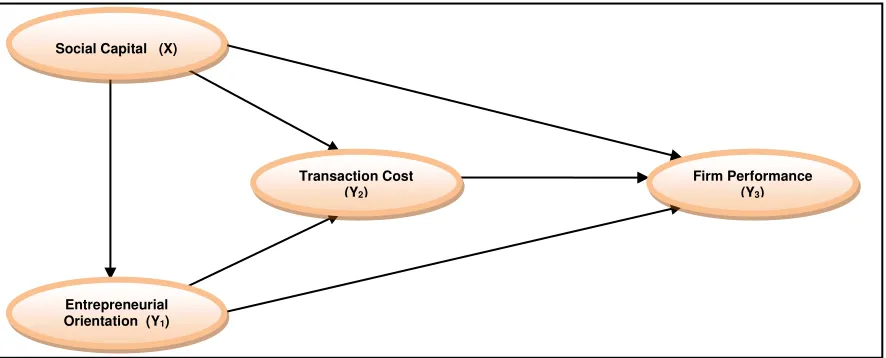
In this study, it is conceptualized that the social capital affects on the entrepreneurial orientation.
Also, the entrepreneurial orientation affects on the business performance. The social modal is
also conceptualized to affect on the business performance, and being mediated by Transaction
Cost, the social capital also affects on the business performance. Also, being mediated by
entrepreneurial orientation, the social capital affects on the transaction cost. The inter-variables
Licensed under Creative Common Page 248 Figure 1 : Concept Framework
RESEARCH METHODOLOGY
The Study
This study takes place in 9 regencies and cities in Bali Province, Indonesia. As the study
subjects are the SME businessmen of wooden craft under the targets of Industry and Trade
Office of Bali Province. This study is conducted on December 2nd 2014 until January 16th, 2015.
The study populations and sample
The study populations are 1.986 SME actors of wooden craft who actively do the business in
Bali province. The sampling technique is using proportional random sampling by voting
technique. The number of sample by using Slovin’s criteria by the error level of 5% is obtained
333 SME actors of wooden craft as the respondents.
Research Variables
The variables in this study include: social capital as the exogenous variable (X),
entrepreneurship orientation as 1st endogenous variable (Y
1), cost transaction as 2nd
endogenous variable (Y2); and Firm Performance as the 3rd endogenous variable (Y3).
Definition of operational variable
a. Social Capital, is a social interaction resource capital reflected by the network,
mutual wellness, trust, norms, values and proactive.
b. Entrepreneurial orientation is a company capability resource reflected by autonomy,
risk taking, initiative and aggressiveness.
Transaction Cost (Y2)
Entrepreneurial Orientation (Y1)
Social Capital (X)
Licensed under Creative Common Page 249 c. Transaction cost is: information cost, negotiation cost, agreement enforcement cost,
coordination cost and exchange coercion cost.
d. Firm Performance is the final results desired to achieve by company in the form of:
financial performance, customer performance, intern business process performance
as well as growth and learning performance.
Data collection method
In this study, the data is collected in the form of ordinal, using questionnaires, which have been
tested the validity and reliability. The questionnaires are given to 333 businessmen of wooden
craft to reveal their perceptions on the effects of Social Capital, Entrepreneurial Orientation, and
Transaction Cost to improve the Firm Performance to the SME of wooden craft in Bali province.
Data analysis method
This study aims to test and analysis the causality relationship between the exogenous and
endogenous variables or between the endogenous variable with exogenous variables. Besides,
this study is intended to know whether it has previously done the validity and reliability test of all
study instruments. This study is using analysis technique of Partial Least Square (PLS), by
application program of Smart-PLS. 30.
ANALYSIS AND RESULTS
Validity and Reliability Test
Validity test in this study is processing by comparison rhitung. and rtabel, with signification 0.95
percent or α = 0.5 percent. Item is valid when rhitung > rstandar = 0.30 (Sugiono, 2011). This test is
found that all item is valid with coefficient correlation >0.5 using Corrected Item Total Correlation
program SPSS 22 (Singgih Santoso, 2005 : 277). Reliability test in this study is found that all
item is reliable by Cronbach,s Alpha >0.07 (Bhuwono Agung, 2005).
Descriptive Analysis
Profile of Wooden craft SMEs
Wooden craft SMEs in Bali province spread relatively evenly in 9 Regencies/Cities.
Proportionally, under the target of Industry and Trade Office Bali Province until 2013, it is noted
to be 1986 businessmen of Wood SME and Wooden craft. Generally, they use local wood
materials, produce based on the order, still combine the machinery and manual products. They
are formed in small groups, work together with mutual benefits in informal entrepreneurship
Licensed under Creative Common Page 250
Respondents’ Description
Out of 333 respondents being surveyed, the respondents’ age range from 25 until 49 years old.
There are 232 people with age ranging from 30 until 44 years old; it is 20 percent people under
the age of 30 years old; and there are 34 people with the age above 44 years old or it is around
10 percent. From the sex-ratio aspect, there are 272 men respondents or it is 82 percent. And
there are 61 women respondents or it is 18 percent. The respondents’ educational background
is: mainly is Senior high that is 152 people or 46 percent. The respondents with educational
background as Junior High graduation below are 94 people of 28 percent; and the one with
Bachelor degree above is 87 people or around 26 percent.
Inferential Analysis
Hypothesis Test
The hypothesis test results are the answers of the questions in this study. This study will prove
the inter-variable relationship based on the study concept, namely : 1) directly, the Social
Capital affects positively and significantly on the Entrepreneurial Orientation, 2) directly, the
Entrepreneurial Orientation affects positively and insignificantly on Business Performance; 3)
directly, the Social Capital affects positively and insignificantly on the business performance; 4)
by transaction Cost as the mediated variable, the Entrepreneurial Orientation affects positively
and significantly on the business performance; 5) by transaction Cost as the mediated variable,
the Social Capital affects positively and significantly on the business performance; and 6) by
Entrepreneurial Orientation as the mediated variable, the Social Capital affects on the
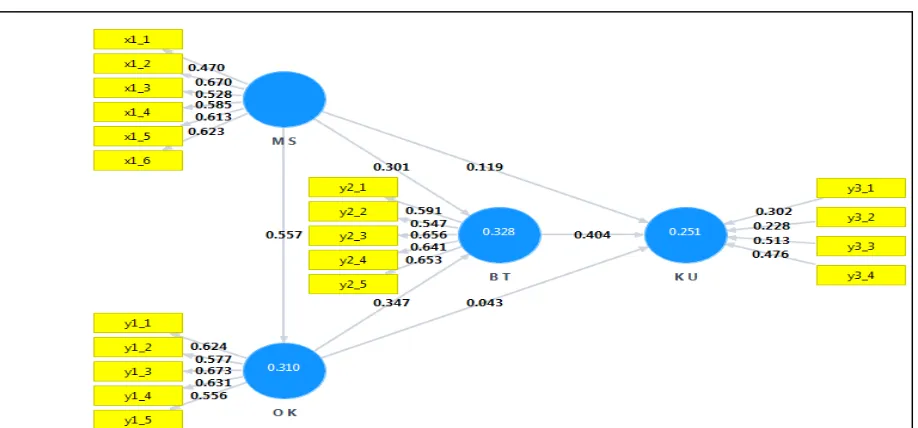
Transaction Cost efficiency?. The flow coefficient index and t-statistics are presented in Table 1.
Interpretation Mediation Effect
Inter-variable mediating effects, based on the analysis results are show in Table 1, can be
explained:
First, the effect of entrepreneurial orientation on Business Performance by mediated by
Transaction Costs is described as follows: the flow coefficient value between the entrepreneurial
orientation and significant Transaction Costs is significant; the flow coefficient value between
Transaction Costs and Business Performance is significant; the flow coefficient value between
the entrepreneurial orientation and the firm Performance is insignificant. From the analysis
results, it is interpreted that the Transaction Costs is completely mediated the effect of the
orientation Entrepreneurial on the firm Performance.
Second, the effect of social capital on business performance by the transaction costs is
Licensed under Creative Common Page 251 Capital and Transaction Costs is significant; the flow coefficient value between Transaction
Costs and firm Performance is significant; whereas the flow coefficient value between the Social
Capital and firm performance is insignificant. Thus, it is interpreted that the Transaction cost is
completely mediated the effects of Social Capital on Business Performance.
Third, the effect of social capital on the Transaction Cost mediated by Enterprise
Orientation is described as follows: the flow coefficient value between the Social Capital and
orientation entrepreneurial is significant; flow coefficient value between the entrepreneurial
orientation and Transaction Costs is significant; while the flow coefficient value of Social Capital
on Transaction costs is significant. From the analysis results, it is concluded that the
Entrepreneurial orientation is partially mediated the effects of Social Capital on Transaction
Costs.
Table 1. Final Results Path Coefficients of Social Modal (MS), Entrepreneurial Orientation (OK),
Transaction Cost (BT) and Firm Performance (KU) of SMEs of Wooden craft in Bali Province
Licensed under Creative Common Page 252 Total Effects :
Original
Sample
(O)
Sample
Mean
(M)
Standard
Error
(STERR)
T Statistics
(|O/STERR|) P
Values
Hypothesis
Testing
Decision
BT -> KU 0,404 0,407 0,070 5,747 0,000 significant
MS -> BT 0,494 0,507 0,048 10,208 0,000 significant
MS -> KU 0,343 0,357 0,055 6,265 0,000 significant
MS -> OK 0,557 0,566 0,039 14,263 0,000 significant
OK -> BT 0,347 0,349 0,054 6,412 0,000 significant
OK -> KU 0,184 0,185 0,056 3,294 0,001 significant
Figure 2. Structural Model (inner model)
DISCUSSION
The findings show that the Social Capital significantly increases the Entrepreneurial Orientation
of SME wooden craft in Bali province. The SME Wooden craft in Bali province of Bali is utilizing
interpersonal relationship showing by participation in the network, mutual wellness, trust, values,
norms and acts as a proactive business community of wooden crafts. By having a group of
small communities cohesively bound together by a network of fellow entrepreneurs, reciprocity,
the businessmen have more knowledge and competence of managerial, making it more
Licensed under Creative Common Page 253 The study also show the Entrepreneurial Orientation directly insignificantly improve the
business. But, it can improve the firm performance when mediated by Transaction Costs which
turns out that the entrepreneurial orientation can improve the firm performance. This indicates
that the Transaction cost is so important and strategic in mobilizing social entrepreneurship
networks among wooded crafters. The study also shows that the Social Capital directly and in
significantly improves the firm Performance, but if mediated by Transaction Cost, the Social
Capital is able to positively and significantly improve the firm Performance. In this case also,
again the Transaction cost is very significant and meaningful as the perfect mediator in bridging
social capital relationships as social interaction capital in improving the firm Performance.
The interpersonal relationships, which is actualized in the form of participation in the
network (networking), exchange wellness (reciprocity), trustworthiness, agreement against
applicable norms on the wooden craft business community, which is based on the trusted and
exalted values together in a community are the driver of proactive action to undertake
mutual-understanding activities, in community group. Under this steady social capital condition, the
search for information, negotiation, coordination are very easy; there is no agreement
enforcement cost, more over the coercion exchange cost, because the transaction parties have
already been in steady social glue.
CONCLUSION
a. The social capital directly and significantly affects on the entrepreneurial Orientation.
Meaning, in perception, the social capital is willing to improve the entrepreneurial
Orientation quality of wooden craft businessmen in Bali province.
b. The entrepreneurial Orientation directly and insignificantly improve the firm performance,
reflected in the form of financial performance, customer performance, intern business
process performance as well as growth and learning performance.
c. The social capital directly and insignificantly improves the firm performance, in this case it
is measured by the financial performance, customer performance, intern business
process performance as well as growth and learning performance.
d. Being mediated by transaction cost, the entrepreneurial orientation can improve the firm
performance; in this case the entrepreneurial orientation can improve the firm
performance because it is willing to reduce the transaction cost.
e. Being mediated by the transaction cost, the social capital can improve the firm business.
Meaning the intensity of entrepreneurial social network showed by participation,
reciprocity, trust, norms, value and proactive actions can show the important and
Licensed under Creative Common Page 254 f. Being mediated by the entrepreneurial orientation, the social capital can reduce the
transaction cost. This study justifies that the social capital which is getting to exist, it can
reduce the transaction cost with the partial mediation role of the entrepreneurial
orientation.
RECOMMENDATIONS
a. The social capital with good work among wooden craft actors, really can reduce the
transaction cost, so that it can improve the firm performance. Maintain this condition, so
the transaction cost efficiency can always be controlled.
b. The transaction cost has very strategic role in improving the firm performance, thus the
SME Wooden craft businessmen….
c. The government of Bali Province should create a conducive situation for the life of small
entrepreneur groups of SME Wooden Craft, because the social capital work well, so it
creates the economic efficiency which is very useful for the community economics
development performance.
RESEARCH LIMITATIONS:
a. This research is still in the theory development level, placing the Social Capital as the
exogenous latent variable affecting endogenous latent variables in the research model.
b. This research only sees the social capital from positive aspect, namely the social
interaction with mutual benefits, in fact, in many cases, the social capital can negatively
affect, namely the bad effect on the community group and inhibiting the business
performance improvement.
c. This study is conducted in relatively short time with cross-sectional data and at the
relatively stable economics conditions. It implies if this study is conducted at different
actual time and condition, it may have different results.
REFERENCES
Alvarez, Sharon A & Busenitz, Lowell W, 2001, The Entrepreneurship of Resource Based Theory, Journal Management, 27, pp,755-775 ll
Ancok , Jamaludin. 2003. Modal Sosial dan Kualitas Masyarakat, PDF, 29/12/2012.
Anderson, A.R. and S.L.Jack, 2002, The Articulation of Social Capital in Entrepreneurial Networks : a glue or lubricant?, Entrepreneurialship andRegional Development, 14, 193 -210
Licensed under Creative Common Page 255 Azzam Manan, 2012, Strategi Pengembangan Usaha Kecil Melalui Capacity Building di Daerah Tujuan Wisata (DTW), Jakarta, PKPP, Kementrian Riset dan Teknologi.
Beal, Reginald M.,2000, Conpeting Effectivity Environmental Scanning Competitive Strategy and Organizational Performance The Small Manufacturing Firm, Journal of Small Business Management, Vol. 22.pp.27- 45
Brown, J & Davidson P, 1998, Entrepreneurial Orientation Versus Entrepreneuriel Management: Relating
Miller/Covin & Slevin’s ConceptualizationTo Stevenson’s, International Business Schol, pp, 1-17
Carton, Robert B & Hofer, Charles W., 2006, Measuring Organizational Performance Matrics for Entrepreneurship and Strategic management Reseach, Published by Edward Elgar Publishing Limited, Glensanda House, United Kindom.
Casson, Mark and Marina Delia Giusta, 2004, The Costly Business of Trust, Development Polisy Review, 22 (3),321 -42
Casson, Mark, 2011, Entrepreneurship, Teori, Jejaring dan Sejarah, Jakarta, Devisi Buku Perguruan Tinggi, Pt Raja Grafindo Persada
Coase Ronald, 1937, The Nature of the Firm, Economics New Series, Vol.4. No. 16
Cohen, D & Prusak, L 2001, In Good Company: How Social Capital MakesOrganization Work. London: Harvard Busines press.
Coleman, J.S. 1998, Sicial Capital in the Creation of Human Capital, American Journal of Sociology, 94, Supplement. S95-S120
Cox Eva, 1995, A Truly Civil Society. Sydney :ABC Bokks.
Dasgupta, P. and I. Sarageldin, 2000, Social Capital: A Multi-faceted Perspective, Washington , DC: The World Bank
Delia Giusta, Marina. 1999, A Model of Social Capital and Access to Productive Resources, Jaournal of International Development, 11, 921-34
Edi Suharto, 2007, Modal Sosial dan Kebijakan Publik, Komunitas Jurnal Pengembangan Masyarakat Islam, Volume 3, Nomor 2, Juni 2007.
Ferreira, Jo’ao & Azevado, Susana, 2007, Entrepreneurial Orientation as a Main Resource and Capability
on Small Firm’s Growth, MPRA Paper, No. 5682, posted 09. Nevember 2007.
Fukuyama Francis, 1995, Trust, The Social Virtues and the Creation of Prosperity, A Devision of Simon & Schuster New York, Free Press Paperbacks.
Fukuyama Francis, 1999, The End of History and The Last Man: Kemenangan Kapitalisme dan Demokrasi Liberal, Yogyakarta, Penerbit Qalam.
Furobotn, E,G. And R.Richter (1998), Institution and Economics Theory, The Contribution of the New InstitutionEconomics. Michinggan, The University of Michinggan Press
Glueck, William F. & Jauch laurence R, 1988, Business Policy ang StrategicManagemant, Mc Graw Hill, New York
Hakim, Adnan, 2007, Karakteristik Kewirausahaan, lingkungan Bisnis, dan Kapabilitas Organisasi : Pengaruhnya Terhadap Strategi Bisnis dan Kinerja Usaha, Disertasi, Tidak Dipublikasikan, PPS UD, Malang
Hasbullah, Jousairi, 2006, Social Capital (Menuju Keunggulan Budaya Manusia Indonesia), Jakarta, MR United Press.
Inayah, 2012, Peranan Modal Sosial dalam Pembangunan, Ragam JurnalPembangunan Humaniora, Vol 12. No 1. April 2012
Licensed under Creative Common Page 256 Knack, S and P. Keefer, 1997, Does Social Capital Have an Economic pay-off? A Cross-Country Investigation, Quaterly Journalof Economic, 112 (4), 1251-88
Lumpkin, G, T, & Dess G.G. 1996, Clarifying the Entrepreneurial Orientation Construct and Linking it to Performance, Academy of ManagementReview, Vol. 21. No.1. pp. 135-172
Lyon, D. W.,Lumpkin, G. T. & Dess, G. G., 2000, Enhancing Entrepreneurial Orientation Research: Operationalizing and Measuring a Key Strategic Decision Making Process, Juornal Of Management, 26 (5), pp.1055-85
Mc Carthy, B., 2003, The Impact of The Etrepreneur Personality on The Strategy Format and Planning
Process in SME’s, Journal of Management, pp . 154-172
Mc Grath, R.M., 1999, Falling Forward: Real Options Reasoning and Entrepreneurial Failure, Academy of Management Review. 24: 13-30
Miller , D., 1983, The Correlates of Entrepreneurship in Three Types of Firms, Management Science Journal, Vol. 29, No.7, pp.770-791.
North Douglass.C.1990, Institution; Instituional Change and Economic Performance, Cambridge, Press Syndicate of the University, Cambridge.
Norton, David, P., and Kaplan, Robert.S., 1992, The Balanced Scorecard – Measures that Drive Performance, Harvard Business Review, Reprint 92105
Penrose, Edith T. (1959), The Theory of the Growth of the Firm, Oxford : Blackwe
Putnam R D, 1993. “The Prosperous Community : Social Capital and Public Life, The American of
Prospect, Vol 13, pp 35-42
Putnam R D, 1995, “Bowling Alone: America’s Declining Social Capital” Journal of Democracy, Vol 6, No.
1, pp 65-78
Suhartono, 2008, Kondisi Usaha Kecil dan Menengah (UMKM) di Provinsi Bali : Antara Kebijakan Kemitraan dan Persaingan, Jurnal Kajian, Vol 14, No.3, September 2008.
Suyatna Yasa, 2012, Kontribusi Faktor Produksi Modal, Tenaga Kerja, dan Teknologi Terhadap Pertumbuhan Usaha Industri Kecil Kerajinan (IKK) di Kabupaten Gianyar – Bali, Disertasi, Tidak Dipublikasikan
Wiklund J & Shepherd D, 2003, Knowledge-Base Resources, Entrepreneurial Orientation, and The Performance Of Small and Medium Sezed Business , Strategic Management Journal, 23, 1307-1314
Wiklund Johan, 1999, The Sustainability of the Entrepreneurial Orientation-Performance Relationship, Entrepreneurship Theory and Practice, Baylor University.
Wiklund, 1999, The Sustainabelity Of Entrepreneurial Orientation-Performance Relationship, Entrepreneurship Theory and Practice, Baylor University
Williamson, Olever E, 1998, The Institutions of Governance, The AmericanEconomic Riview. Vol. 88. Issue, 2 May.
Yustika, Ahmad Erani, 2008, Ekonomi Kelembagaan : Definisi, Teori danStrategi, Bayumedia Publishing