8TH
INTERNATIONAL CONFERENCE
OF
EDUCATION,
RESEARCH
AND
INNOVATION
SEVILLE (SPAIN)
16-18 NOVEMBER 2015
CONFERENCE
PROCEEDINGS
Published by
IATED Academy
www.iated.org
ICERI2015 Proceedings
8th International Conference of Education, Research and Innovation
November 16th-18th, 2015 — Seville, Spain
Edited by
L. Gómez Chova, A. López Martínez, I. Candel Torres
IATED Academy
ISBN: 978-84-608-2657-6
ISSN: 2340-1095
Depósito Legal: V-2722-2015
Book cover designed by
J.L. Bernat
All rights reserved. Copyright
© 2015, IATED
WELCOME INTRODUCTION
Dear ICERI2015 participants,
It is a pleasure to welcome you all to this eighth edition of ICERI.
“
Facing the challenges of Education
” is the main theme of this year's ICERI, as it sets the
agenda for an in-depth discussion of the most important questions facing those in
education today: How education should be provided? What are the newest learning
methodologies? How can we learn in an innovative way? In a world of rapid
technological changes, how can we adapt to the changes in its due time?
All these questions and many more will be debated in the different interactive and
thematic sessions. They will provide an excellent opportunity to acquire skills and get
new ideas from different perspectives and innovative approaches in education around
the world.
Every year, ICERI intends to bring together educational experts from all corners of the
world. This year, it is a pleasure to welcome over 600 participants from more than 75
countries world-wide. This will ensure an international atmosphere that will enrich the
conference program and networking activities.
We hope that joining ICERI2015 will provide you with an opportunity to share your
experiences, learn from other educational innovations and meet new colleagues for
future cooperation.
Thank you very much for your participation at ICERI2015. We hope you enjoy your
time with us!
Thank you very much for your valuable contribution to ICERI2015!
ICERI2015 8th International Conference of Education, Research and Innovation
ICERI2015 COMMITTEE AND ADVISORY BOARD
Aaron Doering UNITED STATES Jose F. Cabeza SPAIN
Adolfo Tanzi Neto BRAZIL Jose Luis Bernat SPAIN
Agustín López SPAIN Juan Carlos Escalante MEXICO
Alessandro Bogliolo ITALY Kaye Price AUSTRALIA
Ali Merç TURKEY Lilian Bacich BRAZIL
Amir Dirin FINLAND Lorena López SPAIN
Amparo Girós SPAIN Luis Gómez Chova SPAIN
Ana Tomás SPAIN Mª Jesús Suesta SPAIN
Andreas Fili SWEDEN Maria Porcel SPAIN
Andrew Youde UNITED KINGDOM Mario Pace MALTA
Ann-Nina Maksimainen FINLAND Martin Nordell FINLAND
Antonio García SPAIN Mehmet Bardakçı TURKEY
Benedict O'Donnell GERMANY Melania Tera ROMANIA
Bernard Etlicher FRANCE Michelle Ellwood UNITED KINGDOM
Chelo González SPAIN Nadja Soldatic SERBIA
Christos Rodosthenous CYPRUS Natalie Brown AUSTRALIA
Connie Ng SINGAPORE Nicholas Peter Stanley AUSTRALIA
Cristina Lozano SPAIN Nigel Atkinson UNITED KINGDOM
David Martí SPAIN Nijole Putriene LITHUANIA
Deborah Azaryad Shechter ISRAEL Nilson Kunioshi JAPAN
Dorota Piotrowska POLAND Norma Barrachina SPAIN
Eladio Duque SPAIN Olga Teruel SPAIN
Emeka Emmanuel Obioha SOUTH AFRICA Ozlem Zengin Unal TURKEY
Emmi Pakkala UGANDA Pablo Opazo CHILE
Euisuk Jeong REPUBLIC OF KOREA Panadda Thanasetkorn THAILAND
Flaminia Del Conte UNITED KINGDOM Paul Leslie UNITED ARAB EMIRATES
Florin Mihai ROMANIA Peter Amosun NIGERIA
Fredy Olarte COLOMBIA Peter Haber AUSTRIA
Fumito Yoshikawa JAPAN Pierre Mora FRANCE
Galina Molodtsova RUSSIAN FEDERATION Priscila Fernandes BRAZIL
Giles Pepler UNITED KINGDOM Raine Valli FINLAND
Harald Haugen NORWAY Rebecca Ferriday UNITED KINGDOM
Ignacio Ballester SPAIN Sergio Pérez SPAIN
Ignacio Candel SPAIN Sharon Judge UNITED STATES
Ingibjörg Frimannsdottir ICELAND Slavka Tzanova BULGARIA
Inma Tomás SPAIN Smaragda Chrysostomou GREECE
Ioana Carmen Paraschiv ROMANIA Stephanie Linek GERMANY
Ismael Serrano SPAIN Svetlana Bekareva RUSSIAN FEDERATION
Iván Martínez SPAIN Teodor Popa ROMANIA
Javier Domenech SPAIN Victor Fester NEW ZEALAND
Javier Martí SPAIN Wiley Davi UNITED STATES
Jean-Paul Becar FRANCE Xavier Lefranc FRANCE
CONFERENCE SESSIONS
ORAL SESSIONS, 16th November 2015
Massive Open Online Courses (MOOC)
Meet the Keynote
Employability Issues and Trends (1)
Teacher Training Experiences
Assessment of Student Learning
Gender Issues in Education
Teacher Training in Foreign Languages
Experiences In Civil Eng. and Architecture Education
Social & Digital Media in Education
Advanced and Mobile Educational Technologies
Employability Issues and Trends (2)
Pre-service Teacher Experiences (1)
Game-based Learning
Inclusive Learning
Technology in Foreign Languages (1)
Experiences in Arts & Humanities Education
Digital Skills
Videos for Learning and Educational Multimedia
Workplace Training and Employability
Pre-service Teacher Experiences (2)
Collaborative and Project-based Learning
ICT in Special Education
Pedagogical Methods and Experiences (1)
Government Policy issues in South African Schools
e-learning Experiences (1)
Experiences in Programming and Computer Science Learning
ICT Skills and Workplace Learning
In-service Training and Professional Development of Teachers
Collaborative Learning Environments
Special and Inclusive Education
Experiences in Engineering Education
Teachers Leaders in an African Context
POSTER SESSIONS, 16th November 2015
New Trends and Experiences in Education
ICERI2015 8th International Conference of Education, Research and Innovation
ORAL SESSIONS, 17th November 2015
e-learning Experiences (2)
Technology in Teaching and Learning (1)
Adult and Vocational Education
Pedagogical Methods and Experiences (2)
Entrepreneurship Education Experiences
Experiences in Secondary and Higher Education
New Trends and Experiences in Postgraduate Education
Curriculum Design
Blended Learning
Technology in Teaching and Learning (2)
ICT in Adult Education
Problem Based Learning in Higher Education
Social Entrepreneurship
Cultural Diversity in Secondary Education
Links between Education and Research (1)
Experiences in Health Sciences Education
Flipped Learning & Flipped Classroom
Technology in Teaching and Learning (3)
Management and Organizational Issues in Education
Teacher Training in STEM Education
University-Industry Cooperation
Pedagogical Experiences in Secondary Education
Links between Education and Research (2)
Leadership and University Administration
Learning Analytics and Intelligent Tutoring Systems
Technology in Foreign Languages (2)
International Cooperation and Mobility Programmes
Professional Development of Teachers (1)
Non-formal Education
Technology Enhanced Learning in Primary and Secondary Education
Experiences in STEM Education
Government and Administration Issues in Secondary Education
New Trends in Online Learning
Foreign Language Learning
Accreditation and Quality in Education
Professional Development of Teachers (2)
Student Support & Tutoring
Experiences in Primary and Secondary Education
Barriers to Learning
School Leadership
POSTER SESSIONS, 17th November 2015.
Technology and Research in Education
VIRTUAL SESSIONS
Academic Research Projects
Accreditation and Quality in Education
Adult education
Advanced classroom applications and ICT Skills
Assessment of student learning
Blended Learning and Flipped Classroom
Collaborative and Problem-based Learning
Cultural Diversity and Inclusive Learning
Curriculum Design
E-content Management and Development
e-learning experiences
Education practice trends and issues
Education, Research and Globalization
Emerging Technologies in Education
Employability issues and trends
Ethical issues in Education
Experiences in Post-graduate education
Experiences in Primary and Secondary education
Experiences in Undergraduate education
Game-based learning and Gamification
Global Issues in Education and Research
In-service training and Professional development of teachers
International Projects
Language Learning Innovations
Learning and Teaching Innovations
Life-long learning
Links between Education and Research
m-Learning: mobile applications and technologies
Massive Open Online Courses (MOOC)
New Challenges for the Higher Education Area
Online/Virtual Laboratories
Pedagogical Methods and Innovations
Pre-service teacher experiences
Research on Technology in Education
Special education
ICERI2015 8th International Conference of Education, Research and Innovation
ABOUT ICERI2015 Proceedings USB
HTML Interface: Navigating with the Web browser
This USB includes all presented papers at ICERI2015 conference. It has been formatted
similarly to the conference Web site in order to keep a familiar environment and to
provide access to the papers trough your default Web browser (open the file named
"ICERI2015.html").
An Author Index, a Session Index, and the Technical Program are included in HTML
format to aid you in finding conference papers. Using these HTML files as a starting
point, you can access other useful information related to the conference.
The links in the Session List jump to the corresponding location in the Technical
Program. The links in the Technical Program and the Author Index open the selected
paper in a new window. These links are located on the titles of the papers and the
Technical Program or Author Index window remains open.
Full Text Search: Searching ICERI2015 index file of cataloged PDFs
If you have Adobe Acrobat Reader version 6 or later (www.adobe.com), you can
perform a full-text search for terms found in ICERI2015 proceedings papers.
Important:
To search the PDF index, you must open Acrobat as a stand-alone
application, not within your web browser, i.e. you should open directly the file
"ICERI2015.pdf" with your Adobe Acrobat or Acrobat Reader application.
This PDF file is attached to an Adobe PDF index that allows text search in all PDF
papers by using the Acrobat search tool (not the same as the find tool). The full-text
index is an alphabetized list of all the words used in the collection of conference
papers. Searching an index is much faster than searching all the text in the documents.
To search the ICERI2015 Proceedings index:
1. Open the Search PDF pane through the menu "Edit > Advanced Search" or click in the PDF bookmark titled "SEARCH PAPERS CONTENT".
2. The "ICERI2015_index.pdx" should be the currently selected index in the Search window (if the index is not listed, click Add, locate the index file .pdx, and then click Open).
3. Type the search text, click Search button, and then proceed with your query.
For Acrobat 9 and later:
1. In the “Edit” menu, choose “Search”. You may receive a message from Acrobat asking if it is safe to load the Catalog Index. Click “Load”.
2. A new window will appear with search options. Enter your search terms and proceed with your search as usual.
For Acrobat 8:
1. Open the Search window, type the words you want to find, and then click Use Advanced Search Options (near the bottom of the window).
2. For Look In, choose Select Index.
3. In the Index Selection dialog box, select an index, if the one you want to search is available, or click Add and then locate and select the index to be searched, and click Open. Repeat as needed until all the indexes you want to search are selected.
4. Click OK to close the Index Selection dialog box, and then choose Currently Selected Indexes on the Look In pop-up menu.
5. Proceed with your search as usual, selecting other options you want to apply, and click Search.
For Acrobat 7 and earlier:
1. In the “Edit” menu, choose “Full Text Search”.
2010-2012
Handaru Jati, Moch Alip
Universitas Negeri Yogyakarta (INDONESIA)
Abstract
The research presented, documentary in nature, it aims to study techniques for analyzing the productivity applicable to Indonesian education Universities. The methodology involves the collection of information, organization, critical analysis, reflection, interpretation and synthesis of recent literature. It is concluded that Malmquist index is innovative technique that focus on the assessment of the technical productivity, possible to estimate the optimal production frontier of universities. The use of these techniques allow real measures of academic processes, to determine the relationship between the variables considered and consequently optimize the academic administration at universities with innovation criteria. The results constitute an important basis for decision making by the management teams of universities, in order to optimize innovation processes information criteria Keywords: Productivity, university, Malmquist Index.
1
INTRODUCTION
Universities and non-profit entities need to make changes in their organizational structures that make their decision centers modern and innovative. This management technique is needed to improve resource allocation and contribute effectively to the decision-making process. In order to achieve this goal, universities need a tool that is able to measures the profitability with which resources are invested, considering in these entities, the objectives are not merely economic profitability and the concept differs from that used in the business world. Productivity is an important aspect that needs to be considered when evaluating management processes in university. In this sense the academic managers require indicators that allow them to establish relationships or comparisons between the various factors that make each of the academic units. For this process to be effective, it is important to have a system of evaluation to measure the efficiency of the units considered productive. According to Viloria et al (2009) [1] to measure productivity it is necessary to quantify the maximum product/work as process efficiency and product/demand relationship as successful treatment outcomes. However, when a functional relationship process between inputs and outputs are unknown, they are limitations for evaluation. In response to the points made, what work has been done in education to measure academic productivity using quantitative measures and how could be applied in Indonesian Educaation universities? In response to these questions, it is intended in the research presented, studying techniques for analyzing the productivity applicable to Indonesian Education universities. The concept in solving this problem was first introduced by Malmquist [2] and has further been studied and developed in the non-parametric framework by Caves et al [3], Fare et al [4, 5] and Cooper et al [6]. Malmquist Methods was first developed to measure the technical changes in Total Factor Productivity (TFP) [4]. This method evolved to another field and service such as health [7], financial services and banking [8]. The Malmquist index approach to productivity measurement has many advantages. It is an index representing Total Factor Productivity (TFP) growth of a Decision Making Unit (DMU). This index reflects (1) progress or regress in efficiency along with (2) progress or regress of the frontier technology between two periods of time. It is based on multi input-output frontier representations of the production technology [9]. Malmquist index is defined using a distance function by decomposing the changes in total factor productivity into two interrelated components: changes in technical productivity and technical efficiency. In the empirical context, the results are obtained using mathematical programming techniques (DEA) that rely on minimum assumptions regarding the shape of the production frontier. Finally, the index decomposes into multiple components to give insights into the root sources of productivity change. DEA-based Malmquist productivity index measures the technical and productivity changes over time.
Proceedings of ICERI2015 Conference
2
OBJECTIVE
Methodology consists of four phases: In the first phase of field research and documentation to obtain database and concepts, theories, and background relevant to the measurement of productivity is via Index Malmquist. In the second phase the variables objects of study are chosen in response to the data. In the third phase of the data processing is done. Subsequently, in the fourth phase, analysis of the results is made and the conclusions of the investigation are made. The data used in this work are : (1) the number of student, (2) the number of academic staff, (3) the number of administration staff, (4) the amount of university funding, (5) the number of study program, (6) the number of Doctor, (7) the number research funded, (8) the number of journal and book published, (9) the number of community service, (10) the number of graduated student during one academic year (11) the number of accredited study programs, and (12) the number of patent. All of the data were taken from the Institution Accreditation Report for year 2010, 2011 and 2012 and University annual report. In this study The DEAP software has been used because this software has an output orientation and it is well known that the orientation employed affects the results in terms of returns to scale [4, 10].
3
INTERPRETATION OF RESULT
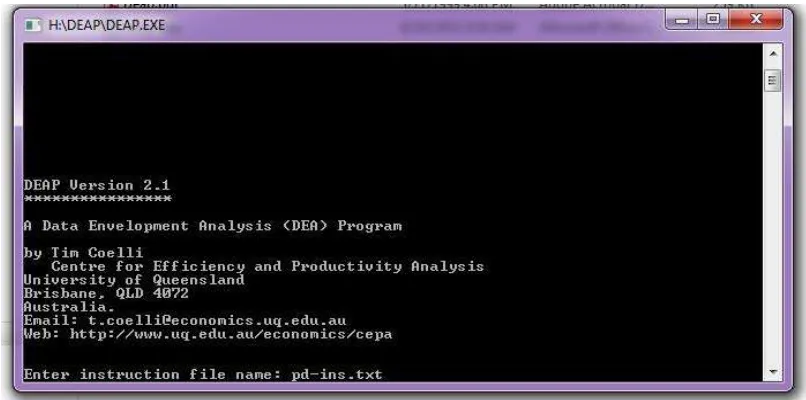
[image:11.595.93.496.394.594.2]After the critical and reflective review of the literature relevant to the subject of study, it is found that an appropriate approach to analyze the productivity of the Universities is the Malmquist Index for productivity, introduced by Caves et al in 1982 [3]. This is a relevant method for studying technical productivity, and has an aim to measure the change in productivity in the same unit, between two periods of time. A ratio greater than one indicates Malmquist productivity improvements, while if a values less than unity it implies losses. Malmquist index decomposes productivity changes in technical efficiency and changes due to technological progress between two time periods. Calculation to obtain the level of productivity of the University Education in Indonesia performed using DEAP. Fig. 1 is the initial view of the DEAP software.
Figure 1. Open Source DEAP
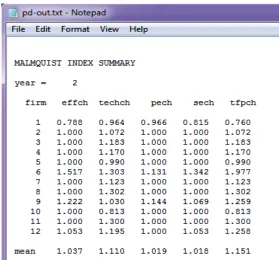
The twelve variables are bases for the calculations, and those are the number of student, the number of academic staff, the number of administration staff, the amount of university funding, the number of study program, the number of Doctor as an input, and the output for this work are the number research funded, the number of journal and book published, the number of community service, (10) the number of graduated student during one academic year the number of accredited study programs, and the number of patent. The result of productivity index showed in fig. 2.
Table 1 shows the changes of TFP relative to the input for the product and for the the year of 2010-2011, 2011-2012. It is noted that for the bienniums, the five universities with greater Malmquist Index to one were UNDHIKSA, UNIMED, UNJ, UM, and UNNES. University with the lowest Malmquist index was UNP, and the highest was UM in 2011-2012.
Table 1. Values of productivities for 2010-2010 and 2011-2012
Number University TFP 2010-2011 TFP 2011-2012 TFP average 1 UNIMA MANADO 0.76 1.171 0.9655 2 UNDHIKSA SINGARAJA 1.072 1.22 1.146 3 UNIMED MEDAN 1.183 1.048 1.1155 4 UNG GORONTALO 1.17 0.935 1.0525 5 UNM MAKASAR 0.99 1.062 1.026 6 UNESA SURABAYA 1.977 0.992 1.4845 7 UNJ JAKARTA 1.123 1.344 1.2335 8 UM MALANG 1.302 1.406 1.354 9 UNNES SEMARANG 1.259 1.115 1.187 10 UNY YOGYAKARTA 0.813 1.049 0.931 11 UPI BANDUNG 1.3 0.936 1.118 12 UNP PADANG 1.258 0.873 1.0655
The full of this study showed the followings: the universities that were technically productive, UNDHIKSA, UNJ, and UM increased productivity during the two periods, while UNIMED and UNNES, another productive units, productivity had decreased in 2011-2012. All other units had a difficulties to achieved the productivity or maintain their productivity in standard.
[image:12.595.68.525.444.657.2]4
CONCLUSIONS
In this paper a study of techniques for analyzing the productivity applicable to Indonesian Education Universities in the 2010-2011 and 2011-2012. The database used consists of six inputs and six outputs from University accreditation report and academic year report. It was found that Malmquist Productivity Index is appropriate and innovative technique that can be used in the performance evaluation between universities, applicable to Indonesian universities. Their strengths are the ability to provide useful information to improve the productivity of the organization, providing academic managers tools that allow managers to establish the productivity variation measurement in a single unit between two periods, and keeping fixed the reference technology; that is, that unity which is used as reference optimum. Finally it is concluded that the use of these techniques allow real measures of academic processes, to determine the relationship between the variables considered and consequently optimize the academic administration at universities with innovation criteria.
REFERENCES
[1] A. Viloria, C. Vasquez, and M. Núňez, "Use of the data envolvent analysis to determine the
correct management of the economic resources of a country," in 2nd International Conference on Adaptive Science & Technology ICAST: IEEE, 2009.
[2] S. Malmquist, "Index numbers and indifference surfaces," Trabajos de Estadistica y de Invest Operativa, vol. 4, pp. 209-242, 1953.
[3] D. Caves, L. Christensen, and W. Diewert, "Multilateral Comparisons of Output, Input and Productivity using Superlative Index Numbers," The Economic Journal, pp. 73-86, 1982. [4] R. Fare, S. Grosskopf, and C. A. K. Lovell, Production Frontiers. Cambridge: Cambridge
University Press, 1994.
[5] R. Fare, S. Grosskopf, B. Lindgren, and P. Roos, " Productivity Developments in Swedish Hospitals : A Malmquist Out," 1994.
[6] W. W. Cooper, L. M. Seiford, and K. Tone., Data Envelopment Analysis: A Comprehensive Text with Models, Applications, References and DEA-Solver Software. Boston: Kluwer Academic Publishers, 2007.
[7] J. Ventura, E. Gonzalez, and A. Carcaba, "Efficiency and Programâ€Contract Bargaining in
Spanish Public Hospitals. ," Annuals of Public and Cooperative Economics, vol. 75, pp. 549-573, 2004.
[8] J.-E. Sturm and B. Williams, "Foreign bank entry, deregulation and bank efficiency: Lessons from the Australian experience.," Journal of Banking & Finance, vol. 28, pp. 1775-1799, 2004. [9] A. Charnes, W.W. Cooper, and E. Rhodes, "Measuring the efficiency of decision making units,"
European Journal Operation Research, vol. 2, pp. 429-444, 1978.
[10] L. M. Seiford and J. Zhu, "An investigation of returns to scale in data envelopment analysis,"
Omega, vol. 27, pp. 1-11, 1999.