* corresponding author: [email protected]
Prognostic factors for constipation
following primary surgery of anorectal
malformations in Yogyakarta, Indonesia
Willy Hardy Marpaung1,2*, Rochadi1
1Pediatric Surgery Division, Department of Surgery, Faculty of Medicine, Universitas
Gadjah Mada/Dr. Sardjito General Hospital, Yogyakarta, 2Department of Surgery,
Raden Mattaher Hospital, Jambi, Indonesia
DOI: http://dx.doi.org/10.19106/JMedSci004701201503
ABSTRACT
Anorectal Malformation (ARM) is a congenital malformation of the anorectal area, occur approximately once in every 5000 live births. There are several morbidities could occur after surgery in ARM. Constipation is the most common morbidity post-surgery in ARM. This study was conducted to evaluate the prognostic factors affecting constipation in postoperative anorectal malformation. This was a case control study involving 74 children who undergo surgery in Dr. Sardjito General Hospital, Yogyakarta from 2008 to 2012. The prognostic factors are sex, type of ARM, age, type of ostomi, type of anoplasty operation, dehiscence of anoplasty, and anal dilatation.
There were 41 (55.4%) male patients and 33 (44.6%) female patients in this study. The risk of constipation in the patients with high level ARM was lower than in low level ARM with an OR of 0.150 (95% CI=0.032 - 0.711; p=0.008). Abdominoperineal pullthrough had higher risk for constipation than non abdominoperineal pullthrough (PSARP and ASA) with p = 0.003. The constipation rate was also different between patients with and without dehiscence of anoplasty with an OR of 0.139 (95% CI=0.033 - 0.584; p=0.005). The gender, types of colostomy, types of colon for colostomy, age of primary operation, and frequency of anal dilatation did not affect the constipation rate. In conclusion, postoperative constipation is still a major problem in surgical for anorectal malformations in Yogyakarta. Types of anomaly, primary operative procedures, and dehiscence of anoplasty operation are the prognostic factors that affect the constipation in anorectal malformations.
ABSTRAK
Malformasi anorektal merupakan salah satu kelainan bawaan yang terjadi pada daerah anorektal dengan insiden 1 dalam 5000 kelahiran hidup. Beberapa morbiditas dapat terjadi setelah pembedahan pada malformasi anorektal. Konstipasi pascabedah merupakan salah satu morbiditas yang paling banyak terjadi setelah tindakan bedah malformasi anorektal. Penelitian ini merupakan penelitian observasional dengan rancangan kasus kontrol, dan dievaluasi 74 anak-anak yang dilakukan operasi di RSUP Dr. Sardjito Yogyakarta mulai 2008 sampai 2012. Faktor-faktor prognostik yang dievaluasi adalah jenis kelamin, tipe ARM, tipe ostomi, tipe operasi anoplasti, dehisensi pada anoplasti dan tindakan dilatasi anus.
anak-INTRODUCTION
Anorectal malformations comprise a wide spectrum of diseases, which can affect boys and girls, and involve several organ systems, such as urinary and genital tracts. Anorectal malformations are congenital anomalies that occur in approximately 1 in 5000 births and the anomalies range from minor to complex anomalies.1-3 There are several classiications
for anorectal malformations proposed by
some authors. Every classiication describes
type, treatment, and also outcome for each anomaly.1-3 The exact etiology for anorectal
malformations remains unclear and is likely multifactorial. There are reasons to believe there is a genetic component. The embryology of anorectal formation consists of complex mechanism. In anorectal malformations, the rectal pouch that will descent normally to the anal canal stops in a certain level and some have connection with urinary and genital tracts. This is why anorectal malformations
may have connection (istula) with these
tracts.1,4
The diagnostic for anorectal malformations consists of several examinations: physical, radiology, and laboratory examination.1 The
surgery treatments consist of neonatal surgery,
primary repair (anoplasty), and the colostomy
closure. The surgeon must decide the most appropriate surgical technique for every patient. In newborn period, the surgeon must
primary repair consists of several techniques such as posterior sagittal anorectoplasy, anterior sagittal anorectoplasty, anterior sagittal anoplasty, and abdominoperineal pullthrough. Each technique is used depends on the type of anomaly.1,2,3 Constipation is
the most frequent disorder encountered after treatment for imperforate anus. It is also the
most important problem to avoid after deinitive
repair for female patients with rectovestibular
or rectoperineal istula and for male patients with rectourethral istula, imperforate anus without istula, and rectoperineal istula.
Failure to avoid constipation can result in megarectum and megasigmoid, and can lead
to fecal impaction and overlow incontinence.5
Constipation occurs usually due to the perirectal dissection causing a degree of denervation. The sacral anomaly also thought to be the cause of constipation, when the nerve for anorectal component is not well developed as well as the muscle complex. Constipation also appears due to hypomotility disorder secondary to chronic bowel dilatation that usually occurs in megarectum that common in transverse or loop colostomy when performed in newborn period. Post-operative constipation is also related to type of anorectal malformations and operative procedure of the anomaly in anorectal malformations.1,5 Types
of the anorectal malformations are also known as prognostic factor for constipation. In
perineal istula and rectovestibuler istula, the
anak pasca operasi abdominal pull-through. Dilatasi anus pasca operasi anoplasti memberikan pengaruh baik pada fungsi usus. Dapat disimpulkan, konstipasi merupakan morbiditas yang umum terjadi pada pasacabedah ARM. ARM tinggi dan dehisensi anus pascabedah merupakan faktor-faktor yang berpengaruh terhadap terjadinya konstipasi pascabedah.
istula, constipation occurs in 55.5%; while in rectovagina istula constipation occurs
in 25%.6The surgery techniques are also
known as prognostic factor for constipation in anorectal malformations. Divided colostomy is recommended for the diverting technique than loop and double barrel colostomy. According to Pena7 large bowel that used as diverting
colostomy for anorectal malformations is descendostomy. Transversostomy or ascendostomy diversion are not recommeded due to lot of disused segment of the bowel, that related to constipation.1,6,7 Primary surgical
technique is also a prognostic factor for constipation. Since Alberto Pena7 introduced
posterior sagittal anorectoplasty in 1982, this technique is used all over the world for primary repair.6Constipation occurred in 78.5% high
level anorectal malformations treated with PSARP, and 64.5% in low levels. PSARP was known superior than abdominoperineal pullthrough in defecation outcome.1,6
Age at primary operation is also known to have impact in defecation function. Dehiscence on primary operation and daily
anal dilatation are also known signiicant in
bowel function on anorectal malformations.6
In this study, we evaluated these prognostic
factors that inluence constipation in anorectal
malformations.
MATERIALS AND METHODS
This was a retrospective study which
evaluates the prognostic factors that inluence
constipation in anorectal malformations in Yogyakarta, Indonesia. We evaluated anorectal malformations patients that had been operated for primary repair in Dr. Sardjito General Hospital, Yogyakarta, Indonesia from January 2008 to December 2012. The inclusion
criterias were patients that underwent primary operation for 1 stage procedure, or underwent colostomy closure for 3 stages procedure, had a complete operation. They were evaluated for constipation by telephone, mail, or direct examination. The prognostic factors were sex, age at primary operation, types of anorectal malformations, types of primary operation, types of colostomy, types of colon for colostomy, dehiscence of anoplasty, and anal dilatation frequency.
We deined constipation as the incapacity
to empty the rectum spontaneously without help everyday, and needs changes in diet, laxatives, or enemas.6,7 Statistical analysis
univariate, multivariate logistic regression analysis was performed with a p value < 0.05
considered signiicant. .
RESULTS
A total of 74 patients fulilled the criteria
for inclusion in this study. There were 41
(55.4%) male patients and 33 (44.6%) female patients. Forty ive (60.8%) patients underwent
primary operation more than 6 months of age,
while 29 patients (39.2%) were operated less
than 6 months of age.
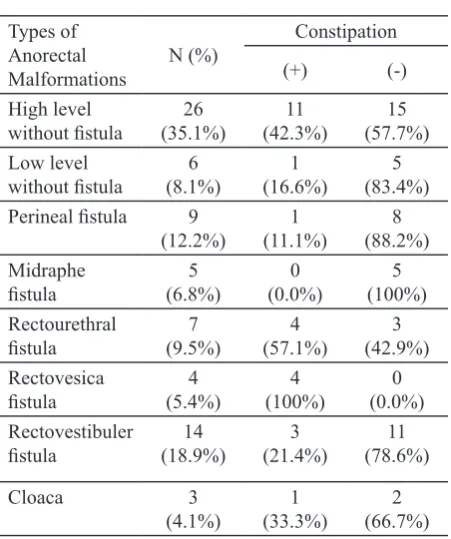
Most of the anomalies were high level
anomaly without istula, that were 26 (35.1%)
patients, while others were rectovestibuler
istula in 14 (18.9%) patients, perineal istula in 9 (12.2%) patients, rectourethral istula in 7 (9.5%) patients, low level anomaly without istula in 6 (8.1%) patients, midraphe istula in 5 (6.8%) patients, rectovesica istula in 4 (5.4%) patient, and cloaca in 3 (4.1%) patients.
We divided these types of anomalies into high
TABLE 1. Types of anorectal malformation-Perineal istula 9
(12.2%) (11.1%)1 (88.2%)8
In types of colostomy procedure, the most frequent colostomy technique used in Dr Sardjito Hospital was loop colostomy. It
is used in 53 (96.4%) patient, while divided colostomy in 2 (3.6%) patients (TABLE 2).
TABLE 2. Types of colostomy associated with
constipation
In types of colon for colostomy, right
transversocolostomy was used in 22 (40%)
patients, left transversocolostomy in 17
(30.9%) patients, sigmoidostomy in 15 (27.3%) patients, and descendostomy in 1
TABLE 3. Types of colostomy associated with
constipation
Types of colon for
colostomy N (%)
PSARP was used in 50 (67.6%) patients, while ASA in 19 (25.7%) patients, and abdomino perineal pullthrough in 5 (6.8%) patients (TABLE 4). Sixty three (85.1%)
patients were having no dehiscence, while
11 (14.9%) patients were having dehiscence. Most of the patients, 70 (94.6%) patients, were routinely did anal dilatation, while 4 (5.4%)
patiens were not routinely dilate the anus after primary operation.
TABLE 4. Types of primary operation associated
with constipation
Types of primary
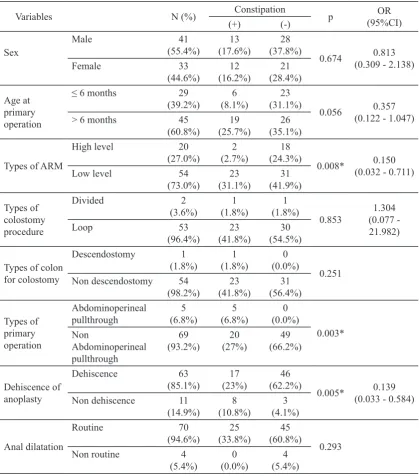
TABLE 5. Correlation between prognostic factors with constipation
Variables N (%) Constipation p (95%CI)OR
(+) (-)
Sex
Male 41
(55.4%) (17.6%)13 (37.8%)28
0.674 (0.309 - 2.138)0.813
Female 33
0.056 (0.122 - 1.047)0.357
> 6 months 45
(60.8%) (25.7%)19 (35.1%)26
Types of ARM
High level 20
(27.0%) (2.7%)2 (24.3%)18
0.008* (0.032 - 0.711)0.150
Low level 54
Types of colon for colostomy
Descendostomy 1
(1.8%) (1.8%)1 (0.0%)0
0.251
Non descendostomy 54
(98.2%) (41.8%)23 (56.4%)31
Dehiscence 63
(85.1%) (23%)17 (62.2%)46
0.005* (0.033 - 0.584)0.139
Non dehiscence 11
(14.9%) (10.8%)8 (4.1%)3
no statistically difference with female in
correlation with constipation (p=0.674). Age
at primary operation revealed no difference between patients that operated on 6 months of
age, and over 6 months of age (p=0.056). There was a signiicantly different between patients with high level and low level (p=0.008) with
an OR of 0.150 (95% CI=0.032 - 0.711),
while types of colostomy, and types of colon
for colostomy did not show any signiicant difference with risk for constipation. Based
on type of operation, in primary operation procedure, abdominoperineal pullthrough was
the anal canal and the brain, facilitating better anorectal sensation and sphincteric function. Eventhough, there is no evidence that early repair would provide better functional outcome.6 Based on the levels of anomaly,
there was a statistically difference between the high level and low level anomaly, p=0.008,
with OR=0.150 (95% CI: 0.032-0.711),
meaning that the high level anomaly is lower in risk for constipation that the low anomaly. This result was different with other studies. Huang et al.8 showed that the constipation
rate in high level anomaly was higher than the
low anomaly (78.6% vs. 64.5%), similar to
a study by Rintala, showing that the surgical management in low anorectal anomalies much better in continence than severe high anomalies.10 The reasons for high level
anomaly have a higher risk for constipation are the hypoplasia of the voluntary sphincter muscles, and the severe sacral abnormalities. Other study showed different from these studies, where constipation particularly occurred in the low type. Constipation in low level anomaly usually related to dilatation of distal colon and rectum, causing hypomotility of the bowel. Diet and early management of constipation in low level usually give good result.5 Types of colostomy showed no
difference between the divided colostomy and loop. Also the bowel for colostomy had no difference between descendostomy and non descendostomy with p=0.251. A divided descending colostomy is ideal for the management of anorectal malformations. The completely diverting colostomy provides bowel decompression as well as protection
for the inal repair of the malformations. A
descending colostomy has several advantages over transversocolostomy because there is a relatively short segment of defunctionalized p = 0.003. Dehiscence of anoplasty was also
signiicantly different with non-dehiscence
patients in risk from constipation in anorectal malformations with p = 0.005 with an OR of
0.139 (95% CI=0.033 - 0.584). Frequency of anal dilatation was not statistically signiicant
in risk from constipation in anorectal
malformations (p= 0.293).
DISCUSSION
Constipation still becomes a problem in post-operative anorectal malformations patients. In this study, the rate of constipation was 33.78%. This rate was not different from other studies. In 1995, Pena described his result, among 285 children in his study, 61.4%
patients with vestibuler istula, 55% patients with bulbar istula, and 41.4% patients with prostatic istula constipated.7 Huang et al.,8
showed 8 constipation rate was 64.5% in low anomaly, and 78.5% in high anomaly. Male patients were more frequent than female in
this study, where 41 (55.4%) patients were male. This inding was similar from the former
study, when Smith and Stephens initially reviewed that 55-70% patients were male.6
A study in Singapore also showed that 63% anorectal malformations were male.9 There
was no difference between sex according to constipation in our study. Age at primary
operation has been suggested to inluence the
long-term functional outcome. In this study, there were no difference between patients
that were operated at ≤ 6 months of age and
> 6 months of age. A higher risk of organ injury will occur if we do not well identify the organ, even though there are some advantages
in performing the deinitive reconstruction
difference in this variable. We usually perform loop colostomy in our institution. Types
for primary operation differed signiicantly
between abdominoperineal pullthrough and non abdominoperineal pullthrough (ASA and
PSARP). This inding is similar with other study.
Surgical method of anorectal reconstruction
is known as signiicant prognostic factor for
constipation. Holschneider et al.,6 reported signiicantly better continence outcome in
PSARP than abdominoperineal pullthrough. Abdominoperinal pullthrough usually breaks many nerves and muscle that usually related to defecation process.6 Evaluation of
PSARP in our study showed that 19 of 50
patients (37.2%) treated with PSARP was constipated. This inding was not different
from other study by Hassett, showing that 21% - 42% patients treated with PSARP was constipated.12 Dehiscence of anoplasty operation signiicantly affected constipation
rate. Wound dehiscence usually causing scar on the anus, and could make an anal stricture which related directly to constipation. Anal dilatation is important to prevent constipation. However, our study showed that anal
dilatation does not inluence the constipation
rate. The anal dilatation might prevent anal stricture.6The quality of life of anorectal
malformations needs a long term follow up. Study about long term functional outcome and quality of life in high imperforate anus found that stooling patterns were perceived to worsen with age.13 Associated anomalies
that usually found in anorectal malformations
patients also inluence the quality of life.
Neurogenic bladder dysfunction, spinal cord malformation, sacral malformation, and
prostatic istula all are negative predictive factors for bowel score at ive years.14
CONCLUSION
Postoperative constipation is still a major problem in surgical for anorectal malformations in Yogyakarta, Indonesia. Types of anomaly, primary operative procedures, and dehiscence of anoplasty operation were the prognostic factors that affect the constipation in anorectal malformations.
ACKNOWLEDGEMENTS
We would like to thank all patients who have participated in this study.
REFERENCES
1. Levitt MA, Pena A. Anorectal malformations. Orphanet J Rare Dis 2007; 2(33):1-13.
http://dx.doi.org/10.1186/1750-1172-2-33
2. Witvliet MJ, Slaar A, Heij H, van der Steeg AF. Quality analysis of studies concerning quality of life in children and adults with anorectal
malformations. J Pediatr Surg 2012; 48(2):372-9.
http://dx.doi.org/10.1016/j.jpedsurg.2012.11.018 3. Moore S. Genetics pathogenesis, and epidemiology
of anorectal malformations and caudal regression syndrome. In: Anorectal Malformations in
Children. Edt; Holschneider AM, Hutson JM. 2006; 31-4.
4. Hutson JH, Putte SCJ, Penington E, Kluth D, Fiegel H. The embryology of anorectal malformations.
In: Anorectal malformations in children. Edt; Holschneider AM, Hutson JM. Berlin: Springer, 2006; 49-62.
5. Levitt MA, Kant A, Pena A. The morbidity
of constipation in patients with anorectal
malformations. J Pediatr Surg 2010;
45(6):1228-33.
http://dx.doi.org/10.1016/j.jpedsurg.2010.02.096 6. Holschneider AM, Koebke J, Meier-Ruge W,
Scafer S. Postoperative pathophysiology of chronic constipation and stool incontinence.
In: Anorectal Malformations in Children. Edt;
Holschneider AM, Hutson JM. 2006: 329-42. 7. Pena A. Anorectal malformations. Semin Pediatr
Surg 1995; 4(1):35-47.
complication after posterior sagittal anorectoplasty for anorectal malformations in children. Pediatr
Neonatol 2012; 53(4):252-6.
http://dx.doi.org/10.1016/j.pedneo.2012.06.007
9. Nah SA, Ong CC, Lakhsmi NK, Yap TL, Jacobsen AS, Low Y. Anomalies associated with anorectal
malformations acording to the Krickenbeck
anatomic classiication. J Pediatr Surg 2012; 47(12):2273-8.
http://dx.doi.org/10.1016/j.jpedsurg.2012.09.017 10. Pakarinen MP, Rintala RJ. Management and
outcome of low anorectal malformations. Pediatr
Surg Int 2010; 26(11):1057-63.
http://dx.doi.org/10.1007/s00383-010-2697-z
11. Burjonrappa S, Youssef S, Lapierre S, Bensoussan A, Bouchard S. Megarectum after surgery for anorectal malformations. J Pediatr Surg 2010; 45(4):762-8.
http://dx.doi.org/10.1016/j.jpedsurg.2009.10.043
12. Hassett S, Snell S, Hughes-Thomas, Holmes K. 10-Year outcome of children born with anorectal malformations, treated by posterior sagittal anorectoplasty, assessed according to the
Krickenbeck classiication. J Pediatr Surg 2008;
44(2):399-403.
http://dx.doi.org/10.1016/j.jpedsurg.2008.10.092
13. Hashish MS, Dawoud HH, Hirschl RB, Bruch SW, El Batarny AM, Mychaliska GB, et al. Long-term functional outcome and quality of life in patients
with high imperforate anus. J Pediatr Surg 2010; 45(1):224-30.
http://dx.doi.org/10.1016/j.jpedsurg.2009.10.041
14. Borg HC, Holmdahl G, Gustaysson K, Doroszkiewicz M, Sillén U. Longitudinal study
of bowel function in children with anorectal
malformations. J Pediatr Surg 2013;
48(3):597-606.