135 Original paper
MITIGATION MEASURES FOR GAZA COASTAL EROSION
Mazen Abualtayef 1,*, Ahmed Abu Foul1, Said Ghabayen1, Abdel Fattah Abd Rabou2, Ahmed Khaled Seif3, Omar Matar4
1
Environmental Engineering Department, Islamic University of Gaza, Gaza, Palestine 2
Biology Department, Islamic University of Gaza, Gaza, Palestine 3
Civil Engineering Department, Al Azhar University, Cairo, Egypt 4
Municipality of Khan Younis, Khan Younis, Palestine
Received: January 3, 2013 ; Accepted: February 23, 2013
ABSTRACT
Coastal erosion is an ongoing hazard affecting Gaza beach, but is worsening due to a wide range of human activities such as the construction of Gaza fishing harbor in 1994-1998. The net annual alongshore sediment transport is about 190×103 m3, but can vary significantly depending on the severity of winter storms. According to the observed wave heights and directions, the net waves are cross-shore, therefore vast quantities of sediments may transfer to deep sea. The main objective of this study is to mitigate the erosion problem of Gaza coast.
Change detection analysis was used to compute the spatial and temporal change of Gaza shoreline between 1972 and 2010. The results show negative rates in general, which means that the erosion was the predominant process. Gaza fishing harbor caused a serious damage to the Beach Camp shoreline.
Consequently, several mitigation measures were considered in this study, which are: relocation of Gaza fishing harbor to offshore, groins, detached breakwaters, wide-crested submerged breakwaters and beach nourishment. Several numerical model tests associated with coastal structures are conducted to investigate the influence on morphodynamics.
The results show that the relocation of the harbor is the best alternative to stop trapping of the sediments. If for any reason the relocation was not carried out, the wide-crested submerged breakwater alternative is an effective structure for preventing sandy beach erosion. The artificial reef type of submerged breakwaters with beach nourishment is recommended for Gaza beach, because it is an environmentally friendly and improving the ecosystem of marine life.
Keywords: Gaza fishing harbor, morphodynamic, artificial reef, remote sensing
*
Correspondence: Phone: +972-599-857-931, Fax:+972-8-2860700, E-mail: [email protected]
I
NTRODUCTIONDevelopment in coastal areas, harbors, breakwaters, jetties and groins, is the focus of considerable research activity by both natural scientists and planners. Compared to many coastlines, that of Eastern Mediterranean coast has been well studied. The primary sediment source is the Nile River. Nile sands have been transported from the outlets of the river to the Palestinian coast by consistent west-to-east and southwest-to-northeast alongshore currents
generated by westerly approaching waves (Goldsmith, 1980). In recent decades, the coast has been plagued by a serious shortage of sand and by erosion. The sand shortage results from the building of coastal structures that are acting as sediment traps and therefore causing sand shortages on adjacent beaches.
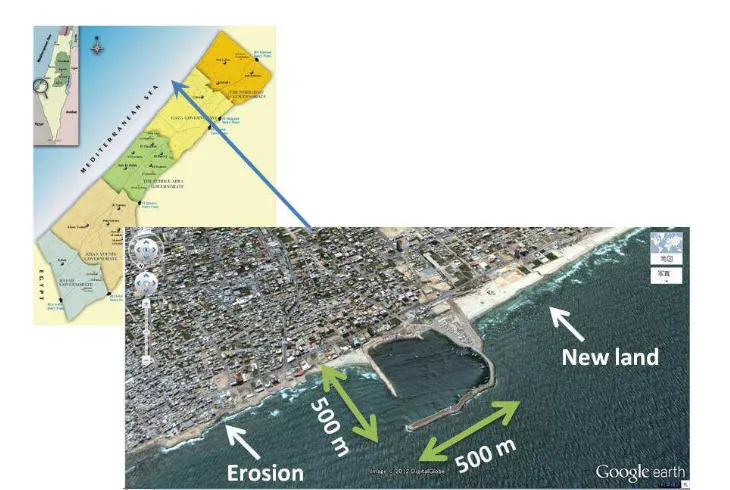
136 sediment discharge to the sea. Fortunately for Gaza, the Bardawil lagoon sandbar continues to act as a significant source and supplier of sand to Gaza coast (Inman, 1976). The coast of Gaza was affected by man-made structures prior to the fishing harbor as shown in Figure 1. In the early 1970s two groins, 120 m long each 500 m apart were built in Gaza City as shown in Figure 1. Sand accumulation occurred south of the southern groin to a distance of 1.1 km. On the other hand, erosion took place north of the northern groin to a distance of 1.2 km. The erosion was controlled by a series of nine detached breakwaters built in 1978. The detached breakwaters, 50-120 m long, were built 50 m from the coast line at a depth of 1 m as shown in Figure 3 (Zviely and Klein, 2003). In 1994, the construction of Gaza fishing harbor started and completed in 1998. The fishing harbor extends some 500 m into the sea, enabling access to vessels up to 6 m deep. The fishing harbor has locally disturbed the coastal erosion and sedimentation pattern and resulting in sand erosion problems. Furthermore, the building and roads adjacent to the shoreline are facing a stability problem and it is expected to
have a serious erosion problem in the coming few years.
As a counter-measure to this, the construction waste was deployed in the eroded area, which is working as a beach revetment, to mitigate the severe beach erosion and protecting the hotels. UNRWA has constructed gabions along the Beach Camp with a total length of 1650 m to protect the main coastal road. Several short groins have been construction along the Beach Camp for shoreline preservation. However, these mitigations are not effective. Therefore, the significance of the current study is that it not only compares coastal processes before and after the fishing harbor, but it also compares the numerical model’s predictive capabilities with the actual impacts.
The objectives of the present study were to twofold:
• to monitor the coastal changes to the north and south of Gaza fishing harbor by using remote sensing techniques, and
• to compare coastal changes with changes forecast by the numerical model in order to provide long-term protection against erosion.
Fig 1: The two groins built in 1972 (Zviely and Klein., 2003)
Fig 3: The detached breakwaters built in 1978 (Zviely and Klein., 2003)
M
ATERIALS ANDM
ETHODSData in the present study have been collected from analyses of Landsat images from 1972 to 2010 and combined with sample collection for
137
Fig 2: The study area
Satellite images
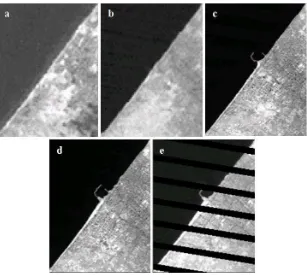
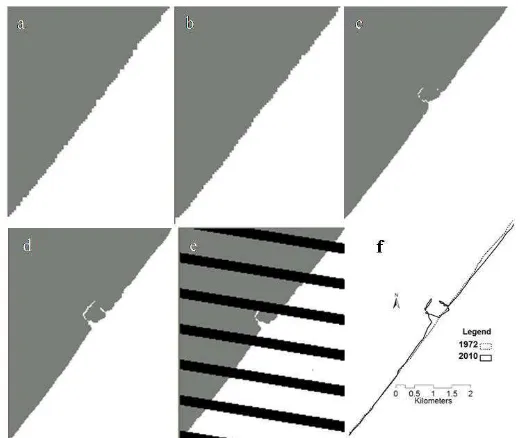
Five satellite Landsat images were obtained for the study area covering path 175 and row 38. The Landsat multispectral scanner (MSS) sensor images are acquired on June 1972 and May 1984, Landsat thematic mapper (TM) sensor images are acquired on May 1998 and March 2003, and Landsat Enhanced Thematic Mapper Plus (ETM+) sensor image is acquired for June 2010 as shown in Figure 4. The images are of medium quality and free from clouds. The raw MSS images consist of four bands, TM images consist of seven bands and ETM+ images consist of nine bands. The infrared band was selected for the subsequent image processing. The pixel size in each image is shown in Table 1. The image processing procedures were carried out using ERDAS Imagine and ArcGIS. Figure 5 shows the study area subsets.
The images are projected to the Universal Transverse Mercator (UTM), with a spheroid
and datum of WGS 84. Landsat images were geometrically certificated. The rectified images were then used for the image classification. A subset image was created from each image, which covers only the study area on each date. An unsupervised classification algorithm was applied requesting 2 classes and applying 24 iterations, a convergence threshold of 0.95 and a standard deviation of one. The classified images produced two clusters in each image and the clusters for the terrestrial and sea parts were recorded.
To estimate the amount of change between the several dates, we applied a post-classification change detection matrix using ERDAS Imagine. This approach is very useful since the images were classified independently. Areas changed from sea to land and vice versa were recorded. The total area and the location of change between 1972 and 2010 were measured. Detailed analysis was carried by Abualtayef et al. (2012) for the study area.
Table 1: Satellite images source and resolutions
Image source Date Resolution [m×m]
Landsat 1 MSS 29-06-1972 60.0×60.0
Landsat 5 MSS 14-05-1984 60.0×60.0
Landsat 5 TM 29-05-1998 30.0×30.0
Landsat 5 TM 29-03-2003 30.0×30.0
138
Field study and sample collection
The field study included identification of the various landscapes of the area along with the sample collection. Three seabed samples were collected along the Beach Camp coast.
Grain size analyses were made using standard sieving techniques at half-phi intervals. The grain size statistical parameters were calculated using the graphical method.
Fig. 4: Landsat satellite images of band-4 in a) 1972, b) 1984, c) 1998 d) 2003 and e) 2010 for the study area
Since a lack of wave data for Gaza coast, the directional wave observations at Idku station in front of Alexandria’s (Egypt) deep waters were considered. The wind conditions at the eastern part of the Mediterranean coast are almost similar. Therefore, the wave condition of Alexandria can be adapted since the wave parameters in deep waters remain the same. The wave recording station is located in a mean water depth of 14 m and yields 6 times daily recordings for a 4-hour interval (Seif, 2011). The wave recording of two-year period from 2004 to 2005 was used in this study. During this period, a total of 4,131 measurements were recorded and analyzed. Table 2 shows the breakdown of the measurements and averaged over one year period. For each wave scenario, the significant wave height, peak period, wave direction and duration were analyzed.
Numerical model
The relocation of fishing harbor to offshore, groins field system, detached breakwaters and wide-crested submerged breakwaters were suggested and examined using the morphodynamic numerical model of nearshore waves, currents, and sediment transport in order to mitigate the coastal erosion. The numerical model was developed by Kuroiwa et al. (1998) and recently modified by Seif et al. (2011). The numerical model consists of four modules to simulate the hydrodynamics and morphodynamics around coastal structures, which are: wave module, nearshore current module, sediment transport module, and beach evolution module.
139 gradient of 1 in 100. The grid size was 10m. The median grain size D50 was 250 m. The significant wave height, wave period and wave direction at the offshore boundary are shown in Table 2. The followings are additional conditions for each model test:
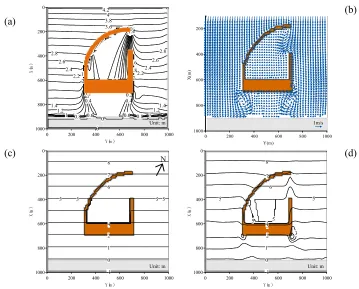
• For the port relocation model test: the computations were performed on an area of 1.0 km alongshore and 1.0 km cross-shore. The distance from shoreline is 200 m. The water depth in the basin range from 5 to 7 m. The harbor layout and initial bathymetry is shown in Figure 6(c).
• For the detached breakwater model test: The computations were performed on an area of 0.6 km alongshore and 0.8 km cross-shore. The length of the detached breakwater was
300 m, 3.0 m crown depth, and the distance from shoreline is 150 m. The test layout and bathymetry is shown in Figure 7(c).
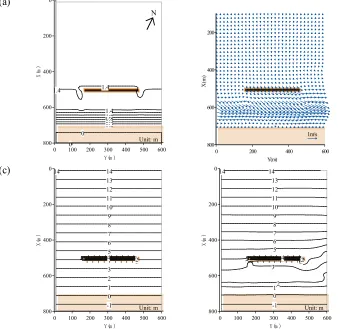
• For the submerged breakwaters model test: The computations were performed on an area of 0.6 km alongshore and 0.8 km cross-shore. The length of the submerged breakwater was 300 m, 2.0 m crown depth, and the distance from shoreline is 200 m. The test layout and bathymetry is shown in Figure 8(c).
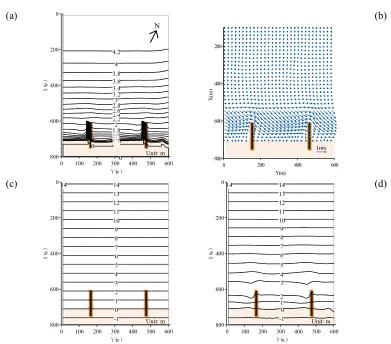
• For the groins model test: The computations were performed on an area of 0.6 km alongshore and 0.8 km cross-shore. The length of the groin was 150 m and 300 m spacing. The test layout and bathymetry is shown in Figure 9(c).
Table 2: The wave scenarios for the study area
Wave
Remote sensing findings
The coast of Gaza was affected by the man-made structures such as groins, breakwaters and fishing harbor. The construction of fishing harbor has caused an accumulation of sand at the southern fringe of the harbor. The “new land” (Figure 1) is large due to the shape of the main breakwater and become a sediment trap. In addition, the “new land” is increased by the dumping of construction waste.
Change detection results of the remotely sensed images between 1972 and 2010 for the study area are shown in Table 3. The study area is extended from Wadi Gaza, 4 km to the south of fishing harbor, to Alsodania area, 3 km to the north of the harbor as shown in Figure 4.
The study findings show that the sediment balance of beach area tended to be negative. This observation is based on the advance of the waterline towards the sea to the south of fishing harbor by an average 0.75 m year-1 and based
on the treat of the waterline towards the land to the north of fishing harbor by an average 1.15 m year-1. Gaza fishing harbor caused a serious damage to the Beach Camp shoreline, especially after removing six detached breakwaters. The impact of harbor construction has extended to 2.6 km to the north and less than 2.4 km to the south of harbor.
140
Table 3: Accretion and erosion rates for the study area
Image period
Erosion Accretion
area ×103 [m2]
rate ×103 [m2 year-1]
area ×103 [m2]
rate ×103 [m2 year-1]
1972-1984 180 15 122 10
1984-1998 200 14 224 16
1998-2003 8 2 190 38
2003-2010 143 20 70 10
Total 531 14 606 16
Sediment transport rates
Since the construction of the Aswan high dam, the Nile no longer brings sediment to the coast, and erosion of Nile delta now constitutes the source for the Nile Littoral Cell (Inman et al., 1976).
The present study computes the net annual rate of wave-induced alongshore sediment transport range from minimum 160×103 to maximum 220×103 m3, and the average annual rate of 190×103 m3, northward. Depending on the wave direction, the net waves are cross-shore; therefore, vast quantities of sediments may transfer to deep sea. In the Rafah-Gaza segment, a drastic
change from eastward to northward occurs in the direction of the coastline. Mayo (1992) claims that large quantities of sediments in this area are out into the deep sea.
The net transport remains counter-clockwise and gradually increases with distance southward from Gaza. Hence, the wave-induced transport appears to provide the driving force for the net counter-clockwise transport of sediments along the Nile Cell, gradually decreasing along the way from the Nile delta about 860×103 m3 year-1 to Gaza about 190×103 m3 year-1 (Carmel et al., 1985).
141
Numerical model results
Four numerical tests were carried out, which are relocation of the exiting harbor to offshore, the detached breakwaters, the submersed breakwater and the groin fields in order to mitigate the erosion problem in the Beach Camp coast. The model results are as follows:
• Offshore fishing harbor model test:
Figure 6 (a, b) shows the computed results of wave height distribution and depth-average current velocity around the offshore harbor, respectively. From these figures, it was found that two vortices are formed between the harbor and shoreline. Clockwise vortex and counter-clockwise vortex are formed at the right side and at the left side, respectively. The strongest currents of 1.0 ms-1 are observed near the harbor’s entrance. The wave height decreases toward the shoreline and nearly calm behind the harbor. Figure 6 (c, d) shows the initial bathymetry and computed one after one year beach revolution, respectively. It was found from these figures that slight changes of the morphodynamic were taken place in which the shoreline was advanced and forming two small salients, siltation was accumulated at the harbor’s entrance and erosion up to 4 m water depth was taken place near the edge of northern breakwater. In general, no significant morphodynamic changes were taken place within the study area.
• Detachedbreakwater model test:
Figure 7shows the computed results of the wave height distribution, the depth-average current velocity and the final bathymetry around the detached breakwater,
respectively. From these figures, it was found that the lee of the breakwater was eroded up to 5.0 m and this will cause a structure failure. The strongest currents of more than 1.0 m s-1 are observed in the study area. The morphodynamic of the area located between the structure and shoreline was severely affected and formed two small salients. The 4-m contour was retreaded and highly contributed to the erosion amounts. The erosion rate in the study area was about 23×103 m3 km-1 yr-1.
• Submerged breakwaters model test:
Figure 8 shows the computed results of the wave height distribution, the current velocity and the final bathymetry around the submerged breakwater. From this figure, it was found that the currents are decreased compared with ones in the previous model tests and the strongest currents are observed over the submersed breakwater and toward the shoreline. The shoreline does not change and the contours of 3 and 4 m are advanced. However, the contour of 2 m was retreated. The annual accretion rate was about 28×103 m3 km-1.
• Groins model test:
143 bathymetry and (d) computed bathymetry
(a) distribution for 1.4 m wave height condition, (b) computed depth-average current velocity for wave height of 1.4 m, (c) initial bathymetry and (d) computed bathymetry
144
Fig 9: Groins field system after one year beach revolution (a) computed wave height distribution, (b) computed depth-average current velocity at wave height of 1.4 m, (c) initial bathymetry and (d) computed bathymetry
The environmental impact on the morphodynamic in the study area is presented in Table 4. The offshore harbor model test shows a positive impact on the environment in which nearly no sand trapping or erosion is taken place at the study area.
The incident waves at the deep sea are almost normal to the shoreline and accordingly the cross-shore sediment component will be
dominated and less amount of sediment transport will be transported alongshore. Therefore, offshore breakwater will decelerate the cross-shore current and then reducing the amount of sediment to be transported. For the time being, the submersed breakwater (artificial reef type) shows an attractive protection from both morphological and environmental points of view.
Table 4: Environmental impact of various mitigation alternatives
Mitigation alternative Annual rate
[m3 km-1] Remarks
Relocation of harbor + 4×10³ Accretion
Detached Breakwater ‒23×103 Erosion
Submersed Breakwater +28×103 Accretion
Groins field system ‒22×103 Erosion
145 Based on the sediment transport, the environmental impact and the numerical model analysis, the recommended alternative is the relocation of harbor. In case the relocation could not be implemented, the submerged artificial reef breakwater would be selected. However, the artificial reef breakwater will transfer the problem to the north. Therefore, combination of nourishment alternative and submerged breakwater is required. The nourishment is used to maintain the shoreline and the erosion at the down-drift side while submerged breakwaters are used as a protection structure. The annual amount of nourishment of 110×103 m3 is required at the down-drift side (i.e. 82×103 m3 due to trapping of sediments behind the existing harbor and 28×103 m3 due to the trapping of sediments behind the artificial reef).
C
ONCLUSIONSThe erosion problem along Gaza beach is due to the man-made structures as confirmed by analyzing the historical satellite images from 1972 to 2010. These structures include groins built in 1968, detached breakwater built in 1978 and finally the construction of Gaza fishing harbor in 1994-1998. The annual average erosion of 1.15 m extended 2.6 km to the north of harbor and the annual average accretion of 0.75 m extended to 2.4 km to the south of harbor.
The numerical model was able to demonstrate the impacts of various wave climates for the suggested beach protection alternatives. Results show that the offshore harbor is the best alternative for Gaza beach restoration in which the erosion problem generator is disappeared. If the relocation could not be implemented, the wide-crested submerged breakwater, “artificial reef”, is an effective structure for preventing sandy beach erosion due to wave and nearshore current actions, and for the landscape of sea-view in front of sandy beaches. The artificial reef type of submerged breakwaters is recommended for Gaza beach, because it is an environmentally friendly and improving the ecosystem of marine life and the fishing
industry. The numerical model results show that both groins and detached breakwater have negative environmental impacts. However, the model most runs for short storm which may worsen the situation in case of groins field being selected.
R
EFERENCESAbualtayef, M., Ghabayen, S., Abu Foul, A., Seif, S., Kuroiwa, M., Matsubara, Y., Matar, O. 2012. The impact of Gaza fishing harbor on the Mediterranean coast of Gaza. J. Coast. Dev.16(1): 1-10.
Carmel, Z., Inman, D. and Golik, A. 1985. Directional wave measurement at Haifa, Israel, and sediment transport along the Nile littoral cell. Coast.
Engineer. 9: 21-36.
Goldsmith, V. and Golik, A. 1980. Sediment transport model of the southeastern Mediterranean coast. Mar. Geol., 37, 147-175.
Inman, D.L., Aubrey, D.G. and Pawka, S.S. 1976. Application of nearshore processes to the Nile Delta. In: Proc. of Seminar on Nile Delta Sedimentology, Alexandria, 25-29 Oct. 1975 by UNDP/UNESCO Project for Coastal Studies, publ. by the Project under Academy of Scientific Research and Technology, pp. 205-255.
Kuroiwa, M., Noda, H. and Matsubara, Y. 1998. Application of a quasi- 3D numerical model to near-shore current. Proc. Int. Conf. Coastal Eng., ICCE, 26, 815-827.
Mase, H., Amamori, H. and Takayama, T. 2005. Wave prediction model in wave-current coexisting field. Proceedings 12th Canadian Coastal Conference, CD-ROM.
146 Seif, A., Kuroiwa, M., Abualtayef, M., Mase,
H. and Matsubara, Y. 2011. A hydrodynamic model of nearshore waves and wave-induced currents. Int.
J. Nav. Archit. Oc. Eng, 3: 216-224.
Seif, A. K. 2011. Numerical simulation of 3D morphodynamic around Coastal structures using quasi-3D nearshore current model. Tottori University, Japan, Doctorate thesis, 152p.