Extraction and Modification of Gum
from Cashew Tree Exudates
Using Wheat Starch and Glycerine
Andri Cahyo Kumoro*, Diah Susetyo Retnowati dan Catarina Sri Budiyati Department of Chemical Engineering, Faculty of Engineering, Diponegoro University,
Jl. Prof. Soedarto, SH - Tembalang Semarang, 50275
Abstract
The objectives of this research were to extract cashew tree gum (CTG) from cashew tree exudates and to modify it into a new drying aid, which can act as a substitute for Arabic gum. The cost problem faced in the spray drying of fruit juices is expected to be solved with the use of modified CTG as a replacement of Arabic gum. The CTG was extracted and precipitated from its raw cashew exudates solution with the help of ethanol as antisolvent. Glycerine and wheat starch were the additives used in the modification of the gum. The good quality of modified CTG was obtained based on their close similarity to Arabic gum properties.
Keywords: CTG, Arabic gum, modification, starch, glycerine
Abstrak
Penelitian ini bertujuan untuk mengekstrak getah pohon mete dan memodifikasi sifatnya untuk dapat digunakan sebagai senyawa pembantu proses pengeringan menggantikan fungsi getah Arab. Dengan menggunakan getah mete termodifikasi dari penelitian ini, permasalahan biaya pada proses pengeringan jus buah dengan spray dryer dapat diatasi. Getah pohon mete dipungut dan diendapkan dari larutan hasil penyadapan dengan bantuan etanol sebagai antisolvent. Dalam penelitian ini gliserin dan pati gandum digunakan sebagai bahan tambahan untuk memodifikasi sifat getah. Hasil penelitian menunjukkan bahwa getah pohon mete termodifikasi yang dihasilkan memiliki kualitas yang baik dan kesamaan sifat dengan getah Arab.
Kata kunci : getah pohon mete, getah Arab, modifikasi, pati, gliserin
Introduction
Spray drying is a widely used technique to produce powders from liquid foods. However, drying of fruit juices into powder is difficult, especially because of the presence of low molecular weight sugars and acids, which have low glass transition temperature (Tg), being then very hygroscopic, because of their high molecular mobility above Tg (Jaya and Das, 2004). While under spray drying temperatures, they tend to stick to the walls of the drying chamber and can produce a paste-like structure instead of powder (Dolinksy et al., 2000; Bhandari and Hartel, 2005). Some possible consequences are related to impaired product stability, decreased yields (because of stickiness on the drier chamber walls), and even operating problems to the spray drier (Bhandari et al., 1997).
The sticky behaviour can be avoided by the addition of drying aids, which are high molecular weight carbohydrates, such as maltodextrins and __________
*Alamat korespondensi: email: [email protected]
Arabic gum, which decrease powder
findings that the viscosity characteristic of the CTG was very similar to Arabic gum, and this property was not significantly affected by pH, temperature and storage time. However, Owusu et al. (2005) did not carry out any modification to the CTG to improve its other drying properties.
CTG is a complex polysaccharide comprising 61% galactose, 14% arabinose, 7% rhamnose, 8% glucose, mannose 2%, xylose 2% and glucurine acid 6% (Anderson et al., 1974). Elementary analysis revealed the average water content 9.7%, total protein measured about 1.5%, total lipids 0.06%, fibres 3.24% and ash 0.5%, the total carbohydrate was 85%. Hydrolysis of CTG yields L-arabinose, L-rhamnose, D-galactose and glucuronic acid (Glicksman and Sand, 1973; Gyedu-Akoto et al., 2008). The variation in acid number is influenced not only by the source of the sample but also by its age. The sticky exudates from this tree darken and thicken rapidly on exposure to air. When applied as a varnish, it provides remarkable protection, as is unchanged by acids, alkalis, alcohols or heat up to 70°C.
In order to provide better information about CTG as a potential substitute for Arabic gum and maltodextrins as drying aids, this research was conducted. The objectives of this research were to extract CTG from cashew tree exudates and to modify it into a new drying aid.The first part of this study deals with the precipitation of CTG using ethanol as antisolvent. Then, in the second part, modification of CTG with starch and collected from local cashew plantation nearby Diponegoro University Campus. Ethanol, sodium hydroxide, wheat starch and glycerine of analytical grade with minimum purity of 98% were purchased from Sigma-Aldrich-Singapore Pte. Ltd. Whereas, distilled water was supplied by the reverse osmosis unit available in the Department of Chemical Engineering, Faculty of Engineering, Diponegoro University.
The dried raw cashew tree exudates were purified as a sodium salt using the method previously described (de Paula et al., 2001; Torquato et al., 2004). Cashew tree exudates gum (10 g) sample was collected and was dried at 45°C to reduce the moisture content. The dried sample was ground to pass through 2.5 mm size
mesh sieve. The gum was isolated, that is the separation of the polysaccharides present in the raw gum, and this was done by stirring the gum sample in 250 mL distilled water for 6-8 hours at room temperature. The solution pH was adjusted to approximately 7.0 by adding diluted NaOH. The sample was centrifuged to remove the impurities and was concentrated by heating to a temperature of 100°C. The residue was washed with water and the washings were added to the separated supernatant. The procedure was repeated four more times. Finally, the supernatant was made up to 500 mL and treated with ethanol in order to precipitate all the carbohydrates. The precipitated material was washed again with distilled water, freeze-dried and ground with mortar to obtain fine powder. The ratio of ethanol to crude CTG weight was studied here.
The CTG was then modified by the use of additives and the properties of gum were measured, i.e gum viscosity, pH, density and glass transition temperature. The viscosity was measured by the use of A programmable Brookfield rheometer (Brookfield Engineering Laboratories, Vertriebs GmbH, Model DV-111, Lorch, Germany), pH measured by the use of pH meter (Hanna Instruments, Model HI 98129, Singapore) and density measured by the use of capillary tube pycnometer of 10 ml capacity; the solution weight were recorded in analytical balance with 0.0001 g precision (Mettler-Toledo GmbH, Model AL54, Greifensee, Switzerland). The glass transition temperatures of the modified CTG samples were determined by differential scanning calorimetry (DSC) (DSC-7, Perkin-Elmer, Norwalk, CT). Various concentrations of starch and glycerine were prepared and were used in the modification and the optimum condition that gave the best modified CTG was noted.
Result and Discussions
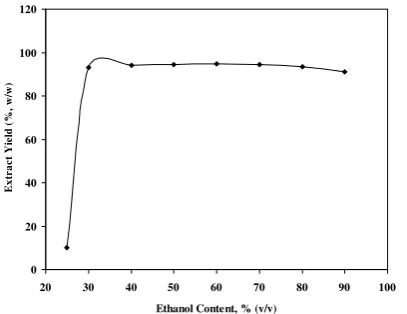
exudates when the ethanol content in the cashew exudates-water solution was very low (below 30%, v/v). Almost all of the gum can be extracted when ethanol was added into cashew exudates-water solution at 30%, v/v composition. However, further addition of ethanol did not increase the extraction yield significantly. Therefore, from economical and technical point of views, the addition of ethanol into cashew there was a structural similarity between cashew gum and Arabic gum (Paula et al., 2002).
Table 1. pH, Density and Viscosity of CTG and Arabic Gum
Parameters CTG Gum Arabic
pH 4.70 3.9 - 4.9 slightly in the range of 4.51 - 4.69 as compared to the original gum extract. On the other hand, the viscosity increased to the range of 4.67 - 9.63 Ns/m2. Starch thus acts as a binding agent since it increases the thickness of the gum when added to the gum solution. It can also be seen that the measured densities remain more or less constant
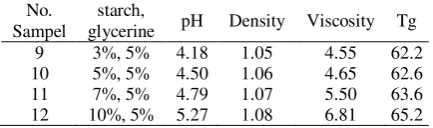
1990), and they also have satisfactory viscosities and Tg. In general, it was shown in the entire results that the increase in pH of the CTG lead to an increase in its viscosity, and the higher the quantity of the additive, the higher the pH and the higher the viscosity of the modified CTG. The pH of the CTG must be in such range so that the material to be dried will be highly soluble in water. While the viscosity and density of the modified CTG as a drying aid cannot be too high because it may reduce the flow ability of the solution and finally also will disturb the nozzle to spray the solution to be dried into the drying chamber. However, the Tg of the CTG should be high enough to enable the formation of coating film on the dried solid from the solution during heating and drying.
Tabel 4. Effect of combination of starch and glycerine addition to physical properties of CTG
No. exudates using ethanol as antisolvent and the use of additives improves substantially, the quality of the CTG. The good quality of modified CTG was obtained with viscosity, pH and Tg of 4.55 Ns/m2, 4.18 and 62.2oC, with the following composition of additives: starch 3% and 5 ml glycerine, and with viscosity, pH and Tg of 4.65 Ns/m2, 4.5 and 62.6oC with the following composition of additives: 5% starch and 5 ml glycerine.
Acknowledgement
The authors would like to express their gratitude to Directorate General of Higher Education, Ministry of National Education the Republic of Indonesia for its partial financial support through Competitive Research on National Priority Areas Grant 2009 Contract No. 517/SP2H/PP/DP2M/VII/2009.
References
Anderson, D.M.W., Bell, P.C. and Millar, R.A., 1974. Composition of Gum Exudates from Anarcadium occidentale, Phytochem., 13 (10), 2189-2193.
Anderson, D.M.W. and Wieping. W., 1990. Acacia gum exudates from Somalia and Tanzania; the Acacia senegal, complex. Biochem. Syst. & Ecol., 78, 413-418.
Awad, S., Chen, H., Chen, G., Gu, X., Lee, J. L., Abdel-Hady, E. E. and Jean, Y.C., 2011, Free Volumes, Glass Transitions, and Cross-Links in Zinc Oxide/Waterborne Polyurethane Nanocompo-sites, Macromolecules, 44 (1), 29–38
Bhandari, B.R., Datta, N., and Howes, T.,1997. Problems associated with spray drying of sugar-rich foods. Drying Technol., 15, 671– 684. Bhandari, B.R. and Hartel, R.W., 2005. Phase
transitions during food powder production and powder stability, in: Onwulata, C. (Eds.) Encapsulated and Powdered Foods (edited by C. Onwulata). Boca Raton, USA: Taylor & Francis, pp. 261–292.
Collares, F.P., Finzer, J.R. and Kieckbusch, T.G., 2004. Glass transition control of the detachment of food pastes dried over glass plates. J. Food Eng., 61, 261–267.
de Paula, R.C.M., Santana, S.A. and Rodrigues, J. F., 2001. Composition and rheological properties of Albizia lebbeck gum exudates. Carbohydr. Polym., 44, 133-139.
de Graaf, R. A., Andre P. Karman, A. P. and Janssen, L. P. B. M., 2003, Material Properties and Glass Transition Temperatures of Different Thermo-plastic Starches After Extrusion Processing, Starch/Stärke, 55, 80–86
Dolinsky, A, Maletskaya, K, Snezhkin, Y., 2000. Fruit and vegetable powders production technology on the bases of spray and convective drying methods. Drying Technol., 18, 747–758.
Galmarini, M.V., Zamora, M.C., Baby, R., Chirife, J., Mesina, V., 2008. Aromatic profiles of spray-dried encapsulated orange flavours: influence of matrix composition on the aroma retention evaluated by sensory analysis and electronic nose techniques. Int. J. Food Sci. & Technol., 43, 1569-1576. Glicksman M. and Sand RE., 1973. Industrial gums,
Polysaccharide and their derivative, Academic Press, New York. glycerol monostearate and tricalcium phosphate on vacuum dried mango powder properties. J. Food Eng., 63,125-134.
Madene, A., Jacquot, M., Scher, J., and Desobry, S., 2006. Flavour encapsulation and controlled release - a review. Int. J. Food Sci. Technol., 41, 1–21.
McNamee, B.F., O’Riordan, E. D., and O’Sullivan,
Mothe, C. G. and Rao, M. A, 2000, Thermal behavior of gum arabic in comparison with cashew gum, Thermochim. Acta. 357-358, 9-13
Owusu, J., Oldham, J.H., Oduro, I., Ellis, W.O., and Barimah, J., 2005. Viscosity studies of cashew gum. Tropic. Sci., 45, 86-89.
Paula, H.C.B., Gomes, F.J.S., and Paula, R.C.M. , 2002. Swelling studies of chitosan/cashew gum physical gels. Carbohydr. Polym., 48, 313-318. Silva, M.A., Sobral, P.J.A. and Kieckbusch, T.G.,
2006. State diagrams of freeze-dried camu–camu
(Myrciaria dubia (HBK) Mc Vaugh) pulp with and without maltodextrin addition. J. Food Eng., 77, 426-432.