ANALYZING THE EFFECT OF CELEBRITY ENDORSEMENT
AND BRAND CREDIBILITY ON BRAND LOYALTY
(A STUDY ON NIKE SHOES IN MANADO)
ANALISIS PENGARUH SELEBRITI PENDUKUNG DAN KREDIBILITAS MEREK
TERHADAP LOYALITAS MEREK (STUDI TERHADAP SEPATU NIKE DI MANADO)
Fritz Wijaya Loei, S.L.H.V Joyce Lapian, Johan Tumiwa
International Business Administration (IBA) Program, Economics and Business Faculty, University of Sam Ratulangi, Manado 95115, Indonesia
Email : [email protected]
ABSTRACT
Today, shoes became the important part of fashion. It is like the identity of people in daily life. Shoes has created a big opportunities for footwear company to getting high market share. In Indonesia, the competition in footwear industry is getting tight and variety. The study aims to analyze the effect of celebrity endorsement and brand credibility on brand loyalty of Nike Shoes in Manado. This research is causal type of research which uses primary data obtained through questionnaires and uses multiple regression analysis. 30 respondents/customers out of the population were surveyed as samples. The result shows celebrity endorsement has not partially affects on Brand Loyalty and brand credibility has partially affect on brand loyalty. Nike shoes company should more intensively and still use celebrity endorsement, even It’s has no significant effect to brand loyalty. Nike shoes company should keep improve their product.
Keywords: Celebrity Endorsement, Brand Credibility, Brand Loyalty
ABSTRAK
Dalam era ini, sepatu menjadi bagian penting dari fashion. Hal ini seperti identitas orang dalam kehidupan sehari-hari. Karena sepatu menjadi bagian penting dari fashion, itu membuat peluang besar bagi perusahaan sepatu untuk mendapatkan pangsa pasar yang tinggi. Sekarang di Indonesia, kompetisi di industri alas kaki semakin ketat dan berbagai. Tujuan dari penelitian ini adalah untuk menganalisis pengaruh dukungan selebriti dan kredibilitas merek terhadap loyalitas merek Sepatu Nike di Manado. Penelitian ini merupakan jenis kausal penelitian yang menggunakan data primer yang diperoleh melalui kuesioner dan menggunakan analisis regresi berganda. Populasi yang diamati adalah orang di Manado yang telah menggunakan sepatu Nike dengan 30 responden sebagai hasil sampel ukuran.Hasil dari penelitian ini menunjukkan bahwa dukungan selebriti belum mempengaruhi pada Brand Loyalty dan kredibilitas merek telah mempengaruhi loyalitas merek. Perusahaan sepatu Nike harus lebih intensif dan masih menggunakan dukungan selebriti, bahkan Ini tidak berpengaruh signifikan terhadap loyalitas merek. Tapi itu akan membuat keputusan pembelian pelanggan. Perusahaan sepatu nike harus menjaga meningkatkan produk mereka dan masih pengiriman apa memberikan apa yang telah mereka janjikan kepada pelanggan untuk peningkatan kredibilitas merek mereka.
1. INTRODUCTION
Background
In this era, shoes became the important part of fashion. It is like the identity of people in daily
life. Because shoes became the important part of fashion, it’s create a big opportunities for
footwear company to getting high market share. Now days in Indonesia, the Competition in footwear industry is getting tight and variety. It makes so much many shoes retail opened and developing. With that situation, the companies are trying to create a variety shoes and trying to adding new value on their product to keep their customer and getting new customer and of course to make them still survive in the market.
To getting new customers, it can cost five times more than the cost of to satisfy and retain existing customers.With various needs and desire of people, the companies are required for keep improve and try to create something new to fulfill what customer needs and wants. Footwear companies should create the identity of the brand through the quality of the product because now, brand and quality are important factor in competitive advantage. Company or brand like Nike, Adidas, Puma, New Balance, and Reebok are the company or Brand in sport shoes industry. Their brand has very good value and high quality, also their company still improved the product and adding new value in their product to fulfill needs and desired of customer. Because that company can fulfill customer needs and desired with good value and high quality, it makes them become success in their market.
Based on the data on Share Sportswear/Sporting Goods Companies Ranked by Worldwide
Revenue, Nike company is leading in market share from their competitor with 27,8%, while the
main competitors of Nike which is Adidas with 19,95%. Nowadays Nike is one of the most popular branding which is basically focused on the production of sport shoes, sports equipment and apparel. Especially for sport shoes, People wear the Nike shoes with pride, thinking what they are wearing will improve their own personal athletic goals, or simply boost their self confidence.
“People get awareness through media about the brands and they have become brand oriented. People also purchase the Nike brand because they relate it with so many of the athletes who Nike endorses. In sport shoes especially in foot ball, Nike used so many endorse like Neymar, Hazard, David Luiz, Ibrahimovic and etc. But also Nike use one of the famous football player and the successful one Cristiano Ronaldo as their endorsement. They are become celebrities with their high popularity. Nike try to used their popularity to promote the product through them. Celebrities act as spokes people in advertising to promote products and services
In Manado city, Nike shoes also become the popular one shoes. Everyone use Nike shoes with pride and confidence when they are used Nike shoes. But in other case, Adidas shoes also become their big competitor. The customer will be easy to change their purchase decision on Nike shoes to Adidas shoes, because Adidas shoes offer the same value and quality from their shoes to customer. So based on the background, this research will be conducted a title as follows: Analyzing the effect of celebrity endorsement and brand credibility on brand loyalty. A Study on Nike Shoes in Manado.
Research Objectives
Regarding the problems which have been formulated and identified that are mentioned in previous section, the following research objective are :
Theoritical Framework
Marketing
McDaniel, Lamb, and Hair (2011) argue that marketing is activity, set of institutions, and procesess for creating, comunicating, delivering , and exchanging offerings that have value for custumers, clients, partners, and society at large. They said marketing involves more than jus activities performed by a group of people in defined area or dapartement. According Kotler and Keller (2012) Marketing is about identifying and meeting human and social needs. Marketing is the one of the key to be success, because there are many theories that make the business growing and get the goal.
Brand
According to Kotler et al. (2011) “Brand is a name, term, sign, symbol, or design, or a
combination of these, that identifies the maker or seller of a product or service. Consumers view a brand as an important part of a product, and branding can add value to a product. Brand is linked to perceived quality by customer, this is a realization which shows total quality and is not based
on customer’s knowledge about detailed characteristics (Rahimi Helleri, 2009). Brand has
become so important that maybe nowadays, finding a product without brand is almost impossible. Brand can help customer by giving information about the quality of product; a customer who always buys a product with a certain brands knows well that these products will have characteristics, advantages, and specific qualities
Brand Loyalty
Brand loyalty is of paramount importance for marketers and consumer researchers (Aaker, 1991; Reichheld, 1996). In services context, many scholars focused on importance and significance of brand loyalty. Rowley (2005, p.574) concludes that there are four types of loyalty: captive, convenience-seekers, contented and committed. Captive customers prefer repeatedly purchasing the same product, service and brand because of lack of opportunities to substitute for alternatives. The organization that have pool of brand loyalists have greater market share and higher rates of return on investments, in turn
Customer Loyalty
According to Bloemer & Kasper (1995), loyalty is interpreted as true loyalty rather than repeat purchasing behavior, which is the actual re-buying of a brand, regardless of commitment. Zeithaml et al. (1996) states loyalty is a multi-dimensional construct and includes both positive and negative responses. However, a loyal customer may not necessarily be a satisfied customer. A loyal and contented customer base helps to increase the organizations relative bargaining power regarding suppliers, partners and channels
Brand Credebility
Brand credibility is a summary of long-term interaction between customers and suppliers of products, in aspect of brand service stability, which in turn, provides a more general concept, has
been long term, and generally explains satisfaction (Sweeney &Swait, 2012). Brand credibility’s
Celebrity Endorsement
Friedman and Friedman (1979) have defined a celebrity as “an individual who is known to the
public (actor, sport figure, entertainer, etc.) for his or her achievements in areas other than that of the product class endorsed. Celebrity endorsement itself is a channel of brand communication in
which a celebrity acts as the brand’s spokesperson and certifies the brand’s claim and position by
extending his/her personality, popularity, stature in the society or expertise in the field to the brand (Martin Roll, 2006). Celebrity endorser uses his fame to advertise a product which has no direct effect on his previous recognition.
Previous Research
Rajesh Sharma (2015) found that as per the empirical findings for luxury brands, celebrity endorsements do not help in improving the perceptions of quality and building brand loyalty. Kiran Sharma and Shashi Shekhar Kumar (2013) found that an assessment of current market situation has indicated that celebrity endorsements and advertising strategies if correctly blended
in terms of matching the strengths of the brands with the celebrity’s quality indeed justifies the
high cost associated with this form of advertising. However, advertising needs to be aware of the complex processing underlying celebrity endorsement by gaining clarity on described concepts of celebrity source, credibility and attractiveness, match-up hypothesis, multiple product endorsement etc. Arshad et. al. (2013) undo up a fresh argue for researchers and practitioners in the sense that credibility and perceived quality of a brand do not have a direct relationship with customer loyalty and that without involving credibility of the brand,superior levels of customer loyalty may not be achieved.
2. RESEARCH METHOD
Type of Research
This research type uses quantitative type of research or quantitative method based on Sugiyono (2013) defined as research method based on positivism paradigm that used to investigate spesific population or samples.
Place and Time of Research
This research will be conducted in Manado. The time of research started from June 2016.
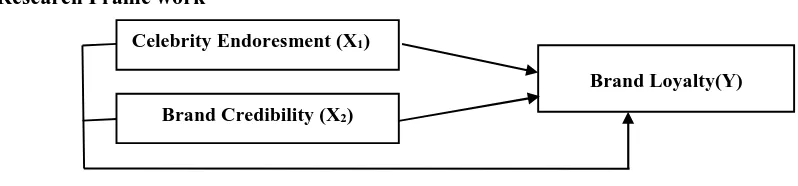
Research Frame work
Figure 1. Conceptual Framework Source Research Procedure, 2016 Population and Sample
Celebrity Endoresment (X1)
Brand Credibility (X2)
Multiple Regression Analysis Method
Cooper and Schindler (2001) stated that multiple regresion analysis is a technique to observed value more than X to estimate or predict coresponding Y value. The equation model of multiple regression analysis whisch used in this research can formulated as shown below :
Where:
Y : Customer Loyalty : Intercept
b1,b2 : The regresion coefficient of each variable x1 : Loyalty program membership card x2 : Customer experience
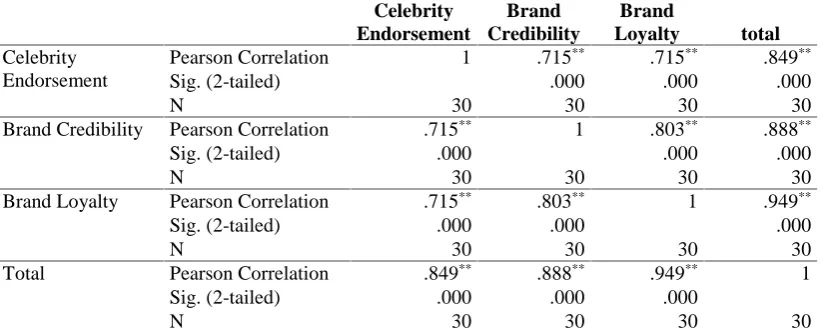
Pearson Correlation 1 .715** .715** .849**
Sig. (2-tailed) .000 .000 .000
N 30 30 30 30
Brand Credibility Pearson Correlation .715** 1 .803** .888**
Sig. (2-tailed) .000 .000 .000
N 30 30 30 30
Brand Loyalty Pearson Correlation .715** .803** 1 .949**
Sig. (2-tailed) .000 .000 .000
N 30 30 30 30
Total Pearson Correlation .849** .888** .949** 1
Sig. (2-tailed) .000 .000 .000
N 30 30 30 30
**. Correlation is significant at the 0.01 level (2-tailed).
Source: Data Processed, 2016
From the result in table 1 it can be seen that value of correlation index for relationship among variable independents (Celebrity Endorsement and Brand Credibility) with variable dependent ( Brand Loyalty ) are greater than 0.3 and below the significant level of 5% ( 0.05 ). The Correlation between Celebrity Endorsement (0.849) Brand Credibility (0.888) with Brand Loyalty (0,949) show a positive relationship. Therefore, the data is considered as valid.
Reliablity Result
Table 2 shows that Alpha Cronbach is 0.884 which is above the acceptance limit of 0.6; therefore the research instrument is reliable.
Multiple Regression Result
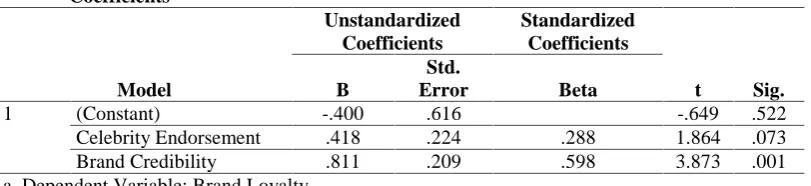
Table 3. Multiple Linear Regression result Coefficientsa
1 (Constant) -.400 .616 -.649 .522
Celebrity Endorsement .418 .224 .288 1.864 .073 Brand Credibility .811 .209 .598 3.873 .001 a. Dependent Variable: Brand Loyalty
Model Sum of Squares df Mean Square F Sig.
1 Regression 22.518 2 11.259 29.458 .000b
Residual 10.319 27 .382
Table 4 shows that F-count is 29.458 with level of significance 0.000. The calculated value of
Fcountis greater than the Ftable(29.458 > 3.35). It means that Hois rejected and Hais accepted. Sig
<0.05 means that the confidence of this prediction is above 95% and the probability of this prediction error is below 5% which is 0.000. The result declares that there is a simultaneously significant effect of celebrity endorsement (X1) and brand credibility (X2) on brand loyalty (Y).
T-test
1 (Constant) -.400 .616 -.649 .522
Celebrity Endorsement .418 .224 .288 1.864 .073 Brand Credibility .811 .209 .598 3.873 .001 a. Dependent Variable: Brand Loyalty
Source: SPSS output (2016)
Ttable = Tinv ( 0.05, n-k) = Tinv ( 0.05, 30-3) = 2.052
1. T-count of X1is 1.864 with the level of significance of 0.073. If the value of tcount= 1.864
< tα (0.05)= 2.052 meaning that Hois accepted and Hais rejected. And Sig > 0.05 it means
the result of this test declares that there is no partially significant effect of celebrity endorsement (X1) on brand loyalty (Y).
2. T-count for X2is 3.873 with the level of significance of 0.000. Since the value of tcount=
is below 5% which is 0.000. The result of this test declares that there is a partially significant effect of brand credibility (X2) on brand loyalty (Y).
Discussion
Celebrity Endorsement on Brand Loyalty
The result of multiple regression analysis shows that there is no significant effect of Celebrity Endorsement on Brand Loyalty, study case of Nike shoes in Manado. Based on the coefficient result in Multiple Linear Regression Analysis, the significant of Celebrity Endorsement is 0,73 which above than 0,05, so the Celebrity Endorsement (X1) has no significant effect on Brand Loyalty (Y). This result is supported by previous research conducted by Uttera and Ankita (2015) which is there is no significant effect celebrity endorsement on brand loyalty. Based on the research of questionnaire, the respondents who are the customer of Nike shoes in Manado mostly disagree that celebrity endorsement affect the brand loyalty on Nike shoes. No one can deny that the celebrity is increasing the awareness of the brand and the remembrance of its characteristics
but that doesn’t ensure brand loyalty. It is important to choose the suitable celebrity to present the
brand but it more important to focus on the quality of the brand. With the increase of awareness of customers, the celebrity is only playing an important role to draw attention to the brand. However if the quality is not as presented the credibility of the brand as well as the celebrity will be endangered.
Brand Credibility on Brand Loyalty
The result of multiple regression analysis shows that there is a significant effect of Brand Credibility on Brand Loyalty, study case of Nike shoes in Manado. Based on the coefficient result in Multiple Linear Regression Analysis, the significant of Brand Credibility is 0,01 which below than 0,05, so the Brand Credibility (X1) has a significant effect on Brand Loyalty (Y). This result is supported by previous research conducted by Shahram, et al. (2012) which is there is a significant effect brand credibility on brand loyalty. Based on the research of questionnaire, the respondents who are the customer of Nike shoes in Manado mostly agree that brand credibility affect the brand loyalty on Nike shoes. Sweeney and Swait (2008) showed that loyalty and brand credibility relationship is affected by satisfaction, and brand credibility influences satisfaction directly. Brand credibility also influences affective commitment directly. When the brand can create satisfaction to customer, itleads to brand credibility and it’s create commitment to customer which is brand loyalty. That’s why brand credibility has a significant role to play in managing
brand loyalty.
4. CONCLUSION AND RECOMMENDATION
Conclusion
After examining the findings and discussing the result, three conclusions can be formulated: 1. The independent variables which are celebrity endorsement and brand credibility not
simultaneously influence brand loyalty as the dependent variable. Because there is one independent variable which is celebrity endorsement has no partially significant effect on brand loyalty as dependent variable.
2. Celebrity Endorsement as one of independent variables in this research has no partially affects on Brand Loyalty.
Recommendation
By looking in the discussion and the result of the research, some recommendation has been made as listed below:
1. Nike shoes company should more intensively and still usecelebrity endorsement, even It’s
has no significant effect to brand loyalty. But it will be create purchase decision of customer.
2. Nike shoes company should keep improve their product and still delivery what deliver what they have promised to customer for increase credibility of their brand.
3. Keep building and maintaining the value of a reputable brand name, because it is one of the ways of increasing brand loyalty.
4. Create more simple and the effectiveness Nike advertising with celebrity endorsement, to increase the sales of Nike shoes
REFERENCES
Papers in Jounals
[1] Arshad, R., Idrees, A., Abdul, M., Urooj, S., Hafsa, Z., Waheed, N., Shoaib, A. A. (2013) Impact of Brand Switching, Brand Credibility, Customer Satisfaction and Service Quality on Brand Loyalty. IOSR Journal of Business and Management.
[2] Bloemer, J.M.M., and Kasper, H.D.P. 1995. The complex relationship between consumer satisfaction and brand loyalty. Journal of Economic Psychology, 16, 311-329.
[3] Friedman, H. H., & Friedman, L. (1979). Endorser Effectiveness by Product Type. Journal of Advertising Research, 19(5), 67-71.
[4] Kiran, S., & Shashi, S. K. (2013) Celebrity Endorsement in Advertising; Can It Lead to Brand Loyalty in The Long Run? International Journal of Marketing, Financial Services &
Management Research Vol.2, No. 3.
[5] Rahimi Helleri, Mohammad, Abolfazli, Abolfazl and Hosseini, Seid Mohammad., 2009.
“Investigating the effect of Brand Equity on Consumers (A case study: Iranol Brand) “, a
view of commercial management, 32: 9-28.
[6] Rajesh Sharma (2015). “Effect of Celebrity Endorsement on Brand Quality Perceptions &
Brand Loyalty–A Comparative Study of Luxury & Non Luxury Brands in India. AIMA
Journal of Management & Research, Volume 9.
[7] Sweeney, J., & Swait, J. (2008). The effects of brand credibility on customer loyalty. Journal of Retailing and Consumer Services, 15, 179–193.
[8] Zeithaml, V., Berry, L., Parasuraman, A., 1996. The Behavioral Consequences of Service Quality. Journal of Marketing 60 (2), 31-46.
Books
[9] Aaker, D.A. (1991). Managing brand equity. Free Press New York, NY, 7-110.
[10] Cooper, D. R., and Schindler, P. S. 2001. Business Research Methods.McGrew-Hill Companies. New York
[11]Kotler, P., Gary, A., Swee, H.A., Siew, M.L., Chin, T.T., Oliver, Y.H.M (2011). “Principle of Marketing An Asian Perspective”.
[12] Martin Roll (2006). Asian Brand Strategy: How Asia Builds Strong Brands, Palgrave Macmillan.
[13] McDaniel. C. D., Lamb, C.W., & Hair ,.F. 2011. Introduction To Marketing . 11th Edition.South-Western. Cengage Learning, International Edition, China.
[14] Rowley, Jennifer. (2005). The four Cs of customer loyalty. [Database] Marketing