®
Toward Transcultural Training
in Phonological Processes
for Bantu Language Mother
Tongue Translators
2012 SIL International®
ISBN: 978-1-55671-306-4 ISSN: 1934-2470
! " "
# $ # $ " %
"" " & $
$ #
Series Editor
Mike Cahill
Managing Editor
IN PHONOLOGICAL PROCESSES FOR BANTU LANGUAGE MOTHER TONGUE TRANSLATORS
By
William Lorin Gardner
A Dissertation Presented to the
Faculty of the School of Intercultural Studies FULLER THEOLOGICAL SEMINARY
In Partial Fulfillment of the Requirements for the Degree
Doctor of Philosophy
ii Gardner, William Lorin
2010 ―Toward Transcultural Training in Phonological Processes for Bantu Language Mother Tongue Translators.‖ Fuller Theological Seminary, School of Intercultural Studies. Ph.D. 300 pp.
Hundreds of languages in Africa are still unwritten or do not yet have Biblical literature translated into them. Many of these belong to the linguistically similar family of Bantu languages which covers most of central, eastern and southern Africa. To help meet this need, translation degree programs for training Africans in linguistics have been developed in several countries across Africa. However, these programs have largely been adapted from Western training programs. For many African students, this formal training has not adequately prepared them for working in their own languages, in particular in analyzing and representing orthographically phonological processes, especially those which neutralize the distinctions between sounds.
The purpose of this study is to develop a new model, to help improve training for Africans in analyzing sound systems and developing writing systems for Bantu languages. The goal is to facilitate the training process and improve the quality of mother tongue Bible translation and literacy, particularly in Bantu languages.
The central research issue addressed in this study is to determine how to adjust existing theory in order to develop new contextual approaches to intercultural training in phonological processes for Bantu language mother tongue translators.
iii
Building upon this background research, I designed and conducted three case studies of translation degree programs in two Anglophone African countries, using several methodologies, including focus groups, archival research, participant observation and ethnographic interviews.
The findings of these case studies indicate there is a need for more than just revising the present programs. Instead, because of significant cultural differences in dominant learning styles and preferred trainer-student relationships, as well as the distinct needs of those who study their own languages as insiders rather than as outsiders, there needs to be a new contextualized translation of the training program—transcultural training—in order to more effectively prepare Bantu language speakers for their contribution to mother tongue Bible translation, literacy and Scripture use.
iv
To all who work to make the translated Word of God more available and more understandable,
v
To the many people who have faithfully supported me in so many ways while I have
been in my doctoral studies, I extend a big thank you.
I wish to first thank my committee members—Judith Lingenfelter, Brian O‘Herin and my supervisor Daniel Shaw—who have all encouraged me to pursue excellence and inspired me by their own examples. And a special thanks to Sherwood Lingenfelter and again Daniel
Shaw who both encouraged me initially to apply to the Fuller doctoral program.
I am grateful to SIL Africa Area and SIL International, for their generous financial
support for my research, including the Kenneth Pike Endowment Fund‘s sponsorship for my travel to northern Nigeria for the TCNN case study. I also wish to thank ―Partners in
Translation‖ and the ―Global Studies Award‖ donors to Fuller‘s School of Intercultural
Studies (SIS), who covered much of my tuition costs.
I also appreciate the many SIL colleagues have encouraged and assisted me in many
ways in the process of my research. And I thank my fellow SIS doctoral students who have
walked alongside me on this path.
Thanks also to my sons, Jonathan and Michael, who encouraged me to keep running
when I sometimes felt like quitting this marathon race.
Finally, I wish to express a special thanks to my wife and life partner Lori, who,
besides being extra patient with and encouraging me these past five years, spent many long
hours transcribing, from audio and video recordings, all of the focus group interviews and a
key individual interview. She is the marathon runner who most inspires me to keep
vi
ABSTRACT ... ii
DEDICATION ... iv
ACKNOWLEDGEMENTS ...v
TABLE OF CONTENTS ... vi
LIST OF TABLES ...xv
LIST OF FIGURES ... xvi
LIST OF MAPS ... xvii
LIST OF ABBREVIATIONS ... xviii
INTRODUCTION ...1
Background ...3
Purpose ...5
Goal ...5
Significance...5
Central Research Issue and Research Questions ...6
Delimitations and Scope ...6
Definitions...7
Bantu Languages ...7
Morphology...9
Phonology ...9
Orthography Development...9
Mother Tongue Translators...9
Intercultural Training of Adults ...10
Assumptions ...10
Overview ...10
PART I THEORETICAL FOUNDATIONS ...12
CHAPTER 1 LINGUISTIC FOUNDATIONS AND BANTU LANGUAGES ..13
Bantu Languages ...13
viii
CHAPTER 2 INTERCULTURAL TRAINING AND MOTHER TONGUE TRANSLATORS ...54
Summary of Learning Styles and Training Roles ...65
Intelligence(s) ...66
Ward‘s Six Levels in Adapting Materials ...74
Shaw‘s Transcultural Factor ...75
Summary of Intercultural Training of Adults ...76
Mother Tongue Scripture Programs ...77
A Brief History of Bible Translation ...77
ix
PART II RESEARCH AND FINDINGS FROM THREE CASE STUDIES ...89
CHAPTER 3 METHODOLOGY ...90
Rationale for Using the Case Study Approach ...93
Criteria for Case Study Selection ...93
CHAPTER 4 CASE STUDY 1: PAN AFRICA CHRISTIAN UNIVERSITY ..101
x
xi
xii
Comparison of Repeated Key Factors and Indicators ...161
Similarities ...161
PART III MODEL DEVELOPMENT AND ITS IMPLICATIONS FOR TRAINING MOTHER TONGUE TRANSLATORS ...168
CHAPTER 8 DEVELOPING MY THEORETICAL MODEL ...169
Reliability and Validity ...170
CHAPTER 9 IMPLICATIONS FOR LINGUISTICS TRAINING FOR BANTU MOTHER TONGUE TRANSLATORS...183
General Issues ...183
Morphology...185
Phonology ...186
xiii
APPENDIX A NOMINAL PREFIXES FOR SELECTED BANTU LANGUAGES ...202
APPENDIX B NOUN CLASS PREFIXES FOR NDAU (S15) ...203
APPENDIX C AFRICAN STUDENTS‘ LEARNING STYLES ...204
Preferences of Field-dependent and Field-independent Students ...204
Field-dependent (Global/Relational) Students ...204
Field-independent (Analytical) Students ...205
Suggestions for More Effectively Teaching Relational Learning Style African Students...205
APPENDIX D COURSE LEARNING OBJECTIVES RECOMMENDED BY SIL INTERNATIONAL ...206
For Articulatory Phonetics ...206
For Introduction to Phonology ...207
For Morphology and Syntax ...208
For Literacy Principles (Including Orthography) ...209
APPENDIX E CASE STUDY INTERVIEW GUIDES ...210
Student Ethnographic Interview Guide ...211
Student Focus Group Interview Guide ...214
Trainer Ethnographic Interview Guide ...216
Supplementary Guide for Developers of Original Curriculum ...219
APPENDIX F FOCUS GROUPS ...220
PAC Former Student Focus Group Transcription ...221
NEGST Student Focus Group Transcription ...234
TCNN Practicum Student Focus Group Transcription ...255
xiv
APPENDIX G TRAINING PROGRAMS ...280
Discover Program ...280
Outline of Global Phonology ...281
A. Phonemics Lecture Notes...281
B. Generative Phonology Lecture Notes ...281
C. Tone and Suprasegmentals ...281
Excerpts from Contents of Bantu Orthography Manual ...282
Part 1: Bantu Orthography Manual ...282
Part 2: A Participatory Approach to Orthography Development: Procedural Guide ...283
xv
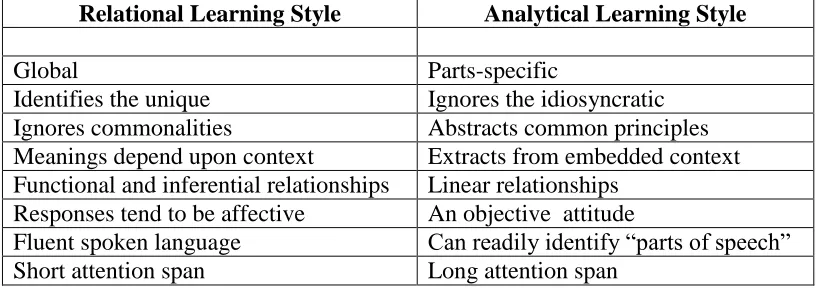
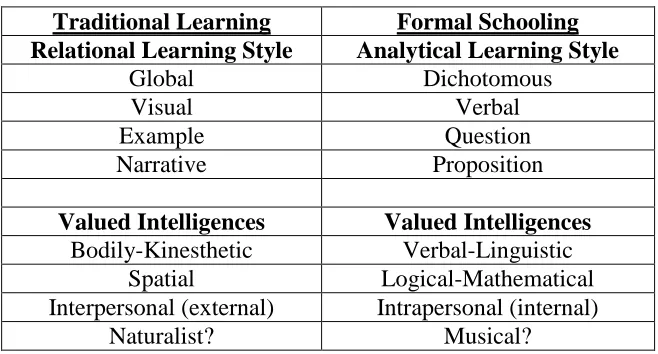
TABLE 1 ANALYTICAL AND RELATIONAL LEARNING STYLES ...56
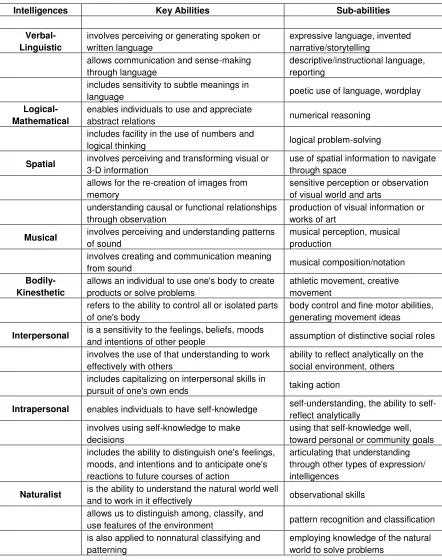
TABLE 2 MULTIPLE INTELLIGENCES AND KEY ABILITIES ...67
TABLE 3 LEARNING STYLES AND THE INTELLIGENCES VALUED ...71
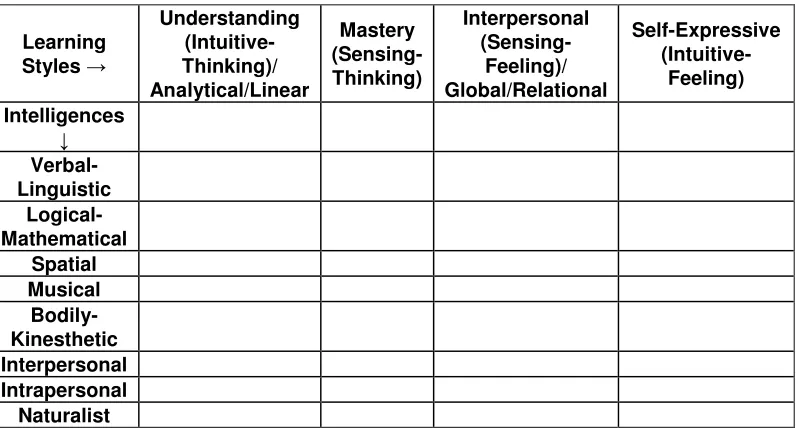
TABLE 4 LEARNING STYLES-MULTIPLE INTELLIGENCES MATRIX ...73
TABLE 5 SIX LEVELS IN ADAPTING INSTRUCTIONAL MATERIAL ...74
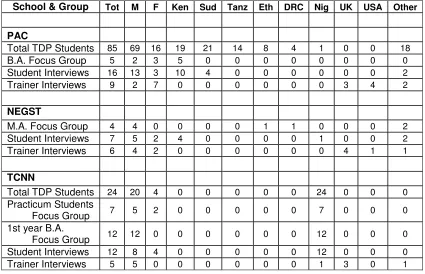
TABLE 6 SUMMARY OF CASE STUDY PARTICIPANTS ...155
xvi
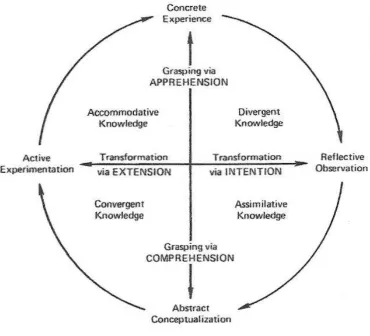
FIGURE 1 KOLB‘S LEARNING CYCLE AND LEARNING STYLES ...58
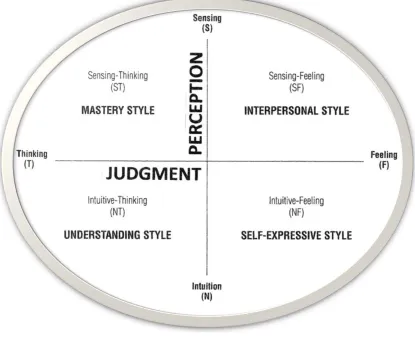
FIGURE 2 JUNG‘S LEARNING STYLES ...59
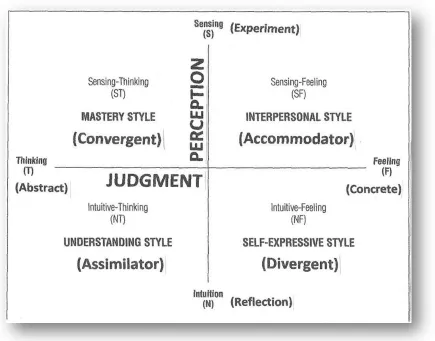
FIGURE 3 KOLB‘S AND JUNG‘S LEARNING STYLES ...61
FIGURE 4 RELATIONSHIPS BETWEEN AREAS AND FACTORS ...176
xvii
xviii
ALF Applied Language Fieldwork (Grammar Project)
ATR Advanced Tongue Root
AV Augment Vowel
BI Bantu Initiative
BOM Bantu Orthography Manual
BTA Bible Translation Association (Papua New Guinea)
BTL Bible Translation and Literacy (Kenya)
C Consonant
CADA Computer-Aided Dialect Adaptation
CAPRO Calvary Ministries
CARLA Computer-Aided Related Language Adaptation
CAUS Causative
CHE Council for Higher Education (Kenya)
CX (C6) Marker for Noun Class X (such as Noun Class 6)
DTL Découvre Ta Langue (Discover Your Language)
ETP European Training Program
F Female
FATEAC Faculté de Théologie Evangélique de l'Alliance Chrétienne
FV Final Vowel, which generally indicates Mood
G Glide
xix
H High Tone
IA Item-and-Arrangement
ICAL Introductory Course for Applied Linguistics (Nigeria)
i-DELTA Institute for the Development of Languages and Translation in Africa
INF Infinitive
IP Item-and-Process
IQ Intelligence Quotient
L Low Tone
M Male
MI Multiple Intelligences
MT Mother Tongue
MTT Mother Tongue Translator
N Nasal
NBTO National Bible Translation Organization
NBTT Nigeria Bible Translation Trust
NEG Negative
NEGST Nairobi Evangelical Graduate School of Theology
NF Intuitive-Feeling (Self-Expressive)
NT Intuitive-Thinking (Understanding)
OAM Object Agreement Marker
PABTEN Partnership for Bible Translation and Evangelism in Nigeria
PAC Pan Africa Christian University
PL Plural
xx PTEST Bantu Phonology Tool
Q Question
RT Relevance Theory
SAM Subject Agreement Marker
SAT Scholastic Aptitude (or Assessment) Test
SF Sensing-Feeling (Interpersonal)
SG Singular
SIL SIL International (formerly Summer Institute of Linguistics)
SIS School of Intercultural Studies, at Fuller Theological Seminary
ST Sensing-Thinking (Mastery)
TA1,TA2 One or more prefixes indicating Tense and/or Aspect
TAP Translation Association of the Philippines
TCNN Theological College of Northern Nigeria
TDP Translation Degree Program
UBS United Bible Societies
UTB Uganda-Tanzania Branch of SIL
V Vowel
V:, VV Long Vowel
VHH Vowel Height Harmony
1
INTRODUCTION
―Is something wrong with Africa?‖ Although not politically correct, this question
is often posed, whether aloud or not. It seems that in so many domains, whether political, economic, medical or educational, Africa is plagued with overwhelming problems that it does not seem able to overcome. Two former Peace Corps workers believe that unless Africa changes some of its traditions, most development programs will not succeed there (Kohanski and Marcucci 2007:49). An African journalist ponders why African countries struggle to find good leaders (Onyango-Obbo 2007). In Kenya, my own students confirm that grade twelve students celebrate their school-leaving exams by burning their books and notebooks, which they no longer need. It seems that something is desperately wrong, but what is it?
Although many factors contribute to these problems, not the least of which are the lasting effects of colonization, one major factor involves the process of translation. I am not referring here to the translation of a particular book or text, such as the Bible, into local or national languages, which is a challenging enough task to do well. Instead, there
has been a failure to ―translate‖ well, into the African context(s), various Western
political, economic, religious and educational institutions. Whether in the case of democracy, capitalism (or socialism), Christianity or formal instruction, structures developed in Western contexts have been brought to Africa, but not always with their intended meanings and functions.
intended ―representational‖ government. Similarly, whether the official economic policy
has been socialism or capitalism, it often primarily benefits a very small group.
In the realm of formal education, a similar problem exists. Many countries have systems based on the colonial French or British systems or the American (8-4-4) model, from which a relatively small percentage of students successfully graduate. Again, many crucial factors are involved, including, among others, the language(s) of instruction, teacher training, economic challenges, war and drought. However, based on my own experience and observation as well as that of others, in many cases the Western structures of formal education have been maintained but not always their intended functions.
This includes formal training programs that have been established to train Africans for the tasks involved in mother tongue Bible translation, literacy and Scripture use. Although a significant number of students have excelled academically, a greater number struggle, in particular with some of the more analytical subjects such as phonology and semantics, and quite a few students never seem to quite ―get it.‖
The question may arise: ―Is the problem with the African students themselves, or with their cultures?‖ Or, instead, is the problem with how and/or what they are being taught? I believe the answer to this second question is affirmative. Many of the problems with these formal training programs arise primarily from issues of methodology and content, and this study describes how the training can be made more effective.
Background
Vision 2025 expresses the desire of Wycliffe Bible Translators, together with partner organizations worldwide, ―To see a Bible translation program in progress in every language still needing one by the year 2025‖ (Wycliffe-USA 2006). However, literally thousands of languages in the world still remain that do not yet have any of God‘s Word, up to 1,000 of them in Africa. New paradigms, strategies, models and tools are essential in order to fulfill Vision 2025.
I have lived and worked for fifteen years in three African countries (Congo-Brazzaville, Mozambique and Kenya) where most peoples speak one or more Bantu languages1. Thousands of years ago the speakers of the ancestral Bantu language started
migrating from the area between Cameroon and Nigeria, toward the east and south of Africa. The resulting languages have maintained a very close linguistic relationship.
Of the over 500 Bantu languages spoken today throughout eastern, central and southern Africa, just under half (246) have at least part of the Bible translated into them (Duerksen 2006:1). Translation programs are now in progress in many of them, but about fifteen million Bantu language speakers still do not yet have adequate access to
God‘s Word in their own language (2006:1).
I have led surveys of Bantu languages in northeast Congo-Brazzaville (in French) and central Mozambique (in Portuguese) and been the Survey coordinator for SIL in Mozambique. In cooperation with the Ministry of Education in Mozambique, I have contributed to the development of orthographies and primers in several Bantu languages, and, as the SIL Mozambique coordinator for Linguistics and Literacy, I have assisted others in studying the phonologies of and developing orthographies for Bantu languages. I have taught university-level linguistics and translation courses in Mozambique (in Portuguese) and in Kenya (in English), mostly to mother tongue speakers of Bantu
languages, and twice led the phonology and orthography components in Bantu orientation courses for new SIL language teams in Mozambique.
Derek Fivaz, Roger VanOtterloo and many others believe that the close similarities between neighboring Bantu languages, especially in their semantic, grammatical and sound systems, should be leveraged to improve and accelerate Bible translations in other Bantu languages. Therefore, the Bantu Initiative (BI) began with a symposium in Ruiru, Kenya, in February 2000, in which I participated. Since then, I also assisted working groups in the development of tools for phonology and orthography.
The motivation for the BI from the beginning until now has been the desire to effectively meet the overwhelming need for Bible translation that remains among the Bantu languages. Through coordinated efforts and the development of new tools, strategies and models, mother tongue Bible translation efforts in the Bantu languages can be multiplied and done better, and hopefully also more quickly.
My personal desire is to contribute to this initiative, specifically through better training, in order to facilitate, accelerate and improve the analysis and description of sound systems and the development of orthographies in Bantu languages. In my personal experience and in working with others, certain kinds of phonological processes (sound changes within words) provide the greatest challenge for analysis, description and representation in the orthography (writing system). A good orthography is also essential for a language program, both for the translation process to proceed and for the long-term effectiveness and impact of mother tongue literacy and Scripture use.
Methods of training in Africa, especially formal training, are often not culturally appropriate, but instead are usually based on Western-style training programs, and thus are less effective than they could be.
languages, were unclear about the difference between complementary distribution2, free
variation3 and contrast4 in identical (or analogous) environments: this indicated that some
fundamental principles about phonology had not been learned by these students, although they had spent over four years studying linguistics in preparation for working in Bantu languages.
Therefore, in this study I have sought to research the analysis and representation of sound processes that occur in Bantu language, key principles of intercultural training, their interaction and their impact on mother tongue Scripture programs.
Purpose
The purpose of this study is to develop new approaches to improve training for analyzing sound systems and developing writing systems for Bantu languages.
Goal
The goal of this study is to facilitate and accelerate the training process and improve the quality of mother tongue Bible translation and literacy in Bantu languages.
Significance
This study will contribute to my own ministry, the ministry of missionary linguists within my own organization and also to missiology in general. Personally, this research will impact my new role as the Anglophone Director for SIL-Africa Area‘s i-DELTA (Institute for the Development of Languages and Translation in Africa).
2 Distribution of two or more sounds where the context in which one sound appears is the
complement of the context in which the other sounds appear (Odden 2005:334). 3 A pair of pronunciations, either of which may be used (Odden 2005:334).
4 Sounds contrast if they can form the sole difference between different words in a language
Contextually, this research will make a contribution to a significant paradigm shift for my own organization (SIL) in Africa, especially among the Bantu languages, and could also contribute to new strategies for Bible translation work among language groups both in and beyond Africa.
Missionally, this research will contribute to significant growth in Scripture use and Scripture impact in African churches, with more language groups having better and quicker access to God‘s Word.
Central Research Issue and Research Questions
The central research issue to be addressed in this study is to determine how to adjust existing theory in order to develop new contextual approaches to intercultural training in phonological processes for Bantu language mother tongue translators.
In order to research this topic, I utilized the following research questions:
1. What phonological processes occur, in Bantu languages in particular, and how are they best analyzed and represented?
2. Which key principles for intercultural training are most relevant for Scripture programs in Bantu languages?
3. How does the intercultural training in phonology impact mother tongue Scripture programs, in African languages?
4. What training methods and content in phonological processes are needed to enable more effective mother tongue translation in Bantu languages?
Delimitations and Scope
In this research, I focus on Bantu languages in Africa, especially eastern, southern and central (but not northwestern) Bantu languages.
not doing phonological analysis nor developing orthographies for any particular language, but rather, gathering data from case studies of formal training programs in linguistics for mother tongue speakers of African languages, in order to assist in future training for the study and development of written literature in yet unstudied Bantu languages.
My research focuses on formal degree-level training programs for adults in two Anglophone countries in Africa (Kenya and Nigeria). Therefore, I am not addressing nonformal or informal training, nor the training of children. I am also not looking at training programs in African countries where the language of instruction is not English.
Definitions
I define here some key concepts that are central to answering the research questions in order to realize my purpose and reach my goal. Other terms are defined in the glossary as needed.
Bantu Languages
MAP 1
THE BANTU LANGUAGES OF AFRICA
Morphology
Morphology is ―the branch of linguistics that deals with words, their internal structure, and how they are formed‖ (Aronoff and Fudeman 2005:1-2). A key concept
for morphology is the morpheme, which is a ―word or a meaningful piece of a word that cannot be divided into smaller meaningful parts‖ (2005:239).
Morphology is distinct from syntax, which is ―[t]he branch of linguistics that
deals with sentence formation‖ (Aronoff and Fudeman 2005:242), and also from the
discourse analysis of larger units such as paragraphs and texts. Grammatical analysis, or grammar, generally includes morphology, syntax and discourse analysis.
Phonology
Phonology is ―the study of sound structure in language‖ (Odden 2005:2). It deals
with phonemes (the sounds which are distinctive within a particular language), sound systems and sound processes, including those that occur when morphemes (meaningful parts of words) come together. It also includes tonology, which is the study of distinctive tones and tonal processes.
Orthography Development
This refers to the development of writing systems for languages, which includes, for alphabetic orthographies, symbols for all of the distinctive sounds (phonemes) as well as for distinctive tone and stress, along with rules for word division and punctuation.
Mother Tongue Translators
Intercultural Training of Adults
By this I refer to the training of adults that takes place across cultures, that is, when the trainer(s) and trainee(s) are from different cultures.
Assumptions
I have made several assumptions that I am not testing in this research. For instance, I assume that the urgency of developing a writing system and written literature for the hundreds of Bantu languages that are still without any of God‘s Word requires that new strategies be developed for studying and describing them more quickly and in greater numbers, and that such strategies do not have to sacrifice the quality of work, but may in fact enhance it.
I assume that although a people group may be evangelized through a trade or national language that they understand to a certain degree (such as English, French, Portuguese, Arabic or Swahili), in order for them as individuals and churches to grow and mature as disciples, it is essential that they have access to God‘s Word in a language they speak and understand very well, which is usually their mother tongue.
I assume that a translation of the Scriptures is not an adequate end in and of itself,
but rather a means to the end of people being able to study, understand and apply God‘s
Word to their individual and corporate lives as growing disciples.
I also assume that my findings in the three case studies are reflective of Bantu speakers and African students in general.
Overview
precedent literature that are key to my research: first on linguistic foundations and Bantu languages in Chapter 1, and then on the intercultural training of MTTs in Chapter 2.
In the second part, on Research and Findings, in Chapter 3, I present the research methodologies I used for this research, especially case study methodology, and then present in Chapters 4, 5 and 6, the results and findings from three case studies of training degree programs, followed in Chapter 7 by Cross-Case Comparisons.
PART I
THEORETICAL FOUNDATIONS
13
CHAPTER 1
LINGUISTIC FOUNDATIONS AND BANTU LANGUAGES
I begin with a brief introduction to Bantu languages, and then discuss some key concepts from the precedent literature regarding morphology, phonology and orthography development, and their interaction with Bantu languages. Each of these topics is vast, with many books written on each one, so by necessity I am only considering those concepts most relevant for understanding, describing and representing phonological processes in Bantu languages, especially ones that result in neutralization of the distinction between phonemes.
Bantu Languages
Scholars generally believe that Bantu languages descended from a Niger-Congo language located near the Cameroon/Nigeria border about 5,000 years ago that spread eastward and southward over several millennia, resulting in the over 500 distinct language varieties today (Nurse and Philippson 2003:5). In this section I discuss several key texts, Bantu language classification and the distinctive characteristics of Bantu languages.
Key Texts on Bantu Languages
Nurse and Phillipson (2003) provides an excellent description of Bantu languages in two parts: (1) a comparative overview of linguistic characteristics shared by Bantu languages, including their sounds and sound systems, tone, tense, aspect, morphology, syntax and other topics; and (2) more in-depth descriptions of various Bantu subgroups and/or individual Bantu languages. Although this resource is primarily comparative and descriptive, it provides a great amount of data that can be used in the development and testing of more theoretical perspectives.
Hombert and Hyman (1999), as its sub-title (Theoretical and Empirical
Perspectives) indicates, both provides description and deals with some theoretical issues relating to Bantu languages. In particular, the second and third sections deal with several phonological and morphological issues regarding Bantu languages, including: vowel harmony1, vowel systems, Katupha‘s Law (of de-aspiration), and tense and aspect.
In the preface, the editors note that there has been much ―historical and
comparative work on Bantu languages‖ (Hombert and Hyman 1999:vii), but not so much
theoretical work. This has begun to change, for example in Autosegmental Phonology‘s
analysis of tonal processes and ATR2 harmony in Bantu languages, but there still remains
much to be done.
Maho (1999) is a primarily ―typological study of Bantu noun class (grammatical
gender) systems‖ (1999:iii). As such, it is primarily descriptive and comparative, but a
rich source of language data, particularly regarding noun and noun phrase morphology.
1 Vowel harmony is a phonological process by which one vowel in a word exerts an influence
(such as rounding or raising) on other vowels (Aronoff and Fudeman 2005:243).
2 Advanced Tongue Root (ATR) is a feature characterizing phonemes which are produced by
Bantu Language Classification
Although several people have been associated with classifying Bantu languages, including more recently Christopher Ehret (1999) and Derek Nurse and Gérard Philippson (2003). Malcolm Guthrie‘s (1948, 1971) system for referring to Bantu languages has stood the test of time and remains the standard.
M. Guthrie labeled Bantu languages zones by beginning with A in the upper Northwest, at the Nigeria/Cameroon border, and heading east to Tanzania, up to G. Then he started over in the west, on the border of Congo and Angola. and headed east toward northern Mozambique, labeling zones H, K, M, N, and P. Once more, he started in the west, near the border of Angola and Namibia, and headed toward southeastern Africa, labeling zones R and S (Maho 1999:27). Later, Meeussen created Group J, the Interlacustrine languages, out of the eastern part of D and western part of E (Bastin 2003:502), because of their many shared characteristics.
Each of these fifteen zones is further divided into sub-zones of language groups, indicated by tens, for example S10 (Shona), S20 (Venda) and S30 (Sotho-Tswana). The second digit subdivides the language groups into separate languages, for example, for the Ngundi (C10) group: C11 (Ngondi), C14 (Bomitaba), and C16 (Lobala). Finally, some of the languages have distinct dialects indicated by letters, such as for Swahili: G42a, G42b and G42c.
Distinctive Characteristics of Bantu Languages
As diverse as modern Bantu languages are, they are marked by several distinctive characteristics, especially: (1) agglutinative3 morphology, both verbal and nominal; (2) a
highly developed noun class system, with prefixes indicating concord in the noun phrase
3 In agglutinative languages, most words are composed of two or more clearly identifiable
and subject (and usually object) agreement4 on the verb; (3) symmetrical vowel systems,
with five or seven vowels (or occasionally nine); (4) two sets of oral stops (usually voiceless and voiced or aspirated and unaspirated), and nasal stops plus pre-nasalized voiced (and often voiceless) stops, all usually at four distinct points of articulation; and (5) almost always having only open syllables5.
In the following sections, I discuss these characteristics and other key concepts relevant to the analysis and representation of phonological processes in Bantu languages. Many of the greatest challenges, both in phonological analysis and in orthographic representation, arise in situations where the distinction between two phonemes in a particular language is ―neutralized‖ in certain contexts. Therefore, I focus primarily on phonological processes which result in such neutralization.
Morphology
Morphology is the study of how words are formed from meaningful units that are called morphemes. Since in Bantu languages most words include two or more morphemes, morphology is an essential linguistic domain to consider when analyzing and describing Bantu languages.
Basic Morphological Concepts
In this section, I discuss some key morphological concepts, including: morphemes and allomorphs, roots and affixes, nominal morphology, verbal morphology, and clitics6.
4 Agreement is the process by which one lexical category is inflected to express the properties of
another, such as a verb bearing person and number morphology that reflect those of the subject (Aronoff and Fudeman 2005:234).
5 An open syllable ends in a vowel.
6 A clitic is a morpheme that behaves syntactically as a word, but, unlike a word, it cannot stand
Morphemes and Allomorphs
Morphemes can have different shapes, called allomorphs, which are usually related phonologically. In most Bantu languages, the prefix indicating ‗single human‘ has two forms: /mu-/ (before consonant-initial roots) and /mw-/ (before vowel-initial roots). In English, Plural number (on nouns) and Past tense (on verbs) may be indicated by a vowel change (umlaut). A morpheme may also have allomorphs that are not related phonologically, such as plural suffixes in English: the regular (most common) /-()z/ and
the less common /-en/ in ‗oxen‘ and /-a/ in ‗curricula.‘ Exceptionally, suppletion may occur, in which a morpheme is replaced by a totally different form, as with ‗go‘ and
‗went‘ in English.
Roots and Affixes
Morphemes are divided up into two major groups: roots and affixes. Affixes (including prefixes, suffixes and infixes) are bound—only appearing attached to roots— while roots may be bound or unbound—appearing by themselves—depending on the language. In Bantu languages, most noun roots must have a prefix (to indicate singular or plural), while verb roots usually have one or more prefixes (except for imperatives7),
and must always have a final vowel suffix (typically /-a/). In addition, a language usually has many more roots, especially for nouns and verbs, than affixes.
Bantu languages are agglutinative, with most words having two or more morphemes, such as /a-na-tak-a/ ‗he wants‘ in Swahili, where the root /tak-/ ‗want‘ has two prefixes (/a-/ ‗he‘ and /na-/ for Present tense) and one suffix (/-a/ for Indicative8).
7 Imperative verb mood expresses a command (Booij 2007:314).
Nominal Morphology
For understanding nouns and their modifiers in Bantu languages, key concepts to address are noun classes, noun phrases and modifiers, and concord.
Noun Classes
Bantu languages are like ―most languages of the Niger-Congo family … having a
complex gender, or noun class, system…. genders are agreement classes of nouns and
pronouns, and a language has as many genders as the agreement system of the language
distinguishes‖ (Aronoff and Fudeman 2005:56). While many Indo-European languages
have two or three genders for nouns, in languages that have more than a three-way distinction, such as Bantu languages do, the term noun class is preferred over gender.9
Noun classes play an essential role in Bantu languages, both for concord (see below) within the noun phrase (also see below) and for subject (and object) agreement indicated on the verb. In general, each Bantu noun is (somewhat arbitrarily) assigned to a noun class (usually having some semantic cohesion), which then determines the set of prefixes used for singular and plural. For example, in Swahili, the noun root /ti/ ‗tree‘ takes the prefix /m-/ for singular and /mi-/ for plural.
Typically the paired noun classes in Bantu languages include: 1/2 (human), 3/4 (natural phenomena like plants and animals), 5/6 (paired things, collective nouns, liquids), 7/8 (body parts, tools, animals and insects, language names, and augmentatives), 9/10 (mostly animals), 11/10 (long thin items), 12/13 (mostly diminutives), 14/6 (abstract nouns), and 15 (infinitives and a few body parts) (Katamba 2003:115-116; Maho
9 Traditional Bantu language noun classes are separate for single and plural which are then paired
1999:51). The addition of prefixes for classes 16 (‗near‘), 17 (‗general‘) and 18 (‗inside‘) can form locative10 nouns, as in Cewa (N31) (Schadeberg 2003a:82):
pa-phiri ku-mudzi mu-mphika
C16-mountain C17-village C18-cooking.pot
‗on the mountain‘ ‗at the village‘ ‗in the cooking pot‘
Appendix A, which includes the noun prefixes for seven Bantu languages (Zulu, Ganda, Zezuru, Cewa, Lingala, Sotho and Swahili), demonstrates how similar the noun prefixes generally are for Bantu languages.
Noun Phrases and Modifiers
Nouns in Bantu languages may optionally be followed by one or more modifiers, including Possessives, Numerals, (several kinds of) Adjectives, Determiners or Quantifiers. Noun modifiers generally follow the noun in a fixed order, like Noun-Possessive-Numeral-Adjective(age)-Adjective(color)-Adjective(height)-Determiner, as in this elicited sentence from the Luhya language Olunyole (EJ33) (W. Gardner 2006:2): (1) a-ma-ɸumo k(a)-andʒe ka-βili a-ma-χulu a-ma-χaɲu a-ma-rambi ka-la
AV-C6-spear C6-my C6-two AV-C6-old AV-C6-red AV-C6-tall C6-that
‗Those two old tall red spears of mine‘
Concord
Concord refers to agreement within noun phrases. In Bantu languages, ―[t]he
head noun takes a prefix marking its class and other words in construction with it take an
appropriate matching prefix‖ (Katamba 2003:111). The prefixes for the modifiers are
usually very similar to the noun prefix. The example above from Olunyole demonstrates this, as all the prefixes on the noun modifiers have the form /ma-/ or /k(a)-/.
10 Locative prefixes may directly precede the stem or precede another noun prefix. Locative
Appendix B includes for the Shona language Ndau (S15) three sets of prefixes, that are used for: (1) nouns and adjectives; (2) numerals; and (3) quantifiers.
Verbal Morphology
Verbs in Bantu languages are agglutinative and typically have the following general structure11 , which is a synthesis from Güldemann (2003:184), Nurse and
Philippson (2003:90) and Schadeberg (2003b:151):
(Initial-)SAM-NEG-TA1-TA2-OAM-ROOT-Extension-FV(-Suffix)
Thus, the verb root may have several prefixes marking subject (and/or object) agreement, negative, or tense/aspect (see below); an extension suffix (discussed below); and an obligatory final vowel (usually either /-a/ or /-e/).
Agreement
Agreement ―is a quite intuitive notion that is nonetheless surprisingly difficult to
delimit with precision‖ (Anderson 1992:103). Basically, the form of the verb can vary
depending on the subject and perhaps one or two objects. Corbett (2001:193) says,
―There are three indisputable agreement features[:] gender, number and person.‖
In Bantu languages, subject and (usually) object agreement are shown on the verb by prefixes, with subject agreement markers generally coming before any tense/aspect prefixes and object agreement markers coming immediately before the verb root, as shown in the above formula. When the subject or object is third person, the prefix usually has a form that is the same as, or similar to, the corresponding noun class prefix, thus agreeing in gender and number.
Tense, Aspect and Mood
Tense refers to the time when an action occurs. Bantu languages usually have one Present tense, one or more Past tenses and one or more Future tenses.
―Aspects are different representations of the time with [an] event‖ (Nurse and
Philippson 2003:94): they describe how an action occurs or is perceived. Several aspects are common for Bantu languages, including: Imperfective12, Perfective13, Anterior14,
Progressive15, Habitual16, and Persistive17 (2003:96).
Different moods, such as Indicative, Imperative and Subjunctive18, ―express a speaker‘s degree of commitment to [an] expressed proposition‘s believability, obligatoriness, desirability, or reality‖ (Aronoff and Fudeman 2005:239).
In Bantu languages, one or two prefixes generally indicate the tense and aspect, while the mood and some aspects can be indicated by suffixes. The final vowel (FV) /-a/ usually indicates indicative mood, while the FV /-e/ generally indicates subjunctive (or irrealis19) mood.
Valency and Extensions
Valency refers to the number of core nominal arguments related to a verb, including subject, (direct) object and indirect object. Common valence changing processes include passive20, causative21, reflexive and applicative (which can indicate
12 Imperfective aspect expresses the situation as ongoing (Booij 2007:314). 13 Perfective aspect presents an action as completed (Booij 2007:319).
14 Anterior aspect refers to an earlier action which produced a state which either lives on or its consequences or relevance live on (Nurse and Philippson 2003:96).
15 Progressive aspect expresses the ongoing nature of an event (Booij 2007:320). 16 Habitual aspect indicates that an action occurs over a period of time.
17 Persistive aspect denotes an activity that started in the past and is still ongoing at the time of the reference (Nurse and Philippson 2003:99).
18 Subjunctive is a verb form that expresses subordination, unreality or desire (Booij 2007:322).
19 Irrealis refers to a non-indicative mood, typically subjunctive.
benefactive22, instrumental23 or locative). Bantu languages usually have a large set of
suffixes called extensions that change the valence and/or meaning of the verb. For example, in Mituku (D13) (Schadeberg 2003a:73), the causative extension /-is/ changes the infinitive ‗boil‘ from intransitive to transitive:
(2) k -súm-a k -súm-ís-a
INF-boil-FV INF-boil-CAUS-FV
‗to boil (intrans.)‘ ‗to boil (trans.)‘
Clitics
―Clitics are phonologically bound morphemes that attach to whole words‖
(Schadeberg 2003b:152). Clitics appear to fall somewhere between full words and affixes. They are ―[m]orphemes that behave syntactically as words, but unlike words, cannot stand alone phonologically and must be incorporated into the prosodic structure of
an adjacent word‖ (Aronoff and Fudeman 2005:236).
Simple clitics are phonologically reduced forms, typically function words, that
usually ―lack stress and are pronounced as a single unit with the preceding [or following]
word‖ (Halpern 2001:102). Simple clitics are common in Bantu languages, including
associate and comparative particles that attach to nouns and locative substitutes that attach to verbs (Schadeberg 2003b:152).
For example, in the Shona prepositional phrase /né=va-na vósé a-va/ ‗with all these children‘, the associative marker /né=/ ‗with‘ is a clitic that is pronounced phonologically with the first word (/va-na/) in the noun phrase (Myers 1987:84).
22 A beneficiary is the person on behalf of whom action is carried out (Spencer 1991:190).
Bantu Languages and Morphological Theory
Bantu languages are rich morphologically, as demonstrated in their well-developed noun class systems and the associated concord in noun phrases and agreement shown on verbs. Despite this, it appears there has been relatively little interaction between the study of Bantu languages and formal morphological theory, Mchombo (1993) being an exception. This is primarily for two reasons: (1) most work in Bantu languages has been descriptive and comparative, and (2) morphology‘s relatively recent renaissance as a distinct domain within modern grammatical theory.
One general exception is the interface between morphology and phonology, where both Lexical Phonology and Autosegmental Phonology are significant for Bantu languages (discussed subsequently). Another is clitics, ―the meeting point of morphology, syntax and phonology‖ (Spencer 1991:350), ―which makes cliticization a
challenging area of research‖ (1991:384). For example, ―some claim … the prefix
system of Bantu is actually a type of clitic cluster affixed to the verb‖ (1991:458). With significantly more Bantu data becoming more accessible, I foresee increasing interaction between Bantu languages and morphological theory.
Phonology
In this section, I begin with some basic concepts of phonology that are most relevant for understanding phonological processes in Bantu languages. Then I discuss phonological models that are particularly insightful for Bantu languages.
Basic Phonological Concepts
Phonemes and Allophones
Although different theories have varying definitions, phonemes are basically abstract forms for the distinctive sounds within a particular language, while allophones are the various phonetic realizations that particular phonemes may have in a language.
Phonotactic discovery procedures can help identify, within a particular language, the differing relationships between sounds, such as Complementary Distribution, Contrast (in Identical or Analogous Environment) or Free Variation, which can be useful for initial phonological analysis, in identifying phonemes and their allophones.
These procedures are best applied by comparing root-only words from the same grammatical category (such as nouns or verbs). Although few nouns and verbs in Bantu languages have just one morpheme, these procedures can still be used effectively by using nouns with just a class prefix attached or for verbs, the single imperative form, with just the FV suffix (usually /-a/).
Vowels and Vowel Systems
―Vowels are distinguished from consonants primarily by a less radical degree of
constriction imposed by the lips and tongue on the flow of air through the mouth‖
(Kenstowicz 1994:17). Usually the nucleus (peak) of a syllable is a vowel.
Almost all Bantu languages have symmetrical vowel systems with seven or five (short) vowels. In addition, for each of the short vowels, many Bantu languages may also have a phonemically distinct long vowel.
Vowel Height
two mid vowels (usually /ɛ/ and / /), as in present-day Swahili (Hyman 2003:45). They may also have two more high vowels (/ɪ/ and / /) and/or two more mid vowels (/e/ and /o/), as in Budu D35: /i ɪ e ɛ u o a/ (Kutsch Lojenga 2003:452).
Thus, all Bantu languages have high, mid and low vowels. In addition, there may be a distinction between two sets of high vowels (/i u/ and /ɪ /) and/or two sets of mid vowels (/e o/ and /ɛ /). This distinction is generally described and represented as close versus open, although commonly in African languages it is really +ATR versus –ATR.
Vowel Length
Many Bantu languages, especially in the Forest24 and Interlacustrine25 zones,
have an underlying contrast between long and short vowels (Hyman 2003:43), where long vowels have a measurably longer duration than the corresponding short vowels.
Long vowels can also arise from several processes, including: (1) two vowels coming together at a morpheme juncture; (2) compensatory lengthening26 after glide
formation or before a prenasalized consonant; and (3) predictable penultimate stress (common in many southern and eastern Bantu languages (Hyman 2003:48). The first two of these processes generally are phonological processes (addressed below), while the final one is phonetic (post-lexical27).
24 Forest Bantu languages include Zones B, C and D (Grégoire 2003:350).
25 ―The Interlacustrine zone lies at the source of the White Nile and includes many of the languages classified in Zones D and E by [M.] Guthrie, combined as Zone J by Meeussen‖ (Bastin 2003:502).
26 Compensatory lengthening is the lengthening of a segment caused by the deletion or desyllabification of an adjacent segment (Odden 2005:334).
27 In Lexical Phonology, post-lexical processes (which may be allophonic or phrasal) occur after
Consonants
The consonant inventory of a typical modern Bantu language includes: obstruents28 (stops, fricatives and affricates), nasals and prenasalized obstruents. All
Bantu languages have (oral) voiceless obstruents, but not all have voiced obstruents. In contrast, voiced prenasalized obstruents are more common than their voiceless counterparts.
Most Bantu languages have either /r/ or /l/, and sometimes both, as in Swahili. Often there are dialectal variations distinguishing language varieties, for example /r/ in Karanga S14 versus /l/ in Kalanga S16, two Shona languages. More commonly, [l] and [r] are allophones of one phoneme /l/, with [r] appearing next to front vowels (/i e/) and [l] elsewhere, as in Nyanja-Cewa N31 and many of the Interlacustrine zone (J) languages (Bastin 2003:509).
Implosives (labial / / and dental/alveolar /ɗ/) are not uncommon, especially in some southern Bantu languages. As noted below, the distinction between implosives and plosives may be neutralized by prenasalization (such as the Class 9/10 prefix).
There are also several common modifications to consonants, such as palatalization, labialization or velarization following glide formation, and aspiration and/or breathy (or murmured) voice from prenasalizing voiceless stops. Most of these modifications arise from phonological processes, so are addressed more below.
Glides
A glide is a ―vowel-like consonant produced with minimal constriction‖ (Odden
2005:334). In Bantu languages, two common glides—palatal /y/29 and labiovelar /w/30—
28 An obstruent is a consonant articulated with a high degree of obstruction (a stop, fricative or affricate) (Booij 2007:318).
29 As is usually done in describing most African languages, in this paper the palatal glide will be
are similar to the high vowels /i/ and /u/ but have a shorter duration. As discussed below, they can arise when a high vowel comes before another vowel.
Tone
Tone is an important distinct topic for Bantu languages. In tonal systems, ―[t]one serves a function like that of consonants and vowels,‖ in contrast to intonation systems,
where ―the pitches are related to the whole phrase or sentence‖ (Smalley 1963a:89).
Almost all Bantu languages are tonal and generally have (underlyingly) two distinctive tones: High and Low (Kisseberth and Odden 2003:59)31.
Underlying tone can be significant lexically, to distinguish words/morphemes, for
example the nouns /ndòngá/ ‗tin‘ versus /ndóngá/ ‗stick‘ in Copi S61 (Gowlett 2003:618)
and the pronouns /wè/ ‗you‘ versus /wé/ ‗he/she‘ in Gikuyu E51. It can also be important
grammatically, for example to distinguish past tenses (as in Mwani G403 (Floor 2009)), relative clauses, or moods, such as yes/no questions (in Gikuyu).
In addition to underlying High and Low tones, Bantu languages may have various other surface realizations, especially Rising and Falling. These generally result from two tones coming together, following the elision of a vowel32. In addition, there are other
common tone phonological processes, including (High) tone spreading (or shifting), downstep (common) and upstep (less so).
30 Some southern Bantu languages (such as Nyanja N30) also have the less common labiodental
glide / /.
31 ―A few languages (Swahili, Tumbuka, Pogolo and others) are non-tonal‖ (Kisseberth and Odden 2003:59). Sena N44 also appears to not have distinctive tone.
32 The elision of a vowel might also create a floating high tone, which is discussed later under
Bantu Languages and Phonological Models
Several phonological theories or models are particularly helpful for understanding and describing phonological processes in Bantu languages, including Phonemics, Generative Phonology and two theories which build upon it: Lexical Phonology and Autosegmental Phonology.
Phonemics
Structuralist phonological theories, such as Pike‘s (1947) Phonemics, have been surpassed by the superior explanatory power of Generative Phonology and subsequent theories. However, in three areas Phonemics made a significant contribution to analyzing and representing the sound systems of languages. First, as the sub-title of Pike (1947)—A Technique for Reducing Languages to Writing—makes explicit, there is a strong connection between phonological analysis and orthography development. This link is key in order for African students to understand the context for studying phonology: ―Why (in the world!) are we studying this very challenging discipline?‖ Second, the phonemic principle (one symbol for each distinct sound: discussed later), although it has its limitations, is an important concept in orthography development.
Third, Phonemics provided a useful methodology of practical systematic steps for organizing data, in order to identify suspicious pairs33 and look for complementary
distribution or contrast in identical (or analogous) environments (or less often, free variation). These phonotactic discovery procedures, for identifying which sounds occur in which positions and near which sounds, provide a good starting point for (at least initially) positing phonemes and allophones within a particular language. In my experience in Africa, students who have studied phonology but have not had a foundation
33 Suspicious pairs are phonetically similar sounds (Pike 1947:251) which may be allophones of
in phonotactic procedures often do not really understand allophonic variation, nor the difference between complementary distribution, contrast and free variation.
Challenges arise for the theory of Phonemics when the distinction between phonemes is neutralized in some environments. For example, in many Bantu languages, the sound [nd] may arise from a class 9/10 prefix (usually /N-/ for both singular and plural) coming before a noun root beginning with an alveolar consonant /d/, /l/, /ɾ/, /ɗ/ or even /t/. Phonemics called these sound changes morphophonemic, because they occur when morphemes come together. The term morphophonemic continues to be widely used in two domains relevant for this study—orthography development and Bantu languages—as a perusal of Kutsch Lojenga (1996a), L. Schroeder (2008) and Nurse and Philippson (2003) confirms.
Generative Phonology
Chomsky and Halle (1968) introduced Generative Phonology which subsequently has been developed by many others. It built upon the proposal by Roman Jakobson that
―phonological segments can be analyzed into complexes of distinctive features that
cross-classify the entire inventory of possible speech sounds into a densely packed network‖
(Kenstowicz 1994:19). These distinctive features have proven extremely useful for
describing ―natural phonology classes‖ and phonological processes, such as nasal
assimilation to the point of articulation of a following obstruent or voicing of an obstruent after a nasal, which both commonly occur in Bantu languages.
prefix can often clarify the underlying phoneme. For example, Shona (S10) has these pairs of words (W. Gardner 2001):
n
-diki ma-ɗiki (6) n-defu ma-ɾefu
C9-small C6-small C9-tall C6-tall
‗small‘ (SG) ‗small‘ (PL) ‗tall‘ (SG) ‗tall‘ (PL)
34-gore ma-kore -gandaᵑga ma-gandaŋga
C5-cloud C6-cloud C5-cloud C6-robber
‗cloud‘ ‗clouds‘ ‗robber‘ ‗robbers‘
When agreeing with a Class 9/10 noun, both ‗small‘ and ‗tall‘ begin with [nd], but
following the Class 6 plural prefix, the root for ‗small‘ begins with [ɗ] while the root for
‗tall‘ starts with an [ɾ]. Similarly, the singular forms for both ‗cloud‘ and ‗robber‘ begin
with [g], but their roots following the Class 6 plural prefix begin with [k] and [g] respectively.
According to Phonemics, this would require the phonemes /ɗ/ and /ɾ/ following prenasalization to have the same allophone [d] and the phonemes /k/ and /g/ word-initially to have the same allophone [g], which would not be allowed. In contrast, Generative Phonology both allows and can explain the neutralization of the distinction between the phonemes /ɗ/ and /ɾ/ following the C9 prefix /N-/, and also between /k/ and /g/ following the C5 prefix. In the latter case, assimilation to the voiced C5 prefix changes the /k/ to [g], while assimilation to the non-continuant and plosive features of the C9 prefix changes both /ɗ/ and /ɾ/ to [d].
I now turn to some more recent branches of Generative Phonology, especially those that provide insights into the phonology of Bantu languages, in particular, Lexical Phonology, Autosegmental Phonology and some theories dealing with syllable structure.
34 The C5 agreement prefix /ri-/does not appear overtly on nouns. However, it does make its
Lexical Phonology
Kiparsky (1982, 1985) and Mohanan (1982, 1986) developed Lexical Phonology, building on Pesetsky (1979) as well as Siegel (1979) and Allen‘s (1978) work (Spencer 1991:79-81). Kenstowicz describes Lexical Phonology as ―the received generative
interpretation of the relation between phonology and morphology‖ (1994:195).
Lexical Phonology is particularly useful for explaining why some phonological processes occur only at certain morpheme junctures, while other processes (allophonic and phrasal) may occur over the whole word. Lexical Phonology proposed an intermediate level, called the lexical level, coming between the underlying (phonological) level and the surface realization (phonetic) level. Certain processes are ―lexical‖ and may occur at various stages of word formation, while post-lexical processes happen only after word formation.
Lexical Phonology helps to explain why phonological processes like Vowel Height Harmony (discussed below) occur in Bantu languages only with extension suffixes, and also why vowel hiatus may have two or more results within the same language, depending on what stage in word formation the hiatus occurs. For example, Goldsmith (1990:46,241-243) shows how in Rundi (DJ60) there can be three distinct results when two vowels come together, depending on whether the juncture occurs between: (1) a root and a suffix (two different vowels merge into a long vowel, as in /a + i/ /e:/ and /a + u/ /o:/), (2) a prefix and a stem (the first vowel deletes while the second becomes long, as in /a + i/ /i:/, rather than /e:/ as above), or (3) two words (the first vowel deletes but the second remains short, as in /e + a/ /a/).
occurs at one lexical level, where vowel fusion produces a long vowel, while prefixation occurs at a different lexical level, where vowel deletion results in a long vowel. In contrast, at the juncture of two words two vowels come together post-lexically, where vowel deletion but not lengthening occurs. These three distinct results within Rundi give evidence for Lexical Phonology‘s claim of distinct lexical levels as well as a post-lexical level (for phrase level phonology) (Goldsmith 1990:243).
Autosegmental Phonology
Tonal processes like spread and shift may take place across the domain of a stem or word, rather than at a segmental level. Such phenomena often act independently of vowels and consonants. For example, when a vowel is deleted (or becomes non-syllabic), its tone may remain and become attached to another vowel (or even a syllabic consonant). If that vowel already has a different tone, then a contour tone may result: Rising (Low-High) or Falling (High-Low).
Goldsmith (1979, 1990) developed Autosegmental Phonology: ―to make the odd behavior of tonal systems seem natural through the perspective of autosegmental
representation…. this taming will eventually be transferred to thorny problems in more
familiar territory‖ like ―vowel length and geminate consonants‖ (1990:5). Goldsmith
proposed the existence of multiple tiers, including the segmental and tonal, which are mapped together by association lines. While typically each vowel is associated with one tone, other mappings may also occur35, including one vowel to two tones or no tone, or
one tone to two vowels or even no vowel36.
Floating tones (often High) are tones that are not associated with any vowel (or consonant) on the segmental tier. A floating tone might not be realized on a morpheme
35 As long as none of the association lines cross.
in isolation, but can become associated with a vowel in an adjacent morpheme. The concept of a floating high tone can help to explain the Meeussen Determinant, a phenomenon which occurs in some Bantu languages, where a High tone is realized on the vowel before the morpheme with which it would otherwise be associated, as in this example from Tonga M64 (Carter 1973:44-45)37:
iku-lang-a iku-mu-lang-a ikú-mu-lang-a
INF-look-FV INF-3SG-look-FV INF-2PL-look-FV
‗to look at‘ ‗to look at him‘ to look at you(pl)‘
The morphemes for ‗him‘ and ‗you(pl)‘ are both /mu-/, but the morpheme indicating
‗you(pl)‘ also changes the tone of /u/ in the infinitive prefix /iku-/ to High tone.
In Autosegmental Phonology, the difference for the distinct surface realizations can be explained by different underlying forms for the two object (agreement) markers38:
mu mu
| ‗him‘ versus | ‗you(pl)‘
L H L
In both cases, there is a Low tone associated with the vowel in /mu-/, but in addition, the
morpheme for ‗you(pl)‘ has an unassociated (floating) High tone coming before the Low. When this morpheme for ‗you(pl)‘ follows the Infinitive morpheme /iku-/, the floating
High tone becomes associated39 with the /u/ in /iku-/:
iku-mu-lang-a iku-mu-lang-a
| | | ‗to look at you(pl)‘
H L H L
The default tone is Low40 in Tonga, so by a (late) default rule all vowels which remain
unassociated receive Low tone, resulting in [ìkúmàlàŋgà] for ‗to look at you(pl).‘
37 A grave accent indicates Low tone, while an acute accent is used for High tone. Where it does
not lead to confusion, Low tone is instead sometimes unmarked.
38 Alternatively, this first morpheme might have no tone associated with it, but that would not affect this analysis, since by default, all unassociated vowels will receive a Low tone.
39 By the Association Convention (Goldsmith 1990:14).
In contrast, when the morpheme /mu-/ for ‗him‘ follows the Infinitive morpheme /iku-/, there is no floating tone to become associated with the /u/ in /iku-/:
iku-mu-lang-a
| ‗to look at him‘ L
All of the other vowels receive the default tone Low, resulting in [ìkùmàlàŋgà].
So, Autosegmental Phonology gives a principled explanation of the Meeussen Determinant. Although traditional Generative Phonology (Chomsky and Halle 1968) was inadequate for elegantly describing such processes, Autosegmental Phonology has proven to be a very insightful extension of the theory, particularly with regard to tonal phenomenon.
Syllable Structure Models
Research has confirmed that ―the syllable is an essential concept for understanding phonological structure‖ (Kenstowicz 1994:250). Clements and Keyser (1983:25) propose ―a three-tiered theory of the syllable,‖ including the σ-tier (for syllable), the CV-tier (for Consonants and Vowels) and the segmental tier. This is further developed by Levin (1985) and others to insert intermediary tiers with an obligatory nucleus and optional (or empty) onset and coda, as well as the Foot and Word levels of Metrical Phonology (Goldsmith 1990:169). These various tiers integrate well into Goldsmith‘s Autosegmental Phonology.
The nucleus, usually a vowel (V), ―is the syllable‘s essential core‖ (Kenstowicz