Janatin Hastuti, Department of Anatomy, Embryology and Anthropology, Faculty of Medicine Gadjah Mada University Yogyakarta
Physical status and motor performance of
junior high school children age of 12-15
years in rural and urban Bantul Yogyakarta
Janatin Hastuti
Department of Anatomy, Embryology and Anthropology Faculty of Medicine Gadjah Mada University Yogyakarta
ABSTRACT
Janatin Hastuti – Physical status and motor performance of junior high school children age of 12-15 years in rural and urban Bantul Yogyakarta
Background: Physical status and motor performance are influenced by living conditions. Those parameters are believed as factors indicated socioeconomics level of a population which effect on the children growth. Growth is also affected by other factors such as nutrition, genetics, hormone, disease, physical activity, environmental stress, and lifestyle. During growth, children adapt to their environment to achieve optimal functional efficiency.
Objective: The aim of this research is to investigate physical status and motor performance of junior high school children age of 12-15 years in Bantul Regency Yogyakarta Province, whether it is differ between rural and urban and between boys and girls.
Methods: The research was done on 481 junior high school students of 12-15 years old, boys and girls, which consisted of 247 children living in District of Kretek (rural area) and 234 children living in District of Bantul (urban area). All subjects were measured on weight, height, upper arm girth, and skinfold thickness of triceps. Physical status was determined from height, weight, body mass index, and muscle area of upper arm. Motor performance was measured on grip strength (left and right), jumping (standing long jump method), throwing, and running tasks. Statistical analyses of chi-square, Pearson correlation, and linear regression were performed on data of physical status and motor performance of the children.
Results: The results indicate that boys in both areas up to 14 years were lighter than the girls, but heavier at age of 15. However, boys were taller than the girls in all ages instead of rural boys at age of 12-13 years. Body mass index and muscle area of upper arm of girls in both areas were greater than of boys except urban boys at age of 15 years. Boys appeared better in all motor performance tasks than the girls as well as in motor performance relative to weight and height. Differences between rural and urban show that urban children were taller and heavier than those were in rural. Body mass index and muscle area of upper arms were greater in urban children. Children in urban area were also stronger in grip strength (left and right). However, rural children were farther in jumping and throwing, and faster in running task..
Conclusions: In conclusions, urban children were better in physical status and grips strength, while rural children were better in jumping, throwing, and running performances. Instead of grips strength, motor performances relative to weight and height of rural children were better than those of urban. Boys have better motor performance and motor performance relative to weight and height than girls.
ABSTRAK
Janatin Hastuti – Status fisik dan performa motorik anak sekolah menengah pertama umur 12-15 tahun di daerah rural dan urban Bantul Yogyakarta
Latar Belakang: Status fisik dan performa motorik dipengaruhi oleh kondisi kehidupan. Parameter tersebut sering digunakan sebagai faktor indikator kondisi sosioekonomis yang tercermin dalam pertumbuhan anak-anak pada suatu populasi. Pertumbuhan juga dipengaruhi oleh beberapa faktor diantaranya nutrisi, genetik, hormon, penyakit, aktivitas fisik, stres lingkungan, dan gaya hidup. Selama masa pertumbuhan tersebut manusia mengalami adaptasi sehingga diperoleh efisiensi fungsional.
Tujuan penelitian: Penelitian ini bertujuan untuk mengkaji performa fisik dan motorik anak sekolah menengah pertama di Kabupaten Bantul, apakah terdapat perbedaan antara anak laki-laki dan perempuan, serta antara anak-anak di daerah rural dan urban.
Bahan dan cara penelitian: Penelitian dilakukan terhadap 481 anak sekolah menengah pertama umur 12-15 tahun, laki-laki dan perempuan, yang terdiri atas 247 anak di Kecamatan Kretek (daerah rural) dan 234 anak di Kecamatan Bantul (daerah urban). Pada semua subjek dilakukan pengukuran tinggi badan, berat badan, lingkar lengan atas, dan tebal lipatan kulit triceps. Status fisik dilihat dari ukuran berat badan, tinggi badan, ideks massa badan, dan area otot lengan atas. Performa motorik diukur dari kekuatan tangan kanan dan kiri, kemampuan lompat (metoda standing long jump), lempar, dan lari. Analisa statistik yang digunakan adalah uji kai kuadrat, uji korelasi Pearson dan regresi linier.
Hasil: Hasil penelitian menunjukkan bahwa anak laki-laki mempunyai berat badan lebih ringan kecuali pada umur 15 tahun. Namun, anak laki-laki lebih tinggi pada semua kelompok umur kecuali anak laki-laki rural umur 12-13 tahun. Indeks massa badan dan area otot lengan atas lebih besar pada anak perempuan kedua daerah, kecuali anak laki-laki urban pada umur 15 tahun. Performa motorik maupun performa motorik relative terhadap berat dan tinggi badan lebih baik pada anak laki-laki daripada anak perempuan. Perbedaan antara anak-anak rural dan urban menunjukkan bahwa, anak-anak urban lebih tinggi dan lebih berat, serta mempunyai indeks massa badan dan area otot lengan atas yang lebih besar. Kekuatan tangan juga lebih besar pada anak-anak urban, namun anak-anak rural mampu melompat dan melempar lebih jauh serta berlari lebih cepat.
Simpulan: Kesimpulan dari penelitian ini bahwa anak-anak daerah urban di Kabupaten Bantul umur 12-15 tahun mempunyai status fisik lebih baik dan kekuatan genggam tangan lebih besar daripada anak-anak rural, namun anak-anak rural mempunyai kemampuan melompat, melempar, dan berlari lebih baik. Selain kekuatan genggam tangan, performa moyorik relative terhadap berat dan tinggi badan anak-anak rural juga lebih baik daripada anak-anak urban. Anak laki-laki kedua daerah mempunyai performa motorik maupun performa motorik relative terhadap berat dan tinggi badan yang lebih baik dibandingkan anak perempuan.
INTRODUCTION
Some evidences indicate that physical activity is necessary during childhood and adolescence to attain healthy body and growth and to anticipate health retardation that possibly will occur in senescence. Plasticity of human body mostly occurred during growth, specifically at puberty. During growth, human body is exposed the most sensitive moment to the harmful environmental effects, such as malnutrition, disease, undernourish-ed, psychosocial environment, and lack of physical activity. If those factors appear, growth and development will be disturbed and genetic potency will not fully function. Consequently, body size and functional capacity will not reach optimum function in adult1.
Relationship between functional development and physical growth is affected by some environmental factors such as disease, nutrition, and physical activity. In addition, individual differences
appear as the effect of genetic variation. Moreover, genetic heterogeneity will lead to variation of functional development of a population. Human body adapts to increase physical activity by improving morphological base as well as physiological motor performance. Insufficient protein and energy intake will reduce fitness and eventually inhibit growth and development1. Body size and composition, motor performance is affected by living condition. Those parameters are often useful to assess socio-economic levels that are biologically relevant2.
process of genetically change. Population attempt nutritional stress will admittedly reduce in size of skeleton. The skeleton will grow slowly, mainly in boys leading to the appearance of ossification centre and epyphiseal growth as well as the close of it. Under nutritional stress, growth period will extend longer resulting in reduce in body size6.
Small body size has better adaptive significance in specific condition, such as children of under nutrition population or population living in high altitude, therefore it was said that they have better functional efficiency6,7,8. However, Malina9 (1987) reported that adaptive significance of small body size in term of functional efficiency during childhood and adolescence varied among population and with working performance they doing.
Bantul Regency provides heterogenic populations; among others are populations of rural and urban areas where in each area live children with different growth status. Since it is important to know adaptive significance of a certain population, it needs such investigation about functional efficiency on children in different populations. Moreover, understanding the functional efficiency of a population will be helpful to assess the actual growth condition of the population to provide data and suggestion in order to achieve young generation who are healthy and have good quality by optimizing their growth.
There are many studies of physical status in regard to growth of children in some Indonesian populations and other populations in the world specifically which refers to rural and urban areas10,11,12,13,14,15,16,17. However, studies on motor performance in Indonesian children and adolescence are few. Malina9 (1987) studied motor performance of children in Mexico and Papua New Guinea in relation to human adaptation to their environment. Soerais18 (1981) investigated the impact of undernutrition to motor development of children 12-18 months. Studies of physical and motor performance of children in Yogyakarta Province with emphasis on its relation to human adaptation and ecology to children growth specifically on junior high school children have never been done. Therefore, this study is necessary to investigate physical and motor performance of junior high school children in Bantul Regency with different environment between rural and urban areas.
This paper attempted to study the physical and motor performance of junior high school students in Bantul Regency, Yogyakarta Province, whether there were any differences between boys and girls and between populations in rural and urban areas.
MATERIALS AND METHODS
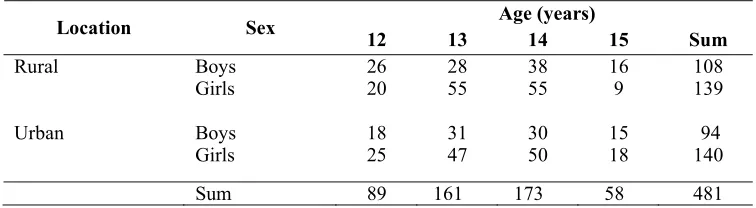
Four hundreds eighty-one junior high school children aged 12-15 years in Bantul Regency volunteered for this study. The children consisted of 202 boys and 279 girls. As many as 247 children lived in rural area and the other 234 children lived in urban area. Subject passed the inclusion criteria, i.e. a junior high school child aged 12-15 years, healthy, did not have physical and mental disorders, born and live in Bantul Regency, and agreed to participate in this research. All subjects signed an informed consent and completed questionnaires. Number of subjects was calculated based on the preliminary research using formula of Colton to predict sample number for comparison of two populations19,20, for this purpose a number of 345 students were needed.
Age (years) Location Sex
12 13 14 15 Sum
Rural
Urban
Boys Girls
Boys Girls
26 20
18 25
28 55
31 47
38 55
30 50
16 9
15 18
108 139
94 140
Sum 89 161 173 58 481
the time elapsed from the starting signal to crossing the finish line. The students were asked to run as fast as they could. Throwing capability was measured using a 12-inch softball as the distance from the throwing line to the point where the ball first touches the ground. Two trials of each
Classification of muscle area of upper arm for height for evaluation of nutritional status based on aged and sex-specific anthropometric distribution by Frisancho and Tracer (1987)23:
Differences among category distribution of physical status were analyzed by chi-square analysis. Pearson correlation of product moment was used to find the relationship between age, weight, and height toward motor performance. Whereas, linear regression analysis was applied to determine the lines of regression of motor performance on body weight and height in rural and urban children age of 12 to 15 years in Bantul Regency.
performance were given to all students and the best scores were used in the analysis.
Physical performance was determined on the measurements of height and weight, body mass index, weight to height ratio, and muscle area of upper arm. The formulae were written below.
Category Percentile
Wasted Below average
Average Above average High muscle
0.0 – 5.0th 5.1 – 15.0th 15.1 – 85.0th 85.1 – 95.0th 95.1 – 100.0th
TABLE 1. Sample distribution by location, sex, and age
RESULTS
The data was collected on August to September 2006 at two junior high schools in Bantul Regency, Yogyakarta Province. Sample areas were distinguished as urban and rural. SMPN 2 Bantul was taken to
resemble urban area, whereas as rural area, SMPN 1 Kretek was chosen. As many as 481 students including boys and girls aged 12 to 15 years participated in this research which sample distribution was presented in TABLE 1.
a). Body mass index22 =
2 (m) height
(kg) weight
b). Muscle area of upper arm23
Total area of upper arm (cm2) =
3,1416) x
(4
) girth arm
(upper 2
Muscle area of upper arm (cm2) =
3,1416) x
(4
3,1416) x
skinfold triceps
-girth arm
(upper 2
4 x 3.1416
4 x 3.1416
Information of physical and motor performance of school children aged 12-15 years in Bantul regency in four separate age groups were provided in FIGURE 1-2. FIGURE 1 presented body weight, height, body mass index, and muscle area of upper arm. Girls up to 14 years tent to be heavier than of boys both in rural and urban areas, but they had different patterns in height increase. Urban boys were the tallest among the others in all age groups. In contrast, rural boys
initially were the shortest at age of 12 and 13 years but then were taller than the girls. When physical status was observed using body mass index, rural girls appeared to have the highest score than others, while boys in both areas had lower. On the other hand, determination of physical status by muscle area of upper arm showed that urban boys and girls were better than their peer in rural, although rural boys still appeared the lowest.
FIGURE 1. Weight, height, body mass index, and muscle area of upper arm of 12-15 years school children in Bantul Regency.
25 30 35 40 45 50
12 13 14 15
Cig *{gctu+
Y
g
kijv
*m
i+
140 145 150 155 160 165 170
12 13 14 15
Cig *{gctu+
Jgk
i
j
v
*
e
o
+
Rural bo ys Rural girls Urban bo ys Urban girls
20 25 30 35 40
O
wu
e
ng
c
t
g
c
qh
wrrg
t
c
t
o
*
e
o
4
+
15 16 17 18 19 20
D
qf{
o
c
u
u
kpfg
z
The average of weight, height, and physical status determined from body mass index, weight to height ratio, and upper arm muscle area in both populations and sex were performed in TABLE 2.
TABLE 2. Mean weight, height, and physical status of 12-15 years schoolchildren in Bantul Regency.
TABLE 3. Percentages of nutritional status base on muscle area of upper arm for height of 12-15 years schoolchildren in Bantul Regency.
Rural Urban Significance
B G Total height ratio
5. Muscle area of
B = boys; G = Girls; R= rural; U= urban; a,b significant at P< 0,05; aa,bb significant at P<0,01 a: difference between boys and girls in one area
b: difference between rural and urban children in the same sex or both sex for total category
Rural Urban Total
Boys Girls Boys Girls Rural Urban
% % % % % %
Wasted Below average
Average Above average High muscle Total
Nutritional status was determined by using muscle area of upper arm. TABLE 3 was attributed to percentage of each categorizes in boys and girls in rural and urban areas. In general, urban children show better nutritional status showed on the more percentage at categorize of average and above average, and less under average. Based on chi-square analysis, there were significant differences
TABLE 4. Results of chi-square analysis of nutritional status category by muscle area of upper arm for height of 12-15 years schoolchildren in Bantul Regency.
χ2
Rural-urban Boys-girls
Indices
Boys Girls Total1 Rural Urban Total2
Muscle area for height 12.50** 4.21** 7.05 5.46 3.59 25.05**
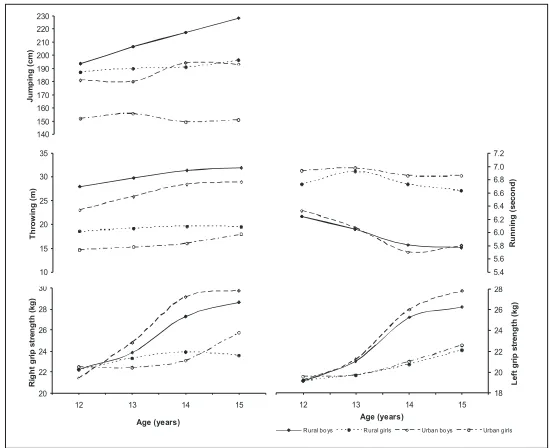
FIGURE 2 illustrated motor performance of schoolchildren in Bantul Regency with the increase of age. Grip strength showed similar pattern between right and left hands. Boys were far stronger than girls in both areas at age 13 years and up. Among others, rural boys were the strongest. Although rural boys also showed the best performance in throwing a 12-inch softball, their capabilities in running were not much different with urban boys. Following the boys, comparison between rural and urban girls also indicated that
rural girls had better performance in both throwing and running than ones in urban. Again, rural boys showed the best score in jumping performance. While, urban boys and rural girls did not show much different in jumping ability, urban girls showed the worst. In compare to grip strength, the increase of throwing, running, and jumping performance by age were only slight. However, students at age of 15 years showed the best performance in all categories.
FIGURE 2. Motor performance of 12-15 years schoolchildren in Bantul Regency.
20
R ural bo ys R ural girls Urban bo ys Urban girls 10
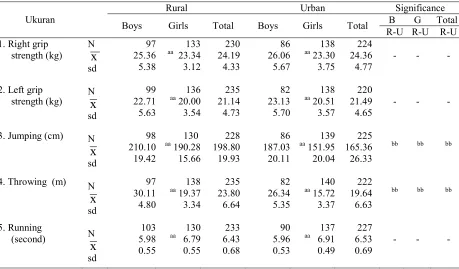
Mean motor performance as presented in TABLE 5 showed that there were significant differences between boys and girls both in rural and urban populations as well. Boys appeared better than girls in all performances did. Whereas,
TABLE 5. Mean motor performance of 12-15 years schoolchildren in Bantul Regency.
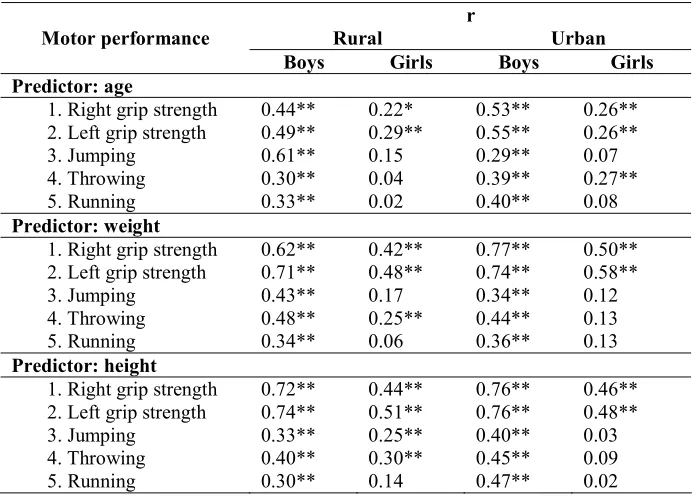
Statistical analysis of Pearson correlation with predictor variables were age, weight, and height to motor performance as depicted in TABLE 4 showed that age was significantly correlated with most of categories in boys of both rural and urban. However, in girls significant differences only found
Rural Urban Significance
B G Total Ukuran
Boys Girls Total Boys Girls Total
R-U R-U R-U 1. Right grip
strength (kg)
2. Left grip strength (kg)
3. Jumping (cm)
in grip strength in both populations with an addition of throwing ability in urban girls. Correlation coefficient values of those significant differences varied and ranged from 0.22 to 0.61. Boys however, showed greater values than girls did.
B = boys; G = Girls; R= rural; U= urban; a,b significant at P< 0,05; aa,bb significant at P<0,01 a: difference between boys and girls in one area
TABLE 6. Results of Pearson correlation analysis of motor performance with predictors of age, weight, and height of 12-15 years schoolchildren in Bantul Regency.
r
Rural Urban Motor performance
Boys Girls Boys Girls Predictor: age
1. Right grip strength 2. Left grip strength 3. Jumping
4. Throwing 5. Running
0.44** 0.49** 0.61** 0.30** 0.33**
0.22* 0.29** 0.15 0.04 0.02
0.53** 0.55** 0.29** 0.39** 0.40**
0.26** 0.26** 0.07 0.27** 0.08
Predictor: weight
1. Right grip strength 2. Left grip strength 3. Jumping
4. Throwing 5. Running
0.62** 0.71** 0.43** 0.48** 0.34**
0.42** 0.48** 0.17 0.25** 0.06
0.77** 0.74** 0.34** 0.44** 0.36**
0.50** 0.58** 0.12 0.13 0.13
Predictor: height
1. Right grip strength 2. Left grip strength 3. Jumping
4. Throwing 5. Running
0.72** 0.74** 0.33** 0.40** 0.30**
0.44** 0.51** 0.25** 0.30** 0.14
0.76** 0.76** 0.40** 0.45** 0.47**
0.46** 0.48** 0.03 0.09 0.02
Weight also significantly correlated with all components of motor performance in both rural and urban boys as shown in TABLE 4. Girls of both populations were reasonably similar which are only weight to grip strength are significantly different. In addition, weight also correlated with throwing ability in rural girls. Compare with age, weight had greater values of correlation coefficient in most of the components. Height significantly correlated with all motor performance components in boys of both population and rural girls with an exception of running ability. However, urban girls showed significant differences only on grips strength.
Boys in rural and urban area still performed better on jumping, throwing, and running performance than girls. Furthermore, the increase of those performances per unit body weight and height were greater in boys as clearly performed by the risen of the regression lines as illustrated in FIGURE 4. On jumping and throwing abilities, rural boys were able to jump and throw the farthest per unit weight and height among others, followed by urban boys. Comparison between girls of both
FIGURE 3. Lines of regression of grip strength on body weight and height of 12-15 years schoolchildren in Bantul Regency.
10 15 20 25 30 35 40
Rural boys Rural girls
Urban boys Urban girls
Lef
t
g
ri
p s
tr
en
g
th (
k
g
)
R
ig
h
t
g
ri
p
s
tren
g
th
(
k
g
)
Weight (kg) Height (cm)
FIGURE 4. Lines of regression of jumping, throwing, and running performance on body weight and height of 12-15 years schoolchildren in Bantul Regency.
R
u
n
n
in
g
(
S
)
150 200 250
Ju
mp
in
g
(c
m
)
15 20 25 30 35 40
T
h
ro
w
in
g
(
m
)
5.5 6.0 6.5 7.0
Weight (kg) Height (cm)
15 20 25 30 35 40
Rural boys Rural girls
Urban boys Urban girls
DISCUSSION
Investigation on physical status of junior high school children age of 12-15 years in Bantul Regency on a cross sectional study found that girls in rural and urban areas attained heavier than of the boys at 12-13 years of age. However, at 14 years, girls and boys in each area had similar weight. It indicated that girls in both areas reached their adolescence growth spurt in weight at 12-13 years of age. Observation on height growth showed different patterns. Girls in rural and urban appeared as high as the boys, but then urban girls showed a bit shorter than their peers in urban and the gap was continuing greater until the age of 15
years. On the other hand rural girls appeared taller than the boys at age of 13 years, but it was decreased somewhat to become shorter at the age of 14 and after. This result indicated that urban boys and girls had better condition in their physical status based on observation on their weight and height growth. The similar findings were reported by some research-ers9,10,12,14,24,25. However, the results were different somewhat to the study in Flemish girls 13 to 18 years reported by Taks26 (1991) who noted that there were no consistent somatic differences between urban, semi urban and rural children.
had greater values of body mass index than of the boys. When ages were taken into account, there was only a slight increase of BMI. This was attributed mainly to the heavier but shorter of the girls. Boys of both populations showed different patterns, urban boys appeared the same values as the girls at age of 12 but it was droppng gradually through the age of 14 years though then rose sharply at 15 years. Whereas rural boys though generally had the lowest values, it increased somewhat through age of 14 years before then declined at age 15 years. Compared to BMI of Javanese adolescence in Yogyakarta reported by Rahmawati and Hastuti27 (2005), Bantul children indicated lighter, shorter, and less BMI values.
When BMI was classified to define physical status into underweight, normal, and overweight, there were no significant differences between rural and urban boy and girls, as also between boys and girls in urban, the only significant difference was between boys and girls in rural area. However, more than 50% of the children were in category of underweight. This did not agree when muscle area of upper arm was classified to identify physical status. Around 61% to 77% of the populations were in category of normal nutrition (in the average nutrition). Differences in distribution of categories were found between rural and urban population in the same sex. Hence, in this case, using muscle area of upper arm to identify physical status in this study was preferable because it could better identify the nutritional status. Moreover, Supariasa22 mentioned that BMI classification was preferable to identify physical status of age more than 18 years. However, in general children aged 12-15 years in urban area appeared to grow better in physical status than their peers in rural area as it is established from height and weight measurements that were significantly greater. Moreover, category distribution of physical status based on body mass index and muscle area of upper arm indicated better category in urban children.
Study on motor performance of the children found that urban boys appeared the strongest in grip strength, though there was just a slight difference in left grip strength compared to rural boys. Evaluation of the task in girls indicated better ability in rural girls, although there was only a bit difference on the left grip strength. According to Malina24et al (2006) strength is included with motor performance because it is as one of
essential components of motor performance which needs a certain level of muscle strength and because motor performance tasks are often used as indicators of aspects of muscle strength. Strength is an expression of muscular force. There are several types of strength. Grip strength indicates static or isometric strength, which is the force exerted against an external resistance without any change in muscle length. Observation on grip strength by age revealed that at the beginning, grip strength was the same between girls and boys in the same place as well as between rural and urban in the same sex. The following year, at age of 13 years, the tendencies were becoming different, boys grew stronger than girls and it was continuing in the next ages to become much stronger. Nevertheless, after 14 years, grip strength increases slowly. Those greatest growths of grip strength at boys age of 14 years indicate adolescence growth spurt on strength that happened in boys as Malina24 et al (2006) reported their study on Philadelphia children, strength increased linearly with age until 13 to 14 years of age in boys, when there was acceleration in strength development, an adolescent strength spurt. Compared with the boys, the girls showed only a slight increase in grip strength by the increase of age. Further, Malina24et al (2006) noted that in girls, strength improved linearly with age through about 16 or 17 years with no clear evidence for adolescent spurt as in boys. This finding was also in agreement with study on “Cape Coloured” community in South Africa that reported by Henneberg2et al (2001), which identified that children from high socioeconomic status were stronger than their peers in low socioeconomic status. There are some possible explanations regarding to the different muscle strength between rural and urban communities as some researchers suggested11. Malina9et al (1987) remarked that it might be doe to specific change in muscle tissue such as reduction in potassium content, DNA concentration, and energy metabolism. Furthermore, Ferretti suggested that hormonal difference and neural motor control might contribute. Henneberg11et al (2001) considered that differences in hormonal influence, neuromuscular control, muscle metabolism, and hormonal regulation might be responsible for future specific muscle strength in low and high socioeconomic status.
and jumping tasks. Throwing task is explosive strength that requires coordination and power in projecting an object, in this case we use a 12-inch leather softball. Similarly, jumping task at standing long jump method indicates explosive strength or power that requires motor coordination and muscular power to project the body horizontally forward. Rural girls, though appeared a little difference with urban boys in jumping ability, on the whole girls performed weaker in both tasks. When jumping and throwing abilities are evaluated by age, it was increased slightly in both rural and urban populations. However, boys appeared to have greater increase, which showed the sex difference more clearly.
Running ability, on the other hand, showed nearly similar either in rural or urban boys. Running task, in this study used a 35-yard dash, was a test of running speed that requires power and coordination to move the body as fast as possible from the starting to the finish line. It found that the older the age, the shorter the time they needed to reach the finish line, although the decrease was little. In girls, however, there seemed to be no difference in running time by the increase of age. As reported in Malina24et al (2006) that on the average, the motor performance of girls from a variety of samples reached plateau and even declined during adolescence, whereas strength increased slowly with age through adolescence. In contrast, the strength and motor performance of boys generally increased through adolescence, resulting in obviously sex differences.
Since motor performance is related to physical status, it is necessary to review motor performance of these rural and urban boys and girls relative to body weight and height particularly as assessments of physical status. Observation on grip strength showed that boys of both populations appeared stronger per weight and height, and increased gradually by the increase of unit weight and height as well. Only slight difference could be distinguished between rural and urban boys on grip strength per unit weight, which at lighter weight, rural boys tended to be stronger but at heavier (more than 45 kg) urban boys take apart. Whereas, rural boys seemed to be a bit stronger than urban boys per unit height. Boys were able to throw, to jump farther, and to run faster per unit weight and height than the girls. On the whole, rural boys performed the greatest ability per unit weight as well
as height than other groups, with an exception in running ability per unit weight that in lighter rural boys were able to run faster but in heavier urban boys do better. Entirely, urban girls showed the lowest performances per unit weight and height as well. These results agreed to Malina24 et al (2006) study on Philadelphia children, that correlation of either stature or weight and strength were greater than those of motor performance. The highest correlations in boys tend to occur between 13 and 15 years of age, which is generally the period of the male adolescent growth spurt. Similar age associated variation in correlations was not evident in girls during adolescence which probably reflects both biological (adolescent growth spurt and sexual maturation) and social (motivational) factors. In addition, changes in body composition associated with adolescence, specifically body fatness, changes in interests and attitudes toward physical activities may influence girls’ motivation to perform at this time.
Those results indicated that even rural children in Bantul regency appeared worse in physical status than urban children they attained motor performance tasks better instead of grip strength.Comparison with children aged 6-15 years from Philadelphia (urban), Pere (rural New Guinea), and Oaxaca (rural Mexico) as reported by Malina9 et al (1987), it sound a little different. Children from Philadelphia, which had better nourish, attained heavier and taller than the others from Pere and Oaxaca. Additionally, they had better abilities in most of motor performance tasks, i.e. strength, jumping, running, and throwing. However, when motor performance tasks were assessed per unit body size (weight and height), the results showed not much different. Philadelphia children appeared lesser motor performance relative to unit eight and height, whereas Pere and Oaxaca children were able to run faster, jump farther, and throw in farther distance relative to unit body size, even there were variations. Malina9 et
al (1987) noted that those cases did not clearly show
Afterall, concerning the results, some factors ought contribute, as according to Malina24 et al (2006) that different test procedures in studies may influence the test score, in addition variation in lifestyles such as habitual physical activity, quality and quantity of school physical education, etc may also affect them. Level of socioeconomic of children from rural and urban Bantul in terms of parents’ education, occupation, and family income might lead to those conditions, additionally with different patterns of nutrition consumption, distance of their home to school, and the way they go to school. Hence, it was thought that differences in socioeconomic backgrounds, habitual activities, and nutrition mights contribute to the differences of physical status and motor performance of children in Bantul Regency
CONCLUSION
1. Urban boys and girls age of 12 to 15 years in Bantul Regency were taller and heavier than their peers in rural.
2. Physical status based on body mass index and muscle area of upper arm indicated that urban children were better than rural children. 3. Urban children had better performance on grip
strength, while rural children had better per-formance on jumping, throwing, and running tasks.
4. Instead of grip strength, motor performance relative to weight and height of rural children were better than those of urban children. 5. Boys had better motor performance and
mo-tor performance relative to weight and height than girls.
ACKNOWLEDGEMENTS
I am grateful to the Dean of Faculty of Medicine, Gadjah Mada University for the giving research fund of Public Fund allocated for Faculty of Medicine, Gadjah Mada University. I am especially thankful to Prof. drg. Etty Indriati, Ph.D., Dra. Neni Trilusiana Rahmawati, M.Kes., Rusyad Adi S, S.Sos., M.Hum., and colleagues for their moral support. I am also grateful to the Principal, staff, and students of: SMPN 1 Kretek and SMAN II Bantul in Bantul Regency, Yogyakarta Province for their collaboration and hospitality during this research.
REFERENCES
1. Andersen KL, Masironi R, Rutenfranz J, Selinger V. Habitual Physical Activity and Health. Copenhagen: WHO, Regional Office for Europe, 1978; 27-30. 2. Henneberg M, Schilitz A, Lambert KM. Assessment of
growth of children and physical status of adults in two aboriginal communities in South Australia. Am. J. Hum. Biol. 2001; (13): 603-11.
3. Leatherman TL, Carey JW, and Thomas RB. Socioeconomic change and patterns of growth in the Andes. Am. J. Phys. Anthropol. 1995; (97): 307-321. 4. Kromeyer-Hauschild K and Jaeger U. Growth studies
in Jena, Germany: change in body size and subcutaneus fat distribution between 1975 and 1995. Am. J. Hum. Biol. 1998; 10: 579-87.
5. Gonzales, G.F., R.G. Garcia, L. Rodriguez, J. Valera, A. Vega, 1984 Secular change in growth of native children and adolescent at high altitude Huancayo, Peru (3280 m). Am. J. Phys. Anthropol. 64(1): 47-51.
6. Stini, W.A., 1975 Adaptive strategies of human population under nutritional stress, in Watts, E.S., F.E. Johnston, and G.W. Lasker (eds): Biosocial Interrelations in Population Adaptation. Mouton Publishers, The Hague, Paris. Pp.19-42.
7. Frisancho AR, Albalak R, Brutsaert BT, Frisancho HG, Milotich M, Saria R, Spielvogel H, Vargas E, Villena M. Developmental, genetic and environmental components of aerobic capacity at high altitude. Am. J. Phys. Anthropol. 1995; 96(4): 431-42.
8. Leonard, W.R., K.M. DeWalt, M.K. McCarton, J. P. Stansburg 1995 Growth differences between children of highland and coastal Ecuador. Am. J. Phys. Anthropol. 98(1): 47-57.
9. Malina RM, Little BB, Shoup RF, Buschang PH. Adaptive significance of small body size: strength and motor performance of school children in Mexico and Papua New Guinea. Am J Phys Anthropol. 1987; 73(4): 489-99.
10. Henneberg M and Louw GJ. Cross-sectional survey of growth of urban and rural “Cape Coloured” schoolchildren: anthropometry and functional tests. Am. J. Hum. Biol. 1998; (10): 73-85.
11. Henneberg M, Brush G, Harrison GA. Growth of specific muscle strength between 6 and 18 years in contrasting socioeconomic condition. Am J Phys Anthropol. 2001; 115(1): 62-70.
12. Malina RM, Himes JH, Stepick CD, Lopez FG, and Buschang PH. Growth of rural and urban children in the Valley of Oaxaca, Mexico. Am. J. Phys. Anthropol. 1981; (54): 327-36.
13. Rahmawati NT dan Hastuti J. Status gizi antropometrik anak usia 7-12 tahun di Daerah Istimewa Yogyakarta. B I Ked. 2003; 35(1): 39-47.
15. Little BB, Buschang PH, Malina RM. Socioeconomic variation in estimated growth velocity of school children from subsistence agricultural community in Southern Mexico. Am. J. Phys. Anthropol. 1988; 76(4): 443-48. 16. Eveleth PB. Differences between populations in body shape of children and adolescents. Am. J. Phys. Anthropol. 1978; 49: 373-82.
17. Singh R. Physical growth and nutritional anthropometric indices of affluent indian children and nutritional anthropometry of adult men and women. Persp. Hum. Biol. 1999; 4(2): 51-66.
18. Soerais S, Sadjimin T, Suhardjojo, Doeljachman MH, Kendarto, Wilopo SA. Akibat Kurang Gizi terhadap Perkembangan Motorik Anak. Laporan Penelitian. Yogyakarta: Universitas Gadjah Mada, 1981.
19. Colton T. Statistics in Medicine. Boston: Little, Brown and Co, 1974.
20. Dawson-Saunders B, Trapp RG. Basic and Clinical Biostatistics, 2nd ed. Norwalk, Connecticut: Appleton
and Lange, 1994.
21. Weiner JS and Lourie JA. Practical Human Biology. London: Academic Press Inc., 1981.
22. Supariasa IDN, Bakri B, Fajar I. Penilaian Status Gizi. Jakrta: EGC, 2001.
23. Frisancho AR, Tracer DP. Standards of arm muscle by stature for assesment of nutritional status of children. Am. J. Phys. Anthropol. 1987; 73(4): 459-65. 24. Malina RM, Bouchard C, Bar-Or O. Growth, Maturation,
and Physical Activity. Illinois: Human Kinetics Books, 2006.
25. Spurgeon JH, French KE, Giese WK, Steele MF, Utenko VN, Bundxen PV, Rogozkin VA. Somatic comparisons of urban and rural Russian boys, ages 6, 9, and 15 years, living in St. Petersburg and surrounding areas. Am. J. Hum. Biol. 1994; (6): 141-51.
26. Taks M, Renson R, Beunen G, Claessens A, Colla M, Lefevre J, Ostyn M, Schueremans C, Simons J, Van Gerven D, Vanreusel B. Sociogeographic variation in the physical fitness of a cross-sectional sample of Flemish girls 13 to 18 years of age. Am. J. Hum. Biol. 1991; (3): 503-13.