Monitoring tobacco control among adults in selected
Member States of South-East Asia Region
– at a glance
Message
Tobacco continues to be a major public health problem in the WHO South-East Asia Region, causing premature deaths and compounding the increasing epidemic of noncommunicable diseases such as chronic lung disease, heart ailments and cancer.
One fourth of the world’s smokers and over 80% of the world’s smokeless tobacco users live in the Region. There are 290 million smokeless tobacco users and 246 million smokers in the Region, as per recent estimates.
The findings of the Global Adult Tobacco Survey (GATS) and STEPwise approach to noncommunicable diseases risk factor surveillance (STEPs) show that 35% of adults are exposed to second-hand smoke at work and over 45% at their homes. Nearly 35% of the people in the Region use tobacco in one form or another; 19.7% use smokeless tobacco and 18.3% people smoke. As many as 35% smokers have been unsuccessful in quitting tobacco due to absence of tobacco cessation support, while two in five smokers have thought of quitting cigarette smoking after seeing the health warning on cigarette packages.
Strengthening tobacco control policies, strictly enforcing existing laws that ban tobacco promotion, enhancing graphic health warnings on all tobacco products, implementing interventions to prevent exposure to second-hand smoke, and most importantly, initiating tobacco cessation
measures with trained health workforce are key to stopping tobacco use in the Region. While continuous efforts are being made to stop the use of tobacco, more needs to be done.
This brochure provides an opportunity to review in graphic form the effects of public health policies and tobacco control interventions in Member States of the Region. In compliance with Article 21 of the WHO Framework Convention on Tobacco Control (WHO FCTC), Member States in the Region have been monitoring tobacco control using the standard protocols of GATS and STEPs. Member States are committed to protecting their people from the ill effects of tobacco and WHO commends and continues to support them in their efforts to protect the people from the scourge of tobacco.
Dr Poonam Khetrapal Singh Regional Director
Introduction
The Global Adult Tobacco Survey (GATS) is a nationally representative household survey that was launched in February 2007 as a new component of the ongoing Global Tobacco Surveillance System (GTSS). GATS enables countries to collect data on adult tobacco use and key tobacco control measures for the 15+ years age group. Results from GATS assist countries in the formulation, tracking and implementation of effective national tobacco control interventions, and comparison with results from other countries. The STEPwise approach to noncommunicable disease risk factor surveillance (STEPs) of the World Health Organization (WHO) comprises a population-based survey to collect information on the major modifiable NCD risk factors, which has been used in many countries. WHO has a set of core indicators derived from STEPs for monitoring NCD risk factors nationally and globally. These core indicators were deemed practical and easily obtainable by countries at all levels of technical capacity. Both data systems assist countries in fulfilling their obligations under the World Health Organization (WHO) Framework Convention on Tobacco Control (FCTC) to generate comparable data within and across countries. WHO has developed MPOWER, a package of selected demand reduction measures contained in WHO FCTC.
This brochure contains data from GATS for Bangladesh (2009), India (2009–2010), Indonesia (2011) and Thailand (2011) for the 15+ years age group and from STEPs for (1) Maldives (2011), Myanmar (2008) and Sri Lanka (2008) for the 15–64 years age group; (2) Nepal (2013) for the 15–69 years age group; and (3) Bhutan (2014) and Timor-Leste (2014) for the 18–69 years age group.
Tobacco use – Smoked and/or Smokeless
Figure 1:
Percentage of current tobacco users
Nearly 35% adults in the Region use
tobacco in one or another form, ranging
from 20% in Maldives to 56% in
Timor-Leste.
Indicator: Percentage of respondents who
currently use tobacco
Numerator: Number of current daily and less
than daily tobacco smokers and/or smokeless
tobacco users
Denominator: Total number of respondents
Total Male Female
Percentage
20 36
4 25
44
7 25
34
14 27
47
8 31
48
14 35
48
20 35
52
18
36 67
5 41
74
21 43
58
29 56
71
29 100
90
80
70
60
50
40
30
20
10
0
Maldives (Malé)*
Sri Lanka Bhutan Thailand Nepal India
SEA Region Indonesia Myanmar Bangladesh Timor-Leste
Tobacco use – Smoked
Figure 2:
Percentage of current tobacco
smokers
Nearly one in five (18%) adults in the
Region smokes, ranging from 7% in
Bhutan to 49% in Timor-Leste.
Indicator: Percentage of adults who currently
smoke tobacco
Numerator: Number of current daily and
less than daily tobacco smokers
Denominator: Total number of respondents
711 3
14 24
3 14
29
0 18
33
3
19 27
10 19
35
3 22
45
8 23
45
2 24
47
3 35
67
3 49
70
10 100
90
80
70
60
50
40
30
20
10
0
Bhutan India Sri Lanka Nepal Myanmar Bangladesh Thailand Indonesia Timor-Leste
SEA Region
*Sub-national
Percentage
Total Male Female
Tobacco use – Smokeless
Figure 3:
Percentage of current smokeless
tobacco users
Nearly one in five (22%) adults in the
Region uses smokeless tobacco, ranging
from 2% in Indonesia to 30% in Myanmar.
Indicator: Percentage of adults who currently
use smokeless tobacco
Numerator: Number of current daily and less
than daily smokeless tobacco users
Denominator: Total number of respondents
2 2
2
3 4 1 3 5
15 24
6 18
31
5 20
27
11 20
16.1 27 22
27
16
26 33
18 27
26 28
30 51
16 100
90
80
70
60
50
40
30
20
10
0
Indonesia Maldives (Malé)*
Thailand Sri Lanka Nepal Bhutan Timor-Leste India Bangladesh Myanmar
SEA Region
1
*Sub-national Total Male Female
Secondhand smoke – at home
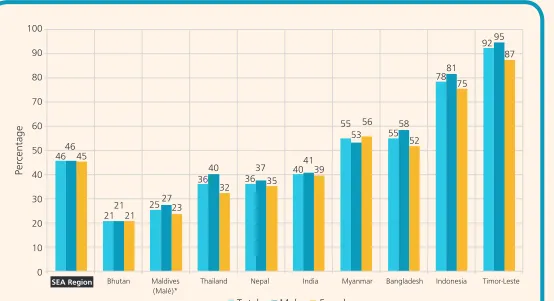
Figure 4:
Percentage of persons who were
exposed to secondhand smoke at home
Over 45% of adults are exposed to second
hand smoke at home in this Region,
ranging from 21% in Bhutan to 92% in
Timor-Leste.
Indicator: Percentage of persons who were
exposed to tobacco smoke at home in the
past 30 days
Numerator: Number of respondents who
reported being exposed to smoke at home
during the past 30 days
Denominator: Total number of respondents
21 21
21
252723 36
40
32 36
37 35
404139 46
46 45
55 56
5558 52
7881 75
9295 87 100
90
80
70
60
50
40
30
20
10
0
Bhutan Maldives (Malé)*
Thailand Nepal India Myanmar Bangladesh Indonesia Timor-Leste
SEA Region
53
*Sub-national Total Male Female
Percentage
Secondhand smoke – at workplace
Figure 5:
Percentage of persons exposed to
secondhand smoke at workplace
35% adults are exposed to secondhand
smoke at workplace in the Region,
ranging from 17% in Maldives to 62% in
Bangladesh.
Indicator: Percentage of indoor workers who
were exposed to tobacco smoke at work in
the past 30 days
Numerator: Number of respondents who
reported being exposed to smoke in indoor
areas at work during the past 30 days
Denominator: Number of respondents who
work outside of the home who usually work
indoors or both indoors and outdoors
1720 11
25 29
19
3032
19 31
37
23 3537
24
37 43
31 39
48
33 51 100
90
80
70
60
50
40
30
20
10
0
Bhutan Maldives
(Malé)*
Thailand Nepal Timor-Leste Indonesia
India Myanmar Bangladesh
39 74
51 58
41 62
67
31
SEA Region
*Sub-national Total Male Female
Percentage
Smokers tried to stop smoking
Figure 6:
Percentage of current smokers
who tried to stop smoking in past 12 months
Nearly 35% smokers in the Region tried
to stop smoking, ranging from 23% in
Timor-Leste to 69% in Bhutan.
Indicator: Percentage of adults who smoked
tobacco during the past 12 months who tried
to quit during the past 12 months
Numerator: Number of current tobacco
smokers who tried to quit during the past
12 months and former tobacco smokers
who have been abstinent for <12 months
Denominator: Total number of current
tobacco smokers and former tobacco smokers
who have been abstinent for <12 months
100
90
80
70
60
50
40
30
20
10
0
Bhutan Maldives
(Malé)* Thailand
Nepal
Timor-Leste Indonesia India Bangladesh
23 75
26 23
30 45 35
35
36 37 38 39 39 44
47
32 69
82
48
39
27
SEA Region
30
37 38 39
66
19
*Sub-national Total Male Female
Percentage
Advised to stop smoking
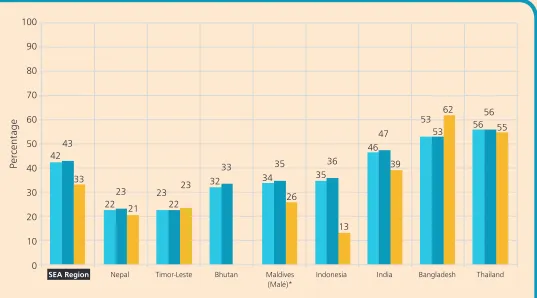
Figure 7:
Prevalence of current smokers
advised by a health care provider to stop
smoking in past 12 months
Nearly two in five (42%) adults have been
advised by health-care providers to stop
smoking, ranging from 22% in Nepal to
56% in Thailand.
Indicator: Percentage of current tobacco
smokers and recent quitters (<12 months)
who visited a doctor or health-care provider
(HCP) during the past 12 months and were
advised to quit smoking tobacco
Numerator: Number of current tobacco
smokers and former tobacco smokers who
have been abstinent for <12 months who
report being advised to quit smoking during
a visit to a health-care provider within the
past 12 months
Denominator: Number of current tobacco
smokers and former tobacco smokers who have
been abstinent for <12 months who visited
a health-care provider in the past 12 months
100
90
80
70
60
50
40
30
20
10
0
Bhutan Maldives (Malé)*
Thailand Nepal Timor-Leste Indonesia India Bangladesh
22 23
21 23
22
23 32
33
34 35
26 35
36 43
42
47 46
53
53 5656
13 33
39
62
55
SEA Region
*Sub-national Total Male Female
Percentage
Thought of quit smoking
Figure 8:
Percentage of current smokers who
saw health warnings on cigarette packages
and thought of quitting in the last 30 days
Nearly two in five (38%) smokers thought
of quitting smoking because of health
warnings on the cigarette packages in
the Region, ranging 5% in Timor-Leste
to 84% Bhutan.
Indicator: Percentage of adults who currently
smoke tobacco
Numerator: Number of current daily and
less than daily tobacco smokers
Denominator: Total number of respondents
100
90
80
70
60
50
40
30
20
10
0
Bhutan Maldives
(Malé)*
Thailand Timor-Leste Indonesia
~ Not available ~ ~ Not available ~
India Bangladesh
5 5
27
34 38
38
63
74
84 83
28
17
50
10 11
59
3
33
40 40
63
75
SEA Region
*Sub-national Total Male Female
Percentage
World Health House Indraprastha Estate Mahatma Gandhi Marg New Delhi-110002, India www.searo.who.int
The findings from the Global Adult Tobacco Survey (GATS, 2009–2011) and STEPwise approach to noncommunicable disease risk
factor surveillance (STEPs, 2008–2015) have been presented in graphic form and by year on important indicators of tobacco control
in selected Member States of the Region.
The data presented in graphic form will be particularly useful for programme managers, tobacco control advocates and any other
relevant stakeholders for generating credible evidence to further promote tobacco control.
For further information, please contact:
Dr Dhirendra N Sinha Regional Adviser
Surveillance (Tobacco Control) E-mail: [email protected]
Mr Naveen Agarwal
Data Analyst, (Tobacco Control) E-mail: [email protected]
WHO Library Cataloguing-in-Publication data
Monitoring tobacco control among adults in selected Member States South-East Asia Region – At a glance.
1. Smoking cessation. 2. Tobacco Products. 3. Tobacco smoke pollution. 4. Tobacco, Smokeless.
5. Tobacco use. 6. South-East Asia. 7. World Health Organization
ISBN 978-92-9022-489-1 (NLM classification: HD 9130)