of Section Twenty on Islamic Terms
Munirul Ikhwan
Fellow of the Training Indonesia’s Young Leaders (TIYL)-Islamic Studies Master Program, Leiden University, the Netherlands
Abstract
This article is a philological study of al-Muz}hir, an encyclopedic work of a prominent Egyptian scholar Jala>l al-Di>n al-Suyu>t\i> (d. 911/1505) which has significant contribution in the study of Arabic linguistics. The book is particularly al-Suyu>t\i>’s own compilation of works of earlier philologists. Due to its importance, it is necessary to study the book in a proper way by deciphering its manuscripts. Studying a book from its manuscripts provides us with much indirect information -which has great value for scholarship- to trace back the history of the book before the printing period. Apart from the text itself, manuscripts generally contain the owner’s seal, introductory remark, colophon, certificate and commentaries. Through examining these additional elements, we may be able to acquire the information about the distribution and public demand of the book, the scribes and days of copying, and the authorization of its manuscripts. This paper will discuss al-Muz}hir by analyzing a number of manuscripts written several decades after the death of the author. It will then focus on the authorization of the manuscripts, a sample of critical edition of the book, and a discussion of section twenty on Islamic terms.
Keywords: Al-Suyu>t\i>, Islamic terms, manuscript, al-Muz}hir, philology
A. Introduction
(d. 911/1505) which has contributed significantly to the study of linguistics. The book contains fifty sections discussing the Arabic language: eight examine Arabic in terms of its transmission (isna>d), thirteen discuss it in terms of its pronunciation (lafz}), another thirteen deal with it in terms of meaning (ma‘na>), five focus on its beauty (lat\a>’if), and the rest deal with the figures (rija>l) and transmitters (ruwa>t).1 The book is al- Suyu>ti>’s compilation of earlier philologists’ ideas on linguistics and his own compendium of other linguistic works such as al-Jamhara of Ibn Durayd’s (d. 321/933), Ama>li> of Qa>li>’s (d. 356/967), al-Khas\a>’is\ of Ibn Jinni> (d. 392/1002), and Fiqh al-Lugha of Ibn Faris (d. 395/1004). Only a few of al-Suyu>t\i>’s own opinions are found in this book. Nevertheless, the book provides broad information on philological sciences from the earlier scholars’ period until the period of the author, and is evidence that the author had broad knowledge of Arabic literature and made every effort to compile it.
With regard to broad information on philological doctrines presented by al-Suyu>t\i>, al-Muz}hir is considered an encyclopedic work on Arabic literature in the sense that it particularly presents history and different genres of Arabic philology from the period of earlier philologists until that of the author. Due to its importance, it is necessary to treat the book in a proper way and make it available for the readers. This paper is an attempt to trace back the authorization of the book and to portray how to present it in a scientific way, by examining a number of manuscripts preserved in the Library of the University of Leiden.
B. Al-Suyu>t\i>: A Short Biography
Abu Fad}l Abd Rah}ma>n ibn Kama>l Abi Bakr Suyu>t\i> al-Sha>fi‘i> al-Khud}ayri>2, known as Jala>l al-Di>n al-Suyu>t\i>, was an Egyptian –––––––––––––––––
1 H{aji> Khali>fa, Kashf al-Z{unu>n, volume II, (Istanbul: Ma‘arif Matbaasi, 1941), p. 420.
2 As mentioned in his autobiography, H{usn Muh}a>dara fi> Akhba>r Mis\r wa
writer, jurist and mufassir whose works deal with a wide variety of subjects: Qur’anic exegesis, prophetic tradition, Islamic law, linguistics, history, philosophy and rhetoric.3 He was born in the month of Rajab 849 AH (1445 AD) in Cairo. His father died when he was very young (five years old). He memorized the Qur’a>n before eight and memorized some important books: al-‘Umdah, Minha>j al-Fiqh wa al-Us\u>l, and Alfiyah of Ibn Malik. He began his learning activities when he was 15 years old (864/1460). He studied fiqh and Arabic grammar with several scholars of his time, and took the laws of inheritance (‘ilm al-fara>’id}) from Shaykh Shiha>b al-Di>n al-Sha>ramsa>h}i>, who was very old when al-Suyu>t\i> met him. He obtained his teaching license of the Arabic language at the beginning of 866 (1462). In the same year he composed his first work Sharh} al-Isti‘a>z}a wa al-Basmala (The Explanation of the seek of protection and Basmala).4
Al-Suyu>t\i> was born in a family of scholars. His father, al-Kamal Abu Bakr (d. 855/1451), was a Shafi‘ite jurist and a preacher of the Tulunese mosque from the time of its establishment. He had close relationship with an Abbasid caliph of Cairo, al-Mustakfi Billah Sulayman (d. 855/1451).5 He was offered the opportunity to be a judge in Mecca, but he refused the position. When al-Munawa was appointed to be a judge in Cairo, al-Suyu>t\i> was very disappointed because he thought himself much more capable.6 al-Suyu>t\i>’s ancestors came from Persia; –––––––––––––––––
3 According to al-Suyu>t\i>’s testimony, he best mastered in Arabic grammar and Islamic jurisprudence, and then rhetoric and tradition science. He knew the laws of inheritance (fara>’id}) only by partnership (musha>raka). His knowledge of astronomy and of the theory and practice of versification (‘aru>d}) was not really significant, and he was not seriously engaged in logic and philosophy because both were forbidden as mentioned by Nawa>wi> (d. 676/1300) and other scholars. See: Suyu>t\i>, al-Tahadduth bi-Ni’mat Allah, ed.: E.M. Sartain, (Cairo: al-Mat\ba‘a al-‘Arabiyya al-Hadi>tha, 1975), p. 138.
4 Al-Suyu>t\i>, H{usn al-Muh}a>d}ara fi> Akhba>r Mis\r wa al-Qa>hira, vol. I, (Cairo: Bab al-Khalq, 1903), pp. 155-6.
5 There were Abbasid Caliphs of Cairo under the patronage of the Mamluk Dynasty. Al-Mustakfi here was one of them who ruled Cairo between 1441 and 1451. Therefore, he was a different person from al-Mustakfi who ruled the Abbasid Dynasty in Baghdad.
the surname al-Khud}ayri> led them to the district al-Khud}ayriya in Baghdad. His great grandfather, Huma>m al-Di>n was a Sufi shaykh and among the folk of al-h}aqi>qa.7 His other forebears held some positions in government; one was an officer in his city, another in H{isba,8 another was a businessman alongside the Emir Shaykhu>n and built a school in Asyu>t and gave it as an endowment. Among his forebears were rich men but, according to him, none of them had served Islamic sciences as his father did.9
Al-Suyu>t\i> studied with a large number of scholars at his time.10 In the early of his life, al-Suyu>t\i> was tutored by a Sufis friend of his father who lived near to the tomb of Sayyida Nafi>sa. He studied fiqh with Shaykh ‘Ilm al-Di>n al-Bulqi>ni> (d. 868/1464), who wrote a gloss for both of his works: Sharh} Isti‘a>z}a wa Basmala and Sharh} H{ay‘ala wa al-H{awqala, and had accompanied him for a long time. He studied h}adi>th and Arabic with Taqiyyu al-Di>n al-Shibli> al-H{anafi>, who wrote a gloss for both Sharh} Alfiyyat Ibn Ma>lik and Jam‘ al-Jawa>mi‘, and had accompanied him for 4 years. He studied many subjects such as tafsi>r, the principles of Islamic jurisprudence (us\u>l fiqh), Arabic and rhetoric, with Muh}y al-Di>n al-Ka>fayji>.
In his pursuit of knowledge, al-Suyu>t\i> traveled to Damascus, Hijaz, Yemen, India, Morocco, Takrur11 as well as to some centers of learning in Egypt such as Alexandria, Dumyat and surroundings. During his –––––––––––––––––
7 In Sufism, al-h}aqi>qa can be understood as the real existence and the absolute truth.
8 H{isba is considered as a religious duty which is defined as societal responsibility to enjoin right conduct when it is abandoned, and to forbid indecency when it is conducted in order apply Islamic law (shari>‘a). The position of h}isba is a medium between the legitimate judicial law (ah}ka>m al-qad}a>’) and violations against law (ah}ka>m al-maz}a>lim). See: Kamaluddin Imam, Us\u>l al-H{isba fi> al-Isla>m, (Cairo: Dar al-Hidaya, 1998), p. 16; al-Mawardi, al-Ah}ka>m al-Sult\a>niyyawa’l-Wila>ya>t al-Di>niyya, ed.: Dr. Ah}mad Muba>rak al-Baghda>di>, (Kuwait: Kuwait University Press, 1989), pp. 315-8.
9 Al-Suyu>t\i>, H{usn al-Muh}a>d}ara, pp. 155-6.
10According to al-Da>wu>di>, one of his students, the number of his teachers reached 51 teachers.
traveling to Hijaz, he composed al-Nah}la al-Zakiyya fi> al-Rih}la al-Makkiyya (the Pure Bee of Traveling into Mecca) and Nafh}a Miskiyya wa al-Tuh}fa al-Makkiyya (the Fragrant Gift and the Meccan Masterpiece), and recorded his traveling to some learning centres in Egypt in al-Ightiba>t\ fi> al-Rih}la ’ila> al-Iskandariyya wa Dimya>t\ (The Happiness of Traveling into Alexandria and Dimyat). He began his teaching in 870/1466 and giving fatwas in 871/1467. He had been a teacher at the Mosque of Ahmad Ibn T{u>lu>n from 872/1468 and at the Shaykhuniyya from 877/1472. In 1486 he was appointed as the head of Kha>niqa>t (Sufi lodge) Baybarsiyya where he was involved in a conflict with some of the Sufi scholars.12 He retired from teaching and giving fatwa>s, and withdrew from people in 889/1484, busying himself with writing and worshiping until his death.13 Among his students were al-Dawudi (d. 944/1538, the author of T|abaqa>t al-Mufassiri>n), Ibn Iyas (d. 930/1523, the author of Bada>’i‘ al-Z{uhu>r), and Shams al-Di>n ibn Tu>lu>n (d. 953/1546).
Al-Suyu>t\i> admitted that he had mastered seven important subjects: tafsi>r, h}adi>th, fiqh, Arabic grammar, ‘ilm al-ma‘a>ni>, al-baya>n, and al-badi>‘ (three sciences of rhetoric) according to the eloquent Arabs’ understanding, not the understanding of non-Arabs and philosophers. Hence, he claimed himself an absolute reformer (al-mujtahid al-mut\laq) in fiqh, hadi>th, and Arabic.14 al-Suyu>t\i> is an author of many works of various disciplines. He appears to have written more than 500 works in tafsi>r, Qur’anic sciences, h}adi>th, fiqh and its principles, philology, and logics. His authorship of innumerable works has faced different receptions among his –––––––––––––––––
12Carl Brockelmann, Geschichte der Arabischen Litteratur, (Leiden: E.J. Brill, 1949), vol. II, p. 143. When he tried to reduce the stipends of Sufi scholars at the mosque in 1501, a revolt broke out, and al-Suyu>t\i> was nearly killed. After his trial, he was placed under house arrest on the island of Rawdah (near Cairo). He worked there in seclusion until his death. See: “al-Suyu>t\i>”, in Online Encyclopedia Britannica.
13Umar Ridha Kah}h{a>la, Mu‘jam al-Mu’allifi>n, (Damascus: al-Taraqqi Press, 1958), vol. V, p. 128.
contemporaries and current scholars. Some scholars consider him not an original writer, but some others regard him as a prominent scholar with a broad knowledge and appreciate his brilliant effort in compiling many works which were considered lost, recognizing his particular ability to sort and select those works and make them useful. The way he wrote makes some accuse him of committing plagiarism. Robert Irwin refers to al-Sakha>wi> (d. 902/1497), one of al-Suyu>t\i>’s teachers, who maintained that his student stole some of his ideas, as well as some works by former scholars which were not well-known, taking credit for their authorship. It is not clear whether this accusation was based on al-Sakhawi’s objectivity when he wrote al-Suyu>t\i>’s biography in his al-D{aw‘ al-La>mi‘ or was based on his personal suspicion, since there was a lot of hostility between them. As a counterattack, al-Suyu>t\i> composed a book Maqa>mat al-Ka>wi> fi> al-Radd ‘ala> al-Sakha>wi> (The Pressure in countering al-Sakha>wi>).15 However, by taking into account the authorship of al-Suyut\i> and his various works, we might say that he was a very responsive and prolific author in various subjects. Kita>b al-Muz}hir itself is evidence that he was a prominent scholar with broad knowledge of Arabic literature. He died in Cairo on October 20, 1505 and was buried beside his father’s tomb.
C. Physical Description of the Three Leiden Manuscripts of Kita>b al-Muz}hir
As suggested by Arnoud Vrolijk, catalogues are the main entry to start studying manuscripts.16 In his Geschichte der Arabischen Litteratur, Brockelmann gives eight places (Berl. 6772, Ms. or. Oct. 3887, Leid. 95/7, BDMG 87, Paris 3984/6, 4859, 6503/4, Br. Mus. Suppl. 879, Mosul 183, 238, gedr. Bulaq 1282) in which manuscripts of al-Muz}hir are well preserved.17 GAL only gives us the information about where the manuscripts are preserved, but does not provide the details of the manuscripts through which we may have the information about physical –––––––––––––––––
15See: Paul Meisami, Julie Scott, and Starkey (eds.), Encyclopedia of Arabic
Literature, (London and New York: Routledge, 1998), vol. II, p. 746; and see also: al-Sakhawi’s al-D{aw’ al-La>mi‘ fi> Aya>n al-Qarn al-Ta>si‘.
16Arnoud Vrolijk, Bringing a Laugh to a Scowling Face, (Leiden: Research School CNWS, 1998), pp. 62-70.
description of manuscripts or the author’s autograph. In order to make a critical edition of a section of Kita>b al-Muz}hir, I am not going to work with all existing manuscripts of al-Muz}hir, but I will limit my self to the manuscripts which are preserved in the library of the University of Leiden. Based on the information from Voorhoeve’s Handlist of Arabic Manuscripts and Inventory of the Oriental Manuscripts of the Library of the University of Leiden, there are three manuscripts of Kita>b al-Muz}hir fi> ‘Ulu>m al-Lugha by al- Suyu>ti> in the Library: MS. Or. 39 (Arabic, paper, 173 ff, dated in 954 AH), MS. Or. 347a (Arabic, paper, 255ff, undated), and MS. Or. 347b (Arabic, paper, 219 ff, dated in 977 AH).18
Apart from the text itself, manuscripts also offer much indirect information which is of great value for scholars. Marginal notes often express interesting critical opinions. Introductory remarks, colophons, commentaries, certificates (ija>za), drafts (musawwada), and the owner’s seal are discussed as they can shed light upon dubious data of literary history.19 Certificates and drafts make some manuscripts more authoritative, while commentaries describe how the text has been consumed and studied. One manuscript could belong to a series of owners, and this gives us beneficial information about the migration of a certain manuscript. Together with the name of the scribe, colophons sometimes indicate not only the day on which the copying was completed, but also the day when it was begun or the number of days devoted to the transcription.20
The colophon of MS. Leiden Or. 39 only provides the name of the scribe and the date of its completion. It was copied by Ibrahim ibn Najm al-Di>n ibn Yah}ya>, known as Ibn al-Muballat\, who completed its copying in 954/1547. The owner’s name and his personal seal are to be found in front of the manuscript, but they are blurred by his fingerprint –––––––––––––––––
18See: J. Just Witkam, Inventory of the Oriental Manuscripts of the Library of the
University of Leiden, (Leiden: Ter Lugt Press, 2007), vol. I, pp. 32, 167; Voorhoeve, Handlist, p. 245.
19Franz Rosenthal, The Technique and Approach of Muslim Scholarship, (Roma: Pontificium Institutum Biblicum, 1947), p. 20.
20François Déroche, “The Copyists’ Working Pace”, in Theoretical Approaches
and thus not readable. The manuscript contains 173 folios (1b-173a) and each folio has 31 lines. It measures 27.5 x 18.4 cm and the body of text is 20 x 13.2 cm. There are only some catchwords mentioned in b pages, but I assume they were not written by the same scribe because of different style of writing. The text was principally written in black ink and in the naskh script. The copyist used red ink only to indicate chapters or sections, and usually to begin with different opinions, especially the author’s own opinions, or fa>’ida (excursion). The text is well arranged with diacritical marks, and thus indicates that it was ready for public consumption.
It is completed with the praise of God, His help and His support by the hand of the poorest of God’s slaves and the most in need of His forgiveness among them, Ibrahim ibn Najm al-Di>n ibn Yah}ya>, know as Ibn al-Muballat\ -may God forgive him-. The completion of its writing was on the blessed Sunday at the end of the great month of Ramad}a>n in 954. May God make good its completion for Muhammad and his family. May God bless and protect our master Muhammad, his family and his companions. (the colophon of MS. Or. 39)
MS. Or. 347a contains 255 folios (1b-255a) written by one scribe in the naskh script. It has a measurement of 27 x 19 cm, and the body of the text measures 19.7 x 12 cm. Every page consists of 29 lines, and catchwords are to be found on the b side. The text is written in black ink, but to begin different sections, poetries, scholars’ opinion or the author’s own opinion, the scribe uses red ink. He also uses red ink to indicate fa>’ida (excursion). To make the manuscript well-ordered, the scribe writes the remaining letters of some incomplete words at the left margin when there is no more space left. The fine arrangement of the text and the quality of paper suggests to us that the manuscript is ready for public consumption or dedication to a certain figure rather than private use. The colophon only contains the praise for God and the prayer for the Prophet. According to the citation and personal seal at the beginning of the manuscript, it belonged to Abd. al-Ba>qi> al-‘Ilmi> who belonged to Rifa’ite Sufi order (rifa>‘iyyu al-t\ari>qa).
lines. Catchwords are to be found on the b side. It measures 27.4 x 18 cm, and the body of the text has 19.5 x 11.5 cm. It was written in black ink and in the naskh script. The scribe uses red ink to write sections and to indicate the beginning of poetries, different opinions and fa>’ida (excursion). He wrote the remaining letters of incomplete words at the left margin if the there was no more space left.
May God bless and protect our master Muhammad, his family and his companions. The completion of its writing was in the hand of the humblest God’s slave and the most need to His forgiveness, Ali ibn Ahmad, on the Blessed Saturday Ramadan 19, 977. May God make good its completion for Muhammad and his family. May god forgive the author, the copyist, the owner, everyone studying it […], and all Muslims. Amin, Amin, Amin. (The colophon of MS. Or. 347b)
At the beginning of the manuscript, there is a piece of citation of the author’s biography based on what the author had written about himself in his book H{usn al-Muh}a>d}ara fi> Akhba>r Mis\r wa al-Qa>hira (A Good Lecture on the History of Egypt and Cairo), even though there are some differences in the writing of certain names. For instance, in the citation of the author’s biography of MS Or. 347b, it is written as “S|a>diq al-Di>n” instead of Sa>biq al-Di>n, and “Na>sir al-Di>n” instead of Na>z}ir al-Di>n. This part is written in the Persian script and so is different from the rest of the book which is written according to the naskh script.
chapter “Sufism”-, others held positions in government; one was an officer in his city, another was in Hisba, another was a businessman alongside the Emir Shaykhu>n and built a school in Asyu>t, and gave it as an endowment. Among them were rich merchants, but I do not know among them who served in knowledge but my father –I would mention him in the chapter “Sha>fi‘ite jurists”-. About our surename to al-Khud}ayri>, I know nothing about this surname but al-Khud}ayriyya, a district in Baghdad. Someone, whose word I trust, told me that he heard my father –may God bless him- said that his great grandfather was an ‘ajam (non-Arab) or came from the east. Apparently the surname is ascribed to the mentioned district. I was born after maghrib Saturday night at the beginning of Rajab 849 AH. I was brought, when my father was still alive, to shaykh Muhammad al-Majz}u>b, among the greatest saint close to the tomb of Sayyida Nafisa. I was lied down. I well grew up and have memorized before eight years old. I memorized al-‘Umda, Miha>j al-Fiqhwa al-Us\u>l and Alfiyya of Ibn Ma>lik. I began to my learning activities at the beginning of 864. I learned fiqh and Arabic grammar from a large group of scholars, and took the laws of inheritance ( al-fara>’id}) from Grand Shaykh Shiha>b al-Di>n al-Sha>rmisa>h}i> who was very old, much more than 100 years old. God knows best. In this circumstance I read his explanation of al-Majmu>‘ in front of him. I obtained the license of teaching of the Arabic language at the beginning of 866 AH in which I composed my first work Sharh} al-Isti‘a>z}a wa al-Basmala (The Explanation of the seek of protection and Basmala). I presented it to my teacher, Shaykh al-Islam ‘Ilm al-Di>n al-Bulqi>ni>, and he wrote a taqri>d} 21 on it. I learned fiqh from him for a long time.22 I read in front of him from the beginning of al-tadri>b of his father until al-wika>la. I listened to him from the beginning of al-H{a>wi> al-S|aghi>r until al-‘adad, and from the beginning of… (a citation of the author’s biography at the beginning of MS. Or. 347b).23
This difference gives rise to the question of whether the scribe of this part and that of the rest of the book is the same person. If the scribe was a different one, what would be the purpose of mentioning this part in a different script? One reason that might be considered is –––––––––––––––––
21Taqri>z} (gloss) in H{usn al-Muh}a>d}ara and in al-Tah|adduth.
22Something is missing in this part. In H{usnal-Muhadara “…and I accompanied his son. I read in front of him from the beginning of al-tadri>b of his father…”
that one scribe would be able to present different Arabic scripts. If so, the manuscript was probably copied from the author’s autograph or another manuscript written under the supervision of the author, since its copying was still close to the author’s lifetime. It was completed 72 years after the death of the author.
An investigation into these three Leiden manuscripts finds that there are similarities among them. They are principally written in black ink. The scribes use red ink only to indicate certain features of the manuscripts such as sections, new topics, poetries, and different opinions, although they do not exactly use it in the same way. The manuscripts are written in the naskh script. The scribes omitted hamza and changed it ya>’. Every page of each of these manuscripts consists of an odd number of lines. The well-arranged text and the quality of paper suggests that the manuscripts were written by professional scribes and ready for public consumption rather than for private use.
D. Collating the Manuscripts: Categorization and Authorization
student from an approved copy by the author which was handed over by him personally (muna>wala), (7) a copy made by a student from an approved copy by the author which was requested by correspondence (muka>taba), (8) a copy made by a student from an approved copy by the author which was licensed by him (ija>za), (9) a copy collated with the author’s autograph, and (10) a copy collated with an approved copy by the author.24
For the case of the two dated manuscripts (Or. 39 and Or. 347b), we can judge that they are not the author’s autographs since the first was written by Ibn Najm al-Di>n ibn Yah}ya>, known as Ibn al-Muballat\, and the later was written by Ali ibn Ahmad. Since both manuscripts were written several decades after the death of the author, it means that the scribes had no direct contacts with the author, and this lead us to categorize them as either the ninth category or the tenth one. Therefore, these two manuscripts belong to the passive authorization.
For Ms. Or. 347, we only have the information about the name of the owner, Khalifa Abd. al-Ba>qi> al-‘Ilmi>, a follower of Rifa‘ite Sufi order. Thus, the questions we have are whether it was written by al-Suyu>t\i> himself, or whether al-Suyu>t\i> had one of his students write it and gave it then to the owner, or whether it had been collated with the author’s autograph or an approved copy by the author?
To prove that a manuscript is an autograph seems to be an important task. At least there are two methods considered valid to identify the author’s autograph: internal and external evidence. The first method can be performed by the help of textual criticism25 or, in other words, by examining the text and comparing it with all other text-bearers in order to prove if it contains true authorial evidence where others do –––––––––––––––––
24Wadad al-Qadhi, “How ‘Sacred’ is the Text of an Arabic Medieval Manuscript?”, in Theoretical Approaches, pp. 43-4. Franz Rosenthal gives three hierarchies of manuscript authorization: the autograph written by the author, the manuscript written by a pupil of the author upon the dictation which was certified and corrected, and the manuscript written by a great scholar or having been in the possession of one or more great scholars. See: Franz Rosenthal, The Technique, p. 23.
not. The second method is by finding other specimens of the author’s handwriting that can be attributed to him, such as personal notes and drafts, with or without corroborative statements by contemporaries.26 If the manuscript has the same style of writing to that of the valid specimen, it could be concluded that the manuscript is the author’s autograph.
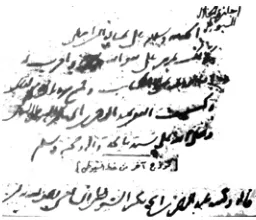
We are lucky here that Khayr al-Di>n al-Zirikli> in his encyclopaedia of the notable writers, al-A‘la>m, mentions two samples of the specimen of al-Suyu>t\i>’s handwriting. According to these samples, we could categorize al-Suyu>t\i>’s handwriting as Persian script or a script close to the Persian style. Therefore, we could draw a conclusion that MS. 347a was not written by the author himself.
Figure 1: Two examples of al-Suyu>t\i>’s handwritings Many works have been dedicated to certain figures by the authors themselves among whom are Ibn Khaldun (d. 808/1406) who dedicated an edition of his Ta>ri>kh to a Mamluks ruler, al-Z{a>hir Sayf al-Di>n Barqu>q (d. 1399), by adding his name Z{a>hiri> fi> ‘Ibar fi> Akhba>r ‘Arab wa al-‘Ajam wa al-Barbar; or Ibn Faris who composed a book on linguistics in the name of al-S|a>h}ib ibn ‘Abba>d (d. 385/995) and called it al-S|a>h}ibi> fi> Fiqh al-Lugha wa-Sunan al-‘Arab fi> Kala>miha>.27 al-Suyu>ti> himself had composed a book on foreign vocabularies in the Qur’a>n dedicated to an Abbasite chaliph of Cairo, al-Mutawakkil III (d. 945/1536) and called it –––––––––––––––––
26Arnoud Vrolijk, Bringing a Laugh, p. 88.
al-Mutawakkili>. The problem we have here is that we have no idea about the owner’s biography: when and where he lived. However, we still have enough evidence that the author did not dedicate this book to the owner, Khalifa ‘Abd al-Ba>qi> al-‘Ilmi>, since the author mentioned the title of the book with its original title, al-Muz}hir fi> ‘Ulu>m al-Lugha, without adding any word referring to a certain figure in MS. Or. 347a. The manuscript is bound with a likely Islamic bookbinding of the sixteenth century similar to the binding style of MS. Or. 347b.28 Therefore, we might assume that the writing period of MS. Or. 347a is still close to that of MS. Or. 347b, and accordingly it might belong to the passive authorization.
E. Collating Manuscripts: Editing Section 20
1. The Importance of Section 20 (al-Naw‘ al-‘Ishru>n)
As mentioned before, al-Suyu>t\i> is very much considered as an encyclopedic writer. Kita>b al-Muz}hir itself is his compilation of earlier philologists’ ideas on linguistics. Only a few of his opinions can be found in this book. He begins his book with the definition and genesis of language whether it is revealed by God (wah}y, tawqi>f), or part of human creation (is\t\ila>h}, tawa>t\u’), or a combination between God’s revelation and human creation. He mentions different linguistic opinions of philologists and scholars from different schools of theology.29 The first opinion is basically based upon God’s speech: And He taught Adam the names of all things (Q. 2:31) and the idea that God taught Adam those names and then taught human beings language through prophets after him. While the second refers to the idea that if language were divinely revealed, –––––––––––––––––
28For more detail information about Islamic bookbindings, see: Friedrich Sarre, Islamic Bookbindings, translated from the German manuscript by F.D. O’Byrne, (Berlin: Scarabeus-Verlag, 1923).
there must be a medium (s\ila) between God and humans, that was, a prophet because it is impossible that God speaks to every one of us. However, this idea is unacceptable because of the fact that every messenger sent by God was only situated in the language of their people: And We did not send any messenger but with the language of his people (Q. 14:4).30 The third one seems to fill the gap between these two different opinions; it is very possible that language has different sources. The discussions, however, tend to support the idea that God taught Adam the language, and then he spread it to human beings.
The importance of section 20 of this book is that the author gives us general description about the dynamics of the Arabic language within the influence of Islam as a new culture and ideology, and as the result of human interactions and transactions. The interactional function of language means how humans use language to interact with each other socially or emotionally, while the transactional function indicates how they use their linguistic abilities to communicate knowledge, skill, and information.31 These dynamics can be identified as follows: some words have had more specific meanings since the advent of Islam such as the word muslim, which originally has a notion of “to hand something over” or “to surrender”, and now is used to indicate someone who embraces Islam as his religion; and mu’min, which etymologically has a meaning of ama>n (peace) and tas\di>q (belief), and now has more a specific meaning, a believer in One God. Muslim philologists and linguists contend that all Islamic scientific terms belong to this category.32
Some other words have not been used anymore because they lost their meanings. The author mentions some words such as al-Mirba>‘, al-Nashi>t\a, and al-fud}u>l. Al-Mirba> means a quarter of the booty taken by a leader in the ja>hiliyya period; al-Nashi>t\a means what people took as booty –––––––––––––––––
30Al-Suyu>t\i>, al-Muz}hir fi> ‘Ulu>m al-Lugha wa-Anwa>‘iha>, eds.: Ah}mad Ja>d al-Mawla>, ‘Ali> Muh}ammad al-Baja>wi>, and Muh}ammad Abu> al-Fad}l Ibra>hi>m, 2nd ed. (Cairo: ‘I<sa> al-Ba>bi> al-H{alabi>, 1950), pp. 8-30. George Yule also indicates different opinions concerning the origins of language: the divine source, the natural-sound source, glossogenetics, physiological adaptation, and interactions and transactions; George Yule, The Study of Language, 2nd ed. (Cambridge: Cambridge University Press, 1996), pp. 1-6.
in their peace travel, not from their invasion; and al-fud}u>l means the small remainder of the booty which was not possible to distribute to a lot of soldiers. While the word al-s\afiy, which means part of the booty taken by a leader before its distribution (qisma) apart from his quarter, was attributed only to the Prophet PBUH.33 There are also some expressions which are extinct because the Prophet prohibits using them such as khabuthat nafsi> which means “I am disgusted or sick of something or somebody”. The prohibition is due to the ugliness of the word khabutha itself. 34
Furthermore, since the advent of Islam there have been many words and expressions produced by Muslims that subsequently become the words of the community. The term al-ja>hiliyya, for instance, is a term produced during the Islamic period to indicate a period before it. The Prophet Muhammad was also a very productive agent in the sense that there are many words and expressions coming from his sayings such as the word al-muh}arram, which replaces the sacred month named in the ja>hiliyya period s\afar al-awwal, and the sentence ma>ta h}atfa anfihi, which means somebody who naturally died, not because of murder. Some words and expressions had also been produced by other persons. We know the word al-julhuma from Abu Sufya>n (d. 630) which means a side of a valley.35 We know the word ba’jan wa>h}idan from Uthma>n ibn ‘Affa>n (d. 656) which means one way. The verbal noun of fa>d}a al-mayyit, ha>dha awa>n fawd}ih (it is the time of his death), is known only from Shurayh
–––––––––––––––––
33Ibid., pp. 296-7; see also footnote by the editors.
34It has been reported that the Prophet said: “Truly among you do not say
khabuthat nafsi> but say it laqisat nafsi>.” These two expressions have the same meaning, but it is detested to use the word khabutha due to its ugliness. Abi> ‘Ubayd al-Qa>sim ibn Salla>m al-Harawi>, Ghari>b al-H{adi>th, (Haydarabad: Da>’irat al-Ma‘a>rif al-‘Uthma>niyya, 1966), vol. III, pp. 333-4.
(d. 632), and the plural of al-dajja>l, al-daja>jila, is only known from Malik ibn Anas (d. 795).36 Investigating language from this perspective is known as sociolinguistics.
2. A Critical Edition of Section 20 of al-Muz}hir
According to Western scholarship on the theory of editing, an editor defines his perception of the relation between the author and the text. Editing activity could be author-based, if the author’s intention is knowable from the text, or text-based, if the authorial intention is unknown. The primary goal of editing itself is to receive a communication from the past.37 Editing Kita>b al-Muz}hir could be categorized as author-based since the author implicitly mentioned his intention of composing at the beginning of the book.38
In order to make a critical edition of a section of the book, I am going to make MS. Or. 347b as the based text, since it provides us with more detail information than the others. Here I would like to choose section 20 on “the Islamic words”, naw‘ ‘ishru>n: ma‘rifat alfa>z} al-Isla>miyya as an example of my critical edition of the book. For several reasons, it is interesting to make a critical edition of this chapter because it discusses the dynamics of the Arabic language, especially since the advent of Islam in the Arabian Peninsula at the beginning of the seventh century. To make the matter easier, I am going to use “A” to indicate MS. Or. 347a, “B” for MS. Or. 347b and “C” for MS. Or. 39. I also use the symbol “è” to indicate the symbol used by the scribe to fill the remaining spaces at the left margin. For some words which the scribe wrote them down with ya>’ instead of hamza, I will write them down on the contrary here.
–––––––––––––––––
36Al-Suyu>t\i>, al-Muz}hir, pp. 300-3.
37Al-Qadhi, Wadad, How ‘Sacred’ is the Text of an Arabic Medieval Manuscript? (in Theoretical approaches to the transmission and edition of Oriental manuscripts), Beirut: Orient-Institut and Wurzburg: Ergon, 2007, pp. 15-17.
–––––––––––––––––
–––––––––––––––––
––––––––––––––––– 53C:
54C:
55C:æ ßÇä åÐÇ ÚäÏåã áãÚäííä ÃÍÏåãÇ ÚäÏ ÇáÍÑãÇä ÅÐÇ ÓÆá áÅäÓÇä, ÞÇá: ÍÌÑÇ ãÍÌæÑÇis mentioned afterwards.
56Based on the printed edition of ‘I<sa> al-Ba>bi> al-H{alabi>, it is written al-qus\wa> (with qa>f). The scribe did not really care about diacritical dots throughout his copying.
–––––––––––––––––
–––––––––––––––––
–––––––––––––––––
B: The sentence " C:
is written twice by the scribe.
C:
with ‘ayn.
–––––––––––––––––
3. The Translation of the Arabic Text
Section twenty: Understanding Islamic Words. Ibn Fa>ris said in Fiqh al-Lugha chapter al-Asba>b al-Isla>miyya (Islamic influences): “In the pre–Islamic Arab period, the Arabs behaved according to their forebears’ legacies: their languages, literature, liturgies, and offerings. As Allah bestowed them Islam, several changes took place: their religions were abrogated; matters were annulled; some words changed from one meaning to another with some addition; and a number of laws were endorsed, the latter replaced the previous. The advent of Islam brought about the appearance of new terms such as mu’min, muslim, ka>fir, and
and B:
is preceded by waw,
not preceded by
@?`
muna>fiq. The Arabs merely knew mu’min from the word ama>n (safety, peace), and i>ma>n which means belief. The shari>‘a (religion) adds some conditions and features due to which a believer is called mu’min. It happens likewise with the words Isla>m and muslim. They only knew Islam from isla>m al-shay’ (to hand it over), and then the religion gives certain features to make the words as they are now understood. They also did not understand kufr, but only cover and veil. The word muna>fiq is used in Islam to indicate people who conceal attitudes different from the ones they actually reveal. The term originally derives from na>fiqa>’ al-yarbu>‘ (the hole of a rat). They did not know fisq but their saying “fasaqat al-rut\ba” when it breaks its shell. The religion thus defines that fisq means indifference from obedience to God.
Another word is al-s\a>la> which originally meant supplication in their language. They already knew ruku>‘ and suju>d but not as in this form. Abu> ‘Amr said: “asjada al-rajul” means he bows and twists his head. He chanted: it was said to him “asjid” to Layla and then it twisted its head. It means a camel when it twists its head so that you can ride on it. The same case, the word al-s\iya>m originally means “to refrain from”. The religion then adds some conditions of fasting such as intention and prohibition of having meal, sexual intercourse etc. They only knew al-h}ajj with a sense of intending to do something. The religion then adds some conditions and slogans of pilgrimage. The Arabs merely understood the word al-zaka> with the meaning of increasing (al-nama>’), and then the religion gives a new meaning to it. This happens in all subjects of fiqh. The reason is that when someone is asked about this changing, he may say: there are two meanings: etymological and terminological meanings. He should mention the meaning understood by the Arabs, and the new one brought by Islam. This also happens in all other disciplines such as Arabic grammar, versification (‘aru>d}) and poetry. Every word has two meanings: etymologic and terminological. [The words of Ibn Faris end]
delivered poetry in the pre-Islamic period and then converted to Islam, among whom are H{assa>n ibn Tha>bit, Labi>d ibn Rabi>‘a, Na>bigha ibn Ja‘da, Abu> Zubayd, ‘Amr ibn Sha‘sh, al-Zabarqa>n ibn Badr, ‘Amr ibn Ma‘di> Kariba, Ka‘b ibn Zuhayr and Ma‘n ibn Aws. The meaning of mukhad}ram derives from “khad}ramtu al-shay’a” which means “I cut it”; “khad}rama fula>n ‘at\iyyatahu>” means he cut it. Those people were called al-mukhad}ramu>n because they quitted being infidels in favour of Islam. It is also possible to say that their level of delivering poetry decreased because the position of poetry slackened in Islam when God revealed the Holy Arabic Book. For us, this idea is the most acceptable one because if it derives from al-qat\‘, everybody who quitted from ignorance (al-ja>hiliyya) in favour of Islam would be called mukhad}ram; the fact did not fit it.
There were words which had existed but then disappeared because their meanings disappeared such as al-mirba>‘,97 al-nashi>t\a,98 and al-fud}u>l.99 The case is different with the word al-s\afiy100 because the Prophet (PBUH) chose [his share] in some of his conquests. The predicate was attributed only to him. The word al-s\afiy disappeared when the Prophet died. Other words -which disappeared- are al-ita>wa (tax taken by a king), al-maks (tax taken from the sellers in a market during the ja>hiliyya period), and al-h}ulwa>n (a fee paid for a soothsayer). This also occurred in some expressions such as an‘im s\aba>h}an wa an‘im z}ala>man (God bless you in the morning and the night),101 their speech to a king: “abayta al-la‘na” (you have refused to do something bad for you).102 The same case occurs with a slave’s call to his owner “rabbi>” (my lord); slaves addressed their lords with “arba>b” (sing. rabb). A poet has said:
–––––––––––––––––
97Al-Mirba> means a quarter of the booty taken by a leader in the ja>hiliyya period.
98Al-Nashi>t\a means what people took as booty during their peaceful travel, not from their invasion.
99Al-fud}u>l means the small remain of the booty which was not possible to distribute to a lot of soldiers.
100Al-s\afiy means part of the booty taken by a leader before its distribution (qisma) apart from his quarter.
101This expression was used to pray for somebody.
Truly the lord of Kinda and his son surrendered there So did the lord of Ma‘ad between terrain and juniper.
Another word –which is not used anymore- is what they called someone who had not gone yet to the pilgrimage “s\aru>ra”, as the Prophet said: “there is no s\aru>ra (celibacy) in Islam.” It is said that the meaning is someone who abandons getting married in favour of celibacy, or who experiences a certain incident and then decides not to get married. Another word is their mentioning a camel which was set as dowry “al-nawa>fij”. Among the expressions, which are detested in Islam, are when a person says: khabuthat nafsi> (I am disgusted or sick of something or somebody), because a hadith prohibits using it, and the expression: ista’thara Alla>h bi fula>n (God appropriates [His paradise] for someone).103 Among the expressions which the Arabs used and then left is their expression “h}ijran mah}ju>ran”. The listener understood that the speaker intended to prohibit him. One said:
I approached to a short palm, then I said: “it is a forbidden thing totally prohibited,” for these misfortunes.
Another meaning [of this expression] is seeking of protection. When a person traveled and saw something frightening him, he would say “h}ijran mah}ju>ran” which meant it was forbidden for you to touch me. According to this meaning, the Word of God (Q. 25:22) is interpreted; “On the day when they shall see the angels, there shall be no joy on that day for the guilty, and they shall say: It is a forbidden thing totally prohibited.” The guilty say this expression when they are not in this world. [The words of Ibn Faris end].
Ibn Burha>n said in his book, al-Us\u>l, “Scholars varied in their opinions about names whether they were transported from etymological into terminological field. The jurists and the Mu‘tazilite scholars said that some of these words were transported such as s\awm (fasting), al-s\ala> (prayer), al-zaka> (almsgiving), and al-h}ajj (pilgrimage). Al-Qa>d}i> Abu> Bakr said: “the words remain in their etymological meanings, not transported [into terminological ones].” Ibn Burha>n said: the former –––––––––––––––––
opinion is the correct one because the Messenger of God PBUH transported them from the etymological meanings into the terminological ones. With this transportation, the words do not deviate from one of the Arabs’ classification of words, that is, metaphor (maja>z). This transportation also occurs when scholars of different disciplines: scholars of versification, grammarians, and jurists, produce certain terms such as al-naqd} (annulment), al-man‘ (prohibition), al-kasr (fracturing), al-qalb (inversion), al-rafa‘ (normative case), al-nas\b (accusative case), al-khafd} (genitive case), al-madi>d, and al-t\awi>l.” He said: “When God introduced this uncommon knowledge which was occupied by the religion, the first and the later generation did not recognize them because they never crossed to the Arabs’ mind. Therefore, there must be certain words to indicate these meanings. [end]
Among the scholars who belonged to the idea of transportation (naql) were Abu> Ish}a>q al-Shi>ra>zi> and Alikya>. Abu> Ish}a>q said: “This does not occur with the word “al-i>ma>n” since it remains in its etymological meaning.” He said: “This transportation is not always applied in all words, but depends on a particular reason.” al-Ta>j al-Sibki> said: “I found in the book of al-s\ala> by al-Ima>m Muh}ammad ibn Nas\r:” [it has been reported] from Abi> ‘Ubayd that he argued that God had transported the word “al-i>ma>n” from the etymological meaning into the terminological one; He had transported the words al-s\ala>, al-h}ajj etc. into other meanings. [Abu> Ish}a>q] said: “How about the word al-i>ma>n?” al-Sibki> said: “This indicates specifying the point of controversy concerning the word al-i>ma>n.
Al-Ima>m Fakhr al-Di>n and his pupils contended: “The transportation occurs -from God- in nouns (al-asma>’), not verbs (al-af‘a>l) and articles (al-h}uru>f). The transportation in these two does not inductively occur through the principal process of changing (bi t\ari>q al-as\a>la), but through the derivative one (bi t\ari>q al-tabi‘iyya). The word al-s\ala> requires the verb s\alla>. He said: “There is no transportation in synonymous nouns because this contradicts with the origin; they are measured according to the necessity.” al-Ima>m al-S|afiy al-Hindi>: “Yet this happens in the words al-fard} and al-wa>jib (obligatory), and the words al-tazwi>j and al-inka>h} (to marry).”
al-mawd}u>‘) of al-s\ala> by modifying its essence, the verbal noun (mas\dar) of the sentence anti t\a>liq (you are divorced): t\ala>q, the subject (ism al-fa>‘il) of the sentences anti t\a>liq and ana d}a>min (I am the guarantor), and the object (ism al-maf‘u>l) of al-t\ala>q, al-‘itq and al-wika>la, the s\ifa mushabbaha of anta h}urr (you are free), the perfective verb of expressions (al-insha>’a>t) in transaction and divorce, the imperfective verb of the word ashhadu (I witness) in testimony and curse, and the imperative form of al-i>ja>b and al-isti>ja>b in transaction, for instance, bi‘ni> wa’shtari minni> (sell to me and buy from me).
Ibn Durayd said in al-Jamhara: “al-jawa>’iz means gifts (sing. al-ja>’iza).” He said: “Some linguists mention that this word is an Islamic word which originally derives from a story in which a general of an army challenged his enemy. There was a river between him and his enemy. He said: “Who crossed this river he would deserve such and so.” He crossed successfully the river and took the prize. It has been said: He took his reward (ja>’iza). Therefore, it was called jawa>’iz (gifts, rewards).” Ibnu Durayd mentioned in al-Jamhara: “the word al-muh}arram was not known in the pre-Islamic period. Instead, it was said s\afar of two s\afars. The first s\afar was one of the sacred months. The Arabs sometimes sanctified it but sometimes fought in it, and sanctified the second s\afar as its replacement.
I say: “This is a beautiful explanation which I never find anywhere but in al-Jamhara. The Arabs mentioned s\afar al-awwal and s\afar al-tha>ni>, al-rabi>‘al-awwal and al-rabi>‘ al-tha>ni>, juma>da> al-u>la> and juma>da> al-a>khira. When Islam came, it abrograted al-nasi>’ (delaying the sacred month into another one) they had done. The Prophet PBUH then called it God’s month al-muh}arram, as mentioned in a hadith: the best fasting after Ramadhan is in God’s month al-muh}arram. From this, we know an anecdote: “God’s month, this attribute is never found in the rest of the months, even Ramadhan. Once I was asked about this anecdote. I did not know about it until I found Ibn Durayd’s presentation from which I knew the anecdote.”
is an Islamic term not known in the ja>hiliyya period which means somebody who converts to Islam with his tongu, not his heart. He is called muna>fiq deriving from na>fiqa>’ yarbu>‘ (the hole of a rat).” In al-Mujmal Ibn al-A‘ra>bi> said: “We never hear the term fa>siq, neither from the speech of ja>hiliyya people nor their poetry.” He said: “It is amazing. It is an Arabic term but never mentioned in the ja>hiliy poetry.” The same opinion is mentioned in al-S|ah}h}a>h}. In the book Laysa: “the meaning of al-d}urra>h} is understood only from a h}adi>th: “It is a house in the sky equivalent of the ka‘ba.
Al-tafath in pilgrimage means activities which include cutting nails, mustache, hair, and pubic hair, throwing stones, slaughtering camels and so forth. Abu ‘Ubayda said: “There is no poetry which deserves to be the argument.” In Fiqh al-Lugha of al-Tha‘a>labi>: “If somebody died not because of murder, this would be called ma>ta h}atfa anfihi.104 The first person who mentioned it was the Prophet PBUH.” [It is also mentioned] in Fiqh al-Lugha: “If a horse does not cease its running, they call it bah}r (sea) compared to sea whose water never ends. The first person who mentioned it was the Prophet PBUH to describe his horse he used to ride.”
Ibn Durayd said in al-Mujtaba> chapter: the terms coming from the Prophet never heard from the others: “Abd al-Awwal ibn Murid, a member of Bani> Anf al-Na>qa, reported from Bani> Sa‘d in Isna>d: Ali said: I never heard an Arabic word from the Arabs but I heard it from the Prophet PBUH. I heard him saying: ma>ta h}atfa anfihi. I had never heard it from an Arab before.” Ibn Durayd said: “h}atfa anfihi means that his soul leaves from his nose successively with his breath, because the unmurdered dead breathes on his bed until his breath ends. It belongs to the nose because breath ends from it.”
Ibn Durayd said: “Among the words which had not known from an Arab before are the sentence: la> yantat\ih}u fi>ha> ‘anza>n (two weak persons do not fight);105 the sentence: al-’a>na h}amiya al-wat\i>s (now the thing –––––––––––––––––
104The Arabs use this expression to indicate somebody who suddenly died, not because of beating or murder. Ibn al-Manz}u>r, Lisa>n al-’Arab, Cairo: Dar al-Ma’arif, 1981, vol. II, p. 770.
becomes harder);106 the sentence: la> yaldagh al-mu’min min h}ajar marratayn (a believer will never fall in the same hole); the sentence: al-h}arb khid‘a> (war is trick); and the sentence: iyya>kum wa h}ad}r al-diman.107
In al-S|ah}h}a>h} ibn Durayd said: “the meaning of al-s\i>r in the Prophet’s hadith is to crack the door. This is only known in the hadith.” He said: “Al-zama>ra in the hadith means a female adulterer.” Abu> ‘Ubayda said: “I never heard this word but only from this hadith. I do not know from which it derives.” [It is also mentioned] in it: al-julhuma with d}amma in a hadith of Abu Sufyan: “You hardly allow me until you allow me to pass the stone of two julhumas (two sides of the valley). Abu> ‘Ubayda said: he meant two sides of the valley.” He said: “I never heard al-julhuma but in this hadith. The word would never appear but must have its origin.”
In al-Tahdhi>b of al-Tabri>zi> in has been said: “Make this thing ba’jan wa>h}idan (with hamza); ba’jan wa>h}idan means one way.” It has been said that the first person who mentioned it was Uthman ibn ‘Affa>n. In Sharh} al-Fas\i>h} of Ibn Kha>lawayh: “Ibn Durayd reported from Abi> H{a>tim from al-As\mu‘i>: first time we heard the verbal noun (mas\dar) of the sentence: fa>d}a al-mayyit (he is dead) from Shurayh who said: ha>dha awa>n fawd}ih (it is the time of his death).” In the book of Laysa: “We never know from anyone the plural of the word al-dajja>l but from Malik ibn Anas, the jusrist of Medina. He said: “Ha>’ula>’i al-daja>jila (They are dajjals).”
F. Concluding Remarks
Identified as the manuscripts written several decades after the death of the author, MSS. Or. 39, Or. 347a and Or. 347b might be considered as the collated copies of the author’s autograph or as the copies collated with an approved copy by the author. Since the active agents of the emergence of these manuscripts are the scribes themselves, not the author, we might categorize them as the manuscripts which belong to the passive authorization. The different features of the manuscripts are back to the innovation of the scribes. The thoughtful arrangement of the manuscripts and the quality of paper and binding suggests that the –––––––––––––––––
106Ibid., vol. II, p. 1015.
107 stay away from a beautiful woman in a disgraceful place. Musnad Shiha>b Qad}a>’i>, no. 890; Ja>mi‘ Ah}a>di>th, no. 41842 (Al-Maktaba al-Shamila).
manuscripts were meant for public consumption or as special gifts to prominent figures rather than for private use. This describes its significant value for the readers, and how the book itself has been consumed in a wide scope.
The editing process is an inevitable step before manuscripts are widely published. The significance of editing itself is an attempt to make a triangle communication between the author, the text and the readers. To deal with manuscripts, an editor must take a certain position in order to obtain the aim of editing. Concerning Islamic Arabic manuscripts, not all the scribes were scholars. Many of them were professional scribes who earned money from copying manuscripts. Thus, it is highly possible that some of them made mistakes during their copying. That is why collating different manuscripts of the same book is an indispensable process before it is publicly published. Since Kita>b al-Muz}hir is one of the most important encyclopedic books in linguistics, it is a scholarly endeavour to treat it righteously in order to receive a communication from the past in the proper way.
BIBLIOGRAPHY
Brockelmann, Carl, Geschichte der Arabischen Litteratur (GAL), Leiden: Brill, 1943.
Déroche, François, “The Copyists’ Working Pace”, in Pfeiffer, Judith and Kropp, Manfred (eds.), Theoretical Approaches to the Transmission and Edition of Oriental Manuscripts, Beirut: Orient-Institut and Wurzburg: Ergon, 2007.
George Yule, The Study of Language, Cambridge [etc.]: Cambridge University Press, 1996, the 2nd edition.
Al-Harawi>, Abi> ‘Ubayd al-Qa>sim ibn Salla>m, Ghari>b al-H{adi>th, Haydarabad: Da>’irat al-Ma‘a>rif al-‘Uthma>niyya, 1966.
Ibn al-Manz}u>r, Lisa>n al-‘Arab, Cairo: Dar al-Ma’arif, 1981. Ibn Fa>ris, al-S|a>h}ibi>, Cairo: al-Maktaba al-Salafiyya, 1910.
—, Mu‘jam Maqa>yi>s al-Lugha, ed. Abd al-Salam Muhammad Harun, Cairo: Da>r Ih}ya>’ al-Kutub al-‘Arabiyya; ‘I<sa> al-Ba>bi> al-H{alabi>, 1947. Imam, Kamaluddin, Us\u>l al-H{isba fi> al-Isla>m, Cairo: Dar al-Hidaya, 1998. Kah}h}a>la, Umar Ridha, Mu‘jam al-Mu’allifi>n, Damascus: al-Taraqqi Press,
1958.
Khali>fa, H{aji>, Kashf al-Z{unu>n, Istanbul: Maarif Matbaasý, 1941.
Al-Mawardi, al-Ah}ka>m al-Sult\a>niyya wa al-Wila>ya>t al-Di>niyya, ed. Dr. Ah}mad Muba>rak al-Baghda>di>, Kuwait: Kuwait University Press, 1989. Meisami, Julie Scott and Starkey, Paul (eds.) Encyclopedia of Arabic Literature,
London and New York: Routledge, 1998.
Al-Qadi, Wadad, “How ‘Sacred’ is the Text of an Arabic Medieval Manuscript?”, in Pfeiffer, Judith and Kropp, Manfred (eds.), Theoretical Approaches to the Transmission and Edition of Oriental Manuscripts, Beirut: Orient-Institut, Wurzburg: Ergon, 2007. Rosenthal, Franz, The Technique and Approach of Muslim Scholarship, Roma:
Pontificium Institutum Biblicum, 1947.
Sezgin, Fuat, Geschichte des Arabichen Schrifttums (GAS), Frankfurt am Main: Institut für Geschichte der Arabisch-Islamischen Wissenschaften an der Johann Wolfgang Goethe-Universität, 2000.
Al-Suyu>t\i>, H{usn Muh}a>d}ara fi> Akhba>r Mis\r wa Qa>hira, Cairo: Bab al-Khalq, 1903.
—, Tah}adduth bi-Ni‘mat Alla>h, ed. Elisabeth Mary Sartin, Cairo: al-Mat\ba‘a al-‘Arabiyya al-Hadi>tha.
—, al-Muz}hir fi> ‘Ulu>m al-Lugha wa-Anwa>‘iha>, eds. Ah}mad Ja>d al-Mawla>, ‘Ali> Muh}ammad al-Baja>wi>, and Muh}ammad Abu> al-Fad}l Ibra>hi>m, Cairo: ‘I<sa> al-Ba>bi> al-H{alabi>, 1950, the 2nd edition.
Voorhoeve, P, Handlist of Arabic Manuscripts in the Library of the University of Leiden and Other Collections in the Netherlands, Leiden: Bibliotheca Universitatis, 1957.
Vrolijk, Arnoud, Bringing a Laugh to a Scowling Face, Leiden: Research School CNWS, School of Asian, African, and Amerindian Studies, 1998. Witkam, Jun Just, Inventory of the Oriental Manuscripts of the Library of the
University of Leiden, Leiden: Ter Lugt Press, 2007.
—, “Establishing the Stemma: Fact or Fiction?”, in Jan Just Witkam (ed.), Manuscripts of the Middle East Journal, Leiden: Ter Lugt Press, 1988.