P
ROCEEDINGS OF THE
I
NTERNATIONAL
C
ONFERENCE ON
U
NIVERSITY
-C
OMMUNITY
E
NGAGEMENT
Surabaya – Indonesia, 2 - 5 August 2016
ICON
UCE
2016
THE INTERNATIONAL CONFERENCE ON UNIVERSITY-COMMUNITY ENGAGEMENT
ii PROCEEDINGS OF THE INTERNATIONAL CONFERENCE ON UNIVERSITY-COMMUNITY ENGAGEMENT SURABAYA –INDONESIA,2-5AUGUST 2016
P
ROCEEDINGS OF THEI
NTERNATIONALC
ONFERENCE ONU
NIVERSITY-C
OMMUNITYE
NGAGEMENTPublished by the Committee of International Conference on University-Community Engagement (ICON UCE 2016), State Islamic University (UIN) of Sunan Ampel Surabaya, Indonesia.
Sulanam, Nabiela Naily, FY. Iwanebel (Eds.) Publication date: August 2016
PROCEEDINGS OF THE INTERNATIONAL CONFERENCE ON UNIVERSITY-COMMUNITY ENGAGEMENT
SURABAYA –INDONESIA,2-5AUGUST 2016 iii
Preface
Betterment of nations across the world has been the longest struggle in the history of mankind. In doing so, education is believed as the key to fasten the development. Yet, in the later development, university is seen as an ivory tower. Meanwhile, the synergy between university and community is important for the better future. Likewise, the university also needs to have partnership with community in oder to strengthen its development. Contextualization is crucial in order to develop knowledge and further develop skills of students and other academics. This is why UIN Sunan Ampel
Surabaya sets it’s commitment to be the community-engaged university.
UIN Sunan Ampel has been committed to this spirit since its beginning and is privileged to have countless benefits from learning together with community and CSO especially trough SILE/LLD project and develop its capacity to be the leading university in terms of university-community engagement. We believe now is the time for us to celebrate our hard work and hard work of others from universities and communities. We also believe that conference is important for sharing ideas and promote collaboration.
The idea of this conference is to promote spirit of collaboration among stakeholders to better the nation and the world as we believe that it is the key for the betterment of a nation and the world. It is also our hope that this conference creates space for champions in University-community engagement to celebrate their stories and can develop even wider networks. This is important because working on various projects that developing partnership between university and community is not an easy task. Gathering and being united can strengthen us and, hopefully, spread the idea and spirit even wider. We want more people and more champions to work on university community engagement for better Indonesia and the world.
With this spirit in mind, we held this international conference on university community engagement or ICONUCE 2016. We believe in the topic that is
iv PROCEEDINGS OF THE INTERNATIONAL CONFERENCE ON UNIVERSITY-COMMUNITY ENGAGEMENT SURABAYA –INDONESIA,2-5AUGUST 2016
cover University Community Engagement as global movement, campus social responsibility, becoming community-engaged university, and engagement for maximizing change. The parallels topics are rich in variety and in the depth of the discussion range from the theories, supporting policy, best practices and monitoring and evaluation mechanisms. These themes are developed with high hope that it will enrich the discussion and develop better the way UCE is developed in the future. The conference is also designed to have various ways of presentations from oral presentation, video, art performance and posters to maximize the learning and interaction processes.
As the head of the committee I thank all parties who have helped and contributed to success of ICONUCE 2016 at UIN Sunan Ampel Surabaya. On behalf of the committee, allow us to express our greatest gratitude towards the speakers, the reviewers and all the participants. We also thank the ministry of religious affairs of the republic of Indonesia, SILE/LLD project, GAC and other sponsors. We believe that such spirit of collaboration can
continue to grow in the future. Lets lead ‘collaborative creation for sustainable change’ ; for Indonesia and the world.
Surabaya – Indonesia, August 2016 Head of Committee
PROCEEDINGS OF THE INTERNATIONAL CONFERENCE ON UNIVERSITY-COMMUNITY ENGAGEMENT
SURABAYA –INDONESIA,2-5AUGUST 2016 v
Table of Content
Chapter 1
Opportunities and Challenges of University-Community
Engagement
1 – 22 Abd Rachman Assegaf | UIN Sunan Kalijaga Yogyakarta
Global-Local Context and Challenges of Academic Shifting Paradigm of Islamic Higher Education in Indonesia
23 – 36 Lailial Muhtifah and Zaenuddin | IAIN Pontianak
Patterns of Integration Democratic Governance, Gender, and Environment into the Curriculum Islamic Religious Universities in Indonesia
37 – 62 Luluk Fikri Zuhriyah | UIN Sunan Ampel Surabaya
Mengawal Perubahan di Perguruan Tinggi; Pengalaman LP2M Universitas Islam Negeri Sunan Ampel Surabaya dalam Penguatan Kemitraan Universitas dengan Masyarakat
63 - 90 Muhammad Fahmi | UIN Sunan Ampel Surabaya
Defeminisasi Kemiskinan Berbasis Komunitas di Mondoluku Wringinanom Gresik
91 - 116 Sukardi Abbas | IAIN Ternate
Konservasi Nyamplung (calophyllum inophylum l.) di Kawasan Pesisir Pantai Afetaduma Kecamatan Pulau Ternate Kota Ternate
117 – 142 Ros Mayasari | IAIN Kendari
Pengembangan Keterampilan Resilience Islam bagi Narapidana Perempuan di Lapas II A Kendari
143 – 164 Ainna Amalia FN | STAI Miftahul Ula, Nganjuk
vi PROCEEDINGS OF THE INTERNATIONAL CONFERENCE ON UNIVERSITY-COMMUNITY ENGAGEMENT SURABAYA –INDONESIA,2-5AUGUST 2016
Radikal di Surabaya Jawa Timur
165 – 180 Suswati Hendriani | IAIN Batusangkar
Empowering the Economy of the Informal Workers in the Tourism Object of Istano Basa Pagaruyung through Practical English Training
181 – 192 Nofel Nofiadri | IAIN Imam Bonjol Padang
Pendampingan Pendirian Sekolah Masyarakat (Community School) di Nagari Koto Nan Gadang Kota Payakumbuh Sumatera Barat
193 - 206 Ahkmad Zaini | IAI Ibrahimy Situbondo
Desain Dakwah Pemberdayaan Masyarakat melalui
Ekowisata Bahari di Kawasan Pantai Banongan Situbondo
Chapter 2
The Innovative, Sustainable and Applied Programs of
University Community Engagement
207 – 230 Santi Andriyani | UNISNU Jepara
Creativity-Based Empowerment of Housewives Community; A Case Study in Pekalongan Batealit Jepara
231 – 262 Salmah SaidandAM. Ali Amiruddin | UIN Alauddin Makassar
Social Entrepreneurship; Initiative Efforts from Higher Education Classrooms
263 – 280 Rizka Safriyani | UIN Sunan Ampel Surabaya
Empowering English Language Teaching Materials Selection through the Implementation of Service Learning
281 – 302 Hasnul Arifin Melayu | UIN Ar-Raniry, Banda Aceh
PROCEEDINGS OF THE INTERNATIONAL CONFERENCE ON UNIVERSITY-COMMUNITY ENGAGEMENT
SURABAYA –INDONESIA,2-5AUGUST 2016 vii
303 – 324 Fikri Mahzumi | UIN Sunan Ampel Surabaya
Imtihan 'Amali, Service Learning a la Pesantren Mambaus Sholihin Gresik; Paradigma Kemanfaatan Bagi Individu Lain
325 – 342 Riswanto | IAIN Bengkulu
Utilizing Second Hand Materials as Assisted Language Teaching Media for Madrasah Learners
343 – 362 Wahidin | IAIN Salatiga
Pemberdayaan Masyarakat Marjinal melalui Konseling Religius dan Pelatihan Life Skill Bidang Tata Rias serta Menjahit; Studi Kasus Kelompok Eks PSK di Lokalisasi Sembir Kelurahan Bugel Kecamatan Sidorejo Kota Salatiga Tahun 2015
363 – 388 Rohmawati | IAIN Tulungagung
Eliminasi Domestic Violence Berbasis Komunitas
389 – 408 Akh. Syamsul Muniri | STAI Al-Yasini Pasuruan
Pengembangan Kewirausahaan Sosial bagi Pemuda Muslim Pengangguran dari Ruang Kelas
409 – 430 Dony Handriawan | IAI Hamzanwadi NW Pancor
Reaktualisasi Pembelajaran Bahasa Arab Berbasis Pariwisata di Pulau Seribu Masjid
431 – 442 Evi Fatimatur R. and Abdulloh Hamid | UIN Sunan Ampel Surabaya
Developing Reading Culture of Madrasah and Pesantren in Surabaya City through Literacy volunteer Student Program
443 - 468 Wiwik Setiyani | UIN Sunan Ampel Surabaya
Agama Sebagai Perilaku Berbasis Harmoni Sosial;
Implementasi Service Learning Matakuliah Psikologi Agama
469 – 490 Aliva Rosdiana | UNISNU Jepara
viii PROCEEDINGS OF THE INTERNATIONAL CONFERENCE ON UNIVERSITY-COMMUNITY ENGAGEMENT SURABAYA –INDONESIA,2-5AUGUST 2016
491 – 506 Alfiana Yuli Efiyanti | UIN Maulana Malik Ibrahim Malang
Entrepreneurship Learning Model Development for Fisher-women in Sendang Biru Malang, East Java, Indonesia
507 – 524 Alisa Alfina | IKIP PGRI Madiun
Program Pelatihan Motivasi, Wawasan dan Ketrampilan untuk Anak Sekolah Dasar di Komunitas Belajar All Kids
525 – 546 Agus Eko Sujianto | IAIN Tulungagung
Model Pendidikan Wirausaha di Pesantren
547 - 576 Hj Siti Chodijah | UIN Sunan Gunung Djati Bandung
Comprehensive Guidance and Counseling Model in Relation with the Improvement of Moral Education (Development of Model By Academic Supervisor at the State Islamic
University of Sunan Gunung Djati Bandung)
Chapter 3
Methods and Approaches to Strengthen
University-Community Engagement
577 – 600 Binti Nur Asiyah | IAIN Tulungagung
Sharia Micro Financing Management on Women Moslem Community in Tulungagung
601 – 610 Safrilsyah | UIN Ar-Raniry Banda Aceh
The Reconstruction of the Islamic Inclusive Paradigm in Society: The Role of Civitas Academica UIN Ar-Raniry in Internal Conflict Areas in Aceh Province
611 – 628 Samsul Arifin | IAI Ibrahimy Situbondo
Meredam Konflik dengan Pola Kemitraan; Studi Kasus Pemberdayaan Petani Penggarap HGU Melalui Jamaah Sholawatan di Situbondo
629 – 652 Fatimah Zuhrah | UIN Sumatera Utara
PROCEEDINGS OF THE INTERNATIONAL CONFERENCE ON UNIVERSITY-COMMUNITY ENGAGEMENT
SURABAYA –INDONESIA,2-5AUGUST 2016 ix
Pasca Pengungsian, Desa Gung Pinto, Kec. Naman Teran Kabupaten Karo Sumatera Utara
653 – 676 Siti Nurhayati | STAIN Kediri
Peningkatan Pendidikan Anti Korupsi di Lembaga Pendidikan Islam Al Ma'aarij Desa Pacalan Kec. Plaosan Kab. Magetan
677 – 700 Dharma Setyawan | STAIN Jurai Siwo Metro
Re-Perform Intellectual Collective Bourdieu; Cangkir Kamisan Community in Building Creative Economy in Metro Lampung
701 – 714 Fauzi | UIN Ar-Raniry Banda Aceh
Training Tajhiz Mayit at Lamno Aceh Jaya
715 – 726 Nur Rusliah | STAIN Kerinci
Pendekatan Etnomatematika dalam Permainan Tradisional Anak di Wilayah Kerapatan Adat Koto Tengah Kota Sungai Penuh Propinsi Jambi
727 – 744 Sri Handayani and Fatati Nuryana | STAIN Pamekasan
Pemberdayaan Pengolahan Air Kelapa Secara Partisipatif di Desa Dik Kodik Gapura Timur melalui Program Pembinaan UMKM KJKS BMT NU Gapura
745 – 766 Nur Faizin | UIN Maliki, Malang
Optimalisasi Infaq Masjid untuk Pendampingan
Pemberdayaan Masyarakat Berbasis Masjid di Kecamatan Donomulyo Kabupaten Malang
767 – 796 Imam Mustofa | STAIN Jurai Siwo Metro
The Effectiveness of Community Service Program Students of State College for Islamic Studies Jurai Siwo of Metro Through Family Empowerment
797 – 808 Muhammad Wakhid Musthofa | UIN Sunan Kalijaga Yogyakarta
Toward A Hamlet of Self-Sufficient in Energy by
x PROCEEDINGS OF THE INTERNATIONAL CONFERENCE ON UNIVERSITY-COMMUNITY ENGAGEMENT SURABAYA –INDONESIA,2-5AUGUST 2016
Ration and Utilizing Biogas of Cow Dung
809 – 828 Sulaiman Mappiasse | IAIN Manado
University-Community Engagement as a Mode of Knowledge Production in Islamic Higher Education: Philosophical, Methodological, Policy Considerations
829 – 856 Aziza Meria | IAIN Imam Bonjol Padang
Penyelamatan Akidah Huffadz Daerah Terluar melalui Bimbingan Agama dan Mental di Sumatra Barat
857 – 880 Gustina | IAIN Batusangkar
Pengembangan Kompetensi Pendidik Anak Usia Dini Islam serta Penguatan Lembaga Pendidikan Anak Usia Dini Islam (PAUDI) di Kabupaten Tanah Datar, Sumatera Barat
881 – 896 Hj. Ika Yunia Fauzia | STIE Perbanas Surabaya
Pengembangan Softskill dalam Bisnis Syariah bagi Pelaku Usaha Mikro, Kecil dan Menengah (UMKM)
897 – 928 Sumarto | STAI MAARIF Kota Jambi
Community Engagement; Waste Management dengan Activated Carbon (Nano Porus Materials), Bioarang dan Kompos; Upaya Mengatasi Pengelolaan Sampah dengan Bioarang, Activated Carbon dan Kompos bagi Masyarakat Desa Parit dan Kebun IX Kecamatan Sungai Gelam
Kabupaten Muara Jambi
929 – 942 Fartika Ifriqia,dkk | STAIN Kediri
Pendidikan Kecakapan Hidup (Life Skill) pada ODHA (Orang Dengan HIV/AIDS) di Kota Kediri
943 – 962 Muh Shofiyuddin | UNISNU Jepara
English Training for The Productive Age Society in Janggalan Kota Kudus
963 – 980 Ardimen | IAIN Batusangkar
Pengembangan Intervensi Konseling untuk Pencegahan Aksi Bunuh Diri Berbasis Psikologi dan Budaya Lokal;
Sosio-PROCEEDINGS OF THE INTERNATIONAL CONFERENCE ON UNIVERSITY-COMMUNITY ENGAGEMENT
SURABAYA –INDONESIA,2-5AUGUST 2016 xi
Kultural dalam Pencegahan Aksi Bunuh Diri di Kabupaten Tanah Datar
981 – 1006 Evita Yuliatul Wahidah | STIT Muhammadiyah Bojonegoro
Pembinaan Karyawati untuk Mengembangkan Spiritual Quotient melalui Implementasi Program Tahsin, Tafsir dan Tahfidz Alquran Berbasis Masjid di KPP Pratama
Bojonegoro
1007 – 1026 Muhiddinur Kamal | IAIN Bukittinggi-Sumatera Barat
Perempuan Peladang, dari Perempuan Terkebelakang menuju Perempuan Berkembang; Pemberdayaan Berbasis Riset pada Perempuan Peladang di pinggir hutan Rimbo Air Karuah Bukit Talang- Limo Koto Kabupaten Pasaman
1027 - 1054 Lukmanul Hakim | IAIN Imam Bonjol Padang
Pemberdayaan Muslimah Minoritas melalui Pembinaan Peningkatan Kualitas Kegamaan di Kepulauan Mentawai
Chapter 4
Critical evaluation on the policy, theoretical framework,
and practice of university-community engagement
1055 – 1080 Jamil Suprihatiningrum | UIN Sunan Kalijaga Yogyakarta
Development of Index for Inclusion to Assess the
Inclusiveness of Islamic Schools and Islamic Universities (PTKI) in Indonesia
1081 – 1102 Serliah Nur and Ilham Alimuddin | Hasanuddin University
Mapping Asset Based Community Development (ABCD) using Geographic Information System (GIS) and Remote Sensing Data
xii PROCEEDINGS OF THE INTERNATIONAL CONFERENCE ON UNIVERSITY-COMMUNITY ENGAGEMENT SURABAYA –INDONESIA,2-5AUGUST 2016
Evaluation of Islamic Management of Beef Cattle Development Program of Lembaga Mandiri Mengakar Masyarakat; Case Study Pondok Pesantren Al Mawaddah Warrahmah Kolaka - Sulawesi Tenggara
1119 – 1128 Marzuki | UIN Sultan Syarif Kasim Riau
Information Technology Business Continuity and Disaster Preparedness Planning Patterns Case Study Oil and Gas Company In Indonesia
1129 – 1144 Harifuddin Halim | Universitas Pejuang RI Makassar
Komunitas Nelayan Miskin sebagai Laboratorium Sosial; Mengkonstruksi Perubahan dari Kepasrahan Menuju Kesadaran.
1145 – 1178 Moh Wardi | STAI Nazhatut Thullab Sampang
Pendampingan Sertifikasi Tanah Wakaf di Kecamatan Sampang
1179 – 1196 Masykur Wahid | IAIN SMH Banten
Bangkit dengan Kripik Singkong Rasa Coklat; Kerja Nyata Komunitas Ciherang
1197 - 1210 Wahidah Zein Br Siregar | UIN Sunan Ampel Surabaya
The Process of Making Gender Equality and Mainstreaming Policy at the State Islamic University of Sunan Ampel
PROCEEDINGS OF THE INTERNATIONAL CONFERENCE ON UNIVERSITY-COMMUNITY ENGAGEMENT
SURABAYA –INDONESIA,2-5AUGUST 2016 1055
Chapter 4
Critical Evaluation on the Policy,
PROCEEDINGS OF THE INTERNATIONAL CONFERENCE ON UNIVERSITY-COMMUNITY ENGAGEMENT
SURABAYA –INDONESIA,2-5AUGUST 2016 1129
Poor Fishermen Community as Social Laboratory;
Constructing Change from Resignation to Awareness
H
ARIFUDDINH
ALIMUniversitas Pejuang RI Makassar, Indonesia [email protected]
R
ASYIDAHZ
AINUDDINUniversitas Bosowa Makassar, Indonesia [email protected]
Abstract: The poverty in the fisher community viewed clearly in lower education level, lower of social participation, the quality of home dwelling is under standard, lower income, etc. Many research found the poverty is in two aspect, they called structural poverty and cultural poverty. Structurally, the poverty regarded to the less of access by the fishermen to public sphere, political sphere, and broader social-economic sphere. Culturally, the fisher have less rational instrumental ethical work, non-oriented long term, tend to fatalist, resigned and deterministic. In the university, the social-culture of fisher community is knowledge space and social laboratory for developing the community change. The fisher community has its social-culture system evolutionary, meanwhile the university has its scientific basic progressively, constructively, futuristically as well as oriented to human wellbeing. University is always identically to knowledge and science that involving rational instrumental and rational of value. Meanwhile, in the fisher community both rational occur unbalancing. This condition bring the fisher to poverty. In that context, university has its legal in science and knowledge with collaborating to fisher community in life changing to prosperity life by constructed their human awareness.
Keywords: Fisher Community, University, Social Laboratory, Poverty, Wellbeing, Awareness
Introduction
1130 PROCEEDINGS OF THE INTERNATIONAL CONFERENCE ON UNIVERSITY-COMMUNITY ENGAGEMENT SURABAYA –INDONESIA,2-5AUGUST 2016
roofs, bamboo floors or sandy soil, and limited furniture, and daily consumption under standard. Moreover, the conflict is an important part of their life, burning and sinking of boat, pegging in coastal areas as a sign and border for other fisher picking up fish.
Anriani (2012, vi) research about conflict between modern fishermen and traditional fishermen in seizing the marine resource found that the modern fishermen who has cut-edge fishing gear spent up all of kind of fish, so that the traditional fishermen who has non modern fishing gear and limited area in the sea did not get fish anymore.
Hakim’s research (2013, 9) about social-culture aspect of fishermen community under constructed of past history, found that the traditional fishermen personality was deterministic, fatalistic, resigned, less passion for developing, short-term oriented, and low work ethic constructed by sufism by a long history of Islam spreading in southern coastal of South Sulawesi.
Kamaruddin research (2010) about social stratification of fishermen community consist of 3 stratas, namely: (1) ‘punggawa’ in the highest strata
as capital owner, (2) ‘sawi’ in the middle strata as labor to support ‘punggawa’, and (3) ‘pa’palele’ or ‘pa’bilolang’ in the lowest strata as fencers
and fish sellers at auction.
In the fisher community social stratification, there is a strong working relation between them called ‘patron-client’ relations. This working relation
explained by Sallatang (1982) that the relation between ‘Punggawa’ and
‘Sawi’ is an interest relation that supported by kinship relation or likely. The
relation is the most appearing, particularly between top ‘punggawa’ and little
‘punggawa’ and between top ’punggawa’ to ‘Sawi’. This is also supported by
Salman (2006) who found the fisher situation in South Sulawesi that has ‘patron-client’ relation significantly if it compared to agricultural society or urban society. Therefore, the developing in production that caused by the modernization is not followed yet by the changing of ‘patron-client’ relation to industrial-relation that is contractually.
Based on the fishermen community poverty above, trillion of fund disbursed in past implemented in various government programs. The programs such as Jaring Pengaman Kemiskinan (JPS), Bantuan Tunai Langsung, PNPM Mandiri are not shown yet the good results.
PROCEEDINGS OF THE INTERNATIONAL CONFERENCE ON UNIVERSITY-COMMUNITY ENGAGEMENT
SURABAYA –INDONESIA,2-5AUGUST 2016 1131
Term ‘social laboratory’ is identical to academic space. In it, the academicians explored many problems and their roots based on the rational-empiric as science indicator and also keep solutions. This will be strong if the fisher community not only as the data source but also they find by their selves solution.
The Realities of Fisher Community as Social Laboratory
The Most Strong of Social Structure
Mukhlis and Kathryn Robinson (1985) in their research found that fisher community in South Sulawesi has organized in functionally grouped and driven by ‘Punggawa’. The working relation between ‘Punggawa’ and
‘Sawi’ formed social system that involving the society and their groups.
Therefore, ‘Punggawa’ has a honour status by its role. ‘Punggawa’ role is
lead the team in seizing fish by using trawl, butterflyfish, boat controlled by ‘Sawi’. In this case, ‘Sawi’ follow ‘Punggawa’ and both are functional group
with strong group-awareness. It could be said that member in one
‘Punggawa’ is under the open-group and the relation between them
functionally.
‘Punggawa’ has role as owner of fish equipment like trawl,
butterflyfish that controlled by some ‘Sawi’. Pa’ppalele/Pa’bilolang
distributed fish to consumer. This grup has about 20-40 members and called compatible with the equipment, such as: lanra, panambe, trawl, butterflyfish, and bagang.
The working relation of ‘punggawa’ and ‘sawi’ in the group is in
temporary situation because the ‘Sawi’ is freelance. The working relation occurred only in one sailing. In fact, the working relation would be permanent because of some factors, such as ‘Sawi’ has credit to ‘Punggawa’
and ‘Sawi’ pay by work to ‘Punggawa’. The relation between ‘Punggawa, Pa’palele or Pa’bilolang’ and ‘Sawi’ stated by Mukhlis and Robinson (1985) has specific motives that explain separately as follows:
1. Relationship between Punggawa with Pa’palele/Pa’bilolang
1132 PROCEEDINGS OF THE INTERNATIONAL CONFERENCE ON UNIVERSITY-COMMUNITY ENGAGEMENT SURABAYA –INDONESIA,2-5AUGUST 2016
need in accelerating and popularizing the catching production.
Pa’ppalele/Pa’bilolang is a freeman for their selves or for other people.
2. Relationship between ‘Punggawa’ and ‘Sawi’
Generally, relationship between ‘Punggawa’ and ‘Sawi’ based on some relation motives, such as; firstly, ‘sawi’ is a member of kinship of
Punggawa that work together based on their family. Secondly, the
relation motive based on the same work orientation. In this case, Sawi is an outsider kinship as freeman and without bond. The diligent ‘Sawi’ often respected until ‘sawi’ stand with its ‘punggawa’ as in its status
called ‘juragang’. If the relationship of ‘Sawi’ and ‘Punggawa’ take place
for a long time, there could be a willingness for Sawi to repay ‘Punggawa’.
This condition fetter ‘Sawi’ to work forever in ‘Punggawa’. 3. Relationship between sawi with pa’palele/pa’bilolang
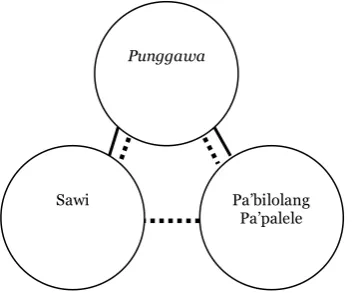
Between sawi and pa’palele/pa’bilolang there is only each functional relationship. ‘Sawi’ is not follower of pa’palele/pa’bilolang but follower of ‘Punggawa’. Duty of ‘Sawi’ only catching fish, meanwhile duty of
pa’palele/pa’bilolang is distribute fish to consumer or to the market. They
work together based on the same interest. Structurally, their group relation seen as follow:
Figure 1: ‘Punggawa’–‘Sawi’ Relations
Notes:
_______ structural relations --- functional relations
Unfinished Conflict
Fishery has a complexity system due to many people has interest in it. The vital component in it is traditional fishermen as the most level. Part of them live in out of area with limited alternative job, so their life is in poverty.
Punggawa
Sawi Pa’bilolang
PROCEEDINGS OF THE INTERNATIONAL CONFERENCE ON UNIVERSITY-COMMUNITY ENGAGEMENT
SURABAYA –INDONESIA,2-5AUGUST 2016 1133
In the social-economic aspect, use of marine resources is still limit to corporate business and foreign business. The whole fishers in Indonesia are the poorest profession (Sumintarsih et al. 2005).
Generally, the fishery conflict related to utilization of sea resources that rare is. The rare resources related to production aspect, it is less and less of fish in the sea. This condition make difficult to fisher community life. Generally, the sides get involved in that conflict are local fishers. The various of conflict caused of the different perceptions between fishers in managing the resource of fish. It is also caused of the hunting principle where the fisher must hunt fishes everywhere. This will be impact to the fisheries competition. In this fact, there is a moment that all of fishers will be in the same place and the same time in catching fish.
The fish and others in the sea are common property and the count of the common property are many. From the sea aspect or territorial aspect, Indonesia is also a common property in practicing with many members of them. Sea is owned by all Indonesian people. By the nature of sea resources like that, both of modern fishermen and traditional fishermen together in catching fish from the same and the linking resources, even from the same fishing ground. In this situation, Bailey (1988, 26) state “…the situation in fisheries is even worse than in agriculture because fishers directly compete
with one another over a finite resource”. This has potential in happening ‘the
tragedy of the common’ that state by Gareth Hardin (1970). In this competition of sea resources, the traditional or local fishers will lose from the modern fishers.
Deterministic Culture
Deterministic culture in a half of fisher community, set the fatalistic personality as a central of historical research. Along historical research, the religion appreciation formed cognitive assumption of basic problem in fatalistic life, caused the instrumental value undeveloped and at the end become poverty.
The spreading Islam in South Sulawesi was under the protection and the power of Bugis Makassar empire. Therefore, Islam in South Sulawesi has a special character differently in other area. The people beliefs Islam but inside part they still also believe to animism and dynamism.
1134 PROCEEDINGS OF THE INTERNATIONAL CONFERENCE ON UNIVERSITY-COMMUNITY ENGAGEMENT SURABAYA –INDONESIA,2-5AUGUST 2016
to five basic problems as Kluckhohn (Koentjaraningrat, 1982, 31) state, namely; nature of life, nature of work, the human perception of time, mankind's view of nature and the nature of human relationships with each other that determines the value orientation of human culture.
The apprication of nature of life momently, signed in working just for subsistence, life orientation more for hereafter, devastating to nature, as well as more dependent to others therefore it is no need to effort hardly. This cultural human orientation is in fatalistic personality. In Islamic psychological view, this belief called ‘jabariyyah’ theology and tend to be apathetic and less of instrumental value.
Most part of fisher community in South Sulawesi particularly, they accustomed to the old tradition and belief that in the faerie as in the real world every space lived by ghost. The fisher community communicated to the ghost’s soul by giving offerings and praying. This ritual occurs from pre Islam in the past until today. Fortune, fate, destiny believed from the faerie because it is from God. The faerie controlled by God messenger, therefore the better life aspect (better income, prosperity, luckiness) must be reach by supra natural way. It done by esteem the controller of sacred sphere. This meant that there is a dual belief, one side believes to the ghost as fortune source and other side believed to Allah as fortune giving.
This inmost aspect shown the fisher community tend to be passively, therefore their rational instrumental value is undeveloped. They prioritized pray and mystic ritual than effort to develop their rational instrumental value. In this aspect, McClelland (1987, 48) relevantly state that a cultural is in lower nAch has more attention to their tradition maintaining especially in religion aspect.
Ritual as symbol of cosmology
The fisher community generally work as fishermen when the catching fish season is coming, when the rainy season comes they work as peasant. Sea makes them as fisherman and rice field makes them also as peasant. They must work both in different time to sustain their family life.
PROCEEDINGS OF THE INTERNATIONAL CONFERENCE ON UNIVERSITY-COMMUNITY ENGAGEMENT
SURABAYA –INDONESIA,2-5AUGUST 2016 1135
In the fisher community, social relation is not based on the pragmatic consideration but every social relation encircled by symbolic constructions that explain, justify and set it. Therefore, whatever ritual related to public phenomenon the actors must shown to public how the event happen. All of social relation surrounded by rituals must be pay by work, money and property. This must do because the ritual is a traditional obligation.
In the other side, the fisher community believed the ritual and even they obligate their selves in doing the animistic rituals for example thank full ceremony of plenty full production, inauguration ceremony of new ship or boat, and inauguration ceremony of ship or boat reparation.
In occurred all three ceremonies above mentioned prioritize the compatibility between place and space, as well as best time and kind of event that will done. The important thing in the ceremony is every ceremony related to sea resources utilization, the ceremony must face the sea.
Through the ceremony, the fisher hoped avoiding any disruption of supernatural beings, especially when the group performs the shipping and fishing. In addition, they also hope to get protection from the ancestors and from the Almighty to safety, happiness, and prosperity in their daily survival. Therefore, the meaning of religious ceremony and custom ceremony, not only for people who still alive, but also for people that died, especially to the ancestors.
Various types of fisher traditional ceremonies that part of the belief system that must occurred by groups of fisher, among others, are:
Production thankful offering ceremony
The production thankful offering ceremony is one of ceremony in the fisher community. This ceremony occurred by fisher groups when there are many beneficiary they get from catching fish. Therefore, the fisher is in obligation to do the ceremony.
1136 PROCEEDINGS OF THE INTERNATIONAL CONFERENCE ON UNIVERSITY-COMMUNITY ENGAGEMENT SURABAYA –INDONESIA,2-5AUGUST 2016
The accumulation of material ceremony mentioned before is the main equipment must be prepared by the fisher befor the ceremony occurred. For the bos ‘punggawa’ and ship ‘punggawa’ called ‘juragang’ that have got
successful in catching fish, generally they slaughtered a buffalo or a goat. Generally, the fisher community in who live in the southern of south Sulawesi province believe on the thankful ceremony. Through occurring the ceremony, it have a function to neutralize the sea from the supra natural dimension. At least, it could quite the sea guard that they believe can make troubles their work. The fisher community also believed that by doing ritual it could influence more of fish production. At least, the meanings of this ceremony are giving an easy and continuity for them in sailing and catching fish.
This production thankful offering ceremony is also same with another ceremony that led by a priest called ‘Sanro’ or ‘Daeng Imang’. This conducted in the beach and start by slaughtering a buffalo or a goat. In the mean time, the other material of ceremony prepared for conducting ‘barzanji’. When this step over, so the all process of this ritual is finish. At same time ritual finished, other people who attended the ceremony taking the offering concurrently. This offering put in a vessel from woven bamboo called
‘rakit-rakit’ resemble mats. The content of the offering are four kind meals.
This is also as main equipment for the ritual. The ‘rakit-rakit’ floated in the
sea as an offering to the sea guard.
About the slaughterd animal, they brought to bos ‘punggawa’ home after ‘barzanji’ finish. When the meat enter there, the wife prepared the meat
and other meals for dinner. This activity conducted together with other wives of ‘Sawi’,Punggawa kecil’, their kinship., as well as their neighbor.
New ship releasing ritual ceremony
This New ship releasing ritual ceremony occurred by fisher community at the time the ship used in the first time to sail in the sea by its owner. Through this ceremony the fisher community have big expectation in utilizing the ship in order it gives a safety in the sailing and also get much results in catching fish. In this ritual ceremony, there are some materials as requirements in its occurring. The fisher must prepare that, such as; layer cake, bananas, white and black sticky rice, Arecas, banana leafs, eggs, griddle with water inside, tobacco, sugar, rooster and hen.
All of material ceremony mentioned above put in a crock called
PROCEEDINGS OF THE INTERNATIONAL CONFERENCE ON UNIVERSITY-COMMUNITY ENGAGEMENT
SURABAYA –INDONESIA,2-5AUGUST 2016 1137
Arecas, and sticky rice collected and wrapped by using banana leafs. This material wrapped called ‘pa’rappo’ means bear fruits. The substantial meaning of it that the ship the fisher use as the main tool of their work in the sea will be better. At least, the new ship is better than the old ship.
When all of the needed material ceremony prepared, then the priest occurred ‘barzanji’. After ‘barzanji’ over, the priest call ‘sandro’ recite
‘mantera’ or praying and at the same time, the priest take three betel leaves
and a pan of water. The priest splashed the water in the pan to the body of the ship by using the three leafs of betel. The parts of the ships are the back part, the front part, the center as a stomach, the right side, and the left side.
When that process finish, the priest take a banana, a layer of cake, an Areca and the material put in to the fifth parts of the ship or boat. The fifth parts are the back part, the front part, the center as a stomach, right side and left side. Amount of each layer cake, Bananas, Arecas are five in every parts of the ship.
Every material ceremony mentioned above has meaning itself. Some of them are layer cake that means layers sustenance, bananas means growing sustenance, areca means upset sustenance. The fifth parts of ship mentioned above for the fisher community means a small urgent part that must be protected. Therefore, all of the fifth parts must have defense function. By ritual ceremony, the fisher believed they put in a supra natural guard as an angel.
When the ceremony process is over, the priest start to say “bismillah” and shove the boat to sea together with the other local people attend the ritual ceremony. The ritual ceremony process finish by putting the brass inside of raft made from the banana stem with its content. Then, the raft shoved to the sea. The fish community meant this process as dedication to the sea security. This last process of ceremony done carefully because of there is often trance to attendee if a mistaken came in the process.
The occurring of ritual ceremony above, generally started from boss
‘Punggawa’ home then finish in the beach. This ceremony also involves the
members of ‘punggawa’ groups. The meaning of this ceremony is about hopefulness on safety in sailing and successful to work in catching fishes.
Safety ritual ceremony
1138 PROCEEDINGS OF THE INTERNATIONAL CONFERENCE ON UNIVERSITY-COMMUNITY ENGAGEMENT SURABAYA –INDONESIA,2-5AUGUST 2016
the old boat or ship that have been renovated. This ritual ritual ceremony resembled to ritual of release of boat or ship ceremony.
According to the belief of fisher community, when a boat or ship has used in the sea then it improved by them, so they believe that there is a ghost live in the ship and will run out. Based on that belief, they must do a ritual ceremony to call back the ghost in securing the boat/ship.
About the ‘securing ritual ceremony’, the fisher community celebrated once a year for every boat or ship. If there is a boat or ship has used and in damaged condition until docking, so as the boat will improve. After the boat improve, there will be a ritual ceremony again before the boat brought to the sea. In this situation, there are two ritual ceremonies at the same time, namely; ‘Upacara Selamatan‘ or Boat or Ship securing ritual ceremony and
‘Upacara Pelepasan’ or Boat or Ship deliverance ritual ceremony. Both ritual
ceremonies have orientation and meaning itself.
Viewing the ritual process above, this means that the ceremony procedure involving place and space aspect related to cultural heritage especially myth that exist there for a long time by the ancestor. In that context, there indicate a syncretic of value between value of traditional custom ritual of fisher community and value of religious ceremony that comes from Islamic teaching al-qur’an and Hadits. This shown by praying
mantera in a ritual ceremony by starting to say “Bismillahirrahmanirrahim”
and followed by the local language mantera of Bugis and Makassar. The end of praying is finis by saying “Kunfayakun”. In every ritual ceremony, there is a special thing as a leader who called ‘Daeng Imang’ as a priest.
The occurring of fisher custom ceremony is a kind of honor and glory to their ancestor. They dedicated the ceremony in order they got protections of soul’s harassment and get security and wellbeing.
The fisher community in the southern coastal of South Sulawesi province generally believe in Islam fanatically. Viewing their behavior, attitude, and mind, they influenced extremely by animistic belief. The conditions seems from their belief to the supra natural power exist in the sea and beach. They also sacred them by many kinds of fisher ritual ceremony. The ritual ceremony also tend to domesticate, to glorify, and to persuade the soul in the supra natural world that can bother their fisher activities (Arifin 2014).
PROCEEDINGS OF THE INTERNATIONAL CONFERENCE ON UNIVERSITY-COMMUNITY ENGAGEMENT
SURABAYA –INDONESIA,2-5AUGUST 2016 1139
teaching alqur’an dan Hadist. The values sourced from immanently belief (fisher custom) and transcend belief (Islam) have been used in fisher community as power to imperishable their relation to supra natural world (Arifin 2014).
For the groups of fisher in this area, the supra natural power appreciated as a power unreached by human mind (ultimate reality), therefore they need worship, tamed and domestication through ceremony as media. Behind that all, they are expected it to create a relationship adjustment or persuasive relationship to the natural marine environment (Arifin 2014).
Collaboration between fisher community with university
Positioning of university
The complexity problems of society demand the responsibility of university as the most legal institution to solve it scientifically. University is part of society, therefore the duty of it is viewing the dynamic of society. University did not decide the policy or execution problems, but it contributes in problem solving.
Regarding to description above, there are some perspective from educational expert, such as; Astin (Nurkhoiri 2012), said that the high education has substantially in resulting knowledge and sciences, technology and art. Moreover, it produce graduates relevantly to the demand of development. This addressed by Fasli Jalal (Nurkhoiri 2012), that research is one of the three pillars in the university (education, research, and community service) naturally has important role in the global era.
There are also some research function in the university stated by Suyanto, such as; establishing the academic culture, solving the human problems, renewal the lecturer’s knowledge, empowering the learning method professionally (Nurkhoiri 2012).
Bambang Soehendro (Nurkhoiri 2012) also state that research in the university tend to; getting the new knowledge, resulting researcher, updating knowledge and capability in science and technology in order the university may compile, divert, spread and implementing science and knowledge for human wellbeing.
1140 PROCEEDINGS OF THE INTERNATIONAL CONFERENCE ON UNIVERSITY-COMMUNITY ENGAGEMENT SURABAYA –INDONESIA,2-5AUGUST 2016
development, such as; developing training research to prepare and upgrade the research potentiality, developing research regarding to science and knowledge as well as developing society, also kind of solving problem models multidisciplinary, developing the science meeting to disseminate the research results and to review and evaluate the research, develop the research publication, developing the inter-university cooperation and with the research agencies. Clark Kerr (Nurkhoiri 2012) also state that to develop research net, it needed collaboration net inter-university, entrepreneurship and government.
Dedi Supriadi (Nurkhoiri 2012) state his agreement about the benefit in cooperation between university and entrepreneurship, namely; the cooperation as a media for the lecturer and student to know the entrepreneurship and industry to examine the theory in practicing. The cooperation opens chance to be research-based university, the cooperation shown the institution achievement of the university, lecturer and its institution may get income.
PRA as strategy to develop awareness
Participatory Rural Appraisal means researching the village situation
in participating aspect. PRA is always in progress, so Chambers (1996) define this as a collecting method and approaching driven society to participate in developing and analyze their knowledge of life and their selves, so that they may plan action.
The principles of PRA according to Chambers (1996) are related to develop the local knowledge with indicators: learning each other and respect the diversity. Experiences and knowledge of local people and outsider may complementary each other in the same value as long as people fixing the choice. Triangulation principle in developing available knowledge and science by check and recheck. The strategy is diversification in outsider perspective (science and experiences diversification), diversification in local perspective (background, social status, sex perspective), and various of learning method. Optimizing the results in arrange the local knowledge.
Discussion
PROCEEDINGS OF THE INTERNATIONAL CONFERENCE ON UNIVERSITY-COMMUNITY ENGAGEMENT
SURABAYA –INDONESIA,2-5AUGUST 2016 1141
change effort. The effort can erase the inequality, injustice, poverty and a marginal position society (Arkanuddin 2009).
For collaborating to society, the university research must be part of social transformation and social movement. Without it, the university will reach its aim, or only just retainer of liberal culture and economical market. The contribution to social transformation could be reach by implementing research method that taking side and integrating to social change dynamic. One of strategy to change the comfort research in the university is implementing the action research.
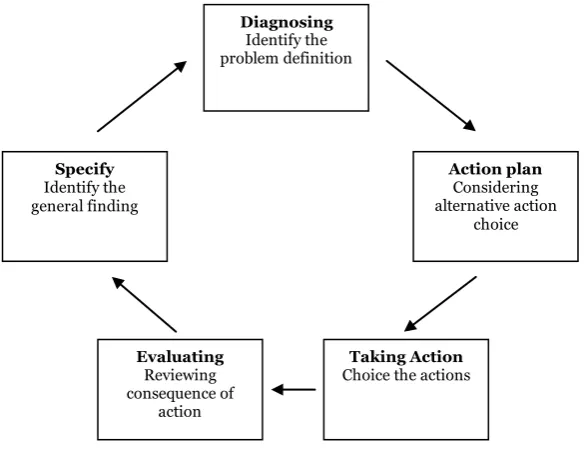
In the Thomas Gilmore, et.al., (1986) perspectives, action research oriented to two things, namely: as an emphasize to problems facing by fisher community as well as answering the aim of science. Therefore, action research collaborate research commitment in developing change.
Figure 2: Action research model (Susman 1993)
Based on the figure above, research action is an related process each other. Starting from diagnosis, action plan, doing action, evaluating and identify, then diagnosis process occur sustainable until the process get results.
In the research action, the researcher and the object form a collaboration complementary in making change. Research and action plan as requirement done in early study. Student has many basic theory, concept, and capabilities integrating to society. Therefore, students prepared their
1142 PROCEEDINGS OF THE INTERNATIONAL CONFERENCE ON UNIVERSITY-COMMUNITY ENGAGEMENT SURABAYA –INDONESIA,2-5AUGUST 2016
selves in understanding problems, planning action, evaluating and noting the sustainable action research (Arkanuddin 2009).
Conclusion
In the fishermen community especially the middle level turn down has complexity problem as caused of their underdevelopment. Their strong social structure, a long conflict, deterministic cultures are the grand theme inside of them.
Various approached implemented to solve the problems and most of them are not success yet. Among the implemented approached is based on the local people knowledge that called ‘participatory rural appraisal’.
By using the participatory rural appraisal, university can plan things such as; Developing collaboration groups of fisher community, Constructing learning action for fisher community to raising their social awareness, Establishing a strategic policy for better life changing, Setting the fisher community to develop basic science relevantly to their need in respond to the dynamic changing by using the local resources. []
Bibliography
Anriani, Haslinda B. “Konflik dan Perubahan Sosial: Studi Pada Komunitas
Nelayan Di Teluk Palu Sulawesi Tengah”. Disertasi Tidak Diterbitkan.
PPS Universitas Negeri Makassar: Makassar. 2012.
Arifin, Ansar. “Perangkap Kemiskinan dan Kekerasan Struktural di Balik
Relasi Kerja Punggawa-Sawi”. Jakarta: Orbit Publishing. 2014.
Arkanuddin, 2009. “Optimalisasi Peran Perguruan Tinggi”.
Arkandien.blog-spot.co.id. April 2009. diakses 22 Juni 2016.
http://arkandien.-blogspot.co.id/2009/04/optimalisasi-peran-perguruan-tinggi.html.
Bailey, Conner. “Mengelola Sumberdaya yang Terbuka: Kasus
Penangkapan Ikan di Daerah Pantai” dalam David C. Korten dan
Syahrir (ed) Pembangunan Berdimensi Kerakyatan. Jakarta : Yayasan Obor Indonesia. 1998.
Chambers, Robert. PRA: “Memahami Desa Secara Partisipatif”. Yogyakarta:
Kanisius dan Oxfam. 1996.
PROCEEDINGS OF THE INTERNATIONAL CONFERENCE ON UNIVERSITY-COMMUNITY ENGAGEMENT
SURABAYA –INDONESIA,2-5AUGUST 2016 1143
Hakim, Maksud. “Sufisme dan Transformasi Kultural Nelayan”. Jakarta: Orbit Publishing. 2013.
Hardin, G. “The Tragedy of the Commons” dalam Garret de Bell (Ed), 1970.
The Environmental Handbook. Prepared for the First National Environtmental Teach-In. Ballantine Books Inc., Intext Publisher, New York. 1970.
Kamaruddin, Syamsu A. “Stratifikasi dan Mobilitas Sosial: Studi Sosiologis
Pada Masyarakat Nelayan”. Jakarta: Orbit Publishing. 2010.
Koentjaraningrat. “Pengantar Antropologi”. Jakarta: Raja Grafindo Persada.
1982.
McClelland, David C. “Memacu Masyarakat Berprestasi”. Alih Bahasa Siswo Suyanto. Jakarta : Intermedia. 1987.
Nurkhoiri, 2012. “Prospek Membangun Prestasi Penelitian”. nurkhoiri-online.blogspot.co.id Februari 2012. 20 Juni 2016. http://nurkhoi-
rionline.blogspot.co.id/2012/02/prospek-membangun-prestasi-penelitian.html.
Robinson Kathryn dan Mukhlis. “Masyarakat Pantai”. Lephas. Sulawesi Selatan. 1978.
Sallatang, M. Arifin, “Pinggawa Sawi, Suatu Studi Sosiologi Kelompok
Kecil”. (Disertasi) Universitas Hasanuddin. 1982.
Salman, Darmawan. “Jagat Maritim: Dialektika Modernitas dan Artikulasi Kapitalisme pada Komunitas Konjo Pesisir di Sulawesi Selatan”,
Makassar: Ininnawa. 2006.
Sumintarsih. et. al. “Kearifan Lokal di Lingkungan Masyarakat Nelayan
Madura”. Yogyakarta: Kementerian Kebudayaan dan Pariwisata: Balai
Kajian Sejarah dan Nilai Tradisional Yogyakarta. 2005.