EFFECT OF CHAMBER PRESSURE ON ELECTRICAL IMPEDANCE OF A
LOW-FREQUENCY NITROGEN PLASMA IN A MEDIUM VACUUM REACTOR
D.J.D.H. Santjojo1, Setyawan P.Sakti2, Wijono3 and Waru Djuriatno4
1,2 Physics Department, University of Brawijaya, Jl. Veteran 2 Malang 65145, Indonesia 3,4 Electrical Engineering Department, University of Brawijaya, Jl. Veteran 2 Malang 65145, Indonesia
Email: 1[email protected], 2[email protected], 3[email protected], 4[email protected]
ABSTRACT capacitive plasma reactor utilizing 40 kHz
generator. The pressure was varied from 0.4 –
4.7 torrs. Results of this work indicated that the pressure in the range significantly affects the electrical impedance. The increase of the chamber pressure decreased the capacitive reactance while increased the resistance. The capacitive plasma indicates the plasma was controlled by excitation and ionization process, while the resistive plasma exhibits complex reactions due to collisions. improve their hardness or surfaces of sensors to improve their functions. The nitrogen plasma is preferable due to its abundance. Furthermore, nitrogen is considered safe to the environment and can be simply released to the atmosphere. There are a number of requirements need to be met in operating a plasma system in general and the nitrogen plasma system in particular. A certain thermal equilibrium condition should be maintained to obtain a stable and controllable plasma. Plasma state generally can be realized and maintained at sufficiently high temperature for the material to be ionized. The temperature required to produce plasmas from pure substances in thermal equilibrium ranges from 4000K to 20,000K (Inan and Golkowski, 2011).
The temperature which is the kinetic energy of the plasma cannot be measured directly because it consists of various state of the neutral and ionized gas. Indirectly, the temperature of ion and electron can be predicted by means of Langmuir measurements. The measurement involves inserting a probe (Langmuir probe) into the plasma. The probe collecting either ions or electrons with a variation of the bias voltage applied to the probe. I-V plot resulted from the measurement is explored to determine the ion temperature and other parameters of the plasma such as electron temperature and ion density.
In plasma processing, information related to ion temperature and density are very important. They determine reactions and processes on the surface of objects in the plasma. The dynamic of the plasma changes over time due to the character of the plasma itself and the particular processes. Although the dynamic of plasma creates variation in ions temperature, the whole plasma is neutral and in thermal equilibrium state. A certain plasma environment such as pressure, temperature and power can affect the thermal equilibrium of the plasma. The thermal equilibrium condition can be achieved by optimizing system parameter i.e. pressure, gas flow rate and electric power.
impedance measurement. An equivalent circuit is utilized to model and understand the physical process via the electrical measurement of the plasma. A number of different methods and technique have been applied to determination the plasma impedance, such as: (a) power dissipation and impedance measurement in RF discharges (Spiliopoulos et al, 1996), (b) measuring current, voltage and impedance in RF plasma, and (c) asymmetric electrical characteristics (Sobolewski, 1995). However, there is no measurement system which suitable to measure impedance in all plasma discharges. This work utilizes a simple voltage and current measurement using series and shunt resistors.
An electrical model which represent any conditions and behavior of the plasma was built and used characterize the plasma system. Computation using numerical approximation was used to simulate the behavior of the plasma. Results of the simulation were then compared to experimental data. As a case study, the model was used to predict the character of the plasma from different pressure regimes of the plasma system. At this stage, the characteristic information obtained from the measurement and the model have not been utilized to predict the plasma parameters i.e. ion temperature, ion density and electron density. However, this work is important as a part of a dedicated control system design for the low 40 kHz frequency plasma system.
2. EXPERIMENT
This study was carried out on a nitrogen plasma system consisting of a mini vacuum chamber, a gas handling and pumping system and a plasma generator as shown in figure 1.
Inside the chamber two electrodes were arranged to form simple capacitor resulted in a capacitive plasma. The plasma generator utilized in this study is a low frequency 40 kHz
generator equipped with an automatic
impedance matching unit. A PXI 1000P controller from National Instruments with Labview software platform installed is utilized to monitor and control the plasma system.
Figure 1. Nitrogen plasma system
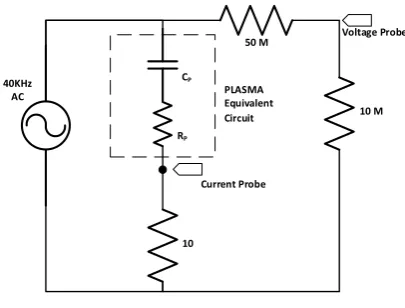
Data from the plasma system is acquired via SCB 68 interface unit and PXI 6225 module. The voltage and current data were picked up by means of a simple voltage divider and resistive current detector as shown in fig. 2.
Figure 2. Schematic diagram of Voltage and Current Detector
Signals from the probes are processed in the Labview platform. Variables measured in this study were chamber pressure, generated voltage and load current. The Labview monitored and showed the measured variables and another parameter such as frequency (kHz), Vrms (volt), Irms (A), phase (degree) and total impedance Z (ohm).
The nitrogen plasma understudied was produced from an ultra-high purity nitrogen gas. The gas was injected into the chamber through a flow rate controller. During the investigation, the pressure of the chamber was adjusted by controlling the flow rate.
50 M
10 M
10 CP
40KHz AC
Current Probe
Voltage Probe
RP
3. DISCUSSION
Nitrogen plasma consists of a number of possible species depending mainly on chamber pressure and the applied electrical power. During this study, the electrical power was kept constant at 100 watts. This work did not identify the species exist in the plasma. However, a
previous study using optical emission
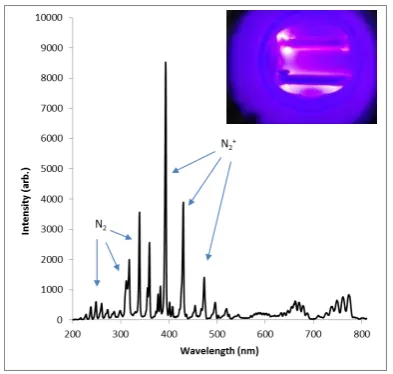
spectroscopy (OES), shows that nitrogen plasma consists of neutral nitrogen molecule N2, excited atom N* and molecules N2*, and ions such as N+ and N2+ (Santjojo and Aizawa, 2014; Santjojo and Aizawa, 2015). Figure 3 shows a typical nitrogen spectrum in the range of 200-800 nm. The observed color of the plasma in this study is similar to the one in the reference. Darker sites are related to molecular nitrogen electronic transition. The brighter plasma indicates more intensity from atomic or ions electronic transitions.
Figure 3. Emission of nitrogen plasma (adapted from Santjojo & Aizawa, 2015)
Argon as a noble gas is an inert gas. The species affect states and properties of the plasma. One of the properties is the electrical property which depends on the charges distributions and kinetics. The charges can originate from ions and electron. During the plasma process, the density and temperature of ions and electron change the electrical characteristic of the plasma. However, their
relationship is not trivial due to the electrical properties of the plasma not only depends on the electron density and temperature parameters. Since every plasma system has a unique plasma character, it is important to understand the relationship between the system, process parameters and the plasma parameters. The general process parameters are the input electrical power, gas flow rate and chamber pressure.
Our measurements of voltage and current with different chamber pressure indicate substantial changes of the plasma electrical property. Figure 4 shows the volt-ampere characteristic of the 40 kHz nitrogen plasma at medium vacuum chamber.
Figure 4. Volt-Ampere characteristic of 40 kHz nitrogen plasma at (a) 0.4 Torr, (b) 4.7
Torr
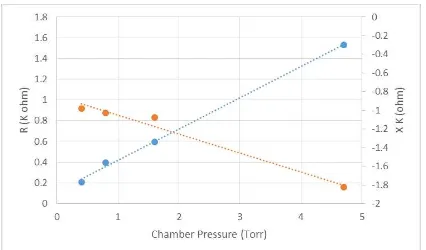
It can be seen from the figure 4, that the voltage and current flow in pulses. At a low pressure of 0.4 torrs, the voltage and current are not in phase indicating the capacitive behavior of the plasma. On the other way, at a higher pressure of 4,7 torrs, the voltage and current are in phase indicating a resistive process. By means of the Labview software, the electrical impedance can be calculated. Figure 5 shows the change of electrical resistivity and capacitive reactivity of the plasma related to the variation of chamber pressure.
(a)
Figure 5. Relation of resistance and capacitive reactance of nitrogen plasma with variation of
chamber pressure
In a capacitive plasma system, the electrical behavior is firstly controlled by electric capacitance produced by the parallel plate structure of the electrodes. This behavior is dominant in the low chamber pressure. At the low pressure, the nitrogen gas has a long free-path leading to a long life charges. Nitrogen gas consists of mainly triple bond molecules. Sufficiently high electrical power between the two electrodes may produce nitrogen ion in the plasma. The long life nitrogen ions reside in the middle of the two electrodes while the electron mostly resides close to the top and bottom electrode. This is due to the electron is much lighter than the nitrogen ions. The separation of the two kinds of the charges also is contributed to the capacitive reactance of the plasma system.
The result of measurements shows that the increase in pressure leads to a linear decrease of the capacitive reactance and increase of resistance of the plasma. The chamber pressure controls the density of the plasma. Furthermore, it also affects collisions and reactions in the plasma. In the high-pressure plasma, the free path of the particles is short due to collisions. The electric energy was converted into kinetic energy. This lead to high energy plasma. In turn, this energy may be transferred to the wall of the chamber which becoming hotter. Another process that arises from the high-pressure chamber is recombination and chemical plasma reactions. By recognizing the color of the plasma qualitatively, it can be predicted that some reactions below may occur in the plasma.
e + N2 N2+ (B) + 2e obvious that the high-pressure regime produces brighter emission as well as hotter plasma. The electrical energy was effectively converted into light and heat. This condition was reflected in the resistive impedance of the plasma where the voltage and current were found in phase. The energy can also be stored in the plasma. This storing mechanism creates more separation of electron and ions. If the separation continues over time, the plasma becomes unstable due to the appearance of arc discharge where electron travels from one electrode to another via the conductive plasma.
4. CONCLUSION
There was a significant effect of chamber pressure on electrical impedance. The result of voltage-current measurements shows that the increase of chamber pressure decreased capacitive reactance of the plasma but increased the resistance of it. The change of the electrical impedance was related to the condition and state of the plasma which can be observed from the optical emission. At lower pressure, the character plasma was controlled by excitation and a little ionization process while at higher pressure the character it was strongly affected by collisions leading to complex reactions. In the future, the relation between the electrical and the optical emission can be investigated and utilized to monitor and control the conditions and the state of the plasma.
5. ACKNOWLEDGEMENT
6. REFERENCES
INAN, U. S. & GOLKOWSKI, M. 2011.
Principles of Plasma Physics for Engineers and Scientists, First.Ed. Cambridge University Press, New York.
SANTJOJO, D. J. AND AIZAWA, T. 2014. Formation of Expanded Martensite in Plasma Nitrided AISI420 Stainless Steel. Proceeding of The 8th South East Asia Technical University Consortium (SEATUC) Symposium, 4-5 March, Malaysia.
SANTJOJO, D. J., ISTIROYAH AND AIZAWA, T. 2015. Dynamics of Nitrogen and Hydrogen Species in a
High Rate Plasma Nitriding of Martensitic Stainless. Proceeding of The 9th South East Asia Technical University Consortium (SEATUC) Symposium, 27-30 July, Thailand. SOBOLEWSKI, M. A. 1995. Characteristics of
Argon Radio Frequency Glow
Discharges in an Asymmetric Cell.
IEEE Transaction on Plasma Science, 23(6), 1006–1008.
SPILIOPOULOS, MATARAS, D. &
RAPAKOULIAS, D. E. 1996. Power
dissipation and impedance
measurements in radio-frequency