Improving Classroom
Learning with ICT
Improving Classroom Learning with ICTexamines the ways in which ICT can be used in the classroom to enhance teaching and learning in different settings and across different subjects.
Weaving together evidence of teachers’ and learners’ experiences of ICT, the authors:
• explain why the process of integrating ICT is not straightforward; • discuss whether hardware and infrastructure alone are sufficient
to ensure full integration and exploitation of ICT investment; • emphasise the pivotal role that teachers play in supporting
learning with ICT across the curriculum;
• argue that teachers need a greater understanding of how to put ICT to use in teaching and learning;
• highlight that out-of-school use of ICT has an impact on in-school learning;
• discuss what kinds of professional development are most effec-tive in supporting teachers to use technologies creaeffec-tively and productively.
Case studies are used to illustrate key issues and to elaborate a range of theoretical ideas that can be used in the classroom.
This book will be of interest to all those concerned with maximising the benefits of ICT in the classroom.
Rosamund Sutherlandis Professor of Education at the University of Bristol, UK.
Susan Robertson is Professor of Sociology of Education at the University of Bristol, UK.
Series Editor: Andrew Pollard, Director of the ESRC Teaching and Learning Programme
Improving Learning How to Learn: Classrooms, schools and networks
Mary James, Robert McCormick, Paul Black, Patrick Carmichael, Mary-Jane Drummond, Alison Fox, John MacBeath, Bethan Marshall, David Pedder, Richard Procter, Sue Swaffield, Joanna Swann and Dylan William
Improving Literacy by Teaching Morphemes Terezinha Nunes and Peter Bryant
Improving Schools, Developing Inclusion Mel Ainscow, Tony Booth and Alan Dyson
Improving Subject Teaching: Lessons from research in science education
Robin Millar, John Leach, Jonathan Osborne and Mary Radcliffe
Improving Learning at Work
Karen Evans, Phil Hodkinson, Helen Rainbird and Lorna Unwin
Improving Learning through Consulting Pupils Jean Rudduck and Donald McIntyre
Improving Learning Cultures in Further Education: Understanding how students learn
Improving Classroom
Learning with ICT
Rosamund Sutherland,
Susan Robertson and
Peter John
2 Park Square, Milton Park, Abingdon, Oxon OX14 4RN Simultaneously published in the USA and Canada by Routledge
270 Madison Ave, New York, NY 10016
Routledge is an imprint of the Taylor & Francis Group, an informa business
© 2009 Rosamund Sutherland, Susan Robertson and Peter John for selection and editorial material; individual chapters, the contributors
All rights reserved. No part of this book may be reprinted or reproduced or utilised in any form or by any electronic, mechanical, or other means, now known or hereafter invented, including photocopying and recording, or in any information storage or retrieval system, without permission in writing from the publishers.
British Library Cataloguing in Publication Data A catalogue record for this book is available from the British Library
Library of Congress Cataloging in Publication Data Improving classroom learning with ICT /
Rosamund Sutherland . . . [et al.]. p. cm. – (Improving learning TLRP)
Includes bibliographical references and index.
1. Computer-assisted instruction. 2. Educational technology. 3. Information technology. 4. Education–Effect of
technological innovations on I. Sutherland, Rosamund, 1947– LB1028.5.I434 2009
371.33’4–dc22 2008025406
ISBN10: 0–415–46173–1 (hbk) ISBN10: 0–415–46174–X (pbk) ISBN10: 0–203–88534–1 (ebk)
ISBN13: 978–0–415–46173–3 (hbk) ISBN13: 978–0–415–46174–0 (pbk) ISBN13: 978–0–203–88534–5 (ebk)
This edition published in the Taylor & Francis e-Library, 2008.
“To purchase your own copy of this or any of Taylor & Francis or Routledge’s collection of thousands of eBooks please go to www.eBookstore.tandf.co.uk.”
Contents
List of illustrations x
Acknowledgements xii
Contributors xiii
Authors’ preface xiv
PART 1
What are the issues?
1
1 A holistic approach to understanding
teaching and learning with ICT 3
What is the issue? 3 Why does this matter? 4 Achieving change 6 Developing professionals 6
Video as a tool for investigating teaching and learning 7
Vignette 1: A teacher reflects on the use of video 8 Using theory and research to inform practice 9 Building knowledge about ICT 11
Case study 1:Learning about functions and graphs 12
Case study 2: Using e-mail to develop understanding of how a sense of audience shapes writing 15
A teacher’s perspective on researching ICT and learning 17 Summary and conclusions 22
PART 2
What does the research tell us?
27
2 Intergrating ICT in teaching and learning 29
Incidental, idiosyncratic and intentional learning 32
Case study 1:Learning language in the primary school 34
Case study 2: Geometry and proof in the secondary school 39
Understanding and exploiting the potential of ICTs 44 Developing common understandings and knowledge 46 Which tools should be privileged? 46
Summary and conclusions 47
3 Learning and technology 49
Introduction – the finger-tip effect 49
Case study: The use of VirtualFishtank in a primary science lesson 50
Interpreting what happened in the classroom – a complex mix of people, culture and technology 56
The instrumentation framework 59
How can instrumentation explain what happened in the VirtualFishtank lesson? 62
The artefact – VirtualFishtank 63 Instruments constructed by students 64 Some other examples of instrumentation 65 Summary and conclusions 67
4 The enabled practitioner 70
Introduction 71
Vignette 1: Ian Thompson 71 The concept of community 73 Layers of community 75
Micro-communities and the investigation of practice 78 An illustration of community learning 81
Vignette 2: Rachel Yates – ‘Thinking it through’ 81 Towards the ‘enabled practitioner’ 83
Summary and conclusions 86
5 Creative designs for learning 88
Liberating constraints 88
Composing in music 95
Case study 2: Dance eJay in the primary school 95
Case study 3: Music for film in the secondary school 99
Case study 4: Enhancing geographical enquiry 105 Freedoms and constraints 109
Summary and conclusions 113
6 Discerning literacy 115
What does it mean to be literate? 115 Research context 119
Multimodal practice: gains and losses 120 Writing with language/working with images 125
Case study 1: Writing Alice 126
Case study 2: PowerPoint poetry 128
Multimodality, the web and literary value 132 Students as discerners of literacy 135
Summary and conclusions 136
7 ‘Aliens in the classroom 2’: when technology
meets classroom life 138
Vignette: Alien 2 139 Introduction 141
Opening the technology ‘black box’ 142
Toward a local ecology of knowledge production with ICTs 145
New economies of knowledge production 147 Classrooms as particular kinds of digitally mediated
social formations 153
‘Assemblages’: a metaphor for seeing classrooms as dynamic social formations 154
Summary and conclusions 155
8 Connecting cultures: home and school
uses of ICT 158
Using computers and the Internet in the home 159 Constructing the computer and Internet in the home 159 Contours of participation in digital cultures outside school 162 Family practices 162
Vignette 1: Alan the family information gatherer 163
Vignette 2:A teacher in the corner of the home 164
Vignette 3: Being a rock musician 165
Comparing patterns of computer and Internet use at home and school 166
When games go to school 167 Colliding or concurring cultures 174 Summary and conclusions 176
PART 3
What are the overall implications?
179
9 Breaking into the curriculum: the impact of
information technology on schooling 181
ICT and society 181
ICT and school geography 187 Future subjects/geographies 189 Summary and conclusions 192
10 Designs and theories for learning 195
Introduction 195
Learning, tools and culture 197
Case study 1: Learning data handling in the primary school 198
Improving learning with ICT – developing a toolkit 201 Ways into knowledge worlds – the role of language 203 The classroom as a knowledge-building community 204 Summary and conclusions 206
11 From ‘should be’ and ‘can be’ to ‘will be’: reflections and new directions on improving
learning with ICT 208
‘Breaking open’ to ‘break into’ ICT discourses to insert curriculum and pedagogical substance and meaning 210 Designing the conditions for learning with technology 213 Concluding remarks 215
Methodological appendix 216
Objective and aims 216
Subject design teams and initiatives 217 Research themes 219
Research methods 219 Analytical techniques 226
Bibliography 229
Index 238
Figures
1.1 Learning about functions and graphs 13
1.2 E-mailing a Viking 16
2.1 Teacher-made ‘activity’ for reading and recognising the
phoneme /e/ 35
2.2 Overview of data collected by Joe 36
2.3 Excerpt from final PowerPoint proof for one group
of students 43
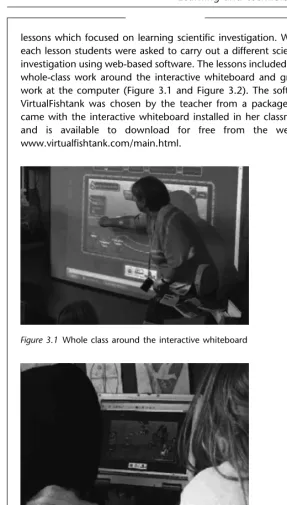
3.1 Whole class around the interactive whiteboard 51 3.2 Pupils using VirtualFishtank in groups at the
computer 51
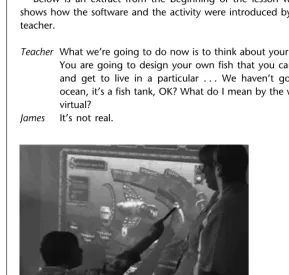
3.3 Student designing a fish using the interactive
whiteboard 52
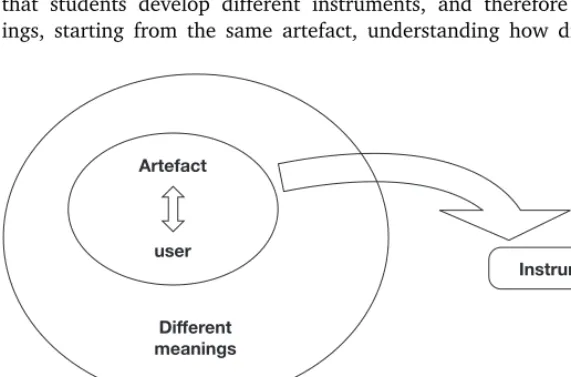
3.4 The instrumentation process 59
3.5 Instrumental orchestration 61
3.6 Interface of VirtualFishtank.com 63
3.7 The instrumentation processes in the VirtualFishtank
case study 66
5.1 The ‘Forms’ toolbar in Word 90
5.2 Section of an early design of a Year 10 writing frame
showing a drop-down menu 91
5.3 Longer writing model adapted using student feedback 93 5.4 Opening of ‘Dream Mix’: demonstration track provided
with the software 97
6.1 Multimodal presentation by students aged 12–13 years 121 6.2 Extract from a multimodal response to Alice in
Wonderland 123
6.4 This sequence represents three animations within one
slide 128
7.1 Excerpt from Google search 150
8.1 Young people’s experience of computer activity at
home and school (2003) 160
Tables
A.1 Number of researchers, teacher educators, research
students and teachers in each subject design team 218 A.2 Overview of data collected within the project 221 A.3 Sample profile for 2001 and 2003 surveys (%) 222
The InterActive Education project (2000–4) was made possible by a grant from the Economic and Social Research Council (ESRC). It was one of the Teaching and Learning Research Programme projects and we are indebted to the ESRC and the TLRP for their support. Mary O’Connell was the administrator for the project and has continued to support the writing of this book. We are deeply grateful to Mary for her loyalty, creativity and absolute commitment to the project and know that the book would not have been finished without her contribution. The InterActive project was a partnership between teachers and researchers, and we would like to thank the following people for the major contribution they made to the project: David Badlan, Dave Baker, Linda Baggott La Velle, Rebecca Ball, Dick Bateman, Bryan Berry, Rob Beswetherwick, Raj Bhakerd, Andrew Bigg, Chas Blacker, Adrian Blight, Kate Bouverie-Brine, Jan Bovill, Stephanie Bower, Helena Brazier, Linda Bridgeman, Chris Carter, Charmaine Clarke, Andrew Cleaver, Ruth Cole, Sarah Curran, Chris Davies, Ian Davies, Liz Dunbar, Rachel Edwards, Thamir Elzubaidi, Alan George, Stephen Godwin, Louise Hamilton, Phil Hamilton, Gary Handley, Andrew Harman, Catherine Harvey, Jo Heppinstall, Natalie Heysham, Ben Houghton, Judi Johnston Hubbold, Nick Jones, Rod Jones, Marie Joubert, Pam Kelly, John Lang, Liz Lang, Nicky McAllister, Sam Mills, Simon Mills, Heidi Moulder, Suzanne Nash, Ros O’Connor, Pat Peel, Sven Rees, Catherine Roberston, Andrew Rome, Muriel Saffon, Emma Scott-Cook, Joe Sharp, Ian Shedden, Tim Shortis, Richard Shotton, Baldev Singh, Paul Stephens-Wood, Daniel Such, Jude Swailes, Paul Taylor, Maria Thompson, Ian Thomson, Toby Tyas, Nigel Varley, Geof Warnock, Marnie Weeden, Aled Williams, Paul Wilson, Jocelyn Wishart, Rachel Yates, Rachel Zewde.
Contributors
Nick Breeze, Graduate School of Education, University of Bristol. Roger Dale, Graduate School of Education, University of Bristol.
Keri Facer, Education & Social Research Institute, Manchester Metropolitan University.
Marina Gall, Graduate School of Education, University of Bristol.
Peter John, Thames Valley University, London.
Elisabeth Lazarus, Graduate School of Education, University of Bristol.
Sasha Matthewman, Graduate School of Education, University of Bristol.
John Morgan, Graduate School of Education, University of Bristol.
Federica Olivero, Graduate School of Education, University of Bristol.
Susan Robertson, Graduate School of Education, University of Bristol.
Dan Sutch, Futurelab.
Rosamund Sutherland, Graduate School of Education, University of Bristol.
Celia Tidmarsh, Graduate School of Education, University of Bristol.
What are the issues?
Chapter 1*
* This chapter has been authored by Pat Triggs and Rosamund Sutherland.
A holistic approach to
understanding teaching
and learning with ICT
Computer-based technologies can be powerful pedagogical tools – not just rich sources of information, but extensions of human capabilities and contexts for social interactions.
(Bransford et al.2000, p. 218)
What is the issue?
The keynote quotation for this chapter presents a vision for the use of ICTs in teaching and learning that we share. It is ten years since Bransford and his colleagues articulated this idea of digital tech-nologies as ‘powerful pedagogical tools’. How near are we today to releasing the potential of new technologies to enhance teaching and learning in different settings and across different subjects?
Statistics show that between 2000 and 2006 large and ongoing government investment in technology resulted in a steady improve-ment in computer : student ratios in primary and secondary schools in the UK. In 2006, on average, there was one computer for every six students; in secondary schools there was one computer for 3.6 students.1Laptops became more available along with an increase in
wireless connectivity.2 Interactive whiteboards became a feature of
many classrooms, especially in secondary schools. The central commit-ment to technology has been and remains a feature of educational policy documents. However, throughout this period the consistent message is that new digital technologies were and are being incor-porated only inconsistently by practitioners in UK schools.3
presentation software and word processing, of downloaded and online resources in lesson planning and delivery increased. Aside from whole-class activity, uses of ICT remain in general limited to word processing and Internet search.4 These tools appear deceptively
transparent, while other technologies are perceived as more complex and challenging to use. However, assumptions that these more familiar uses of technology are unproblematic in relation to learning require examination.
Measures of the ‘e-maturity’5 of schools show wide variations in
the extent to which use of technology is embedded in teaching and learning. School inspectors report that on average only two in six secondary school subject departments make effective use of ICT; the remaining four use ICT little if at all. Few practitioners in any phase of education fully exploit the possibilities for learning and teaching that new technologies offer. Using technology for analysing informa-tion and problem solving is limited, especially in the secondary phase. Few teachers incorporate new technologies to support students to work together collaboratively or cooperatively; there is little evidence of ICTs used to support creativity.6
The challenge, then, is to make the best use of new technologies for the benefit of learners, to enable practitioners to incorporate ICT securely and effectively in their practice and to develop their pedagogic repertoire.
Why does this matter?
Policy documents refer to evidence that incorporating ICT to support learning has a positive impact on learning outcomes. ‘Statistical links between the use of technology and learning outcomes have been identified in an increasing body of evidence . . . The impact is greatest where ICT is an integral and embedded part of the day-to-day learning experience’.7If this is so then, at the most basic level of social justice,
we owe it to our students to engage with this issue.
attainment, but even so, two-thirds of them thought the impact could be positive.8In theory, at least, the climate among teachers appears
to be favourable to incorporating ICT in teaching and learning. The notional twenty-first-century learner and worker, in ‘the know-ledge economy’, is at the centre of much current educational discus-sion. The competencies, skills and attitudes required by this person are inextricably involved with new (and yet to be developed) tech-nologies. But the issue goes beyond technology to the need for changes in current educational practices. Rather than using technology to keep learners in a passive role (as some technologies make possible), where learners are on the receiving end of resources and requirements for activity determined by teachers, schools or other agencies, the idea is to utilise the potential of technologies for more learner-centred approaches, to give learners more autonomy and choice about how to engage with what is offered. Although recent surveys show that around 60 per cent of teachers say they need training in the use of ICT in their teaching,9 the kinds of pedagogical change that new technologies
make possible frequently challenge current practice; so this is dan-gerous country, an uncomfortable place to travel for many schools and teachers. Our research experienced this at first hand and this book does not play down the tensions and dilemmas that are a part of the change process.
There is, then, a general feeling that pedagogical change is needed, and that, to an extent, technology will drive. This is also bound up in a concern that young people’s informal out-of-school experiences with and of technology are so at odds with their in-school experi-ences that they may lose enthusiasm for formal education. The con-cept of ‘personalised learning’10 has appeared, associated with new
approaches to learner support and management and to closer links between formal and informal learning which are in the process of being articulated and exemplified.
While a main driver for these desired changes may be to encourage the range of competencies increasingly demanded by employers and the economy more generally or to ‘benefit learners entering a rapidly changing knowledge economy’,11many in education will
asso-ciate them also with the creation of a more just, humane, inclusive society, where the development and transformation of teaching and learning serves social and emotional as well as economic ends.
The InterActive Education research project took up the challenge of expanding teachers’ practice and empowering them in their uses of technology for teaching and learning. The Methodological Appendix
sets out the details of how the research was carried out. The know-ledge and understandings teachers and researchers acquired during this process are set out and developed in subsequent chapters of this book. This chapter provides an introduction: it sets out some of the central ideas that informed the work teachers and researchers did together and illustrates some of the processes by which knowledge was collectively constructed.
Achieving change
We know that to enhance learning using ICT, having the equipment and meeting the technical challenges is necessary but not sufficient. Truckloads of hardware (however shiny) arriving in school will not necessarily change much for the better. Teachers are key and effective; professional development is the crucial element.
Experience has taught us that teachers remain central to students’ learning with ICT but, to fully exploit the potential of new technologies in transforming learning, there is much for them to learn. Incorpo-rating ICT frequently challenges well-established ways of teaching and learning. This sometimes involves painful rethinking. Things do not always work as planned and hoped. Ambiguities and paradoxes emerge as new roles and new rules emerge. Technology alters the social relationships in the classroom between students and between the teacher and the students in ways that are challenging. The tension between freedom/autonomy and constraints in managing learning is a constant issue and is an important thread developed in other chapters. We have found that learning is enhanced when teachers analyse and understand the potentialities of different ICT tools as they relate to the practices and purposes of their subject teaching, and when these tools are deployed appropriately for their students. The teacher’s role, at best, involves a complex shifting of perspectives from the ‘more-knowledgeable-other’ to the ‘co-constructor of know-ledge’ to the ‘vicarious participant’. Effective teachers orchestrate the use of ICT, the interactions around it, and their own interventions.
Developing professionals
ICT can enhance teaching and learning, the traditional relationship between teachers and researchers has to be changed. Both groups should bring their distinctive and complementary perspectives to the project, and should see themselves as co-constructors in the knowledge-building process. This book is based on research partner-ships between university researchers, teacher educators and teachers. This group of people collaborated in designing research-informed learning initiatives and then analysed the outcomes.
A model of professional development where researchers are seen as knowledge generators and teachers as knowledge translators or users is too limited to achieve what is needed. The process of creating researcher-practitioner communities as places where co-learning takes place is complex, but the outcomes can be substantial. The majority of teacher researchers in the InterActive project used ICT successfully to enhance student learning. They attributed this success to the support they received from the project team and to feeling they had permission to take risks and experiment with embedding ICT into their classroom practices. In many cases this was in the context of institutional constraints and conditions.
Putting a ‘thought experiment’ into practice is not always a comfortable process. The relationships established within a community of practice are crucial. And, of course, being a member of a commu-nity researching practice is only one of teachers’ many concerns and priorities. In our experience, professional events such as inspections by Ofsted,12 high stakes assessment periods, school reorganisation,
staff changes and crises, as well as personal events such as getting married, having twins, accidents and illness, all had an impact. One effect is that teachers engage with their professional development in different ways and at different levels.
Video as a tool for investigating teaching
and learning
Digital video can be crucial to teachers’ development. As a means of capturing teachers in action and students’ responses, video, for us, proved to be vital in understanding and evaluating practice.
Teachers and students quickly became used to the presence of cameras in class. Teachers adapted more slowly to the experience of seeing themselves in action, but in many cases the outcomes were very positive, as this vignette shows.
VIGNETTE 1
A teacher reflects on the use of video
Ian Thompson was acting head of English in a secondary school when he joined the InterActive project. Ian’s design initiative involved 13–14-year-old students producing a magazine-style newsletter for their parents about the school. The initiative was developed jointly with ICT staff at his school. All the classes took place in the computer room where students worked individually with a PC each. Students had different roles on the magazine and there was some interaction and collaboration. There were also teacher-led class sessions reviewing progress and highlighting different aspects of ICT and English. However, the majority of the work was individual and the configuration of the space was very different from that of the English classroom. Although he could circulate and interact more with individuals because the others were all working on their PCs, Ian felt that he was less in touch with the thinking of the whole class. The video evidence gave him an additional perspective.
Ian It was a bit unnerving at first having two cameras in the
myself to pieces – it’s a good tool for a head of department. It’s particularly valuable because it allows you to see the outcomes of your interventions in a way that doesn’t focus on written outcomes. To see process when you are in the thick of it is difficult. On video you can see yourself interacting one-to-one or with a group, more importantly you can see students working when you are not there. I’ve got insights into the way they think, what they are doing with what I said at the beginning of the lesson. To be able to see something of their thought processes is very unusual. Most of us when we look at ICT we go for what’s safe. We go to what we know. Whereas this sometimes is not particularly safe – I like that. Have a go and get it wrong. The video was the important thing – it’s allowed me to sit and watch and be comfortable with it . . . It’s an important process. I can now refine my teaching . . . sit back and reflect properly. I never had the chance and video made it happen.
Ian was one of the teacher researchers who became deeply engaged with the project. He was also one of the first to use a video recording of himself to promote discussion in his department. His story continues in Chapter 4. For other teacher researchers micro-analysis of video data enabled the development of ideas about the kinds of learning that were happening, and speculation about the range of factors that were having an impact on this. Chapter 2 provides detailed examples of this.
The use of video to focus issues and offer ‘realistic portraits of
practice’ can be a powerful way of moving thinking on.13
Holistic approach with ICT 9
Using theory and research to inform
practice
A key aspect of socio-cultural theory is the claim that all human action is mediated by ‘technical’ and ‘cognitive’ tools. We interpret the idea of ‘tool’ to incorporate a wide range of technologies and artefacts such as pen, paper, book and computer, as well as semiotic systems and institutional structures. Within this broad conception of tools the master tool is language. We understand the computer as a techno-logical tool where the culture and context of use shapes the potential and possibilities of the tool.
A fundamental assumption in a socio-cultural understanding of human learning is precisely this: learning is always learning to do something with cultural tools (be they intellectual and/ or theoretical). This has the important implication that when understanding learning we have to consider the unit that we are studying is people in action using tools of some kind.
(Saljo 1999, p. 147)
From this basic assumption of ‘tools’ or a ‘tool kit’ as central to learning we use Wertsch’s idea of ‘person-acting-with-mediational-means’, and Salomon’s (1993) distinctions between the ‘effects-with and the effects-of technology’, to consider classroom activities and interactions.
We also draw on ideas of intelligence as distributed (Salomon 1993, Pea 1993) and learning as situated and socially constructed (Vygotsky 1978). Our interest is in learning communities and group practices, and in the ways these are dynamic and changing. The way in which individuals and groups draw on ‘available resources’ to create new resources (New London Group 1996) led us to expand ideas around the ‘potential’ of a tool (Gibson 1979, Norman 1983 and 1993) to consider the differences between the planned and actual use of the tool and to point to the crucial role of the teacher in considering and planning for the use of tools. The concept of ‘appropriation’ (Wertsch 1991) is important to the analysis of the variety of ways in which ICT tools are incorporated in different subject domains and the concept of ‘instrumentation’ (Verillon and Rabardel 1995) explains why different people appropriate the same tool in different ways.
mediate how ICTs are used, how learning with ICT might be theorised in different subject domains – inter-relate and have an impact on what happens in classrooms. What students bring into school from their out-of-school experiences of ICT and how this relates to their in-school learning provides another essential dimension.
Building knowledge about ICT
An important concept in this respect is the idea of communities of learners (Wenger 1998, Lave and Wenger 1991). Co-researchers and knowledge builders need to develop mutual understanding, confidence and trust. In our communities, group members explored beliefs about their subject and the ways in which it is best taught and learned. Key points about ICT and the subject were discussed and clarified. In general teachers make little use of research to think about or inform their practice. We set out to share research-based ideas about teaching and learning, and about embedding ICT in teaching and learning and to consider them in relation to teachers’ practices and their institutional settings.
For example, in the English Subject Design Team (SDT)14an activity
exploring poems using PowerPoint sparked a discussion in which the issue of the ‘English bit’ and the ‘ICT bit’ emerged strongly. (The team made a note to look at the work of Gunther Kress and of the New London Group in subsequent meetings.15) Also articulated were the
tensions between current definitions of the school English curriculum and its approach to assessment (as in the Literacy Hour, the National Curriculum and GCSE courses16) and the kinds of activities learners
engaged in and the work they produced in response to the incorpora-tion of ICT in learning.
Questions like: ‘Is English becoming a new subject, with new genres and new texts?’ ‘How do we understand and respond to terms like visual literacy, multimodality, multimedia?’ became central to the English SDT as the project progressed. (This is considered more fully in Chapter 6.)
Most teachers liked engaging with research-based ideas and findings.
Dan Working closely with my university partner and the whole team was without doubt the biggest influence on my learning. I was introduced to new subject knowledge and new theories of teaching and learning.
Maria Sometimes research was introduced but not in a pushy way. It was more thoughtful. The university people would try to explain why things had been done a particular way by using their own knowledge of the area and sometimes they would quote key sources and back them up with references. Then it would move to us choosing one for discussion at our next meeting.
They also for the most part enjoyed the idea that they were involved in a research activity. Data collected in the classroom was considered first by teacher-researcher partnerships. Key points and issues that emerged from this collaborative analysis became the focus for the whole group. Extracts of data were presented and discussed. The larger group became for us the forum in which understandings developed and knowledge was co-constructed. In this context teachers achieved insights into their own practice and to ICT in teaching and learning generally.
Heidi It’s just another tool – and it’s what you can do with it that counts, not the tool itself.
Simon Researching work with ICT in my class reminded me that learning doesn’t happen in straight lines but is a social and shared experience which at times can appear chaotic.
Two examples, from secondary mathematics and primary English, show how teacher researchers can work on data to extend the analysis and generalise from the specific. Both examples are shown in the ‘comic strip’ format we developed to share ideas with other interested teachers.
CASE STUDY 1
Learning about functions and graphs
Rachel Zewde worked with her Year 9 mathematics group
(13–14-year-olds) to investigate the properties of linear functions.17 She
Holistic approach with ICT 13
secondary teachers dislike taking students to a computer room and this was particularly marked for the mathematics teachers we worked with.
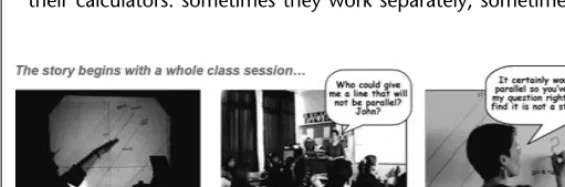
The class worked on functions for four lessons. Rachel’s research partner from the university, Steve Godwin, used two cameras to collect video recordings of Rachel with the whole class and also of two boys (John and Mike) working together. Rachel and Steve looked closely at the video from the third lesson, and from their analysis selected one extract for discussion with the maths team (see Figure 1.1 below).
The team members were interested in how the two boys approached the task. John starts by ignoring the set task and trying out the function he suggested earlier. He shows the results to Mike and only then applies himself to the set task, quickly loading the examples Rachel has provided. He identifies a trend: ‘The gradient gets steeper’. The video shows the way the boys use their calculators: sometimes they work separately, sometimes we
Figure 1.1Learning about functions and graphs
see both hands on one calculator in close collaboration. The final section of the video shows the two boys transforming what they have learned from using the calculator. John shows Mike how they can use the trace facility of the calculator to identify the coordinates of two points along the line and thus reconstruct it on paper.
Analysis of the video suggests that both students, as well as following their own thinking, were learning the mathematical knowledge that was the intended focus of Rachel’s lessons. Comparing assessments before and after the lessons, John’s score went up by 57 per cent and Mike’s by 71 per cent.
Discussion of the video extract produced ideas about how the potential of graphic calculators was helping John and Mike’s learning.
• Investigating and trying out things – John was able to try out
his suggestions for a non-parallel function, see what happened, show his friend and then apply himself to the set task. With pen and paper John would not have been able to pursue his idea AND follow Rachel’s plan for the lesson.
• Constructing and viewing a large number of graphs quickly
to develop an insight into the properties of related graphs (graph families). John constructed a series of graphs suggested by his teacher and was able to see how the gradient became steeper. The time taken to produce graphs with pen and paper places a limit on ‘seeing’ relationships and properties.
• Experimenting within liberating constraints18– Rachel was able
to set up carefully chosen tasks to scaffold the learning.
• Supporting pen and paper forms of representation.
Holistic approach with ICT 15
CASE STUDY 2
Using e-mail to develop understanding of how a sense of audience shapes writing
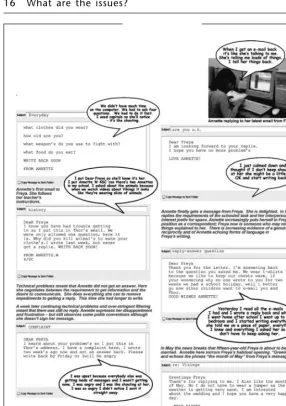
Emma Scott-Cook’s class of eight-year-olds used e-mail as a source of information for their history work on Vikings. An associated aim of the design was to increase understanding of the role of audience and purpose in shaping writing. A university-based researcher took on the identities of Thor and Freya, Viking settlers in England in 880. In the history activity, information gained from ‘e-mailing a Viking’ was combined in group presentations. E-mails (with permission) were also shared with the whole class; in these plenary sessions the focus might be on the historical content or on the style of the children’s writing and the effect this might have on a reader.
It was the writing development aspect that was foregrounded when the English team looked at the data. In this case the data was in the form of copies of the e-mails written over several weeks, and evidence from six children who were recorded as they read through the whole e-mail exchange with an interviewer and recalled whatever aspects of the reading and writing were prompted by this activity.
Presented below is the group’s commentary on the e-mail exchange between one of the students, Annette, and the Viking Freya.
The group commented on the way in which all the children had entered the ‘fiction’. The interview data showed that although they ‘knew’ that they could not really be ‘e-mailing a Viking’ they were very happy to sustain the idea that they were. This ‘willing suspension of disbelief’ appeared to create a strong sense of authenticity which enabled useful work around ‘audience’. Looking at the data and the analysis of Annette’s writing the team thought that Annette had learned a lot about writing from the activity. The ‘authenticity’ of the communication seems to have sharpened her sense of audience as a controlling factor. The ongoing feedback provided by e-mail was encouraging. Being given access to a computer and time to write, the supportive frame of the e-mail and little expectation about length were also identified as
contributory factors in Annette’s writing development. The team also thought that the more ‘public’ discussion of the exchanges in plenary sessions had been useful in enabling a specific focus on language and ‘audience’. Gaining the e-mail recipient’s permission for the messages to be shared was seen as important
We end this chapter with a teacher’s story. It illustrates how working as part of a research community of practice had both a personal and professional impact, and how the various strands evident in this book interweave in one teacher’s experience.
A teacher’s perspective on researching ICT
and learning
Holistic approach with ICT 17
as a clear acknowledgement of the interpersonal nature of the format.
The group discussed e-mail as a genre and the many conven-tions assumed to be associated with it. The feeling was that this was a valuable form for the discussion of the range of ‘appropriate’ styles and the negotiation of a relationship between writer and reader. The group also considered the effects of the research method by which a sample of students had been encouraged to reread, reflect on and reconstruct the process of composing their e-mails. Team members felt this was a strategy that might be incorporated in the teaching and learning as it was valuable for writers to be given an opportunity to reflect on, review and be articulate about a writing sequence captured in this way.
CASE STUDY 3
A personal account by Simon Mills
I have worked at the school for 16 years, which has been rewarding, exhausting and high stress in turn and simultaneously. In 2002, my head teacher asked me, as ICT co-ordinator, to evaluate how the use of the interactive whiteboard in my classroom was influencing student learning. I heard about the InterActive project, made contact and was invited to join the mathematics team. Looking back over the past six years I can see how much my involvement has meant to me personally and professionally. Most importantly, I think, it meant that I came again to see teaching as a research-informed practice, something I had lost sight of since my undergraduate days.
During one of our team meetings we were discussing how and perhaps why some children found the interpretation of graphs and charts to be problematic. One of us suggested that one of the barriers to developing understanding of graphs and charts was that young children could not distinguish between the roles that various charts fulfilled. As the discussion unfolded I began to think that perhaps the reason for this was not embedded in children’s understanding but in the way the teaching of mathematics in this area was limited by the paper-based activities we use to develop it, and perhaps by the way in which charts and graphs were perceived as mathematical tools by their users. I decided that this was an area I would like to explore and develop further. Data handling and graphical interpretation were areas of the curriculum which my colleagues in school were concerned about. It was becoming a common vehicle for engaging children with ‘using and applying work’ within science. The National Curriculum docu-mentation links data handling, with the mathematics and science curriculum, and with areas as diverse as geography (exploring land use, climate and change over time) and design and technology (surveying and supporting the identification of needs). There is also the everyday use of charts and graphs in non-fiction texts, newspapers and on TV.
Holistic approach with ICT 19
I could see the limitations of paper-based work. It is very difficult to teach young children to draw, for example, pie charts. They may be limited in the accurate use of instruments, and also in their conceptual understanding of how to divide a circle using trigonometry or proportion. The time it takes to generate charts and graphs on paper has been pointed out by Ainley, Nardi and Pratt (2000) as a reason why children rarely engage with charts and graphs beyond their drawing and simple interpretation, and why charts were rarely used for problem solving or the identification of trends and patterns within the primary school. ICT offers a solution to these limitations. I decided that for my design initiative I would work with my class of eight-year-olds to look at charts and graphs not as things we draw, but as meaning-making objects. The focus would not be on drawing charts, but on collecting data and using ICT to help us generate graphical representations. We could then concentrate on reading the charts and understanding what they were able to tell us.
In class the sessions began within a structure very much like a literacy hour. The children were given a number of chart types, and asked to discuss these, framed by the following questions:
• what was the chart about?
• who might have made the chart and why?
• who might find it useful?
• how useful was the chart?
• what features of the charts enabled you to make these
decisions?
Moving from the classroom to the ICT suite, children were intro-duced to the software environment Microsoft Excel, as a tool to support the evaluation of a real-life problem. The problem was ‘borrowed’ from the work of Janet Ainley (2000) but I had no problems presenting it to the children as an authentic one. I really, really like Smarties, but I had noticed that there never seemed to be the same number of my favourite orange flavour in every tube. And it had also struck me that there were more of some colours than others in the tubes I bought. I asked the children to investigate whether my impressions were correct. Each child was given a tube of the sweets, and asked to count them, and input the frequency of each colour to the spreadsheet. I emphasised the need for titles and labels which would help the readers of our data.
What was interesting from the start was the existence of two distinct ways of organising the Smarties for counting. Some children sorted colours into groups while others sorted and arranged their beans into columns, making a pictogram-type presentation before inputting their data to the spreadsheet. This observation became a key feature and teaching point since it represented to me and the children a powerful way of linking the frequency table to the bar chart representation they eventually made.
Having completed the frequency table, one of the children began playing within the spreadsheet environment with the chart wizards. (We had used wizards in other Microsoft packages.) He quickly and independently began generating pie charts and bar charts from the data he and his partner had collected. Later when the researchers interviewed children on their out-of-school uses of ICT we learned that some of them had used spreadsheets at home, and this experience must also have impacted on what the children produced in the classroom.
Holistic approach with ICT 21
understand. We discussed how to add axis labels and titles to the chart and began to draw on previous work to think about how we could use these to further help users to understand the charts.
Aside from learning about presentation, we also concluded from our work that my impressions about the frequency of different coloured Smarties were right. I asked the group in the final session to suggest ways that I might be able to investigate how many tubes I would have to buy, in order to get a fair share. One of the girls suggested that we could combine the class data sets in a pie chart; we could watch the segments in the chart until they were about the same size, and then we could count the number of tubes we had used, and this would tell us.
This whole sequence of lessons took eight hours. The children followed these up by desk-top publishing their results, and together we e-mailed our findings to Nestlé and asked for some explana-tions. To judge from their reply (an acknowledgement and a fact sheet) they didn’t seem to understand we were a group of eight-year-old investigators.
The conversations with my university research partners, the video data and discussion in the maths team all made me more aware of what was happening in my classroom and in the ICT suite. I noticed myself being a ‘scaffold’ and a facilitator: picking up on what the children had done, encouraging them to be explicit and share their thinking, helping groups identify next steps, focusing them on the ideas and skills they were developing and constantly referring them to the questions they were investigating. I was interested in the number of bits of unplanned and opportunistic teaching and learning that had happened because of the technology: the missed opportunities I might have developed. It was clear to me that I needed and wanted to think more about the relationship between my pedagogy, the ICT and the children’s learning, in mathematics and all the rest.
Recent years have provided many exciting and fascinating opportunities for me. In order to engage further with the data I had collected I applied for and was awarded a DfES Best Practice
Research scholarship.19 I then began a part-time MSc degree in
Master’s dissertation, I am using video data collected in my classroom as a ‘way of seeing’ and understanding what learning looks like, and exploring how the range of classroom tools helps me achieve my planned outcomes. I have been involved in other university-based researcher-practitioner partnerships around new technologies. I have had opportunities to share my emerging classroom-based findings and practices with other practitioners, researchers and a wider educational audience. This has been through workshops, conference presentations, teachers’ TV and publications. I feel I have also been a contributory voice in local, national and international debates on policy, practice and curriculum development, involving the role ICTs might perform as tools to support teaching and learning. This year my school has acknowledged this by providing the opportunity for me to take on a non-classroom-based role to review our use of ICT and develop it as a learning tool across the curriculum.
In school currently we have examples of children blogging in Year 6, multimedia authoring in Year 2, staff multimedia authoring to tell holiday stories from the point of view of our travelling teddy bear, geotagging, stories developed within digital writing frames and a host of other things, some of which have been sought out for use by the Local Authority as examples of good practice for the development of writing. I was recently asked to lead two sessions for ICT subject leaders on the roles and potential uses of blogs in the primary school. Web 2.0 is a really exciting place to
be.20
Simon’s story shows the development of an enabled and proactive practitioner; he exemplifies the kind of Masters level teacher the profession is looking towards. Ideas around how we achieve this are explored more fully in Chapter 4. Simon’s experience also provides a practical illustration of how classroom experiences must be seen as embedded in the wider context of home and school. Simon worked effectively within existing local and national constraints on curriculum and pedagogy. He was also already very aware of much of the social background of the children in his class. However, as a result of reflect-ing on data collected in his classroom and with the support of his co-researchers he began to find out much more about the experiences of ICTs as tools that the children were bringing to school, and to think about how these might relate to their in-school learning. We consider the out-of-school dimension more broadly in Chapter 8.
Summary and conclusions
This chapter has identified the challenges, issues and questions which this book addresses. These are located firmly in the current context and stage of development in embedding new technologies in the processes of learning and teaching for the benefit of students in school. Arguments about why it is important to address the issues and questions associated with the challenge of incorporating ICTs in learning have been set out.
The chapter explains briefly some of the central ideas that inform the book: the theories we draw on and the principles that underpin the processes of the work teachers and researchers did together. The three case studies illustrate some of the processes by which teachers and university researchers worked together to build knowledge. They show how teachers’ ‘designs’ are informed in an ongoing and iterative way by theory, research-based evidence, teacher’s craft knowledge and the expertise of the whole community. Reciprocity characterised the processes by which knowledge was constructed.
Holistic approach with ICT 23
Each of the following chapters in the book develops and adds to these ideas, drawing on research experience to engage in depth with the issues and questions surrounding improving learning with ICT which we have outlined and begun to raise here. Chapters 2, 3, 5 and 7 provide more detailed examples of this process in action. Chapter 7, for example, uses the instinctively negative response of a teacher to moving from his own classroom to the computer area (the same instinct that in part prompted Rachel, in this chapter, to use graphic calculators) as a starting point for discussing ideas about the ways in which ICTs constitute a challenge to assumptions about how people learn and how teachers should teach. Chapters 6 and 7 look also at the epistemological challenges the InterActive project has highlighted in relation to ‘subjects’, the tensions around subject definitions and subject cultures that technology produces, and the associated challenge to articulate these changing understandings in defining a school curriculum and approaches to assessment. Chapters 10 and 11 are concerned with the way in which our own thinking has moved on as we deal with a very fast-moving technological environment.
The vignettes and case studies in this chapter give a voice to some of the teachers who have been active collaborators in the quest to find ways to make the most effective use of the potential of new tech-nologies for learning and teaching. We hear these voices consistently throughout the book. Not all those who were part of the community moved as far as Simon or Ian. For others, their steps on the road towards the ‘enabled practitioner’ described in Chapter 4 were smaller, more hesitant, less secure. But it is important also to hear their voices and their experiences if we are to understand how to face the professional development challenge.
Notes
1 Prior, G. and Hall, L. (2004), DfES (2007). 2 Kitchen, Finch and Sinclair (2007).
3 See Goldstein (1997), DfEE (1997), Becta (2007). 4 Kitchen, Finch and Sinclair (2007).
5 This is a concept developed by Butt and Cebulla (2006) to indicate the extent to which the use of ICT is integral to teaching and planning in a school, and the extent of students’ access to ICT in and out of the classroom.
6 Kitchen, Finch and Sinclair (2007). 7 Becta (2007).
8 Kitchen, Finch and Sinclair (2007). 9 Ashby (2007).
10 This concept first appeared under this name in a pamphlet ‘A National Conversation about Personalised Learning’ DfES (2004). It is supported in the report of the DfES ‘Teaching and Learning in 2020’ Review Group. For more detail see the government websites www.standards.dfes. gov.uk/personalisedlearning and www.teachernet.gov.uk/management/ newrelationships/personalisedlearning.
11 Becta (2007).
12 The Office for Standards in Education, a governmental agency charged with inspecting and assessing standards of student attainment, teaching quality, effectiveness and value for money of schools in England. 13 The InterActive project has incorporated video data in materials developed
to disseminate project outcomes. These include video papers and CPD resources on the project website: www.interactiveeducation.ac.uk. See also Olivero et al.(2004).
14 For an explanation of the role and operation of Subject Design Teams (SDT) in the InterActive Education project see the Methodological Appendix (p. 217).
15 See New London Group (1996). Gunther Kress is a member of the New London Group. He has written widely on multimodality, representation and new media in relation to education and learning.
16 Since 1986 the national curriculum in the UK has provided a structured and assessed education through Key Stages for students aged 5–14. At the time of the InterActive project students took standardised assessment tests at the end of each Key Stage, at ages 7, 11 and 14. Post-14 students generally followed two-year courses, including those for the GCSE (General Certificate of Secondary Education) which are available in all subjects. The National Curriculum and GCSE are administered by the govern-ment’s Qualifications and Curriculum Authority (QCA). From September 1998 all primary schools in England have been expected to teach the literacy hour as laid down in the National Literacy Strategy. The structure
and content of the daily hour-long lesson is prescribed. From 2000 this initiative to raise literacy standards was extended to English lessons in secondary schools for students in Key Stage 3 (see www.standards.dfes. gov.uk).
17 For a fuller discussion of Rachel’s work see Godwin and Sutherland (2004). 18 For further discussion of the concept of liberating constraints see
Chapter 5.
19 Best Practice Research Scholarships were awarded to teachers by the government Department for Education and Skills (DfES) on a competitive basis. Several teachers working in the InterActive project gained scholar-ships which enabled them to pursue their research in more depth. University researchers acted as mentors. These scholarships have now been discontinued.
What does the research
tell us?
In this part we enter into the detail of the InterActive Education project. We introduce a range of theoretical ideas that can be used to help understand the challenges involved in introducing ICT into the classroom. We present arguments and case studies to illustrate the results from the project, which include:
• the teacher remains key to the successful use of ICT for learning; • learning is distributed between the technology, the learner and
the social and cultural context;
• effective teaching and learning with ICT involves building bridges between ‘incidental’ and ‘intended’ learning;
• there is nothing inherent in technology that guarantees the intended learning;
• there is a two-way exchange of knowledge between home and school use of ICT that impacts on learning in school;
• professional development needs to enable teachers to take risks with ICT and learning;
• teachers can work within the constraints of available technology to enhance learning;
Integrating ICT in teaching
and learning
Research in the area of ICT and classroom learning is now virtually unanimous in claiming that while new technologies can be used to enhance learning, they are not sufficient in themselves to produce effective learning. This chapter builds on this proposition and shows that the teacher is key to ‘improving learning with ICT’. The chapter further highlights the processes by which a teacher can act as a lever to reorientate learning so that there is a convergence towards the development of common knowledge. Much of the chapter’s argument is based on the idea of the classroom as a collective experience where learning is not seen as an isolated endeavour but one which is both mutual and collaborative.
One clear observation to be taken from the chapter is that classroom learning with ICT requires teachers to exploit the sense of familiarity with new technologies that is now widespread among young people. However, this also means that teachers themselves need time to gain an intimate knowledge of the technology and that this can sometimes be best achieved through ‘playfulness’ and experimentation. The chapter has three aims at its core:
• to discuss the ways in which ICT can be integrated into classroom practices to enhance learning;
• to highlight the ways in which students bring out-of-school experiences of using ICT into the classroom;
• to emphasise that effective teaching and learning with ICT involves building bridges between ‘idiosyncratic’ and ‘intended’ learning.
Chapter 2*
Exploiting available technology
We know that merely introducing ICT into schools will not in itself lead to enhanced learning nor will devolving the responsibility for teaching to the technology. But we also know that it is possible to find ways of incorporating ICT into classroom practices to improve learning. However, beginning the process of integrating ICT into teaching and learning is not straightforward and involves being able to imagine the potential of particular technologies for learning within the contexts in which it will take place. It also involves taking the risk of experimenting with ICT in the classroom. This process has to be concerned with the here and now of available technologies, as opposed to looking to the future for the next big technological development that will somehow solve the problem of integrating ICT into teaching and learning. Those of us who have been around since the early days of the introduction of computers into schools have observed how each new technological development, from Logo to multimedia, to the Internet, to mobile technology to Web 2.0, has been heralded as being the final breakthrough that will make the difference to education. We have also observed that riding the wave of each new technological breakthrough never begins to address the issues that face education. Rather, we believe that we need to focus on understanding the inter-related factors that come together when technology is being used to enhance learning.
Within the InterActive project we developed a way of working that enabled teachers to work together with teacher educators and researchers in order to start the process of using ICT in the classroom. Each teacher developed a subject design initiative (SDI) and this process involved:
• deciding on a focused area of the curriculumthat students normally find difficult to learn and choosing ICTs that could potentially enhance learning in this area;
• into-the-classroom contingent teaching which draws on all the prepared activities while at the same time opportunistically using what the students bring to the lesson to extend their learning; • out-of-the-classroom reflection on and analysis of the design
initiative using video data collected from the classroom experi-mentation.
In this approach learning initiatives usually started out as simple ideas which exploited the use of available technology in schools. Over time and with iteration they were transformed into powerful new uses of ICT for learning. As discussed in Chapter 1 the InterActive Education project was organised around subject design teams (SDTs) in English, mathematics, science, modern foreign languages, music, history and geography. Within each team a partnership of teachers, teacher educators and researchers supported teachers to take the risk of experimenting with ICT in the classroom.
Throughout the book we have incorporated case studies that highlight the ways in which ICT can be used to enhance learning. We start this chapter with an example from the work of one of the teachers, Dan Sutch, from the English design team. Dan’s starting point was a desire to help his 10–11-year-old students learn about spelling in the English language. He worked with students, using WordRoot,1 a
multimedia sound and word package to analyse the structure and etymology of ‘hard words’, and through this work students’ spelling improved.
Throughout the book we present the work of other teachers from the InterActive project. In Chapter 5 we discuss how Elisabeth Lazarus and Ruth Cole used ICT with 13–14-year-olds to support their writing in German. They designed a drop-down menu template in Word that enabled students to write more in the foreign language and take more risks with grammar. Students’ writing on paper was also enhanced after this initiative.
In Chapter 1 Simon Mills describes how he incorporated the use of spreadsheets and an interactive whiteboard to teach 8–9-year-old students statistical ideas. This initiative centred on a whole-class investigation of the distribution of the colours of Smarties in a tube.
Later in this chapter we discuss how Marnie Weeden used dynamic geometry software with 13–14-year-old students to learn about geometrical proof. Students worked in groups and presented their work to the class for feedback on the validity of the proofs they had produced.
In Chapter 5 we discuss how primary and secondary students used software to learn about composing in music.2 Also in Chapter 5 we
present the evolution of an SDI for geography in which the teacher used ICT to support geographical inquiry.
Incidental, idiosyncratic and intentional
learning
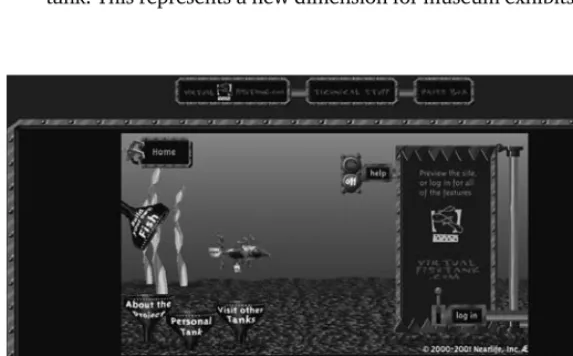
Analysis of the video data from the InterActive project showed that students often work with ICT for extended periods of time, investigating their own questions and experimenting with ideas in an interactive and iterative way. This relates to the power and potential of ICT for learning, and through this process students inevitably learn and construct new knowledge. However, there is a tension inherent in this potential of ICT. Extended individual engagement often leads to the construction of idiosyncratic or incidental learning which is at odds or is only part of the intended learning. For example, as we discuss in Chapter 3, when primary students were using simulation software to learn about the ecology of the sea they treated the simulation as a game and became engaged in winning. The language they used as they interacted with the software was about winning: ‘Don’t die . . . we gotta beat people . . . we need to beat 5 minutes’. In this situation the students were not entering the world of science, as the designers of the simulation had intended: ‘The Fishtank draws on research from the new field of “artificial life”, which focuses on computer modeling of animal behavior. The VirtualFishtank adopts a constructionist approach, enabling visitors to design (and not merely observe) the behaviors of fish.’3 It was not until the teacher began
to analyse video data from classroom interactions that she became aware that students were interacting with the software as a computer game, and that unknowingly she had supported this practice through her own use of language.
Learning is an inevitable part of living. We learn from interacting with the people and things which surround us, through language and play. We call this sort of learning ‘incidental’ because it is not normally planned as learning, and can take place in settings which have not been specifically designed for learning. For example, we can learn how to sing, how to play chess and how to throw a ball through interacting with family and friends.
is always some kind of ‘intended’ learning associated with schooling which relates to a curriculum. Such a curriculum is not fixed and changes over time and between cultures. In fact, as we discuss in Chapter 9, ICTs are challenging what should or could be in the curriculum, challenging knowledge domains, such as mathematics, science and geography. And, as we discuss in Chapter 6, ICT is also challenging what is important in the school subject of English.
It is important to emphasise that in school there is not a simple relationship between what students learn and what a teacher intends them to learn: in other words there can be no simple transmission from the teacher to students. Students will always learn much that is incidental to what is intended. All that teachers can achieve is a sort of convergence towards a ‘common knowledge’. Introducing ICTs into the classroom does not necessarily help this process of conver-gence and in fact can actually work against it. This is because students can work with ICTs to develop idiosyncratic knowledge that is actually at odds with what the teacher wants to teach, as illustrated by the VirtualFishtank case study discussed more fully in Chapter 3. Students also bring to the classroom a history of learning which can also be ‘different’ from that which the teacher wants them to learn, as illustrated by the vignette on geometry and proof discussed later in this chapter. Students can also construct knowledge that is ‘correct’ for a particular situation, but is not generalisable to a wide range of situations, as illustrated by the vignette on learning language, discussed in the next section of this chapter. This is not a new phe-nomenon, but can be exacerbated by the introduction of ICTs into schools, and also by the more informal use of ICTs out of school, as discussed more fully in Chapter 8.
Throughout the InterActive project we struggled with the ideas of ‘incidental’ and ‘intended’ learning. Whereas the mathematics and science subject teams were comfortable with discussing these concepts, members of the music and English teams were less so, sometimes seeming to adopt a position in which they wanted to value all learning which takes place within music or English classrooms. However, as we worked together throughout the project it became clear that within each subject area teachers have strong views about what they consider to be appropriate learning. This is evident in Chapter 6 in which Sasha Matthewman argues for the importance of retaining a focus on spoken and written language within the English curriculum. This argument for maintaining an emphasis on language in school occurs at a time when students are likely (if given the
freedom) to privilege other modes, such as the visual, when construct-ing texts in the English classroom. We are not suggestconstruct-ing that all teachers agree on what is to be valued within a particular subject area, but that they have views about what they want students to learn: views that are, of course, influenced by the curriculum. The ‘intended learning’ is what the teacher wants students to learn, which is not the same as what they actually learn.
We now present two case studies taken from the work of the English and mathematics SDTs in order to illustrate the creative tensions inherent in integrating ICT into classroom practices, and the crucial role of the teacher in focusing students’ attention on the ‘intended’ learning.
CASE STUDY 1
Learning language in the primary school
Introduction
This case study is taken from the work of Dan Sutch who was a member of the English design team. It is used to illustrate three important aspects of learning with ICT. The first is that students inevitably bring to the classroom experiences of using ICT out of school and that it is important for the teacher to value this learning. The second is that when students are constructing knowledge for themselves it is likely to work for a particular situation but is not always generalisable to a wider range of situations. The third is that an effective way of confronting students with their ongoing knowledge construction is through whole-class discussion.
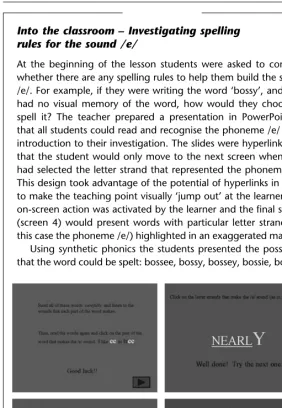
Dan worked over a period of two years to develop an inquiry-based approach to learning spelling which incorporated the use of the software WordRoot and PowerPoint. Students aged 10–11 years worked on a series of investigations of the English language that centred around the idea of providing them with a ‘speller’s toolkit’. In general lessons consisted of a mixture of whole-class, group and independent work supported by extensive homework investigations. The vignette we present here relates to two lessons in which students were investigating how to select the appropriate
grapheme to represent an irregular phoneme.4For example,