HOW TO INTEGRATE XBRL INTO ACCOUNTING
CURRICULUM AT BANJARMASIN STATE POLYTECHNIC
Noor Romy Rahwani
(1)(1)
Accounting Lecturer Banjarmasin State Polytechnic
Abstract
The purpose of this research is to develop accounting curriculums for Banjarmasin State Polytechnic (POLIBAN). The curriculums integrate the XBRL (eXtensible Business Re-porting Language) materials into their course designs. The ideal XBRL related curriculum was developed based on the course designs recommended by Debreceny and Farewell (2011). In the recommended course design, the coverage of XBRL builds in the ac-counting curriculum the same way that the breadth and depth of acac-counting concepts in-creases.
However, when it comes to the implementation, there are some main barriers that should be taken into account i.e. (1) Not all lecturers understand well about XBRL as the XBRL is relatively new ’topic’ to most of the accounting lecturers. (2) As Indonesia GAAP Ta-xonomy has not been developed, it means that there will be no real case studies related to this taxonomy that can be developed. (3) Developing a good XBRL related syllabus should take time.
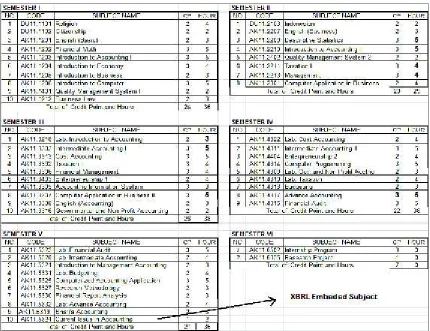
Based on those impediments, the applicable accounting curriculums that integrate the XBRL were then designed for academic year 2011/2012 via curriculum development workshop. In the Computerized Accounting Study Program, the subjects that cover the XBRL materials are Management Information System, Accounting Information System II, and Internet/Web-based Programming. In the Regular accounting Study Program, the subjects that cover the XBRL materials are “Current Issue in Accounting”
The subsequent academic years (after 2011/2012), the XBRL related course design in previous academic years has to be evaluated and enhance. The accounting Department has better apply the suggestions discussed in the last chapter, so the XBRL related cour-se design recommended by Debreceny and Farewell (2011) will be eventually achieved.
Keyword: integrate the XBRL, accounting curriculums
1. INTRODUCTION
Background
XBRL stands for eXtensible Business Re-porting Language. XBRL is one of a family of "XML" languages that focuses particularly on the financial reporting arena. It has been a wi-dely accepted standard and implemented world-wide including US, China, and Australia. All pu-blics companies in those countries will be re-quired to prepare their financial statements in XBRL format to government agencies such as Central Bank, Tax Office, and Securities Coms.
Troshani and Doolin (2005) justify that the adoption of the International Accounting Stan-dards (IAS) as one main reason for the slow XBRL adoption in Australia. Similarly, Indone-sian Financial Accounting Standards Board of Indonesian Institute of Accountants (DSAK-IAI) has also started the IFRS convergence process since 2009 and was determind to finish in 2012.
This may be also the reason why a kind of “wait-and-see” situation also currently occurs in Indonesia. However, there are many countries
that require the use of IFRS and then most of them also adopt XBRL.
It is then projected that the XBRL adoption in Indonesia will soon be done once the IFRS convergence efforts will have been in place in 2012/2013.
Research Problems
Jianing (2010) indicates that one main rea-son for the slow XBRL adoption in US is that almost all of the US schools or universities have not covered XBRL materials in their courses yet. Based on Jianing’s findings, it can be con-cluded that it is important to adopt XBRL related topics to Indonesia universities’ curriculum. By adopting XBRL in the curriculums, the similar problem can be avoided when Indonesia imple-ment the XBRL in the very near future.
The following research problems are what this paper discuses:
2. Applicable ways to integrate XBRL materials in Accounting Curriculums at POLIBAN.
2. LITERATURE REVIEW
What is XBRL
XBRL promises to help achieve those goals. XBRL stands for eXtensible Business Reporting Language. XBRL is one of a family of "XML" la-nguages in the financial reporting arena. It has been designed to standardize financial and bu-siness reporting. It enables unique identifying tags to be applied to items of financial data, such as ‘net profit’.
As a simplification, XBRL is just like using BARCODE for financial data which can track a can of milk from the manufacturing plant through the point of sale.
Likewise, XBRL tags financial information so it, too, can be tracked, from the first interactions with vendors, to reports submitted to various operating divisions within a company, and finally to become part of a consolidated financial re-port.
Source: Bapepam-LK (2011)
Figure 1 : Consolidated financial re-port
Those reports can be financial like balance sheets, income statement and statement of cash flow. Furthermore, they can be non-finan-cial such as loan application, statistic, and per-formance measurement.
XBRL is being developed by XBRL Inter-national Inc (XII) which is a global consortium that uses a cooperative effort to create a com-mon business reporting language based on XML. This Web protocol is being developed and promoted by an international, not-for-profit con-sortium of more than 600 international com-panies, associations and government agencies.
To avoid misunderstanding with the basic concept of XBRL, Darmawan and Hudiyanto (2006) explained that XBRL is not:
A software or application, that will replace previous established data and application. A
new accounting standard, and does not require any changes to existing accounting standards. A chart of accounts.
How XBRL Works
There are two primary components in the delivery of XBRL reporting solutions i.e. XBRL taxonomy and XBRL instance documents. By splitting XBRL report into two documents, the taxonomy will remain the same every time a new balance sheet is created. It is only the facts which are updating.
XBRL Taxonomy
The taxonomy document outlines the con-cepts which are to be reported. It also includes the definition of those concepts and describes the relationship between the concepts. A con-cept is a basic piece of information that exists in a report.
The following picture shows the example of relationships between concepts in a simple ba-lance sheet:
(Source: KPMG:2011)
Figure 1 : Concept Relationship
Taxonomy Concept File
It is an XML schema file contains the busi-ness reporting concept definitions. It usually has the extension .xsd. The taxonomy file is de-veloped as XML schema. Therefore, there must be a root element. This root element is always the <schema> element of the XBRL Taxonomy concept file.
XBRL instance documents
The values or financial facts are contained in an instances document. Those values refer to the concepts that are described in the taxonomy document.
(Source: KPMG:2011)
Figure 2 : Taxonomy Document
Table 1: Facts
By combining a taxonomy document with an instance document, a meaningful business re-port can be produced.
Figure 3: Balance Sheet
Hoffman and Watson (2010) explained that an XBRL instance has four main parts: Values, Context, Concepts, and Dictionary.
Instance - Values
The values are the text (individual values or entire narratives) and numbers in the report, the business information. Generally, the text and numbers come from some sort of business sys-tem, such as an ERP system or a spreadsheet.
The instance document can handle numeric and non-numeric data, different units of measu-rement and multi-period financial statements. For example, a value would be a number like
“1254” or text, such as “Inventory consists of finished goods and working-progress” or even a paragraph or so of narratives.
Instance – Context
The context explains important information about the values. For instances: what entity the value relates to, what period the values relate to, and whether the values are actual, budget-ed, and so on.
By having context, then it is possible to say that the information relates to a company and not some other company, and that the period is for 2011, not 2007.
Instance – Concept
Concepts mean technical representations of business terms like “Net Income (Loss)” and “Sales, Net”. These terms are associated with the text or numbers contained on a business report, the values. Values (like “5347” in the example) are reported for concepts and within a specific context.
Source: Hoffman and Watson (2011)
Figure 5 : Profit and Loss
Instance – Dictionary
Concepts are expressed within a dictionary. The dictionary is the central location where con-cepts are pointed to information that defines that concept.
The dictionary gives an exact definition about the meaning of each term (semantics), including references and examples.
XBRL around the world
XII (2011) explains that XBRL International is comprised of local jurisdictions which repre-sent countries, regions or international bodies and focus on the progress of XBRL in there are-as are-as well are-as contributing to international deve-lopment. XII (2011) adds that there are two ty-pes of jurisdictions i.e. provisional jurisdictions and established jurisdictions.
Provisional jurisdictions
According to XII (2011), Provisional jurisdic-tions are similar to start-up organisajurisdic-tions with a small working group focussed on increasing in-terest within their region and developing an ini-tial taxonomy for local accounting standards. Provisional jurisdictions have up to two years to become an established jurisdiction.
3. RESEARCH AIM AND BENEFITS
Research aim and objectives are interrela-ted. The aim is what this research wants to achieve, and the objective describes how this research achieves that aim. An aim is a general statement, which reflects the intention or pur-pose of the area of this research, while an ob-jective is a specific statement relating to the de-fined aim of this research.
Research Aim
The aim that this research wants to achieve is to design accounting curriculums at POLIBAN that integrate the XBRL materials. The designs will be implemented in Computerized Accoun-ting Study Program and Regular AccounAccoun-ting Study Program.
Research Objectives
The following research objectives are what this research wants to conduct in order to achi-eve the research aim:
1. To develop an ideal accounting curriculum of POLIBAN that applies the XBRL related course design suggested by Debreceny and Farewell (2010).
2. To develop an applicable accounting curricu-lum of POLIBAN that integrates the XBRL material.
To define the strategy that minimizes the barriers of implementing gradually the ideal ac-counting curriculum suggested by Debreceny and Farewell (2010) in every academic years.
4. RESEARCH METHODS
Research method is a procedure to find the required data to draw conclusion or make some predictable results In other words, research me-thod is a way of collecting inputs and finding the outputs.
1. Conducting XBRL related literature reviews and related previous researches, such as XBRL concepts and principles. Studying the related literature is one way to gathering the research inputs i.e. how to adopt the XBRL materials into accounting curriculum. The main literatures for this research are from the work of Roger Debreceny and Stephanie Fa-rewell (2010): XBRL in the Accounting Cur-riculum and the work of Jianing, F (2011). 2. As the secondary data, the current
accoun-ting curriculums for academic year 2010 / 2011 were explored. From this analysis, the ideal XBRL material integration into accoun-ting curriculums was then developed based on the suggestion of Debreceny and Fare-well (2010)
3. The feasibility of the ideal course design im-plementation was investigated. Based on this investigation, the barriers were determined.
Suggestions were developed to avoid or mi-nimize the impediment and finally to implement gradually the ideal course design in every aca-demic year.
5. FINDINGS AND DISCUSSIONS
Findings sub chapter discuses about the current status of XBRL implementation in Indo-nesia, and current curriculum in accounting de-partment at State Polytechnic Banjarmasin. The discussion sub chapter then discusses about how to integrate XBRL topics in the curriculum.
Findings : XBRL Implementation in Indone-sia
At the time of this writing, there is neither established jurisdiction nor even provisional jurisdiction for Indonesia. In fact, the awareness of XBRL has already appeared since 2006.
In that year, two staffs of BAPEPAM-LK (In-donesian Capital Market and Financial Institu-tions Supervisory Agency) went to IASCF XBRL Team in UK. The staffs (Mr. Hudiyanto and Mr. Sidi Darmawan) joint one-month XBRL training/ apprentice program.
The other Indonesia regulatory agency, the Indonesia Central Bank (Indonesia Bank) parti-cipates also in some XBRL events such as do-ing a comparative study at XBRL Belgium at 21.03.2011 and attending XBRL International 21st Conference at Beijing on October 19-21, 2010.
Discussioss
include adjusting the subjects offered to student in order to match the needs of industries and accounting knowledge trends. Another objective of this workshop is to correct which semester that a subject has to be offered based on pre-vious lectures.
The current curriculums 2010/2011 are now adjusted via curriculum development workshop in year 2011. One of accounting knowledge trends that will be adapted to the new curricu-lums is XBRL formatted Financial Report.
XBRL materials will be integrated into the latest accounting curriculums developed via cur-riculum workshop in 2011.
1. Ideal ways to integrate XBRL materials in Accounting Curriculums at POLIBAN This chapters will explain the scenario how to integrate ideally XBRL related materials into POLIBAN’s accounting curriculum will be based on an XBRL research done by Roger Debre-ceny and Stephanie Farewell XBRL in the Ac-counting Curriculum. According to them, the co-verage of XBRL builds in the accounting curri-culum the same way that the breadth and depth of accounting concepts increases.
According to Roger Debreceny and Stepha-nie (2010), the XBRL topics are not only about a systems topic or specially only about XBRL technology. As the XBRL topics will be also re-lated to accounting principles, it is then sugges-ted that the coverage of XBRL builds in the ac-counting curriculum the same way that the bre-adth and depth of accounting concepts incre-ases.
These include the double-entry bookkeeping system and the role of accounting information within organizations and the broader economy. Later in the program the curriculum broadens (financial and management accounting, sys-tems and auditing) and deepens.
Debreceny and Stephanie (2010) suggested that the more senior then the deeper/wider the coverage of XBRL.
Introduction to Accounting Subjects
The XBRL materials in these subjects should focus on an end-user perspective on XBRL and only at a relatively surface level.
Cost and Management Accounting Subjects
Debreceny and Farewell (2010) suggested that the focus remains on users within the intro-ductory cost and management course.
Cost and Management Accounting Subjects
In regular accounting study program, the subjects will just focus on (limited to) the pri-mary components of XBRL i.e. Taxonomy and Instance Document. Where as in The
Compu-terized Accounting Study Program will include more detailed knowledge of the technical as-pects of XBRL.
Intermediate Financial Accounting Subjects
Students of regular accounting stu-dy and of computerized accounting program-study will get the foundation skill and knowledge of how to prepare financial statement based on Indonesian GAAP i.e. PSAK.
Advanced Financial Accounting subjects
The key element of the discussion on XBRL in these subjects should encompass its role in the consolidation process. This may involve the use of both XBRL-GL and financial reporting ta-xonomies such as PSAK and IFRS tata-xonomies.
2. Applicable ways to integrate XBRL ma-terials in Accounting Curriculums at PO-LIBAN
Actually, the curriculum suggested by De-breceny and Farewell (2010) can be adopted into POLIBAN’s accounting curriculum since most of the core subjects (such as Introductory Accounting, Cost Accounting, Budgeting, Public Sector Accounting, Audit, Intermediate Account-ing and Advance AccountAccount-ing) have its account-ing lab subjects. However, there are some bar-riers that should be taken into account when the curriculum design comes to implementation.
This chapter discusses the feasibility and strategy to integrating the above course designs into Accounting Curriculum at POLIBAN. Actu-ally, Debreceny and Farewell (2010) suggested integrating the study of XBRL with overall lear-ning objectives for those courses rather than be a standalone learning outcome. However, there are some reasons that cause the suggestions not fully applicable for the case of POLIBAN Ac-counting Department. Then on the next sub chapter, it will explain how to adjust the sug-gestions of Debreceny and Farewell (2010), so then the suggestions fit with the case of PO-LIBAN Accounting Department.
Main Impediments of XBRL Integration into all core accounting courses
When we come to implement the ideal course designs above, we cannot adopt them in one go. The following main impediments make us cannot ’suddenly’ integrate XBRL into all subjects mentioned on previous chapter:
every subject mentioned in previous chapter. Accounting Department currently has no si-ngle XBRL related textbook. This will then give the obstacle to develop a good syllabus. 2. Integrating XBRL materials into almost all ac-counting core subjects means that all lectu-rers who teach those subjects should master the materials otherwise the lecturers will in-deed have problem to reach the XBRL rela-ted learning objectives. As XBRL is relatively new ’topic’ to most of the accounting lectur-ers, then not all lecturers understand well about XBRL
3. Indonesia GAAP Taxonomy has not been developed at the time of this writing. It me-ans that there is no case study related to this taxonomy that can be developed
Applicable ways: XBRL materials integration into accounting curriculum 2011/2012
Based on the reasons/obstacles explained on the previous sub chapter, it can be conclud-ed that it is not easy to implement what Debre-ceny and Farewell (2010) suggested i.e. inte-grating the study of XBRL with overall learning objectives for those courses. However in the long run, the further XBRL implementation in In-donesia, the more comprehensive the course designs will be implemented in Accounting Cur-riculum at POLIBAN.
For academic year 2011/2012, the writer su-ggests to include the XBRL materials as a standalone learning outcome. The next sub chapters explain what subjects that will include the XBRL materials.
1. Computerized Accounting Study Program – 2011/2012
a. Management Information System • Understand the essential concepts of
XBRL
• Understand how business implements the XBRL through their Enterprise Ap-plication (ERP systems).
• Understand the two primary compo-nents in the delivery of XBRL report-ing solutions i.e. XBRL taxonomy and XBRL instance documents.
b. Accounting Information System II An introduction to XBRL GL which al-lows transfer of much more than just fi-nancial data between systems.
c. Internet/Web Programming
Understanding XML languages and its relation to XBRL
2. Regular/General Accounting Study Program – 2011/2012
A subject called “Current Issue in Accoun-ting” will explore the essential concepts of XBRL and Introduction of XBRL Global Led-ger (GL).
This subject is actually intended to offer any current issues in Accounting which has not been covered yet in any other core accoun-ting subjects, for instance: XBRL implemen-tation, IFRS convergence, Mining Accoun-ting, Human Resource AccounAccoun-ting, Compu-ter based Auditing and so on.
6. CONCLUSIONS AND SUGGESTIONS
Conclusions
XBRL stands for eXtensible Business Re-porting Language. XBRL is one of a family of "XML" languages that focuses particularly on the financial reporting arena. It has been a wi-dely accepted standard and implemented world-wide including US, China, and Australia. All pu-blics companies in those countries will be requi-red to prepare their financial statements in XBRL format to government agencies such as Central Bank, Tax Office, and Securities Com-mission.
At the time of this writing, Indonesia has not yet adopted the XBRL formally and has not had any XBRL Jurisdiction, although the initial awa-reness of XBRL among Indonesia government agencies has appeared since 2006. One main reason for the slow XBRL adoption in US is that
almost all of the US schools or universities have not covered XBRL materials in their courses yet. Indonesia had better determine and avoid the same problems that other countries like US had confronted when implementing XBRL. Indonesian Universities should then integrate XBRL materials in their courses.
The XBRL course design suggested by De-breceny and Farewell (2010) is considered as an ideal XBRL integration into curriculum. The coverage of XBRL builds in the accounting curriculum the same way that the breadth and depth of accounting concepts increases. Howe-ver, there are two main impedi-ments that make Accounting Dept.cannot adopt them in one go : 1. As XBRL is relatively new ’topic’ to most of
the accounting lecturers, then not all lec-turers understand well about XBRL
2. Developing a syllabus in every accounting core subject that accommodates the recom-mended course designs will take time. 3. Indonesia GAAP Taxonomy has not been
developed at the time of this writing. It me-ans that there is no case study related to this taxonomy that can be developed. 4. In Academic Year 2011/2012, Accounting
a. Regular Accounting Study Program : Current Issue in Accounting
b. Computerized Accounting Study Pro-gram: Accounting Information system II, Management Information System, and Internet Programming.
5. In subsequent academic years (after 2011/ 2012), Accounting Department at POLIBAN should then evaluate:
a. The previous XBRL course designs im-plemented in previous academic years. b. The feasibility adoption of XBRL course
designs suggested by Debreceny and Farewell (2010).
Suggestions
1. POLIBAN should take sustainable improve-ment in accounting curriculum developimprove-ment to accommodate the link and match with in-dustrial needs and accounting currents is-sues. One of accounting current issues is im-plementation of XBRL.
2. The accounting department should take the initiative to the integration of XBRL material into accounting curriculum. This initiative is one of the efforts to be the leading innovative Polytechnics in INDONESIA.
3. To combat or minimize the obstacles in XBRL materials integration in accounting curriculum, the following strategies may have to be done in order to adopt gradually the XBRL related course design suggested by a. Debreceny and Farewell (2010):
a. Lecturers should efforts to sustainable researches related to XBRL (at least XBRL literatures researches). It will then help speed up the acceleration of XBRL learning among the lecturers. b. Accounting department should invest
more on XBRL textbooks specially the textbooks recommended by Debreceny and Farewell(2010) is indeed impor-tant.
c. The institution (via P2M POLIBAN -Research and Society Service Unit) should provide or socialize the access to National and International Database Online Journals such as EBSCO, JS TOR, PROQUEST, EBSCO, IEEE, Sci-ence Direct, and SPRINGERLINK. The journals provide XBRL related papers/ researches that help the lecturers up-date their knowledge and insight of XBRL. Thus, the access will help lec-turers to prepare a better syllabus. d. Accounting department should invest
more on XBRL training because the training will also enhance the XBRL skill and knowledge of accounting lecturers.
e. The teaching team should be formed in order to disseminate the XBRL know-ledge and skills among the lecturers.
7. REFERENCES
1. Adobe.(2011),Accelerating XBRL Adoption, Adobe System Inc.,viewed 29 May 2011, www.adobe.com/financial/pdfs/xbrl_wp.pdf 2. Bartley, J, Al-Chen, Y, & Taylor, E (2010),
’Avoiding Common Errors of XBRL Imple-mentation’,Journal of Accountancy, 209, 2, pp. 46-51, Business Source Elite, EBSCO 3. Darmawan and Hudiyanto. (2006), XBRL
Innitiative, Bepepam-LK, viewed 30 August 2011,< www.bapepam.go.id/old/xbrl/id/> 4. Debreceny, R, & Farewell, S (2010), ’XBRL
in the Accounting Curriculum’, Issues in Ac-counting Education, 25, 3, pp. 379-403, Bu-siness Source Elite, EBSCOhost,
5. Debreceny, R, Felden ,C. & Piechocki, M. (2007), ‘New Dimensions of Business Re-porting and XBRL’, Deutscher Universitäts, Germany.
6. Hoffman, Charles. & Watson, Liv. (2009),
‘XBRL for Dummies’, Wiley Publishing, Ca-nada.
7. Jianing, F (2011), ’Why Is the U.S. XBRL Conversion Process So Slow?’, CPA Jour-nal, 81, 1, pp. 6-10, Business Source Elite, EBSCOhost, viewed 1 June 2011.
8. KPMG. (2011), ‘XBRL: Digital business reporting’,The KPMG, viewed 5 June 2011, < http://www.us.kpmg.com>
9. Ramin, K, Prather, D, Warner, P, & Smith, L (2003), ’BUILDING AN XBRL IFRS TAXO-NOMY’,CPA Journal, 73, 5, p. 50, Business Source Elite, EBSCOhost.
10. Sledgianowski, D, Fonfeder, R, & Slavin, N (2010), ’Implementing XBRL Reporting’,
CPA Journal, 80, 8, pp. 68-72, Business Source Elite, EBSCOhost.
11. Spink, C (2010), ’Preparing for take-off?’, Acquisitions Monthly, 310, pp. 23-25, Busi-ness Source Elite, EBSCOhost.
12. Troshani, I., Doolin, B. (2005), "Drivers and inhibitors impacting technology adoption: a qualitative investigation into the Australian experience with XBRL", in Vogel, D.R., Wal-den, P., Gricar, J., Lenart, G. (Eds),18th Bled eCommerce Conference: eIntegration in Action, Moderna Organizacija, Bled, Slovenia, June 6-8.
13. Troshani, I., Doolin, B. (2004), "XBRL: a research note", Qualitative Research in Ac-counting & Management, Vol. 1 Iss: 2, pp.93 – 104.