112
J Med Sci, Volume 43, No. 2, June 2011: 112-115 J Med Sci
Volume 43, No. 2, June 2011: 112-115
* corresponding author: [email protected]
Agreement between pediatrician and trained
paramedic in the assessment of gestational
age among newborns using New Ballard
Scored
Henky Sulistyo1*, Djauhar Ismail2, Tunjung Wibowo2
1Department of Pediatric, Merauke Distric General Hospital, Papua, 2Department of Pediatric,
Faculty of Medicine/Dr. Sardjito General Hospital, Gadjah Mada University, Yogyakarta, Indonesia
ABSTRACT
Accurate gestational age assessment is important in newborn examination to determine further management. One of methods to estimate newborn gestation is New Ballard Score (NBS). With limited number of pediatrician especially in remote areas, it is expected trained paramedic will be able to perform NBS examination properly. The aim of this study was to assess whether there is agreement between pediatricians and trained paramedics in determining newborn gestational age using NBS. This was a cross sectional study. Ballard scoring was performed by pediatricians and trained paramedics in Dentatama Mother and Child Hospital, Sragen Distric, Central Java, Indonesia from February-May 2008. Statistical analysis was performed using intraclass correlation. This study was performed in 175 newborns those consisted of 55.4% males and 44.6% females. From those newborns, 30.3% were delivered by caesarian section, and 10.3% were premature baby. Majority of Ballard score examination (69.7%) was performed in 2nd day. According to intraclass correlation, there was a very strong correlation agreement between pediatricians and trained paramedics (r=0.925 and p<0.05). The result of Ballard score examination that close to gold standard those which were performed at 48-96 hours of age (r=0.993 and p<0.05). In conclusion, there was a good agreement between pediatricians and trained paramedics in assessing newborn gestational age using NBS.
Key words: Ballard score - trained paramedic - newborn – pedriatician - hospital
ABSTRAK
Penilaian masa gestasi penting dilakukan pada bayi baru lahir untuk menentukan penanganan selanjutnya. Salah satu metode penilaian masa gestasi yang digunakan adalah skor Ballard baru (New Ballard Score/NBS). Dengan keterbatasan jumlah dokter spesialis anak yang bekerja di daerah maka diharapkan paramedik terlatih dapat melaksanakan pemeriksaan ini dengan baik. Tujuan penelitian ini adalah untuk menilai kesepakatan antara dokter spesialis anak dan paramedik terlatih dalam menentukan masa gestasi menggunakan metode NBS. Penelitian ini merupakan penelitian potong lintang. Penetapan skor Ballard dilakukan oleh dokter spesialis anak dan paramedik terlatih di RSIA Dentatama, Sragen, Jawa Tengah pada bulan Februari sampai Mei 2008. Data yang diperoleh dianalisis secara statistik menggunakan korelasi intraklas. Penelitian melibatkan 175 bayi baru lahir yang terdiri dari laki-laki 55,4% dan perempuan 44,6%. Sebanyak 30,3% kelahiran dilakukan operasi Caesar, dan 10,3% bayi yang dilahirkan merupakan bayi kurang bulan. Pemeriksaan skor Ballard yang dilakukan pada hari kedua sebanyak 69,7%. Hasil analisis menggunakan korelasi intraklas menunjukkan adanya korelasi yang kuat antara dokter spesialis anak dan paramedik terlatih (r=0,925 dan p<0,05) dalam penilaian masa gestasi. Usia bayi pada saat dilakukan pemeriksaan skor Ballard adalah 48-96 jam (r=0,993 dan p<0,05) paling mendekati standar emas. Dari hasil penelitian dapat disimpulkan terdapat kesepakatan yang baik antara dokter spesialis anak dan paramedik terlatih dalam menetapkan masa gestasi menggunakan pemeriksaan NBS.
113
Sulistyo et al, Agreement between pediatrician and trained paramedic in the assessment of gestational age among newborns using New Ballard Scored
INTRODUCTION
Nowadays, the number of pediatrician in Indonesia is 2065. The number of residents in pediatrics department in twelve medical faculty in Indonesia is 800. The number of toddlers in Indonesia is 25 millions, and 4.5 millions of neonatus were born annualy. Therefore, the total the amount of children and teenagers is 80 million. The ratio of pediatrician to the number of children and teenagers is 2.4 doctors for 100 thousands children. Whilst in United States which population is about 280 millions people, ratio of pediatrician to the number of children and teenagers is 42 doctors for 100 millions children.1
In good health care centre fo mother and children, pediatricians and nurses are needed to give service to patient. Indonesia has so many nursing school now. Originally, only 42 diploma degree in nursing school existed in Indonesia, but now it has become 411 diploma degree and 160 bachelor degree that are distributed in Java and Sumatra. Therefore, there are 250.000 nurses in Indonesia. Now a days, there is s shift in nursing service from a skillful service to a professional service. Professional service uses scientific problem solving using scientific analytic background.2
Gestational period can be estimated using the first day of last menstrual period and ultra-sonography. If there is difference in gestational period estimated using the first day of last menstrual priod and ultrasonography of more than 14 days, ultrasonography results should be the one to be used.3 For most of post partum mother, they have
difficulty to remember the first day of last menstrual period, therefore it is difficult for doctor to estimate gestational period. In this case, ultrasonography can be used. However, the use of ultrasonography is expensive and only available to obstetricians. On the other hand, to know the gestational period of a newborn is important because it can predict the probability of the next problem of a newborn and plan the management. Therefore, to find an alternative method that more inexpensive to estimate gestational period is important.
Ballard score is a new method that was created to estimate gestational period of a newborn. Ballard created a short version of Dubowitz system. In this
procedure, neurologic criteria do not depend on the baby calm and relaxity. The score begins from -10 (the same as 20 weeks gestational period) until 50 (the same as 44 weeks). For a baby with gestational period of < 26 weeks, the best time to check the Ballard score is <12 hours after birth. Otherwisw for the baby with gestational period of > 26 weeks, the best time to check is <96 hours after birth. The correlation of Ballard score examination compared with prenatal ultrasonography is 0.97 which indicates that Ballard score accurately determines gestational period.5 Ballard score examination
consists of six neuromuscular criteria and six physical criteria. Neuromuscular criteria is used in the examination based on the scientific reason that passive tonus is better than active tonus in measuring gestational period.6 This study was conducted to
assess whether there is agreement between pediatricians and trained paramedics in determining newborn gestational age using NBS.
MATERIALS AND METHODS
This was a cross sectional study conducted to estimate the newborn age using NBS. Ballard score assessment was performed by pediatricians and trained paramedics who worked in Dentatama Mother and Child Hospital, Sragen, Central Java, Indonesia. The protocol of the study has been approved by the Medical and Health Research Ethics Committee, Faculty of Medicine, Gadjah Mada University.
114
J Med Sci, Volume 43, No. 2, June 2011: 112-115
RESULTS
A total of 175 subjects were enrolled in this study. The characteristics of the subjects are shown in TABLE 1. From those 175 newborn babies, 13 (7.4%) newborn babies had asphyxia while the rest or 162 (92.6%) were normal.
TABLE 1. Characteristics of the studied population
Characteristics Frequency Percentage
(%) Gender
• male 97 55.4
• female 78 44.6
Birth
• vaginal birth 122 69.7
• sectio secarian 53 30.3
Ballard score examination
• first day 14 8
• second day 122 69.7
• third day 39 22.3
Gestational period
• post term 2 1.1
• aterm 155 88.6
• pretem 18 10.3
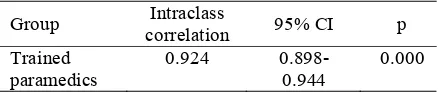
Because the data were numeric, therefore the statistical analysis of agreement between paediatricians and trained paramedics used intraclass correlation coefficient (ICC). This study found (TABLE 2) that there was a good agreement between pediatrician and trained paramedics (ICC: 0.924; 95% CI: 0.898 - 0.944 and p<0.05). Mean was used to express the data because the Ballard score use some criteria that become one score.
TABLE 2. Intraclass correlation cooficient
Group Intraclass
correlation 95% CI p
Trained paramedics
0.924 0.898-0.944
0.000
The results of Ballard score measurement in the first, second, and thirth day of age were shown in TABLE 3. This study also found that that there was a good agreement between pediatrician and trained paramedics in each day measurement.
TABLE 3. The results Ballard score measurement in each day of baby age
Baby age Intraclass
correlation 95% CI p
First day 0.860 0.840-0.881 0.000
Second day 0.921 0.908-0.945 0.000
Third day 0.924 0.894-0.997 0.000
DISCUSSION
Before this study begun, training for paramedic and refreshing for pediatrician were conducted. Materials of paramedic training consists of theories which cover neuromuscular maturity, physical maturity, and the count of maturity score. Interobserver agreement among paramedic after training was measured on nine babies (5% of sample) under supervision of pediatric resident resulting an excellent clinical agreement (ICC=0.95 and p<0.05).
A very good agreement with ICC from 0.860-0.924 between pediatricians and trained paramedics was obtained from this study. Maria et al.7 reported
that interobserver agreement between two examiners of New Ballard Score was considered to be very good if the ICC value is more than 0.8.
New Ballard Score method has its own advantages and disadvantages. For example, the accuration of New Ballard Score method was better than USG (ICC = 0.6-0.8). However, in comparison with Dubowitz Score Method, New Ballard Score was less accurate (Dubowitz score ICC: 0.94 vs Ballard score ICC=0.93), although duration of assessment for New Ballard Score (2 minutes and 48 seconds) was more rapid than Dubowitz Score Method (4 minutes and 28 seconds).8
Verhoeff et al.9 recommended that in health
care centers with limited human resources, routine physical criteria examination of New Ballard Score can be performed by nurse. This recommendation was supported by Mcgready et al.10 who mentioned
that the examination of neurological criteria of New Ballard Score can be performed reliably by paramedic.
115
Sulistyo et al, Agreement between pediatrician and trained paramedic in the assessment of gestational age among newborns using New Ballard Scored
assessment of gestational age on the third day of age had the strongest correlation and statistical significant with gold standard (ICC=0.993 with p<0.005). It was equal with the study of Riandiani and Hidayat11 which reported that assessment using
New Ballard Score in gestational age more than 48 hours was near with gestational age estimated using the first day of last menstrual period. In addition, Gomella4 reported that the best time to perform New
Ballard Score examination was when the newborn age was < 96 hours.
To reduce bias, the data were collected by general practitioner, therefore the two examiners did not know the examination results and the subjects of research. Accuracy of measurement was influenced by variability of observers, subjects, and instruments. To increase the accuracy of measurement in this study, standardization of measurement, examination, and repeated measurement were performed. One method to know the accuracy of numeric variable measurement is by observing the confidence interval, the narrower confidence interval, the more accurate the measurement.12
This study attempted to avoid three sources of measurement bias, such as subject bias, examiner bias and instrumental bias. The subject bias was controlled by valid sampling that was consecutive sampling, in which all subjects who fulfilled the inclusion criteria were included until the minimum amount of subjects was fulfilled. Mean while the examiner bias was controlled by blinded examination. The two examiners did not know the examination results of each subject. The instumental bias was controlled by standardization of time and place of examination.
Intraclass correlation was used to test the reproducibility of New Ballard Score assessment. For further study, it was suggested to have better planning, to use pediatrician as observer, and to perform a good measurement standardization.
CONCLUSION
There was a very good agreement between pediatrician and trained paramedic in estimating the gestational period of newborns using the New Ballard Score.
ACKNOWLEDGMENT
The authors would like to thank all the pediatricians and trained paramedics from Dentatama Mother and Child Hospital, Sragen, Central Java who participated in this study. We also thank the Director of Dentatama Mother and Child Hospital Sragen, Central Java, Indonesia who have given his permission to perfom this study.
REFERENCES
1. Satrio US. Dokter spesialis dan permasalahannya ditinjau dari aspek pemanfaatan. Jendela Rumah Sakit 1999;11: 38-40.
2. Mihardja E. Uji kompetensi sebagai salah satu upaya meningkatkan harkat dan martabat profesi perawat. Media Perawat Indonesia 2007;20:19-23.
3. Taipale P, Hilesmaa V. Predicting delivery date by ultrasound and last menstrual period in gestation. Obstet Gynecol 2001;97:189-94.
4. Gomella TC, Cuningham MD, Eyal FG, Zenk KE editors. A Lange clinical manual. 4th ed. New York:
McGraw-Hill, 2005.
5. Ballard JL, Khoury JC, Wedig K. New Ballard Score, expanded to include extremely premature infants. J Paediatr 1991; 119(3):417-23.
6. Fanaroff AA. Gestational age and classification of low birth weight. In: Klaus MH, Fanaroff AA editors. Care of the high-risk neonate, 4th ed. Pensylvania. WB
Saunders, 1995:100-33.
7. Maria MA, Moreirs M, Literas FG, Delgado GS, Alonso CR, Perez F. Assessment of New Ballard Score to estimate gestational age. Ann Paediatr 2006;64(2): 140-5.
8. Sunjoh F, Njamnshi AK, Tietche F, Kago I. Assessment of gestational age in the Cameroonian newborn infant: a comparison of four scoring methods. J Trop Pediatr 2004;50(5):285-91.
9. Verhoeff VH, Miligan P, Brabin BJ, Mlanga S, Nakoma V. Gestational age assessment by nurse in developing country using the Ballard score, external criteria only. Ann Trop Paediatr 1997;17(4): 333-42.
10. McGready R, Simpson J, Dubowitz L, Kolatat T. Neonatal neurological testing in resource poor setting. Ann Tropical Paediatr 2000;20:323-36.
11. Riandiani I, Hidayat DS. Relevansi dan akurasi waktu penilaian masa gestasi menurut skor Ballard terhadap baku emas HPM. Jakarta: IDAI, 2004.