Synthesis and Characterization of Chitosan
Linked by Methylene Bridge and Schiff Base of 4,4-Diaminodiphenyl Ether-Vanillin
Ahmad Fatoni
1,2,*, Poedji Loekitowati Hariani
2, Hermansyah
2, and Aldes Lesbani
2 1Bhakti Pertiwi School of Pharmacy Science, Jl. Ariodillah 3 No. 22, Palembang 30128, South Sumatera, Indonesia2Department of Chemistry, Faculty of Mathematics and Natural Sciences, Sriwijaya University, Jl. Palembang-Prabumulih Km. 32, Indralaya Ogan Ilir, South Sumatera, Indonesia
Received June 13, 2017; Accepted October 27, 2017
ABSTRACT
The synthesis chitosan-methylene bridge-Schiff base of 4,4-diaminodiphenyl ether-vanillin using casting method has been done. The aims of this research were modification chitosan with Schiff base of 4,4-diaminodiphenyl ether-vanillin, formaldehyde and its characterization using FTIR spectroscopy, SEM analysis, 1
H-NMR and X-Ray Diffraction analysis. The first step was a synthesis of modified chitosan between chitosan and Schiff base of diaminodiphenyl ether-vanillin. The second step was chitosan modified Schiff base of 4,4-diaminodiphenyl ether-vanillin then reacted with formaldehyde through casting method. The result showed that chitosan can be modified with Schiff base of 4,4-diaminodiphenyl ether-vanillin and formaldehyde and this modified chitosan can be linked by methylene bridge (-NH-CH2-NH-) and had azomethine group (-C=N-). The functional
group of –C=N in modified chitosan before and after adding formaldehyde appeared at a constant wavenumber of 1597 cm-1. The functional group C-N in methylene bridge detected at 1388 and 1496 cm-1. The chitosan-Schiff base
of 4,4-diaminodiphenyl vanillin and Chitosan-methylene bridge-Schiff base of 4,4-diaminodiphenyl ether-vanillin had index crystalline (%)16.04 and 25.76, respectively. The chemical sift of signal proton azomethine group (-C=N-) in modified chitosan detected at 8.44–8.48 and 9.77 ppm. Proton from methylene bridge in modified chitosan appeared at 4.97–4.99 and 3.75 ppm. Surface morphology chitosan-methylene bridge-Schiff base of 4,4-diaminodiphenylether-vanillin had dense surfaces, mostly uniform and regular in shape.
Keywords:chitosan; methylene bridge; Schiff base
ABSTRAK
Telah dilakukan penelitian sintesis kitosan-jembatan metilen-basa Schiff 4,4-diaminodifenil eter-vanilin. Tujuan-tujuan dari penelitian adalah modifikasi kitosan dengan basa Schiff 4,4-diaminodifenil eter-vanilin, formalin dan
karakterisasinya dengan menggunakan spektrofotomer FTIR, SEM, 1H-NMR and XRD. Tahap pertama sintesa
kitosan termodifikasi antara kitosan dan basa Schiff 4,4-diaminodifenil eter-vanilin. Tahap kedua kitosan termodifikasi basa Schiff 4,4-diaminodifenil eter-vanilin direaksikan dengan formalin melalui metode pencelupan (perendaman). Hasil penelitian menunjukkan bahwa kitosan dapat dimodifikasi dan kitosan termodifikasi ini dapat dihubungkan dengan jembatan metilena dan mempunyai gugus fungsi azometin (-N=CH). Gugus fungsi –N=CH dalam kitosan termodifikasi sebelum dan sesudah penambahan formalin mempunyai bilangan gelombang yang tetap yaitu 1597 cm-1. Gugus fungsi C-N dalam jembatan metilena terdeteksi pada bilangan gelombang 1388 and
1496 cm-1. Kitosan-basa Schiff -diaminodifenil eter-vanilin dan kitosan-jembatan metilena-basa Schiff
4,4-diaminodifenil eter-vanilin, masing-masing mempunyai indeks kristalinitas (%) 16,04 dan 25,76. Sinyal proton gugus fungsi azometin (-C=N-) di kitosan termodifikasi terdeteksi pergeseran kimianya pada 8,44–8,48 dan 9,77 ppm. Proton dari jembatan metilena di kitosan termodifikasi muncul pada 4,97–4,99 dan 3,75 ppm. Morfologi permukaan kitosan-jembatan metilen-basa Schiff 4,4-diaminodifenil eter-vanilin mempunyai permukaan yang padat, lebih seragam dan bentuk teratur.
Kata Kunci:kitosan, jembatan metilen, and basa Schiff
INTRODUCTION
Chitosan is a natural polymer, derived from chitin by alkaline deacetylation. Chitosan has chemical
structure (C6H11NO4)n (n = 1 and 3) and it has a mass of 161 g/unit monomer. The concentration of primary amine group (-NH2) is 6.21 mmol/g if it is perfectly deacetylated [1]. The solubility of chitosan in dilute
Indones. J. Chem., xxxx, xx (x), xx - xx
2
acidic aqueous solutions such as acetic, propionic, lactic, citric, and other acids and that is a problem of chitosan.
Chitosan can be modified by reaction substitution at -NH2 group (C2) and or –OH group (C3, deacetylated unit) and (C6, deacetylation unit). Kandile and Nasr [2] and Dai et al. [3] reported that the aims of chemical modification chitosan were to increase the metal adsorption properties and change the characteristic solubility of chitosan in water or acid medium. Modification –NH2 group of chitosan can be carried out by two methods, i.e. physical and chemical method. Physical method is to increase widely of surface area, the active site of adsorption, swelling polymer chain, decrease crystallinity and to increase the swell of it. The chemical method can be done by grafting, impregnating and cross-linking [4].
4,4-diaminodiphenyl ether or 4,4-oxydianilline is diamine monomer because has two primary amine (-NH2), chemical structure C12H12N2O and molecular weight 200.24 g/mol [5]. 4,4-diaminodiphenyl ether has one or more oxazine ring and called heterocyclic compound [6]. This primary amine can be modified to be derived 4,4-diaminodiphenyl ether and used as abiological and medical field [7].
Vanillin (3-methoxy-4-hydroxybenzaldehyde, IUPAC) obtained from vanilla pods is flavoring agent which used in industry such as food, drink and cosmetic [8]. Vanillin has chemical formula C8H8O3 and molecular weight 152.15 g/mol [9]. Vanillin has an aromatic ring and it is trisubstituted with –CH=O, -OCH3 and -OH groups [10]. Aldehyde group (-CH=O) can be reacted with primary amine from 4.4-diaminodiphenyl ether to form Schiff base (–N=CH-) group with mol ratio aldehyde and primary amine was 2:1 [11].
The solubility of chitosan only in dilute acidic aqueous solutions and it is a problem of chitosan so that chitosan need to modify. In this paper, we successfully synthesized Schiff base (-N=CH-) compound from aldehyde group of vanillin and one primary amine of 4,4-diaminodiphenyl ether with mol ratio aldehyde and primary amine were 1:1 to form Schiff base of 4,4-diaminodiphenyl ether-vanillin (compound 1). Another primary amine (as a free primary amine) at 4,4-diaminodiphenyl ether in compound 1 can be reacted with a primary amine of chitosan with formaldehyde compound as linkages [12-14] to form -NH-CH2 -NH-group. This group acts as methylene bridge between chitosan and compound 1. The final product named chitosan-methylene bridge-Schiff base of 4,4-diaminodiphenyl ether-vanillin (compound 3) and the solubility properties of this product in dimethyl sulfoxide (DMSO) and N,N-dimethyl-formamide (DMF). If used as an adsorbent, compound 3 has functional groups of-NH-, -C=N- and –OH. Characterization of this product has
been conducted based upon FTIR, XRD,1H-NMR and SEM data.
EXPERIMENTAL SECTION
Materials
Chemical were supplied from Merck and Aldrich in analytical grades such as acetic acid 100%, methanol, vanillin, dimethyl sulfoxide (DMSO), formaldehyde (37%, v/v), 4,4-diaminodiphenyl ether 97% and sulfuric acid 97% (v/v). Chitosan (DD 87%) obtained from CV. Ocean Fresh Bandung, West Java, Indonesia.
Instrumentation
The instruments used for characterization included Fourier Transform Infrared (FTIR) spectrometer (Shimadzu Prestige-21) for identifying the presence of functional groups. Scanning Electron Microscope (SEM) (JEOL JSM-6510 LA) for characterizing the surface morphology, 1H-NMR spectrometer (JEOL JNM-ECP600) for characterizing the chemical structure using DMSO-d6 as a solvent, Fisher-Johns apparatus for analyzing of melting point and X-Ray diffractometer (Shimadzu XRD-6000) for evaluating the crystalline level.
Procedure
Synthesis Schiff base of 4, 4-diaminodiphenyl ether-vanillin (compound 1)
Schiff base of 4,4-diaminodiphenyl ether-vanillin (Fig. 1) was synthesized according to Cucos et al. [11] procedure with slight modification. 4,4-diaminodiphenyl ether (4 g, 0.02 mol) was dissolved in 20 mL methanol in beaker glass 250 mL. In this beaker glass, vanillin solution (3.04 g, 0.02 mol, 10 mL methanol) was added. The mixture was stirred continuously at temperature 75 °C for 1 h. After 1 h, orange solution was appeared and stored at room temperature until yellow powder formed. The yellow powder washed with 10 mL methanol and dried in an oven at 55 °C until constant weight.
Synthesis chitosan–compound 1 (compound 2)
Chitosan (0.805 g, 0.005 mol) was dissolved with 20 mL acetic acid solution 3% (v/v) in beaker glass 250 mL and stirred continuously at room temperature for 30 min. After 30 min, clear chitosan solution formed. In this beaker glass was added compound 1 solution (5.010 g, 0.015 mol, 5 mL of DMSO). The mixture was stirred continuously at temperature 70 °C for 1 h. After 1 h, the mixture was transferred to the oven at temperature
Fig 1.Illustration of chemical reaction of compound 1
Fig 2.Schematic reaction of synthesis compound 3
70 °C until a brown gel formed. A brown gel washed with 10 mL ethanol and stored for 15 min at room temperature. A brown gel dried in an oven at temperature 50 °C until constant weight.
Synthesis chitosan linked by methylene bridge and compound 1 [12]
A 5 g of dry compound 2 was soaked in 5 mL of
formaldehyde solution 37% (v/v) and 0.5 mL sulfuric acid solution 10% (v/v) in beaker glass 250 mL (Fig. 2). The mixture was stored at room temperature for 30 min. After 30 min, the mixture was washed with water several times until the filtrate has pH 6-7. The residue dried in an oven at 50 °C until constant weight. This product named chitosan-methylene bridge-Schiff base of 4,4 diaminodiphenyl ether-vanillin (compound 3).
Indones. J. Chem., xxxx, xx (x), xx - xx
4
Table 1.The result of melting point and solubility analysis
No. Compound Melting point (°C) Solubility
1 4,4-diaminodiphenyl ether 187 methanol
2 vanillin 75 methanol
3 compound 1 125 DMF and DMSO
4 chitosan 230 Acetic acid
5 compound 2 80 DMF and DMSO
6 compound 3 160 DMF and DMSO
The functional group, morphology and physical structure analysis
Characterization of functional group, morphology and physical structure of chitosan before and after modification using FTIR spectroscopy, SEM analysis, and X-Ray diffractometer, respectively. The chemical structure of modified chitosan was identified using 1 H-NMR Spectroscopy.
RESULT AND DISCUSSION
Synthesis, Purification, Physical and Chemical Properties of Compound 3
4,4-diaminodiphenyl ether has two primary amines. The first, primary amine of 4,4-diaminodiphenyl ether can be reacted by aldehyde group of vanillin to get compound 1 and it has azomethine group (-N=CH). Unreacted aldehyde purified with methanol in compound 1 product. The second, primary amine of 4,4-diaminodiphenyl ether at compound 1 is free of primary amine and can bound with primary amine chitosan with formaldehyde as linkages to form compound 3.
The purification of compound 2 with absolute ethanol to remove acetic acid whereas the purification of compound 3 using distilled water to remove excess of formaldehyde and neutralization process of this product, so it will increase in coordination ability of hydroxyl oxygen atom and basicity of the imine nitrogen atom as active sites [15]. Fajardo et al. [12] and Li et al. [13] used formaldehyde as linkage and reported that chitosan structure after modified had the reactive functional group N and S as donor atom. We synthesized modified chitosan had the reactive functional group of –NH2, -NH-, azomethine group and hydroxyl oxygen atom (phenolic groups) [15-17]. If it’s used such at adsorption process, the reactive functional group N and O can act as donor atom because decreases effect of the electron density at the phenolic oxygen atom and modified chitosan contain the electron cloud upon the aromatic ring and the electronegative atoms such as nitrogen and oxygen [15]. The analysis of physical (melting point) and chemical properties (solubility) compound 1, 2, and 3 as seen in Table 1. Table 1 showed that the melting point of compound 3 was higher than compound 1 and 2.
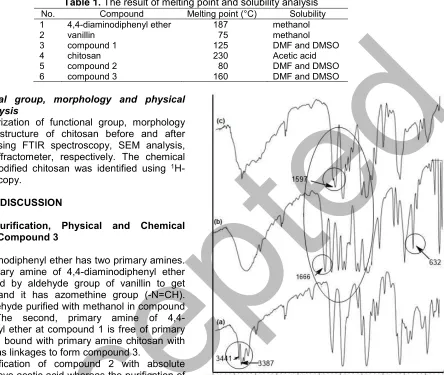
Fig 3. The FTIR spectra of: (a) 4,4-diaminodiphenyl eter, (b) vanillin, and (c) compound
Characterization of Product Synthesis
Presence of functional group with FTIR
Synthesis of compound 1. The reaction between aldehyde group (vanillin) and primary amine (4,4-diaminodiphenyl ether) formed Schiff base compound with mol ratio (aldehyde and primary amine group) 1:1. The spectra FTIR vanillin, 4,4-diaminodiphenyl ether and compound 1 are shown in Fig. 3.
The FTIR spectra of 4,4-diaminodiphenyl ether (Fig. 3a) shows that peaks at 3441 and 3387 cm-1are as asymmetric and symmetric stretching vibration of primary amine (-NH2) respectively [18-19]. Stretching vibration of C-O (C-O-C) appeared with a sharp peak at 1219 cm-1and a medium peak at 1087 cm-1 and 1010 cm-1[20-21]. Bending vibration N-H from primary amine appeared at wavenumber 1620 cm-1with a sharp peak
Fig 4. FTIR spectra of: (a) chitosan, (b) compound 2, and (c) compound 3
and a peak at 1273 cm-1 with medium intensity is assigned stretching vibration of C-N from aromatic amine (NH2-Aromatic) [20]. Stretching vibration of the aromatic ring (C=C-C) detected with a weak peak at 1442 cm-1 and a sharp peak at 1504 cm-1, whereas stretching and bending vibration of C-H aromatic ring appeared at wavenumber between 3016–3039 cm-1and 732-825 cm-1, respectively [20-21].
The FTIR spectra of vanillin (Fig. 3b) shows that stretching (a broad band) and bending (a medium band) vibration -OH group are detected at 3178 and between 1265–1296 cm-1, respectively [22]. Stretching vibration -C-H can be detected at 2847–3024 cm-1 with a weak band absorption. A sharp peaks at 1666 and 632 cm-1 are stretching and bending vibration of aldehyde group (C=O), respectively [10,22]. Stretching vibration of O-CH3 with medium intensity appeared at 1026 cm-1 [10] and stretching vibration of C=C-C group appeared at wavenumber between 1427–1589 cm-1[20-21].
Fig. 3c is the FTIR spectra of compound 1. In this spectra shows that a broad band at 3387 cm-1 are stretching vibration asymmetric of primary amine (N-H) and overlap with stretching vibration –OH, but –OH group also detected at 3224 cm-1[18-20]. A peak at 1280 cm-1is assigned as bending vibration of OH group [22]. Stretching and bending vibration of C-H group detected with weak and sharp peaks at 3008 and 833 cm-1, respectively [10,21].
Stretching vibration of C=C-C group with a sharp intensity appeared at 1504 cm-1 [18]. Stretching vibration of C-O (C-O-C) appeared at 1226–1234 cm -1(medium intensity) [21,23]. A peak at 1280 cm-1 with intensity medium is stretching vibration of C-N from aromatic amine (NH2-Aromatic) [20]. Stretching vibration of O-CH3 (medium intensity) appeared at 1033 cm-1 [10]. A new peak at 1597 cm-1 is a azomethine group (-N=CH-, Schiff base) [20,24-25]. Synthesis of compound 3. The FTIR spectra chitosan, compound 2 and compound 3 were shown in Fig. 4. The FTIR spectrum of chitosan (Fig. 4a) shows that a peak at 3441 cm-1representing –OH stretching and overlap with -NH stretching vibration [26-27]. The weak band at 2924 cm−1 attributed to -CH and -CH2 stretching vibration of chitosan [26-27]. The characteristic of at 1604 cm-1 is due to bending vibration of primary amine chitosan [27-28]. C-H symmetric bending vibrations in -CHOH- appeared at 1381 cm-1 [29]. –NH deformation vibration in primary amine can be found at 1427 cm-1 [25] and a peak at 1095 cm-1is stretching vibration of C-O group [17].
The FTIR spectrum of compound 2 (Fig. 4b) had a peak at 3387 cm-1and it is stretching vibration -OH group [20] from chitosan and vanillin. This –OH group overlaps with -NH primary amine in chitosan and 4,4-diaminodiphenyl ether. The bending vibration of -NH primary amine from chitosan and 4,4-diaminodiphenyl ether appeared with medium intensity at 1627 cm-1, bending vibration OH group observed at 1226-1311 cm-1, a peak at 2916 cm-1is stretching vibrations of -CH and –CH2 and the functional group of C=C–C (stretching vibrations) appeared at 1411 and 1504 cm-1 [20]. A peak at 1118 cm-1 (C-O-C group) is stretching vibrations [20] from chitosan and 4,4-diaminodiphenyl ether. The stretching vibration of –OCH3 vanillin appeared at 1018 cm-1[10]. Absorption band observed at 1597 cm-1 is due to the vibration stretch of Schiff Base (-N=CH-) group [20,24-25] from the reaction between aldehyde group of vanillin and one primary amine group of 4,4-diaminodiphenyl ether. The data from FTIR spectra in Fig. 4b shown that compound 2 has functional groups of -NH2, -C=N- and –OH.
The FTIR spectrum of compound 3 (Fig. 4c) shows that stretching vibration -OH (at chitosan and vanillin) with broad band appeared at 3324–3363 cm-1 and bending vibration OH group observed at 1211– 1234 cm-1 (medium intensity) [20]. Kandile et al. [17] reported that a peak at 3363 cm-1 was the functional group -NH secondary. A peak at 1118 cm-1 (C-O-C group) is stretching vibrations [20] from chitosan and 4,4-diaminodiphenyl ether whereas the stretching vibration of -OCH3vanillin appeared at 1026 cm-1[10].
A new peak at 1388 cm-1 with weak intensity appeared after added formaldehyde. Monier [14] and
Indones. J. Chem., xxxx, xx (x), xx - xx
6
Du et al. [30] reported that this peak was C-N group from methylene bridge (-NH-H2C-NH-). In other hand, after added a formaldehyde the functional group of C=C–C (stretching vibrations) appeared at 1427 (medium intensity) and 1496 cm-1(sharp intensity) but a peak at 1496 cm-1 is also C-N group from methylene bridge (-NH-H2C-NH-) and this peak obscured of C=C-C group in benzene ring as reported by [31-33]. The wavenumber of 1597 cm-1(-N=CH- group) was constant and this peak was almost not affected by adding formaldehyde whereas bending vibration of –NH primary amine from chitosan and 4,4-diaminodiphenyl ether at 1627 cm-1 were disappeared. This fact showed that formaldehyde was reacted with -NH2group [12-14,25] in chitosan (–C2 -NH2) and 4,4-diaminodiphenyl ether (–C-NH2) become – C-N- group as methylene bridge. The data from FTIR spectra in Fig. 4c shown that compound 3 has the functional group of the secondary amine (-NH-), -C=N-and -OH.
Analysis of physical structure with XRD
The physical structure of chitosan, compound 2 and 3 can be seen in Fig. 5. Fig. 5a shows that physical structure of chitosan is crystalline form. It has two strong
diffractions at 2θ = 9.90° and 20°. These peaks are
corresponding to the characteristics of chitosan [27,34]. The crystalline form chitosan is an indication that chitosan structure has intra and intermolecular hydrogen bond included all polymer chain.
Diffraction of chitosan modified as shown in Fig. 5b and c have changed the crystallinity of chitosan. This fact showed that strong hydrogen bond in chitosan can be deformed by insertion of the functional group [35-36] Schiff base of 4,4-diaminodiphenyl ether-vanillin. The index of crystalline (%) of chitosan, compound 2 and 3 were 50.50, 16.04, and 25.76, respectively.
Analysis of chemical structure with1H-NMR
1H-NMR spectra of compound 2 and 3 are shown in Fig. 6 and Fig. 7, respectively. DMSO-d6 used as a solvent in order to identify the chemical structures of compound 2 and 3.
As can be seen in Fig. 2 and 6, the signals of proton Ha, Hb and Hc vanillin were observed at 7.04– 7.06 (d), 7.20–7.21 (d) and 7.49 (s) ppm, respectively [36]. A signal at 3.83–3.84 (s) ppm was proton of -OCH3in vanillin [38] and signal proton of -OH appeared at 6.76–6.78 ppm (d) [39].
Protons of 4,4-diaminodiphenyl ether were observed at different region (signal). A signal at 6.50– 6.52 ppm (d) was Hd proton (meta) and signal appearing at 6.58–6.62 ppm (dd) may be due to He proton (ortho) [40-41]. Protons of Hg (meta) and Hf (ortho) can be found at chemical shift 7.27–7.31 ppm (dd) [42] and 6.86–6.88 ppm (dd) [21,43], respectively. Proton from azomethine (-N=CH-) group appeared at 8.43–8.44 ppm (s) [44].
H2 proton from chitosan was observed at 2.67 ppm (s) and the signal at 1.90 ppm (s) was shown as proton of H-acetyl [45]. H3, 4, 5, and 6 protons were not observable because they overlapped with a proton
Fig 5. XRD powder patterns of: (a) chitosan, (b) compound 2, and (c) compound 3
Fig 6.1H-NMR spectra of compound 2
Fig 7.1H-NMR spectra of compound 3
Fig 8.SEM image of: (a) chitosan, (b) compound 2 and (c) compound 3
from H2O [46] whereas –NH2proton was not detected as reported by Fang et al. [47]. The result of this analysis shown that there is a functional group of –NH2 (although not detected), -C=N- and -OH in compound 2.
Fig. 7 show that there is a significant change in spectra of compound 3 compared to compound 2, so a new signals appeared and can be observed. A new signal of methylene bridge (-NH-CH2-NH-) proton appeared in two regions and detected at chemical shift 4.97–4.99 (d) and 3.75 ppm (s) [39,48]. Proton from azomethine (-N=CH-) group was appeared become two signals, the first atchemical shift 8.44–8.48 ppm (s) [44] and the second at 9.77 ppm (s) [38]. The analysis of compound 3 with1H-NMR shown that only the functional group of primary amine (-NH2) changed into secondary amine (-NH-).
The data from FTIR spectra in Fig. 4 shown that analysis of functional group was supported chemical structure of compound 2 and 3 (Fig. 2) which analyzed by1H-NMR (Fig. 6 and 7).
Analysis of surface morphology with SEM
Surface morphology chitosan, compound 2 and 3 are shown in Fig. 8. SEM image of chitosan (Fig. 8a) have surface morphology smooth and uniform [49-50]. If compared with Fig. 8b, the surface morphology of chitosan was changed. Surface morphology of compound 2 was not smooth and uniform but uneven and rough. As can be seen in Fig. 8c, surface morphology of compound 3 become regular in shape, had dense surfaces and mostly uniform.
Indones. J. Chem., xxxx, xx (x), xx - xx
8
CONCLUSION
Compound 3 was successfully synthesized by the reaction between chitosan, compound 1 and formaldehyde as linkages agent. The functional group of –CH=N- before and after addition formaldehyde was not changed. The presence of functional group C-N at methylene bridge can be detected at 1388 and 1496 cm-1. The crystallinity of derivated chitosan was lower than raw chitosan. Proton methylene bridge was detected at 4.97–4.99 and 3.75 ppm, whereas proton azomethine (-N=CH-) appeared at 8.44–8.48 and 9.77 ppm. Surface morphology of derivated chitosan had shape uneven, rough, regular, dense surface and mostly uniform.
ACKNOWLEDGEMENT
We thank to Directorate of Research and Community Service, Directorate General of Research and Development Reinforcement, Ministry of Research, Technology and Higher Education of the Republic of Indonesia 2017 for providing financial support to this research throughHibah Penelitian Disertasi Doktor.
REFERENCES
[1] Wu, F.C., Tseng, R.L., and Juang, R.S., 2010, A review and experimental verification of using chitosan and its derivatives as adsorbents for selected heavy metals,J. Environ. Manage., 91 (4): 798–806.
[2] Kandile, N.G., and Nasr, A.S., 2011, Hydrogels based on a three component system with potential for leaching metals, Carbohydr. Polym., 85 (1), 120–128.
[3] Dai, B., Cao, M., Fang, G., Liu, B., Dong, X., Pan, M., and Wang, S., 2012, Schiff base-chitosan grafted multiwalled carbon nanotubes as a novel solid-phase extraction adsorbent for determination of heavy metal by ICP-MS,J. Hazard. Mater., 219-220, 103–110.
[4] Zhang, L., Zeng, Y., and Cheng, Z., 2016, Removal of heavy metal ions using chitosan and modified chitosan: A review,J. Mol. Liq., 214, 175–191. [5] Gangolli, S.D., 1999, The Dictionary of Substances
and their Effects (DOSE): O-S, Vol. 6, 2nded., The Royal Society of Chemistry, Cambridge.
[6] Liu, Y., Zhang, J., Li, Z., Luo, X., Jing, S., and Run, M., 2014, A pair of benzoxazine isomers from o
-allylphenol and 4,4′-diaminodiphenyl ether:
Synthesis, polymerization behavior, and thermal properties,Polymer, 55 (7), 1688–1697.
[7] Singh, V.K., Kadu, R., and Roy, H., 2014,
4,4′-Diaminodiphenyl ether derivatives: Synthesis,
spectral, optical, thermal characterization and
in-vitro cytotoxicity against Hep 3B and IMR 32
human cell lines, Eur. J. Med. Chem., 74, 552– 561.
[8] Wang, G., Li, P., Peng, Z., Huang, M., and Kong, L., 2011, Formulation of vanillin cross-linked chitosan nanoparticles and its characterization,
Adv. Mater. Res., 335-336, 474–477.
[9] Shakeel, F., Haq, N., And Siddiqui, N.A., 2015, Solubility and thermodynamic function of vanillin in ten different environmentally benign solvents,
Food Chem., 180, 244–248.
[10] Balachandran, V., and Parimala, K., 2012, Vanillin and isovanillin: Comparative vibrational spectroscopic studies, conformational stability and NLO properties by density functional theory calculations, Spectrochim. Acta, Part A, 95, 354– 368.
[11] Cucos, P., Tuna, F., Sorace, L., Matei, I., Maxim, C., Shova, S., Gheorghe, R., Caneschi, A., Hillebrand, M., and Andruh, M., 2014, Magnetic and luminescent binuclear double-stranded helicates,Inor. Chem., 53 (14), 7738–7747. [12] Fajardo, A.R., Lopes, L.C., Rubira, A.F., and
Muniz, E.C., 2012, Development and application of chitosan/poly(vinyl alcohol) films for removal and recovery of Pb(II),Chem. Eng. J., 183, 253–260. [13] Li, M., Xu, J., Li, R., Wang, D., Li, T., Yuan, M.,
and Wang, J., 2014, Simple preparation of aminothiourea-modified chitosan as corrosion inhibitor and heavy metal ion adsorbent,J. Colloid Interface Sci., 417, 131–136.
[14] Monier, M., 2012, Adsorption of Hg2+, Cu2+ and Zn2+ ions from aqueous solution using formaldehyde cross-linked modified chitosan– thioglyceraldehyde Schiff's base, Int. J. Biol. Macromol., 50, 773–781.
[15] Dey, R.K., Jha, U., Singh, A.C., Samal, S., and Ray, A.R., 2006, Extraction of metal ions using chemically modified silica gel covalently bonded with 4,4'-diaminodiphenylether and 4,4'-diaminodiphenylsulfone-salicylaldehyde Schiff bases,Anal. Sci., 22 (8), 1105–1110.
[16] Wang, X., Deng, W., Xie, Y., and Wang, C., 2013, Selective removal of mercury ions using a chitosan–poly(vinyl alcohol) hydrogel adsorbent with three-dimensional network structure, Chem. Eng. J., 228, 232–242.
[17] Kandile, N.G., Razek, T.M.A., Al-Sabagh, A.M., and Khattab, M.M.T., 2014, Synthesis and evaluation of some amine compounds having surface active properties as H2S scavenger,Egypt.
J. Pet., 23 (3), 323–329.
[18] Chi, N.T.Q., Luu, D.X. and Kim, D., 2011, Sulfonated poly(ether ether ketone) electrolyte
membranes cross-linked with 4,4′-diaminodiphenyl
ether,Solid State Ionics, 187 (1), 78–84.
[19] Uysal, Ş., and Uçan, H.I., 2010, The synthesis and
characterization of single substitute melamine cored Schiff bases and their [Fe(III) and Cr(III)] complexes, J. Inclusion Phenom. Macrocyclic Chem., 68 (1-2), 165–173.
[20] Coates, J., 2006, “Interpretation of Infrared Spectra, A Practical Approach” in The Encyclopedia of
Analytical Chemistry, John Wiley and Sons, New
York, 1–23.
[21] Liu, Y., Li, Z., Zhang, J., Zhang, H., Fan, H., and Run, M., 2013, Polymerization behavior and thermal
properties of benzoxazine based on
4,4′-diaminodiphenyl ether, J. Therm. Anal. Calorim., 111 (2), 1523–1530.
[22] Peng, H., Xiong, H., Li, J., Xie, M., Liu, Y., Bai, C., and Chen, L., 2010, Vanillin cross-linked chitosan microspheres for controlled release of resveratrol,
Food Chem., 121 (1), 23–28.
[23] Khoee, S., and Zamani, S., 2007, Synthesis, characterization and fluorimetric studies of novel photoactive poly(amide-imide) from anthracene
9-carboxaldehyde and 4,4′-diaminodiphenyl ether by
microwave irradiation,Eur. Polym. J., 43 (5), 2096– 2110.
[24] Zhou, G., Ruhan, A., Ge, H., Wang, L., Liu, M., Wang, B., Su, H., Yan, M., Xi, Y., and Fan, Y., 2014, Research on a novel poly (vinyl alcohol)/lysine/vanillin wound dressing: Biocompatibility, bioactivity and antimicrobial activity,Burns, 40 (8), 1668–1678.
[25] Li, N., and Bai, R., 2005, A novel amine-shielded surface cross-linking of chitosan hydrogel beads for enhanced metal adsorption performance, Ind. Eng. Chem. Res., 44 (17), 6692–6700.
[26] Jiangtao, W., and Hedong, W., 2011, Preparation of soluble p-aminobenzoyl chitosan ester by Schiff's base and antibacterial activity of the derivatives,Int. J. Biol. Macromol., 48 (3), 523–529.
[27] Kumari, S., Rath, P., Kumar, A.S.H., and Tiwari, T.N., 2015, Extraction and characterization of chitin and chitosan from fishery waste by chemical method,Environ. Technol. Innovation, 3, 77–85. [28] Mohammed, M.H., Williams, P.A., and
Tverezovskaya, O., 2013, Extraction of chitin from prawn shells and conversion to low molecular mass chitosan,Food Hydrocolloids, 31 (2), 166–171. [29] Huang, R., Yang, B., and Liu, Q., 2013, Removal of
chromium(VI) Ions from aqueous solutions with protonated crosslinked chitosan, J. Appl. Polym. Sci., 129 (2), 1–8.
[30] Du, W.L., Niu, S.S., Xu, Z.R., and Xu, Y.L., 2009, Preparation, characterization, and adsorption properties of chitosan microspheres crosslinked by
formaldehyde for copper(II) from aqueous solution,
J. Appl. Polym. Sci., 111 (6), 2881–2885.
[31] Karunakaran, M., Vijayakumar, C.T., Selvan, D.M., and Magesh, C., 2013, o-Cresol, thiourea and formaldehyde terpolymer – A cation exchange resin,J. Saudi Chem. Soc., 17 (1), 1–8.
[32] Can, M., Bulut, E., and Özacar, M., 2012, Synthesis and characterization of pyrogallol-formaldehyde nano resin and its usage as an adsorbent, J. Chem. Eng. Data, 57 (10), 2710– 2717.
[33] Poljanšek, I., and Krajnc, M., 2005, Characterization of phenol-formaldehyde prepolymer resins by in line FT-IR spectroscopy,
Acta Chim. Slov., 52, 238−244.
[34] Machado, M.O., Lopes, E.C.N., Sousa, K.S., and Airoldi, C., 2009, The effectiveness of the protected amino group on crosslinked chitosans for copper removal and the thermodynamics of interaction at the solid/liquid interface, Carbohydr. Polym., 77 (4), 760–766.
[35] Ding, P., Huang, K.L., Li, G.Y., and Zeng, W.W., 2007, Mechanisms and kinetics of chelating reaction between novel chitosan derivatives and Zn(II),J. Hazard. Mater., 146 (1-2), 58–64.
[36] Pereira, F.S., de Souza, G.G., Moraes, P.G.P., Barroso, R.P., Lanfredi, S., Gomes, H.M., Filho, A.J. C., and Gonzales, R.P., 2015, Study of chitosans interaction with Cu(II) from the corresponding sulfate and chloride salts,
Cellulose, 22 (4), 2391–2407.
[37] Wang, Q., Zhang, J., Shi, D., and Du, Min., 2015, Synthesis, characterization and inhibition performance of vanillin-modified chitosan quaternary ammonium salts for Q235 steel corrosion in HCl solution, J. Surfactants Deterg., 18 (5), 825–835.
[38] Kaya, I., Bilici, A., and Gül, M., 2008, Schiff base substitute polyphenol and its metal complexes derived from o-vanillin with 2,3-diaminopyridine: Synthesis, characterization, thermal, and conductivity properties, Polym. Adv. Technol., 19 (9), 1154–1163.
[39] Chauhan, N.P.S., 2014, Preparation and characterization of bio-based terpolymer derived from vanillin oxime, formaldehyde, and p-hydroxyacetophenone,Des. Monomers Polym., 17 (2), 176–185.
[40] García, J.M., Jones, G.O., Virwani, K., McCloskey, B.D., Boday, D.J., ter Huurne, G.M., Hom, H.W., Coady, D.J., Bintaleb, A.M., Alabdulrahman, A.M.S., Alsewailem, F., Almegren, H.A.A.and Hedrick, J.L., 2014, Recyclable, strong thermosets and organogels via paraformaldehyde
Indones. J. Chem., xxxx, xx (x), xx - xx
10
condensation with diamines, Science, 344 (6185), 732–735.
[41] Yi, L., Li, C., Huang, W., and Yan, D., 2015, Soluble
polyimides from 4,4′-diaminodiphenyl ether with one
or two tert-butyl pedant groups,Polymer, 80, 67–75. [42] Shoji, E., and Nasuno, N., 2014, Synthetic route to soluble sulfonated poly(arylene sulfone imide),
Polym. J., 46 (10), 694–698.
[43] Chen, B.K., Wong, J.M., Wu, T.Y., Chen, L.C., and Shih, C., 2014, Improving the conductivity of sulfonated polyimides as proton exchange membranes by doping of a protic ionic liquid,
Polymers, 6 (11), 2720–2736.
[44] Samal, S., Das, R.R., Dey, R.K., and Acharya, S., 2000, Chelating resins VI: Chelating resins of formaldehyde condensed phenolic Schiff bases
derived from 4,4′-diaminodiphenyl ether with
hydroxybenzaldehydes–synthesis, characterization, and metal ion adsorption studies, J. Appl. Polym. Sci., 77 (5), 967–981.
[45] Lal, S., Arora, S., and Sharma, C., 2016, Synthesis, thermal and antimicrobial studies of some Schiff bases of chitosan,J. Therm. Anal. Calorim., 124 (2), 909–916.
[46] Kasaai, M.R., 2010, Determination of the degree of N-acetylation for chitin and chitosan by various
NMR spectroscopy techniques: A review,
Carbohydr. Polym., 79 (4), 801–810.
[47] Fang, J., Guo, X., Harada, S., Watari, T., Tanaka, K., Kita, H., and Okamoto, K., 2002, Novel sulfonated polyimides as polyelectrolytes for fuel cell application. 1. Synthesis, proton conductivity, and water stability of polyimides from 4,4‘-diaminodiphenyl ether-2,2‘-disulfonic acid,
Macromolecules, 35 (24), 9022–9028.
[48] Samal, S., Das, R.R., Mohapatra, N.K., Acharya, S., and Dey, R.K., 2000, Synthesis, characterization, and metal-ion uptake studies of chelating resins derived from
formaldehyde-condensed azodyes of aniline and
4,4′-diaminodiphenylmethane coupled with phenol/resorcinol, J. Appl. Polym. Sci., 77 (14), 3128–3141.
[49] He, L.H., Xue, R., Yang, D.B., Liu, Y., and Song, R., 2009, Effects of blending chitosan with PEG on surface morphology, crystallization and thermal properties,Chin. J. Polym. Sci., 27 (4), 501−510. [50] Mujeeb, V.M.A., Alikutty, P., and Muraleedharan,
K., 2014, Synthesis, characterization and vanadium (V) sorption studies on some chitosan derivatives,J. Water Process Eng., 4, 143–148.