ROLE OF SEED SIZE IN RE-SPROUTING ABILITY OF OAK
SEEDLING AFTER BEING DAMAGED BY HERBIVORY
PENGARUH UKURAN BIJI TERHADAP KEMAMPUAN TANAMAN
TUMBUH KEMBALI SETELAH RUSAK AKIBAT HERBIVORI
Erniwati
Forestry Department Agriculture Faculty Bengkulu University Jln. Raya Kandang Limun Bengkulu 38371A
ABSTRACT
The objective of the study is to investigate the effect of seed size in the resprouting ability of seedling after being damaged and whether it correlates with the reserve effect. We grew the seedlings of two species of oak, namely Quercus robur and Quercus petraea from different seed size, in a greenhouse. The seedlings were harvested at different stages; after emergence, at the first shoot fully developed, and after the seedling had re-grown after the initial shoot was clipped. The result showed that: firstly, at the time of full seedling development, large seeds translocated less percentage of reserve from the seed to seedling. After clipping, the seedlings from large seeds translocated additional resources to the seedling. Secondly, although the larger seed has the larger biomass to re-sprout, the total mass invested in re-sprouting proportional with seedling size. We concluded that the seedlings of larger seeds re-sprout better than those of the smaller seeds. However, we did not find the improved performances correlating with the Reserve Effect Theory
Key words: defoliation, reserve effect Theory, seed size, re-sprouting ability.
ABSTRAK
Tujuan penelitian ini adalah untuk melihat pengaruh ukuran biji terhadap kemampuan anakan untuk tumbuh kembali setelah rusak akibat herbivori, dan untuk melihat apakah ada hubungannya dengan teori Reserve Effect. Penelitian yang dilakukan di rumah kaca ini menggunakan dua spesies pohon Oak yaitu Quercus robur dan
Quercus petraea. Tanaman dipanen pada tahap yang berbeda:1. tahap perkecambahan, 2. tahap daun berkembang sempurna, 3.pada saat tanaman tumbuh kembali setelah semua daun pada saat awal pertumbuhan dibuang. Hasil penelitian menunjukkan bahwa: pertama, pada saat tanaman berkembang sempurna, biji yang lebih besar mentransfer lebih sedikit cadangan makanan dari biji ke anakan. Kedua, walaupun biji yang lebih besar mempunyai total biomasa lebih besar setelah tumbuh kembali, namun jumlah total biomasa tetap proporsional dengan ukuran anakan. Dapat disimpulkan bahwa anakan dari biji yang lebih besar dapat tumbuh lebih baik daripada anakan dari biji lebih kecil, tetapi tidak ditemukan meningkatnya pertumbuhan berkorelasi dengan teori Reserve Effect
Kata kunci : defoliasi, teori Reserve Effect, ukuran biji, kemampuan tumbuh kembali.
INTRODUCTION
Defoliation due to herbivory is one of environmental hazards that a seedling faces early in its establishment. The ability of a seedling to cope with it may be related to the size of the seed. Few studies have observed that seedlings from larger seeds can re-sprout and tolerate defoliation
better than seedlings from small seeds. The ability of a seedling to recover after being damaged by herbivores or otherwise physically damaged may be linked to the quantity and utilization of its seed
reserve (Foster et al, 1985).
leaf stage of 13 Neotropical woody species. They found that only the largest-seeded species were be able to re-sprout, while smaller seeded species, which failed to re-sprout, died after clipping. A similar experiment was performed in 1999 on the
seedling of tropical large seeded species, Gustavia
superba and it showed the remarkable ability of cotyledons to regenerate up to eight new shoots (Dalling and Harms, 1999). Bonfil (1998) showed that seed size and cotyledon retention affected
the ability of Quercus rugosa in Mexicoto
recover from herbivory, as both factors had a significant effect on relative growth rates after biomass removal.
One theory that might explain those phenomenons is The Reserve Effect. The Reserve Effect, initially proposed by Westoby (1996) and later by Leishman and Murray (2001), explains that the seedlings of larger seeded species perform better because they have more mobilized reserves available to them during times of carbon deficit or for temporary support while replacing photosynthetic tissue lost through herbivory or mechanical damage. The key concept is that not only do large seeds have absolutely more stored energy reserves than smaller seeds, but that a
greater proportion of seed reserves in larger
seeded species remains uncommitted during seedling deployment, and is thus held in reserve to provide seedlings that germinate in hazardous
environments (Westoby et al. 1996; Kidson and
Westoby, 2000).
The seeds of Quercus robur and Quercus
petraea varies between 1-15 g. Once the seeds grow to be young seedlings in the field, they become vulnerable to herbivory attack. Young seedlings of oaks are likely prone since many herbivorous insects prefer its newly expanded leaves. Insect attacks to oak seedlings are mainly done by caterpillars and to a lesser extent by
weevils (Malphettes 1990; Harmer, 1995 In Chaar,
1997).
The objective of this experiment is to investigate how seed size affects the ability of young seedlings to re-sprout and whether there is any correlation between seed size and reserve-effect. In order to meet the objectives, the following questions were posed: (1) Is the translocation of seed reserve from cotyledon to seedling affected by seed size? (2) Does the variation in seed size or seedling size affect the re-sprouting ability? (3) Do the different nutrient and light level affect the translocation and re-sprouting ability?
In this study, two hypotheses are formulated: Hypothesis 1: Larger seeds save relatively more reserves than do smaller seeds. Hypothesis 2: Seedlings from larger seeds have a greater re-sprouting capacity (scale more than proportional) than those from smaller seeds.
METHODOLOGY
The experiment was carried out in a greenhouse in Wageningen, The Netherlands, between April and August 2005. Fresh seeds
were collected from ten adult trees for Quercus
robur and four adult trees for Quercus petraea
in the surroundings of Wageningen during October 2004.
The freshly collected acorns were submerged in water. Only sunken acorns were selected and stored in dry peat in a refrigerator that was kept
at a constant temperature of 1 oC. At the start of
the experiment, acorns were put in water again to re-hydrate them prior to planting. Seeds that were obviously rotten were discarded. To prevent genetic effects among the acorns, as we assumed that there were no differences among mother trees, seeds of individual trees in both species were mixed together. In both species, there was a wide variation in seed mass, which permitted the categorization of seeds into classes. They were
split into 8 classes of seed mass for Q. robur and
6 classes for Q. petraea. Each class of species
was replicated two or three times.
Forty eight viable acorn seeds were randomly selected from each class and were numbered individually. Individual fresh weight was recorded on balance with an accuracy of 0.01 g. The total
fresh seed samples for Q. robur included 912
acorns with weights ranging from 0.84 to 11.95, and Q. petraea samples are 672, ranging from 0.28 to 7.14.
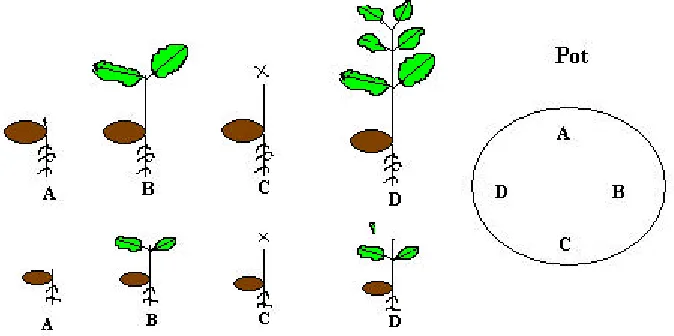
At the start of the experiment, four seeds from the same weight class and species were planted in 22 cm diameter pot containing Perlite. These four seeds were positioned in clock-wise Direction, and treated as below (see figure 1) A. Seedling was harvested immediately after
germination when the shoot reached above ground (germination stage)
B. Seedling was harvested after the first set of leaves is fully expanded. In this experiment, the seedlings were understood at full development when the first leaves are fully expanded
C. Seedling was subjected to simulate herbivory.
Whole leaves were removed by scissors just after each seedling’s first set of true leaves become fully expanded (100% leaves removed).
D. The emerging seedling was grown continuously and seedling was harvested at the end of the experiment (unclipped seedling as a control) The seedlings were harvested or clipped at a comparable developmental stage, rather than at same standard time. Therefore the time of clipping and harvesting were varied somewhat among individual.
Twelve pots from each species; Q. robur and
Q. petraea of each seed size class and different nutrient level were randomly assigned to different light intensity. This yielded in total 228 pots for Q. robur and 164 for Q. petraea. A high nutrient treatment was applied individually to each pot by adding 2 g of slow releasing granular of Osmocote
fertilizer (13% N, 13% P2O5, 13% K2O, 2% MgO
and 1% Fe). The low nutrient treatment was established by not applying fertilizer. The low light treatment was established by placing seedling in a table and covering it with one layer of shade mass to produce 5% sunlight. The high light treatment was not covered and it received 50% light.
The proportion reserves used was calculated by substracting the seed dry weight at the start of experiment with the seed dry weight after harvesting. Whereas percentage of reserves used was calculated by the following formula : (reserves used/cotyseed size) x 100%.
In this study, we could not measure the individual seed dry weight seedling directly; consequently we predicted their values from a regression equation. The dry weight of the individual seed was estimated by using the equation of fresh weight and dry weigh, 56 of
seeds from Q. petraea and 76 seeds from Q.
robur. The data follow the linear relationship therefore the linear regression model was used for this equation.
Figure 2. There was no relationship between the seed size (g) and the percentage reserves transferred to the root during germination stage
level is the main plot factor nutrient level and clipping level is a sub plot factors and seed size as co variable. Seed mass and other variables were log-transformed to normalize data distribution and stabilize error term variances. All the analyses were carried out using the GLM Procedure in SPSS v12.0.
RESULT AND DISCUSSION
Result
Percentage reserves used and seed size at the germination stage
The percentage reserves used during germination stage was not significant on seed size in both species (Fpetraea(1,81)=2.426, p=0.123; Frobur
(1,118)=0.68, p=0.79).The results showed that the
percentage of reserves transferred during germi-nation varied between 0.1 to 30 % (Figure 2).
Percentage of cotyledon used and seed size at the fully developed stage
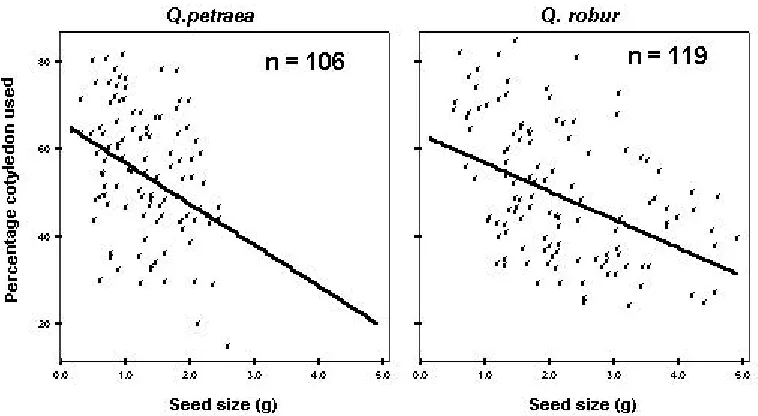
The percentage reserves used tended to decrease significantly as the seed size increased
during the growth of the initial shoot in both species (Q. petraea: F (1,101) =16, p=0.00; and Q. robur: F
(1,114) =31, p=0.00), while we found no significant
difference in the nutrient effect (Q. petraea:
p=0.253; Q. robur: p=0.892) and light effect (Q.
petraea: P=0.401; Q. robur: p=0.086) at this stage. This result demonstrated that the seedlings from larger seeds using a smaller proportion of the seed reserves to grow their initial shoot than the seedling from smaller seeds. The average percentage of cotyledon transferred to seedling at the fully developed stage varied from 40 to 80% (Figure 3).
Percentage of cotyledon used and cotyledon size post clipping treatment
The percentage of reserves transferred to seedlings after clipping treatment was not
significantly different on seed size in Q. petraea
(F1, 183=0.006, p=0.936) but slightly differed in Q. robur, the percentage reserves used declined
when the seed size increased (F1 , 2 3 5=7.36,
Figure 3. Relationship between seed size and percentage cotyledon used.
Figure 4. Relationship between seed size and percentage of cotyledon used after clipping treatment.
Cotyledon at start versus cotyledon at harvest in different stage
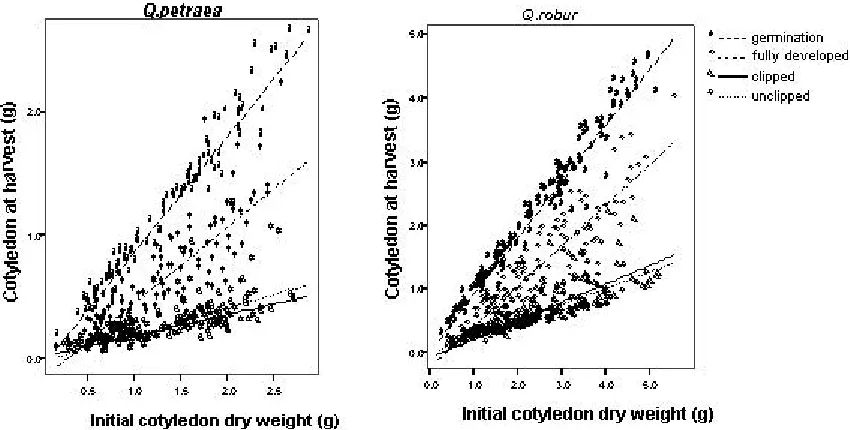
Figure 5 illustrates the change of reserves on cotyledon during the seedling growth. The dry weight of cotyledon decreased as the seedling developed and the rate of reduction was not different between species (F=0.086, p=0.77) (Figure 4).
Seedling biomass at point fully developed versus biomass re-sprouts
Figure 5. The change in the amount of dry mass remaining in the cotyledon at different developmental stage. Cotyledon weights did not differ between light and nutrient treatments.
Figure 6. Relationship between seedling biomass at fully stage and biomass re-sprout.
Discussion Seedling survival
More than 95% of the seedlings survived after clipping treatment in both species. The results showed that once seeds germinated, survival rates were quite high in all sizes of seeds. This indicates
that the seedling survival in Q. petraea and Q.
robur is not related to seed size. Our findings contrasted with Bonfil (1998) whose results showed that the seedling survival after cotyledon
removal and shoot removal of oak (Q. laurina
and Q r u g o s a) correlated to seed size.
Apparently the seedlings of oak suffered more from the combination of cotyledon removal and shoot removal than leaf removal alone. Therefore,
we can conclude that Q. robur and Q. petraea
are potentially tolerant of leaf removal early in their life cycle.
between plants, no exposing to pathogens, and having sufficient water resources.
Proportion reserves used vs. seed size
Our results showed that the percentage of cotyledon reserves transferred to seedling at germination stage is independent on seed size, light and nutrient treatment. It implies that the seedlings of Q.robur and Q.petraea acted proportionally in terms of consumption of seed reserves for root development during the germination stage. Bigger seeds took larger seed reserves and vice versa, yielding a similar percentage of reserves used in comparison with the small seeds.
In addition, the cotyledon reserves which have been consumed by the individual seedling vary between 0.1 to 30%. This variation might be caused by the variation of moisture content at some individual fresh weight of the seed. Since the dry weight of cotyledon was estimated by fresh weight, it was possible the same fresh weight of seed resulted in different dry weight. Another source of variation might be the differences in the rate of translocation of seed reserves from seed to root (Den Ouden, personal communication).
However, as predicted, the percentage of reserves that was transferred to the seedling during its initial growth is highly related to its seed size. The percentage reserves used decreased when the cotyledon size increased. One explanation for this pattern which is proposed by Westoby (1996) and Leishman and Murray (2001) is that the seed reserves that are transferred to seedling at the time of full seedling expansion of larger seed may have been proportionately smaller than those from smaller seed. The seedling from the larger seed allocated relatively less of its initial seed reserves to seedling growth and larger proportion of reserves is used during a time of resource deficit or imposed hazard such as herbivory damage. In contrast, the small seed tends to use all of its reserves to support the growth of initial seedling. In other word, small seeds spend their reserves at once and, as a consequence, small seeds do not have the ability to recover from herbivory or physical damage.
After clipping treatment, we expected the percentage seed reserves consumed would increase with the seed size. Surprisingly, the results were contrary to our prediction. We did not find the relationship between the percentage of seed reserves used and seed size, with either at clipped
seedlings or unclipped seedlings at Q.petraea.
However, with Q.robur the percentage reserves
used slightly decreased as the seed size increased.
In general, the pattern was similar to Q.petraea.
Besides, the amount of percentage of reserves used remained the same between clipped and unclipped seedling which varied between 60 - 90%. This percentage was not really different to the amount of percentage reserves used during the initial growth, which ranged from 40 to 80%. This indicates that after the initial shoot was fully developed, the seedlings did not use the reserves from cotyledon anymore, either for growing or re-sprouting. Probably soon after the fully developed stage terminated, all of the reserves of the cotyledon were transferred to the seedling. Therefore the seedlings were no longer dependent on cotyledon reserves. This idea is supported by previous experiments which concluded that oak seedling growth and survival are independent of their cotyledon after the initial seedling’s full development (Andersson and Frost, 1996;
Sonesson, 1994;Garcia-Cebrian et al., 2003).
Our results suggest that Q. robur and Q.
petraea might not save their uncommitted reserves in the cotyledon, but a large proportion of the reserves might be stored in the root, while a small proportion are kept in the stem. The reason that these species save their reserves in the root or stem instead of in the cotyledon might be related to environmental pressure of acorns being eaten by seed predator such as Jays and rodents during seedling development ((Bossema, 1979; Den Ouden., 2005). Kabeya and Sakai (2003) argued
that some of seed resources at Quercus crispula
cotyledon (Kabeya and Sakai, 2003). According to Ziegenhagen and Kausch (1995), young common oak are known to accumulate a certain amount of starch in their root. A large storage reserve in the root can cover the loss of carbon and make the plant less vulnerable to herbivory attack. It is a fact that the seedlings take the resources for re-sprouting from the seedling biomass (either from root or shoot). However, there was no indication that larger seedlings took relatively larger reserves from seedling biomass. Our result shows that the total mass invested in re-sprouting increased proportionally with increasing seedling biomass (Figure 6). In other word, the seedlings from larger and smaller seed did not respond differently in order to allocate reserves for re-sprouting.
The decrease of carbohydrate reserves in the cotyledon during shoot development showed a very similar trend under condition of low light and full light as well as nutrient and no nutrient (Figure 5). We expected that the reserves in cotyledon would be consumed in larger amounts under low light and low nutrient condition for the seedlings to survive. Hence, the results suggest that in both species, cotyledon reserves were not the main resources for survival under low light and low nutrient conditions. However, it is likely that seed reserves that are relocated to the root play an important role in survival under such conditions.
Figure 5 also confirms that after the stage fully development, there was a trend that the weight of cotyledons still decreased until the termination of the experiment. It is still not clear, whether the reduction was caused by cotyledon that was still transferring their reserves during that time or because of decaying or leaching. If cotyledon was still transferring the reserves, one explanation might be related to time at which the seedlings at the stage of full development were harvested, as this stage was sometimes difficult to identify accurately. The seedlings might have been harvested too early before their shoot had been fully expanded. However, if there was a transferal of reserves after the fully developed stage, the amount of transferring only represented a small portion (about 10 % in average).
The objective of this experiment is to investigate the role of seed size in re-sprouting ability of oak and whether it correlates to the Reserve Effect. This study showed that even though the larger seed can save relatively more reserves at full seedling development, the greater ability of the seedlings from larger seed to re-sprout was not dependent on this. In other word, their better ability was not related to Theory Reserve Effect. Green and Juniper (2004) also found that the Reserve Effect is not related to the greater ability of the seedling from larger seed to re-sprout. They argued that The Reserve Effect may have functional significance under other circumstances (Green and Juniper, 2004).
CONCLUSION
It become clear from this study that seedlings from large seed performed better than seedlings from small seeds in term of their re-sprouting ability after being damaged by herbivory. However, we did not find that the total mass invested in re-sprouting scale more than proportionately to seedling size. The results did not reveal a Reserve Effect, which predicted that total mass invested should have increased more than proportionately with the seedling size. Thus, concerning the
question “Do large seeds of Q. robur and Q.
petraea have an advantage by saving more resources for re-sprouting (or are there Reserve Effect)?” it can be answered that no Reserve Effect was found with these species.
REFERENCES
Anderson, C. and Frost I. 1996. Growth of
Quercus robur seedlings after experimental grazing and cotyledon removal. Acta Botanica Neerlandica 45(1): 85-94.
Bonfil, C. 1998. The effects of seed size, cotyledon reserves, and herbivory on seedling survival
and growth in Quercus rugosa and Q.
laurina (Fagaceae). American Journal Of Botany 85(1): 79-87.
Chaar H, C. F., and Leborgne G 1997. Artificial defoliation, decapitation of the terminal bud, and removal of the apical tip of the shoot in sessile oak seedlings and consequences on subsequent growth. For. Res 27: 1614-1621. Dalling, J. W. and Harms K. E. 1999. Damage tolerance and cotyledonary resource use in
the tropical tree Gustavia superba. Oikos
85(2): 257-264.
Den Ouden.J., E. A. 2002. Jays,Mice and
Oaks:Predation and Dispersal of Q. robur
and Q. petraea in North-Western Europe. Book: Seed Fate; Predation,Dispersal and Seedling Establishment edited by P.M.Forget et al.
Foster, S. A. and Janson C. H. 1985. The Relationship Between Seed Size And Establishment Conditions In Tropical Woody-Plants. Ecology 66(3): 773-780.
Garcia-Cebrian, F., J. Esteso-Martinez and Pelegrin E. Gil 2003. Influence of cotyledon
removal on early seedling growth in Quercus
robur L. Annals of Forest Science 60(1): 69-73.
Green, P. T. and Juniper P. A. 2004. Seed mass, seedling herbivory and the reserve effect in tropical rainforest seedlings. Functional Ecology 18(4): 539-547.
Harms, K. E. and Dalling J. W. 1997. Damage and herbivory tolerance through resprouting as an advantage of large seed size in tropical
trees and lianas. Journal of Tropical Ecology 13: 617-621.
Kabeya, D. and Sakai.S. 2003. The role of roots and cotyledons as storage organs in early
stages of establishment in Quercus crispula:
a quantitative analysis of the nonstructural carbohydrate in cotyledons and roots. Annals of Botany 92(4): 537-545.
Kidson, R. and Westoby M. 2000. Seed mass and seedling dimensions in relation to seedling establishment. Oecologia 125(1): 11-17. Leishman, M. R. and Murray B.R. 2001. The
relationship between seed size and abundance in plant communities: model predictions and observed patterns. Oikos 94(1): 151-161.
Sonesson, L. K. 1994. Growth and Survival after
Cotyledon Removal in Quercus robur
Seedlings, Grown In Different Natural Soil Types. Oikos 69(1): 65-70.
Westoby. M., Leishman. M and Lord J. 1996. Comparative ecology of seed size and dispersal. Philosophical Transactions of The Royal Society of London Series B-Biological Sciences 351(1345): 1309-1317.