ISOLATION AND IDENTIFICATION LACTIC ACID BACTERIA
FROM RAW BEEF MEAT
Hendronoto Arnoldus W. Lengkey1, Lovita Adriani1, Nooremma Sophianie2 and Roostita L. Balia1
1
Fakultas Peternakan Universitas Padjadjaran, 2Biomerieux Indonesia
Presented in
3rd International Conference of Indonesian Societies for Lactic Acid Bacteria (3rd IC-ISLAB) The Faculty of Agricultural Technology, Gadjah Mada University, Indonesia
ISOLATION AND IDENTIFICATION LACTIC ACID BACTERIA
FROM RAW BEEF MEAT
Hendronoto Arnoldus W. Lengkey1, Lovita Adriani1, Nooremma Sophianie2 and Roostita L. Balia1
1Fakultas Peternakan Universitas Padjadjaran, 2Biomerieux Indonesia
ABSTRACT
Eighteen presumptive isolates of lactic acid bacteria, has been isolated and identified from raw beef
meat. The results of the standard physiological and biochemical test, 7 identified isolates of Lactobacillus
fermentum I , 4 identified isolates of Lactococcus lactis ssp. lactis I,
3 identified isolates of Lactobacillus plantarum I and 4 identified isolates of Lactobacillus paracasei ssp.
paracasei I. These strains results of this study, indicated that the presence of heterofermentative
Lactobacillus species in raw beef meat.
Key words:
lactic acid bacteria, heterofermentative Lactobacillus spp, Lactobacillus fermentum I,
Lactobacillus lactis spp. lactis I, Lactobacillus plantarum I and Lactobacillus paracasei spp. paracasei I
INTRODUCTION
Lactic acid bacteria refers to a large group of beneficial bacteria that have similar properties and all produce
lactic acid as an end product of the fermentation process. They are widespread in nature and are also found in human
digestive systems. Although they are best known for their role in the preparation of fermented dairy foods, they are
also used for pickling of vegetables, baking, winemaking, curing fish, meats and sausages.
Lactic acid bacteria play an important role in food fermentation process. Lactic acid bacteria have a long history of
safe use in the production of fermented foods and beverages. Whereas natural, spontaneous fermentation processes
are still common practice in many cases, there is a clear trend towards the use of multiple, defined starter cultures to
have a controlled industrial fermentation process. The current role and industrial relevance of the natural, wildtype
strains which do not belong to the starter culture but originate from the raw material or the production environment
is regarded with interest.
Lactic acid bacteria are therefore excellent ambassadors for an often maligned microbial world. They are
not only of major economic significance, but are also of value in maintaining and promoting human health.
Moreover, making use of specific properties of new strains may enhance the inherent value of a food product or the
food quality, and enables a high flexibility with respect to application for product diversification. Since the strains
have to be perfectly adapted to the food environment in which they are to be applied, the use of natural food isolates
seems most promising. Traditional fermented food products are a rich source of new interesting starter cultures. The
isolation of natural lactic acid bacteria from traditional fermented foods to analyze the biodiversity of such food
chemicals of functional and technological importance. It is a group of industrially important microorganisms with
generally regarded as safe (GRAS) status.
The lactic acid bacteria as well as other types of microorganisms are also capable of producing and discharging into
the environment a great variety of antimicrobial substances, which inhibit the development of microorganisms not
suitable for ensiling. The bacteriocides form a class of antibiotic substances whose biosynthesis occurs during or at
the end of the exponential stage of lactic bacteria strain growth (Jones, 2000; Stiles, 1996 and Enan et al., 1994 in
Vamanu, et al, 2005).
Lactic acid bacteria produce several antimicrobial compounds such as organic acids, ethanol,
hydroperoxides and bacteriocins. Lactic acid bacteria, a physiologically related group of gram-positive bacteria,
produce a variety of compounds with antimicrobial activity, and they are termed bacteriocin.
Lactobacillus are gram positive and vary in morphology from long, slender rods to short coccobacilli,
which frequently form chains. Their metabolism is fermentative: some species are aerotolerant and may utilize
oxygen through the enzymes flavoprotein oxidase, while others are strictly anaerobic. While spore bearing
lactobacilli are facultative anaerobes, the rest are strictly anaerobic. The growth is optimum at pH 5.5-5.8 and the
organisms have complex nutritional requirements for amino acids, peptides, nucleotide bases, vitamins, minerals,
fatty acids and carbohydrates.
As their habitat, Lactobacilli are widely distributed in nature and are ubiquitous in humans. They inhabit
the mouth, gastrointestinal tract, vagina and other sites. The Lactobacilli are include L. acidophilus, L. casei, L.
fermenti, L. cellobiosus, and Leuconostoc mesenteroides. In most instances, identification of these organisms to the
species level is not necessary because they usually have little clinical significance. However, it is important to
differentiate lactobacilli from streptococci, which can show rod-shaped forms on solid media (Koneman et. al,
1992).
Based on fermentation patterns, the genus is divided into three groups :
1. homofermentative : produce more than 85% lactic acid from glucose.
2. heterofermentative : produce only 50% lactic acid and considerable amounts of ethanol, acetic acid and carbon
dioxide.
3. less well known heterofermentative species which produce DL-lactic acid, acetic acid and carbon dioxide.
The genus Lactobacillus consists of non-sporulating, gram-positive bacilli that are classified in the family
Lactobacillaceae. The genus is defined in part by the metabolic products produced, and the majority of species are
homofermentative; that is, they form lactic acid from glucose as the major fermentation product. Heterofermentative
species may be encountered that produce about 50% lactic acid and varying amounts of CO2, acetic acid, and
The lactobacilli are non-endospore-forming, rod-shaped bacteria, varying from long and slender forms to
short coccobacilli, at times producing short chains. Pleomorphic forms are sometimes encountered with some
tendency to form palisades. Most species are nonmotile.
Additional characteristics for differentiating the lactobacilli from other species of gram-positive bacilli fermentation
opf glucose, and good growth on tomato juice agar. The helpful differentiating features of lactobacilli are negative
catalase reaction, the production of major quantities of lactic acid, and the lack of lateral outgrowth from the stab
line in a gelatin tube. Also, the use of enriched thioglycolate broth is helpful to allow differentiation of lactobacilli
from streptococci which form chains of cocci.
Lactobacilli are important organisms recognized for their fermentative ability as well as their health and
nutritional benefits. Their produce various compounds such as organis acids, diacetyl, hydrogen peroxide, and
bacteriocin of the bacteriocidal proteins during lactic fgermentation (Lindgren and Dobrogosz, 1990, in Ogunbanwo,
et. al., 2003).
The genus Streptococcus belongs to the family Streptococcaceae. These organisms are gram-positive,
catalase negative bacteria that tend of grow in pairs and chains. The detection of cytochrome enzymes with the
catalase test distinguishes members of the Micrococcaceae (catalase positive) from the members of the
Streptococcaceae (catalase negative). In recent years, the taxonomy of the streptococci and Streptococcus-like
bacteria has undergone extensive revision and expansion.
The general characteristics of streptococci are facultative anaerobes; in fact, some strains will grow better
under anaerobic conditions. Many isolate are also stimulated by an atmosphere containing increased CO2 (e.g.
5%-7%). Medically important streptococci, enterococci, and aerococci are homofermentative, meaning that the sole
product of glucose fermentation is lactic acid. Streptococci are also oxidase negative, a property that, together with
Gram stain, differentiates streptococci from Neisseria species.
The composition of the cell wall of the streptococci is similar to that of other gram-positive bacteria, being primarily
of peptidoglycan in which a variety of carbohydrates, teichoic acids, lipo-proteins, and surface protein antigens are
embedded. Some streptococcal species may be grouped serologically on the basis of cell-wall carbohydrate antigens.
The lactic acid bacteria (LAB) including the genera Lactobacillus, Lactococcus, Leuconostoc and
Pediococcus, have long been used in fermentation to preserve the nutritive qualities of various foods. The major
function of a starter culture is the production of lactic acid at a suitable rate to ensure a consistent and successful
fermentation. Other function include the production of flavour compounds such as diacetyl and CO2, from citrate by
mesophilic cultures, and acetaldehyde from lactose by thermophilic cultures; acting as a source of proteolytic
enzymes during growth in milk and ripening of many cheese; and finally contributing to the preservation of the
fermented product as a consequence of a number of inhibitory metabolites produced by the lactic cultures (O’Keeffe
and Hill, 1999). The major metabolite of lactic acid bacteria is lactic acid. The production of this organic acid is
Lactic acid bacteria convert sugars to lactic acid. Flavors are produced as well and the increased acidity of
the product helps to prevent the growth of unwanted spoilage bacteria and pathogens. Changes in texture may also
occur. Lactic acid bacteria has been used to ferment or culture foods for at least 4000 years. They are used in
particular in fermented milk products from all over the world, including yoghurt, cheese, butter, buttermilk, kefir
and koumiss. In Algeria, dairy products are prepared from cow and goat’s milk including cheese and curds (leben
and rayeb). In these products, the species composition of lactic acid bacteria is more varying and inconsistent when
compared with those of the trade products (Guessas and Kihal, 2004). Lactic acid bacteria widely distributed in the
nature and occurring naturally as indigenous microflora in raw milk are Gram-positive bacteria that play an
important role in many food and feed fermentations. In this group are included representatives of the genus
Lactobacillus, Lactococcus, Pediococcus and Leuconostoc. The lactic acid fermentation, which these bacteria carry
out, has long been known and applied by humans for making different foodstuffs. For many centuries lactic acid
bacteria have served to provide an effective form of natural preservation. In addition, they strongly determine the
flavor, texture and, frequently, the nutritional value of food and feed products.
The major function of a starter culture is the production of lactic acid at a suitable rate to ensure a
consistent and successful fermentation. Other function include the production of flavour compounds such as diacetyl
and CO2 from citrate by mesophilic cultures, and acetaldehyde from lactose by thermophilic cultures; acting as a
source of proteolytic enzymes during growth in milk and ripening of many cheeses; and finally contributing to the
preservation of the fermented product as a consequence of a number of inhibitory metabolites produced by the lactic
cultures (O’Keeffe and Hill, 1999).
The major metabolite of lactic acid bacteria is lactic acid. The production of this organic acid is responsible
for the associated drop in pH, which may be sufficient to antagonize many microorganisms. In addition to a direct
effect of the pH, the undissociated form of the molecule can cause the collapse of the electrochemical proton
gradient of susceptible bacteria, leading to bacteriostatis and eventual death (O’Keeffe and Hill, 1999).
Lactic acid bacteria produce various compounds such as organic acids, diacetyl, hydrogen peroxide, and
bacteriocins or bactericidal proteins during lactic acid fermentations (Oyetayo et al, 2003). The bacteriocins from the
generally recognized as safe (GRAS) lactic acid bacteria (LAB) have arisen a great deal of attention as a novel
approach to control pathogens in food-stuffs. Research on Bacteriocins from lactic acid bacteria has expanded
during the last decades, to include the use of bacteriocins or the producer organisms as natural food preservatives
(Savadogo, et al, 2004a). The lactic acid fermentation, which these bacteria perform has long been known and
applied by the humans for making different food stuffs. According to Savadogo, et al (2004b), there are eight strains
of lactic acid bacteria in Burkina Faso fermented milk, and identified as Lactobacillus fermentum, Pediococcus spp.,
Leuconostoc mesenteroides subsp. mesenteroides and Lactococcus sp. Savadogo also stated that in a general way
the genus usually met in traditional fermented milk are Lactobacillus, Leuconostoc, Lactococcus, Streptococcus and
MATERIALS AND METHODS
Isolation and identification of lactic acid bacteria.
The lactic acid bacteria were isolated from raw beef meats, by appropriate dilutions with NaCl fisiological.
Decimal dilution of these samples were mixed with MRS medium (AEB, France) and incubated at 37oC for 48-72
h. Pure cultures were maintained in MRS agar at 4oC for short term use. Eighteen well-isolated colonies were
picked up and transferred to MRS broth. They were propagated twice and streaked on MRS broth to check the purity
of the isolates and then stored in MRS agar and overlaid with MRS agar for the anaerobic condition. Selection of
strains was made in agreement with morphology, Gram stain, viability during storage at 4oC .
The identification of the cultures was based on the characteristics of the lactic acid bacteria as described in
Bergey’s Manual of Determinative Bacteriology, fermentation of different carbon sources (API 50 CHL,
bioMerieux SA, France), gas production from glucose, growth at different temperatures.
Sugar fermentation profiles of isolates.
The abilities of these isolated strains to produce acids from different carbohydrates was determined by API
50 CHL test kit (bioMerieux SA, France). The API test strips were prepared as recommended by the kit supplier and
scored after incubation for 24 and 48 hours at 37oC. The results were communicated to the APIWEB, which used
the phenotypic data to predict a species for each isolate. Interpretations pf the fermentation profiles were facilitated
by systematically comparing all results obtained for the isolates studied with information from the computer-aided
database, in which the identification of a microorganism is accompanied by the following information : (i) The
percentage of identification (%ID) is an estimate of how closely the profile corresponds to the taxon relative to all
the other taxa in the database. (ii) The T-index represents an estimate of how closely the profile corresponds to the
most typical set of reactions for each taxon. Its value varies between 0 and 1, and is inversely proportional to the
number of atypical tests. (iii) Comments on the quality of identification derived from the %ID and the T-index of the
selected taxon (exellent identification %ID > 99.9 and T>0.75).
RESULTS AND DISCUSSION
Lactic acid bacteria. Eighteen isolates of LAB were isolated from the samples. After series of purification on MRS
agar, eighteen isolates were found to be Gram-positive, catalase negative, non-motile bacili. The results of the
isolation and identification of the standard physiological and biochemical tests were identified the isolates as 7
isolates of Lactobacillus fermentum I, 4 isolatesof Lactobacillus paracasei ssp. paracasei I, 3 isolates of
Lactobacillus plantarum I, and 4 isolates of Lactobacillus lactis ssp. lactis I.
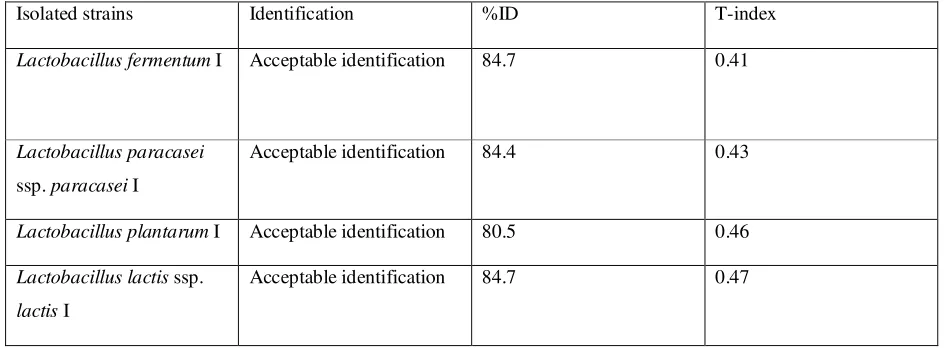
Table 1. Results of the biochemical tests for the identification of the isolated strains by using API gallery
Isolated strains Identification %ID T-index
Lactobacillus fermentum I Acceptable identification 84.7 0.41
Lactobacillus paracasei
ssp. paracasei I
Acceptable identification 84.4 0.43
Lactobacillus plantarum I Acceptable identification 80.5 0.46
Lactobacillus lactis ssp.
lactis I
Acceptable identification 84.7 0.47
CONCLUSIONS
The results obtained in this study revealed the presence of a wide variety of Lactic acid bacteria (LAB) in
the beef raw meat. Some of the isolated and identified LAB shows as Lactobacillus fermentum I, Lactobacillus
paracasei ssp. paracasei I, Lactobacillus plantarum I, and Lactobacillus lactis ssp. lactis I.
For further researches, we can get the antimicrobial compounds produced by lactic acid bacteria, to proof that these
bacteria have a competitive advantage over other pathogenic microorganisms. Because lactic acid bacteria have
capability of producing good amount of bacteriocins, that have been anticipated to have enormous potential for
applications as biopreservatives. These researches are vital in the sense that functional properties in lactic acid
bacteria improved the preservative effects to the meat, meat products and other food and feed. Also the lactic acid
bacteria have an essential role in the meat fermentation and food fermentation processes, as we known was food
preservation of fermented foods, and the isolated strains can positively have impact on their use as starter cultures
for fermented and other food production.
BIBLIOGRAPHY
Guessas, Bettache and Mebrouk Kihal, 2004, Characterization of lactic acid bacteria isolated from Algerian arid zone raw goats’ milk. African Journal of Biotechnology Vol. 3 (6), pp. 339-342.
Koneman, Elmer W., Stephen D. Allen, William M. Janda, Paul C. Schreckenberger, Washington C. Winn, Jr.. 1992, Color atlas and textbook of Diagnostic Microbiology, 4th Edition. J.B. Lippincott Company, Philadelphia, Pennsylvania.
Lengkey, H. A. W. 2008. Isolation and Identification of Lactic Acid Bacteria from Meat and Meat Products. Thesis. Universitatea Stiinte Agronomice si Medicina Veterinara Bucuresti. Romania.
O’Keeffe Triona and Colin Hill, 1999, Bacteriocins, Potential in Food Preservation.
Oyetayo, V.O., F.C. Adetuyi and F.A. Akinyosoye, 2003. Safety and productive effect of Lactobacillus acidophilus
and Lactobacillus casei used as probiotic agent in vivo, African Journal of Biotechnology Vol. 2 (11), pp. 448-452.
Savadogo, Aly; Cheik A. T. Ouattara, Imael, H. N. Bassole; and Alfred S. Traore, 2004a, Antimicrobial Activities of Lactic Acid Bacteria Strains Isolated from Burkina Faso Fermented Milk, Pakistan Journal of Nutrition # (3): pp 174-179.
Savadogo, A., A.T. Ouattara Cheik, W. Savadogo Paul, Baro Nicolas, Ouattara, S. Aboubacar and S. Traore Alfred, 2004. Identification of exopolysaccharides producing lactic acid bacteria strains from Burkina Faso fermented milk samples by specific primers. African. Journal of Biotechnology. Vol. 3 (1), pp. 189-194.