International Journal of Economics and Financial Issues | Vol 6 • Special Issue (S7) • 2016 47
International Journal of Economics and Financial
Issues
ISSN: 2146-4138
available at http: www.econjournals.com
International Journal of Economics and Financial Issues, 2016, 6(S7) 47-50.
Special Issue for "International Soft Science Conference (ISSC 2016), 11-13 April 2016, Universiti Utara Malaysia, Malaysia”
The Social Capital and Firm Performance: Evident from
Indonesia Small businesses
Aluisius Hery Pratono
1*, Ruswiati Surya Saputra
2, Jatie K. Pudjibudojo
31Faculty of Business and Economics, Universitas Surabaya, Indonesia, 2Othman Yeop Abdullah School of Business, Universiti Utara
Malaysia, Malaysia, 3Faculty of Psychology, Universitas Surabaya, Indonesia. *Email: [email protected]
ABSTRACT
This study aims to contribute to the social capital (SC) theory through examining the direct impact of SC and moderating impact of marketing capability (MC) on irm performance (FP). This study proposes a structural equation model and tests the hypothesis through generalized structured component analysis with random survey on small medium enterprises in Indonesia. The approach allows to analysis the element of SC: Network, trust and cognitive as well as the elements of MC: Pricing capability, product development, and marketing communication. The result indicates the SC and MC provide complementary effect to the FP.
Keywords: Social Capital, Firm Performance, Marketing Capability
JEL Classiications: D21, L30, M31
1. INTRODUCTION
The role of social capital (SC) on the irm competitiveness has long been an interest to entrepreneurial studies. However the transformation process from SC to irm performance (FP) has raised debates. Major literatures argue that SC plays pivotal role on irm competitiveness through providing valuable information access (Kwon and Adler, 2014) a high level of mutual of trust (Li et al., 2013). Previous empirical studies also conirm that SC has a signiicant impact on innovation and supply channel (Alguezaui and Fillieri, 2010), work environment (Duffy et al., 2012) and value creation (Afuah, 2013).
On the other hand, some other studies provide evident that SC does not have signiicant impact on FP for some reasons, e.g. the age of irm (Pirolo and Presutti, 2010), organizational capacity (Jansen et al., 2011), various level of institutional context (Stam et al., 2014) and also spillover effect that comes from homophile solidarities, which express similarities (Kwon and Adler, 2014).
This article has intention to contribute to the debate by investigating the impact of SC on FP. To understand the complex relationship
between SC and FP, this study involves marketing capability (MC) as a mediating variable. In addition, this study has intention to understand the impact of each element of SC and MC through generalized structured component analysis.
2. LITERATURE REVIEW
2.1. SC Theory
The concept of SC mainly springs from social network theory, which is considered as valuable resource to FP. The concept of SC has been emerging from social to individual perspective as. Bourdie ponders proitability of SC as a private good, while Coleman considers SC as a public good, which becomes an element of social structure (Häuberer, 2011; Denrell et al., 2013). Hence, this concept becomes popular when the World Bank pays attention on declining public participation (Putnam, 2000).
In the context of irm (Parra-Requena et al., 2012), argue that SC
constitutes to three main elements: Network structure, trust, and
Pratono, et al.: The Social Capital and Firm Performance: Evident from Indonesia Small Businesses
International Journal of Economics and Financial Issues | Vol 6 • Special Issue (S7) • 2016 48
dispute on dimension of SC has been increased including the role of social ties on providing information and solidarity (Kwon and Adler, 2014).
In strategic alliance literatures, irm size is essential to their bargaining power within an alliance. The equilibrium of a matching market relies on positive assortative matching, which implies on high bargaining power (Mindruta et al., 2016).
2.2. Hypothesis Development
Hypothesis 1: SC has direct effect on FP: SC has become major
concern in social network theory with aims to understand the social relationship as well as economic transaction. In the organization context, strong SC provides positive work environment (Duffy et al., 2012) and greater life satisfaction (Lim and Putnam, 2010). SC can be a major key for FP through innovation as well as supply management channel (Pratono, 2016). Greater SC allows irms to manage their relationship with other irms, which implies on cost and risk (Alguezaui and Fillieri, 2010) and FP that is essential to monitor the outcomes of their organizations in order to gain more proit (Garg, 2013).
Hypothesis 1.1: Network structure is main element of SC:Network structure provides opportunities to irms to acquire information (Broadbridge, 2010), which brings impact on their performance. The development of network structures is associated with development stages of organization, which indicates their resources since early stage of development (Johnsson and Lindbergh, 2013). The dense and cohesive network structure can generate information exchange and call for marketing capacity as mediator to drive performance (Rouziés et al., 2010). Duffy et al. (2012) identify a risk of moral disengagement, such as condemnation and loathing, due to cognitive justiication. A cognitive brings a constraint to utilize SC due to exponentially level of SC (Oldroyd and Morris, 2012). Another example is strong cohesive work group bring about dominant voice and views, which affected inferior group, such as woman in workplace (Broadbridge, 2010).
Hypothesis 1.2: Trust is main element of SC: Trust dimension is the core content of SC, which enable a social order. In organization context, social exchange relationship relies on inter-personal trust, which can reduce uncertainty in relationship and enhance the quality of social exchange. This implies on ability to access information, support and resources (Schaubroeck et al., 2013). The affect-based trust refers to emotional dimension embedded in conidence (Schaubroeck et al., 2013). In the context of business communication, perceived social identity may come from synchronization of communication style, such as gesture, voice and posture (Ludwig et al., 2013).
Hypothesis 1.3: Cognitive is main element of SC: Cognitive
dimension refers to collective conscience and identity of the group, which can bring eficient interaction. Information and resources are more accessible among people with a collective identity. This dimension is associated with common codes and languages, which spring from repeated social interaction (structural dimension), which can create trust and mutual commitment (Alguezaui and Fillieri, 2010).
Collective identity may come with a complex challenge. Diversiied cultural background among the workforce in business organization has been emerged with issue of organization performance. Cultural diversity may be more relevant to boast performance when learning orientation among members of a network is greater (Pieterse et al., 2013). However, a set of cognitive with moral disengagement allows members of a network to commit acts, such as social undermining or self-condemnation (Duffy et al., 2012).
Hypothesis 2: MC provides mediating effect that may strengthen effect of SC onFP: It is essential to business organization to invest on social networks to boost their performance, however it does not always the case. MC can provide mediating effect to explain the relationship between structural SC and marketing performance (Parra-Requena et al., 2011).
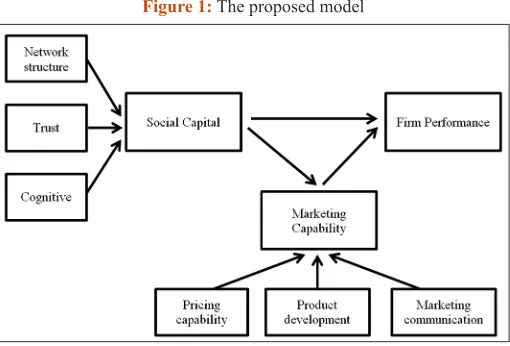
Hypothesis 2.1: Pricing capability is main element of MC: Pricing capability refers to the ability of a irm to set price for their product to gain high revenue in the market (Murray et al., 2011). One possible reason why a irm has greater pricing capability or market power lies on scale economies, which implies on eficiency to manage resources as well as information (Lira et al., 2012). In a highly competitive market, firms experience high interdependency on pricing strategy. Firms with heavily dependent on costumers have less differential pricing (Limehouse et al., 2012) (Figure 1).
Hypothesis 2.2: Product development is main element of MC: The concept refers to capability of irms to develop new product to meet customers’ demand (Murray et al., 2011). This concept is believed to provide irms with a greater level of differentiation in order to gain a competitive advantage. When carried out product development, firms pay more attention not only on product functionality but also its implications in which owning such products may make consumers feel different from others (Lukas et al., 2013).
Hypothesis 2.3: Marketing communication is main element of MC: Marketing communication indicates the expansion of MC from the advertising to customer relationship approach. As sales process involves a conversation, marketing communication is a
Pratono, et al.: The Social Capital and Firm Performance: Evident from Indonesia Small Businesses
International Journal of Economics and Financial Issues | Vol 6 • Special Issue (S7) • 2016 49
response to market signals on the spot adjustments. The small irms have advantages on developing word of mouth approach to gain positive externality.
3. METHOD
This research uses quantitative method with cross-section design. The information required to answer the research questions refers to quantify relationship among observed variables with family business as unit analysis. This survey is equated with a list of distributed questionnaires through random sampling method. To generalize the result, this research employs a random selection procedure in order to ensure sample representation for the observed population. Data collection was taken in Surabaya Indonesia with random selected respondents. Based on data based published by Directorate General of Trade, Ministry of Trade and Industry, this research randomly selected 800 respondents and send them questionnaires. From 390 respondents who provided contribution, 54% respondents represent single-family ownership, 24% are partnerships, and the rest are limited corporations. There is no respondent with go-public companies.
4. RESULTS
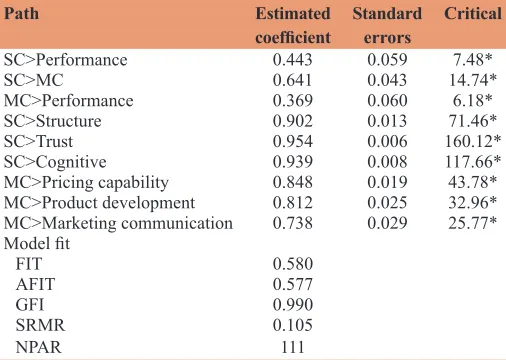
Table 1 shows that network structure, trust and cognitive
signiicantly contribute to SC. Similarly, pricing capability, product development and marketing communication provide signiicant impact on MC variable. The elements provide signiicant impact with greater coeficients than 0.9. The trust provides greatest coeficient with 0.95, which indicates as the strongest contribution to SC (H1.2), followed by cognitive and structure with 0.93 and
0.90 respectively (H1.1 and H1.3).
Similarly, pricing capability, product development, and marketing
communication are considered to be relevant to the latent variable
of SC (H2.1, H2.2, H2.3). However, the goodness of it testing
shows that model is quite it. FIT 0.58 shows that the model can explain 58% of the variance in the observed variables. Goodness
of it indices exceeds 0.90 implies that the model is acceptable.
Standardized root mean residual (SRMR) as absolute it indicator is 0.105, which indicates that model is nearly perfect. A model should have SRMR smaller than 0.08 for a good it model.
The bootstrap calculation shows that SC has signiicant impact on performance (FP) with t = 7.48 and P < 0.01. This implies that H1, which explains the relationship between SC and FP is conirmed. The bootstrap also show that relationship between SC and MC has t-test of 14.74 and P < 0.01. This indicates H2 is accepted and SC has signiicant impact on FP. In addition, the impact of SC and FP has signiicant impact with t-test = 6.18 and P = 0.01. Hence, H3 is accepted, which implies that there is partial indirect effect on SC on FP. Speciically, the role of MC on the relationship between SC and FP shows complementary mediating effect 0.443 × 0.641 × 0.369 = 0.1047 (Zhao et al., 2010).
Trust provides abundant contexts in small medium enterprises. While inancial slack is considered to be the most challenging issue to small businesses (Bradley et al., 2011), the businesses still can seize business opportunities and gain competitive advantage by exploiting social network structure, trust and cognition. While larger networks is not main factor which can attract customers and develop market power (Afuah, 2013), this study shows that trust provide greater contribution to the context of SC.
This study presents empirical result that explains structural relationship between SC and competitive advantage in which MC provides mediating effect. Apparently, terms “partial” and “full” are associated with effect size of a mediating effect. Current practices suggest that signiicant indirect effect can be observed even if c’ is not signiicant, this research considers that a wide range of indirect effect level (Rucker et al., 2011). Instead of claiming that the result shows partial mediating effect, this research considers that the effect of MC as mediating variable can be computed by 0.641 × 0.369, which is equivalent to 0.236.
5. CONCLUSION
Nurturing small businesses should consider the role of SC. While the businesses are considered with limited inancial resources and out of dated technology, it is important to pay more attention on SC as intangible resource, which can turn into performance. This refers to the strong relationship among the stakeholders, including employees as well as business partners. This resource can promote knowledge acquisition and innovation (Martínez-Cañas et al., 2012) as well as positive work environment (Duffy et al., 2012).
This study conirms the combination between resource-based theory and SC theory that SC determines the capacity of irms to control market price over its marginal cost. The result indicates that SC is a valuable resource, which allows small businesses to gain competitive advantage. As the main ellements of SC, networks, trust and cognitive allow the irms to gain competitive advantage. Hence, irms performance does not only relies on their MC but also from SC.
Pratono, et al.: The Social Capital and Firm Performance: Evident from Indonesia Small Businesses
International Journal of Economics and Financial Issues | Vol 6 • Special Issue (S7) • 2016 50
REFERENCES
Afuah, A. (2013), Are network effect really all about size? The role of structure and conduct. Strategic Management Journal, 34, 257-273. Alguezaui, S., Fillieri, R. (2010), Investigating the role of social capital
in innovation: Sparse versus dense network. Journal of Knowledge Management, 14(6), 891-909.
Bradley, S., Wiklund, J., Shepherd, D. (2011), Swinging a double-edged sword: The effect of slack on entrepreneurial management and growth. Journal of Business Venturing, 26(5), 537-554.
Broadbridge, A. (2010), Social capital, gender and careers: Evidence from retail senior managers. Equality, Diversity and Inclusion: An International Journal, 29(8), 815-834.
Denrell, J., Fang, C., Zhao, Z. (2013), Inferring superior capabilities from sustained superior performance: A bayesian analysis. Strategic Management Journal, 34(1), 182-195.
Duffy, M., Scott, K., Shaw, J., Tepper, B., Aquino, K. (2012), A social context model of envy and social undermining. Academy of Management Journal, 55(3), 643-666.
Garg, J. (2013), Venture boards: Distinctive monitoring and implications for irm performance. Academy of Management Review, 38(1), 90-108.
Häuberer, J. (2011), Social Capital Theory Toward a Methodological Foundation. Prague: Springer Fachmedien Wiesbaden GmbH. Jansen, R., Curseu, P., Vermeulen, P., Geurts, J., Gibcus, P. (2011), Social
capital as a decision aid in strategic decision-making in services organization. Management Decision, 49(5), 734-747.
Johnsson, S., Lindbergh, J. (2013), The development of social capital and inancing of entrepreneurial irms: From inancial bootstrapping to bank funding. Entrepreneurship Theory and Practice, 37(4), 661-686. Kwon, S.W., Adler, P. (2014), Social capital: Maturation of a ield of
research. Academy of Management Review, 39(4), 412-422. Li, Q., Maggitti, P., Smith, K., Tesluk, P., Katila, R. (2013), Top
management attention to innovation: The role of search selection and intensify in new product introduction. Academy of Management Journal, 56(3), 893-916.
Lim, C., Putnam, R. (2010), Religion, social networks and life satisfaction. American Sociological Review, 75(6), 914-933.
Limehouse, F., Michael, T., Rotthoff, K. (2012), Peak-load verse discrimination pricing: Evidence from the golf industry. Review of Industrial Organization, 40(3), 141-165.
Lira, L., Ugarte, M., Vergara, R. (2012), Prices and market structure: An emphirical analysis of the supermarket industry in Chile. Applied Economics, 44(36), 4731-4744.
Ludwig, S., Ruyter, K., Friedman, M., Brüggen, E., Wetzels, M., Pfann, G. (2013), More than words: The inluence of affective content and linguistic style matches in online reviews on conversion rates. Journal of Marketing, 77(1), 87-103.
Lukas, B., Whitwell, G., Heide, J. (2013), Why do customers get more than they need? How organizational culture shapes product capability decision. Journal of Marketing, 77(1), 1-12.
Martínez-Cañas, R., Sáez-Martínez, F., Ruiz-Palomino, P. (2012), Knowledge acquisition's mediation of social capital-irm innovation, Journal of Knowledge Management 16(1), 61-76.
Mindruta, D, Moeen, M, Agarwal, R. (2016), A two-sided matching approach for partner selection and assessing complementarities in partners’ attributes in inter-irm alliances. Strategic Management Journal, 37(1), 206-231.
Murray, J., Gao, G., Kotabe, M. (2011), Market orientation and performance of export ventures: The process through marketing capabilities and competitive advantage. Journal of Academic Marketing Science, 39(2), 252-369.
Oldroyd, J., Morris, S. (2012), Catching falling stars: A human resource response to social capital’s detrimental effect of information overload on star employees. Academy of Management Review, 37(3), 398-418.
Parra-Requena, G., Ruiz-Ortega, M., Garcia-Villaverde, P. (2011), Towards pioneering through capabilities in dense and cohesive social networks. Journal of Business and Industrial Marketing, 27(1), 41-56. Pieterse, A., Van Knippenberg, D., Van Dierendonck, D. (2013), Cultural
diversity and team performance: The role of team member goal orientation. Academy of Management Journal, 56(3), 782-804. Pirolo, L., Presutti, M. (2010), The impact of social capital on the
start-ups’ performance growth. Journal of Small Business Management, 48(2), 197-227.
Pratono, A.H. (2016), Strategic orientation and information technological turbulence: Contingency perspective in SMEs. Business Process Management Journal, 22(2), 368-382.
Putnam, R. (2000), Bowling Alone. New York: Simon & Schuster Paperbacks.
Rouziés, D., Hulland, J., Barclay, D. (2010), Does Marketing and Sales Integration Always Pay Off? Evidence from a Social Capital Perspective. Stockholm: Handelshögskolan.
Rucker, D., Preacher, K., Tormala, Z., Petty, R. (2011), Mediation analysis in social psychology: Current practices and new recommendations. Social and Personal Psychology Compass, 5(6), 359-371.
Schaubroeck, J., Peng, A., Hannah, S. (2013), Developing trust with peers and leaders: Impacts on organizational identiication and performance during entry. Academy of Management Journal, 56(4), 1148-1168. Stam, W., Arzalanian, S., Elfiring, T. (2014), Social capital of
entrepreneurs and small irm performance: A meta-analysis of contextual and methodological moderators. Journal of Business Venturing, 29 (1), 152-173.
Zhao, X., Lynch, J., Chen, Q. (2010), Reconsidering Baron and Kenny: Myths and truths about mediation analysis. The Journal of Consumer Research, 37(2), 197-206.