DEBATING THE IMPACT OF ACCRUAL ACCOUNTING
AND REPORTING IN THE PUBLIC SECTOR
TYRONEM. CARLIN*
INTRODUCTION
Debates about the adoption of accrual accounting and financial reporting techniques by the public sector have been so widespread over the last decade that they may be labelled, without risk of inaccuracy, peripatetic. Questions as to whether accrual based techniques should be adopted by public sector entities are largely passe´ in the antipodes where they have penetrated every layer of the public sector over the past decade, making the question moot (Pallot, 1994; Shand, 1995; and English et al., 2000). However, these same issues are still being pondered by interested parties in jurisdictions which have only recently adopted comprehensive sector wide accrual based financial management and reporting frameworks, for example the UK (Likierman, 2000), or which are at the stage of announcing future moves to accrual based reporting and management frame-works, for example Hong Kong (Awty, 2002).
Given the breadth and depth of extant literature on the subject, scepticism on the part of the reader as to the capacity of yet another paper on the subject to make a meaningful contribution to the literature would be entirely natural. However, gaps do exist in our understanding of the implications of the decision, on the part of many jurisdictions, to transform accounting, reporting and financial management processes from cash to an accrual footing. In particular, little attention has been paid to the impact wrought by the implementation within the public sector of accrual accounting and financial reporting in the context of other related public financial management reforms, for example capital charging, the adoption of a purchaser – provider model of government and the implementation of accrual output based budgeting (Carlin and Guthrie 2001a; Carlin 2003a; Heald and Dowdall 1999; and Robinson 1998b).
The remainder of the paper proceeds as follows. The next section reviews international patterns of adoption of accrual accounting and reporting in the public sector. This part of the paper provides broad background context to the subject matter of the paper. The third section demonstrates the motivation for the paper by critically analysing the existing literature on accrual accounting and financial
*The author is a Professor at the Macquarie Graduate School of Management, Australia.
Address for correspondence: Tyrone M. Carlin, Macquarie Graduate School of Management, Macquarie University, NSW 2109, Australia.
e-mail: [email protected]
reporting in the public sector and demonstrating that, as asserted above, despite the significant bulk of the literature on this subject, material knowledge gaps do exist.
Following on from this, the fourth section of the paper describes an alternative theoretical lens through which public sector accrual accounting and financial reporting may be viewed, with particular emphasis placed on the need to con-template the impact of public sector applications of accrual accounting and reporting in the context of other related public financial management reforms. This discussion gives rise to propositions capable of being tested against empirical data, and in consequence the fifth section contains a case study focusing on the impact of accrual accounting and reporting as implemented in the public sector of the Australian state of Victoria. The paper’s conclusions are set out in the final section.
INTERNATIONAL ADOPTION OF ACCRUAL ACCOUNTING IN THE PUBLIC SECTOR
Accrual based accounting and financial reporting in the public sector is not, despite appearances to the contrary, an entirely new phenomenon. By way of example, it has been noted that in Australia, the Postmaster-General’s depart-ment commenced preparing commercial accounts (including a full profit and loss statement and balance sheet) in 1913, and continued to use this form of report-ing through time (Standish, 1968). Generally however, cash rather than accrual accounting1has been the mainstay of accounting and financial reporting in the public sector throughout the world (OECD, 2002).
The shift towards a comprehensive accrual oriented public sector accounting and financial reporting structure began to take place in the late 1980s, most notably in Australia and New Zealand. The latter jurisdiction became the first sovereign nation to fully implement accrual accounting at both a national and agency level. By the early 1980s, many New Zealand GTEs had adopted accrual accounting and financial reporting (IFAC, 1996). However, the most significant impetus for wholesale adoption of accrual accounting in the New Zealand public sector2can be attributed to two pieces of legislation, theState Sector Act 1988(NZ) and the Public Finance Act 1989 (NZ). The first of these milestone pieces of legislation created a new legal framework for the relationship between depart-mental heads and their Ministers. The fundadepart-mental goal of redesigning these relationships was to increase the accountability to Ministers of departmental heads for their performance and that of their departments.
Reconstituting the accountability framework in this manner entailed modifi-cations to the broader accountability infrastructure. These were embodied in the
accrual accounting environment, leading to the production of the first accrual based whole of government reports a year later (Ball et al., 1999).
Australia has also been noted as an early adopter of accrual accounting techniques within its public sector (Funnel and Cooper, 1998). However, since Australia is a federal state, an analysis of the infusion of accrual accounting into the public sector is better conducted by taking account of the progress of the technique through the various jurisdictions which make up the federation. Taking this approach, the early adopter jurisdictions were the Commonwealth and the state of New South Wales, both of which commenced using accrual techniques for their government trading enterprises from the early 1980s onwards ( JCPA, 1982). Starting from this point, these two jurisdictions com-pleted the roll out of accrual accounting systems throughout their entire public sectors (including the non-commercial budget funded sector) by the early 1990s (Christensen, 2002). The state of Victoria completed its sector wide implementa-tion by 1996, and by the compleimplementa-tion of the decade all Australian jurisdicimplementa-tions had adopted accrual based accounting and financial reporting systems3across the breadth of their public sectors. Thus, as had been the case in New Zealand, upon the formation of a policy consensus, accrual accounting rapidly colonised the public sectors of all Australian jurisdictions.
In the United Kingdom, matters also moved quickly. In 1992, the first wide-spread application of accrual accounting methodologies in the UK public sector4 came with the creation of NHS Trusts (Broadbent, 1992). However, the applica-tion of accrual practices within the UK naapplica-tional health system may be viewed as a pilot application, the model adopted within one sector providing the basis for a later public sector wide roll out.
Thus in 1993, the Chancellor of the Exchequer announced, as part of that year’s budget proposals, that ‘resource accounting’5 would be implemented throughout the UK public sector over the successive 3–5 years (H M Treasury, 1993). Further details were released and a period of public consulta-tion period (of eighteen months) was announced in 1994 (H M Government, 1994), at the conclusion of which, a timetable requiring the adoption of accrual accounting by 1998 was set in place (H M Government, 1995). The actual implementation of public sector wide accrual accounting and reporting took longer than envisaged, the original timetable being amended to require dry run accounts for the 1998/99 year, and full audited and published accrual accounts for the financial year ending March 31, 2000 (IFAC, 2002).
accounting and reporting was to be completed for all financial years from 2001 onwards (Ball et al., 1999).
In addition to the jurisdictions discussed above, full accrual reporting for budget funded agencies has been adopted in the Netherlands (OECD, 1997), Finland, Japan, Portugal, Sweden and Switzerland (OECD, 2002). Iceland uses a modified accruals system, differing from the ‘full’ accrual model only in that as a matter of policy, all long lived assets are expensed at the point of acquisition. In other jurisdictions, a primarily cash based reporting framework is maintained, supplemented by additional accrual disclosures.
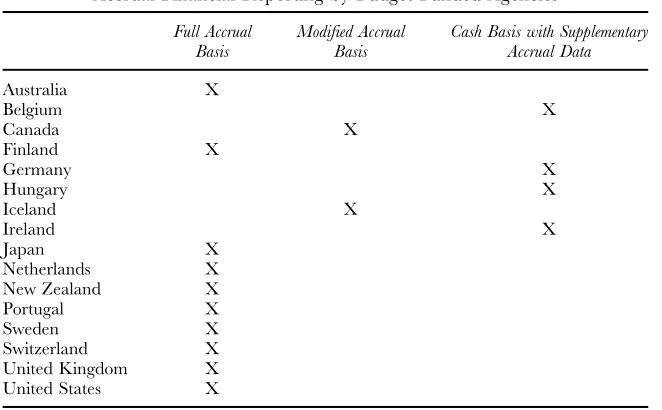
Table 1 provides an overview of the international adoption of accrual based accounting and financial reporting for budget funded agencies. A three way classifica-tion system is adopted, jurisdicclassifica-tions being categorised as using ‘full accrual’ ( largely indistinguishable from typical commercial practice), ‘modified accrual’ (essentially reflecting commercial practice but with less emphasis on comprehensive statements of financial position) or ‘cash with accrual disclosure’ models of reporting.
The necessarily brief review of international adoption of accrual accounting and reporting by budget funded agencies set out above suggests that although the implementation experience has differed significantly between jurisdictions, particularly on dimensions such as degree of public consultation and gestation period, the trend towards the adoption of accrual accounting is a global, rather than an English speaking ‘club’ phenomenon.
Table 1
Accrual Financial Reporting by Budget Funded Agencies
Full Accrual Basis
Modified Accrual Basis
Cash Basis with Supplementary Accrual Data
Australia X
Belgium X
Canada X
Finland X
Germany X
Hungary X
Iceland X
Ireland X
Japan X
Netherlands X
New Zealand X
Portugal X
Sweden X
Switzerland X
United Kingdom X
United States X
Indeed, the repetitious reference in technical and academic literature to the experience of Australia and New Zealand in particular, as early adopters of comprehensive accrual frameworks, may have resulted in insufficient recognition of the breadth and depth of the impetus towards the adoption of accrual accounting and financial reporting techniques within the public sectors of a growing number of jurisdictions throughout the world. For example, in Sweden, accrual accounting was introduced into the local government sector in 1986, and by the central government in 1993 (Mattisson et al., 2003), a very early and comprehensive adoption, but one which has attracted far less attention than the examples of Anglophone jurisdictions such as New Zealand and Australia. Further, even in those jurisdictions where the least reforming fervour has been demonstrated, for example parts of continental Europe and South America, it is difficult to find remaining examples of pure cash based accounting and reporting frameworks (Morphett, 1998).
It does not follow however, that because the adoption of accrual accounting and financial reporting has become so widespread within a relatively constrained time period, the transition has taken place without debate or controversy. On the contrary, the decision to adopt accrual accounting within the public sector has been the subject of considerable debate, a review of which is set out in the next section.
DEBATES ABOUT ACCRUALS IN THE PUBLIC SECTOR
The introduction of accrual based accounting and financial reporting to the public sectors of many jurisdictions throughout the world was not the result of a silent revolution. The weight and volume of material produced both in support of and against the whole project, either wholly or in part, has been both considerable and sustained. For a small sample of papers in support see (AARF, 1991, 1993 and 1998; Barrett, 1993 and 1994; Evans, 1997; Gillibrand and Hilton, 1998; Heald and Georgiou, 1995; IFAC, 1994, 1996 and 2002; JCPA, 1995; NSWPAC, 1988, 1994 and 1996; Pendlebury and Karbhari, 1998; Rowles, 1992, 1993 and 2002; and Talbot, 1998). For a small sample of papers expressing critical views see (Guthrie, 1993 and 1998; Jones and Puglisi, 1997; Ma and Matthews, 1993; McCrae and Aiken, 1994; Mellett, 1997; and Walker, 1988).
reporting systems are ‘superior’7 to alternative systems ( MacIntosh, 1992; McPhee, 1993; DOF 1994a; and Mellor, 1996).
These works are more akin to sermonising than serious explications of prin-ciple. They constitute accrual accounting as a ‘good thing’ in public manage-ment but do so on essentially emotive grounds. As such they represent, at best, a call to action, a statement of ‘why’ organisations within the public sector ought to adopt a new reporting structure, but not an explanation of ‘how’ this ought to be carried into practice, nor ‘what’ the effects will be once the task of implementa-tion is complete.
At a greater level of sophistication, three related themes appear and reappear in appeals for the adoption of accrual accounting and reporting. These do address the ‘what’ as a key element of their rhetorical structure. First, it is often argued that the adoption of accrual reporting will enhance transparency, both internally and externally ( Boxall, 1998; Denis, 1993; Micallef, 1994; and Wong, 1998). Second, whilst on occasions increased transparency in and of itself is suggested to represent a sufficient basis for recommending the adoption of accrual accounting over alternative systems, more frequently, asserted increases in transparency, particularly internal transparency, are said to in turn drive greater organisational performance, primarily through improved resource allo-cation ( Ball, 1992; Churchill, 1992; Kelly, 1998; Likierman, 2000; and Slamet, 1998). A third and closely allied argument is that accrual accounting allows organisations to identify the full cost of their various activities, again leading to greater efficiency, better resource allocation and improved performance ( DOF, 1994b; Evans, 1995; and Webster, 1998).
Each of these lines of argument is ripe for criticism. Claims that a particular model of accounting offers greater transparency are implicitly claims as to the believability and objectivity of the numbers produced therein. In the context of the private sector there exists a burgeoning literature on the susceptibility of accrual accounting and financial reporting to obfuscation and diminished transparency (Clarke et al., 1997; Griffiths, 1995; Jensen, 2001; Mulford and Cominskey, 2002; Naser, 1993; Rezaee, 2002; Schilit, 2002; and Smith, 1996). Yet in almost none of the literature8on public sector applications of accrual accounting is a meaningful, direct challenge issued on this most fundamental point.
Some authors ( Broadbent and Guthrie, 1992; Guthrie, 1994; and Hines, 1988) dance around the issue when they conceptualise accounting technologies, whether cash or accrual based, as other than neutral and disinterested. Such a characterisation suggests that a range of agendas may lie behind the apparently objective veneer of accounting, in turn suggesting that transparency may have been diminished in a manner not immediately or readily noticeable to the world at large. However, this does not provide a direct answer to the matter at hand, namely, whether the introduction of accrual accounting to the public sector will have the effect of increasing transparency.
seem to fly in the face of claims made by those partial to a sanguine view of the enhanced transparency of accrual based financial reporting. Yet when examined closely, Barton’s arguments have little force in relation to the system, as opposed to the particular application of the system about which he complained so forcefully and eloquently. Barton’s bette noire was the requirement, in AAS 27 Financial Reporting by Local Governments, that local government organisations ascer-tain the value of land underneath the roads under their purview, undertake a valuation and recognise the asset in each period’s statement of financial position. Barton’s argument is with this requirement, not with the adoption of accrual based accounting systems in the public sector, and certainly not with their potential degree of transparency, leaving aside specific technical anomalies such as that about which he complained.
Similar observations may be made in respect of recent contributions by Walker et al. (1999, 2000a and 2000b), which focused on critiquing the use of current cost accounting by GTEs, suggesting that this lowered the serviceability of the resulting data for decision making purposes9. Again, the core critique here is not of accrual accounting and reporting in the hands of general government sector agencies, but rather, about a particular technical aspect of a particular observed implementa-tion. So, a central rhetorical weapon of the pro public sector accrual camp has been left almost entirely intact for the period of greater than a decade.
The record is equally poor in relation to the sequitur to the ‘transparency’ argument, namely that this leads to improved organisational performance. While significant quantities of literature have been devoted to the issue of performance measurement systems and techniques within the context of the public sector ( Bowerman and Humphrey, 2001; Neale and Pallot, 2001; and Walker, 2001), literature which critically and empirically addresses the alleged linkage between the adoption of accrual accounting and reporting within the public sector and improved overall performance is essentially non existent. A limited amount of work touches on this question tangentially (Carlin and Guthrie, 2001b). There is a small quantity of published evidence which suggests that the costs of implement-ing accrual based accountimplement-ing and reportimplement-ing may have outweighed the benefits ( Jones and Puglisi, 1997), while Mellet (2002) provides a satirical insight into some of the absurdities which have resulted from the adoption of new techniques such as accrual accounting. Overall however, the critical response has been a muted one.
Nonetheless, given that the bulk of the ‘evidence’ called upon by those disposed towards public sector accrual accounting to lend support to their claims of improved performance has been ‘soft’, that is, based essentially on impressions and opinions rather than data (e.g., Richardson, 1994), a greater weight of effective critical counter argument on this point might reasonably have been expected to emerge over time. Largely, as noted previously, that expectation has not been met.
The critical response has been measurably more effective in relation to the third key claim set out above, namely that the adoption of accrual accounting results in improved capacity to measure cost, leading to better resource alloca-tion decisions and overall performance. Robinson argues that the suggesalloca-tion that accrual systems improve conceptualisation of cost only makes sense when the measure of cost being considered is ‘full accrual cost’. This includes all recurring and capital costs, including depreciation and some measure of the cost of capital employed to produce a particular good or service ( Robinson, 1998a, p. 22). That this is so means that full accrual costs captured by an accounting and reporting system are contingent on a range of factors, including the valuation of assets (which feeds into depreciation and capital charges) as well as the assumed cost of capital.
This line of argument has been taken up by other authors who demonstrate, both empirically and analytically, that these choices, far from improving the accuracy and usefulness of cost estimates as asserted, may have the opposite effect, in the process generating poor quality investment and resource allocation decisions (Carlin, 2000; and Johnstone, 1999). Even some of the most entrenched supporters of the public sector accruals ideal have acknowledged these arguments as ‘very powerful’ ( Rowles, 2002, p. 358).
If the critical rejoinder to normative claims made by proponents of public sector accrual accounting has been relatively weak, what has been the nature of the large quantity of literature, much of it ‘critical’, devoted to the subject of public sector accrual accounting? Examination of three distinct streams of papers will suffice to provide an answer to the question.
criteria than those used to measure and recognise conventional financial and physical assets.
A diametrically opposed response was not long in the making. This view asserted that private sector organisations had long controlled substantial collec-tions of cultural, scientific and heritage assets, and had accounted for those assets in a manner consistent with accounting treatments adopted in relation to more conventional asset classes. That being so, there could be no reason, especially given the beginnings of moves towards accrual accounting (already in place by that time in New Zealand and in the process of implementation in New South Wales), why accounting for public sector assets of that ilk could not proceed commensurately with the private sector experience ( Rowles, 1991). This approach informed the essence of a discussion paper on the subject published by the Australian Accounting Research Foundation the following year ( Rowles, 1992).
Sceptical voices soon emerged, a comprehensive critique of the official posi-tion being published by Carnegie and Wolnizer in 1995 (Carnegie and Wolnizer, 1995). These authors argued that to require comprehensive recognition of heritage, scientific and cultural collections as assets was flawed, because these items did not meet the definition or recognition criteria for assets set out in the (Australian) conceptual framework. Further, recognition and valuation of these items would offend the cost benefit trade-off for financial information made explicit inSAC 3, there being no identifiable users for the information. Finally, the authors argued, since the mission of government agencies with respect to cultural, heritage and scientific assets is ‘to be’ and ‘to hold’ rather than ‘to do business’, to engage in commercial style recognition and valuation would result in an information set fundamentally at odds with the core purpose of the agency to which the (offending) financial report related.
‘Official’ voices were quick to respond, suggesting that recognition and valua-tion of cultural, heritage and scientific assets, far from offending the core values of public sector organisations, was central to maintaining and furthering those values ( Hone, 1997), that there were indeed demands for valuation data pertain-ing to these assets ( Vic PAEC, 1995), and that neither the definitional or recognition requirements for assets according to the conceptual framework were offended as a result of the valuation and incorporation of cultural, heritage and scientific collections into the statements of financial position of public sector entities ( Micallef and Peirson, 1997).
framework for accounting which governs financial reporting in private sector contexts be imported without modification into public sector settings. While the origins of this debate may be traced back to at least the late 1970s (Anthony, 1978), a significant quantity of literature devoted to the question was published from the mid 1990s onwards. Two fundamentally opposed schools of thought have emerged. The first leans towards what might be described as ‘sector neutrality’, the idea that one conceptual framework, and thus one essential body of accounting and reporting rules ought to function equally well for both private and public sector applications ( MacIntosh, 1999; McGreggor, 1999; and Micallef and Peirson, 1997).
The alternative view is that the nature of the public sector is so fundamentally different ( because of the different markets within which governments operate, the different objectives of public sector organisations and the differing nature of many of the assets and liabilities of governments and public sector agencies when compared against the private sector), that a different set of rules ought to be implemented to govern accounting and financial reporting in the public sector ( Barton, 1999a, 1999b, 2002a and 2002b; and Carnegie and Wolnizer, 1999). As with the debate on heritage, cultural and scientific assets reviewed above, the public sector conceptual framework debate shows signs of heightening rhetoric (recent contributions speaking of the outrage, vehemence, and demonisation of others’ positions displayed by authors of opposed views ( Barton, 2002b)), but little sign of resolution.
The ‘accruals as a rhetorical device’ literature forms the basis for a third example. This collection of papers argues against the wholesale introduction of commercial style accrual accounting into the public sector largely on the grounds that theraison d’etreof accounting in private sector settings is fundamentally and irreconcilably different than in public sector settings. Authors who have adopted this line of argument suggest, for example, that the key focal objects of private sector accounting, namely profitability, solvency and capital structure wither into irrelevance in public sector settings (Aiken and Capitano, 1995; McCrae and Aiken, 1994; and Ma and Matthews, 1992 and 1993). This fundamental mis-match between the core objects of accounting technologies appropriate to private sector applications and techniques pertinent to public sector settings suggests firstly that the widespread decision to adopt accrual accounting within the public sector has been grounded in rhetoric rather than reality and secondly, following on from this, that it may have been adopted as part of a broader agenda (Guthrie, 1998).
implementation rhetoric versus reality, whilst executed with eloquence and stamina, have not resulted in a materially improved capacity to comprehend the impact of accrual accounting systems in place in public sector settings.
That this has been so may be attributed to several factors, including the highly technical and semantic focus of many of the (reviewed) contributions to the public sector accounting literature, but also the comparative recency of some novel additions to the public financial management constellation, in particular the construction of credible markets and quasi markets for goods and services traditionally produced monopolistically by public sector agencies, the implemen-tation of accrual output based budgeting and the introduction, in some
jurisdic-tions, of capital charging. These represent fundamental contextual
transformations, and suggest the need for a broadened analytical perspective. This is not to derogate from the contribution made by the pre-existing literature. Debates about conceptual frameworks, the nature of public sector assets and liabilities, the match or mismatch between the goals and objectives of public sector organisations and their adopted modes of representing and mana-ging their financial positions have been and remain important. However, there is a growing recognition that a vital, though to this point under-researched ques-tion has been as to the impact of the public sector pulling on new financial management clothing, such that there is a strong outward resemblance to commercial enterprise management and reporting systems, when inwardly, fundamental differences remain ( Newberry, 2001 and 2002). It is to concerns such as these that the paper turns in the fourth section, by setting out an alternative theoretical lens through which to view the nature and impact of public sector applications of accrual accounting and financial reporting.
AN ALTERNATIVE THEORETICAL LENS
The broad sweep of public sector accrual accounting literature surveyed in this paper has largely displayed most concern for the detailed, technical dimensions of reforms, rather than how the impact of these reforms interacts with simulta-neous and subsequent changes to public management regimes which have been implemented over the past decade. Thus authors agonise about whether a museum collection constitutes an asset in any meaningful sense, or whether a particular set of conceptual guidance principles apply equally well in one sector of the economy as in another, but pay scant attention to the position of accrual accounting within an overall composite reform architecture.
term. However, changes to the assumptions made within the existing infrastruc-ture may be made at a far lower cost. Therefore, a study of actual implementa-tions of accrual systems already in place is not a pyrrhic activity, since though public sector accrual accounting and reporting systems appear likely to be a persistent rather than transient phenomena, the internal assumptions required to drive these systems need not be.
It has been observed that far more fiction has been created in the realm of financial reporting as a result of zealous adherence to prevailing accounting standards, than by blatant rejection of generally accepted accounting principles (Clarke et al., 1997, p. 18). In a similar vein it seems plausible to observe that far more confusion as to identity and purpose has been created as a result of the cloaking of the public sector in the same financial reporting fabric, that of accruals, as worn in the commercial realm.
Earlier literature has insisted that the application of accruals technology to the public sector is inappropriate because of the fundamentally differing objective sets of the public versus the private sector (e.g Guthrie, 1998). That may be so, but a more important consideration, at a pragmatic level, is that once similar technologies are adopted by one sector of the economy as another, a significant barrier to surface level analytical comparability has been demolished. The ‘sameness’ which has been achieved between accounting and reporting stan-dards in the public and private sectors is itself a powerful rhetorical tool, but one which may lead to confused and suboptimal outcomes.
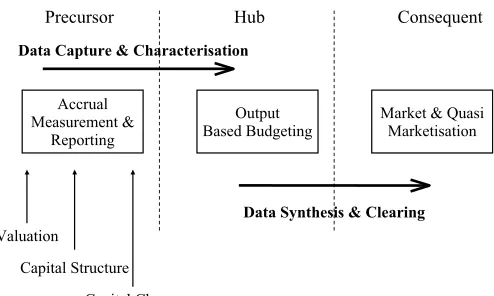
As discussed above, the adoption of accrual based accounting and reporting has not been an end in itself ( Mellor, 1996). Rather, the role and impact of accrual accounting is better understood as forming one part of an interconnected chain of reforms to public financial management techniques. A depiction of these interconnections is set out in Figure 1.
Viewed in this way, the changes to public sector financial management which have occurred over the past decade may be classified as falling into one of three categories. The first category consists of ‘precursor’ reforms, so called because the adoption of such techniques is a necessary precondition to the subsequent implementation of a range of other techniques. Accrual measurement and reporting fits into this category. The recording and reporting apparatus acts as a feeder mechanism for the second category of reforms, here labelled ‘hub’ reforms. The ‘hub’ technique of accrual output based budgeting (AOBB) lies at the centre of the new public financial management environment. It charac-terises all activities carried out by public sector agencies as the production of outputs measurable both in terms of their physical and financial dimensions (Carlin, 2003b).
outputs with known cost functions, transmit these data into the third (consequent) layer of the public financial management reforms, the markets and quasi markets within which outputs are traded. This architecture fits well with the vision of competitive neutrality between the public and private sector mapped out, for example, in the national competition policy adopted by Australian governments during the 1990s (Hilmer, 1993; and Industry Commission, 1996).
Recall that neither the ‘hub’ nor the consequent markets and quasi markets for outputs can function without a precursor data feeder system, in this case accrual financial accounting and reporting. It therefore follows that the output costs calculated within the AOBB and transmitted into output markets will be sensitive to assumptions made within the accrual accounting reporting system, for example in relation to asset value and depreciation schedules.
A naı¨ve analysis of public sector financial management arrangements prevail-ing in jurisdictions in which accrual based accountprevail-ing and reportprevail-ing has been adopted may lead to the conclusion that one result is directly comparable with the financial dimensions of private sector organisations. The inherent logic of this train of thought is that if the underlying financial data system is the same in both segments of the economy, then the product of the system, for example output cost data must also be directly comparable.
However, this argument is rendered absurd when it can be demonstrated that there are fundamental differences in the assumptions inherent in accrual accounting and reporting as practiced in the private versus the public sector, and that these differences in accounting policy choice have, or have the potential
Output Based Budgeting
Precursor Hub Consequent
Accrual Measurement &
Reporting
Market & Quasi Marketisation
Data Synthesis & Clearing
Valuation
Capital Structure
Capital Charge
Data Capture & Characterisation
Figure 1
to have, a material impact on the measurement of the financial position and performance and efficiency of public versus private sector entities. This possi-bility is tested by reference to a case study on financial reporting by Victorian public sector agencies compared against a sample of Australian listed corpora-tions, reported below.
AN EMPIRICAL EXAMINATION OF THE VICTORIAN POSITION
Though flirted with briefly but quickly discarded by the private sector (Clarke, 1982 and 1998; Tweedie and Whittington, 1984 and 1987; and Whittington and Pong, 1996), asset valuation based on current replacement cost has flourished in Australian public sector settings. This single factor represents a significant barrier to comparability between the financial statements and apparent efficiency of public and private sector organisations, even though they are using ostensibly the same accounting and reporting methodologies and structures.
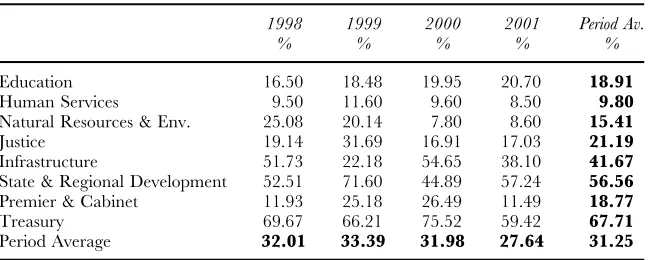
The State of Victoria is used10as a case study to illustrate the impact that this differential approach to asset valuation can have on comparative financial analysis. Table 2 sets out data on the proportion of non-current physical assets controlled by Victorian government departments11between 199812and 200113 which were measured and reported in departmental statements of financial position at written down historical cost. The data clearly reveal a bias away from the use of historical cost as the prime asset valuation methodology employed across Victorian government departments.
On average, across the eight departments for the four years studied, approxi-mately 70% of assets were valued at other than historical cost. The predominant alternative measure used was replacement cost. The extent to which this practice
Table 2
Per Cent of Physical Non-current Assets at Historical Cost – Victorian Government Departments
1998 1999 2000 2001 Period Av.
% % % % %
Education 16.50 18.48 19.95 20.70 18.91
Human Services 9.50 11.60 9.60 8.50 9.80
Natural Resources & Env. 25.08 20.14 7.80 8.60 15.41
Justice 19.14 31.69 16.91 17.03 21.19
Infrastructure 51.73 22.18 54.65 38.10 41.67
State & Regional Development 52.51 71.60 44.89 57.24 56.56
Premier & Cabinet 11.93 25.18 26.49 11.49 18.77
Treasury 69.67 66.21 75.52 59.42 67.71
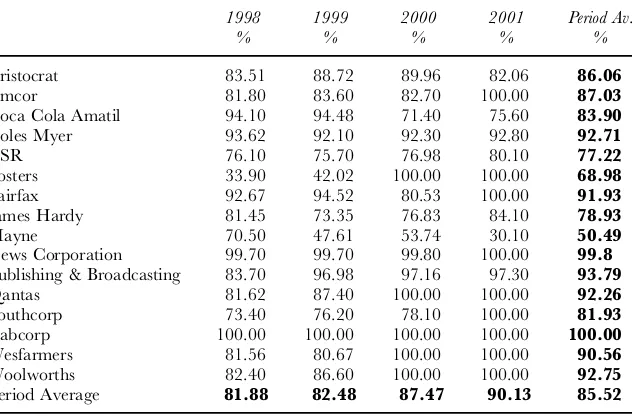
differs from that adopted by private sector organisations may be gauged by even a brief examination of the data reported in Table 3.
The data set out in Table 3 provides evidence of a systematic and persistent preference for the use of historical cost measures by private sector entities. This may be explained in part by the likelihood that the adoption of historical cost accounting is likely to result in higher apparent rates of return on assets and earnings per share15 than would be achieved were asset valuation techniques which tended to inflate asset values16adopted. In addition, prevailing applicable accounting standards which touch on the question of the valuation of non-current physical assets take a relatively permissive stance, allowing extensive use of historical cost accounting by private sector reporting entities.17
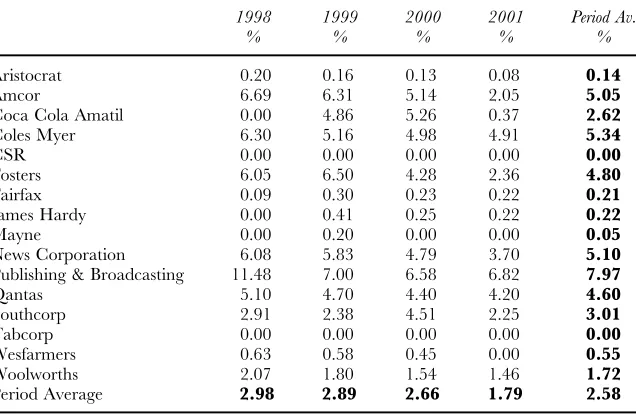
That the adoption of replacement cost valuation methodologies by public sector entities has had the effect of inflating the size of the balance sheets of public sector balance sheets when compared against their private sector peers is able to be demonstrated by comparing the proportion of total assets made up of asset revaluation increments in both sectors. Data for Victorian government departments is set out in Table 4.
Note that on average, across all Victorian government departments for the four year period studied, asset revaluation increments represented 12.27% of
Table 3
Per Cent of Physical Non-current Assets at Historical Cost – ASX Listed Companies Sample14
1998 1999 2000 2001 Period Av.
% % % % %
Aristocrat 83.51 88.72 89.96 82.06 86.06
Amcor 81.80 83.60 82.70 100.00 87.03
Coca Cola Amatil 94.10 94.48 71.40 75.60 83.90
Coles Myer 93.62 92.10 92.30 92.80 92.71
CSR 76.10 75.70 76.98 80.10 77.22
Fosters 33.90 42.02 100.00 100.00 68.98
Fairfax 92.67 94.52 80.53 100.00 91.93
James Hardy 81.45 73.35 76.83 84.10 78.93
Mayne 70.50 47.61 53.74 30.10 50.49
News Corporation 99.70 99.70 99.80 100.00 99.8
Publishing & Broadcasting 83.70 96.98 97.16 97.30 93.79
Qantas 81.62 87.40 100.00 100.00 92.26
Southcorp 73.40 76.20 78.10 100.00 81.93
Tabcorp 100.00 100.00 100.00 100.00 100.00
Wesfarmers 81.56 80.67 100.00 100.00 90.56
Woolworths 82.40 86.60 100.00 100.00 92.75
total reported assets,18as opposed to the whole of period average of 2.58%19for the sample of comparator listed companies, as set out in Table 5.
A combination of the comparisons between the Victorian government depart-ments and the sample of private sector entities on the dimensions of asset
Table 4
Asset Revaluation Reserve Percentage of Total Assets – Victorian Government Departments
1998 1999 2000 2001 Period Av.
% % % % %
Education 3.00 5.88 10.03 13.79 8.18
Human Services 28.05 29.04 59.66 55.08 42.96
Natural Resources & Env. 11.78 28.43 31.34 31.16 25.68
Justice 1.15 1.03 7.12 5.66 3.74
Infrastructure 2.56 4.66 1.96 7.03 4.05
State & Regional Development 0.00 0.00 12.76 6.96 4.93
Premier & Cabinet 3.18 2.78 2.99 5.22 3.54
Treasury 3.47 3.18 3.66 9.84 5.04
Period Average 6.65 9.38 16.19 16.84 12.27
Table 5
Per Cent Asset Revaluation Reserve Per Cent Total Assets – ASX Listed Companies Sample
1998 1999 2000 2001 Period Av.
% % % % %
Aristocrat 0.20 0.16 0.13 0.08 0.14
Amcor 6.69 6.31 5.14 2.05 5.05
Coca Cola Amatil 0.00 4.86 5.26 0.37 2.62
Coles Myer 6.30 5.16 4.98 4.91 5.34
CSR 0.00 0.00 0.00 0.00 0.00
Fosters 6.05 6.50 4.28 2.36 4.80
Fairfax 0.09 0.30 0.23 0.22 0.21
James Hardy 0.00 0.41 0.25 0.22 0.22
Mayne 0.00 0.20 0.00 0.00 0.05
News Corporation 6.08 5.83 4.79 3.70 5.10
Publishing & Broadcasting 11.48 7.00 6.58 6.82 7.97
Qantas 5.10 4.70 4.40 4.20 4.60
Southcorp 2.91 2.38 4.51 2.25 3.01
Tabcorp 0.00 0.00 0.00 0.00 0.00
Wesfarmers 0.63 0.58 0.45 0.00 0.55
Woolworths 2.07 1.80 1.54 1.46 1.72
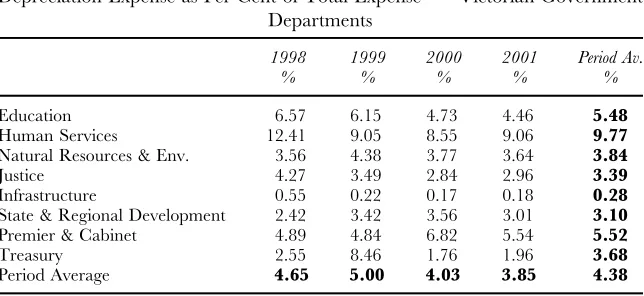
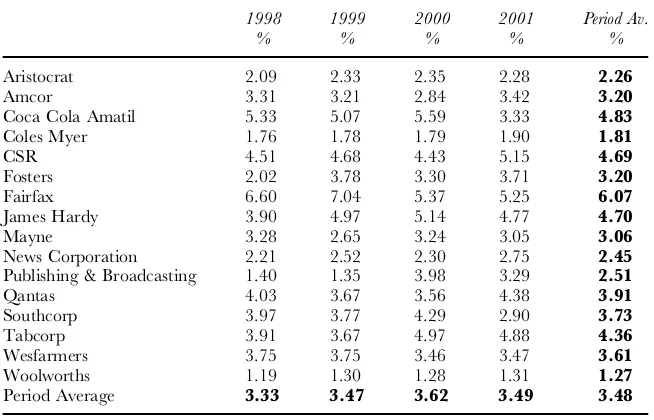
valuation choice and relative balance sheet inflation leads to the expectation that among public sector entities, depreciation charges as a proportion of total expense would also be higher than that observed for the private sector sample. This stems from the expectation that higher overall asset values will generally lead to higher period depreciation expenses. This expectation is borne out in the data, as demonstrated by Tables 6 and 7.
The data in these tables should be interpreted carefully. First, note that on average, across the four year period under study, depreciation expense repre-sented 4.38% of the total expenses of the Victorian government departments, as opposed to 3.48% of the total expenses of the selected sample of private sector entities. This difference is in the direction expected. However, there are reasons to believe that the magnitude of the observed difference may, for a variety of reasons, fail to capture the full extent of relative distortions to measures of financial performance brought about by differing depreciation charges in public versus private sector entities.
One source of difficulty arises from the nature of the sample of private sector entities used. These were not chosen because of their inherent balance sheet or asset valuation choice characteristics, but rather, on the basis of their large market capitalisation. As a result, most of the private sector entities included in the research sample are capital intensive businesses, whereas certain of the Victorian government departments (e.g Treasury, Premier & Cabinet) are almost purely administrative in their activities and would therefore be better compared against private sector entities drawn from the ‘services’ sector.21
Despite this, the observed differences are instructive. The private sector businesses which form the comparator sample are, as noted, capital intensive businesses. On the other hand, if a two point categorisation model, characterised by ‘capital intensive’ organisations on the one hand and ‘non-capital intensive’
Table 6
Depreciation Expense as Per Cent of Total Expense20– Victorian Government Departments
1998 1999 2000 2001 Period Av.
% % % % %
Education 6.57 6.15 4.73 4.46 5.48
Human Services 12.41 9.05 8.55 9.06 9.77
Natural Resources & Env. 3.56 4.38 3.77 3.64 3.84
Justice 4.27 3.49 2.84 2.96 3.39
Infrastructure 0.55 0.22 0.17 0.18 0.28
State & Regional Development 2.42 3.42 3.56 3.01 3.10
Premier & Cabinet 4.89 4.84 6.82 5.54 5.52
Treasury 2.55 8.46 1.76 1.96 3.68
organisations on the other were to be adopted, then given the service orientation of the public sector entities as opposed to the product orientation of the private sector entities, the former would most likely be classified as ‘non capital inten-sive’. It is therefore surprising that despite the capital intensity of the private sector organisations, the depreciation charges of the less capital intensive public sector organisations are observed to be larger in magnitude. This strengthens rather than diminishes the credibility of the direction of the observed differential in relative depreciation expense.
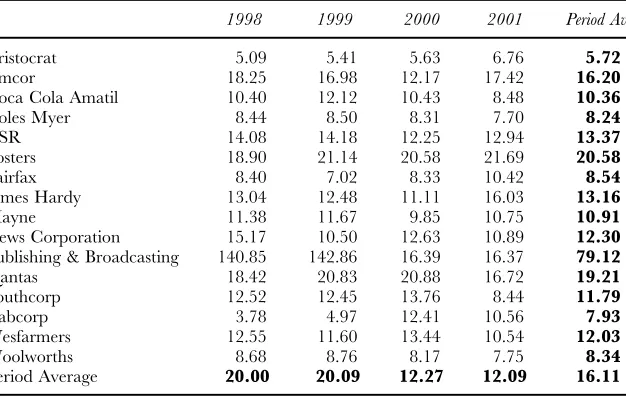
A second difficulty in interpreting relative depreciation expense data is that depreciation expense, quite apart from being a product of choices made with respect to asset valuation, is also a product of choices made with respect to other variables, most significantly the period of time over which the depreciation is to proceed. Material differences in adopted timing regimes might also confound the results. In order to test for this, the implicit aggregate depreciation periods of the public sector and private sector entities were also calculated.22These are set out in Tables 8 and 9.
Again, the results of this analysis are instructive. Note that the observed implicit total depreciation period for the Victorian government departments was, on average over the period of the sample, approximately twice the rate observed for the sample of private sector entities. This means that the private
Table 7
Depreciation Expense as Per Cent of Total Expense – ASX Listed Companies Sample
1998 1999 2000 2001 Period Av.
% % % % %
Aristocrat 2.09 2.33 2.35 2.28 2.26
Amcor 3.31 3.21 2.84 3.42 3.20
Coca Cola Amatil 5.33 5.07 5.59 3.33 4.83
Coles Myer 1.76 1.78 1.79 1.90 1.81
CSR 4.51 4.68 4.43 5.15 4.69
Fosters 2.02 3.78 3.30 3.71 3.20
Fairfax 6.60 7.04 5.37 5.25 6.07
James Hardy 3.90 4.97 5.14 4.77 4.70
Mayne 3.28 2.65 3.24 3.05 3.06
News Corporation 2.21 2.52 2.30 2.75 2.45
Publishing & Broadcasting 1.40 1.35 3.98 3.29 2.51
Qantas 4.03 3.67 3.56 4.38 3.91
Southcorp 3.97 3.77 4.29 2.90 3.73
Tabcorp 3.91 3.67 4.97 4.88 4.36
Wesfarmers 3.75 3.75 3.46 3.47 3.61
Woolworths 1.19 1.30 1.28 1.31 1.27
sector entities are, on average, depreciating their assets at close to twice the rate at which the Victorian government departments are engaging in the process. Despite this, as set out in Tables 6 and 7 above, the level of depreciation expense relative to total expense in the Victorian government departments was higher than that observed for the private sector entity comparator sample.
This suggests that if the public sector implicit total depreciation period were reduced to a level comparable with that observed for the sample of private sector
Table 9
Implicit Total Depreciation Period ( Years) – ASX Listed Companies Sample
1998 1999 2000 2001 Period Av.
Aristocrat 5.09 5.41 5.63 6.76 5.72
Amcor 18.25 16.98 12.17 17.42 16.20
Coca Cola Amatil 10.40 12.12 10.43 8.48 10.36
Coles Myer 8.44 8.50 8.31 7.70 8.24
CSR 14.08 14.18 12.25 12.94 13.37
Fosters 18.90 21.14 20.58 21.69 20.58
Fairfax 8.40 7.02 8.33 10.42 8.54
James Hardy 13.04 12.48 11.11 16.03 13.16
Mayne 11.38 11.67 9.85 10.75 10.91
News Corporation 15.17 10.50 12.63 10.89 12.30
Publishing & Broadcasting 140.85 142.86 16.39 16.37 79.12
Qantas 18.42 20.83 20.88 16.72 19.21
Southcorp 12.52 12.45 13.76 8.44 11.79
Tabcorp 3.78 4.97 12.41 10.56 7.93
Wesfarmers 12.55 11.60 13.44 10.54 12.03
Woolworths 8.68 8.76 8.17 7.75 8.34
Period Average 20.00 20.09 12.27 12.09 16.11
Table 8
Implicit Total Depreciation Period ( Years) – Victorian Government Departments
1998 1999 2000 2001 Period Av.
Education 24.27 23.36 30.86 32.15 27.66
Human Services 66.67 72.46 76.34 76.92 73.10
Natural Resources & Env. 50.25 97.09 117.65 112.36 94.34
Justice 17.42 20.37 27.03 24.27 22.27
Infrastructure 10.83 15.34 25.71 30.49 20.59
State & Regional Development 6.85 5.06 5.91 8.87 6.67
Premier & Cabinet 13.09 21.28 40.32 40.49 28.79
Treasury 22.42 18.80 16.21 17.45 18.72
entities, the gap between relative depreciation in both sectors would widen further. As it stands, even with a retarded depreciation function, the effect of heightened asset valuation in the public sector dominates to produce higher depreciation expense functions, and therefore a higher period by period total entity cost function. This suggests a flow through impact to the estimation of output costs, and therefore, a direct impact on a variety of resource allocation decisions, including those relating to outsourcing.
CONCLUSION
A central tenet of the arguments contained within this paper is that the adoption of accrual accounting and reporting by public sector entities must be analysed at more than an introspective, techno-centric level. This is because the implications of the adoption of such a technology into the inventory of public sector financial management techniques range far beyond the fact of consequential changes in reporting format and content.
By conceptualising public sector accrual accounting as part of a chain of linked reforms, it is possible to extend debates about public sector accrual accounting such that they yield insights not just into the nature of accounting, but also into the consequences for subsequent decision making and resource allocation of the employment of accounting tools in particular ways. While the conceptual analytical framework suggested in this paper demonstrates the lin-kages between accrual accounting and other reforms which have been a feature of the changing public financial management landscape over the past two decades, the empirical data analysed in the paper clearly suggests that the introduction of accrual accounting to the public sector may not be neutral in its impact.
The point is not so much that the data from the Victorian case study suggest that inflationary asset valuation techniques may have led to increased accrual charges against the operating statements of Victorian public sector agencies and thus potentially higher assessed cost of output production than would have been the case had underlying accounting conventions more akin to those implemen-ted by potential private sector output providers been used. Rather, it is that what counts is not so much the fact of the existence of an accrual accounting and reporting system, but its content – in particular the norms and assumptions without which no such system can exist.
While at a headline level one accrual system looks much like another, and while systems of regulating the content of financial reports may cross boundaries between the public and private sectors, it does not follow from this that system-atic differences will not arise between the assumptions and conventions used to actually drive the machinery of the accounting system in public and private sector settings. Indeed, the data set out in the previous section provides evidence of such systematic differences and the nature of their impact.
This inevitably gives rise to questions as to the root cause of these differences, if and where they do in fact exist. A sanguine view of affairs is that the types of differences noted and discussed in the previous section arise either serendipi-tously, or alternatively, through the naivety of the actors involved in the imple-mentation of public sector accrual accounting and financial reporting systems. Given the systematic nature of the data set out in the previous section of this paper, at least in relation to the question of asset valuation choices, serendipity hardly seems a satisfying explanation. Likewise, given the enormous resources which have been devoted by governments around the world towards the task of designing and implementing accrual reporting systems, suggestions of naı¨ve system architecture also seem an unappealing explanation of affairs.
An alternative explanation is that differences such as those observed in the case of the data examined in the previous section exist because the architects of public sector applications of accrual accounting systems intend them to be in existence and that they serve a premeditated purpose. In the case of the data set out in the previous section of this paper, one conclusion might be that the agenda served is a form of privatisation by stealth, because the accrual account-ing assumptions systematically bias public sector output costs upwards when compared against private sector alternatives. At this stage, the logic of the accrual output based budgeting system takes over to purposely shift economic activity from one sector to another. In the context of studying public financial management reforms in other settings, similar conclusions have been reached by other authors (e.g Newberry, 2002).
other by calculation. The issue of central importance is that the purposive design of public sector accrual accounting systems as tools for the hollowing out of the public sector and as agents of ideologies which laud smaller government is a reality which researchers must take account of with far greater intensity than the pre-existing literature on public sector accrual accounting suggests has been the case in past.
In particular, analysis of public sector applications of accrual accounting and financial reporting through the alternative theoretical lens discussed in the fourth section of this paper should assist researchers in taking a more directed and systematic view of the potential decision consequences of actual public sector accrual implementations in a wider variety of different institutional settings than has appeared to be possible given the narrower and more technocentric tradition into which much of the extant literature on the subject falls.
NOTES
1 There are other examples of this. For example, commercial style accounting was used in nationalised industries in the United Kingdom from the 1950s onwards.
2 There had of course been a more wide ranging contemplation of the issue than is necessary to catalogue here. For example, in 1978, the New Zealand Comptroller and Auditor General had advocated accrual accounting as a means of improving cost and asset management ( NZ Audit Office, 1978).
3 Though not necessarily accrual budgeting systems.
4 Holding aside the case of nationalised industries which had used commercial accounting techni-ques over an extended period.
5 A term of the art used in the United Kingdom which encompasses, amongst other things, the adoption of an accruals framework.
6 Even at that stage, the OECD did not regard Canada as having a full accrual system. The OECD regards Canada’s system as partial accrual because of the tendency to expense rather than capitalise long lived assets in that jurisdiction (OECD, 2002).
7 Generally there is little specification as to the cause of the asserted superiority. It is almost as if, for certain authors, the proposition is so obvious that it speaks for itself (a case ofres ipsa loquitur). 8 Walker (1988) represents a clear exception.
9 The analysis provided by Walker et al. is not directly on point for the purposes of this paper, because it concentrates on Government Trading Enterprises (GTEs). There has been little controversy about the applicability of accrual models of accounting by GTEs.
10 Victoria is chosen as the object of study for several reasons. First, it was an early adopter of a range of public financial management reforms, meaning that at the time of writing, adequate quantities of historical, post implementation data is available for scrutiny and analysis. Second, the structure of Victoria’s public sector has remained relatively static over an extended period. This means that analysis can proceed without the obfuscating effect of departmental amalgama-tions, integraamalgama-tions, reorganisations and so on. The overarching departmental structure has remained essentially unchanged over the period studied.
11 There are 8 main departments, data for all of which is reported and analysed in this paper. 12 By 1998 all Victorian Government departments had adopted full accrual accounting and
reporting.
13 The most recent period for which data is available as at the time of writing.
sample of stocks (drawn from the Standard & Poors ASX 50 index was $110.7 billion, represent-ing 31% of the non-minrepresent-ing and financial services market capitalisation of the ASX. The financial characteristics of mining and resource stocks ( by reason of high infrastructure investment) and financial institutions ( leverage) differ significantly from other businesses and from public sector agencies. These were therefore excluded from the selected sample, which includes only stocks drawn from the manufacturing and services sector. Though small in absolute numbers (there were 1,382 stocks listed on the ASX as at 30 June, 2001) the large share of relevant aggregate market capitalisation embodied by the sample provides comfort as to the generality of conclusions reached on the basis of observations drawn from the sample.
15 Via lower depreciation charges.
16 And thus diminish return on assets, as well as EPS by way of heightened depreciation charges. 17 SeeAustralian Accounting Standard AASB 1041,Revaluation of Non Current Assets(Australian Accounting
Standards Board). Furthermore, Australian Stock Exchange listing rules do not contain prescrip-tions in relation to the question of asset valuation.
18 With a minimum of 3.54% and a maximum of 42.96% across the 4 year study period. 19 Minimum value 0.00%, maximum value 7.97% across the 4 year study period.
20 Total expenses reported by Victorian government departments were modified for the purposes of this calculation. In most years under study, most Victorian government departments made grants, often material in size, to other entities, which then used those grants to deliver goods and services. There are no analogous expenses in the statements of financial performance of private sector entities. Therefore, on the basis that these were ‘administered’ rather than ‘entity’ expenses, these were excluded from the total quantum of expenses used for making the calculations set out in Table 6.
21 Unfortunately there are relatively few pure services businesses which maintain direct listings on the ASX, and those whose shares are listed for quotation tend to be small in terms of market capitalisation.
22 The reciprocal of depreciation divided by total expense is a raw measure of the total period of time which it would take to write down the entire asset base of the entity to zero, assuming no replacement and a constant period depreciation function.
REFERENCES
Aiken, M. and C. Capitanio (1995), ‘Accrual Accounting Valuations and Accountability in Government: A Potentially Pernicious Union’, Australian Journal of Public Administration, Vol. 54, No. 4, pp. 564–75.
Anthony, R. (1978),Financial Accounting in Nonbusiness Organisations – An Exploratory Study, Financial Accounting Standards Board (Connecticut).
Australian Accounting Research Foundation (AARF ) (1991), Australian Accounting Standard AAS 27: Financial Reporting by Local Governments( Melbourne, AARF).
——— (AARF ) (1993), Australian Accounting Standard AAS 29: Financial Reporting by Government Departments(Melbourne, AARF).
——— (AARF ) (1998), Australian Accounting Standard AAS 31: Financial Reporting by Governments ( Melbourne, AARF ).
Awty, A. (2002), ‘Hong Kong Moves On’,Australian CPA(February), pp. 50–51.
Ball, I. (1994), ‘Reinventing Government: Lessons Learned From the New Zealand Treasury’,The Government Accountants Journal, Vol. 43, pp. 19–25.
———, T. Dale, W. Eggers and J. Sacco (1999), ‘Reforming Financial Management in the Public Sector: Lessons U.S. Officials Can Learn From New Zealand’,Reason Public Policy Institute Policy Study 258(RPPI, Los Angeles).
Barrett, P. (1993), ‘Managing in an Accrual Accounting Environment’, RIPA Public Sector Conference (February, Canberra).
——— (1994), ‘Success in Managing Accrual Accounting – More Gain than Pain’, ASCPA Seminar, (Canberra).
Barton, A. (1999b), ‘Public and Private Sector Accounting – The Non Identical Twins’,Australian Accounting Review, Vol. 9, No. 2, pp. 22–31.
——— (2002a), ‘How to Profit from Defence – A Study in the Misapplication of Business Sector Accounting to the Public Sector’,Proceedings of the International Conference on Accounting, Auditing & Management in Public Sector Reforms(September, Dublin).
——— (2002b), ‘Public Sector Accounting: A Common Reporting Framework? A Rejoinder’, Australian Accounting Review, Vol. 12, No.3, pp. 41–45.
Bowerman, M. and C. Humphrey (2001), ‘Should Non-Financial Performance Information be Audited? The Case of Public Service Agreements in UK Government’,Australian Accounting Review, Vol. 11, No. 3, pp. 35–43.
Boxall, P. (1998), ‘The Revolution in Government Accounting’,Australian CPA(April), pp. 18–20. Broadbent, J. (1992), ‘Change in Organisations: A Case Study of the Use of Accounting Information
in the NHS’,British Accounting Review, Vol. 24, No. 4, pp. 343–67.
——— and J. Guthrie (1992), ‘Changes in the Public Sector: A Review of Recent Alternative Accounting Research’,Accounting Auditing & Accountability Journal, Vol. 5, No. 2, pp. 3–31. Brorstrom, B. (1998), ‘Accrual Accounting, Politics and Politicians’, Financial Accountability &
Management, Vol. 14, No. 4, pp. 319–33.
Canada, Office of the Auditor General (CanAG) (1987), Financial Management and Control Study (Government Printer, Ottowa).
Carlin, T. (2000), ‘Measurement Challenges and Consequences in the Public Sector’,Australian Accounting Review, Vol. 11, No. 2, pp. 63–72.
——— (2002), ‘Linkage and Legitimisation – A Decade of Public Sector Financial Management Reforms in Australia’, Proceedings of 7th Annual Asia Pacific Decision Sciences Institute
Conference (Bangkok, July).
——— (2003a), ‘Unravelling the Capital Charging Riddle – Some Empirical Evidence From Victoria’,Financial Accountability & Management, Vol 19. No. 1, pp. 73–92.
——— (2003b), ‘Accrual Output Based Budgeting Systems in Australia – A Great Leap Backwards?’,Australian Accounting Review, Vol. 13, No. 2 ( July), pp. 41–47.
——— and J. Guthrie (2001a), ‘Lessons From Australian and New Zealand Experiences With Accrual Output Based Budgeting’, in Jones, Guthrie and Steane (eds.), Learning From International Management Reform(Elsevier Science, New York, Vol IIA), pp. 89–100.
——— ——— (2001b), ‘The New Business of Government Budgeting: Reporting Non-Financial Information in Victoria’,Australian Accounting Review, Vol. 11, No. 3, pp. 17–26.
Carnegie, G. and P. Wolnizer (1995), ‘The Financial Value of Cultural, Heritage and Scientific Collections: An Accounting Fiction’,Australian Accounting Review, Vol. 5, No. 1, pp. 31–47. ——— ——— (1996), ‘Enabling Accountability in Museums’,Accounting, Auditing and Accountability
Journal, Vol. 9, No. 5, pp. 84–99.
——— ——— (1997), ‘Accounting for Publicly Owned Collections: Whither Financial (Market) Values and Contingent Valuation Estimates?’,Australian Accounting Review, Vol. 7, No. 1, pp. 44–50. ——— ——— (1999), ‘Unravelling the Rhetoric About the Financial Reporting of Public
Collections as Assets. A Response to Micallef and Peirson’,Australian Accounting Review, Vol. 9, No. 1, pp. 16–21.
——— ——— (2002), ‘A Rejoinder’,Australian Accounting Review, Vol. 12, No. 3, pp. 45–47. Carter, G. (1994), ‘Accrual Accounting – Why?’, ASCPA Public Sector Accounting Conference
(March, Adelaide).
Certified General Accountants Association of Canada (CGAAC) (1999),Getting It Right – The Financial Information Strategy in the Federal Government, Position Paper (Ottowa).
Christensen, M. (2002), ‘Public Sector Accrual Accounting: An Early Adopter’s History’, Proceedings of the 9thWorld Congress of Accounting Historians (Melbourne, July).
Churchill, M. (1992), ‘Accrual Accounting in the Public Sector’, Australian Accountant (June), pp. 39–42.
Clarke, F. (1982),The Tangled Web of Price Variation Accounting(Garland, Sydney).
———, G. Dean and K. Oliver (1997),Corporate Collapse – Regulatory, Accounting and Ethical Failure (Cambridge University Press).
——— (1998), ‘Deprival Value and Optimised Deprival Value in Australasian Public Sector Accounting: Unwarranted Drift and Contested Serviceability’,Abacus, Vol. 34, No. 1, pp. 8–17. Commonwealth Commission of Audit (1996),National Commission of Audit – Report to the Commonwealth
Conn, N. (1996), ‘Reservations About Governments Producing Balance Sheets’,Australian Journal of Public Administration, Vol. 55, No. 1, pp. 82–85.
Dennis, J. (1993), ‘Financial Reporting by the Government in Canada’,CMA Magazine(November), p. 29.
Department of Finance (Cth) (DOF) (1994a),The New Financial Reports of Agencies: A Guide to the Use of Accrual Accounting and Reporting by Commonwealth Agencies(AGPS, Canberra).
——— (1994b),Resource Management in the Australian Public Service(AGPS, Canberra).
English, L., J. Guthrie and T. Carlin (2000), ‘Transformation of Public Sector Financial Management: Reflection on the Victorian Experience Downunder’,EAA 23rd Annual Congress (Munich, Germany).
Evans, M. (1995), ‘A Change for the Better?’,Accountancy, Vol. 115 (February), pp. 92–94. ——— (1997), ‘Information for Decision Taking about the Allocation of Resources’,Public Finance
Foundation Review, Vol. 13, p. 4.
Funnell, W. and K. Cooper (1998),Public Sector Accounting and Accountability in Australia(UNSW Press, Sydney).
Gillibrand, A. and B. Hilton (1998), ‘Resource Accounting and Budgeting: Principles, Concepts and Practice – the MOD Case’,Public Money & Management, Vol. 18, No. 2, pp. 21–28.
Glassco (1962),Report of Royal Commission on Government Organisations ( Canada), 5 Volumes (Government Printer, Ottowa).
Griffiths, I. (1995), New Creative Accounting: How to Make Your Profits What You Want Them to Be (Macmillan, London).
Groom, E. (1990), ‘The Curran Report and the Role of the State’, Australian Journal of Public Administration, Vol. 49, pp. 144–54.
Guthrie, J. (1993), ‘Australian Public Sector Accounting: Transformations and Managerialism’, Accounting Research Journal, Vol. 6, No. 2, pp. 15–25.
——— (1994), ‘Understanding Australian Federal Public Sector Accounting Developments in Their Context’, Unpublished PhD Thesis (University of New South Wales).
——— (1998), ‘Application of Accrual Accounting in the Australian Public Sector – Rhetoric or Reality’,Financial Accountability & Management, Vol. 14, No. 1, pp. 1–19.
Heald, D. and A. Dowdall (1999), ‘Capital Charging as a VFM Tool in Public Services’,Financial Accountability & Management, Vol. 15, No. 3&4, pp. 229–45.
——— and G. Georgiou (1995), ‘Resource Accounting: Valuation, Consolidation and Accounting Regulation,Public Administration, Vol. 73, No. 4, pp. 63–71.
Hilmer, F., M. Rayner and G. Taperell (1993),National Competition Policy, Report by the Independent Committee of Inquiry (AGPS, Canberra).
Hines, R. (1988), ‘Financial Accounting: In Communicating Reality We Construct Reality’,Accounting Organisations and Society, Vol. 13, No. 3, pp. 251–61.
H. M. Government (1994),Better Accounting for the Taxpayer’s Money – The Government’s Proposals, CM 2626 (HMSO, London).
——— (1995),Better Accounting for the Taxpayer’s Money – The Government’s Proposals, CM 2629 (HMSO, London).
H. M. Treasury (1993),Financial Statement and Budget Report 1994–95(HMSO, London).
Humphrey, C., P. Miller and R. Scapens (1993), ‘Accounting, Accountability and the ‘New’ UK Public Sector’,Accounting Auditing & Accountability Journal, Vol 6. No. 3, pp. 7–29.
Industry Commission (1996), Inquiry into Competitive Tendering and Contracting by Public Sector Agencies (Melbourne, AGPS).
International Federation of Accountants (IFAC) (1994), ‘Implementing Accrual Accounting in Government: The New Zealand Experience’,IFAC Occasional Paper 1(IFAC, New York). ——— (IFAC) (1996), ‘Perspectives on Accrual Accounting’,IFAC Occasional Paper 3(IFAC, New
York).
——— (IFAC) (2002), ‘Resource Accounting – Framework of Accounting Standard Setting in the UK Central Government Sector’,IFAC Occasional Paper 7(IFAC, New York).
Jensen, M. (2001), ‘Corporate Budgeting is Broke, Lets Fix It’,Harvard Business Review(November), pp. 94–101.
Joint Committee of Public Accounts (JCPA) (1982),The Form and Standard of Financial Statements of Commonwealth Undertakings, Report 199 (Canberra, AGPS).
Jones, S. and N. Puglisi (1997), ‘The Relevance of AAS 29 to the Australian Public Sector: A Case for Doubt?’,Abacus, Vol. 33, No. 1, pp. 115–32.
Lambert (1979), Report of Royal Commission on Financial Accountability and Management ( Canada) (Government Printer, Ottowa).
Lewis, N. (1995), ‘AAS 29 – A Critique’,Readings in Accounting Developments in the Public Sector(ASCPA, Melbourne), pp. 16–25.
Likierman, A. (2000), ‘Changes to Managerial Decision-Taking in U.K. Central Government’, Management Accounting Research, Vol. 11, pp. 253–61.
Ma, R. and R. Matthews (1992), ‘What’s Wrong with ED 55’,Financial Forum(ASCPA, Melbourne, November), p. 5.
——— ——— (1993), ‘Financial Reporting by Government Departments: ED 55 – A Dissenting View’,Australian Journal of Corporate Law, Vol. 3, No. 1, pp. 67–88.
MacIntosh, I. (1992), ‘Accrual Accounting for Departments and the Whole of Government: Costs, Benefits and Opportunities’, Australian Society of Certified Practicing Accountants, Annual Research Lecture in Government Accounting (Canberra).
——— (1999), ‘Public Sector Accounting Standard Setting in the Next Century’,The Standard, No. 3 (AAAR and AASB).
Mattisson, O., G. Paulsson and T. Tagesson (2003), ‘Sweden’, in K. Luder and R. Jones (eds.), Reforming Governmental Accounting and Budgeting in Europe (Fachverlag Moderne Wirtschafts, Frankfurt am Main).
Mautz, R. (1981), ‘Financial Reporting: Should Government Emulate Business?’, Journal of Accountancy(August), pp. 53–60.
——— (1988), ‘Monuments, Mistakes and Opportunities’,Accounting Horizons(June), pp. 123–28. McCrae, M. and M. Aiken (1994), ‘AAS 29 and Public Sector Reporting: Unresolved Issues’,
Australian Accounting Review, Vol. 4, No. 2, pp. 65–72.
McCulloch, B. and I. Ball (1992), ‘Accounting in the Context of Public Sector Management Reform’, Financial Accountability & Management, Vol. 8, No. 1, pp. 7–12.
McGregor, W. (1999), ‘The Pivotal Role of Accounting Concepts in the Development of Public Sector Accounting Standards’,Australian Accounting Review, Vol. 9, No. 1, pp. 3–8.
McPhee, I. (1993), ‘Developments and Priorities in Commonwealth Government Accounting’, in J. Guthrie (ed.), Australian Public Service: Pathways to Change in the 1990s (IIR, Sydney), pp. 84–89.
——— (1994), ‘Accrual Accounting – Are Agencies Ready?’, Australian Society of CPAs Congress (October, Melbourne).
Mellett, H. (1997), ‘The Role of Resource Accounting in the U.K Government’s Quest for Better Accounting’,Accounting and Business Research, Vol. 27, No. 2, pp. 157–68.
——— (2002), ‘The Consequences and Causes of Resource Accounting’, Critical Perspectives on Accounting, Vol. 13, pp. 231–54.
Mellor, T. (1996), ‘Why Governments Should Produce Balance Sheets’,Australian Journal of Public Administration, Vol. 55, No. 1, pp. 78–81.
Micallef, F. (1994), ‘A New Era in Reporting by Government Departments’,Australian Accountant (March), pp. 33–34.
——— and G. Peirson (1997), ‘Financial Reporting of Cultural, Heritage, Scientific and Community Collections’,Australian Accounting Review, Vol. 7, No. 1, pp. 31–37.
Morphett, S. (1998), ‘Public Sector Accounting: Developing New Standards’,Australian CPA(April), pp. 32–33.
Mulford, C. and E. Comiskey (2002),The Financial Numbers Game: Detecting Creative Accounting Practices (Wiley, New York).
Nasser, K. (1993),Creative Financial Accounting – Its Nature and Use(Prentice Hall, Hertfordshire). Neale, A. and J. Pallot (2001), ‘Frontiers of Non-Financial Performance Reporting in New Zealand’,
Australian Accounting Review, Vol. 11, No. 2, pp. 27–34.
Newberry, S. (2001), ‘Public Sector Accounting: A Common Reporting Framework?’,Australian Accounting Review, Vol. 11, No. 1, pp. 2–7.
——— (2002), ‘The Conceptual Framework Sham’,Australian Accounting Review, Vol. 12, No. 3, pp. 47–49.
New Zealand Audit Office (1978),Report of the Controller and Auditor General on Financial Management in Administrative Government Departments(Govt Printer, Wellington).