ANTECEDENTS AND CONSEQUENCES OF
IMPULSE BUYING BEHAVIOR
RENNY RISQIANI
Lecturer at the Magister Management Trisakti University Jakarta Email: [email protected]
ABSTRACT
The objective of this research is to identify and analyze the factors that of inluence of consumers The purpose of this research is to analyze and determine the factors that inluence consumer’s impulse buying behavior in mini market (convenience store) based on inluence of variable store atmosphere, in-store browsing, in-store layouts, salesperson, promotional approach, reference group, use payment card and shopping emotion. This study attempts to analyze post-purchase consumer regret and investigates the inluence of impulse behavior to post purchase regret. The sample was collected and analyzed from 244 respondents of convenience store shoppers in ages in Greater Jakarta region. Structural Equation Modeling (SEM) and AMOS were used for data analysis and hypotheses testing.
Results indicate that there is a signiicant effect of the impulse buying behavior in the four variables; the role of salesperson, sales promotion, the participation of reference groups and payments made by debit card. As a result, this study addresses concerns about disappointed consumers after making an impulsive purchase.
This study emphasizes the importance of friendly and ready to help the consumers in sales person’s role to encourage consumers to make impulsive purchases. The readiness and friendliness of employees in serving consumers can occur when companies often provide training to employees. Employees must pay particular attention and effort put into effect reward and punishment system that can increase work motivation. Furthermore, reference groups have an effect on impulsive buying behavior, and the tendency of consumers to shop more is high when accompanied with a mutual friend. In addition to sales person and reference group, promotions made by the store can also attract consumers and encourage them to make purchases impulsively. Additional value that can encourage the purchase of impulsive payment system is by using a debit card instead of credit card. In further research, the convenience store consumers do not make purchases in large quantities so payment using credit card does not give a signiicant effect while consumers can use a debit card in lieu of cash. Other research results show consumers regret after making an impulsive purchase. The negative consequence of consumer disappointment is that consumers become disloyal even spreading negative word of mouth. Thus, the company needs to explore these impacts in more detail and determine the factors that can reduce consumer disappointment This study examines the factors that cause and impact impulse buying behavior. The study was conducted at convenience stores in Greater Jakarta region. The results showed the impact of impulse buying behavior on consumer regret after doing impulse buying.
INTRODUCTION
The rapid growth of the middle class is generally a phenomenon in the developing
countries. The proportion of middle-class society to total Indonesian population is estimated
to increase from 56.5% in 2010 amounted to 68.4% in 2015 and by 76.1% in 2020 (http://
www.bankmandiri.co.id/indonesia/ Eriview-pdf / OJHH51192704.pdf) Industry update,
Bank Mandiri, Volume 16, September 2014. The growth of the middle class is driven
by good education, high employment opportunities, and good purchasing power so that
their consumption activity is also good. According to Sumarwan (2013) the middle class
in Indonesia expressed itself through consumption activities
(http://swa.co.id/business-strategy/inilah-iurus-them-marketing-class).
The increasing number of public incomes, rising population with demographic bonuses
and rapid growth of the middle class, urbanization, a strong level of consumer optimism, and
the growth of commercial property into drivers of retail industry demand. The current wave
of retail growth in Indonesia is increasing from year to year. The Nielsen Company (2011)
assesses the trend of shoppers in Indonesia is growing increasingly impulsive each year.
The impulsiveness of shoppers in Indonesia, can be a great opportunity for manufacturing
companies and retailers to develop their ideas and attract the attention of people to shop
more often (http://www.tempo.co/read/news/2011/06/21/090342265/
Manager-lndonesia-Makin-Impulsif).
The need to know impulsive buying purchases at retail stores was irst recognized in
the marketing literature more than 50 years ago (Clover, 1950 in Tinne, 2010). Rook and
Gardner (in Muruganantham and Bhakat, 2013) deines impulse buying as an unplanned
behavior involving quick decision-making and tendency for immediate acquisition of the
product. Impulsive purchases do not perform the usual steps in purchasing decisions. The
impulse buying process begins with product awareness gained by browsing. At the time of
browsing was the consumer stimuli to make a purchase. When the desire to buy it increases
then the decision to buy immediately done without seeking information or to evaluate other
alternatives (Tinne, 2010). Then, after making a consumer purchase will have positive or
negative consequences for the decision. When decisions are made negative they will regret
known as post-purchase regret (Saleh, 2012).
According to Chen (in Yang, Huang and Feng, 2011), impulse buying is inluenced by
T.-H, 2014) stated that positive word-of-mouth of referenced groups about a product can
give positive effect on consumers to make spontaneous and unplanned purchases. In other
literature also mentioned that there are four factors related to impulse buying behavior that is
consumer characteristics, store characteristics, situational factors and product characteristics
(Tinne, 2010).
Several other studies such as those conducted by Robert and Jones, 2001; Kim, 2001;
Karbasivar and Yarahmadi, 2011) found that the use of credit cards as a method of payment
could affect purchases impulsively. The number of promotions given to credit card users
such as in restaurants and retail is one effective way done by banks to make consumers
more transactions with credit cards. This strategy will encourage consumers to impulse
buying, where they are without plans to use credit card with attractive promo or discount
offer (Marketing, May 2014). However, since 2013 Bank Indonesia has attempted to halt
the growth of credit cards. BI policy by limiting customers with income Rp 3,000,000, - to
Rp 10.000.000, - per month maximum can only have two cards. The impact of the policy
of the national credit card industry grew only 1%. Due to the small growth of credit cards
today many banks are switching to market debit cards. (Http://swa.co.id/business-research/
transaksi-kartu-debit-most-setara-kliring-perbankan-about- rp-12-trilMonday, April 18,
2014). The growth in the volume of debit card transactions in some banks has now beaten
credit cards. This opens opportunities for banks to increase debit card transactions to achieve
non-interest income and increase third party funds. To encourage customers to be transacted
by debit card, some banks are quite incentive to do promos such as reward points, buy
one get one etc. Although according to some banks such as BNI and Citibank currently
debit cards are used for daily transaction transactions to meet the primary needs, but if the
campaign is done vigorously this may encourage consumers to make impulse buying.
Based on the above background, this research would like to examine the factors that
encourage impulsive buying behavior, especially caused by the increasingly vibrant store
atmosphere, in-store browsing, in-store layout, salesperson, intense promotion conducted by
retailers, referenced groups, consumer emotions while shopping both positive and negative
emotions that enable impulse buying. In addition to other methods of payment in addition to
cash as using a credit card or debit card will be examined also the effect on the occurrence of
impulse buying. Furthermore, the effect of impulse buying behavior on post regchase regret
will be investigated. Objects to be studied is a mini market that is currently growing lively
Greater Jakarta region and all over Indonesia.
Considering the numerous changes in transactions, a community of cash usage to
cashless, it is crucial to examine the inluence of the use of credit card or debit card against
impulse buying. The research problem is organized as follows.
Based on the formulation of the above problems, then the research problem can be
formulated as:
3. Does In-store layouts have an effect on impulse buying behavior? 4. Does the existence of salesperson affect the impulse buying behavior?
5. Does the promotional approach affect the impulse buying behavior? 6. Do reference groups affect the impulse buying behavior?
7. Is the use of credit and debit cards affecting impulse buying behavior?
8. Are shopping emotions both positive and negative affect the impulse buying behavior?
9. Does impulse buying behavior affect post purchase regret?
The purpose of this study is to analyze and determine the factors that inluence the
behavior of impulse buying consumers in mini market (convenience store), which viewed
from the inluence of variable store atmosphere, in-store browsing, in-store layouts,
salesperson, promotional approach, reference group, use of payment card (credit and debit
card) and shopping emotion both positive and negative. Then to identify the inluence of
impulse buying behavior to post purchase regret. Therefore, it is expected that information
to companies, especially retail stores in decision-making of the factors affect impulse buying
and keep the consumer remain loyal without any regret.
THEORETICAL FRAMEWORK AND HYPOTHESIS
DEVELOPMENT
According to Engel and Blackwell (1982) impulse buying is an action undertaken without previously having been consciously recognised or a buying intention formed prior to entering the
store, impulse buying according Beatty and Ferrell (1998) is a sudden and immediate purchase with
no pre-shopping intentions either to buy the speciic product category or to fulill a speciic buying
task, whereas unplanned reminder buying may simply be “out of stock” reminder buying. This study discusses the antecedent of impulsive buying behavior that consists of store atmosphere, in-store
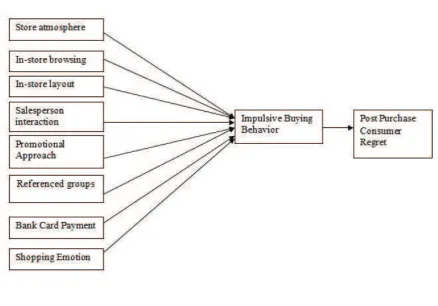
browsing, in-store layout, salesperson interaction, promotional approach, reference group, bank card payment and shopping emotion. Notably, to know whether impulse buying behavior affect the disappointment of consumers after making a purchase (post purchase consumer regret).
Some research results in a pleasant store atmosphere can encourage consumers to make purchases impulsively (Crawford & Melewar, 2003; Kaur & Singh, 2007). Furthermore, Mattila and Wirtz
(2008) observed that in-store environment consisting of background music played in-store, store
color, aroma in-store will give positive inluence to impulsive purchasing. Based on this hypothesis
can be written as follows:
H1: store atmosphere affects impulse buying behavior
Browse people often make more unplanned purchases than non-browsers and the more time for
in-store browsing can increase the chances of impulsive buying (Crawford & Melewar, 2003; Sam, Jeffrey, Yanliu, & Jacob, 2013). It is also revealed by Beatty & Ferrel (in Foroughi, Buang, Sherilou
positive inluence with impulse buying.
H2: in-store browsing affect impulse buying behavior
Meanwhile, lay out a comfortable store with a good image can increase shopping convenience which
can further affect the impulse buying behavior (Crawford & Melewar, 2003).
H3: Positive perceptions of in-store layout will affect impulse buying.
Yu and Bastin 2010 argue the praise, hospitality, and help provided by store employees can provide
positive emotions to consumers that can subsequently affect the impulse buying behavior.
H4: The interaction between salespersons and consumers will affect impulse buying
Wong and Zhou (2003) state that the price of the product affects impulse purchases. Consumers
tend to buy products at special prices, or if there are promotional activities (Dholakia, 2000). Harmanciouglu (2009) suggests that in order to promote impulse purchases and the desire to try new
products, marketers should make the consumer happy and the fun atmosphere in the promotional activities undertaken.
H5: Promotional approach will affect impulse buying
Positive word-of-mouth of the group referenced on a positive product may affect product evaluation
and individual buyer decision making, spontaneously convincing them to purchase unplanned items (Luo, 2004). Cho, Ching, & Luong, (2014). Harmancioglu (2009) suggests that in order to promote
impulse buying and willingness to try new products, marketers should emphasize excitement, fun and various promotional activities. Meanwhile, Mattila and Wirtz (2008) impulse buying can be
inluenced by the inluence of social factors such as the hospitality of shop employees and shopping
with others
H6: Shopping with friends or family (referenced groups) will affect the impulse buying behavior
This mode of payment mode can inluence purchasing decisions. Speciically paying cash hurts more
than paying with a credit card or debit card. Cash payments may limit impulsive responses and
thereby reduce purchases. While payments by credit card and debit card have a signiicant positive
impact on impulsive purchases. Consumers are more likely to make impulsive purchases when
paying by credit or debit card (Thomas, Desai and Seenivasan, 2011)
H7a: The use of credit cards affects impulse buying behavior H7b: The use of debit cards affects impulse buying behavior
Giraud (2001) saw a positive inluence between mood and impulse buying. Consumers with good
emotions tend to spend more irrationally or want to pamper themselves more impulsively. Chang, Eckman and Yan (2011) argue that consumers who have a more positive emotional response to the
retail environment are more likely to make impulsive purchases (Cho, Ching & Luong, 2014)
H8a: Positive mood effect on impulse buying behavior H8b: Negative mood effect on impulse buying behavior
Wood (1998) points out in many cases unplanned purchases cause regret and anger. Hoch &
purchasing decisions, lead to a sense of regret in post-purchase. A study proves an adverse relationship between impulsive purchases and post-purchase regret, in which impulsive buyers are less sorry than
the buyers who planned their purchase. Consumers unfamiliar with unplanned purchases feel more remorse than consumers who are used to this behavior (George and Yaoyuneyong, 2010). This result is
also evident in the Saleh (2012) study which states that impulsive buying affects post-purchase regret
H9: impulsive buying behavior affects post-purchase regret
Figure 1 Conceptual Framework
METODS
Testing the hypotheses proposed in the previous model involved developing and administering
a questionnaire to sample of consumers at convenience stores. Equally important, assessing the reliability of the scales employed, and conducting a path analysis model to examine impulse buying
behaviors among respondents.
Sampling procedure
Population for this study consists of the all consumers who have made purchases in the mini
market (convenience store) around Greater Jakarta on February 2015. Sampling technique used for the present study is a convenience sampling procedure. Self-administrated questionnaire was
distributed to the respondents. A total of 350 questionnaires were distributed to the respondents and 244 questionnaires were found to be useful with complete answers (response rate of about 69.7
Variables and Measurements
Store atmosphere is measured using three items adopted from Cho, Ching, and Luong (2014),
while the items are:
1. The pleasant store atmosphere makes me very happy to shop here
2. Music heard in this shop can make me calm 3. The aroma of this shop makes me comfortable
In-store Browsing is measured using three items adopted from Cho, Ching, and Luong (2014),
while the items are:
1. The more time available to shop, the more opportunities to buy more 2. The longer you walk in the store the more items I buy
3. The longer in the store, the more opportunities to buy additional products
In-store Layouts are measured using the four items adopted from Cho, Ching, and Luong (2014), while the items are:
1. Interior neatly arranged in this shop makes me comfortable shopping 2. Information and clear signs add convenience to shopping
3. Display of interesting products add my interest to buy
4. If this store is well organized, I want to spend a lot of time shopping
Salespersons are measured using the four items adopted from Cho, Ching, and Luong (2014),
while the items are:
1. The friendly and helpful shopkeeper positively inluenced me to make a decision to buy
2. The employee’s desire to communicate with consumers affected me in purchasing the product 3. Recommendations from employees affect my desire to buy
4. Friendly employees can make me decide to buy
Promotion is measured using the six items adopted from Cho, Ching, and Luong (2014), while the items of the statement are:
1. I would like to make a product purchase immediately upon promotion 2. Promo “buy 1 get 1 free” became my reason to buy the product
3. When there is a rebate I will make a purchase even if it is not planned 4. When there is an interesting offer, I will buy more
5. “Free gifts” became the reason for me to buy the product 6. I often buy products when there is a “sale”
Reference Groups were measured using three items adopted from Cho, Ching, and Luong
(2014), while the items are:
1. I feel more fun when shopping with friends
3. I sometimes buy more when I shop with family
Shopping Emotion is measured in two dimensions: positive emotion and negative emotion. Both
positive and negative emotions, each measured by three points of revelation developed by Cho, Ching, and Luong (2014) are:
Positive Emotion
1. Positive emotional state positively inluences my shopping behavior
2. I often buy more things than needed when the heart is happy
3. I often buy more than needed to reward myself for having work well-done
Negative Emotion
1. When you are gloomy, shopping is “cheer me up” solution
2. When your mood goes low, you often buy more than needed to lift your mood 3. You tend to buy more things than originally planned to lessen the stressfulness
Bank Card Payment is measured by several statements developed by Roberts & Jones (2001)
and Phau & Woo (2008), Bank Card Payment currently used is Debit Card and Credit Card 1. I often use credit cards when shopping at this store
2. By using a credit card I do not really pay attention to price 3. With a credit card makes me shop more often
4. Credit Cards inluence me not to pay attention to my shopping value
5. I often use debit cards when shopping at this store
6. Using a debit card I paid little attention to price 7. With a debit card makes me shop more often
8. The Debit Card affects me not to pay attention to my spending value
Impulse Buying Behavior is measured by six statements adopted from Cho, Ching, & Luong (2014) are as follows:
1. I often buy things spontaneously
2. It is irresistible to buy a seductive product
3. I do not think much when making purchases
4. When something is very attractive, I buy without concerning consequences
5. I often buy things which you did not intend
6. I often end up spending more money than you initially set out to spend
The Post Purchase Consumer Regret is measured by four items of statement adopted from Bui
(2011) as follows:
1. Sometimes I feel guilty after purchasing an unplanned product
2. I think that the planned purchase provides more beneits
3. I try to believe in myself that products purchased without a plan can be useful for me
The variables in the theoretical model were measured on ive point scales ranging from 1 = strongly disagree to 5 = strongly agree
Collection Techniques and Data Types
The technique used to collect data is ield-research is research conducted by collecting data
directly by approaching the respondents. While the data used in this research is the primary data
obtained directly from the respondents, by distributing questionnaires. Respondents are given a list of questions to be answered.
Respondents’ characteristic
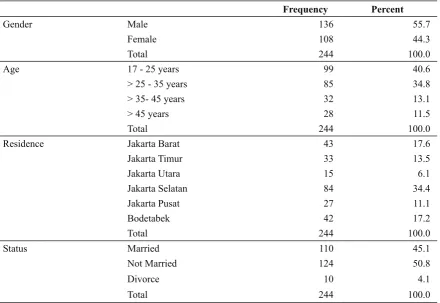
Based on the results of questionnaires, the characteristics of respondents are as follows:
Table 1 : Respondents Characteristics
RESULTS AND DISCUSSION
Characteristic of Respondents
Of the 300 questionnaires distributed only 244 respondents who answered so well that respondent
rate obtained was 81.33%. Based on the results of questionnaires obtained characteristics of the respondents as follows:
Table 1. Characteristic of Respondents
Frequency Percent
Gender Male 136 55.7
Female 108 44.3
Total 244 100.0
Age 17 - 25 years 99 40.6
> 25 - 35 years 85 34.8
> 35- 45 years 32 13.1
> 45 years 28 11.5
Total 244 100.0
Residence Jakarta Barat 43 17.6
Jakarta Timur 33 13.5
Jakarta Utara 15 6.1
Jakarta Selatan 84 34.4
Jakarta Pusat 27 11.1
Bodetabek 42 17.2
Total 244 100.0
Status Married 110 45.1
Not Married 124 50.8
Divorce 10 4.1
Education <= SMA 112 45.9
Academy - S1 116 47.5
Posgraduate 16 6.6
Total 244 100.0
Expenditure per month Rp 1 million - Rp 3 million 114 46.7 > Rp 3 million - Rp 5 million 75 30.7
The contents of the questionnaire are 55.7% of men and 44.3% of women with age around
17-25 years (40.6%) and> 17-25-35 years (34.8%). Most respondents live in South Jakarta (34.4%) and the rest are scattered throughout Greater Jakarta. The majority of their education is high school to
undergraduate degree, with monthly spending rate between Rp 1 - 3 million (46.7%) and> Rp 3 - 5 million (30.7%). Convenience Store that they often visit is Alfamart (45.1%) and Indomaret (32.8%).
The majority of respondents visited the store every week (42.2%).
Testing Research Instrument
Validity test
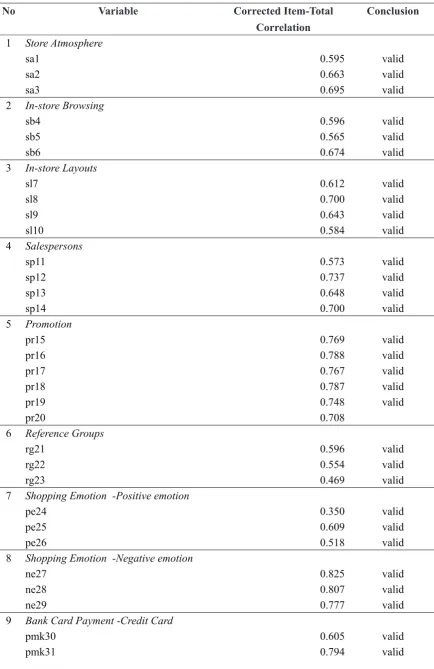
Validity testing is done to test how well an instrument is made to measure a particular concept
to be measured or in other words the validity is related to whether the researcher measures the right
concept (now, 2003). Validity test is done by inding correlation of each indicator to its total value
using Pearson Correlation Product Moment technique formula with SPSS version 22.0 software (in 2017, SPSS Version 24.0). The decision is taken by comparing the p-value of each statement variable
(a = 0.05). The basis of decision making validity test is as follows: if p-value <0,05 then statement
item can be said valid. If p-value> 0,05 then statement item can be said invalid. Correspondingly,
if doing a direct assessment of the correlation coeficient, we can use a minimum value limit of 30 correlation. According to Azwar (1999) all items that achieve a correlation coeficient of at least 0.30
Table 2. The Result of Validity Test
No Variable Corrected Item-Total
Correlation
Conclusion
1 Store Atmosphere
sa1 0.595 valid
sa2 0.663 valid
sa3 0.695 valid
2 In-store Browsing
sb4 0.596 valid
sb5 0.565 valid
sb6 0.674 valid
3 In-store Layouts
sl7 0.612 valid
sl8 0.700 valid
sl9 0.643 valid
sl10 0.584 valid
4 Salespersons
sp11 0.573 valid
sp12 0.737 valid
sp13 0.648 valid
sp14 0.700 valid
5 Promotion
pr15 0.769 valid
pr16 0.788 valid
pr17 0.767 valid
pr18 0.787 valid
pr19 0.748 valid
pr20 0.708
6 Reference Groups
rg21 0.596 valid
rg22 0.554 valid
rg23 0.469 valid
7 Shopping Emotion -Positive emotion
pe24 0.350 valid
pe25 0.609 valid
pe26 0.518 valid
8 Shopping Emotion -Negative emotion
ne27 0.825 valid
ne28 0.807 valid
ne29 0.777 valid
9 Bank Card Payment -Credit Card
pmk30 0.605 valid
No Variable Corrected Item-Total
Correlation
Conclusion
pmk32 0.745 valid
pmk33 0.716 valid
10 Bank Card Payment -Debit card
pmd34 0.584 valid
pmd35 0.824 valid
pmd36 0.763 valid
pmd37 0.789 valid
11 Impulse Buying Behavior
ib38 0.507 valid
ib39 0.527 valid
ib40 0.580 valid
ib41 0.624 valid
ib42 0.595 valid
ib43 0.383 valid
12 Post Purchase Consumer Regret
pp45 0.404 valid
pp47 0.404 valid
Based on the data obtained majority are all valid statement items, but there are 2 items on the variable Post Purchase Consumer Regret are not valid those are pp44 and pp46. Consequently, these
items cannot be included in subsequent data processing.
Reliability Test
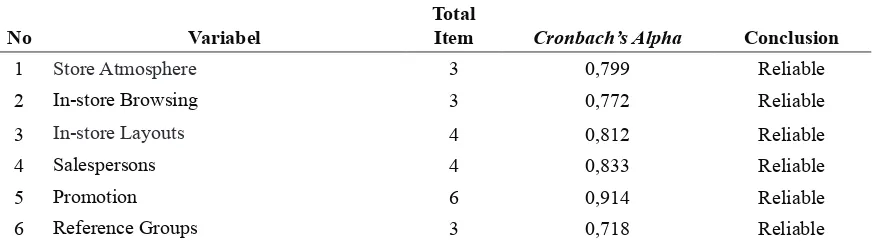
According Sekaran (2006), the basis of decision-making reliability test are as follows:
1. If the coeficient Cronbach’s Alpha > 0.6 then declared Cronbach’s Alpha acceptable (con -struct reliable).
2. If the coeficient Cronbach’s Alpha <0.6 then declared Cronbach’s Alpha poor acceptable
(contruct unreliable).
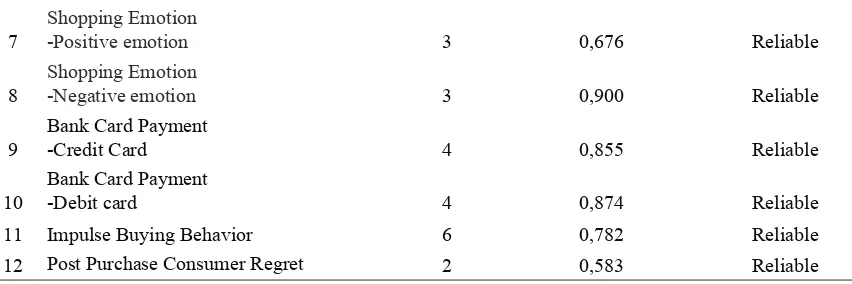
Validity and reliability were performed with software SPSS 22.0. The results of validity and reliability
test for each research variable are as follows:
Table 3. The Result of Reliability Test
No Variabel
Total
Item Cronbach’s Alpha Conclusion
1 Store Atmosphere 3 0,799 Reliable
2 In-store Browsing 3 0,772 Reliable
3 In-store Layouts 4 0,812 Reliable
4 Salespersons 4 0,833 Reliable
5 Promotion 6 0,914 Reliable
7
Shopping Emotion
-Positive emotion 3 0,676 Reliable
8
Shopping Emotion
-Negative emotion 3 0,900 Reliable
9
Bank Card Payment
-Credit Card 4 0,855 Reliable
10
Bank Card Payment
-Debit card 4 0,874 Reliable
11 Impulse Buying Behavior 6 0,782 Reliable
12 Post Purchase Consumer Regret 2 0,583 Reliable
Data Analysis Method
The analysis technique used in this research is Structural Equation Model (SEM) which is operated by AMOS program.According to Hair et al (2010), conformance testing the model goodness of it is done by looking at some measurement criteria as follows:
Table 4. Goodness of Fit Model Criteria
Measurement of
Good-ness-of-it Acceptance limitsRecommended Value Conclusion
Chi-square count X2 hit < X2 table (df=2668) 2366.990 Fit
P-valueChi-Square ≥ 0,05 0,000 Not Fit
CMIN/DF (Normed
chi-square) ≤ 3,0 2,420 Fit
RMSEA ≤ 0,08 0,076 Fit
TLI ≥ 0,90 0,753 Marginal Fit
CFI ≥ 0,90 0,786 Marginal Fit
NFI ≥ 0,90 0,689 Marginal Fit
From the results of the table above shows that with the approach of CMIN / DF (2,420), RMSEA
(0.076) and CFI (0.786) is an indicator of it and marginal it. It can be concluded that some indicators show the it and marginal model, so the theory hypothesis can be continued
Data Analysis
The test results on the hypothesis proposed in this study are summarized in table 5 below:
Table 5 : Results of Hypothesis Testing
Estimate S.E. C.R. P Explanation
Store Atmosphere Impulse Buying Behavior .138 .101 1.361 .174 Ha rejected
In-store Browsing Impulse Buying Behavior .098 .069 1.425 .154 Ha rejected
In-store Layouts
Estimate S.E. C.R. P Explanation
Salespersons Impulse Buying Behavior .341 .120 2.837 .005 Ha accepted
Promotion Impulse Buying Behavior .290 .078 3.731 *** Ha accepted
Reference Groups Impulse Buying Behavior .309 .126 2.448 .014 Ha accepted
Shopping Emotion
-Positive emotion Impulse Buying Behavior .051 .221 .229 .819 Ha rejected Shopping Emotion
-Negative emotion Impulse Buying Behavior .066 .062 1.055 .291 Ha rejected
Bank Card Payment
-Credit Card Impulse Buying Behavior .027 .074 .365 .715 Ha rejected Bank Card Payment
-Debit card Impulse Buying Behavior .303 .084 3.591 *** Ha accepted
Impulse Buying
Be-havior
Post Purchase Consumer
Regret .207 .067 3.073 .002 Ha accepted
As shown in Table V, the Results of Hypothesis Testing:
Hypothesis #1:
Based on the test results obtained signiicant value (p value) of 0.174 (p value > alpha 0,05). This
indicates that store atmosphere has no effect on impulse buying behavior. The results of this study
indicate that the store environment such as the atmosphere of a fun store, music in-store and store
smell do not have a signiicant effect on the behavior of impulse buying. The results of this study
are not in line with research conducted by some previous researchers such as Graa, Dani-Elkebir
and Bensaid (2014); Azim (2013) who found that the store’s atmosphere has a signiicant effect on
impulse buying behavior.
Hypothesis #2:
The results of research for hypothesis 2 show the value p = 0, 154 where the value is greater than
alpha 0.05, it can be interpreted In-store Browsing has no effect on impulse buying behavior.
That means more time is available to shop, the longer people are in the store does not lead toward impulse buying. The results of this study do not coincide with Lee’s previous research (in Nameghi
and Shadi, 2013) which show indings that emotions have a considerable inluence on green consumer
behavior.
Hypothesis #3:
The result of research shows that sig value 0,096 > 0,05, can be interpreted that in-store layouts have no effect to impulse buying behavior. Although store interiors are neatly arranged, attractive
product displays and clear store instructions in a convenience store do not cause people to make impulsive purchases.
Hypothesis #4:
rejected. These results can be interpreted that the sales person can affect the impulse buying behavior. A friendly shopkeeper and able to communicate well with customers can increase the customer’s
interest in impulse buying.
Hypothesis #5:
The result of the research shows that sig 0,000 < 0,05 indicates that promotion by convenience
store has an effect on impulse buying behavior. Promotions such as “buy one get one, free gift, or discounted price” can increase consumer interest to buy product that is not planned before.
Hypothesis #6:
The result of this research shows that sig value 0,014 < 0,05 means that reference group inluence to impulse buying behavior. Consumers who shop with friends or family will inluence purchases
impulsively. These results support the results of previous studies conducted by Cho, Ching & Luong (2014).
Hypothesis #7:
Research on the effect of payment system used in retail stores, either by credit card or debit card to impulse buying behavior is made in two hypotheses that result as follows:
Based on the results obtained for the hypothesis 7a obtained a signiicant value of 0.715 (> 0.05),
which indicates that the use of credit cards does not affect the behavior of impulse buying. As for the
payment using debit card (Hypothesis 7b) obtained a signiicance value of 0.000 (< 0.05). Altogether,
these results indicate that payments by debit card can affect the impulse buying behavior of 0.303.
On the contrary, the results of this study do not support the results of previous research conducted by Thomas, Desai, Seenivasan (2010) which states that both credit and debit cards have a positive and
signiicant impact on impulsive purchases. Henceforth, these are results indicating that the consumer
will make an impulsive purchase if payment can be made by credit card and debit card.
Hypothesis #8:
The results of the research for hypothesis 8a show sig value 0.819 > 0.05 which shows that positive shopping emotion has no effect on impulse buying behavior. Furthermore, for hypothesis 8b
got the sig value of 0.291 > 0.05 means negative shopping emotion has no effect on impulse buying
behavior. Given these points, consumer’s impulsive buying behavior at minimarket is not inluenced
by shopping emotion either positive shopping emotion or negative shopping emotion.
The results of this study do not entirely support the results of previous research conducted by
Cho, Ching & Luong (2014). Based on the results of this study positive emotions have a positive
inluence on the purchase of unplanned products (Chang et al., 2011), but negative emotion has no
effect on impulse buying behavior.
Hypothesis #9:
indicating that Impulse buying behavior affects the Post Purchase Consumer Regret of 0.207. These results show that consumers feel sorry when they purchase unplanned products. The higher the
impulse buying behavior the higher the post purchase consumer regret. The results of this study are in line with previous research conducted by Saleh (2012) from the results of his research indicates
that unplanned purchases have a positive effect on Post-Purchase Regret.
CONCLUSIONS
This study discusses the variables that can affect consumers to make purchases in impulsive or
purchases that are not planned before. As has been noted, to know whether impulse buying behavior affect the disappointment of consumers after making a purchase (post purchase consumer regret).
From the results of the study found that there are four variables that affect the impulse buying behavior, namely the role of salesperson, there are sales promotions, the participation of reference
groups and payments made by debit card. These four variables give as much as the same effect, the existence of a salesperson or shopkeeper who can be friendly who can communicate and help
consumers can inluence impulsive purchases.
Some other variables tested do not show a signiicant effect on impulsive buying behavior is store
atmosphere, in store browsing, emotional level or shopping emotion either positive or negative
emotion and payment by using credit card. This is possible because the research is done at convenience stores where consumers only shop for daily needs in a handful number by and large. Consumers do
not take long in shopping so do not pay too much attention to the atmosphere of the store. From the results of the study also found that consumers disappointed after making an impulsive purchase.
Managerial Implications
The results of this study have important implications for specialized companies in the convenience
store. Consumers will be encouraged to make an impulsive purchase if the sales person can be friendly and ready to help the consumer if needed. The readiness and friendliness of employees
in serving consumers can occur when companies often provide training to employees. Employees are also enforced well and put into effect reward and punishment system that can increase work
motivation.
On balance, reference groups or reference groups have an effect on impulsive buying behavior.
The tendency of consumers to shop more is high when accompanied with a mutual friend. Reference
groups can also mean people who are inluential in purchasing a product. In addition to sales person
and reference group, promotions made by the store can also attract consumers and encourage them to make purchases impulsively.
Additional value that can encourage the purchase of impulsive payment system is by using a debit card and not with a credit card. It is interesting to note, at the convenience store consumers do
not make purchases in large quantities so payment using credit card does not give a signiicant effect
Other research results show consumers regret after making an impulsive purchase. The negative consequence of consumer disappointment is that consumers become disloyal even spreading negative
word of mouth. Henceforth, the company needs to consider the factors that can reduce consumer disappointment.
Limitations and Suggestions for Future Research
This research is only done at the convenience store in Greater Jakarta so that the result only applies to the object under study and cannot be generalized. The variables studied are also only some
that affect impulse buying behavior and post purchase stage. For further research it is necessary to examine the variables that affect the post purchase so that consumers can reduce consumer disappointment.
REFERENCES
Azim, Ahsan. (2013). “Effect of Dynamic Environment, Customers’ Tendency towards Promotion & New Experiences on Impulse Buying”. Management and Administrative Sciences Review Sciences Review, Vol.@, Issue, 3 Pp 291-292
Banerjee, Sonali; Sunetra Saha, 2012. “Impulse Buying Behaviour in Retail Stores – Triggering The Senses,Asia Paciic Journal Of Marketing & Management Review Vol.1 No. 2, October 2012
Baumeister, R. F. (2002). “Yielding to temptation: Self-control failure, impulsive purchasing, and consumer behavior”. Journal of Consumer Research, 28(4), 670-676. http://dx.doi. org/10.1086/338209
Beatty, S.E. & Ferrell, M.E. (1998). “Impulse buying: modeling its precursors”, Journal of Retailing, 74, 169-191.
Bui, My; Anjala S. Krishen; Kenneth Bates, 2011, “Modeling regret effects on consumer post-Purchasedecisions”, European Journal of Marketing Vol. 45 No. 7/8, 2011 pp. 1068-1090
Bushra, Aliya (2014), “The Relationship of Compulsive Buying with Consumer Culture and Post-PurchaseRegret”, Pakistan Journal of Commerce and Social Sciences 2014, Vol. 8 (3),
590-611
Chang, H.-J., Eckman, M., & Yan, R-N. (2011). “Application of the Stimulus-Organism-Response
model to the retail environment: the role of hedonic motivation in impulse buying behavior”. The International Review of Retail, Distribution and Consumer Research, 21(3), 233-249 Choudhary , Shweta (2014).“Study of Impulse Buying Behavior of Consumers”,International Journal ofAdvance Research in Computer Science and Management Studies Volume 2, Issue 9,
September 2014 pg. 1-4
Cho, J., Ching, G. S., & Luong, T.-H.(2014), “Impulse buying behavior of Vietnamese consumers in supermarket setting”, International Journal of Research Studies in Management2014 October, Volume 3 Number 2, 33-50
international airport environment”. Journal of Consumer Behavior, 3(1), 85-98. http:// dx.doi.org/10.1002/cb.124
Donovan, R. J.; Rossiter, J.R. (1982):“Store Atmosphere: An Environmental Psychology Approach”. Journal of Retailing, 58(1), pp. 34-58.
Donovan, R. J., Rossiter, J. R., Marcoolyn, G., & Nesdale, A. (1994). “Store atmosphere and Purchasingbehavior”. Journal of retailing, 70(3), 283-294.
http://dx.doi.org/10.1016/0022-4359(94)90037-X
Dawson, S., & Kim, M. (2009). “External and internal trigger cues of impulse buying online”.
DirectMarketing: An International Journal
, 3(1), 20-34. http://dx.doi.
org/10.1108/17505930910945714
Foroughi. Amir; Nor Aishah Buang, Zizah Che Senik, Reihaneh Sadat Hajmirsadeghi & Mehdi
MohamadBagheri, “The Causes of Impulse Buying Behavior among Iranian Shoppers”, Asian Social Science; Vol. 10, No. 21; 2014
Forney, Judith C and Eun Joo Park,Browsing Perspectives for Impulse Buying Behavior of CollegeStudents
Gardner, P. M. (1985): “Mood States and Consumer Behavior: A Critical Review”. Journal of ConsumerResearch, 12(3), pp. 281
Ghani, U., Imran, M. and Jan, F. A. 2011. “The Impact of Demographic Characteristics on Impulse
Buying Behaviour of Urban Consumers in Peshawar International Journal of Academic Research”, 3 (5): 286-289
Graa,Amel ; Maachou Dani-Elkebir, And Mohamed Bensaid (2014), “The impact of Environmental FactorsonImpulse Buying Behavior Using the Mehrabian and Russell’s Framework”, Leonardo Journal of Sciences, Issue 24, January-June 2014 p. 101-114
Holbrook, M. B. and Anand, P. (1990). “Effects of Tempo on Responses to Music”. Psychology of
Music, 18,150- 162
Hausman, A. (2000).“A multi-method investigation of consumer motivations in impulse buying
Behavior”.Journal of Consumer Marketing, 17: 403-419.
Karbasivar, Alireza and Hasti Yarahmadi (2011), “Evaluating Effective Factors on Consumer Impulse Buying Behavior”,Asian Journal of Business Management Studies 2 (4): 174-181, 2011 Leith, K.P., & Baumeister, R.F. (1996). “Why do bad moods increase self-defeating behaviour?
Emotion, risk and self-regulation”. Journal of Personality and Social Psychology, 71, 1250– 1267.
Lee, Seung Hwan; June Cotte, 2009, Post-Purchase Consumer Regret: Conceptualization and Development of the PPCR Scale Advances in Consumer Research Volume 36,
Lee, G. Y., & Yi, Y. (2008). “The effect of Shopping Emotions and Perceived Risk on Impulsive Buying: The Moderating role of Impulsiveness trait”. Seoul Journal of Business, 14(2),
67-92.
Luo, X. (2005). “How does shopping with others inluence impulsive purchasing?”Journal of Consumer Psychology, 15(A), 288-294.
Behavior”InternationalJournal of Marketing Studies; Vol. 5, No. 3; 2013
Mattila, A. S., & Wirtz, J. (2008). “The role of store environmental stimulation and social factors on impulse purchasing”. Journal of Services Marketing, 22(7), 562-567. http://dx.doi. org/10.1108/08876040810909686
Majalah Marketing, Edisi Mei 2014
Park,Eun Joo (2009)tafcs.org/wp-content/uploads/2014/02/ResearchJournal2009.pdf
Park, E. J., Kim, E. Y., & Forney, J. C. (2005). “A structural model of fashion-oriented impulse buying behavior”. Journal of Fashion Marketing and Management, 10(4), 433-446.
Piron, F. (1991). “Deining Impulse Purchasing, Advances in Consumer Research”, 18: 509-514.
Pirog III, S. F., & Roberts, J. A. (2007). “Personality and Credit Card Misuse among College Students: The Mediating Role of Impulsiveness”. Journal of Marketing Theory and Practice, 15(1),
65-77. http://dx.doi.org/10.2753/MTP1069-6679150105
Rook, D. W. (1987). “The buying impulse”. Journal of Consumer Research, 14(2), 189-197. http://
dx.doi.org/10.1086/209105
Rook, W. D.; Gardner, M. P. (1993): “In the Mood: Impulse Buyings’ Affective Antecedents, in
JaneenArnold-Costa and Russell W. Belk (Eds.)’. Research in Consumer Behavior, 6, Greenwich, CT: JAI Press, pp. 1-28, 1993
Saleh, Mahmoud Abdel Hamid, (2012). An Investigation of the Relationship between Unplanned Buying and Post-purchase Regret International Journal of Marketing Studies; Vol. 4, No. 4;
2012
Sam K. Hui, J. Jeffrey Inman, Yanliu Huang, Jacob Suher (2013),“The Effect of In-Store Travel Distance on Unplanned Spending: Applications to Mobile Promotion Strategies”. Journal of Marketing: March 2013, Vol. 77, No. 2, pp. 1-16.
Saraswat Rekha, Gyan Prakash Review Of Literature On Factor Affecting Impulse Buying Behavior Of Consumers, 4D Journal of Technology and Science @4D Crossconnect.com, Inc, 2012
www.4dinternationaljournal.com Vol.1, Issue1, 2013
Scaraboto, C. A.V. Rossi, D. Costa (2012),“How Consumers Persuade Each Other: Rhetorical
Strategies of Interpersonal Inluence IN Online Communities”, BRAZILIAN Administration Review, Rio de Janeiro, v. 9, n. 3, art. 1, pp.246-267 July/Sept. 2012
Sharma, P., Sivakumaran, B., & Marshall, R. (2010). “Impulse buying and Variety seeking: A trait-correlates perspective”. Journal of Business Research, 63, 276-283. http://dx.doi.org/10.1016/j.
jbusres.2009.03.013
Shojaei,Mohammad Reza; Arshia Shahlaei, Sima Torabi, Mohammad Reza Ghaedi “Investigating
the Effective Factors on Impulse Buying European Journal of Business and Management”, Vol.6, No.11, 2014
Singh, Priyanka;Neha Katiyar, Gaurav Verma, (2014)“Retail Shoppability: The Impact Of Store Atmospherics & Store Layout On Consumer Buying Patterns International”, Journal Of Scientiic & Technology Research Volume 3, ISSUE 8, August 2014
Behaviour Of Consumers At Malls (Delhi)”, International Journal of Research and Development - A Management Review (IJRDMR) Volume-2, Issue – 2, 2013
Tinne, Wahida Shahan, 2010. “Impulse Purchasing: A Literature Overview”,ASA University Review, Vol. 4No. 2, July–December 2010
Tinne, Wahida Shahan (2011),“Factors Affecting Impulse Buying Behavior of Consumers at Superstores in Bangladesh”, ASA University Review, Vol. 5 No. 1, January–June, 2011
Thomas, Manoj;“Kalpesh Kaushik Desai, Satheeshkumar SeenivasanHow Credit Card Payments Increase Unhealthy Food Purchases: Visceral Regulation of Vices”, Journal of Consumer Research, Vol. 38, June 2011
Verplanken, B., Herabadi, A.G., Perry, J.A. & Silvera D.H. (2005). “Consumer style and health: The
role oimpulsive buying in unhealthy eating”. Psychology and Health, No.20 (4), 429–441
Virvilaitė. Regina , Violeta Saladienė , Jūratė Žvinklytė, “The Impact Of External And Internal
Stimuli On Impulsive Purchasing, Economics And Management”: 2011. 16
Xu, Y. (2007). “Impact of store environment on adult generation Y consumers’ impulse buying”. Journal of Shopping Center Research, 14(1), 39-56.
Yang , Dong-Jenn; Kuang Chuan Huang and Xuanxiaoqing Feng, 2011,“A Study of the Factors that Affectthe Impulsive Cosmetics Buying of Female Consumers in Kaohsiung”, International Journal of Business and Social Science, Vol. 2 No. 24 [Special Issue – December 2011
Ying-Ping Liang, (2012),The Relationship between Consumer Product Involvement,
ProductKnowledge and Impulsive Buying Behavior/Procedia - Social and Behavioral Sciences 57 ( 2012 ) 325 – 330
Yu, C., & Bastin, M. (2010). “Hedonic shopping value and impulse buying behavior in
transitional economies: A symbiosis in the Mainland China marketplace”. Journal of Brand Management, 18(2), 105-114. http://dx.doi.org/10.1057/bm.2010.32
Zhou, L., & Wong, A. (2004). “Consumer impulse buying and in-store stimuli in Chinese
Supermarkets”.Journal of International Consumer Marketing, 16(2), 37-53. http://dx.doi. org/10.1300/J046v16n02_03
http://swa.co.id/business-strategy/inilah-jurus-menggarap-kelas-menengah.
http://bisnis.liputan6.com/read/813277/penduduk-indonesia-paling-doyan-belanja-di-dunia#sthash.
nJPj4ztg.dpuf.
http://swa.co.id/business-research/bcg-pertumbuhan-kelas-menengah-atas-indonesia-meluas-ke-daerah.
http://www.bankmandiri.co.id/indonesia/eriview-pdf/OJHH51192704.pdf
http://www.tempo.co/read/news/2011/06/21/090342265/Pembelanja-Indonesia-Makin-Impulsif