Marine natural products: A lead for Anti-cancer
Sarfaraj Hussain Md.1*, Sheeba Fareed1, Saba Ansari1 & Mohd. Sajid khan2
1
Faculty of Pharmacy, Integral University, Lucknow-226026. India 2
Department of Biotechnology, Integral University, Lucknow-226026. India *[Email: [email protected]]
Received 21 August 2010; revised 7 January 2011
Various active anticancer agents are derived from plants and terrestrial microorganisms. Isolation of C-nucleosides from the Caribbean sponge, Cryptotheca crypta, four decades ago, provided the basis for the synthesis of cytarabine, the first marine derived anticancer agent to be developed for clinical use. Cytarabine is currently used in the routine treatment of patients with leukaemia and lymphoma. Gemcitabine, one of its fluorinated derivatives, has also been approved for use in patients with pancreatic, breast, bladder, and non-small-cell lung cancer. Over the past decade, several new experimental anticancer agents derived from marine sources have entered preclinical and clinical trials. Present study address anticancer drug discovery from an evolutionary perspective and present a series of case studies that demonstrate that the rate of anticancer drug discovery can be increased greatly by targeted screening of natural compounds from marine sources. [Keywords: Marine natural products, didemnin B, Dolastatin, Bryostatin1,Kahalalide F]
Introduction
Marine environment is an exceptional reservoir of bioactive natural products, many of which exhibit structural/chemical features not found in terrestrial natural products1. Marine organisms have evolved biochemical and physiological mechanisms that include the production of bioactive compounds for such purposes as reproduction, communication, and protection against predation, infection and competition2. Because of the physical and chemical conditions in the marine environment, almost every class of marine organism exhibits a variety of molecules with unique structural features. The oceans covers over 70% of the earth’s surface and 95% of its tropical biosphere represents 34 of the 36 phyla contain an extraordinary diversity of life3-6. Our interest in understanding the function of marine ecosystems has been accelerated in recent years with growing recognition of their importance in human life7-9. Cancer is a growing public problem whose estimated worldwide new incidence is about 6 million cases per year.
A large number of plant, marine, and microbial sources have been tested as leads, and many
compounds have survived the potential leads10. Marine organisms comprise approximately half of the total biodiversity on the earth and the marine ecosystem is the greatest source to discover useful therapeutics4,11-12 Sessile marine invertebrates such as sponges, bryozoans, tunicates, mostly lacking morphological defence structures have developed the largest number of marine-derived secondary metabolites including some of the most interesting drug candidates13-16. In recent years, a significant number of novel metabolites with potent pharmacological properties have been discovered from the marine organisms. Although there are only few marine-derived products currently in the market, several marine natural products are now in the clinical pipeline, with more undergoing development17-18. The development of molecular biology field and recent progress of new technologies such as genetic engineering and bioactivity screening offer a unique opportunity to establish marine natural products as drug leads19-21.
There are several examples of recent advances in the application of above technologies to the discovery and development of novel drugs from marine origin. In this review we have focused on the pharmacologically active marine natural products that have been shown to have biological activity, including cytotoxic, anti-cancer activity and
___________ *Corresponding author
INDIAN J. MAR. SCI., VOL. 41, NO. 1, FEBRUARY 2012
28
antitopoisomerase-I activity, along with in vivo
activity when available.
Marine natural products and drug discovery
Unlike the long-standing historical medical uses of terrestrial plants, marine organisms have a shorter history of utilization in the treatment and/or prevention of human disease.
Among the first bioactive compounds from marine sources, spongouridine and spongothymidine from the Caribbean sponge (Cryptotheca crypta), were isolated serendipitously in the early 1950s22. They were approved as an anticancer drug (cytosine arabinoside, Ara-C) and an antiviral drug (adenine arabinoside, Ara-A), respectively, 15 years later23. However, it was only in middle of the 20th century that scientists began to systematically probe oceans for medicines. So far, more than 10,000 bioactive molecules have been discovered from marine sources, with hundreds of new compounds still being discovered every year24. However, in marine environment, this leading position is taken by invertebrates such as sponges, molluscs, bryozoans, tunicates, etc. They not only produce a great number of marine natural products currently known but also show the largest chemical diversity of natural products, including alkaloids, peptides, terpenes, polyketides, etc. Interestingly, out of 13 marine natural products (or analogues derived from them) that are currently in clinical trials as new drug candidates, 12 are derived from invertebrates25. Consider the fact that many marine organisms have soft bodies and lead a sedentary lifestyle, making a chemical system of defense almost essential for survival. Marine organisms have evolved the ability to synthesize such toxic compounds or extract or convert pertinent compounds from other marine microorganisms. Natural products from marine organisms are released into the water and therefore are rapidly diluted; accordingly they must be very potent materials to have the desired end effect. The richly available marine biodiversity that is available to us has to this point only been explored to an extremely limited extent. Furthermore, the primary chemical diversity available from marine organisms is most likely capable of delivering an even greater abundance of secondary metabolites for research use. Drug discovery research from marine organisms has been accelerating and now involves interdisciplinary research including biochemistry, biology, ecology, organic chemistry, and pharmacology26-27. For all of
these reasons it is believed that the natural products that are available from the seas and oceans provide a tremendous opportunity for the discovery of novel therapeutic agents28.
Marine organism derived anticancer agents
In the past 30-40 years, marine plants and animals have been the focus of a worldwide effort to define the natural products of the marine environment. A small number of marine plants, animals, and microbes have already yielded more than 12000 novel chemicals, with hundreds of new compounds still being discovered every year. These discovery efforts have yielded several bioactive metabolites that have been successfully developed by the pharmaceutical industry28-29. Several clinically useful drugs, investigational drug candidates, and pharmacological tools have already resulted from these marine-product discovery programmes. One of the marine natural products that is currently under clinical investigation as a potential new anticancer agents is the marine alkaloid ecteinascidin-743, isolated from the tunicate
Ecteinascidia turbinate. Ecteinascidin is a
multiple tumor types42-44. Most of these compounds were identified during the 1980s following great improvements in deep-sea sample collection and in technologies that allowed the production of drugs on a large scale through aquaculture and synthesis45. Overall, more than 3000 new substances have been identified from marine organisms during the past three decades, demonstrating the great potential of the sea as a source of novel chemical classes46-48. To date, researchers have isolated approximately 7000 marine natural products, 25 percent of which are from algae, 33 percent from sponges, 18 percent from coelenterates (sea whips, sea fans and soft corals), and 24 percent from representatives of other invertebrate phyla such as ascidians (also called tunicates), opisthobranch molluscs (nudibranchs, sea hares etc), echinoderms (starfish, sea cucumbers etc) and bryozoans (moss animals). A simplistic analysis of these data reveals that as the search for “Drugs from the Sea” progresses at the rate of a 10 percent increase
in new compounds per year, researchers are concentrating their efforts on slow-moving or sessile invertebrate phyla that have soft bodies, and lack of spines or a shell, i.e. animals that require a chemical defence mechanism40,49-51. The first anticancer product derived from marine sources to enter clinical trials was didemnin B, a cyclic depsipeptide isolated from the tunicate Trididemnum solidum46.
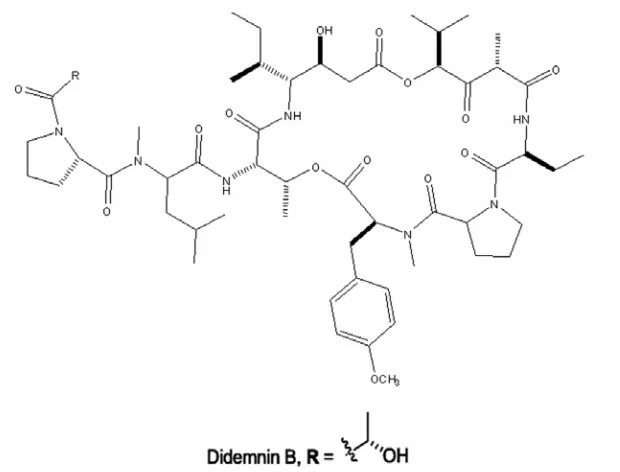
Didemnin B (Fig. 1)
Our first compound is a didemnins are cyclic depsipeptide compounds isolated from a tunicate (sea-squirt) of the genus Trididemnum (family of Didemnidæ) that were collected in the Caribbean Sea52,53. They were first isolated in 1978 at the University of Illinois Fig. 1. Although more than nine didemnins (Didemnins A-E, G, X and Y) have been isolated from the extract of Trididemnum solidum, Didemnin B is the one that possesses the most potent biological activities54. Mechanistically, didemnin B
Table 1—Marine Natural Products with established mechanism of action
Organism Compound Chemistry Mechanism of action References
Sponge Aaptamine Alkaloid Induction of p21 gene and G2/M cell cycle arrest 104 Sponge Agosterol A Steroid Azido agosterol A binding to MRP1 abolished by
ICL5 and ICL7 domain mutations
105 Sponge Alkylpyridinim salts Alkaloid Induction of apoptosis and reduced cell adhesion 106 Ascidian Ascididemin Alkaloid Enhanced binding to telomeric DNA quadruplex 107 Sea hare Aplyronine A Macrolide Binding to hydrophobic cleft in actin molecule
involving trimethylserine moiety
108 Ascidian Aplidine Depsipeptide Oxidation and inactivation of low molecular
weight-protein tyrosine phosphatase activity
109 Bryozoan Bryostatin-1 Macrolide Apoptosis induction enhanced by PKCe
overexpression
110 Sponge Bastadin 6 Alkaloid Inhibition of angiogenesis in vitro and in vivo involves
apoptosis
111 Ascidian Bistramide A Polyketide Depolymerisation of F-actin, inhibition of G-actin
polymerisation, binding to actin subdomains 1 and 3
112, 113 Soft coral Bromovulone III Prostanoid Apoptosis and endoplasmic reticulum stress, activation
of caspase-12
114 Tube worm Cephalostatin 1 Steroid Bcl-2 hyperphosphorylation independent of M-phase
arrest and DNA damage
115 Sponge Cortistatin A Alkaloid Selective inhibition of angiogenesis 116 Sponge Dictyostatin-1 Macrolide Tubulin binding, taxoid site binding and
antiproliferative effects comparable to discodermolide
117 Sponge Discodermolide Polyketide Binding to amino acid residues 305-359 in the S9-S10
loop in b-tubulin
118 Ascidian Ecteinascidin-743 Isoquinoline alkaloid Cell cycle promoters are selectively affected 119 Ascidian Fucoxanthinol Carotenoid Induction of apoptosis and decrease in Bcl-2 protein 120
Mollusk Kahalalide F Depsipeptide ErbB3 protein and PI3K-Akt pathway involved in necrosis induction
121, 122 Sponge Onnamide A Polyketide Protein synthesis inhibition, activation of
stress-activated protein kinases and apoptosis
123, 124 Sponge Peloruside A Macrolide Synergistic effect with taxoid site drugs but not with
laulimalide
INDIAN J. MAR. SCI., VOL. 41, NO. 1, FEBRUARY 2012
30
acts at the GTP-binding protein elongation factor55. This compound, though, is too toxic to be useful as antiviral or immunosuppressive agent; it has been in Phase I clinical trials as an anticancer agent. Phase II clinical trials are underway56-57. A close relative of didemnin B-dehydrodidemnin B, isolated from a Mediterranean tunicate Aplidium albicans, is currently in Phase II studies in the United States and Europe, to determine its anticancer properties50.
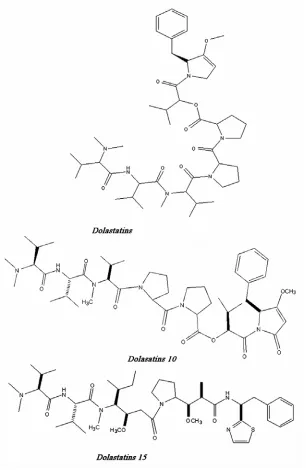
Dolastatins (Fig. 2)
Dolastatins are peptides isolated from the Indian Ocean sea hare, Dolabella auricularia. Among the dolastatin family, the linear peptide dolastatin 10 and the desipeptide dolastatin 15 exhibit the most promising antiproliferative actions58. Dolastatin 10 is a pentapeptide with four of the residues being structurally unique (dolavaline, dolaisoleucine, dolaproline, and dolaphenine, in addition to valine) Fig. 2. Interestingly, at the time of its discovery, it was the most potent antiproliferative agent. Dolastatin 10 is in Phase I clinical trials as anticancer agent for use in the treatment of breast and liver cancers, solid tumours and leukemia59. Dolastatins 10 and 15 are small peptides; dolastatin 10 was selected for clinical trials because of its more favourable preclinical profile60-61. It inhibits microtubule assembly, causing cells to accumulate in metaphase and is extremely potent in vitro62-63. Dolastatin 10 caused bone-marrow toxicity in initial clinical trials, as well as local
irritation at the injection site and mild peripheral neuropathy64-65. Dolastatin 15, a seven-subunit depsipeptide derived from Dolabella auricularia, is a potent antimitotic agent structurally related to the antitubulin agent dolastatin 10, a five-subunit peptide isolated from extracts of the Indian Ocean sea hare D. auricularia. Indeed, numerous dolastatin 15-related peptides have been isolated from diverse marine cyanobacteria65. Its linear depsipeptide sequence is composed of seven amino acid or hydroxyl acid residues.
Bryostatin 1 (Fig. 3)
The Bryostatins are macrocyclic lactones isolated from the marine bryozoan Bugula neritina
(Bugulidae) and found to possess both antineoplastic and immunopotentiating properties. Bryostatin 1 is one of the most abundant and best studied compounds of this series40,66. It was originally described on the basis of inhibiting growth in murine P388 lymphocytic leukemia cells at subnanomolar concentrations. A range of properties have subsequently been described including activation of T-cells, immunomodulation and stimulation of haematopoietic progenitor cells. However,only many years after its discovery was the molecular site of action of this compound identified. Bryostatin 1 was found to bind to protein kinase C with high affinity, which may be the mechanistic basis for both observed anticancer and immunostimulating properties Fig. 3.
Bryostatin 1 may be used in tandem with cancer treatments that respond to taxol, such as breast, ovarian and lung cancers. It modulates the activity of protein kinase C (PKC), lacks tumour-promoting activity and shows differentiationinducing effects in various in vitro and in vivo models57,67-68. It also has immunomodulatory properties, including the induction of cytokine release and expansion of tumourspecific lymphocyte populations69-70. Bryostatin 1 has shown antitumour activity in phase I trials in patients with malignant melanoma,
lymphoma, and ovarian carcinoma and is undergoing broad phase II evaluation. The main toxic effects in initial clinical trials were myalgia, local phlebitis, fatigue, nausea and vomiting, and thrombocytopenia. Bryostatin 1 showed no significant objective antitumour activity in phase I and II trials in patients with advanced solid tumours, including renal-cell and non-small-cell lung cancer, and malignant melanoma46,72-75. However, it was shown to induce cell differentiation in patients with refractory chronic lymphocytic leukaemia.
INDIAN J. MAR. SCI., VOL. 41, NO. 1, FEBRUARY 2012
32
Khalalide F (Fig. 4)
Kahalalide F (KF) is one of a family of dehydroaminobutyric acid-containing peptides derived from the marine mollusc Elysia rufescens., a marine mollusc found in Hawaii. This mollusc is able to sequester chloroplasts from an alga to participate in the synthesis of secondary metabolites76-79. The green algae Bryopsis sp. also produces some of Kahalalide peptides in smaller yields. The structure of KF (Fig. 4) contains a lateral chain and a cycled region with the molecular formula C75H124N14O16. KF is the
largest and most active of the seven natural compounds isolated from E. rufescens. Six cyclic (peptides A-F) and one acyclic analogue (peptide G) are known80. KF displays both in vitro and in vivo
antitumor activity in various solid tumor models, including colon, breast, non–small cell lung, and in particular prostate cancer81. Studies to determine the mechanism of action of Kahalaide F showed that, in certain experimental systems, it caused a disruption of lysosomal membranes and consequently the formation of large vacuoles. This mechanism is unique among anticancer agents and may cause increasing acidification of the intra-cellular space, a stimulatory event that initiates a pathway for apoptosis79. In addition, Kahalaide F leads to an inhibition of
erb 2 transmembrane tyrosine kinase activity and inhibits TGF-a gene expression. The pattern of Kahalaide F cytotoxicity was distinct from any of the other standard chemotherapeutic agents. Kahalaide F showed in vitro and in vivo selectivity for prostate-derived cell lines and tumours. It is further selective for hormone-independent prostate tumour cells, which generally represent the more aggressive and harder to
treat type of prostate cancer. Phase-I clinical trials in patients with androgen-independent prostate cancer have begun.
Manzamine (Fig. 5)
Manzamine A, a beta-carboline alkaloid present in several marine sponge species, has potent anti-inflammatory activity, antifungal, anti-HIV-I activities with moderate antitumour activity80-81 Fig. 5. Manzamine also exhibited insecticidal activity towards neonate larvae of the polyphagouspset insects
Spodopteralittoralis with an Ed50 35 ppm in a chronic
feeding bioassay. It was also found to be active against the Gram-positive bacteria Bacillus subtillis
and Staphylococcus aureus. The anti-malarial effect
of manzamine A was due to inhibition of the growth of the rodent malaria parasite Plasmodium berghei
in vivo82. Several new derivatives of manzamine A
have been isolated from indo-pacific sponges with similar or improved biological activity83-84. Oral and intravenous pharmacokinetic studies of manzamine A derivatives in rats indicated that they have low metabolic clearance, a reasonably long pharmacokinetic half life, and good absolute oral bioavailability which make them as potential leads for preclinical assessment. In addition, 8-hydroxymanzamine A, isolated from an undescribed sponge, Pachypellina species exhibited moderate antitumour and anti HSV-II activity. Further (-) 8-hydroxymanzamine A was also found to be a promosing new anti-malarial agent85.
Fig. 3–Chemical structure of bryostatin 1
Future prospects of marine natural products as anti-cancer
In the future, marine natural products will remain as important sources of new drugs and lead structures. Nature has supplied several active anticancer agents (eg the vinca alkaloids-vincristine, vinblastine, anthracyclines, epipodophyllotoxins, and taxanes), which have significantly improved the management of many types of human cancers86-90. These
marine-derived compounds are extremely potent in culture, with inhibitory concentrations generally in the nanogram range67. Traditionally, among the first options to be explored for the supply of marine-derived small molecules is chemical synthesis. Unfortunately, the structural complexity of marine molecules Figs 6 & 7, which suggests novel mechanisms of action and high selectivity, has also resulted in few economically feasible strategies for total chemical synthesis. The successful example of the synthetic production of a marine-product drug in unlimited quantities is the conus toxin ziconotide, because of its peptide nature91-92. The aquaculture of the source organisms, including sponges, tunicates, and bryozoans, with the aim of securing a steady supply of drug product, has progressed notably in cancer applications, although in most cases the biomass currently generated is still far short of those required should a marine-based drug finally enter the market93. Furthermore, the cultivation of invertebrates in their natural environment is subject to several uncertainties, such as destruction by storms or disease. An intriguing strategy has been to identify the true producers of bioactive compounds to find out whether or not they are of microbial origin, based on the fact that most if not all of the marine invertebrates harbour large communities of microorganisms, including bacteria, cyanobacteria, and fungi within their tissues94. Many studies have successfully provided data to support the involvement of
Fig. 6–Chemical structures of some marine natural products with antibacterial properties. (a) Bromosphaerone (b) Cribrostatin 3 (c) Pestalone (d) Jorumycin (e) Squalamine.
INDIAN J. MAR. SCI., VOL. 41, NO. 1, FEBRUARY 2012
34
Fig. 7–Chemical structure of some marine natural products with antiviral properties. (a) Ara- A, (b) Thyrsiferol 7 18S, 19R, (c) Gymnochrome D, (d) Hennoxazole A, (e) Solenolide A, (f) Spongiadiol.
microorganisms in the biosynthesis of natural products isolated from invertebrates. The challenge of identifying new anticancer agents Fig. 8 in the oceans has been taken up by a group of scientists who have formed a worldwide collaboration to investigate the organisms found on coral reefs and in deep ocean thermal vents. This field is also expanding thanks to advances in deep-sea collection techniques, aquaculture, and the technology needed to extract nucleic acids from biological materials. The manipulation of microbial biosynthetic pathways through genetic engineering has also led to the production of interesting new molecules. These living organisms represent a rich reservoir of genetic and metabolic diversity, which is ready to be exploited and which will certainly make anticancer drug discovery from marine sources67.
Conclusions
The medical treatment of cancer has made substantial improvements since the early years of modern anti-tumour drug research. A selected number of human malignancies (e.g. childhood lymphoblastic leukemia, lymphomas and testicular cancer) can be cured with the today’s therapies and prolonged survival has been obtained in several others95-96. The identification and development of marine natural compounds and their derivatives have greatly contributed to this progress and many of these compounds are now being used in clinical practice. Marine is still today a rich source of active principles against cancer cells. Marine natural compounds comprise either classical cytotoxic moieties targeting nonspecific macromolecules expressed by cancer cells and to a lesser extent by normal proliferating cells (e.g. DNA, enzymes, microtubules) or new compounds targeting macromolecules specifically expressed on cancer cells (e.g. oncogenic signal transduction pathways). Another relevant field of application of marine natural compounds is cancer chemoprevention since these compounds may inhibit specific processes involved in cancerogenesis97. In conclusion, the application of natural compounds in the treatment of cancer, the very common “plague” of our modern times, has resulted in increased therapeutic efficacy. Research results both testify to the evolution of knowledge coming from marine pharmacognosy and its historical roots in marine medicine, as well as to the great possibilities of future progress by means of a rational, marine natural
product-based drug discovery approach98. The above examples illustrate the intense excitement which surrounds the past decade's achievements in the area of new anticancer leads from marine organisms. The combination of novel structures and for some, novel mechanisms of action, is translating into new methods by which to treat cancer, and ultimately, improved outcomes, particularly for patients with solid tumors of the lung, breast, colon or prostate60,99. The last decade has seen an ever evolving strategy for the screening and discovery of new anticancer leads from nature, and this is proving effective. From former times of evaluation of crude extracts by in vivo
INDIAN J. MAR. SCI., VOL. 41, NO. 1, FEBRUARY 2012
36
Approaches in the past which have largely screened crude extracts for biological activity have allowed a rich harvest of “low hanging fruit.” With effective prefractionation strategies broadly in utilization, a rich repertoire of diverse biological assays now available, highly effective nuclear magnetic resonance and mass spectrometry methods well suited to solving complex structures on vanishingly small quantities of a compound, and synthetic methods able to approach and be commercially tenable for exceedingly complex natural products and their derivatives, we can expect the next decade to yield an even more bountiful crop of new clinical agents from the sea103.
Acknowledgement
Authors are thankful to Dr. K.F.H. Nazeer Ahamed, Assistant Professor, Department of Pharmacology, Vel’s College of Pharmacy, Chennai, for his unprecedented support and encouragement.
References
1 Jimeno J M. A clinical armamentarium of marine derived anti-cancer compounds, Anticancer Drugs, 13 (2002) (suppl 1): S15–19.Pomponi S A.
2 The bioprocess-technological potential of the sea.
J Biotechnol., 70 (1999) 5-13.
3 Narsinh L, Thakur A, Roopesh Jain, Filipe Natalio, Bojan Hamer, Archana N T, Werner E G, Müller, Marine molecular biology: An emerging field of biological sciences. Biotechnol Adv., 26 (2008) 233-24.
4 Waseem Gul, Hamann T M, Indole alkaloid marine natural products: An established source of cancer drug leads with considerable promise for the control of parasitic, neurological and other diseases.
5 Cragg G M, Newman D J, Weiss R B, Coral reefs, forests, and thermal vents: The worldwide exploration of nature for novel antitumor agents. Semin Oncol., 24 (1997) 156-63. 6 Pomponi A S. The bioprocess-technological potential of the
sea. J Biotechnol 70 (1999) 5-13.
7 Schweitzer J, Handley F G, Edwards J, Summary of the workshop on drug development, biologic diversity, and economic growth. J Natl Cancer Inst., 83 (1991) 1294-98. 8 Rinehart K L, Antitumor compounds from tunicates. Med
Res Rev., 20 (2000) 1-27.
9 Molecular biology in marine science. Scientific questions, technological approaches and practical implications. Committee on Molecular Marine Biology, Ocean Studies Board, National Research Council. Washington, D.C. National Academy Press; 1994 (http://www.nap.edu/catalog.php?record_id=9119#toc). 10 Vandana Srivastava, Arvind Singh Negi,. Kumar J K, Gupta
M M, Suman P, Khanuja S, Plant-based anticancer molecules: A chemical and biological profile of some important leads. Bio & Med Chem ., 13 (2005) 5892-5908. 11 Blunt J W, Copp B R, Munro M H G, Northcote P T, Prinsep
M R. Marine natural products. Nat Prod Rep., 22 (2005) 15-61.
12 Faulkner J. Marine natural products. Nat Prod Rep., 19 (2002) 1-48.
13 Newman D J, Cragg G M. Marine natural products and related compounds in clinical and advanced preclinical trials.
J Nat Prod., 67 (2004) 1216-38.
14 Sipkema D, Franssen M C, Osinga R, Tramper J, Wijffels R H. Marine sponges as pharmacy. Mar Biotechnol., 7 (2005) 142-62.
15 Mayer A M S, Gustafson K R, Marine Pharmacology in 2003–4: Antitumor and cytotoxic compounds. Eur J Cancer.,
43 (2006) 2241-70.
16 Mayer A M S, Rodríguez A D, Berlinck R G S, Hamann M T. Marine pharmacology in 2003–4: marine compounds with anthelmintic antibacterial, anticoagulant, antifungal, anti-inflammatory, antimalarial, antiplatelet, antiprotozoal, antituberculosis, and antiviral activities; affecting the cardiovascular, immune and nervous systems, and other miscellaneous mechanisms of action. Comp Biochem Physiol, Toxicol Pharmacol., 145 (2007) 553-81.
17 Rawat D S, Joshi M C, Joshi P, Atheaya H. Marine peptides and related compounds in clinical trial. Anti-Cancer Agents
Med Chem., 6 (2006) 1-8.
18 Haefner B. Drugs from the deep:marine natural products as drug candidates. Drug Discov Today, 8 (2003) 536-44. 19 Donadio S, Monciardini P, Alduina R, Mazza P, Chiocchini
C, Cavaletti L, Microbial technologies for the discovery of novel bioactive metabolites. J Biotechnol., 99 (2002) 187-98. 20 Rondon M R, August P R, Bettermann A D, Brady S F,
Grossman T H, Liles M R, Cloning the soil metagenome: a strategy for accessing the genetic and functional diversity of uncultured microorganisms, Appl Environ Microbiol., 66 (2000) 2541-7.
21 Keller M, Zengler K, Tapping into microbial diversity. Nat Rev Microbiol., 2 (2004) 141-50.
22 Jimeno J, Faircloth G, Fernández Sousa-Faro J M, Scheuer P and Rinehart K. New Marine Derived Anticancer Therapeutics - A Journey from the Sea to Clinical Trials.
Mar. Drugs, 1 (2004) 14-29.
23 Craigg G M, Newman D J, Weiss R B, Coral reefs, forests and thermal vents: The worldwide exploration of nature for novel antitumor agents. Semin. Oncol, 24(1997) 156-163. 24 Newman D J, Cragg G M. Advanced preclinical and clinical
trials of natural products and related compounds from marine sources. Curr MedChem., 11 (2004) 1693-1713.
25 Newman D J, Cragg G M. Marine natural products and related compounds in clinical and advanced preclinical trials.
J Nat Prod., 67 (2004) 1216-1238.
26 Proksch P, Edrada R A and Ebel R. Appl Microbial Biotechnol., 59 (2002)125-134.
27 Proksch P, Ebel R., Edrada R A, Wray V and Steube K, In Marine Molecular Biotechnology (ed. Müller, W. E. G.), Springer- Verlag, Berlin, (2003) 117-142.
28 Xianghui Ma, Zhiwen Wang. Anticancer drug discovery in the future: an evolutionary prospective. Drug disco today. 14 (23/24), (2009) 1137-1144.
29 Mann J. Natural products in cancer chemotherapy: past, present and future. Nat Rev Cancer, 2 (2002) 143-148. 30 Wani M C. Plant antitumor agents VI. The isolation and
31 Capon R J. Marine bioprospecting-trawling for treasure and pleasure. Eur J Org Chem., 9 (2001) 633-645.
32 Haefner B. Drugs from the deep: marine natural products as drug candidates. Drug Discov Today, 8 (2003) 536-544. 33 Haefner, B. Drugs from the deep: Marine natural products as
drug candidates. Drug Discov. Today, 8(12) (2003) 536. 34 Wall M E. Camptothecin and Taxol: discovery to clinic. Med
Res Rev., 18 (1998) 299-314.
35 Cirla A and Mann J. Combrestatins: from natural product to drug discovery. Nat Prod Rep., 20 (2003) 558-564.
36 Konig G M, Wright A D, Sticher O, Angerhofer C K, Pezzuto J M. Biological activities of selected marine natural products. Planta Med., 60 (1994) 532-37.
37 Faulkner D J. Marine natural products. Nat Prod Rep., 18 (2001) 1-49.
38 Cvetkovic R S, Figgitt D P, Plosker G L. ET-743. Drugs, 62 (2002) 1185-92.
39 Canel C. Podophyllotoxin. Phytochemistry, 54 (2000) 115-120.
40 Johnson, I.S. et al. (1963). The Vinca alkaloids: a new class of oncolytic agents. Cancer Res. 23, 1390.
41 Anake Kijjoa and Pichan Sawangwong. Drugs and Cosmetics from the Sea. Mar Drugs, 2 (2004) 73-82.
42 Adriana B, Rocha D A, Rafael M, Lopes and Gilberto Schwartsmann. Natural products in anticancer therapy.
Current Opinion in Pharmacol., 1(2001) 364-369.
43 Schwartsmann G. Marine organisms and other novel natural sources of new anticancer drugs. Ann Oncol., 11 (2000) 235-243.
44 Schwartsmann G, Rocha A B, Berlinck R, Jimeno J: Marine organisms as a source of new anticancer agents. Lancet Oncol., 2 (2001) 221-225.
45 Pomponi A S. The bioprocess-technological potential of the sea. J Biotechnol., 70 (1999) 5-13.
46 Schweitzer J, Handley F G, Edwards J, Harris W F, Grever M R, Schepartz S A, Cragg G, Snader K, Bhat A. Summary of the workshop on drug development, biological diversity, and economic growth. J Natl Cancer Inst., 83 (1991) 1294-1298.
47 Rinehart K L. Antitumor compounds from tunicates. Med Res Rev., 20 (2000) 1-27.
48 Chun H G, Davies B, Hoth D, Suffness M, Plowman J, Flora K, Grieshaber C, Leyland-Jones B: Didemnin B. The first marine compound entering clinical trials as an anti-neoplastic agent. Invest New Drugs, 4 (1986) 279-284.
49 Halvorson H O. Aquaculture, Marine Sciences and Oceanography: A Confluence Connection. New Engl J Higher Ed Econ Dev, 13 (1998) 28-42.
50 Scheuer P J. Marine Metabolites as Drug Leads-Retrospect and Prospect: In Biochemical Aspects of Marine Pharmacology. Lazarovici P, Spira M E, Zlotkin Eliahu Eds, Alaken Inc.:Fort Collins, Colorado, (1996) 1-12.
51 Rinehart K L, Kishore V, Bible K C, Sakai R., Sullins D W, Li K M. Didemnins and Tunichlorin: Novel Natural Products from the Marine Tunicate Trididemnum solidum. J. Nat. Prod., 51 (1988) 1-21.
52 Rinehart K, Gloer J, Cook J, Carter J, Mizsak S, Scahill T. Structures of the didemnins, antiviral and cytotoxic depsipeptides from a Caribbean tunicate. J Am Chem Soc 103 (1987) 1857-9.
53 T Luke Simmons, Eric Andrianasolo, Kerry McPhail, Patricia Flatt, and William H, Gerwick. Marine natural products as anticancer drugs. Mol Cancer Ther., 4(2) (2005) 333-42.
54 Montgomery D, Zukoshi C F. Transplantation, (1985) 40-49. 55 Nuijen B, Bouma M, Manada C. Pharmaceutical
development of anticancer agents derived from marine sources. Anticancer Drugs, 11 (2000) 793-811.
56 Scheuer P J. Marine Metabolites as Drug Leads-Retrospect and Prospect: In Biochemical Aspects of Marine Pharmacology. Lazarovici P, Spira M E, Zlotkin Eliahu Eds, Alaken, Inc Fort Collins, Colorado, (1996) 1-12.
57 Vries D E, Beart D J P M. Fishing for Drugs from the Sea: Status and Strategies. TiPS., (1995) 16, 275-279.
58 Yamada K Okija M, Kigoshi H, Suenaga K. Cytotoxic Substances from Opisthobranch Molluscs: In Drugs From The Sea; Fusetani, N., Ed.; Karger AG: Basel, (2000) 59-73. 59 Poncet J. The dolastatins, a family of promising
antineoplastic agents. Curr Pharm Des., 5 (1999) 139-62. 60 Gilberto Schwartsmann, Adriana Brondani da Rocha,
Roberto GS, Berlinck and Jose Jimeno. Marine organisms as a source of new anticancer agents. Lancet Oncol., 2 (2001) 221-25.
61 Bai R, Pettit G R, Hamel E. Dolastatin 10, a powerful cytostatic peptide derived from a marine animal. Inhibition of tubulin polymerization mediated through the vinca alkaloid binding domain. Biochem Pharmacol., 39 (1990) 1941-49.
62 Pathak S. Dolastatin-10 induces polyploidy, telomeric associations and apoptosis in a murine melanoma cell line.
OncolRep., 5 (1998) 373-76.
63 Wright J J, Blatner G, Cheson B D. Clinical trials referral resource, Clinical trials of dolastatin-10. Oncology, 3 (1999) 68-70.
64 Madden T, Tran H T, Beck D. Novel marine-derived anticancer agents: a phase I clinical, pharmacological, and pharmacodynamic study of dolastatin 10 (NSC 376128) in patients with advanced solid tumors. Clin Cancer Res.,
6 (2000) 1293-301.
65 Wender P A, Hinkle K W, Koehler M F, Lippa B. The rational design of potential chemotherapeutic agents: synthesis of bryostatin analogues. Med Res Rev., 19 (1999) 388-407.
66 Krug L M, Miller V A, Kalemkerian G P. Phase II study of dolastatin-10 in patients with advanced non-small-cell lung cancer. Ann Oncol., 11 (2000) 227-28.
67 Pettit G R. Isolation and structure of bryostatin-1. J Am Chem Soc., 104 (1982) 6846-48.
68 Trenn G. Immunomodulating properties of a novel series of protein kinase C activators. The bryostatins. J Immunol., 140 (1988) 433-39.
69 Kobayashi M, Natsume T, Tamaoki S. Antitumor activity of TZT-1027, a novel dolastatin 10 derivative. Jpn J Cancer Re., 88 (1997) 316-27.
70 Hornung R L. Preclinical evaluation of bryostatin as an anticancer agent against several murine tumor cell lines: in vitro and in vivo activity. Cancer Res., 52 (1992) 101-07. 71 Varterasian ML. Phase I study of bryostatin-1 in patients
INDIAN J. MAR. SCI., VOL. 41, NO. 1, FEBRUARY 2012
38
72 Jayson G C. A phase I trial of bryostatin 1 in patients with advanced malignancies using a hour intravenous infusion. Br J Cancer., 72 (1995) 461-68.
73 Prendiville J. A phase I study of intravenous bryostatin 1 in patients with advanced cancer. Br J Cancer, 68 (1993) 418-24.
74 Propper D J, Macaulay V, Obyrne K J. A phase II study of bryostatin 1 in metastatic malignant melanoma. Br J Cancer,
78 (1998) 1337-41.
75 Gerwick W H, Tan L T, Sitachitta N. Nitrogen-containing metabolites from marine cyanobacteria. In: Cordell G, editor. The alkaloids. San Diego: Academic Press, (2001) 75-184. 76 Kan Y, Fujita T, Sakamoto B, A new cyclic depsipeptide
from the hawaiian green alga bryopsis species. J Nat Prod.,
62 (1999) 1169-72.
77 Menon K, Alvarez E, Forler P, Antitumor activity of cryptophycins: Effect of infusion time and combination studies. Cancer Chemother Pharmacol., 46 (2000) 142-49. 78 Hamann M T, Otto C S, Scheuer P J. Kahalalides: bioactive
peptides from a marine mollusk Elysia rufescens and its algal diet Bryopsis sp. J Org Chem., 61 (1996) 6594-660.
79 Hamann M T, Scheuer P J. Kahalalide F: A bioactive depsipeptide from the sacoglossan mollusk Elysia rufescens
and the green alga Bryopsis sp. J Am Chem Soc., 115 (1993) 5825-6.
80 Lopez-Macia A, Jimenez J C, Royo M, Giralt E, Albericio F. Synthesis and structure determination of Kahalalide F. J Am Chem Soc., 123 (2001) 11398-401.
81 Faircloth G T, Smith B, Grant W, Selective antitumor activity of Kahalalide F, a marine-derived cyclic depsipeptide. Proc Am Assoc Cancer Res., 42 (2001) 1140. 82 Cragg G M, Newman D J, Snader K M, et al. Natural
products in drug discovery and development. J Nat Prod., 60 (1997) 52-60.
83 Schwartsmann G, Workmann P. Anticancer drug screening and discovery in the 1990s: A European perspective. Eur J Cancer., 29 (1993) 3-14.
84 Schwartsmann G. Marine organisms and other novel natural sources of new cancer drugs. Ann Oncol., 11 (2000) 235-43. 85 Cragg G M, Newman D J. Discovery and development of
anti-neoplastic agents from natural sources. Cancer Invest.,
17 (1999) 153-63.
86 Christian M C, Pluda J M, Ho T C, Promising new agents under development by the Division of Cancer Treatment, Diagnosis and Centers of the National Cancer Institute.
SeminOncol., 24 (1997) 219-40.
87 Marwa Donia and Mark T Hamann. Marine natural products and their potential applications as anti-infective agents.
Lancet Infect Dis., 3 (2003) 338-48.
88 Olivera B M. Conotoxin MVIIA: from marine snail venom to analgesic drug. In: Fusetani N, ed. Drugs from the sea. Basel: Karger, (2000) 74-85.
89 Mendola D. Aquacultural production of bryostatin 1 and ecteinascidin 743. In: Fusetani N, ed. Drugs from the sea. Basel: Karger, (2000) 120-33.
90 Vacelet J, Donadey C. Electron microscope study of the association between some sponges and bacteria. J Exp Mar Ecol., 30 (1977) 301-14.
91 Stefania Nobili, Donatella Lippib, Ewa Witortc, Martino Donninic, Letizia Bausi, Enrico Minia, Sergio Capaccioli.
Natural compounds for cancer treatment and prevention.
Pharmacol Res., 59 (2009) 365-378.
92 Mayer A M, Gustafson K R Marine pharmacology in 2000: anti-tumour and cytotoxicity compounds. Int J cancer, 105 (2003) 291-299.
93 Ichiba T, Corgiat J M, Scheuer P J, Kelly-Borges M. 8-hydroxymanzamine A, a beta-carboline alkaloids from a sponge, Pachypellina sp. J Nat Prod., 57 (1994) 168-170. 94 Edrada R A, Proksch P, Wray V, Witte L, Muller W E, Van
Soest R W. Four new bioactive manzamine-type alkaloids from the Philippine marine sponges Xestopongia ashmorica. J Nat Prod., 59 (1996) 1056-1060.
95 Ang K K, Holmes M J, Higa T, Hamann M T, Kara U A (2000). In vitro antimicrobial activity of the beta-carboline alkaloid manzamine A. Antimicrob Agents Chemother., 44 (2000) 1645-1649.
96 Ang K K, Holmes M J, Higa T, Kara U A (2001). Immune-mediated parasite clearancein mice infected with
Plasmodium berghei following treatment with manzamine A.
Parasitol Res., 87 (2001) 715-721.
97 Yousuf M, Hammond N L, Peng J, Wahyuono S, Mclntosh K A, Charman W N, Mayer A M, Hamann M T. New manzamine alkaloids from an Indo-Pacific sponge. Pharmacokinetics, oral availability, and the significant activity of several manzamines against HIV-I, AIDS opportunistic infections and inflammatory diseases. J Med Chem., 47 (2004) 3512-3517.
98 Garattini S, La Vecchia C. Perspectives in cancer chemotherapy. Eur J Cancer., 37 (2001) (Suppl 8):S128-47, doi:10.1158/0008-5472.CAN-08-1490.
99 Heaney M L, Gardner J R, Karasavvas N, Golde D W, Scheinberg D A, Smith E A, et al. Vitamin C antagonizes the cytotoxic effects of anti-neoplastic drugs. Cancer Res., 68 (2008) 8031-8.
100 Frei B, Lawson S. Vitamin C and cancer revisited. Proc Natl
Acad Sci USA, 105 (2008) 11037-8,
doi:10.1073/pnas.0806433105.
101 Faulkner D J, Harper M K, Haygood M G. Symbiotic bacteria in sponges: sources of bioactive substances. In: Fusetani N, editor. Drugs from the sea. Basel, Switz: S. Karger A G, (2000) 107-19.
102 Flowers A, Garson M J, Webb R, Dumdei E, Charan R. Cellular origin of chlorinated diketopiperazines in the dictyoceratid sponge Dysidea herbacea (Keller). Cell Tissue Res., 292 (1998) 597-607.
103 Unson M D, Faulkner D J. Cyanobacterial symbiont biosynthesis of chlorinated metabolites from Dysidea herbacea (Porifera). Experientia., 49 (1993) 349-53.
104 Orjala J O, Gerwick W H. Barbamide, a chlorinated metabolite with molluscicidal activity from the Caribbean cyanobacterium Lyngbya majuscula. J Nat Prod., 59 (1996) 427-30.
105 Suarez Y, Gonzalez L, Cuadrado A, Berciano M., Lafarga M., Muñoz A, Kahalalide F, a new marine derived compound induces oncosis in human prostate and breast cancer cells. Mol. Cancer Therapeutics., (2003) 863-872. 106 Aoki S, Kong D, Suna H, Sowa Y, Sakai T, Setiawan A.
Aaptamine, a spongean alkaloid, activates p21 promoter in a p53-independent manner. Biochem Biophys Res Commun.,
107 Ren X Q, Furukawa T, Yamamoto M, Aoki S, Kobayashi M, Nakagawa M. A functional role of intracellular loops of human multidrug resistance protein 1. J Biochem., (Tokyo) 140(3) (2006) 313-8.
108 Guittat L, De C A, Rosu F, Gabelica V, De P E, Delfourne E. Ascididemin and meridine stabilise G-quadruplexes and inhibit telomerase in vitro. Biochim Biophys Acta., 1724(3) (2005) 375-84.
109 Hirata K, Muraoka S, Suenaga K, Kuroda T, Kato K, Tanaka H, Structure basis for antitumor effect of aplyronine a. J Mol Biol., 356(4) (2006) 945-54.
110 Paleari L, Trombino S, Falugi C, Gallus L, Carlone S, Angelini C, Marine sponge-derived polymeric alkylpyridinium salts as a novel tumor chemotherapeutic targeting the cholinergic system in lung tumors. Int J Oncol
29(6) (2006) 1381-8.
111 Taddei M L, Chiarugi P, Cuevas C, Ramponi G, Raugei G. Oxidation and inactivation of low molecular weight protein tyrosine phosphatase by the anticancer drug Aplidin. Int J Cancer., 118(8) (2006) 2082-8.
112 Powell C T, Yin L. Overexpression of PKCepsilon sensitizes LNCaP human prostate cancer cells to induction of apoptosis by bryostatin 1. Int J Cancer., 118(6) (2006) 1572-6. 113 Aoki S, Cho S H, Ono M, Kuwano T, Nakao S, Kuwano M,
Bastadin 6, a spongean brominated tyrosine derivative, inhibits tumor angiogenesis by inducing selective apoptosis to endothelial cells. Anticancer Drugs, 17(3) (2006) 269-78. 114 Statsuk A V, Bai R, Baryza J L, Verma V A, Hamel E,
Wender P A, Actin is the primary cellular receptor of bistramide A. Nat Chem Biol., 1(7) (2005) 383-8.
115 Rizvi S A, Tereshko V, Kossiakoff A A, Kozmin S A. Structure of bistramide A-actin complex at a 135 angstroms resolution. J Am Chem Soc., 128(12) (2006) 3882-3.
116 Chiang P C, Chien C L, Pan S L, Chen W P, Teng C M, Shen Y C, Induction of endoplasmic reticulum stress and
apoptosis by a marine prostanoid in human hepatocellular carcinoma. J Hepatol., 43(4) (2005) 679-86.
117 Muller I M, Dirsch V M, Rudy A, Lopez-Anton N, Pettit G R, Vollmar A M. Cephalostatin 1 inactivates Bcl-2 by hyperphosphorylation independent of M-phase arrest and DNA damage. Mol Pharmacol., 67(5) (2005) 1684-9. 118 Aoki S, Watanabe Y, Sanagawa M, Setiawan A, Kotoku N,
Kobayashi M. Cortistatins A, B, C and D, anti-angiogenic steroidal alkaloids, from the marine sponge Corticium simplex. J Am Chem Soc., 128(10) (2006) 3148-9.
119 Madiraju C, Edler M C, Hamel E, Raccor B S, Balachandran R, Zhu G, Tubulin assembly, taxoid site binding, and cellular effects of the microtubule-stabilizing agent dictyostatin.
Biochemistry; 44 (45) (2005) 15053-63.
120 Xia S, Kenesky C S, Rucker P V, Smith III A B, Orr G A, Horwitz S B. A photoaffinity analogue of discodermolide specifically labels a peptide in beta-tubulin. Biochemistry, 45(39) (2006) 11762-75.
121 Minuzzo M, Ceribelli M, Pitarque-Marti M, Borrelli S, Erba E, DiSilvio A, Selective effects of the anticancer drug Yondelis (ET-743) on cell-cycle promoters. Mol Pharmacol., 68(5) (2005) 1496-503.
122 Janmaat ML, Rodriguez JA, Jimeno J, Kruyt FA, Giaccone G. Kahalalide F induces necrosis-like cell death that involves depletion of ErbB3 and inhibition of Akt signaling. Mol Pharmacol., 68(2) (2005) 502-10.
123 Lee K H, Nishimura S, Matsunaga S, Fusetani N, Horinouchi S, Yoshida M. Inhibition of protein synthesis and activation of stress-activated protein kinases by onnamide A and theopederin B, antitumor marine natural products. Cancer Sci., 96(6) (2005) 357-64.