1
A GLIMPSE OF PHYSICS
L. Wilardjo
Program Studi Teknik Elektro Fakultas Teknik Elektronika dan Komputer Universitas
Kristen Satya Wacana
ABSTRACT
Three stories are told, interspersed by two interludes. The first story is
about Einstein’s mass-energy equivalent, the second is on De
Broglie’s particle-wave duality, and the third is the perennial
controversy of determinism versus probabilism. The first interlude
gives Pythagorean theorem and Socratic anamnetic questions, whilst
the second is a brief account of Philosophy of Science focused on
paradigm and values. Through the stories and their interludes attempt
is made to give just a glimpse of Physics.
key words: science, physics, faith, values, sustainability
1. STORY 1 : PLAGIARISM, EINSTEIN, AND PLANCK
It was Friday, June 1st, 2012, in the Probowinoto Lecture Hall. There was a talk given by Dr. Henry Sulistyo Budi, on “Plagiarism: its legal and ethical aspects”. The
speaker is a lawyer specializing in copywrite and TRIPP (Trade-Related Intellectual
Property rights Protection). When the interesting talk ended and the moderator opened
the discussion session, I raised a question. I was wearing this cap, with Einstein’s
equation, E =
m0c2, on it, so while pointing to the equation I asked, whether Icommitted the sin of plagiarism and modification, as there was neither mention of
Einstein, nor was there reference to his article, “Zur Elektrodynamik Bewegter Koerper,”
published in an issue of Annalen der Physik, in 1905. Besides, the original equation, E =
2
1.1. Einstein and Planck
Of course you know that the equation, E = mc2, expresses the equivalence of mass
(m) and energy (E), where c is the speed of light in free space. In the equation on my cap,
= ,
= , and m0 is the rest mass of the particle under consideration. Either E= mc2, or E =
m0c 2, is another way of saying that the square of a vector is a scalar,
an invariant. In this particular case, the vector that is inner or “dot” multiplied by itself is
the momentum-energy four vector, p= (⃗,
)
, where p = m0U , U being thevelocity four-vector, i.e. the proper-time derivative of the space-time coordinates x = (⃗,
jct), written as U = =
. Thus the fourth component of the momentum-energyfour-vector is P4 = m0U4 =
m0v4 =
m0 ( )= j
m0c = j , giving E =
m0c2or E = mc2, since the mass of the relativistically moving particle is m =
m0.Since scalars are invariant under a Lorentz transformation from an inertial frame of
reference to another inertial frame of reference,
p2 - = 0 -
where the non zero term on the right side is in the rest frame of reference. In this
frame of reference the velocity of the particle is 0, hence the square of its momentum is
also 0. Since in this frame of reference ⃗ = 0, then =
= = √ = 1, hence
E0 = m0c 2
(the rest energy). The above equation can be rewritten as
E2 = (pc)2 + (m0c 2
)2,
which is the Pythagorean form of Einstein’s mass-energy equivalence. For photons,
which are massless, i.e., m0 = 0, we have
E2 = (pc)2, or p = = =
.
Use has been made of the Planck equation, E = hf.
The relation E = hf, for photons, was obtained by Max Planck in 1901, while
3 Pythagorean form. Pythagorean theorem states that in a right-angle triangle the square of
the hypotenuse is equal to the sum of the squares of the right sides.
In his “Dialogue (Meno)”, Plato described how Socrates demonstrated to their
friend, Meno, that a kid, the son of a slave, was able to prove Pythagorean theorem under
the guidance of a series of anamnetic questions given by the master philosopher. The
proof was only for an isosceles right-angle triangle.
Thus c2 = 2b2 = b2 + b2, Q.E.D. (quod erat demonstrandum).
In the right-angle triangle ABC in which C is the top vertex and AB is the base (Fig. 1) the area = c2f(), where c is the base and f() is a certain function of a base angle, . It is so, because a right-angle triangle is well specified when its base and one of its base
angles are given. Dimensionally the relation is correct as f() is dimensionless. Since square BCDE = four times the area of triangle ABC
or twice the area of square ABFC. Figure 1
4
b2f(), and a2f(), respectively. But it is obvious from the figure that area ABC = area
ACD + area CBD, or
c2f() = b2f() + a2f() , hence c2 = b2 + a2 (QED)
It can be easily shown that f() = sin(2)
2. STORY 2: FAMILY REUNION AND THE PRODIGIOUS PRINCE
On Sunday, June 17th, 2012 we had a family reunion in Yogyakarta. Before and after a solemn worship, we had a good time and a lot of fun, shaking hands, hugging,
kissing, chatting, joking, bantering, and enjoying delicious cookies and having a good
luncheon. When we our grandson and granddaughter, their granny, and I were
leaving, two nephews of mine stopped me at the gate, saying “Hey, uncle Liek, what’s
that on your cap? What does it mean?” They were refering to this equation, p = k. I
answered: Forget it. You guys wouldn’t understand. This is definitely beyond your
capacity!” But later I sent them an E-mail, explaining the equation by way of a story.
Once upon a time there was a young prince who belonged to a nobility family of
considerable influence in France. His name was Louis, Louis Victor de Broglie. He
was a graduate of Sorbonne University, and was of the Humanities major with a
specialization History. But he was captivated by Einstein’s Theory of Relativity, which
he studied by himself. He argued, “If light has dual nature as a stream of particles and at
the same time also as propagating electromagnetic wave, then why shouldn’t other
particles? Then he made a bold step, generalizing the relation p = h/ which had heretofore been considered valid for photons only.
He drew a right-angle triangle, putting frequency as its hypotenuse and the
reciprocal of wavelength times the speed of light as one of its right sides. In analogy to
the Pythagorean form of Einstein’s equation, E = mc2, the other right side must be an invariant corresponding to Einstein’s rest energy, m0c
2
. This invariant of wave was as yet
5 Professor Paul Langevin, a leading theorist at the university hesitated. On the one
hand, Louis de Broglie was “a nobody” in Physics at the time. What if his accepting
Louis de Broglie’s paper as a dissertation would make the University of Paris the
laughing stock of the physicists in all over Europe? On the other hand, he did not dare to
insult the highly-respected de Broglie family. So he showed Louis de Broglie’s paper to
Einstein and asked for his opinion. Einstein said: “It may look crazy, but it really is
sound.” Being thus encouraged, Langevin let Louis de Broglie defend his dissertation.
It surely is counter-intuitive to think that a particle, an electron, say, which is
necessarily localized, could at the same time be a wave, which is always spread-out.
Louis de Broglie couldn’t explain it. He characterized his theory as “a formal scheme
whose physical content is not yet determined.” Anyway, he was deemed successful in his
oral defense, and was awarded the degree of doctor in Physics. That was in the year 1924.
The postulate of particle-wave duality was later confirmed experimentally by Clinton
Davisson in USA and by George P. Thomson in UK. In 1929 Louis de Broglie was
awarded Nobel prize. He was the first, and so far the only, person whose thesis made him
a Nobel prize winner.
Two years before Louis de Broglie became a Nobel Laureate, at the Fifth Solvay
Physics Conference, held in Brussels, October 23 – 29, 1927, his concept of the pilot
wave associated with a particle was clobbered very hard, especially by Wolfgang Pauli.
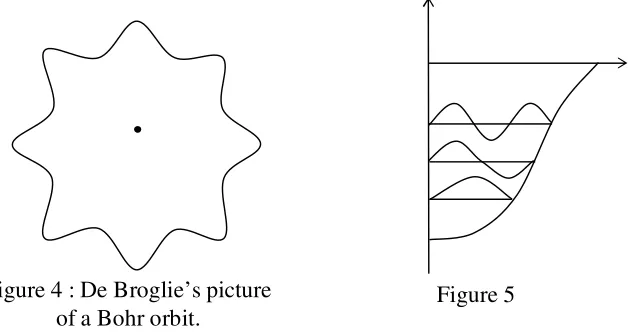
But de Broglie showed that by demanding that the wave associated with the electron in
the Bohr’s theory of the hydrogen atom be of such wavelengths so as to make the
circumference of the circular Bohr orbits an integral multiple of the wavelength, i.e.,
C = n, one could do away with Bohr’s “ad hoc” quantization rule for the orbital angular
momentum. Later, use was made of Planck’s equation, E = , and that of de Broglie’s, c/ f
└
unnamed invariant
Figure 3
6
p = k, by Erwin Schroedinger, who was then a professor at ETH Zuerich, to develop
what we now know as Schroedinger equation,
−
+
=
.The relation C = n for Bohr’s orbits of the electron in hydrogen atom is the same as the condition satisfied by a standing wave between two nodal points. I applied this
condition to an electron moving back and forth between the two “walls” of Coulomb
potential well, and obtained the quantized energies of the Bohr hydrogen atom. In my
actual derivation use was made of only one half of the potential well, i.e., from the wall
to the symmetry axis of the well, so that the required condition to be satisfied was
∫
= ,r
mbeing the distance between the axis and the wall, from whichE
n =
, n = 1, 2, ...
was obtained for a hydrogen-like atom of atomic number Z and reduced mass
.When saying to Langevin that de Broglie’s idea was crazy but sound, Einstein was
truly appreciative. In his letter to Hendrik A, Lorentz, dated December 16, 1924, which
was learned of by de Broglie only after Einstein’s death in 1955. Einstein wrote: “A
younger brother of de Broglie (the one we know) has undertaken a very interesting
investigation (Paris Dissertation, 1924) to interpret Bohr-Sommerfeld quantum rules. I
believe this is a first weak ray to illuminate the most serious of our physical riddles.” Figure 4 : De Broglie’s picture
of a Bohr orbit.
7 2.1. Interlude 2: Science: Is It Epistemic?
According to Richard M. Bubes (1989?) science is a way of knowing. It is based on
human interpretation of data which are publicly obtained through interaction with nature
and the realities therein. Following Robert K. Merton, we use the term “science” here to
refer to it not only as product, but also as process and paradigm. The process is the trail
traversed by the scientists to arrive at the product, whereas the paradigm is the “guiding
star used by the scientists so as not to get astray. It is an ordering belief framework. The
codes of ethic that should be upheld in scientific endeavors are spelled out in four
imperatives. These are universalism, communalism, disinterestedness, and organized
skepticism.
But the third imperative, i.e., disinterestedness or detachment, is no longer a
“decree” that coute-que-coute must be obeyed, both in the humanities and in “hard” sciences. In researches that use in-depth case study approach, the researcher deliberately
blends her or himself with the case being studied, thus being accepted as and becoming
part of the system. In the sub-atomic world, the very act of the observer observing the
observed disturbs the latter and changes its state. Thus the classical picture of an observer
standing aloof at a distance from the phenomenon has been drastically changed by the
new conviction.
This shows that science is not objective, in the sense that it does not give us the absolute understanding of things, exactly as they really are. Science is also based on faith,
faith that realities in nature are orderly and to certain extent comprehensible, yet to the
limited capacity of our mind they are so complex and even mysterious. According to the
physicist Fritjof Capra and the theologian David Steindl-Rast, science is not objective; it
is epistemic in the sense that it depends on, and limited by, our capacity to know.
I started this interlude by quoting Richard Bube that science is a way of knowing.
In the scientific community there is no pretence that it is either the only way, or the best
one. Using approximate metaphors and simplified models, science describes essential
characteristic properties, events, and phenomena in the natural world, and provides
8
Great scientists like John Dalton and Albert Einstein advise us that the model, and
thus also the theory that is developed from it, be based on as simple and as few basic
assumptions as possible, in keeping with the principles of simplicity and parsimony. This
“stinginess” in the assumptions must, however, be compensated with as much
Einfuehlung as possible. Einfuehlung is a term used by Einstein. It is a sort of loving empathy towards the objects of your investigation. This is the recipe to open the
possibility of reaching a universal principle as, Einstein believed, there is no logical path
that leads to it.
Yes, universal principles render a part of the complex realities scientifically
comprehensible, but there are also things that are very important and of the most
relevance to us that cannot be explained by science. To peek into these mysterious things
and get a glimpse of each of them, we turn to spiritualism, philosophy, or religion.
Metaphorically science can be thought of as an edifice sitting firmly on three
foundational pedestals. These are ontology, epistemology, and axiology or teleology. The
third pedestal sets the objectives1 which science is in pursuit of, and they are reflected in those values2 which the scientists uphold in the development and application of science. On the “development’ side, the more relevant values are constitutive values, such as
truth, honesty, openness, willingness to collaborate, and suspension of (dis)beliefs,
whereas on the “application” side the more important values are contextual values which
have a lot to do with the societal context in which scientific endeavors are decided upon
and carried out. As Edward Teller (1999) said, “Ethics begins where science ... has
opened possibilities (and offered choices)3.”
We must be really careful in deciding which ones of these alternatives that not only
can, but also may, be developed further in applied research to design prototypes, and which ones of the chosen prototypes that may be perfected in technological R & D to end
up in environmentally and user-friendly technologies. For instance, considering that
plutonium is so fiendishly toxic and of “tough” radioactive longevity, I would argue
whether the world can be sustainable if we adopt plutonium-based energy policy, unless
1 telos = objective
2 axios = value
9 the skipper at the helm of our one-and-only ship, GAIA, is a fiercely authoritarian dictator.
Physics is a branch of science. It is one of the basic sciences, if not even the most
basic of all sciences. Physics deals with events and phenomena in the inanimate world.
As such, it shares with the rest of sciences the general characteristics described above.
3. STORY 3: BOHR et al. VERSUS EINSTEIN et al.
In this subtitle, the “et alli” in the case of Niels Bohr means Arnold Sommerfeld (I think), the “Goetingen Trio” (Max Born, Werner Heisenberg and Pascual Jordan),
Wolfgang Pauli and others, while in the case of Albert Einstein it includes Max Planck,
Louis de Broglie, Erwin Schroedinger, B. Podolsky, N. Rosen, David Bohm, Karl R.
Popper and others. The word “versus” refers to the difference in their views of science.
Bohr held to the view that in the microworld there is no certainty, i.e., that science is not
deterministic, but probabilistic. On the contrary, Einstein believed that science is
deterministic. Given an already proven universal principle plus all pertinent initial and
boundary conditions, what will become of a known, present state of a particle or a system
in the future can be predicted deterministically.
Einstein expressed his conviction in his reply to Born’s letter of November 30,
1926: “The theory4 says a lot but does not really bring us any closer to the secret of the “old one”. I, at any rate, am convinced that He5 is not playing dice.” Heresay has it, that to this Bohr replied that that may be so6, but God often throws the dice in a direction which we do not know.
In their paper of 1935 on a thought experiment which became more known as EPR7 paradox, A. Einstein, B. Podolsky, and N. Rosen concluded that quantum mechanics is an
abstraction that only gives an incomplete and fragmentary description of the underlying
reality. To this N. Bohr answered that the measurement process is an unanalyzable whole
which led to the conclusion that there is no meaning to the attempt to give a detailed
4 He meant Quantum Theory
5 It was God whom he was referring to. 6 i.e., that God does not play dice.
7 EPR: Einstein – Podolsky – Rosen. Their paper “Can Quantum Mechanical Description of Physical
10
description of how correlations of position and momentum are carried along by the
motions of the parts of a many-body system.
At a certain stage of the debate, the scientific community gave the verdict that the
Einstein “camp” was the loser. Einstein conceded that the other party was more
consistent in their argument. But he said that he only lost a battle, while the war was not
over. In the early fifties David Bohm joined the war on Einstein’s side. He rediscovered
de Broglie pilot wave which had been “crushed” by Wolfgang Pauli at the Solvay
Conference in Brussels, in 1927, where Einstein , who was there, too, did not rise up in
defense of his protégé.
Using the ideas of de Broglie and Bohm, John S. Bell, in his paper “On the
Impossible Pilot Wave”, adds to the wave function (n, x, t) a particle position X(t). According to Bell, probability enters once only, in connection with initial conditions.
Thereafter the joint evolution of andX is perfectly deterministic. Yet Einstein was not
enthusiastic about the idea, probably due to the nonlocality of the quantum potential.
The nonlocality of quantum potential is shown in the experiments of French
physicist, Aspect (1982), where even on a macroscopic scale of meters we may not
consider parts of a physical problem separately. Basing his conclusion on the observation
of the Melbourne-based astronomer, Robert Hanbury Brown, Dutch Physicist, Stefan
Persijn (2004) extents the scale to the distance between a point on Earth and another
point on Sirius B. Quantum mechanically this is obvious as a single wave function
describes the process. As Egbert Boeker says, “One may not even say that the whole is
more than the sum of its parts as the parts may not be considered as separate entities.
Concluding this story, I would like to return to Louis de Broglie. He said that
neutrinos are not massless. This was first confirmed in 1998 at Super-Kamiokande8. De Broglie’s La Mecanique Ondulatoire (Wave Mechanics) of the pilot wave has as its consequence a double solution, one of which representing superluminal particle. Perhaps
this superluminal particle would have been considered confirmed if the OPERA9
8 Kamiokande stands for Kamioka Neotrino Detection Experiment. It is a neutrino observatory located
under Mount Kamioka near the city of Hida, Gifu Prefecture, Japan. It is 1,000m underground in the Mazume mine. The detector is a huge cylindrical tank full of ultra-pure water surrounded by over 11,000 photomultiplier tubes.
11 experiment to determine the velocity of muon neutrino in 2011 yielded correct result, as
it was found that the neutrino’s velocity was faster than that of light in free space. The
experiment is a collaboration between CERN in Geneva Switzerland, and the Laboratori
Nazionali del Gran Sasso (LNGS) in Gran Sasso, Italy. Neutrinos produced at the CERN
SPS are beamed to LNGS along an underground baseline 730 km in length in a period of
about 3 milliseconds. The result was (v – c)/c = 2.48 ± 0.28 (stat.) ± 0.3 (sys.) 105. (Adam, T., 2011) But after repeating the experiment several times, finally in May 2012
the Gran Sasso Lab stated that the original OPERA result had been mistaken.
The war between probabilism and determinism is still going on. At the helm of the
probabilism group is Stephen Hawking (UK), while the leading physicist on the
determinism camp is Roger Penrose (also in UK).
In the afternoon on July 4th, 2012 I learned from a BBC report sent to me by our daughter (who lives in Norwich, UK) that the long-sought Higgs boson had just been
discovered by the ATLAS team of researches using the LHC (Large Hadron Collider) at
CERN. If the result of the experiment was not mistaken and a Higgs boson was indeed
discovered, it was a really very important discovery, as the boson is the key to
understanding how massive particles in the universe have come into being, i.e.,
supposedly due to locally broken symmetry in a highly energetic energy field.
According to Suharyo Sumowidagdo, an Indonesian researcher at CERN who is a
member of the team that discovered the particle, much work has still to be done to
ascertain whether the particle was really a Higgs boson, although a boson it certainly was,
decaying into two photons plus four fermions. But even if it turns out to have been
something else, the discovery of such a big particle10 is indeed very important. When told that Louis de Broglie had thought of pilot wave associated with
massless as well as massive particle, Einstein said, “It is a crazy idea ....” Similarly, when
Peter Higgs in 1964 submitted his original paper to the European, journal, Physics Letters, the editors of the journal must have thought that the idea of a broken symmetry giving rise to mass was a crazy idea. Peter Higgs’ paper was rejected by Physics Letters.
=========
12
REFERENCES
Adam, T. et al. (a total of 173 contributors from research institutes all over the world): “Measurement of the neutrion velocity with the OPERA detector in the CNGS beam”, (2011), Geneva, CERN-LNGS Collaboration Publication; arxiv.org/abs/1109.4897 (Cornell University Library)
Bell, John S.: “On the Einstein-Podolsky-Rosen Paradox”, (1964), Physics, 1, 195-200 Bell, John S.: “On the Impossible Pilot Wave”, (1982), Foundations of Physics, 12,
99-99
Boeker, Egbert, and Rienk van Grondelle: Environmental Physics (1995), Chichester,
John Wiley & Sons, p.430-1
Bube, Richard H.: “Can a Scientist Be a Christian in Today’s World?”, in Mott, Sir
Nevill (ed.), Can Scientists Believe? James&James, London, (1989), p.109-19
Capra, Fritjof, and David Steindl-Rast: Belonging to the Universe (1992), New York,
HarperCollins, p.123-6
Einstein, A., B. Podolsky, and N. Rosen: “Can Quantum Mechanical Description of
Physical Reality Be Considered Complete?” (1935), Phys. Rev. 47, 777. 80
Halpern, Paul, Collider (2009), Hoboken, NY, John Wiley & Sons, p. 46
March, Robert, H.: Physics for Poets (1970), New York, McGraw-Hill, p.210-2
Pais, Abraham: Inward Bound (1986), Oxford, Clarendon Press, p.251-3
Persijn, Stefan: “An Old Vision on Science”, in Widianarko, Budi, et al. (eds):
Menelusuri Jejak Capra, (2004), Yogyakarta, Kanisius, p.74-5
Plato: “Dialogue (Meno)”, retitled “Mathematics as Eternal Truth” in Brown, Stuart,
et al. (eds): Conceptions of Inquiry (1981), London, Methuen, p.3-11
Teller, Edward: In a letter in response to Lord Ashcroft (of the UK) who was getting
himself ready to address the UNESCO sponsored “Science at the End of the 20th Century” Conference in Budapest, in December 1999
Wilardjo, Liek: “From Isosceles Triangle to Nobel Laureates Compton, de Broglie,
Davisson and Thomson Techne, Vol.9, No.2, Oct,2010, p.125-31
Wilardjo, Liek: “Using Standing Wave Patterns to Explain Quantization” (2001),