75
Jurnal Ilmiah Administrasi Publik (JIAP)
U R L : h t t p : / / e j o u r n a l f i a . u b . a c . i d / i n d e x . p h p / j i a p
Gender Adjustment for Sustainable City (Case of 3G (Glintung Go Green) in Malang
City)
M. Nuh a *, Erlita Cahyasari a, Niken Lastiti V.A a, Suhartono Winoto a
a Brawijaya University, Malang, East Java, Indonesia
*Corresponding author. Tel.: +62-852-3029-8323; e-mail: [email protected] A R T IC L E I N F O R M A T IO N A B S T R A C T
Article history:
Date submission: 16 March 2018 First revision: 20 March 2018 Accepted: 25 April 2018 Available online: 17 May 2018
Gender issue always become an interesting topic to be researched, especially when the gender issue itself is related to sustainable city issue. Sustainability of a city cannot be separated from gender role and contribution. The existence of gender often becoming influential group in city living environment. In one part of Malang City, at Kelurahan Purwantoro, initiating a Water Saving Movement or Gerakan Menabung Air (Gemar) at Kampung 3G (Glintung Go Green). The purpose of this research is to provide the relationship representation between gender and sustainable city program, especially in succeeding the activity at Kampung 3G (Glintung Go Green). This research using descriptive quantitative method, with questionnaire as the data gathering method in knowing the gender role and perception. This research also using SPSS to analyze the data. The result shows that there is a significant relation between gender and Kampung 3G sustainable city program, however the successes and development of the program did not affecting gender perception. It also shows that the successes of sustainable city program is not in line with the development of gender perception.
INTISARI
Isu gender selalu menjadi topik yang menarik untuk diteliti, terutama bila isu gender itu sendiri terkait dengan isu kota yang berkelanjutan. Kesinambungan suatu kota tidak terlepas dari peran dan kontribusi gender. Adanya jenis kelamin sering menjadi kelompok yang berpengaruh di lingkungan kota. Di salah satu bagian Kota Malang, di Kelurahan Purwantoro, memulai Gerakan Penghematan Air atau Gerakan Menabung Air (Gemar) di Kampung 3G (Glintung Go Green). Tujuan dari penelitian ini adalah untuk memberikan keterwakilan hubungan antara gender dan program kota yang berkelanjutan, terutama dalam mensukseskan kegiatan di Kampung 3G (Glintung Go Green). Penelitian ini menggunakan metode deskriptif kuantitatif, dengan kuesioner sebagai metode pengumpulan data dalam mengetahui peran dan persepsi gender. Penelitian ini juga menggunakan SPSS untuk menganalisis data. Hasilnya menunjukkan bahwa ada hubungan yang signifikan antara gender dan program kota berkelanjutan Kampung 3G, namun keberhasilan dan pengembangan program tidak mempengaruhi persepsi gender. Hal ini juga menunjukkan bahwa keberhasilan program kota yang berkelanjutan tidak sejalan dengan perkembangan persepsi gender.
2018 FIA UB. All rights reserved.
Keywords: gender adjustment, sustainable city, society participation
76 1.Introduction
This research wants to shows on how much the significance of relationship between gender and sustainable city development. Sustainable development is a development concept which taking environment aspect into its consideration. According to Salim (1986:20), environmentally based development is an effort of awareness and planning in using and managing natural resources wisely in sustainable development to increase the quality of life. According to the definition above, there are 3 main components in sustainable development concept, which are: a) The usage/managing resources wisely; b) supporting sustainable development; c) Increasing quality of life.
Those definition isn’t only in economic definition
spectrum, but also including all parts of our environment, start from biotic resources (human, animals and plants), abiotic resources (water, air, lights, soil, mining resources and etc.), and also man-made resources (machine, industrial outcome and building).
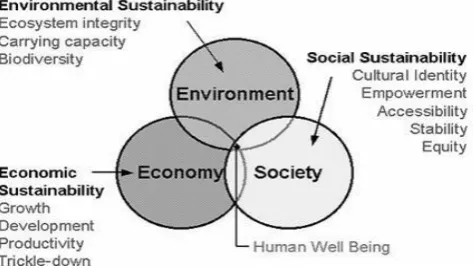
In the next development concept, sustainable city as an interaction between biologist system and resources, economy system and social system. Thus we can see those statement in picture bellow:
Figure 1 Sustainable Development Concept Source: United Nations, 2013
Urban development of Malang city are directed to sustainable development which taking environmental sustainability; economy sustainability and social sustainability into consideration. This according to development mission 2013-2018 by Malang City Government which to increase integrated and sustainable infrastructure development and city support capacity, orderly city planning and environmentally friendly. These are the sustainable agenda which being applied by Malang City government: (1) Reducing Poverty; (2) Overcoming Starvation; (3) Health; (4) Gender Equality; (5) Clean Water and Sanitation; (6) Affordable Clean Energy; (7) Jobs and Economy Growth; (8) Discrepancy; (9) City and Sustainable Communities; (10) Responsibly Consumption and Production; (11) Climate Action; (12) Underwater Life;
(13) Life On the Ground; (14) Justice and Peace; and (15) Global Cooperation.
Participation from the whole layer and structure of society is the main part in sustainable development strategy. One of it is the gender role in the effort of sustainable city development. Gender refers not just to differences between women and men but to the multiple level at which gender operates, the ways those differences create and area created by societal and cultural norms, expectations, patterns of behavior and ideology, and the inequilities that result (Scott, 1986). The existence of gender participation in development have direct contribution to development program planning, and indirect contribution in participation and moral support (Jaenudin, 2017). If society participate in the whole aspect of development, which start from the decision making process, implementation, supervision, evaluation, up until benefits acceptance, then the purposes of development will be accomplished by itself. Without the participation of society, then the goal of
sustainable city development won’t be achieved.
Urban development focus in this global era have their focus of achievement on residency area aspect and slump area, accessibility and integrated transportation, participation and integrated planning, green open space, increasing air quality and waste management, and also reducing the risk of natural disaster (Klopp, 2017). Even
though in reality it’s not that easy to practice the
sustainable development (Pupphachai, 2017). Governance which have tendencies in using sustainability approach always faced with obstacles and challenges. One of the effort to minimalize those obstacles and challenges is through participation. Furthermore, adaptive government also needed to implement a flexible, experimental and adaptive government (Pupphachai, 2017).
Interest towards the gender issue and sustainable development starts to shows up and develop in current era. A fast and dynamic changes in the current era affecting the society social environment. Gender role expected to be one form of social structure construction in society which can control the changes and sustainable development. Gender is not merely an issue about rights equality, but also as one of society social structure which can affecting the success of sustainable development.
2.Theory
2.1 Gender
77 organizing principle in all societies. It is often difficult to separate biological and social aspects of human behavior, or to point to distinct biological and social influences on the difference beetwen women and men. Real and perceived physical differences between women and men are often part of the meaning and organization of gender (Udry, 1994).
The differences between women and men are of less central concern than the role thaht gender plays as a social institution. Gender refers not just to differences between women and men but to the multiple level at which gender operates, the ways those differences create and area created by societal and cultural norms, expectations, patterns of behavior and ideology, and the inequilities that result (Scott, 1986).
2.2 Sustainable Development
The concept of sustainable development as described by the World Commission on Development and the Environment, in its report entitled Our Common Future 1997 (in Kristanto, 2002:60), is a strategy for the utilization of natural ecosystems and all natural resources within such a way that, its functional capacity to provide benefits to human life is not threatened/ damaged. Sustainable development is a development concept that takes into account environmental aspects. Meanwhile, according to Salim (1986:20), environmentally sound development is a conscious and planned effort in using and managing natural resources wisely in sustainable development to improve the quality of life. Based on the above definition, then there are at least 3 important elements in the concept of sustainable development, namely:
a) Use/ management of resources wisely; b) supporting sustainable development; and c) Improve the quality of life.
The above definition not only covers the economic sense only. But it also covers all parts of our environment, ranging from biotic resources (humans, animals and plants), abiotic resources (water, air, light, soil, minerals and so on), to artificial sources (machines, yields industry and building). This is in line with the principles of environmentally sound development contained in the GBHN which includes:
a) In the framework of development, natural resources must be used rationally;
b) Utilization of resources should be endeavored not to damage the environment;
c) Must be implemented with a comprehensive policy of taking into account the needs of future generations; and
d) Taking into account the relation of hook-hooks and dependencies between various problems.
Environmental factors needed to support environmentally sound development in Kristanto (2002:60-62), namely:
a) The maintenance of essential ecological processes, including the process of photosynthesis, population control and the process of self-renewal after experiencing disruption; and
b) Availability of sufficient resources
Further, according to Kristanto (2002), Development is basically an effort to increase the benefits derived from resources, Increase the principle of this benefit can be achieved by:
a) Increasing the efficiency of natural resource use, without increasing the amount of natural resources used;
b) Carry out recycling efforts to reduce the risk of pollution and depletion of resources;
c) Seeking alternative natural resources to ensure long-term natural resource supply; and
d) Appropriate social, cultural and economic environment.
According to Kristanto (2002:62-63), basically the concept of sustainable development consists of two dimensions, namely:
a) Techno-Ecological Dimensions
Each development activity should be placed in an appropriate location (spatial concept);
Mechanism of control and utilization of natural resources; and
Waste management. b) Socio-Economic Dimension
In environmentally sound development, the cost component of the environmental risk risk must be included in the decision-making process and does not wait until pollution occurs. For that needed the selection of social environment, where the development will be done which includes:
Economic growth, involving added value as a result of development;
Equity of income, by opening up wider employment; and
Improved allocation of natural resources, to improve the quality of life.
Based on the above concepts, sustainable development is the result of synergy between social, economic and environmental development.
2.3 Sustainable City
78 referred to as regulated cities that enable their communities to meet their needs and to improve their welfare without harming the natural environment or endangering living conditions of other beings now and in the future. A city that works for the people: protecting its health, providing shelter and offering opportunities to work and express its culture (Seragaldin, 1996).
More integrated approaches, more ecological and community sensitive, need greater uncertainty and more openness to community engagement. The ecosystem approach confirms ecology and community as the basis of the goals and planning process. So economic growth is only acceptable when it comes to the interests of people who depend on ecology and community togetherness.
2.4 Community Participation
2.4.1 Concept of Community Participation
The concept of public participation is growing from narrow to broad terms. In the beginning, the participation is fully understood politically (Bryant & White, 1987:271). In this traditional sense, participation means voting, membership in parties, activities in voluntary associations, protest movements and so on. This understanding is reinforced by Huntington & Nelson (1994:5-10), as political participation that is limited only by behavior, to the exclusion of the attitude aspect, which aims to influence the decision of the government. Political participation is then divided into two types, namely the mobilized and the autonomous. Participation mobilized is the involvement of the perpetrator or not the personal will in the course of political activity, while the autonomous means the sipelaku acts on his own will to influence the policy.
This is in contrast to the broader sense of public participation, known as the new public involvement. In this second concept, participation includes policy making as well as involvement in deciding how the policy is implemented. In addition, participation has also involved the relevant public in a broader sense. This broader understanding is also supported by Bryant & White (1987:272-273) as a participation not only of political and electoral processes but also the administrative process. They reveal that this development is triggered by the realization that the implementation process is the main arena for damn resources is the main link in the interaction between the government and its citizens.
Participation forms that are participation in development activities at least there are two types of participation, Koentjaraningrat (1998:79) states that: a) Participation in joint activities in development
projects; and
b) Participation as individuals outside of joint activities in development.
The substance of participation is the operation of a system of government where no policy is taken without the consent of the people, while the basic direction taken without the consent of the people, while the basic direction to be developed is the process of empowerment, further said that the purpose of participation development are: First, that participation will enable the people to autonomously organize themselves, thereby facilitating people to face difficult situations, and be able to resist adverse tendencies. Second, participation is not only a concrete reflection of the opportunity for the expression of aspirations and the way to fight for it, but more importantly, participation is a kind of guarantee for the non-neglect of the public interest. Third, that the problems in the dynamics of development will be overcome by community participation.
2.4.2 The importance of Community Participation in Development
Conyers (1984:28) provides three main reasons for the importance of community participation in development, namely: (a) Community participation is a tool for obtaining information about the conditions, needs and attitudes of local communities, without the presence of development programs and projects failing; (b) The community trusts the development program if involved in the preparation and planning process, as the community knows more about the project and feels it owns the project; and (c) Participation is the right of people's democracy in its involvement in development. According to Conyers (1984:28), community participation in development seen from:
a) As a mental window is by opening the hearts of the people to consciously and sincerely involved in the development process; and
b) As an act of real, active and creative involvement of the community, accompanied by the potential of skill, ability, knowledge, and willingness to sacrifice to participate in solving the problems of society itself, and not as a mob which takes refuge in the concept of participation, and the growth of people's empowerment and self-reliance to be able to solve their own problems.
79 development efforts, it is necessary to change management development that is dominated by the paradigm of structural efficiency as a management based on community participation. Community involvement in the development planning process will greatly encourage the creation of a good planning result, because the community as one of the elements in the development, of course can know and understand the existing in the region.
In addition, by involving the community in the development planning process, the government, especially the local government, has given trust to the community, so that the community can feel responsible and feel that having clear development programs will be very beneficial for the implementation. From the description, it can be known about the importance of community participation in the development planning process of dareah. Successful implementation of development programs can not ignore community participation in development planning.
2.4.3 Forms of Participation
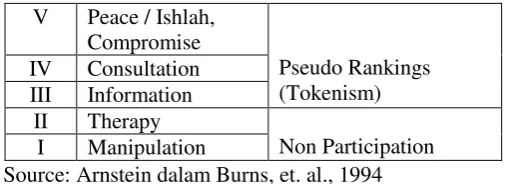
According to Arnstein in Burns, et. al. (1994:156-158), there are eight levels of participation. At the bottom of the stairs there are two levels that are classified as non-participation, ie manipulation dant erapi. This ladder should not encourage the people to participate in the planning or implementation of the program, it would be disruptive for the holder of power in educating or 'treating' the people. The second ladder consists of three levels involving dialogue with the public, ie information (one-way communication from government to community), consultation (two-way communication), and placation (community involvement in a program).
The last ladder is made up of three levels, in which members give an opportunity to the community in a better degree in decision making. The three levels are partnerships between government and society, delegated powers (the government empowers the community to take care of some of its needs), and the level of citizen control, in which the public takes part in the formulation, implementation and evaluation
Table 1 Model Eight Stakeholder Community Participation
Stairs Forms of
Participation Category VIII Community
Monitoring Degrees of Citizens Power (Degrees of
Source: Arnstein dalam Burns, et. al., 1994
Participation between the community with one another has different levels or stages because each society has sociological characteristics and different economic and cultural circumstances. According to Wilcox in Theresia (2014:202) there are five levels of participation, namely:
a) Provide information (information);
b) Consultation: that is to offer an opinion, as a good listener to provide feedback, but not involved in the implementation of these ideas and ideas;
c) Deciding together, in the sense of providing support for ideas, ideas, choices, and developing the opportunities needed for decision making;
d) Acting together (acting together), in the sense of not just participate in decision-making, but also involved in establishing partnerships in the implementation of its activities; and
e) Provide support (support independent community interest) where local groups offer funding, advice and other support to develop the agenda of the activity.
2.4.4 Factors Affecting the Participation of People in Development
a) Supporting Factors
The concept of community participation is not a new thing in Indonesia. From the time of the ancestors, has been known the spirit gotong-royong starting from the cultural values that concern human relationships. This spirit encourages community participation. The community needs a regional development program to build and improve its area. So awareness to participate in development is very high.
80 (2001:30), argued that the low level of education, literacy and limited knowledge of society so that technically difficult to participate productively, the community is in a situation of political-centralist-authoritarian so that entrenching an attitude of rebuke, passivity, fear of taking initiative and living in a culture of instruction; the people have lost credible local institutions and local intelligence as a result of elite political pressure and the aspirations conveyed by the people is a reflection of the aspirations of the state.
Some urban people live more individually than villagers known for kinship. Many of the inhibiting factors of urban communities are reluctant to participate, the first inhibiting factor is the very heterogeneous social structure with very different socio-cultural conditions. The second is the bitter experience of the community about the previous programs, so the community becomes less confident and even pessimistic with the new program to be implemented. The third is the vested interest of some of the people. The fifth is the decision-making system from top to bottom, the absolute decision still exists on the government, in this case the local government and kelurahan. The sixth presence of various social inequalities and poverty also contributed to the inhibition of community participation.
3.Research Method
This research using descriptive quantitative research, with questionnaire as data retrieval techniques in order to know the gender role and perception. Descriptive research tried to explain the problem solvency according to the data also analyzing and interpreting data (Darmawan, 2013). This research try to interpret the object as it is (Sukardi, 2003). Gender role and participation become an influential aspect in creating sustainable city. Data analysis in descriptive quantitative approach using SPSS analysis tool. Population in this research are people of RW 23 Kelurahan Purwantoro District Lowokwaru Malang City. Sampling techniques that being used in this research is probability sampling technique, which every single population member have the same chance to be chosen as research sample member. Sample in this research is 60 respondent which is the gender representative in RW 23 Kelurahan Purwantoro.
4.Results and Discussion
4.1 Results
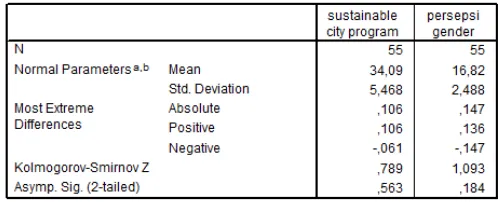
The usage of descriptive quantitative research begin with data retrieving techniques through questionnaire. Before we can able to see the significance relation between gender perception and sustainable city program, first we conduct normality test.
Table 2 Kolmogorov-Smirnov Test Result
Source: Analytical result, 2018
According to normality result test using Kolmogorov-Smirnov test shows that normal distribution test can be seen from significant assumption (2-tailed). The value resulted from variable x (sustainable city program) is 0.563 and variable y (gender perception) is 0.184, shows variable significant bigger that 0.05 means that questionnaire data have normal distribution.
Next, we conduct linearity test as an effort to see whether there are linearity between questions variable x and variable y in questionnaire. Here is the result of linearity test.
Table 3 Linearity Test Result
Based on the result of linearity test shows that the value of linearity is 0.00 which the linearity significance between variable x and variable y smaller than 0.05, means that there is no linearity.
Next, we used nonparametric correlations which function to produce significance relation between variable x and variable y as big as possible. Below is the table of significan relation.
Table 3 Nonparametric Correlatio
According to the calculation above, shows that there is a significance relation between variable x and variable y. The amount of significance relation between the two variable is 0.467 which the significance relation with those amount can be classified as medium
Source: Analytical result, 2018
81 classification. Meanwhile, the nature of relation that resulted shows that the bigger the development of
sustainable city programs doesn’t affecting the gender
perception.
4.2 Discussion
Glintung Go Green (3G) is a social movement which being founded by the Chief of RW 23 Kelurahan Purwantoro District Blimbing Malang City. Glintung area, especially the one in RW 23 always have the same problem in every year, which is flood. The condition of high density residential area and the small gap between each houses causing area of RW 23 becoming an area where its environment condition becoming worse each year. Sustainable city program which initiated by people of RW23 Kelurahan Purwantoro begin with the people effort in minimalizing flood in those area. The early program that being initiated is saving water movement. People which coordinate by Chief RW tried to implement saving water movement with building injection wells. Those wells functioned as infiltration wells to minimalize the flood. Not only that, the people also try to build their environment to be more green, clean and neat. The effort that being done is building waste bank and obligate each house to have plants and flowers. Those various programs have been conducted since years ago and currently become a model for cities both domestic and foreign cities.
Consistency and the triumph of the sustainable city
program implementation at Kelurahan Purwantoro can’t
be separate from the existence of Board of RW, Board of RT but also gender participation in working together to create a comfortable environment, green and free from flooding. On their own, people start to learn on how to plant vegetable and another crops. Under the guidance of Balai Pengkajian Teknologi Pertanian (Agriculture Technology Assessment Centre) East Java, the applied technology variated from conventional way at field and at pot/polybag, until hydroponic system. Those are being introduced, thus the people are able to choose their own method in accordance to their own
condition. The Glintung’s people performance in
implementation of 3G makes the Malang City Government to be interested in those programs.
Apart from answering the issue related to sustainable environment, the development of Glintung Go Green also answering the main issue which is residency infrastructure, especially on waterways management. During rainy season, Glintung area always faced with flooding issue. Through Gerakan Menabung Air (GEMAR), emerge several movement to care about their own residence environment. GEMAR become one of alternative ways in solving flooding problem in Glintung area. Besides, through GEMAR also expected
to create a healthy, environmental friendly area and free from flooding.
Judged by the success of those program actually
isn’t fully having an impact to the society, especially for
gender. According to the research result, shows that not all society can participate and actively involved in building and succeeding the Kampung 3G program. Even though based on the result of correlation test shows that there are significance relation between the involvement and participation of gender in developing the Kampung 3G program, but the nature of those relation tend to be not inline. In other means, that the
success and achievement of Kampung 3G program isn’t
because of gender factor. Even if the gender involvement and participation really active and can be
counted as success but still doesn’t have any effects on
gender.
Gender perception shows that not all of the success of the program can lift the gender role and involvement. Those if being left behind, can possibly cause a bigger resistance in Kampung 3G activity. The success and achievement of Kampung 3G will be threaten if the resistance prove to be bigger and affecting the implementation of the program.
5.Conclusion
Heterogenic society pattern can be an obstacles to society participation. Heterogenic pattern should be easy to be found at urban society which tend to be formed by different groups, race, religion and social status. Because of that, the process to push society participation need a better strategy because of heterogenic condition. Society participation, especially in gender at the implementation of Kampung 3G with those conditions needs to be strengthen so that the sustainability of the
program can be guaranteed. The other this that’s very
important to be prepared is regeneration. With the tendency of majority being old age, thus the regeneration needed so that the implementation of Kampung 3G can be maintained. Gender isn’t the only social groups that influencing but the existence of gender is very important in guarding and conserving the sustainability of Kampung 3G program.
82 Daftar Pustaka
Abe, Alexander. (2001). Perencanaan Daerah memperkuat Prakarsa Rakyat dalam Otonomi Daerah. Lapera Pustaka Utama:Yogyakarta. Bryant, Coralie., & Louis G. Whtite. (1987).
Manajemen Pembangunan untuk Negara
Berkembang. Jakarta:LP3ES
Burns, D., Hambleton, R., & Hogget, P. (1994). The Politics of Decentralizations: Revitalizing Local Democracy. London: The Mac Milan Press. Conyers, Diana., & Peter Hill. (1984). An Introduction
to Development Planning In The Third World. Wiley: Chichester.
Darmawan, Deni. (2013). Metode Penelitian Kuantitatif (Quantitative Research Method). PT Remaja Rosdakarya: Bandung.
Huntington, Samuel P., & Joan Nelson.(1994). Partisipasi Politik di Negara Berkembang. Jakarta: RIneka Cipta.
Islamy, M. Irfan. (2004). Prinsip-Prinsip Permusan Kebijaksanaan Negara. Jakarta: Bumi Aksara. Jaenudin, Ahmad., Darsono Wisadirana., & Sholih
Mu’adi. (2017). Womens Participation in Rural
Development. Wacana, Vol.20, No.3, pp.127-134.
Koentjoroningrat. (1998). Ritus Peralihan di Indonesia. Jakarta: Gramedia.
Kristanto, P.(2002). Ekologi Industri. Penerbit Andi: Yogyakarta.
Klopp, Jacqueline M., & Danielle L Petretta. (2017). The Urban Sustainable Development Goal: Indicator, complexity and the Politics of Measuring Cities. Journal Cities, Vol. 63, pp.92-97.
Pupphachai, Umaporn., & Christian Zuidema. (2017). Sustainability Indicators: a Tool to generate learning and adaptation in sustainable urban development. Ecological Indicators, Vol.72, pp.784-793.
Riley, N.E. (2005). Demography of Gender. Kluwer Academic/ Plenum Publishers, New York.
Salim, Emil. (1986). Pembangunan Berwawasan
Lingkungan (Environmentally Based
Development). LP3ES:Jakarta.
Seragaldin, I. (1996). Sustainability and the Wealth of Nations: First Steps in an Ongoing Journey. Environmentally Sustainable Development (ESD) Studies and Monographs Series No. 5. World Bank, Washington DC.
Scott, J.W. (1986). Gender: A Useful Category For Historical Analysis. American Historical Review, Vol. 91, pp.1053-1075.
Sukardi. (2003). Metodologi Penelitian Pendidikan Kompetensi dan Prakteknya. Jakarta: Bumi Aksara.
Theresia, A dkk. (2014). Pembangunan Berbasis Masyarakat. Bandung, Alfabeta.
Turner, Lynn H., & Richard West. (2008). Pengantar Teori Komunikasi: Analisis dan Aplikasi (Buku 2) (edisi 3). Jakarta: Salemba Humanika.
Udry, J.R. (1994) . The Nature of Gender. Demography, Vol. 31, pp. 561-573.
United Nation. (2013). World Economic and Social
Survey 2013 Sustainable Development
Challenges. Available at