On: 06 Decem ber 2011, At : 05: 55 Publisher : Rout ledge
I nfor m a Lt d Regist er ed in England and Wales Regist er ed Num ber : 1072954 Regist er ed office: Mor t im er House, 37- 41 Mor t im er St r eet , London W1T 3JH, UK
Inter-Asia Cultural Studies
Publ icat ion det ail s, incl uding inst ruct ions f or aut hors and subscript ion inf ormat ion:
ht t p: / / www. t andf onl ine. com/ l oi/ riac20
Pasar Baru: colonial space and contemporary
hybridity
Lil awat i Kurnia
Avail abl e onl ine: 06 Dec 2011
To cite this article: Lil awat i Kurnia (2011): Pasar Baru: col onial space and cont emporary hybridit y, Int er-Asia Cul t ural St udies, 12: 4, 552-567
To link to this article: ht t p: / / dx. doi. org/ 10. 1080/ 14649373. 2011. 603918
PLEASE SCROLL DOWN FOR ARTI CLE
Full t er m s and condit ions of use: ht t p: / / w w w.t andfonline.com / page/ t er m s- and- condit ions
This ar t icle m ay be used for r esear ch, t eaching, and pr ivat e st udy pur poses. Any subst ant ial or syst em at ic r epr oduct ion, r edist r ibut ion, r eselling, loan, sub- licensing, syst em at ic supply, or dist r ibut ion in any for m t o anyone is expr essly for bidden.
Pasar Baru: colonial space and contemporary hybridity
Lilawati KURNIA
ABSTRACT Pasar Baru is a shopping arcade that still retains some of its colonial legacy in a vastly changing city space of Jakarta. Originating from a Chinese settlement area, this shopping arcade has survived the worst anti-Chinese riots in Jakarta, in 1998. This paper examines the complex way space and identity has been constructed and negotiated in this site since the colonial period. This paper shows that the Dutch-made cosmopolitan hybrid modernity actually offers a (partial) solution to multi-ethnic urban society, while the spatial and social segregation based on race, class and religion, a postcolonial legacy, which is now the trend of the spatial development in Jakarta, actually aggravates the inter-group conflict in the metropolis.
KEYWORDS: Pasar Baru, colonial space, cosmopolitan hybrid, anti-Chinese riots
A city is built by meanings, it is meaning that makes a place earn its name.
(Seno Gumira Ajidarma1)
Introduction
During the riots of 1998 in Jakarta, which occurred on the final days before the fall of the New Order government, many Chinese residential areas and shopping centres or malls were plun-dered and burned.2The worst damage occurred in North and West Jakarta, where the con-centration of Chinese population was markedly high. Glodok shopping centre, known as one of the oldest and most well-known Chinese retail markets in Jakarta was severely hit.
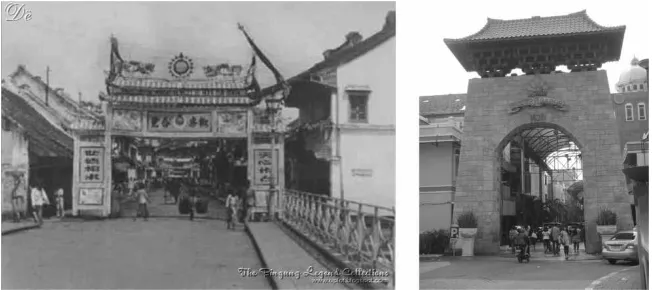
About 2.5 miles southeast from Glodok, there is another shopping landmark in Jakarta, called Pasar Baru, which literally means the new market, but is known as the shopping area built within Dutch the residential area in the 1850s. Most of the Pasar Baru shop owners are Chinese, and the residential areas surrounding the place are also inhabited by Chinese. Unlike Glodok, however, Pasar Baru has never been victim of anti-Chinese riots.3In fact, not long after the riot, the shop owners, with the project funded by the Jakarta City Council, built a new gate, which conspicuously displays the emblems of Chineseness (Figures 1 and 2). Why was such an area, which is confident of its Chineseness, spared from the anti-Chinese riot? What was the background behind the remarkable endurance and pliancy of the site? The reason lies in the construction Pasar Baru both as a market place and a space of particular social interaction, which is embedded in the history of Jakarta and the Dutch occupation. The Dutch spatial policy towards the Chinese residential area was based on division between those who could be integrated within the confines of Dutch establishment and those who should be excluded. I will show how this postcolonial legacy of spatial division between what is inside and outside bears on the present social position of Pasar Baru, and how the spatial arrangement relates to racial markings and social integration.
ISSN 1464-9373 Print/ISSN 1469-8447 Online/11/040552–16 © 2011 Taylor & Francis http://dx.doi.org/10.1080/14649373.2011.603918
Passer Baroe as a Dutch-formed racial pluralism and the Dutchhabitus4formation
It started with Governor J.P. Coen, who needed Chinese traders and farmers to help the development of Jayakarta to be a modern colonial Batavia, because he needed traders and hard labour who could supply food and other necessities for the Dutch forts. They worked on farm lands in the outskirts of the governmental and residential area of Batavia, which was then located in the fort around the estuary of the Jakarta Bay. The surrounding area of Batavia was then called the Ommelande. Here, the Dutch and Chinese opened the forest and started the coconut plantage/plantation (Raben 2007: 102–103). During the early Dutch colonial period, every Chinese who wanted to come to the city Batavia had to have a travel pass, and they were only allowed to enter through one gate, called Pintu Kecil (small door). There was another gate called Pintu Besar (big door). Today these two gates remain only as street names in the Glodok area.
The expansion of the Batavia fort towards the south along the river Ciliwung caused the growth of settlements and plantations in theOmmelande, which in turn invited the coming of new inhabitants. Besides Chinese, Javanese migrants were also prohibited by then the Vereei-nigde Oost-Indische Compagnie (Dutch East-India Company) to enter the city of Batavia, resulting in the exclusion of Muslim population for the next 150 years of the VOC rule in Batavia (Raben 2007: 102-103). In 1656–1657, VOC built six fortresses that were placed a mile from the city to watch over the growing population. More and more ethnic groups migrated to Ommelande, including the Mollucans, inhabitants of the Mollucan’s islands, who were colonialized and made Dutch soldiers. The mingling of this diverse population worried the VOC so that they separated them into different race/ethnic-based settlements in theOmmelande.
The Dutch Indies government had the earliest record of the Chinese population in 1620, even though their existence had been acknowledged way before that. Their numbers were growing rapidly, even though their population in Batavia was limited by various regulations that were both colonialist and racist. The VOC was uneasy about their increasing number and tried to pressure or even blackmail them. By then, rumours about a Chinese plan to attack Batavia were spreading (Haris 2007: 153). The growing numbers of Chinese peasants, manual workers and traders worried the Dutch Governor, Valckenier, who decided to Figure 1 and Figure 2 Two gates of Pasar Baru, left side from 1850 and right side after 1998 (source: Uplot 2006). Pasar Baru got a Chinese gate in 1850 during Dutch colonial period, which was gone after the independence. The new‘Chinese’gate, erected after 1998, resembles the great wall of China and was massive in contrast to the colonial one.
reduce their numbers. Hence there was the massacre of more than 10,000 Chinese in 1740 (Toer 1998: 124).
As a result of the massacre of 1740, many Chinese ran away to the remote areas, leaving their farms and plantations. Because of that, VOC tried to draw them back by giving them the power to collect market tax and to work in the trading field (Toer 1998: 167). Many Chinese made the best of this VOC policy and grew to be entrepreneurs and traders. They were also skilled workers and some were resourceful in collecting and lending money.5 In the 18th century, as the Batavia city expanded to the hinterland, the entrepreneurial Chinese and skilled workers who had climbed the social ladder were integrated into the new Dutch area, while the peasants and the workers remained outside in the Ommelande area.
In the eighteenth century, as the Dutch considered the air in the Old Town North had turned bad for health, the Dutch expatriates started to look for a new area in which to settle down. This area was initially seen as a hinterland and was mainly forest, unpopulated by the Dutch. The land around what is now known as Lapangan Banteng area was given to a man named Anthonij Paviljoen, and after that the fort Noordwijk was built there to keep the area safe. The open field where Paviljoen’s cattle fed on grass was then calledPaviljoensveld, the first name of Lapangan Banteng (Haris 2007: 149). Meanwhile, around the river Ciliwung in that area there was already a neighbourhood of Chinese immigrants who cultivated their land, renting it from Dutch landlords. The land then fell to the arms of Cornelis Chastelein, who opened it as a farm, bringing slaves from Bali. He started a coffee plantation right in the heart of what is now the city of Jakarta. Aside from that, he built a resting house near Lapan-gan Banteng which he calledWeltevreden(Very Satisfied). This name was then used for almost all of the area that has now become Central Jakarta.
During the time of expansion in the beginning of the 18th century, upper VOC officials bought lands in southern Batavia, and builtlandhuizenor villas and open plantations. Some par-ticular lands were rented out to the Chinese for plantations too, and some streets there still bear the name from that time, such as Kebon Kacang (nut plantation), Kebon Sirih (betel plantation), and Kebon Jahe (ginger plantation) (Haris 2007: 137–138). After Vinck, the next owner of Wel-tevreden was Governor General Jacob Mosel (1704–1761), and under him the area started to become the centre of government, not only for Batavia but for the whole region where VOC ruled. He also added the grandness of the big house that carried the name Weltevreden.6 Mosel was replaced by Governor General van der Parra, who loved luxury and festivity. Wel-tevreden then had become the centre of the economy for it had grown into a small town with a busy market. There were two bustling market places, called the Pasar Tanah Abang (The Tanah Abang Market) and the Pasar Senin (The Monday Market). Governor General van der Parra sold the thriving Weltevreden to Governor General van Overstraten (1797–1801). He made this area the centre of government by building military camps and government buildings (Heuken 1982: 153). Therefore, the Weltevreden vicinity (from Pasar Senin to Lapangan Banteng) had replaced the Old Town in the north as the centre of government, and the Dutch and other residents who could afford it moved here. The relocation of people in the 18th century from inside the fort to the neighbourhood with plantations that developed outside helped the growth of the city of Batavia. This land expansion, which was originally limited to the inside of the Dutch Indies forts, caused Batavia to evolve as a more open town.
The ability to trade made some enterprising Chinese settle in a‘shopping area’called Passer Baroe, built by the Dutch in 1820 near their ‘new’ settlement away from the harbour Sunda Kelapa (northern Jakarta) into the hinterland. Passer Baroe, which literally means the new market, emerged as a new alternative that time, because the two existing markets, Pasar Senin and Pasar Tanah Abang,7 could not sufficiently serve any more the thriving lifestyle and consumption of the Dutch community in the hinterland.
When the new market grew, most of the shops were owned by the Chinese (Heuken 1982: 119). Passer Baroe continued to grow to be a busy shopping centre, crowded by the people of
Batavia. The strong presence of the Chinese was indicated by the grand house of a Chinese Mayor, built in the early 20th century.8 Besides houses with the Chinese style, there were houses or buildings in the Dutch style, indicating that the Dutch also lived in this area.
The development of Passer Baroe as a multi-racial shopping centre was framed within Dutch colonial politics, especially concerning the Chinese population (Figure 3). Within this colonial policy, the integration of the Chinese to the society was divided into two distinct groups, the much-needed skilled labour and the peasant or hard labour. The first group, which was amenable to supporting the Dutch lifestyle, was allowed to reside within Dutch establishments, while the second group was largely kept outside the city by the two gates (Pintu Kecil and Pintu Besar) mentioned earlier.
Pasar Baru, located in Central Jakarta, is now considered as one of the oldest or former residential areas of the Dutch expatriate in Batavia. How the new settlement‘Weltevreden’
was developed to a‘habitus’ of the expatriate from Europe or Holland is described in a book written by a young Dutch soldier who came to fulfil his duty in Batavia. What is rel-evant in this narrative account is the soldier’s observation of the multi-racial atmosphere of the Passer Baroe and theperanakannature of the Chinese residing in Passer Baroe.9
Once upon a time, an 18-year-old soldier who came from Amsterdam and had just entered the military academy in 1892, experienced the adventure he had been dreaming of for so long.10 He was to serve duty in the seventh infantry regiment, and was posted in Batavia. In his view, the Dutch Indies was a collection of green islands resembling a giant flower arrangement in the middle of the ocean. Seashores shaded by trees, and Krakatau volcano in the middle of a strait. This soldier was so happy thinking about the beauty of the Dutch Indies that his words could not describe it (Brousson 2007: 11). When approaching the island of Java, he enjoyed the beautiful island scenery, and thought that he finally reached Figure 3. Map of Batavia (source: Herbowo 1989: 6). The arrow indicated the moving of Dutch site in the 19th century to the hinterland and to form their‘Weltevreden’. The star indicates the site where Passer Baroe developed from an area intended for the Chinese
population.
the land he had been longing for. After serving for many years, he wrote about all his experi-ence and impressions on the Dutch Indies in a journal, and sent it to a magazine editor named H.C.C. Clockener Brousson. In the soldier’s words, not only the scenery of the Dutch Indies was pretty, a part of Batavia that he considered beautiful was Weltevreden. The soldier marched in front ofKoningsplein, which he thought was extraordinarily beautiful, passing the protestant churchWillemskerk, crossingHertogspark, the place where the commander of the troop lived, to the military camps of Batavia (Brousson 2007: 18).
The soldier walked aroundWeltevredenand arrived in Passer Baroe, which he wrote as De Nieuwe Markt, a crowded Chinese quarter, where houses in the streets also functioned as shops. Besides Chinese, there were also some Indian, Japanese, and Keling (people from South India with dark skin) merchants. Even though it was a Chinese quarter, he thought that the place felt different from the Chinatown area in Glodok (Brousson 2007: 120). Most of the inhabitants there were Chinese people who had lived in the Dutch Indies for a long time and even mixed with the natives. These people were called Babah and they spoke Malay, Dutch, and English (Brousson 2007: 123).
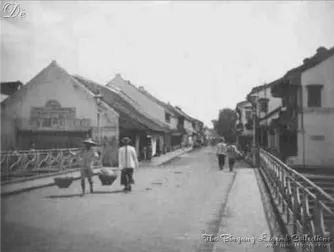
From the description of this unnamed soldier, there are a few things to be noted when talking about Passer Baroe: that this area had long been populated by people of Chinese descent, also called Babah,11who mixed with the natives and spoke Malay. The Chinese merchants in Passer Baroe were different from the ones residing in Ommelande, where later the Glodok market emerged, because the ones in Passer Baroe had acculturated with the natives and got the chance to interact with the Dutch and the Indo-Dutch people who came to shop.12Apart from that, Passer Baroe was also known among the Dutch as a place to order quality shoes and clothing. At the time the Dutch Indies government ruled, Passer Baroe was a shopping centre for the mid-upper class,13serving customers from various nationalities. Although serving various national-ities, the Chinese there were not completely immersed into the‘habitus’of the Dutch. They pre-served their Chinese culture and tradition because that was what was expected from this site, an exotic place and market for the European dwellers. Figure 4 shows Passer Baroe in the early 20th century with a Chinese man strolling, still wearing his long pig-tail hair, and the native
‘pribumi’shown as a vegetable seller carrying his basket, the picture seems to be very idyllic but it shows how exoticism was used to enliven the plurality in Passer Baroe.
Race discrimination within the Dutchhabitus
The historical development of Passer Baroe during the colonial time shows how a space with an original function as an alternative market for a colonial establishment gradually trans-formed into a space integrated into the Dutch colonial habitus, and later on a meeting place for a cross-cultural interaction. However, then, the social interaction did not occur on
Figure 4. Passer Baroe in the early 20th century (source: Uplot 2006).
equal terms. The VOC and the Dutch Indies government as the ruling institutions conducted internal politics based on racial segregation to control the interaction of the population in East Indies. This discrimination was regulated by a law that divided the non-Dutch people into three categories. The first was the one that held a special position with privileges, the Eur-opeans orEuropeanen, while the second category–called the foreign easterners orvreemde osterlingen–consisted of Chinese, Arabs, and Indians. The third and the lowest in the hierar-chy were the indigenous population orinlanders(Lubis 2008: 79–80). However, this racial cat-egorization was inconsistent, as the Japanese, Filipinos, and Thais who were then not colonized were put into the first category. They were deemed equal to the Europeans. Appar-ently, the economic achievements of the individuals played a role in increasing their social status, so that they can transcend the racial categories (Lubis 2008: 80).
The Chinese were particularly dubbedChinezenbecause of their large population and that they brought problems to the rulers. Discrimination was also reflected in thewijkenstelsel14rule, a rule about segregated residential areas for the racial groups lower than the Europeans. For example, if someone who lived inChineesche wijkwanted to go outside of his area, he must obtain a certain pass, and this was also regulated in a law calledpassenstelsel. These racist prac-tices sparked hatred in the Chinatowns. The Dutch Indies government implemented this regu-lation at the end of the 19th century (to the early twentieth century). Afterwards, they finally abolished thewijkenstelselso that the Chinese could reside anywhere they wanted.15
Passer Baroe was originally a Chinesewijk, as it was build within the place, where many Chinese migrants resided as plantation workers before the Dutch expanded the Batavia city to the hinterland. Chinese skilled workers were also moved to this area with the moving of the Dutch masters. Soon the forests and living spaces along the Ciliwung River grew into a place for trading, and the Passer Baroe market, with the highly skilled workers opening their trades, became a place for the Dutch to shop. The transition from exclusive Chinese area to an open market could be seen from the changes of the architecture style in Passer Baroe. The ear-liest building had architectural elements that were distinctively of Chinese influence. It was only later in the end of nineteenth century that a building with mixed Chinese-Dutch style was found. This building was the house of Pasar Baroe’s Mayor, and this proved that Passer Baroe was no longer regarded as a‘semi-wild’, unkempt exclusively Chinese neigh-bourhood. This area had then become a part of the Dutch Indies region, and this elevated Passer Baroe’s status to be almost at the same level with the Dutch immigrants’area. This could also be seen with the construction of several buildings in Passer Baroe’s vicinity that functioned as government and military establishments,16and also buildings that marked
cul-tural activities of the time, like Gedung Kesenian Jakarta (originally namedSchouwburg), a neo-classic building for arts and performances, located right across Passer Baroe (Figure 5).
Figure 5. Schouwburg, 1900 (now: Gedung Kesenian Jakarta) (source: Uplot 2006).
This place brought cultural life to theWeltevredenarea, and it showed that the area had the potential to become a public space for the Dutch who desired a life like they lived back in their hometowns (the Dutch Indies was considered a tropical land that was unhealthy, popu-lated by the uncivilized people). As the wijkenstelsel was abandoned in 1866, more mobility among different nationalities and races occurred in the Dutch Indies. Passer Baroe became a site where cross-cultural contacts took place between the Dutch and the natives, the Chinese and Indian people, and others. Since the opening of the market, many indigenous vendors and pedlars had frequented the place. Dutch colonial workers from Indian and other back-grounds who resided near the place started to do business at the site. The cross-cultural inter-action gave Passer Baroe its significance as a site of cultural diversity, reflected in the way the Chinese and European style buildings stood side by side.
In the vicinity of Passer Baroe there stood an Ursulin convent school for girls, located in Jalan Pos (then called the Postweg). Founded in 1859, this school, called Santa Ursula, indi-cated that cultural life was of utmost importance in the area. Next to Santa Ursula was the historical Gedung Pos (post office building), officially opened in 1912. Later on, the older part of the post office building facing the Ciliwung River was exclusively used for philately, while postal activities were moved to the building in front of the open land of the Lapangan Banteng. This area became an elite neighbourhood, comparable to Menteng and Pondok Indah, the elitist area in Jakarta today, where upper middle classes live.17At that time, the upper class society only consisted of Dutch people.
The Dutch elites in this area also had their own district (wijk), and at that time, the natives, Chinese, and people of other races were not allowed to live in these districts. The Dutchwijk wereNordwijk(jalan Juanda) andRijswijk(jalan Veteran). These streets were lined with tall leafy trees, and the houses were painted in white. There were also buildings that functioned as social clubs for the Dutch elites, likeSocietijt Harmonie, a neo-classical building that was first built by Daendels in 1810 and was finished in the Raffles era in 1814, located inNordwijk (unfortunately this building was torn down in 1985). InRijswijkthere were a few luxurious shops, such as a Parisian boutique called Oger Freres.18 This kind of setting in the 19th century, especially the second half of it, was a distinctive feature, a marker of a certain high-class habitus. It also indicated of a power structure, which was not only military and pol-itical, but cultural, with clear European characteristics.
The European culture brought by the colonial rulers to civilize Passer Baroe and the sur-rounding area was aimed at making it a part of Dutch Indies authority. The existence of Chinese culture in Pasar Baru was also a part of it, because Dutch Indies government ruled the site through a Chinese Mayor who lived in the area. Therefore, it can be said that the pre-served cultural diversity in Pasar Baru was not merely a form of pluralism, but because of an economic necessity for providing the European establishment with various goods to support their lifestyle, and the skills for serving them at cheaper cost compared with importing goods and human resources from the Netherlands. A more noticeable change became apparent in the early years of the 20th century, when Passer Baroe started to be immersed in the era of freedom. The Independence of Indonesia in 1945 had left Pasar Baru with no other choice than to con-tinue its process of transformation.
Pasar Baru after the independence war
After the Dutch finally left Indonesia, Pasar Baru19was left with a problem: how to maintain its identity as a shopping centre. The expatriate was not there anymore, so Pasar Baru had to gain customers from Jakarta, the capital of the new Republic of Indonesia. The transformation to contemporary Jakarta had to take place. Meanwhile, the new Republic of Indonesia did not, or maybe could not, in that time handle the transformation of the social world in Jakarta from the Dutch‘habitus’to the multi-ethnic societies. In this process, the Chinese
were not the only ones who had to adjust to the new era, for so did the Indonesian-born Indians, and the indigenous population who were there already since the Dutch time, working as small traders, and vegetable and fruit vendors. So Pasar Baru had to develop this multi-ethnicity for profit, and owned it as its identity (Figure 6).
Figure 6. Contemporary Jakarta (source: Map of the City n.d.). The arrow indicates the site of Pasar Baru nowadays. The triangle indicates the site of Batavia prior to the 19th
century.
Figure 7. Pasar Baru in the 1950s (source: Uplot 2006).
The notion of modernity infiltrated Pasar Baru after independence, and this was not sur-prising as the advancing communication and media technologies had made the people more exposed to western cultures. But this time the western culture did not enter forcibly, as when the Dutch Indies government used domination and power over native Indonesians. Moder-nity came through the appealing images of western world that were considered more advanced and sophisticated. This can be seen in the various names used for the shops in Pasar Baru. In the Dutch Indies era, the shop names were linked to the owners;20while in the 1950s up to the present, the shops were named with country names or English words.
Figure 7 shows Pasar Baru in the 1950s. Noticeable in the picture is the sport utilities shop with the tennis racket, which can be interpreted as a sign of movement towards the inter-national level and progressing into the Western world in a different way from its colonial past. The progress towards the international level was translated into the transition of the
‘ideal’Western world of Anglo-American countries. This is maybe the reason for choosing Western names for their shops when the Indonesian government under Suharto in the 1960s prohibited the use of Chinese names. Here we see how the shop owners have to fit in with the government policy and the demand of goods from their costumers, for whom Pasar Baru is well known as the place to buy quality products, such as shoes, tailor-made clothes, sports utilities, musical instruments (earlier the gramophone and later music cas-settes) and also fashion goods.
The type of business that still lasts until now is shoe shops. It is interesting to see how the shoe shops are sporting foreign city and country names, such as‘Toronto’,‘Canada’,
‘Italy’, and ‘Holland’. There are possibilities that the shop owners have relatives or chil-dren in Toronto, Canada. However, this sort of naming system most likely possesses a meaning beyond what is obvious, a desire to show that the goods sold in these shops are as sophisticated and as advanced as the city or country that bears the name. The same applies to the name ‘Holland’, which refers to the Dutch Indies period. The name shows a certain cultural affinity. Many Chinese locals migrated to the Netherlands in the 1950s after the Indonesian government issued unfavourable rules against the Chinese. The choice of ‘Italy’ refers to the fact that Italy is internationally renowned for its elite shoemaking industry.
The sign of modernity is also apparent in the shop named ‘Popular’. This shop has existed since the 1950s, and is now selling bags and suitcases. In the 1960s to the 1980s, the shop was known as the one shop that specialized in Indonesian music cassettes. Currently, this newly renovated shop has a façade modelled after a renaissance structure and appears more prominent compared with other buildings in the vicinity. Pasar Baru, which is an arcade,21is unique due to the historical journey that is reflected on its shops’appearance. Besides the modern-looking shops, some still maintain the old structure from the colonial time. In fact, some of these shops deliberately display the year of their establishment, such as ‘Tjungtjung 1935’, ‘Lee Ie Seng 1873’, and the shop ‘Kompak’, with its ancient and mouldy appearance. The historical marks give the shops their value as tourist attractions (Figure 8).
Nowadays it is noticeable that many of the shoe shops along Pasar Baru’s arcade have identical names. Apart from the ones using city and country names (Figure 9), as mentioned earlier, there are shops using the same names:‘Sin Lie Seng’,‘Sinar Terang’, and‘Sinar Baru’. These shops originated from one famous shoemaker in the 1960s to 1970s, Sin Lie Seng, The skills of shoemakers in Pasar Baru have been acknowledged since the colonial period, as told in the story about Sapie Ie, a shoemaker who had loyal Dutch customers. He was so success-ful that the place where he produced and sold his shoes is now known as Gang Sapie Ie (Sapie Ie Alley).22The various efforts for modernization that the shops have attempted seem to be a crucial move to render Pasar Baru worthy of competition with other more sophisticated shop-ping centres and malls that are develoshop-ping rapidly in Jakarta.
Figure 8. The shops Popular, Kompak, Lee Ie Seng, and Tjungtjung (photo by author).
Figure 9. Shoe shops Canada, Toronto, Italy, and Holland (photo by author).
The shops that have close ties to Pasar Baru’s past, like‘Kompak’,‘Tjungtjung’, and‘Lee Ie Seng’, as well as‘Busana’(Figure 8) strive to continue to exist despite the many difficulties they face as a result of the changing of the era, as modernization and the physical restructur-ing of Jakarta also extend to Pasar Baru. Unfortunately, the maintenance of these time-ravaged yet historical shops is left entirely to the shop owners, who might not have the proper time and resources to handle it. These shops stand side by side with others that have undergone renovations and use foreign-sounding names to appear more modern and sophisticated. This juxtaposition of modernism and colonial heritage give Pasar Baru a certain charisma, a distinguishing character that puts Pasar Baru as one of Jakarta’s assets, as it also tells of the city’s long, rich history.
A great number of buildings and shops in Pasar Baru have been replaced or renovated, some torn down, or changed function. For example, a building that was once a drug store is now brightened up with the art deco style appropriate for a tropical climate by adding water and sunlight-resistant windows. Inside this building (Figure 10) we can see stained glass windows with traditional motifs, such as a goblet and snake (symbol of medicine) on the right-hand side, while on the left-hand side we can see a symbol of a stone mortar. These various symbols of apothecary give hybrid cultural references. The goblet is a Greek symbol, referring to the European nature of the Dutch colonial heritage, while the stone mortar is used in making local traditional herbal medicines. This hybridity of the building and its interior reveals that a pluralistic life is important to Pasar Baru as a site of public space.
Peranakanculture in Pasar Baru
The peranakan Chinese culture, and especially cuisine, which is adapted to local taste gives colour to the plurality of Pasar Baru.23Pasar Baru has been known as a centre for Chinese food frequented by the locals, but this was before Jakarta was transformed into a glimmering metropolitan city with new people in the middle upper social classes. Now Pasar Baru has to compete with other culinary centres. However, some older restaurants remained, for example the popular Bakmi Kelinci (name of a noodle restaurant) and the restaurant Sui Sen (famous for rice with various pork dishes).Bakmior boiled noodles are common everyday foods that can be cooked easily, but the two generations of the family that maintains the Bakmi Kelinci restaurant business have their own special recipe and techniques that make the place popular among culinary enthusiasts in Jakarta.
The first Bakmi Kelinci is located right in front of the entrance to Pasar Baru’s wet market and was originally known as Bakmi Aboen. The place was very simple and humble, using the small front yard as the kitchen area and the owner’s living room as the restaurant area. The second generation of owners could not reach an agreement to run the business together, so they split and now there can also be found a restaurant in a newer, bigger building in jalan Figure 10. Formerly a drugstore (‘apotheek’), now a clothing shop (photo by author).
Figure 11. Lontar fruits, traditional cakes, bakmi Sui Sen (photo by author).
Figure 12. Clockwise from top left: Gereja Kelinci, Gurudwara Sikh Temple, Vihara Sin Tek Bio, Gereja Ayam (photo by author).
Kelinci, with the name Bakmi Kelinci. Apart from Bakmi Aboen, there are other Chinese food restaurants serving noodles,nasi campur, and other Chinese dishes, like Sui Sen (Figure 11). In the Pasar Baru arcade, there is a restaurant that was established in the 1950s called Tropic, which has done business for two generations now. In accordance with its name, this restau-rant serves hybrid Chinese-European-Indonesian dishes, such asmie yamin,mie pangsit, gado-gado,laksa, and the star of the restaurant menu, homemade ice cream and sodagembira24as a nostalgic drink towards the Dutch era. In the arcade there can also be found a fruit vendor selling indigenous plants such aslontar,buah atap, guava, mango, and some others. There are also local/betawinese cakes such askue ape,kue pancong,kue semprong, and so on.
The plurality that forms–and is also formed by–these cultural elements, religious and culinary, is part of the everyday lives at this site. All of it has a particular meaning for the people in the area. The collective memory of its people, who have inherited stories and wit-nessed the passing of history, has become a part of their identities. Their cultural heritage, a hybrid culture consisting of plural European, Chinese, Indian, and Betawinese (native Jakarta) cultures, is a form of defence to the rapid physical changes happening around them. The cultural diversity in Pasar Baru became even more evident after the arrival of Indian immigrants in the 1920s, after the First World War. After India’s independence and separ-ation from Pakistan in 1947, there was an even larger Indian diaspora in Pasar Baru. It can be said that, since the 1950s, the number of Indian immigrants in Pasar Baru increased signifi-cantly. The majority came from the Punjabi and Sind region. The increasing Indian popu-lation in the area brought a direct physical change of the space, as in the construction of a Sikh Temple, a modest building located in Jalan Pasar Baru Timur (east Pasar Baru), in 1955 (Gurudwara Sikh Temple n.d.). The Indian merchants filled the need for textile and sport equipment. They also offer tailoring services for suits, trousers, and dresses at a reason-able price. One example is the tailor‘Isardas’, now owned by the third generation of the Isarda family25 (Figure 12). Other examples are ‘Sri Vishnu Tailor’ and ‘Hariom Tailor’,
which still exist up to the present.
The Indian diaspora is also evident with the opening of an Indian salon called‘Heritage’
and a mini-market selling everyday Indian goods,‘Shalimar’. Part of this Indian community has become Indonesian citizens, even though many of them still hold their Indian citizenship. The native Jakarta people call them the Bombays (Lubis 2008: 95), and therefore their shops are usually called Bombay shops (even though there is a textile shop particularly named ‘Bombay Textile’), this is perhaps caused by the general perception of the city Bombay, now Mumbai. There are alsomartabak sellers bearing the name‘Martabak India’, while the food they sell is most likely different from what they have in India. Besides food, we can also see the plurality in religious buildings in the area of Pasar Baru. Not only does the area consist of temples, both Chinese and Indian, but there are also at least two churches. The pluralistic life in Pasar Baru can also be seen in the many religious establishments in the area. There are two Chinese Temples, two Protestant churches called Gereja Ayam (the
‘rooster church’, because of the rooster statue on top of the dome), and the GKI church, the Catholic cathedral across Pasar Baru that was built in the 1930s,26and a Sikh Temple. In addition, in the last ten years there stood worshipping centres for Sai Baba and Hare Krishna, both located on jalan Pasar Baru Selatan (south Pasar Baru). These places are social and religious spaces essential for the immigrants, who formed diaspora in the new land–the Dutch Indies, and now Indonesia.
Conclusion
The hybrid nature of Pasar Baru described above shows how the space has evolved from being an exclusive site for a racial group, to a space of cross-cultural interaction, which was owned by all. The fact that the shop owners of Pasar Baru, regardless of their ethnic
background, decided after 1998 to build a distinctly Chinese looking gate suggests that Chi-neseness in Pasar Baru is seen as a common heritage. The building of the gate certainly has an economic interest, as Pasar Baru has to compete with the booming of super modern malls all over Jakarta.27Cultural heritage, therefore, is seen as a marketing device.
However, the display of Chineseness also suggests a confidence of social integration, something that cannot be taken for granted in the late 1990s. This is seen from the fate of other Chinese centres, such as Glodok, which became the target of rioting. To be fair, Glodok, as one of the oldest and most well known shopping centres for cheap, electronic goods and other practical utensils, is an inseparable part of Jakarta, frequented by people of all backgrounds. However, the place is still seen as exclusively Chinese in its ownership and dwellings.
Both Pasar Baru and the Glodok shopping centres are a postcolonial legacy, which speaks about both the tenacity and pliancy of spatial and racial politics. It is ironic that the Dutch-made cosmopolitan hybrid modernity actually offers a (partial) solution to multi-ethnic urban society, while at the same time, the colonial othering based on race and class (the lower class Chinese) actually aggravates the inter-group conflict in the metropolis.
The handling of the Chinese in the Dutch habitus continued in the twentieth century and after Independence. In a way, the Indonesian government has uncritically continued the spatial and racial politics without any intervention. The evolving of Jakarta as a metropolis has given rise to new segregated areas, with apparent racial markings, such as the Chinese populated areas in the north, west and northeast of Jakarta. Unlike the colonial time, this development was not imposed by the state, but from the social interaction that was allowed to occur in the expanding city.
The Dutch type of plural modernity depicted in Pasar Baru towards the end of its rule is certainly class-based, and made to benefit and support their Europeanhabitus. As seen from the absence of State intervention in spatial and racial politics above, the role of the new nation of Indonesia to give a new definition of multicultural modernity, remains highly questionable.
Left to its own market mechanism, the city and its markets have evolved in its own ways. Compared with the glamorous future-oriented super malls in Jakarta, and the basic day-to-day survival appearance and pricing of Glodok market, Pasar Baru, which was initially for the upper classes, now occupies the middle position, which allows for more mingling of the social classes. It is a space where the past, the present and the future are mixed, and atti-tudes towards identities are consumed in a relaxed modernity. Whether this is an alternative for the future of a multicultural city remains to be seen.
Notes
1. Seno Gumira Ajidarma (2004: 105).
2. This was not the only riot that targeted the Chinese in the history of Jakarta since the occupation of the VOC and the Dutch.
3. As some of the residents in Pasar Baru for more than 50 years, my family has never experienced any of the rioting that hit the Chinese and their belongings.
4. The wordhabitusis used to describe the whole content of the lifestyle and trappings of the Dutch expatriate during the occupation in Batavia, especially in the 19th century. I use the word in the attempt to show that the Dutch were bringing along their European lifestyle while they were also trying to fit in the space that was already multiethnic in Batavia. They used the Passer Baroe marketplace as a space to support their European lifestyle, and by doing so they made it theirs.
5. The profession of money lender caused the Chinese to be stereotyped by the indigenous population as
‘lintah darat’(leeches), who suck people’s fortune to extort profit. See Haris (2007: 153).
6. Unfortunately there’s nothing left of this beautiful building now, and on the spot where it once was now stands Angkatan Darat (National Army) Hospital in A. Rahman Saleh Street.
7. Justinus Vinck in 1733 bought the land and opened these two markets, and later on built a street (now called Jalan Prapatan and Kebon Sirih) connecting the two markets in 1735. See Heuken (1982: 151).
8. ‘The Mayor of the Passer Baroe lived in a beautiful Chinese styled house with two giant lanterns, with dark red colour. The veranda was decked with red lanterns. We could not see the interior, but what we saw was definitely majestic and beautiful’(Heuken 1982: 120, author’s translation.).
9. Peranakanis a term to refer to the hybrid culture of the Chinese who assimilated with the indigenous popu-lation. Usually when we use the wordPeranakanit is only for the Indonesian-born Chinese, this has been also the discussion along the history of Chinese diaspora in Indonesia. Pramoedya Ananta Toer has suggested the wordHoakiau, which has the meaning of overseas Chinese instead ofPeranakanorBabah. Anyway, the wordPeranakan has been transplanted in the mind of Indonesians as a description of Chinese who were born and raised together with the native Pribumi and other ethnicities in Indonesia. Other ethnicities such as Indian or Arab, who also have been born here have not been named Peranakan or Babah. The naming is due to the segregation policy of the VOC and the Dutch occupation’s race policy, which I mentioned earlier. So, within the Chinese society there are two distinctions already planted long ago by the Dutch colonial power; no wonder even thePeranakanChinese have a certain‘ unbe-hagen’(a German word that describe a certain uneasiness towards others who we consider alien or other) towards the non-PeranakanChinese.
10. There has been many books about the Dutch Indies available recently, translated from Dutch. Among these is the book written by H.C.C Clockner Brousson.
11. For the definition of Babah, see Hoay (2001: 408).
12. ‘Pasar Baru was always busy with pedastrian and sado. In the morning the European ladies and mestizo (half-Indonesian, half-Dutch) ladies going shopping’(Brousson 2007: 120, author’s translation).
13. Around Passer Baroe were areas inhabited by Dutch immigrants such asRijswikandNoordwijkand also government buildings. There were also the convent Ursulin, the art houseSchouwburg, and the central office ofPost en Telegraaf(Brousson 2007: 124–125).
14. This practice ofwijkenstelselin 1835, according to Pramoedya Ananta Toer, Indonesia’s most famous nove-list who wrote on colonial times, is similar to building a ghetto (as in Europe) for the Chinese population of Batavia. See Toer (1998: 125).
15. More about this can be read in Tio Tek Hong’s (2006) biography.
16. Gedung Pancasila (the Pancasila Building) in Pejambon street, in the old times was the house of a military chief (Heuken 1982: 162).
17. ‘The fame of“Passer Baroe”was admitted during the time of the VOC. The area of Passer Baroe was known as an elite area because it was close to the Rijswijk (now Jalan Veteran), which was built by the Dutch company for rich people in Batavia. Yes, now it can be compared to the Menteng or Pondok Indah area’; see Uplot (2006).
18. Adolf Heuken in his bookHistorical sights of Jakartawent through parts of Jakarta that were once the centres of Dutch Indies colonial life with a meticulousness such that it can be seen in accurate maps and photos of beautiful colonial buildings that no longer exist.
19. Pasar Baru got its present spelling after independence.
20. For example, the shop owned by Tio Tek Hong was named NV. Tio Tek Hong. See Tio Tek Hong (2006: 23). 21. Pasar Baru got its arcade structure when the owners of shops in Pasar Baru constructed a high roof made of plastic above the lane lined with shops. In addition, mosaic-shaped granite floors were put in front of the entrance gate. These things were done after the May 1998 riot. Pasar Baru was then restricted to pedestrians, but this rule is often disobeyed. By giving some money to the guards, cars can pass the street and even park in front of shops, this clearly annoying pedestrians’comfort. Starting in 2011, Pasar Baru is no longer pedes-trianized, as the owners have lifted the restriction on cars entering the site.
22. Justinus van Maurik (1897) wrote in his bookIndrukken van een Totok, Indische Type en Schetsen(‘Impression of a Totok (new comer), East-Indies Type and Sketch’) about his experience ordering a pair of shoes from a well-known craftsman in the area, Sapie Ie. The street where the craftsman used to live still bears his name, Sapie Ie Alley. See risma budiyani (2006).
23. Food hybridity in South-East Asia, especially which consumed and produced by the Chinese-born population in Indonesia, Singapore and Malaysia is called in bahasa Indonesia‘peranakan’(born in the host-land); food also influenced the formation and establishment of‘peranakan’culture. Later the word
‘peranakan’was also adopted in Singapore and Malaysia.
24. ‘Gembira’means happy; this is a drink made of soda bicarbonate and sweet, usually red, syrup added to crushed ice cubes. The drink was developed during the Dutch era, maybe in the early 20th century, and was especially well-known in the Pasar Gambir, a kind of night-carnival in Batavia.
25. ‘Our family business has its roots in textiles. When my father, Isarda Sadhwani, came here, he opened a textiles shop and offered tailoring services,’said Gobind Hiro Sadhwani, third generation Indian trader (Febrina 2006).
26. The cathedral situated just across the street of the great mosque‘Istiqlal’, symbolizing the many religions in Indonesia.
27. Another global context is the rise of China as the new economic super power in the region.
References
Ajidarma, Seno Gumira (2004)‘Does Jakarta still mean victory?’ ‘Masihkah Jakarta Berarti Kemenangan?’. In
Affair, A Chat about Jakarta (Affair, Obrolan tentang Jakarta), Yogyakarta: Buku Baik, 105–108.
Brousson and Clockener, H.C.C. (2007)Jakarta in the Early 20th Century (Batavia Awal Abad 20), Jakarta: Masup. Febrina, Anissa S. (2006)‘Traders change with the times in Pasar Baru: Jakarta, Indonesia’,Planet Mole,
17 August, http://www.planetmole.org/indonesian-news/traders-change-with-the-times-in-pasar-baru-jakarta-indonesia.html, accessed 10 April 2011.
Gurudwara Sikh, Temple (n.d)‘Brief history’, http://sikhtemplejakarta.com/, 10 April 2011.
Haris, Tawalinuddin (2007) The City and Community of Jakarta, From a Traditional Town to a Colonial City (16th–18th century) (Kota dan Masyarakat Jakarta, Dari Kota Tradisional ke Kota Kolonial [Abad XVI–XVIII]), Jakarta: Wedatama Widyasastra.
Herbowo (ed.) (1989)Jakarta, Jakarta: The Government of Jakarta (Pemerintah Daerah Khusus Ibukota Jakarta). Heuken, Adolf (1982)Historical Sights of Jakarta, Jakarta: Cipta Lokacaraka.
Hoay, Kwee Tek (2001)‘The cause of Chinese movement’ ‘Asal Mulahnya Timbul Pergerakan Tionghoa’. In Marcus As, Pax Benedanto (eds)History of Chinese Malay Literature (Kesastraan Melayu Tionghoa), Vol. 4, Jakarta: Kepustakaan Populer Gramedia, 393–534.
Lubis, Firman (2008)Jakarta in the 1950s, Memories During Teenage Years (Jakarta 1950-an, Kenangan Semasa Remaja), Jakarta: Masup.
Map of the City (Gambar Peta kota) (n.d)‘Map of Jakarta, Capital of Indonesia’ ‘Gambar Peta DKI Jakarta Indonesia’, http://2.bp.blogspot.com/_MgfFnb8nlkU/S5ycqYS2SyI/AAAAAAAACsg/ZThfp7l4bOM/ s1600-h/peta_jakarta_utara.gif, accessed 8 June 2011.
Raben, Remco (2007)‘Around Batavia: ethnicity and authority in Ommelande, 1650–1800’ ‘Seputar Batavia: etnisitas dan otoritas di Ommelanden, 1650–1800’. In Kees Grijns and Peter J.M. Nas (eds) Jakarta Batavia, a Socio-Cultural Essay (Jakarta Batavia, Esai Sosio-Kultural), Jakarta: KITLV, 101–122.
risma, budiyani (2006) ‘Passer Baroe in history’, http://rheesma.blogspot.com/2006/11/passer-baroe-in-history.html, accessed 8 April 2011.
Tek Hong, Tio (2006)Jakarta in the Past. A Memory 1882–1959 (Keadaan Jakarta Tempo Doeloe. Sebuah Kenangan 1882–1959), Jakarta: Masup.
Toer, Pramoedya Ananta (1998)Hoakiau in Indonesia (Hoakiau di Indonesia), Jakarta: Garba Budaya.
Uplot (2006)‘Pasar Baru now and then: looking at the glory in the past‘ ‘Pasar Baru Dulu & Kini. Mengintip Kejayaan Passer Baroe’di Masa Lampau’, http://kotatua.blogspot.com/2006/08/pasar-baru-dulu-kini. html, accessed 18 April 2011.
Author’s biography
Lilawati Kurnia teaches at the German Department and Cultural Studies Master Programme at the Faculty of Humanities, Universitas Indonesia. She got her PhD at the Faculty of Humanities, UI and her M.A from Gesamthochschule Kassel, Germany. She has published several articles, for example,‘Fire in mind: collective memroy in Sapardi Djoko Damono’s poetry’ ‘Api dalam Ingatan. Memori Kolektif dalam Puisi Sapardi Djoko Damono’, inAnthology‘reading Sapardi’(Anthology‘Membaca Sapardi’) (Obor Publisher, 2010);‘The art of culinary, power and multiculturalism inMaster Cooking Boyby Etsushi Ogawa’, inWacana(Vol. 8, No. 2, 2006). She also translates in her free time and has publishedPublic space, identity and collective memory: post-Suharto Jakarta (English-Bahasa Indonesia Ruang Publik, Identitas dan Memori Kolektif: Jakarta Pasca-Suharto) (author: Abidin Kusno, Yogyakarta: Ombak, 2009); and three German children’s books published by Obor Publisher.
Contact address:Email: [email protected]