37
DETERMINANT OF CORPORATE SOCIAL RESPONSIBILITY:
CASE FROM INDONESIA
Yusuf Sulfarano Barusman [email protected]
Lindrianasari Universitas Bandar Lampung
Universitas Lampung
ABSTRAK
Tujuan penelitian ini adalah untuk memberikan bukti empiris pada faktor-faktor yang mempengaruhi tingkat indeks pengungkapan pertanggungjawaban sosial perusahaan. Indeks pengungkapan pertanggungjawaban sosial perusahaan dalam penelitian ini menggunakan indeks GRI G3.1, yang terdiri dari enam poin utama, yaitu pengaruh ekonomi langsung, hal-hal yang berkaitan dengan lingkungan, praktik ketenagakerjaan, hak asasi manusia, sosial, dan tanggung jawab untuk produk. Data penelitian ini menggunakan data sekunder, yang diperoleh dari laporan tahunan perusahaan yang terdaftar di Bursa Efek Indonesia. Sampel yang digunakan dalam penelitian ini adalah sebanyak 20 perusahaan yang dipilih menggunakan penyempelan acak. Pengamatan yang dilakukan selama periode 2007-2014. Hasil penelitian ini menunjukkan bahwa kepemilikan (saham) pemerintah, spesifikasi perusahaan, dan ukuran perusahaan menjadi penentuan terbaik untuk indeks CSR. Selain itu, teori regulasi yang memprediksi bahwa keterlibatan pemerintah dapat mendorong lebih banyak perusahaan mematuhi aturan yang berlaku, berhasil dikonfirmasi dalam penelitian ini.
Kata kunci: pengungkapan pertanggungjawaban sosial, pemerintah share, spesifikasi perusahaan, ukuran perusahaan, umur perusahaan
ABSTRACT
The purpose of research is to provide empirical evidence of the factors that influence the extent of disclosure index of corporate social responsibility. Index of corporate social responsibility disclosure in this study using the GRI G3.1 index, which consists of six main points; the direct economic influence, matters related to the environment, labor practices, human rights, social, and responsibility for the product. The data of this study using secondary data, obtained from annual reports of companies listed in Indonesia Stock Exchange. The sample used in the study were as many as 20 companies were selected using random sampling. Observations made during the period 2007-2014. In the observation period, the Indonesian government issued Act No. 17, 2007 that one of its content requires the company in Indonesia to allocate funds for the social and environmental responsibility. The results of this study indicate that the ownership (stocks) government, the specifications of the company, and the size of the company become the best determination for CSR index. In addition, regulatory theory predicts that government involvement will encourage more companies adhere to the rules prevailing, successfully confirmed in this study.
Key words: Corporate Social Responsibility Index (CSRI) Disclosure, government share, firm specification, size, age
BACKGROUND
Today, the people of the world try to find a solution to solve the problems of climate change due to global warming. The signing of the Kyoto Protocol (Japan) on December 11, 1997 is a testament to the commitment of countries to stabilize GHG
Kyoto Protocol is (in average) reduction emission 5% in 37 industrialized countries and the European community in the first commitment period, 2008-2012 (http:// unfccc.int/kyoto_protocol/).
In Indonesia, the government issued Act No. 17/2004 in response to the Kyoto Protoko. In addition to Law No. 17 of 2004, there is no government policy which specifi-cally regulate carbon emissions reductions. Act No. 40/2007 on Limited Company includes Article 74 (1) which says that the company which runs its business activities in the field or related to the natural resour-ces required to implement the Social and Environmental Responsibility. Subsequent-ly, implemented a program of Corporate Social Responsibility (hereinafter will be referred to CSR) in Indonesia has been strengthened with the issuance of Govern-ment Regulation No. 47/2012 on Social and Environmental Responsibility for Limited Company. Realization Government Regula-tion 47/2012 is beginning of the second quarter of 2012. This regulation was issued to complete the things which previously have not been regulated in Law No. 40 Year 2007 on Limited Company. Through this policy, the Indonesian state requires that the company, especially those in that the activities of exploration and exploitation of natural resources, to conduct social responsibility.
Although not specifically address the problem of carbon emissions reduction, but the Act and Government Regulations has been much awaited Indonesian society. Regulations governing corporate social responsibility are expected to improve the quality of life. Corporate social respon-sibility is expected to improve the quality of life and social environment, promote human rights and produce products that are friendly to the environment. The fulfillment of these aspects will ultimately lead to economic growth in the company directly. Harmonization between the activities of the company with the social, environmental and human rights will ultimately impact the
decline in emissions (waste), one of which is carbon emissions. However, the lack of responsibility can disregard the rights of the needs of the most fundamental of human life, ie food, shelter, and clothing.
The previous study conducted by Lindrianasari and Asmaranti (2016) tested separately three times (2004, 2007, and 2012) the enforcement of laws relating to the environment in Indonesia. Three times is predicted to have the power relations at the level of adherence to the environment. Results of tests performed by using a sam-ple of 246 years of the company's 11 years of observations show that the disclosure of environmental information on food and beverage companies in Indonesia has increased significantly and better after legislation was issued. This finding suggests that since the Indonesian government to ratify the Kyoto Protocol in 2004, Indo-nesian companies more transparent in informing the environmental conservation activities that they do.
Corporate Social Responsibility (CSR) is a concept that describes that an entity have broad responsibilities for all stakeholders in all aspects of corporate activities that include economic, social, and environmental (three bottom line). Stakeholders such enti-ties among which is the consumer, govern-ment, employees, shareholders, communi-ties and the environment, and the wider community in the area of country. CSR is a balancing between operational company in that particular area to make profits with the community around the the company that will be impacted by the company's ope-rations. The impact of the company's operations is the waste in the form of litter, air pollution, water pollution, odor, and also vibration. CSR is given by the company aimed at reducing the negative impact of the the company’s waste.
sus-tainability, accountability, and transparen-cy. Sustainability is concerned with the current selection of activities taking into account the sustainability of the resources used in the future. Furthermore, as far as possible not to use resources that can not be regenerated.
Accountabilityrefers to the true meaning of that accountability, and or the conditions that must be accounted for. In addition, the terms of accountability also means the state for the requested accountability to the parties that manage the resources of entities, both private and public. In other words, accountability associated with the demand to account for the obligations entrusted to individuals or institutions. Accountability also be interpreted as a measure to control the actions to achieve a predetermined result.
In the social and environmental issues, accountability requires the development is done using the appropriate measurement and reporting on the environmental per-formance of each operation in the company.
Transparency is a principle, which means that the external impact of corporate action can be ensured through the information reported to the company and all the facts needed nothing is hidden in the report (Crowther and Aras, 2008).
Gray (2002) conducted research for 25 years on literature (journal) Accounting, Organizations and Society. The journal pre-sents a lot of research and also implement-ation of CSR conducted by researchers and companies. Gray argues that social account-ing is not a part that is fully accepted and well established for the company. In prac-tice, companies are not enthusiastic about adopting social and environmental account-ing. This is because these issues are not admired and expected by many industries. The results of a review conducted Gray is further described as follows.
First, accountants concern about the social and environment must be literate and demonstrate awareness of the cognizant of the theoretical critiques of social accounting.
This is the first step to make sure that we've started to talk more about what is important to our own.
Second, we can see considerable mo-mentum derived from the freedom of of society to voice their rights. This momen-tum gives an opportunity for social and environmental accounting to step away, because of pressure from of society be the impetus as well as a support for the environmental changes that have not been consistently among the community.
Third, now it's time for an accountant as an observer of social and environmental issues to start writing about their under-standing and share their vision of the concept of "new accountings". This is not an easy task, but this movement should be at the heart of any substance accounting social activities.
There are many number of issues that can not be found and described by Gray in this essay. However, it is important for accountants to continue the study, even when the opinions of some people judge this activity something strange.
Although this study is already over 10 years ago conducted Gray, but until now, the Indonesian step towards obedience to the rules of CSR is still halting. The role of accounting in the current CSR issues increa-singly challenging. The financial statements provide elements that provide the accounta-bility of management to manage the compa-ny's assets as well as their compliance with the existing regulations. Accounting num-bers contained in the financial statements, conventionally, it has the interpretation that can be understood by some stakeholders. Therefore, accounting articulating in the issue of CSR is something that is more interesting and challenging.
Development, has formulated an agreement on the National Action Plan for Greenhouse Gases, because Indonesia is one country which committed to global climate change program. Although Indonesia is a group of countries Non-Annex I (developing country contributor to lower carbon emissions), but it needs to be shown to the world how the efforts made by Indonesia to support in the reduction of GHG emissions at the first commitment period.
Clarkson is one of the beginner resear-cher in the study that investigates the issue of CSR. Clarkson (1995) argued that CSP can be analyzed and evaluated more effectively by using an approach based on relationship management with the company's stake-holders. This explanation is supported in the research Meehan et al. (2006) which reviews the three main approaches of Corporate Responsibility: Corporate Social Responsibility (CSR), Corporate Social Per-formance (CSP), and Corporate Citizenship (CC), and found that each of these approa-ches can not be the only tool for managers to embed CR orientation within their organizations. The three approaches should be carried out simultaneously and support-ed by the commitment, connection and consistency of the company. Roles together of these three approaches will lead to limitations of the approaches that can be covered by other more capable approach towards accountability.
This paper aims to provide empirical evidence about the factors that become determination disclosure of corporate social responsibility. Corporate social responsibi-lity disclosure index refers to the index of the Global Reporting Initiative (GRI), which consists of six main points; The direct economic influence, matters related to the environment, labor practices, human rights, social, and responsibility for the product. This index is used because some companies in Indonesia has been using the GRI index since the third generation. We use CSR index disclosure as a proxy for assessing the company's actions related to social
respon-sibility. The better the CSR index disclosure by the company, the better the social responsibility of the company. Because, companies tend to report all positive mea-sures undertaken in the current year to give a positive signal for market participants (investors).
LITERATURE REVIEW AND HYPO-THESIS DEVELOPMENT
Theories
Agency theory is the theory underlying the studies that discuss the policy and management of the company. Agency theory introduced by Jensen and Meckling (1976) explains that since the separation between the owners and managers, the owner and agent conflict of interest arises. Management tend to have more extensive information on the company compared with the owner, has led to asymmetric infor-mation between the two parties. To over-come the problems which arise because of this information gap, the policy of disclo-sure to be one way out to minimize the gap between the owner and the management of information. Extensive disclosures will determine the cost of capital of the compa-ny, and if the lower cost of capital stock of the company will be more attractive to investors and the stock price will rise. in other words, the disclosure of which conta-ins a positive signal will provide benefits for the owner, therefore disclosure policy is needed.
Williams and Siegel (2001) using agency theory to explain the factors that affect the level of CSR. McWilliams and Siegel stated that the agency theory to be a challenge in many studies, such as a previous study conducted Preston (1978) and Carroll (1979), and Wright and Ferris (1997).
Mitchell, Agle, and Wood, 1997) until the end of the period (Agle, Donaldson, Free-man, Jensen, Mitchell, and Wood, 2008; and Parmar, Freeman, Harrison, Wicks, Decolle, and Purnell, 2010). From the early period of development, stakeholder theory is state of the art in CSR issues and until now the idea of CSR is still alive, useful, and relevant to use.
The term stakeholder is the parties that have relevance and interest to a particular object. In the field of management and organization, stakeholders are the people that have relevance and interest to a particular entity. Stakeholder theory (deve-loped by Freeman, 1984) describes an approach to stakeholder model, and identify those that become stakeholders of an entity. Neither approach is a model and the identification of stakeholder approach, both to explain and recommend management model to be able to give attention to their company's stakeholders. That is, this theory have moral message of the management the company to pay attention and prioritize the rights of the company's stakeholders. One of the rights of stakeholders is have a decent environment to live. In this context, the company must be able to manage the environment around them, in order to guarantee the quality of the environment (value of life) better.
Others relevant theory to explain this issue is the theory of legitimacy. It is also a theory which can explain the issue of CSR. In a study, Clarkson (1995) found that there was no definition of CRPerformance, CS-Responsibility, or CSResponsiveness which able to provide a framework or model to collect, organize and analyze data syste-matically related to CSR issues. Clarkson argues that CSP can be analyzed and evaluated more effectively by using an approach based on relationship manage-ment with enterprise stakeholders.
Legitimacy theory explains that in order to ensure the company can execute its business activities on an ongoing basis, the company must be carry out activities of the
company in accordance with the norms and rules prevailing in the community (Deegan, 2004). Lindrianasari (2007) found that many companies in Indonesia has voluntarily undertake environmental disclosure even though the situation there is no obligation on the part of the authorities. This is done to maintain the reputation of the company so that the company can maintain their (sur-vive) and protected from various forms of public rejection. This explanation is sup-ported by the theory of legitimacy which can be used as an alternative reason why companies are motivated to do. Arguments Lindrianasari (2007) is confirmed through studies Barkemeyer (2007) which explains that legitimacy theory is a theory which important to consider in developing countries.
Previous studies conducted by Dina et al. (2016) showed that the cost of acquiring the best technology that companies use when performing exfoliating ground at the beginning of production activities to encou-rage a positive performance for the compa-ny. Similarly, environmental management implemented in the company, also had a positive impact on the survival of the company. The results of their study indicate that companies that implement best activi-ties in environmental management, impact on improving corporate performance. The consequence of all this is the sustainability of the enterprise more secure.
that carry out activities in line with the expectations of society, means the company has aligned with the social contract and got the legitimacy from the community.
Crowther and Aras (2008) explained that at present, the social contract has gained new prominence as it has been explained the relationship between the company and the community. But they mean the relationship is not simple, but is more complex and involves many parties (see Figure 1). In view of this, the next company (or other organization) has an obligation to other parts of society to obtain recognition of corporate existence in the community.
This can be described as below:
According to the EU Commission [(2002) 347 final: 5], CSR is a concept whereby companies integrate social and environment concern in their business operations and in their interaction with their stakeholders on a voluntary basis. This concept shows that CSR is actually the company's business operations that take into account social and environmental
aspects without any coercion from any party. Thus, if the government issued a series of regulatory compliance while companies in implementing CSR remains low, it is really surprising to many parties.
Previous studies and hypothesis develop-ment
Government’s share
KPMG (2011), in the international survey of corporate responsibility reporting in 2011, report on the quality of CSR world countries. In the first quadrant (Leading the Pack), the majority of European countries have been doing CSR record well in the past few decades. Leading the pack, measured from both of the power of communication and professionalism of these countries in the implementation of CSR. Countries in Asia are entered in the first quadrant is Taiwan. Japan and the UK both report near-unanimous adherence to CR reporting. Meanwhile, the United States and Canada is more concerned with process than with communicating CSR content. KPMG states that if conditions in developed countries that still do not show the balance of its CSR management, it seems to give clarification that in some developing countries and the poor, it will be more constrained in the implementation of CSR.
Research in Indonesia showed that the regulations issued by the government proved to be a reason for the company to increase the activity of their environmental and social responsibility. Lindrianasari and Asmaranti (2016), Asmaranti and Lindriana-sari (2014) found that there has been a rise in the company's CSR disclosure since the Indonesian government to participate in the ratification of the Kyoto protoko 2004. Another study (Dina et al., 2016) also indicates it has done best practice in the environmental management of mining companies in Indonesia during 2011 to 2014. Encouragemen of leaders greatly influ-ence the motivation of companies to "go green". This study uses a mixed method, secondary data and primary data obtained through interviews with company mana-gers. Babiak and Trendafilova (2011) found that managers who practice overall respon-sibility for social and environmental (called a green manager), can have a positive impact on a company's bottom line. In other words, if the leadership intends to imple-ment CSR well, the entire organization will implement CSR better as well.
England is one of the developed countries and strong, have shown their concern for social and environmental issues (Aaronson 2003; Moon, 2004). Concern from the British government was demonstrated in several documents (written rules) related to CSR. The government has identified CSR as a potential contributor to improve their communities. Therefore, CSR in the UK has grown better from in other countries that are comparable in this period (Aaronson 2003). Under the British Society believes the government's efforts in social issues reflec-ted in the country at large market and will continue to grow hand in hand. Because of the demands of the new society and traditi-onal institutions today to the development of the greater social impact, along with the British public administration struggled to bring together all stakeholders needs. Because CSR is strongly influenced by the rules from the government and or
instituti-onal (Moon, 2004; and Meehan et al. 2006), the shares in a company will also greatly affect the implementation of CSR in the company.
Previous studies conducted in deve-loping countries to investigate the relation-ship between government ownerrelation-ship with CSR has been carried out in China (Li and Zhang, 2010), Malaysia (Ali, Esa and Zahari, 2012), and Indonesia (Lindrianasari, 2007). Government ownership is still common in developing countries (see Claessens et al.,
2000). These studies demonstrate the impor-tance of considering the government's share in the issue of CSR. It is because some investors pro-CSR such as government and institutional investors will do more pressure to companies in which they invest to generate the value of the investment that is economically, environmentally and socially responsible (Ndemanga and Koffi, 2009). Furthermore, we formulated hypotheses associated with the above explanation is as follows.
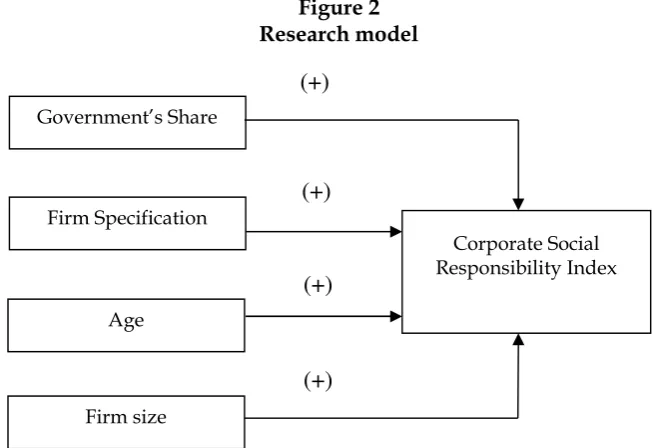
H1 : Government’s share has a positive
relationship with CSR Index
Firm specification
There are three reasons why the role of government is needed to encourage CSR practices in a country. Moon (2002; see Moon 2004) identify three things (in rank pattern) business motivation in the deve-lopment of CSR: firm-specific; collective business interest; and the interests of the collective interest in society. For reasons that are implemented CSR development in each company will be greatly influenced by the specifications, business interests, busi-nesses and community groups, government should provide policy direction of CSR that can accommodate the three patterns.
specifications. This is done for each type of industry has a specification of activities and production processes. So that kind of disclosed index of CSR information will vary according to the firm specificity.
Branco and Rodrigues (2006) conducted a study to ascertain whether a Portuguese bank using their website as media to disclose social responsibility information. In addition, their research to try to identify what are the types of information that the banking spread. Further disclosure Branco and Rodrigues comparing it with similar disclosures in the company perbeda in the annual report. By investigating the disclo-sure of social responsibility information on internet banking in Portugal in 2004 and 2003, Branco and Rodrigues compares the level of disclosure media by using content analysis.
Branco and Rodrigues research results showed that the Bank with greater visibility among consumers seem to indicate a greater concern to improve the company image through social responsibility information disclosure. The results of their study show-ed that the theory of legitimacy may be the explanation of social responsibility disclo-sure by a Portuguese bank.
Branco and Rodrigues (2006) argues that research contributions in the field of CSR in the literature is still small, especially on social responsibility disclosure by finan-cial institutions. This can happen because of the sensitivity of the banking terjadap CSR issues is relatively small. Therefore, the company's specifications need to be exa-mined in further studies.
It is important to examine how social responsibility performed by sensitive companies to nature. This is due to the impact of the company's activities were a great effect on the environment. Pollution generated by sensitive companies that are as varied as water pollution, odor pollution, vibration pollution, and garbage pollution. The greater the negative impact given by companies to the environment, the greater the public's attention to the company.
Many researchers have conducted stu-dies related to the company's CSR sensitive. Dashwood (2007) conducted a study on the two mining companies in Canada in adop-ting social accountability norms. Dashwood explains the mining company as one of the companies that are sensitive to the environ-ment, has CSR rules are more complex than generally accepted assumptions.
In developing countries, studies the sensitivity of the company and CSR also conducted by Kapelus (2002), Asmaranti and Lindrianasari (2014), Lindrianasari and Asmaranti (2016), and Dina et al. (2016). Kapelus find the social responsibility of the company can determine the harmonious relationship between the company and the surrounding community. Meanwhile, the success of the company to achieve its object-ives is highly dependent on its relationship with the community. Therefore, companies must demonstrate their awareness on the social and environmental communities around the company, particularly in deve-loping countries. Meanwhile, Asmaranti and Lindrianasari (2014), Lindrianasari and Asmaranti (2016), and Dina et al. (2016) found mining companies in Indonesia has been carry out best practice in environ-mental management of mining companies along with the application of the principle that became the basis of their obligations towards CSR.
"Philanthropy" social responsibility has been designed by the company, but the message is not accepted by society.
Ha2 : Firm specification has a positive
relationship with CSR Index
Firm Age
Although many variables could deter-mine the level of CSR, McWilliams and Siegel (2001) consider the stages of the life cycle (age) companies in the model studies, whileBlombäck and Wigren (2009) explains that company age is an important factor in doing CSR. Both of these researchers explain that the firm age is an important determinant for the CSR.
Brown and Fraser (2006) explains that in earlier studies conducted by O'Dwyer (2003) found that business cases tend to ignore, reject or ignore conflicts of interest in business-community relations. But on the other hand, the World Business Council for Sustainable Development (2003, p.15; in Brown and Fraser, 2006) identifies several advantages that will be achieved by the company when they carry out sustainable development. The advantages is as follows: a) creating financial value
b) attracting long-term capital and favora-ble financing conditions
c) raising awareness, motivating and alig-ning staff, and attracting talent
d) improving management systems e) risk awareness
f) encouraging innovation g) continuous improvement h) enhancing reputation
i) transparency to stakeholders j) maintaining license to operate
Husted and Allen (2011: p.2) state that: “Competitive advantage and fortune appa-rently await those who can provide pro-ducts and services to “the bottom of the pyramid.” As firms address environmental and social problems via social action pro-jects, the message of business opportunity and reputation building appears to be
unbeatable; who would not want to do well by doing good and reap praise for it? “
But is it true that the companies involved in social action will be rewarded with a good name, a competitive advantage, superior profits, and the company's sustain-ability? This question is answered back by Husted and Allen (2011: p.14) that: ”…the firm’s social projects allow it to achieve measurable social objectives as well as improve corporate financial performance in those cases where the social action is linked to product and service innovation, process innovation, or corporate reputation”
So far, they also state that: “…business strategies first measure financial perfor-mance (ROI and ROE) as well as secondary benefits of activities (trust, reputation, commitment, values, identity). Proponents of the benefits of social action cite as the key beneits what business strategies consider secondary (trust, reputation, commitment, values, identity) while arguing that these lead to improved performance (Husted and Allen, 2011: p.21)"
This statement indicates that many advantages to be obtained by the company when they implement CSR. One of the advantages of it is financial performance. Because of many advantages achieved by companies when they conduct CSR well, it is supposed drive corporate performance. Therefore, it is logical that many researchers suspect the positive relationship between CSR and company performance, both finan-cial performance and market performance. However, the benefit obtained by the company on CSR they do only be felt in a relatively long time horizon.
accounting study found that age plays a role in the company's CSR disclosure. Compa-nies that have long standing will provide sizeable disclosure. Hypothesis formulated from the above are as follows.
Ha3 : Age has a positive relationship with
CSR Index
Firm Size
Some researchers seem to have the opinion that size is an important deter-minant of CSR. Model of supply and demand on CSR offered in the study of McWilliams and Siegel (2001), give the other side of looking at CSR in the company.
The idea of their study was based on the assumption that the level of CSR will depend on many things, including the size of the company. Study Blombäck and Wigren (2009) explain that company size is an important factor in doing CSR. This study use size of the company (proxied by lnTotal Asset) as determinant of CSR.
Blombäck, A. and Wigren (2009) expla-ins that many of the features and character-istics of the company (such as local embed-dedness, corporate governance, and indi-vidual motivation) that can be a determi-nant of CSR, but the size is a determidetermi-nant that is challenging the importance. Godfrey and Merrill (2009) theorized that company size plays an important role in to value of CSR activities. The size of the company can influence the level of risk faced by the company. In simple terms, the company with greater value will have a greater risk that the market will get a higher pressure, than smaller firms.
Hypotheses are formulated for both variables are as follows.
Ha4 : Firm size has a positive relationship
with CSR Index
Furthermore, the research model pre-sented in Figure 2.
Figure 2 Research model
Research Methodology
The population of this research is all the big companies in Indonesia that are listed in the Indonesia Stock Exchange. We did a random sampling method with the use of the facilities in SPSS. From the random method, come out 20 the companies name
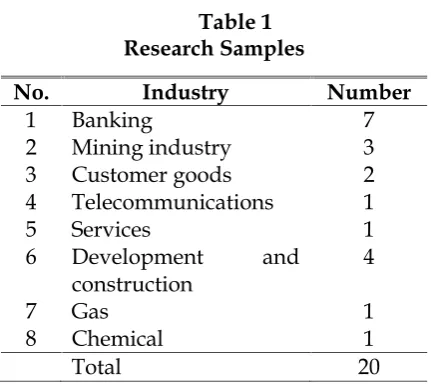
from the 7 types of industries. Table 1 describes the number and the origin industry company which is the object of this study.
In addition to the company that the research samples came from listed compa-nies, the samples we select a company that
Corporate Social Responsibility Index Government’s Share
Firm Specification
Age
Firm size
(+)
(+)
(+)
Table 1 Research Samples
No. Industry Number
1 Banking 7
2 Mining industry 3
3 Customer goods 2
4 Telecommunications 1
5 Services 1
6 Development and construction
4
7 Gas 1
8 Chemical 1
Total 20
has used the GRI in the implementation of CSR policies.
A total of 20 companies selected for the observation period of 8 years, the period 2007-2014. Of the entire sample and the observations, as many as nine companies were excluded because of incomplete data. The final sample used in this study are as many as 160 firms years of observations. Statistical models used in this study of model of determination formu- lating CSR as follow.
CSRIndex=α + β1Gov_Share + α2Firm_Spec +
α3Age + α4Size + εi
The operational definition of research variables
CSR Index is determined on how much of the company disclosure of CSR-related information they have done with the use of
the GRI reference. Furthermore, the total check list obtained from observations in the company calls compared to the total points that should exist for each type of company. Data government share (Gov_Share) deri-ved from the number of percentage of shares owned by the government in a parti-cular company. Firm specification using criteria sensitive company and is not sensitive to social and environmental. Sensi-tive company (1) is a group company of the mining industry, development and cons-truction, gas, and chemical. While this type of banking industry, telecommunications, services and customer goods grouped into non-sensitive industries (0). The data used nominal age of age of the company since listing on the Indonesia Stock Exchange and for the Size, this study uses Ln_Total Asset.
Results and Discussion
Table 2 shows the descriptive statistics of the variables used in this study. The total sample used in the study was 160 firms years. CSR_Index have a minimum value of 0.16 which is in 2007 at PT Bank Central Asia Tbk, and the highest was 1.00 (best perception) in 2010 for several companies, namely PT Bukit Asam Coal Mine, PT Perusahaan Gas Negara (Persero) Tbk, and PT Jasa Marga Tbk. But for the duration of observation, the mean of CSR_Index is at 0.6617. This value indicates that, on average, an index of perceptions of social responsi-bility of the company is pretty good.
Table 2
Descriptive Statistics
N Minimum Maximum Mean Std. Deviation
CSR_Index 160 .16 1.00 .6617 .25774
Gov_Share 160 .00 100.00 43.3972 29.57953
Firm_Spec 160 .00 94.70 24.9789 26.81591
Age 160 -3.00 34.00 12.4875 8.88642
Size 160 4.34 13.08 10.2723 1.26043
Table 3
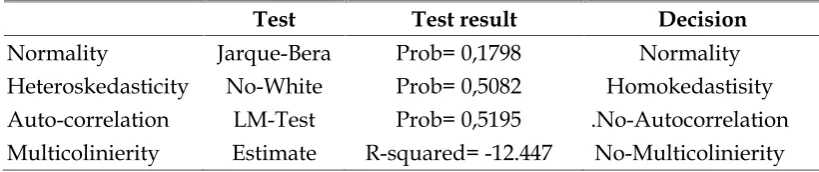
Classical assumption test results
Test Test result Decision
Normality Jarque-Bera Prob= 0,1798 Normality
Heteroskedasticity No-White Prob= 0,5082 Homokedastisity Auto-correlation LM-Test Prob= 0,5195 .No-Autocorrelation Multicolinierity Estimate R-squared= -12.447 No-Multicolinierity
Testing the hypothesis
Before carrying out testing the model using OLS, it will first be tested classical assumptions (as. The classical assumption made in the research model to obtain the value that gives reason to conclude that this research data is normally distributed, the data derived from a homogeneous, there is no auto-correlation and no experience multicollinearity.
The results of the model test (F-test) shows the F-statistic worth 11.4437, Prob (F-Statistics) worth of 0.00000, and R-Squared 0.2665. By doing so, the model in this study can say is good and can be continued testing of each independent variable on the dependent by using OLS as the rule of tumb applicable. Table 3 presents a summary of the results of the test classical assumptions of this study.
Determination Testing of CSR
There are four variables that are used as a determination of CSR in this study, namely Government Share (Gov_Share), specification of the company (Firm_spec), Age and Size. As we noted earlier, govern-ment ownership data (Gov_Share) is de-rived from the total percentage of shares held by the government in a particular company.
For firm specifications (Firm_Spec), we use the criteria of companies that have operational impact sensitive and not sensi-tive to social and environmental. Further-more, we denote (1) for sensitive groups, which are companies of the mining indus-try, building and construction, gas, and chemicals, and (0) for the industry that is
not sensitive industries such as banking, telecommunications, services and customer goods. The age variable is used nominal age of the company since listing on the Indo-nesia Stock Exchange. Size in this study using a Total Asset.
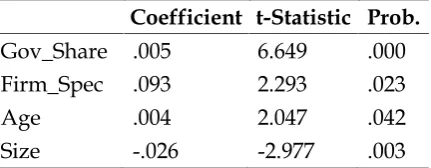
In the first hypothesis testing regression coefficient values obtained for 0.005, t-statistic of 6.649 and significance worth 0,000. With this value can be explained that the larger the government ownership, the greater the company's CSR index. These results support the previous argument that governments in countries that ratified the Kyoto Protocol to work together to reduce carbon emissions world.
The findings of this study also support the statement that previous researchers stated that CSR is strongly influenced by the rules of the government and or institutional (Moon, 2004; and Meehan et al. 2006). Therefore, government ownership of the shares in a company will also greatly affect the implementation of CSR in the company. These findings provide sufficient grounds to support the first hypothesis proposed research.
second hypothesis of this study is supported.
The existence of a positive relationship between enterprise specification with CSR disclosure indices can be found from the results of previous studies using surveys conducted by McWilliams et al. (2005); Battaglia et al. (2010) and the experimental methods (Sen and Bhattacharya, 2001). Overall the results of their research supports the finding that the level of disclosure of CSR-related activities carried out also depends on the specifics of the company. Moon (2002) explains that there are three patterns that motivate business judgment in considering the broad disclosure of CSR. One of them is a specific company.
This study also confirmed the findings of the previous studies conducted by Kape-lus (2002), Dashwood (2007), Asmaranti and Lindrianasari (2014), Lindrianasari and Asmaranti (2016), and Dina et al. (2016). As Dashwood study (2007) on the two mining companies in Canada and found that the mining company as one of the company sensitive to the environment, CSR already has rules that are more complex than generally accepted assumptions. Overall the study indicates that companies are sensitive to the environment has provided adequate disclosure of social responsibility than those who did not. Is it merely the fulfillment of obligations or are already based on the awareness of the company to conserve the environment? We still need more efforts to prove it.
The third hypothesis testing this study did not find support for previous studies conducted Robert (1992) and Blombäck and Wigren (2009) who found that age is an important factor that into the company's CSR disclosure determination. In this study, statistical results showed regression coeffi-cient 0.004, t-statistics 2.047 with 0.042 signi-ficance. This result is the reason for the claim that the third research hypothesis is also supported.
Table 4 Statistics test results
Coefficient t-Statistic Prob.
Gov_Share .005 6.649 .000
Firm_Spec .093 2.293 .023
Age .004 2.047 .042
Size -.026 -2.977 .003
Firm size are predicted to have a relationship with CSR disclosure formu-lated in the third hypothesis. Regression coefficient values obtained for -026, -2.977 for t-statistics and significance worth 0.003. These findings indicate that companies that have a relatively small asset proved more CSR disclosure, or in other words that companies that have a larger asset provide CSR disclosure relatively less. The results of this statistical test showed that the level of Sign <0.1 size effect on CSR disclosure. These findings as well as a sufficient reason to support the fourth hypothesis of this study.
The findings of this study support previous studies which argue that size is an important determinant of CSR. Robert (1992) and Blombäck and Wigren (2009) states that the size is a determinant of the disclosure. Most of the research findings indicate that the size of the firm sometimes negatively related to the broad disclosure. That is, companies that have a relatively low assets, disclosure broader than the compa-nies that have large assets. Table 4 presents a summary of the results of research hypo-thesis testing.
The study also found that companies are more sensitive to the environment tend to provide higher disclosure than the companies that are not sensitive. As we understand that sensitive company is consi-dered by many parties, NGOs, local com-munities, government, academia, trade unions, and others aimed at prosecuting the company remains in "social contact" is inherent in a particular environment. "The big concern" given the parties is what might be the reason the company is sensitive to disclosures more.
Other findings show that companies that have a long-standing disclosure found higher compared with a new company. These findings support the reason for that is consistent with disclosures made by compa-nies sensitive. The image of a company that has a long standing demanded stronger and more legitimacy in the community. in addition, the existence of companies that have long amid its environment also proved that the company fulfill its social contract and legitimate in the community in an enterprise environment.
Another finding of this study indicate that the company has a long-standing dis-closure of CSR higher than with a new company. These findings support the reason for that is consistent with disclosures made by companies sensitive. The image of a company that has a long standing deman-ded stronger and more legitimacy in the community. in addition, the existence of companies that have long amid its environ-ment also proved that the company fulfill its social contract and legitimate in the commu-nity in an enterprise environment. Howe-ver, the size of the companies found to have negative effects on CSR disclosure index which gives the sense that relatively small companies have a CSR index higher than the large enterprise assets.
Small sample felt to be limitations that dominate this study. In addition, there are many variables that can be a CSR index determination, but in this study we involves four variables only. Future studies should
attempt to cover up the limitations of this research in order to contribute to better research.
REFERENCES
Aaronson, S. 2003. CSR in the Global Village: the British Role Model and the American Laggard. Business and Society Review108(3): 309–338.
Agle, B. R., T. Donaldson, R.E. Freeman, M. Jensen, R.K. Mitchell, and D.J. Wood. 2010. Dialogue: Toward Superior Stake-holder Theory. Business Ethics Quarterly
18(2): 153-190.
Ali, I. M., E. Esa, and A. R. Zahari. 2012. Sustainable Development - Corporate Social Responsibility (CSR) and Share-holder Value: A Study of Government Linked Companies.Paper Series.
Asmaranti, Y. and Lindrianasari. 2014. Comparation of Greenhouse Gas Emis-sion Disclosure Before and After Enact-ment of the Indonesia Act No. 17 of 2004. Issues in Social and Environmental Accounting8(4): 225-234.
Babiak, K. and S. Trendafilova. 2011. CSR and Environmental Responsibility: Motives and Pressures to Adopt Green Management Practices. Corporate Social Responsibility and Environmental Manage-ment18: 11–24.
Barkemeyer, R. 2007. Legitimacy as a Key Driver and Determinant of CSR in Developing Countries.Paper for the 2007 Marie Curie Summer School on Earth System Governance, 28 May – 06 June, Amsterdam.
Battaglia, M., L. Bianchi, M. Frey, and F. Iraldo. 2010. An Innovative Model to Promote CSR among SMEs Operating in Industrial Clusters: Evidence froman EU Project.Corporate Social Responsibility and Environmental Management 17: 133– 141.
Branco, M. C. and L. L. Rodrigues. 2006. Communication of corporate social responsibility by Portuguese banks. A legitimacy theory perspective. Corporate Communications: An International Journal
11(3): 232-248.
Brown, J. and M. Fraser. 2006. Approaches and Perspectives in Social and Environ-mental Accounting: an Overview of the Conceptual Landscape. Business Stra-tegy and the Environment 15: 103–117. Carroll, A. B. 1979. A three-dimensional
concepttual model of corporate perfor-mance. Academy of Management Review
4(4): 497-505.
Chamorro, A. and T. M. Bañegil. 2005. Green Marketing Philosophy: A Study of SpanishFirms with Ecolabels. Corpo-rate Social Responsibility and Environ-mental Management13(1): 11-24.
Claessens, S., S. Djankov. and L. Lang. 2000. The Separation of Ownership and Con-trol in East Asian Corporations. Journal of Financial Economics58(1–2): 81–112. Clarkson, M. B. E. 1995. A Stakeholder
Framework for Analyzing and Evalua-ting Corporate Social Performance. The Academy of Management Review20(1): 92-117.
Crowther, D. and G. Aras. 2008. Corporate Social responsibility. Ventus Publishing ApS. Denmark, Frederiksberg.
Dashwood, H. S. 2007. Canadian Mining Companies and Corporate Social Responsibility: Weighing the Impact of Global Norms. Canadian Journal of Political Science/Revue Canadienne de Science Politique40(1): 129-156.
Davis, K. 1973. The Case For and Against Business Assumption of Social Responsibilities.Academy of Management Journal16(2): 312-22.
Dina, F., Lindrianasari, and Y. Asmaranti. 2016. Environmental Management Acti-vity toward Financial Performance in Indonesian Mining Companies Inter-national Journal of Environment and Sustainability 5(1): 76-85.
Freeman, R. E. 1984.Strategic Management: A stakeholder approach. Boston: Pitman. Godfrey, P. C. and, N. W. Hatch. 2007.
Researching Corporate Social Responsi-bility: An Agenda for the 21st Century.
Journal of Business Ethics70: 87–98. Gray, Rob. 2002. The Social Accounting
Project And Accounting Organizations and Society Privileging Engagement, Imaginings, New Accountings And Pragmatism Over Critique? Accounting, Organizations and Society27: 687–708 Hamann, Ralph and P. Kapelus. 2004.
Corporate Social Responsibility in Mi-ning in Southern Africa: Fair Accounta-bility or just greenwash? Development
47(3): 85–92.
Hiscox, M. J. and N. F. B. Smyth. 2007. Is There Consumer Demand for Improved Labor Standards? Evidence from Field Experiments in Social Product Labeling.
Unpublish paper.
Husted, B. W. and D. B. Allen. 2011. Corpo-rate Social StCorpo-rategy Stakeholder Engage-ment and Competitive Advantage. Cam-bridge University Press. New York. Jamali, D. and R. Mirshak. 2006. Corporate
Social Responsibility (CSR): Theory and Practice in a Developing Country Con-text. Journal of Business Ethics 72: 243-262.
Jensen, M. C. and W. H. Meckling. 1976. Theory of the Firm: Managerial Beha-vior, Agency Cost and Ownership Structure. Journal of Financial Economics
3: 305-360.
Kapelus, P. 2002. Mining, Corporate Social Responsibility and the "Community": The Case of Rio Tinto, Richards Bay Minerals and the Mbonambi. Journal of Business Ethics39(3): 275-296.
KPMG. 2011. International Survey of Corpo-rate Responsibility Reporting 2011. https://www.kpmg.com/PT/pt/Issue sAndInsights/Documents/corporate-responsibility2011.pdf. Downloaded at 10th of Sept.2016.
and Political Interperence: Evidence from China. Journal of Businee Ethics 96: 631-645.
Lindrianasari, 2007. Hubungan Antara Kinerja Lingkungan dan Kualitas Peng-ungkapan Lingkungan Dengan Kinerja Ekonomi Perusahaan di Indonesia.
Jurnal Akuntansi dan Auditing Indonesia
11(2): 159-172.
Lindrianasari and Y. Asmaranti. 2016. Investigative Studies On Environmental Disclosure And The Costs of R & D As A Compliance With Government Policy On Corporate Social Responsibility in Indonesia. International Journal of Environment and Sustainability 5(2): 61-71.
McWilliams, A. and D. Siegel. 2001. Corpo-rate Social Responsibility: A Theory of the Firm Perspective. The Academy of Management Review26(1): 117-127. McWilliams, A., D. S. Siegel, and P. M.
Wright. 2005. Corporate Social Respon-sibility: Strategic Implications. Un-Publish Paper. Rensselaer Working Papers in Economics: http://www.rpi.edu/ dept/economics/www/workingpaper Meehan, J., K. Meehan, and A. Richards.
2006. Corporate social responsibility: the 3C-SR model.International Journal of Social Economics33(5/6): 386-398.
Mitchell, R. K., B. R. Agle, and D. J. Wood. 1997. Toward a Theory of Stakeholder Identification and Salience: Defining the Principle of Who and What Really Counts. The Academy of Management Review22(4): 853-886.
Moon, J. 2002. Corporate Social Responsibility: On Overview. International Directory of Corporate Philanthropy Europa Publi-cations, London.
Moon, J. 2004. Government as a Driver of Corporate Social Responsibility: The UK in Comparative Perspective. Research Paper Series International Centre for Corporate Social Responsibility. Editor: Dirk Matten. ISSN 1479-5124.
Nan, X., and K. Heo. 2007. Consumer Responses to Corporate Social
Respon-sibility (CSR) Initiatives. Examining the Role of Brand-Cause Fit in Cause-Related. Marketing Journal of Advertising
36(2): 63–74.
Ndemanga, D. A. and E. T. Koffi. 2009. Ownership Structure, Industry sector and Corporate SocialResponsibility (CSR) Practices: The case of Swedish listed companies. Master Degree Project. University of Gothenburg School of Business, Economics and Law. Germa-ny.
O’Dwyer B. 2003. Conceptions of Corporate Social Responsibility: the Nature of Managerial capture. Accounting, Audi-ting and Accountability Journal 16(4): 523–557.
Parmar, B. L., R. E. Freeman, J.S. Harrison, A.C. Wicks, S. DeColle, and L. Purnell. 2010. Stakeholder Theory: The State of the Art. Cambridge University Press. Cambridge.
Preston, L. E. and J. E. Post. 1975. Measuring corporate responsibility.Journal of Gene-ral Management2(3): 45-53.
Sen, S. and C. B. Bhattacharya. 2001. Does Doing Good Always Lead to Doing Better? Consumer Reactions to Corpo-rate Social Responsibility. Journal of Marketing Research38(2): 225-243.
Tsoutsoura, M. 2004. Corporate Social Responsibility and Financial Per-formance.Working Paper Series Center for Responsible Business. Permalink: http:// escholarship.org/ uc/item/111799p2 World Business Council for Sustainable
Development (WBCSD). 2003. Sustaina-ble Development Reporting: Striking the Balance.WBCSD: Geneva.
Wright, P. and S. P. Ferris. 1997. Agency Conflict and Corporate Strategy: The Effect of Divestment on Corporate Value. Strategic Management Journal
18(1): 77-83.