Zurich Open Repository and Archive University of Zurich Main Library Strickhofstrasse 39 CH-8057 Zurich www.zora.uzh.ch Year: 2016
Glucagon-like peptide-1, glucagon-like peptide-2, and lipid metabolism
Lutz, Thomas A ; Osto, Elena
Abstract: PURPOSE OF REVIEW: Glucagon-like peptide-1 (GLP-1) is the best known incretin hormone able to potentiate glucose-induced insulin secretion. Moreover, GLP-1 is currently under intensive inves-tigation as a potential crucial mediator of beneficial metabolic effects after bariatric surgery, because of its eating inhibitory, antiobesity, and antidiabetes effects. This review briefly summarizes recent findings on the specific effects of GLP-1 on lipoprotein metabolism. The related hormone GLP-2 is derived from the same precursor gene; its effects on lipoprotein metabolism will also be discussed briefly. RECENT FINDINGS: Pharmacological activation of the GLP-1 system has beneficial effects on obesity-induced alterations of lipoprotein metabolism. These benefits can be observed with direct GLP-1 receptor ago-nists like liraglutide or exendin-4, but also with inhibitors of dipeptidyl peptidase IV (DPP-IV), which reduce the breakdown of endogenous GLP-1. The role of GLP-2-related pathways on lipid levels and metabolism are less clear, but some effects (e.g. increased intestinal chylomicron output) are opposite to GLP-1. SUMMARY: Activation of the GLP-1-dependent pathways may perhaps translate into a lower cardiovascular risk. Understanding how GLP-1 and GLP-2 regulate and interact in the control of lipoprotein metabolism will set the stage for the development of new strategies to treat dyslipidaemia in obesity, diabetes, and other cardiometabolic diseases.
DOI: https://doi.org/10.1097/MOL.0000000000000293
Posted at the Zurich Open Repository and Archive, University of Zurich ZORA URL: https://doi.org/10.5167/uzh-133609
Journal Article Published Version Originally published at:
Lutz, Thomas A; Osto, Elena (2016). Glucagon-like peptide-1, glucagon-like peptide-2, and lipid metabolism. Current Opinion in Lipidology, 27(3):257-263.
C
URRENTO
PINIONGlucagon-like peptide-1, glucagon-like peptide-2,
and lipid metabolism
Thomas A. Lutz
a,band Elena Osto
b,c,dPurpose of review
Glucagon-like peptide-1 (GLP-1) is the best known incretin hormone able to potentiate glucose-induced insulin secretion. Moreover, GLP-1 is currently under intensive investigation as a potential crucial mediator of beneficial metabolic effects after bariatric surgery, because of its eating inhibitory, antiobesity, and antidiabetes effects. This review briefly summarizes recent findings on the specific effects of GLP-1 on lipoprotein metabolism. The related hormone GLP-2 is derived from the same precursor gene; its effects on lipoprotein metabolism will also be discussed briefly.
Recent findings
Pharmacological activation of the GLP-1 system has beneficial effects on obesity-induced alterations of lipoprotein metabolism. These benefits can be observed with direct GLP-1 receptor agonists like liraglutide or exendin-4, but also with inhibitors of dipeptidyl peptidase IV (DPP-IV), which reduce the breakdown of endogenous GLP-1. The role of GLP-2-related pathways on lipid levels and metabolism are less clear, but some effects (e.g. increased intestinal chylomicron output) are opposite to GLP-1.
Summary
Activation of the GLP-1-dependent pathways may perhaps translate into a lower cardiovascular risk. Understanding how GLP-1 and GLP-2 regulate and interact in the control of lipoprotein metabolism will set the stage for the development of new strategies to treat dyslipidaemia in obesity, diabetes, and other cardiometabolic diseases.
Keywords
glucagon-like peptide-1, glucagon-like peptide-2, incretin, lipoprotein
INTRODUCTION
Glucagon-like peptide 1 (GLP-1) is the best studied gut-derived incretin hormone. The incretin effect describes the phenomenon that glucose triggers a stronger increase in insulin secretion when given orally as compared with an intravenous infusion; the higher insulin secretion is observed when oral or intravenous glucose are compared for their insulin releasing effects under conditions when they lead to the same changes in blood glucose levels [1–3].
Because of their capacity to increase insulin secretion and to inhibit pancreatic glucagon secretion, GLP-1 receptor (GLP-1R) agonists and inhibitors of dipeptidyl peptidase-IV (DPP-IV), which reduce the breakdown of endogenous GLP-1, are cornerstones of today’s antidiabetic therapy. A second boost to the study of GLP-1-mediated effects followed the observation that some effects of bariatric surgery, in particular of the Roux-en-Y gastric bypass (RYGB) and the verti-cal sleeve gastrectomy (VSG) may depend on the
exaggerated secretion of gut hormones, including GLP-1, after surgery. The contribution of GLP-1 to bariatric surgery benefits is still a matter of debate, but it is clear that GLP-1 produces a large number of effects (e.g. reduction in eating; increase in insulin secretion) that are also induced by RYGB and VSG [4–6]. The potent reduction in eating by GLP-1 led to the recent approval of the GLP-1R agonist lira-glutide for the treatment of obesity in the USA.
aInstitute of Veterinary Physiology, Vetsuisse Faculty University of Zurich,
bCenter for Integrative Human Physiology, University of Zurich, Zurich,
cInstitute for Food Nutrition and Health, Laboratory of Translational
Nutritional Biology, ETH Zurich, Schwerzenbach and dCenter for
Molecular Cardiology, University of Zurich, Schlieren, Switzerland Correspondence to Thomas A. Lutz, Institute of Veterinary Physiology, Vetsuisse Faculty University of Zurich, Winterthurerstrasse 260, 8057 Zurich, Switzerland. Tel: +41 44 635 88 08; fax: +41 44 635 89 32; e-mail: [email protected]
Curr Opin Lipidol2016, 27:257–263 DOI:10.1097/MOL.0000000000000293
(http://www.fda.gov/NewsEvents/Newsroom/Press Announcements/ucm427913.htm).
The first randomized trial indicated that liraglu-tide treatment over 1 year as an adjunct to diet and exercise was associated with reduced body weight and improved metabolic control in a population of nondiabetic patients with dyslipidaemia or hyper-tension [7&&
]. In particular, the fasting lipid profile was markedly improved in the liraglutide-treated patients, including significant decreases in total cholesterol and plasma triglycerides (TAG), and increases in HDL cholesterol (HDL-C).
Hence, beyond the well studied incretin effects, this class of hormones exerts a number of pleio-tropic actions that may be beneficial in cardiome-tabolic disease. The main topic of this brief review is to summarize effects of incretins, in particular GLP-1, but also of GLP-2, on lipid metabolism. We will concentrate on the recently published liter-ature on extrapancreatic effects of GLP-1 and GLP-2.
Glucose-dependent insulinotropic polypeptide
(GIP; also called gastric inhibitory polypeptide) is another hormone with well known incretin action but GIP’s role in the control of lipid metabolism is less clear than for GLP-1. GIP is known to improve LDL clearance, but at the same time to favour an unhealthy type of fat distribution with a decrease in subcutaneous and an increase in intra-abdominal fat [8&
]. Hence, more research needs to be done to better understand the role of GIP in lipid meta-bolism.
Dyslipidaemia, which frequently accompanies diseases like the metabolic syndrome and type 2 diabetes mellitus contributes to the elevated risk of cardiovascular disease under these conditions. The proatherosclerotic lipid abnormalities include elevated levels of plasma TAG and TAG-rich VLDL and chylomicrons. Further, dyslipidaemia includes high levels of LDL cholesterol (LDL-C) together with low levels of HDL-C. Quantitative but also qualita-tive changes in lipoprotein structure and function, for example, altered glycation and oxidation of lip-oprotein particles and altered function of HDL-C, are present [9&
,10,11&& ].
The alterations in lipoprotein metabolism mutually influence each other; elevated TAG-rich lipoproteins contribute to lower HDL levels and to elevated levels of LDL. Further, insulin resistance and type 2 diabetes mellitus are associated with an increased production of TAG-rich lipoproteins in the intestine [characterized by their apolipoprotein (Apo)B-48 content] and in the liver (characterized by ApoB-100) (for review: [12,13]). In particular, the intestinal production of lipoproteins is modulated by GLP-1 but also GLP-2. Although it is derived from the same preproglucagon gene [14] and is released from the same intestinal L cells in the same molar ratio as GLP-1, GLP-2 does not exert incretin actions.
Production site of glucagon-like peptide-1
and glucagon-like peptide-2
GLP-1 and GLP-2 are secreted from enteroendocrine L cells [1,15]. Two important issues are unclear. First, it is unknown which part of the gastrointestinal tract contributes most to circulating GLP-1 because the density of the GLP-1 and GLP-2 producing L cells is higher in distal parts of the small intestine and in the colon, but the highest total number of L cells at least in rats is in the jejunum [16]. Second, L cells express various receptors and transporters that trig-ger L-cell secretion in response to a large variety of stimuli, such as glucose, long or short-chain fatty acids but also bile acids [17]. However, it is a matter of debate which of these stimuli contributes most to the postprandial release of GLP-1 and GLP-2; there are even more uncertainties about their contri-bution to the elevated basal and postprandial GLP-1 and GLP-2 levels after RYGB or VSG because of the altered transit of the food and anatomical rearrangement of the gut after these procedures [16,18–22,23&&
].
GLP-1 is also produced in a subset of neurons in the nucleus of the solitary tract (NTS). GLP-1 analogues have recently been shown to control intestinal lipoprotein secretion when administered directly into the central nervous system [24&&
], whether this effect mimics the action of GLP-1 released from NTS neurons and whether this has a specific role in the control of lipid metabolism needs further clarification.
Sites of glucagon-like peptide-1 action to
increase insulin secretion and to reduce
eating
GLP-1-dependent actions are mediated by different receptor populations. GLP-1’s incretin effect is
mediated by direct action on pancreatic b-cells
KEY POINTS
GLP-1 improves dyslipidaemia in obesity.
GLP-1 directly affects intestinal lipoprotein metabolism. GLP-1’s effect on liver lipoprotein metabolism
is indirect.
GLP-2 has opposite effects compared with GLP-1. Lipid metabolism
[25], but part of the effect may also depend on activation of vagal afferent neurons [26]. GLP-1’s eating inhibitory effect also depends on a paracrine action via intestinal vagal afferents, which trans-mit the signal to the NTS [27]. Whether a direct action of endogenous GLP-1 on the brain also plays a role for the eating inhibitory effect under phys-iological conditions is a matter of debate; this may be different from exogenously applied GLP-1 ago-nists like liraglutide because their direct access to the brain is facilitated by the compound’s chemical structure [28]. Details for the site of GLP-1’s effects on lipid metabolism will be discussed in the sub-sequent sections; depending on the target organ, part of the effects seems to be direct (e.g. on intes-tinal epithelial cells), and part seems indirect (e.g. central nervous system-mediated effects on the liver).
Glucagon-like peptide-1 and lipid metabolism
GLP-1 agonists like exendin-4 or liraglutide and DPP-IV inhibitors have been shown to improve basal and postprandial lipaemia in a number of animal models and also in humans [7&&
,29& ,30]. Improved lipaemia typically includes reduced levels of LDL-C, total cholesterol, and TAG. A network meta-analysis has recently reviewed the most
important clinical studies, which prove the
beneficial effects of such treatment on dyslipidae-mia [29&
]. GLP-1 agonists and DPP-IV inhibitors do not consistently increase HDL-C levels [29&
] which at first sight may seem counterintuitive. It is import-ant to highlight that the vascular-protective proper-ties of HDL may be more relevant than the HDL-C concentration alone to inhibit atherosclerosis [31&&
]. Along this line, in a recent study early after RYGB, elevated plasmatic GLP-1 levels were associated with an improved capacity of HDL to stimulate excessive cholesterol efflux from macrophages; further, at the endothelial level, HDL stimulation induced nitric oxide production, and exerted anti-inflammatory and antiapoptotic actions not only in a rat RYGB model but also in patients. Interestingly, liraglutide
treatment in diet-induced obese rats rapidly
improved the functions of HDL and mimicked the beneficial effect of RYGB surgery. This functional improvement occurred despite unchanged HDL-C concentration [23&&
].
Liraglutide also seems to affect the distribution of cholesterol within specific lipoprotein subclasses. In patients, liraglutide caused a shift away from small, dense LDL particles, and it decreased the apolipopro-tein B concentration [30]. In our own study, we showed that the HDL-C particle size was shifted toward smaller size HDL particles by RYGB surgery
in diet-induced obese rats, and this effect was mim-icked by liraglutide [23&&
]. Recent evidence suggests that small dense HDL particles may be of clinical relevance as a major mediator of the cardiovascular protective properties of HDL [32,33&
]. Finally, indi-rect evidence also supports a role of GLP-1 in improved lipaemia after RYGB, because the most
pertinent changes like decreased postprandial
LDL-C and TAG, and increased HDL-C after RYGB were best predicted by the associated GLP-1 peak [34]. Regarding atherosclerosis, which is the vascular consequence of chronic pathologic alterations in lipid levels, DPP-IV inhibition has been shown to reduce plaque inflammation and increase plaque collagen content in respective mouse models [35,36]. GLP-1 and its split products were reported to reduce plaque vulnerability in a mouse model of vascular disease without affecting atherosclerotic lesion size [37]. Further, liraglutide treatment seemed to prevent and stabilize early onset athero-sclerotic vascular disease partially through GLP-1R-dependent mechanisms but had no significant effect on the progression of late onset, high-burden atherosclerotic disease [38]. Recently, treatment with engineered fusion proteins constituted by GLP-1 fused to the globular domain of adiponectin has been reported to reduce atherosclerosis and
glucose intolerance in ApoE / mice fed a
high-fat diet [39]. To the best of our knowledge, there are no published studies assessing specifically the role of GLP-2 on atherosclerosis processes or plaque vulnerability.
Role of the intestine in glucagon-like
peptide-1’s effects on blood lipids
Intestinal and hepatic metabolism of lipids and lip-oproteins are the two major players affecting lipae-mia. A number of studies suggest that GLP-1 may influence both organs in a different way: with a direct local action at the intestinal level and with an indirect modulation on the liver. GLP-1 agonism has been shown to reduce the activity of jejunal microsomal triglyceride transfer protein and of jejunal TAG availability in hamsters. Further, the reduction in the concentration of chylomicrons was due to reduced production rather than increased clearance of these compounds. Hence, GLP-1 ago-nists (e.g. exendin-4) and reduced GLP-1 breakdown (e.g. by sitagliptin) in experimental animals or in humans lead to a direct reduction in intestinal lipo-protein synthesis so that less TAG and less ApoB-48 reached the circulation after oral lipid adminis-tration [40,41&&
,42]; to our knowledge, it is unclear how the TAG that are not packaged into chylomi-crons will eventually be metabolized. Exendin-4 or
sitagliptin also reduced postprandial free fatty acid levels in patients [41&&
,43].
Direct action in the intestine
It is generally believed that the above-mentioned effects are direct effects at the intestinal level, for example on intestinal ApoB-48 production. A direct mode of action is also supported by in-vitro studies with isolated hamster enterocytes because exendin-4 inhibited ApoB-exendin-48 secretion also under these con-ditions [11&&
,42]. The molecular mechanisms of GLP-1’s influence on chylomicron synthesis, assem-bly, and secretion in enterocytes are still unknown.
Indirect action via the brain
Indirect actions may to some extent contribute to GLP-1’s effects on intestinal lipid and lipoprotein handling. These may, for example include a reduction in the rate of gastric emptying and gastric lipase activity, which lead to a lower availability and lower rate of processing of dietary fat. Indirect effects mediated by GLP-1 action in the central nervous system may also play some role, but more detailed studies will be necessary in the future [11&&
,24&&
] (see also below).
Role of the liver and brown adipose tissue in
glucagon-like peptide-1’s effects on blood
lipids
Dyslipidaemia in obesity and diabetes are associ-ated with alterations in hepatic lipid metabolism. At least some of these alterations can be corrected by GLP-1. GLP-1 agonists, for example reduce
hep-atic VLDL overproduction andde novolipogenesis
in hamsters. These effects were associated with decreased hepatic lipid accumulation, and a decrease in circulating VLDL-bound TAG and plasmatic ApoB-100 [44&
].
Indirect action via insulin release and the brain
In contrast to GLP-1’s effect in the intestine, most of GLP-1’s hepatic effects seem to be mediated indirectly. The antilipolytic effect and the effect to lower free fatty acids, TAG-rich VLDL, and chy-lomicrons seem to be driven by insulin; hence, they depend on GLP-1’s incretin effect [11&&
,40]. Part of these effects may also be mediated by the central nervous system because centrally administered exendin-4 increases peripheral energy utilization and decreases hepatic lipid synthesis. Because the effect was blocked by vagotomy, modulation of parasympathetic nerve activity may mediate part of the indirect effects of GLP-1 on the liver [44&
].
Indirect action via the sympathetic nervous system and brown fat
Finally, increased peripheral energy utilization may result from an enhanced burning of fat and an
activation of brown adipose tissue function
[44& ,45&
]. The latter effect may also be mediated by the central nervous system because GLP-1 increases thermogenesis via the brain and because central exendin-4 has been shown to increase brown adipose tissue function and subsequently to lower TAG levels [45&
]. The effects of central exendin-4 to reduce the TAG content in lipoproteins and to reduce ApoB-48 seem to be mediated via sympath-etic nervous system activation [24&&
] and may there-fore also be linked to an enhanced burning of fat. The reduction of ApoB-48 observed after central administration of exendin-4 indicates that the reduced chylomicron formation by enterocytes depends on direct activation of intestinal GLP-1 receptors (as discussed above) and GLP-1-mediated central nervous system effects via sympathetic acti-vation [24&&
]. The effects of central exendin-4 on peripheral lipid metabolism seem to be independent of exendin-4’s effects on food intake or body weight [46].
Effect of glucagon-like peptide-1 to improve
hepatic steatosis
Exendin-4 or liraglutide has been shown to reduce the occurrence and degree of hepatic steatosis inde-pendent of their action on body weight [47]. These effects were observed in experimental animals but also in the clinical setting. Liraglutide, for example improves metabolic dysfunction and insulin resist-ance, reduces lipotoxicity in the liver, and counter-acts the pathogenesis of nonalcoholic hepatic steatosis [48,49&
].
Indirect action via enhanced insulin release and sensitivity
Similar to GLP-1’s hepatic action on circulating lipids, this effect seems to be indirect and related to increased insulin release and sensitivity [48]. The beneficial effects on hepatic lipid accumulation and on metabolic parameters in fatty liver disease seem to be because of reduced inflammation and endo-plasmic reticulum stress [50]. The antioxidative and anti-inflammatory effects were also associated with an inactivation of the proinflammatory c-Jun N-terminal kinase pathway [49&
]. Further, the antioxidative, cell-protective levels of glutathione were increased by exendin-4, which suggests that GLP-1 receptor agonists play a beneficial role against increased oxidative stress [51].
Lipid metabolism
Glucagon-like peptide-1 mediated but
glucagon-like peptide-1R-independent
processes
In some, but not all previously discussed studies, the effects of GLP-1 agonists or inhibitors of GLP-1 breakdown were suggested to be mediated by the GLP-1R because of their reversal after adminis-tration of the receptor blocker exendin-9. We and others, however, reported actions of GLP-1 or of its split products, which appear to be medi-ated by an additional not yet identified GLP-1 receptor system [37]. In our recent experiments, we compared effects of RYGB surgery and of direct GLP-1 receptor activation on the cardiovascular system and parameters of lipoprotein metabolism in rats. The beneficial effects of RYGB on the vas-cular endothelium were mimicked by liraglutide and blocked by exendin-9, which suggests an involvement of the known GLP-1R [23&&
]. In the same study, however, we also observed that GLP-1 favoured lipid metabolism by a mechanism that presumably was independent of the known GLP-1R [23&&
]. In other words, GLP-1 mimicked RYGB effects on the circulating lipoprotein concen-tration and function, but these effects were not blocked by exendin-9, that is, HDL properties were not impaired in RYGB rats receiving exendin-9 chronically [23&&
]. It remains to be clarified which type of receptor may be responsible for the latter liraglutide-induced effects.
Glucagon-like peptide-1 versus glucagon-like peptide-2
In contrast to the effects of GLP-1, GLP-2 has recently been demonstrated to enhance intestinal lipoprotein release. In hamsters, GLP-2 stimulated enterocyte fat absorption and intestinal chylomicron output [42,52,53&&
]. The mechanism of action is not clear because the GLP-2 receptor is not expressed in enter-ocytes; whether this indicates that the relevant recep-tor still needs to be identified, or that the effect is indirect, needs to be investigated. Blockade of nitric
oxide synthesis reduced the GLP-2-stimulated
secretion of ApoB-48, and nitric oxide donors increased the release of TAG-rich lipoproteinsin vivo
and in vitro; hence, nitric oxide seems to be
required for the mobilization and secretion
of stored TAG after GLP-2 stimulation. Similarly, GLP-2 stimulation also led to a rapid increase in ApoB-48 and enhanced the secretion of intestinal apolipoprotein in humans [54].
Interestingly, GLP-1 reduces and GLP-2
increases intestinal chylomicron release. This sup-ports the idea that the two hormones are part of the fine regulation of intestinal chylomicron metab-olism with opposite counterregulatory effects. A recent study in hamsters showed that an acute coinfusion of GLP-1 and GLP-2 resulted in a net
increase in lipid absorption, associated with
increased TAG and ApoB-48. In contrast, an extended 2-h coinfusion or a blockade of GLP-1
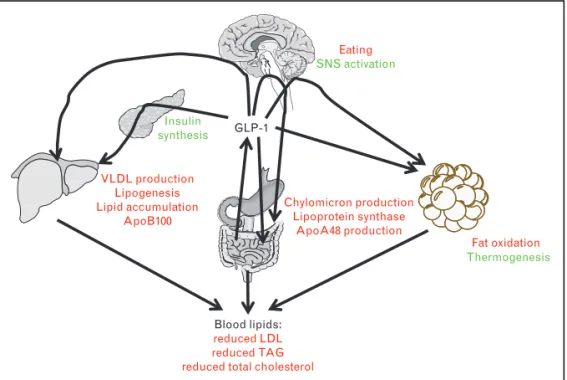
GLP-1
Blood lipids:
reduced LDL reduced TAG reduced total cholesterol
Chylomicron production Lipoprotein synthase ApoA48 production VLDL production Lipogenesis Lipid accumulation ApoB100 Insulin synthesis Fat oxidation Thermogenesis Eating SNS activation
FIGURE 1. Summary of glucagon-like peptide-1 (GLP-1)-mediated effects on lipid metabolism. GLP-1, which is released from
intestinal L cells acts directly on the intestine, the brown adipose tissue, the brain, and the pancreas. The latter effects
contribute to GLP-1’s effects on hepatic lipid metabolism and eventually on blood lipid levels. For details, please see text. Red: inhibitory effect; green: stimulatory effect.
breakdown by DPP-IV inhibition decreased post-prandial lipaemia. It, therefore, seems that acutely, the effect of GLP-2 may dominate, but sustained GLP-1 activity will eventually result in lower lip-oprotein levels [52].
CONCLUSION
The review briefly summarizes some recent findings on the effects of GLP-1 and GLP-2 on lipoprotein metabolism (Fig. 1). Pharmacological activation of the GLP-1 system has clear beneficial effects on lipoprotein metabolism. Effects can be observed with direct GLP-1R agonists like liraglutide or exen-din-4, but also with DPP-IV inhibitors, which reduce the breakdown of endogenous GLP-1. It needs to be shown that the effects of GLP-1 activation will even-tually translate into a lower cardiovascular risk. Understanding the control of lipoprotein metab-olism by GLP-1 may offer new insights into the development of new strategies to treat dyslipidae-mia. Overall, the described effects may be an import-ant basis for the further development of drugs to treat dyslipidaemia in obesity, diabetes, and other cardiometabolic diseases.
Acknowledgements
None.
Financial support and sponsorship
The continued financial support by the Swiss National Science Foundation (T.A.L.), the Swiss National Science Foundation Ambizione Grant (E.O.), the support by the European Union FP7 (Resolve; T.A.L.), the Zurich Center of Integrative Human Physiology (T.A.L.; E.O.), and the Swiss Cardio-Onco-Grant – Alfred and Annemarie von Sick Grant (E.O.) are gratefully acknowledged.
Conflicts of interest
There are no conflicts of interest.
REFERENCES AND RECOMMENDED
READING
Papers of particular interest, published within the annual period of review, have been highlighted as:
& of special interest && of outstanding interest
1. Creutzfeldt W. The entero-insular axis in type 2 diabetes: incretins as therapeutic agents. Exp Clin Endocrinol Diabetes 2001; 109(Suppl 2): S288–S303.
2. Perley MJ, Kipnis DM. Plasma insulin responses to oral and intravenous glucose: studies in normal and diabetic subjects. J Clin Invest 1967; 46:1954–1962.
3. Horowitz M, Nauck MA. To be or not to be: an incretin or enterogastrone? Gut 2006; 55:148–150.
4. Jorgensen NB, Jacobsen SH, Dirksen C,et al.Acute and long-term effects of Roux-en-Y gastric bypass on glucose metabolism in subjects with type 2 diabetes and normal glucose tolerance. Am J Physiol Endocrinol Metab 2012; 303:E122–E131.
5. Ye J, Hao Z, Mumphrey MB,et al.GLP-1 receptor signaling is not required for reduced body weight after RYGB in rodents. Am J Physiol Regul Integr Comp Physiol 2014; 306:R352–R362.
6. Lutz TA, Bueter M. Physiological mechanisms behind Roux-en-Y gastric bypass surgery. Dig Surg 2014; 31:13–24.
7.
&&
Pi-Sunyer X, Astrup A, Fujioka K,et al.A randomized, controlled trial of 3.0 mg of liraglutide in weight management. N Engl J Med 2015; 373:11–22. Describes the first randomized trial with the antiobesity dose of liraglutide and metabolic consequences.
8.
&
Moller CL, Vistisen D, Faerch K,et al.Glucose-dependent insulinotropic polypeptide (GIP) is associated with lower LDL but unhealthy fat distribution, independent of insulin: the ADDITION-PRO study. J Clin Endocrinol Metab 2016; 101:485–493.
Describes positive and negative effects of GIP on lipid metabolism.
9.
&
Hegele RA, Ginsberg HN, Chapman MJ,et al.The polygenic nature of hypertriglyceridaemia: implications for definition, diagnosis, and management. Lancet Diabetes Endocrinol 2014; 2:655–666.
Describes the importance of quantitative and qualitative changes in blood lipids.
10. Rached FH, Chapman MJ, Kontush A. An overview of the new frontiers in the treatment of atherogenic dyslipidemias. Clin Pharmacol Ther 2014; 96:57– 63.
11.
&&
Xiao C, Dash S, Morgantini C,et al.Gut peptides are novel regulators of intestinal lipoprotein secretion: experimental and pharmacological manipula-tion of lipoprotein metabolism. Diabetes 2015; 64:2310–2318.
Comprehensive review of the role of incretins in intestinal lipoprotein metabolism.
12. Dash S, Xiao C, Morgantini C, Lewis GF. New insights into the regulation of chylomicron production. Annu Rev Nutr 2015; 35:265–294.
13. Tomkin GH, Owens D. Dyslipidaemia of diabetes and the intestine. World J Diabetes 2015; 6:970–977.
14. Drucker DJ. Biologic actions and therapeutic potential of the
proglucagon-derived peptides. Nat Clin Pract Endocrinol Metab 2005; 1:22–31.
15. Barrera JG, Sandoval DA, D’Alessio DA, Seeley RJ. GLP-1 and energy
balance: an integrated model of short-term and long-term control. Nat Rev Endocrinol 2011; 7:507–516.
16. Hansen FC, Bueter M, Theis N,et al.Hypertrophy dependent doubling of L-cells in Roux-en-Y gastric bypass operated rats. PLoS One 2013; 8:e65696.
17. Ezcurra M, Reimann F, Gribble FM, Emery E. Molecular mechanisms of incretin hormone secretion. Curr Opin Pharmacol 2013; 13:922–927.
18. Chambers AP, Jessen L, Ryan KK,et al.Weight-independent changes in blood glucose homeostasis after gastric bypass or vertical sleeve gastrect-omy in rats. Gastroenterology 2011; 141:950–958.
19. Jorgensen NB, Dirksen C, Bojsen-Moller KN,et al.Exaggerated glucagon-like peptide 1 response is important for improved beta-cell function and glucose tolerance after Roux-en-Y gastric bypass in patients with type 2 diabetes. Diabetes 2013; 62:3044–3052.
20. le Roux CW, Aylwin SJ, Batterham RL,et al.Gut hormone profiles following bariatric surgery favor an anorectic state, facilitate weight loss, and improve metabolic parameters. Ann Surg 2006; 243:108–114.
21. Mumphrey MB, Patterson LM, Zheng H, Berthoud HR. Roux-en-Y gastric bypass surgery increases number but not density of CCK-, GLP-1-, 5-HT-, and neurotensin-expressing enteroendocrine cells in rats. Neurogastroenterol Motil 2013; 25:e70–e79.
22. Bueter M, Lowenstein C, Olbers T,et al.Gastric bypass increases energy expenditure in rats. Gastroenterology 2010; 138:1845–1853.
23.
&&
Osto E, Doytcheva P, Corteville C,et al.Rapid and body weight-independent improvement of endothelial and HDL function after Roux-en-Y gastric bypass: role of glucagon-like peptide-1. Circulation 2015; 131:871–878. Describes the beneficial role of GLP-1 in mediating RYGB effects on the cardiovascular system.
24.
&&
Farr S, Baker C, Naples M, et al.Central nervous system regulation of intestinal lipoprotein metabolism by glucagon-like peptide-1 via a brain-gut axis. Arterioscler Thromb Vasc Biol 2015; 35:1092–1100.
Describes the role of central GLP-1R activation for peripheral lipid metabolism.
25. Ahren B, Larsson H, Holst JJ. Effects of glucagon-like peptide-1 on islet function and insulin sensitivity in noninsulin-dependent diabetes mellitus. J Clin Endocrinol Metab 1997; 82:473–478.
26. Ronveaux CC, Tome D, Raybould HE. Glucagon-like peptide 1 interacts with ghrelin and leptin to regulate glucose metabolism and food intake through vagal afferent neuron signaling. J Nutr 2015; 145:672–680.
27. Ruttimann EB, Arnold M, Hillebrand JJ,et al.Intrameal hepatic portal and intraperitoneal infusions of glucagon-like peptide-1 reduce spontaneous meal size in the rat via different mechanisms. Endocrinology 2009; 150:1174– 1181.
28. Secher A, Jelsing J, Baquero AF,et al.The arcuate nucleus mediates GLP-1 receptor agonist liraglutide-dependent weight loss. J Clin Invest 2014; 124:4473–4488.
29.
&
Sun F, Wu S, Wang J,et al. Effect of glucagon-like peptide-1 receptor agonists on lipid profiles among type 2 diabetes: a systematic review and network meta-analysis. Clin Ther 2015; 37:225–241.
Comprehensive meta-analysis of GLP-1’s effects on blood lipids in humans.
30. Ariel D, Kim SH, Abbasi F,et al.Effect of liraglutide administration and a calorie-restricted diet on lipoprotein profile in overweight/obese persons with prediabetes. Nutr Metab Cardiovasc Dis 2014; 24:1317–1322.
Lipid metabolism
31.
&&
Rosenson RS, Brewer HB Jr, Ansell BJ, et al. Dysfunctional HDL and atherosclerotic cardiovascular disease. Nat Rev Cardiol 2016; 13:48–60. Describes the importance of HDL quality for cardioprotective effects.
32. Martin SS, Khokhar AA, May HT,et al.HDL cholesterol subclasses, myo-cardial infarction, and mortality in secondary prevention: the Lipoprotein Investigators Collaborative. Eur Heart J 2015; 36:22–30.
33.
&
Du XM, Kim MJ, Hou L,et al.HDL particle size is a critical determinant of ABCA1-mediated macrophage cellular cholesterol export. Circ Res 2015; 116:1133–1142.
Describes the importance of the particle size of lipoproteins in cardioprotective effects.
34. Griffo E, Cotugno M, Nosso G,et al.Effects of sleeve gastrectomy and gastric bypass on postprandial lipid profile in obese type 2 diabetic patients: a 2-year follow-up. Obes Surg 2015. [Epub ahead of print]
35. Shah Z, Kampfrath T, Deiuliis JA,et al.Long-term dipeptidyl-peptidase 4 inhibition reduces atherosclerosis and inflammation via effects on monocyte recruitment and chemotaxis. Circulation 2011; 124:2338–2349.
36. Matsubara J, Sugiyama S, Sugamura K, et al. A dipeptidyl peptidase-4 inhibitor, des-fluoro-sitagliptin, improves endothelial function and reduces atherosclerotic lesion formation in apolipoprotein E-deficient mice. J Am Coll Cardiol 2012; 59:265–276.
37. Burgmaier M, Liberman A, Mollmann J,et al.Glucagon-like peptide-1 (GLP-1) and its split products GLP-1(9-37) and GLP-1(28-37) stabilize atherosclerotic lesions in apoe(-)/(-) mice. Atherosclerosis 2013; 231: 427–435.
38. Gaspari T, Welungoda I, Widdop RE,et al.The GLP-1 receptor agonist liraglutide inhibits progression of vascular disease via effects on atherogen-esis, plaque stability and endothelial function in an ApoE(-/-) mouse model. Diab Vasc Dis Res 2013; 10:353–360.
39. Kong Y, Tong Y, Chen C,et al.Alleviation of high-fat diet-induced athero-sclerosis and glucose intolerance by a novel GLP-1 fusion protein in ApoE mice. Endocrine 2016. [Epub ahead of print]
40. Xiao C, Bandsma RH, Dash S,et al.Exenatide, a glucagon-like peptide-1 receptor agonist, acutely inhibits intestinal lipoprotein production in healthy humans. Arterioscler Thromb Vasc Biol 2012; 32:1513–1519.
41.
&&
Xiao C, Dash S, Morgantini C,et al.Sitagliptin, a DPP-4 inhibitor, acutely inhibits intestinal lipoprotein particle secretion in healthy humans. Diabetes 2014; 63:2394–2401.
Describes the effects of the inhibition of GLP-1 breakdown on intestinal lipoprotein metabolism.
42. Hsieh J, Longuet C, Baker CL,et al.The glucagon-like peptide 1 receptor is essential for postprandial lipoprotein synthesis and secretion in hamsters and mice. Diabetologia 2010; 53:552–561.
43. Tremblay AJ, Lamarche B, Deacon CF,et al.Effect of sitagliptin therapy on postprandial lipoprotein levels in patients with type 2 diabetes. Diabetes Obes Metab 2011; 13:366–373.
44.
&
Taher J, Baker CL, Cuizon C,et al.GLP-1 receptor agonism ameliorates hepatic VLDL overproduction and de novo lipogenesis in insulin resistance. Mol Metab 2014; 3:823–833.
Describes effects of GLP-1 on hepatic lipoprotein metabolism.
45.
&
Kooijman S, Wang Y, Parlevliet ET,et al.Central GLP-1 receptor signalling accelerates plasma clearance of triacylglycerol and glucose by activating brown adipose tissue in mice. Diabetologia 2015; 58:2637–2646. Describes the role of central GLP-1R activation for peripheral lipid metabolism.
46. Patel V, Joharapurkar AA, Kshirsagar SG,et al. Central GLP-1 receptor activation improves cholesterol metabolism partially independent of its effect on food intake. Can J Physiol Pharmacol 2016; 94:161–167.
47. Abdesselam I, Pepino P, Troalen T,et al.Time course of cardiometabolic alterations in a high fat high sucrose diet mice model and improvement after GLP-1 analog treatment using multimodal cardiovascular magnetic reso-nance. J Cardiovasc Magn Reson 2015; 17:95.
48. Armstrong MJ, Hull D, Guo K,et al.Glucagon-like peptide 1 decreases lipotoxicity in nonalcoholic steatohepatitis. J Hepatol 2016; 64:399–408.
49.
&
Gao H, Zeng Z, Zhang H, et al.The glucagon-like peptide-1 analogue liraglutide inhibits oxidative stress and inflammatory response in the liver of rats with diet-induced nonalcoholic fatty liver disease. Biol Pharm Bull 2015; 38:694–702.
Describes the role of oxidative stress in the hepatoprotective effects of GLP-1.
50. Ao N, Yang J, Wang X, Du J. Glucagon-like peptide-1 preserves nonalcoholic fatty liver disease through inhibition of the endoplasmic reticulum stress-associated pathway. Hepatol Res 2015. [Epub ahead of print]. doi: 10.1111/ hepr.12551.
51. Niu S, Wang L, He M,et al.Exendin-4 regulates redox homeostasis in rats fed with high-fat diet. Acta Biochim Biophys Sin 2015; 47:397–403.
52. Hein GJ, Baker C, Hsieh J,et al.GLP-1 and GLP-2 as yin and yang of intestinal lipoprotein production: evidence for predominance of GLP-2-stimulated postprandial lipemia in normal and insulin-resistant states. Diabetes 2013; 62:373–381.
53.
&&
Hsieh J, Trajcevski KE, Farr SL,et al.Glucagon-like peptide 2 (GLP-2) stimulates postprandial chylomicron production and postabsorptive release of intestinal triglyceride storage pools via induction of nitric oxide signaling in male hamsters and mice. Endocrinology 2015; 156:3538–3547. Describes the role of GLP-2 in intestinal lipoprotein metabolism
54. Dash S, Xiao C, Morgantini C,et al.Glucagon-like peptide-2 regulates release of chylomicrons from the intestine. Gastroenterology 2014; 147:1275– 1284.