Better to die than to leave a friend behind: industry
strategy to reach the young
Susy K Sebayang,
1Rizanna Rosemary,
2Dono Widiatmoko,
3Kartono Mohamad,
4Laksono Trisnantoro
5Tobacco control policy in Indonesia is, by interna-tional standards, very rudimentary. Weak regulation has made Indonesia a‘place of freedom’for tobacco companies. Tobacco advertising and promotion is rampant and has been described as being‘above the law’and the‘most aggressive and innovative in the world’.1 2Tobacco advertisements are highly visible in all media (electronic, print and public billboards and displays),3 4 and have contributed to the increased prevalence of smoking among young Indonesians. From 2006 to 2009 the prevalence among boys aged 13 to 15 nearly doubled from 24.5% to 41%, and nearly tripled from 2.3% to 6.2% among girls of the same age group.5 6
PT HM Sampoerna Tbk, one of the largest Indonesian tobacco companies, now owned by Philip Morris International, is known for its long-standing creativity in advertising, promotion and marketing. In the early 1930s, the founder of the company changed his family and his company name to Sampoerna, which means ‘perfect’ or ‘perfection’in Indonesian. This name is also used in branding some of the company’s non-tobacco products. In 2005, Hendra Lesmono, the creative director for the company proclaimed that Sampoerna’s success was due to the production of unusual tobacco advertisements, such as ‘satirical ads that poke fun at aspects of Indonesian society’.7 8 In pursuit of its mission that Sampoerna products be perceived as the best smoking experience for adults in Indonesia,9 the company built a reputation for creating interesting, funny, catchy adverts and disseminating messages of freedom, masculinity, adventure, enjoyment and stress release as its brand image.1
In marketing its A Mild brand of cigarettes to young people, for instance, Sampoerna builds rapport through advertising taglines such as‘Tanya Kenapa’(translated as‘Ask why’), and‘Yang Muda Yang Nggak Dipercaya’ (‘It is the young who are not being trusted’) that exploit generational conflicts and insecurities. As a complementary
approach to appeal to young consumers, Sampoerna created geng hijau (the Green Gank), a group of friends who promote the brand Sampoerna Hijau, a hand-rolled kretek. The basic strategy is to portray the everyday life of young Indonesians who place a high value on friendships. There were several taglines for this product, including ‘Asyiknya Rame-Rame’ (translated as ‘Togetherness is fun’), suggesting smoking with friends is fun, and‘Tahan Lama Seperti Pertemanan, Sampoerna Hijau, Nggak Ada Loe, Nggak Rame!’ (translated as ‘Long lasting like friendship,
Sampoerna Hijau, Without you is not fun’) (figure
1). Even the premium kretek Dji Sam Soe, a sub-brand that was not considered to be young and trendy, is now advertised showing cool young people in an effort to appeal to the younger generation.
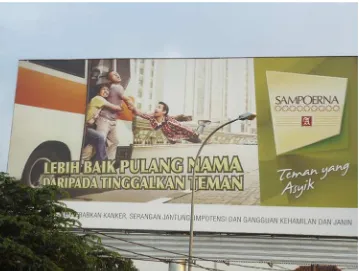
In August 2011, during the Islamic fasting month of Ramadan, a new extreme was set by Sampoerna in their efforts to promote Sampoerna A Hijau. Sampoerna posted billboards showing two young men standing on the door of a moving bus holding on to their friend who was getting left behind (figure 2). The words ‘Lebih baik pulang nama
daripada tinggalkan teman’ (translated as ‘It is better to die than to leave a friend behind’) appeared in the image, side by side with the Sampoerna logo and a tagline‘Teman yang Asyik’ (translated as‘A fun friend’). Ramadan, the Islamic fasting month that is observed by most Indone-sians, is a time when smokers in the nation with the largest Muslim population in the world, would reduce or even stop smoking. As such, tobacco companies make extra efforts to promote their product during and at the end of Ramadan to encourage people to resume smoking. Towards the end of Ramadan, the majority of Indonesians travel to their home towns to celebrate. The resulting crowded public transportation system and traffic
jams at this time are well known, and the Sampoerna advertisement was intended to show empathy with those struggling through this massive seasonal migration.
The adverts stirred a strong reaction from anti-tobacco activists, who viewed the message as suggesting that dying of smoking is better than to quit smoking Sampoerna products. An online petition (http://www.ipetitions.com/peti-tion/protes-iklan-sampoerna/) was signed by more than 200 people, and an open protest letter was also sent on behalf of health groups to Sampoerna, urging the company to withdraw the adverts and make a public apology. The controversial advert caught global attention when international tobacco control stakeholders spread the tagline through Twitter, Facebook and the Globalink listserv. The Southeast Asia Tobacco Control Alliance issued a press release, urging the Indonesian government to remove the outrageous advert.10 In response, Sampoerna explained that its intention was to depict solidarity and not to link the brand to death. However, Sampoerna neither apologised nor explained why they used the idiom‘pulang nama’, which clearly means death in the minds of most Indonesians. 2Department of Communication,
Faculty of Social and Political Sciences, University of Syiah Kuala, Banda Aceh, Indonesia 3School of Health Sciences,
University of Salford, UK 4Indonesian Doctor Association, Jakarta, Indonesia
5
Center for Health Service Management, Faculty of Mataram, Jalan Pendidikan No 37, Mataram, NTB, Indonesia; [email protected]
Received 8 September 2011 Accepted 23 February 2012 Published Online First 16 March 2012
370 Tobacco Control2012;21:370e372. doi:10.1136/tobaccocontrol-2011-050223
Industry watch
group.bmj.com on April 24, 2012 - Published by
Sampoerna’s decision to depict solidarity, especially with the youth, in tobacco advertisements is alarming. Through previous campaigns, it has already successfully appealed to young consumers. A local study examining the influence of television
advertising of ‘Sampoerna A Mild’ cigarettes on university students’ decision to buy cigarettes found that nearly 40% of students were influenced by the adverts to purchase the
brand.11 12Using solidarity as a gateway for brand appeal, it seems likely that the Sampoerna adverts are attempting to create peer groups that are very loyal to smoking, making it
difficult for the existing weak tobacco control policies to have an
effect on smoking prevalence in Indonesia.
Advocates have been working for years to have stricter tobacco control regulations in Indonesia. However, tobacco companies have avoided regulatory restrictions in Indonesia for decades, through lobby, sponsorships and other methods.13 The current tobacco regulation (PP 19/2003) has not addressed many key aspects of tobacco control, including age restriction for tobacco marketing, packaging and labelling, and a compre-hensive ban on advertising, promotion and sponsorship.4
Figure 1 Sampoerna Hijau billboard advert ‘Tahan Lama Seperti
Pertemanan, Sampoerna Hijau, Nggak Ada Loe, Nggak Rame!’ (Long lasting like friendship, Sampoerna Hijau, Without you is not fun). Photo by National Commission for Child Protection, Indonesia.
Figure 2 Sampoerna A Hijau billboard advert ‘Lebih baik pulang nama daripada tinggalkan teman’ (It is better to die than to leave a friend behind) ‘Sampoerna A, A fun friend’. Photo by National Commission for Child Protection, Indonesia.
Tobacco Control2012;21:370e372. doi:10.1136/tobaccocontrol-2011-050223 371
Industry watch
group.bmj.com on April 24, 2012 - Published by
The challenge for tobacco control activists now is to push the government’s panic button to save the young generation from tobacco dependence and call for stronger regulation in tobacco advertising and promotion to be in line with the World Health Organization Framework Convention on Tobacco Control guidelines. Indonesia needs to realise its vulnerability to the creativity of tobacco companies and to start joining forces with and learning from other countries who are already members of the World Health Organization Frame-work Convention on Tobacco Control, including Thailand, a close neighbour who has put into place a comprehensive ban of tobacco advertising at point of sale. In Indonesia, creation and enforcement of anti-tobacco policy and legislation will require very strong political will from the government and strong collaborations with experts and advocates at the national and international level. As shown by the experience in South Africa, the combination of science, evidence and politics proved successful in achieving control over tobacco advertise-ment and promotion, as well as reduction in smoking prevalence.14
AcknowledgementsWe would like to acknowledge the contribution of members of the mailing list of health decentralisation ([email protected]) expressed in the protest letter to Sampoerna for their adverts. We would also like to acknowledge the National Commission for Child Protection in Indonesia for providing photos for this paper and for monitoring marketing strategies of tobacco companies in general.
ContributorsSKS and RR designed the analysis; performed data searching, analysis and prepared the manuscript; DW, KM and LT provided advice on analysis and interpretation, and revised the manuscript.
Competing interestsNone.
Provenance and peer reviewNot commissioned; externally peer reviewed.
REFERENCES
1. Nichter M,Padmawati S, Danardono M,et al. Reading culture from tobacco advertisements in Indonesia.Tob Control2009;18:98e107.
2. Thompson G.80 million a day.ABC News1 September 2009. http://www.abc.net. au/foreign/content/2009/s2673564.htm (accessed 5 Sep 2011).
3. Achadi A,Soerojo W, Barber S. The relevance and prospects of advancing tobacco control in Indonesia.Health Policy2005;72:333e49.
4. Ministry of Health of the Republic of Indonesia.The Tobacco Source Book: Data to support a National Tobacco Control Strategy: English translation. Jakarta: Ministry of Health Republic of Indonesia, 2004:108e19.
5. Aditama T,Pradono J, Rahman K,et al. Linking global youth tobacco survey (GYTS) data to the WHO framework convention on tobacco control: The case for Indonesia.
Preventive Medicine2008;47:S11eS14.
6. Global Tobacco Surveilance System.Global Youth Tobacco Survey (GYTS) Fact Sheet - Indonesia (Ages 13e15). 2009. http://www.searo.who.int/LinkFiles/
GYTS_IndonesiaFactsheet2009.pdf (accessed 1 Feb 2012).
7. Wright T.Advertising: Wide-open Indonesia tests tobacco firms’ creativity.The Wall Street Journal EuropeMarch 2011:6.
8. Tanudjadja B.Kreatifitas pembuatan iklan produk rokok di Indonesia.Nirmana
2002;4:1e13.
9. PT HM. Sampoerna Tbk. Sekilas Sampoerna. 2011. http://www.sampoerna.com/ id_id/about_us/pages/sampoerna_overview.aspx (accessed 22 Dec 2011). 10. Sampoerna billboard ad Draws Flak from anti-tobacco group.The Jakarta Globe26
August 2011. http://www.thejakartaglobe.com/home/sampoerna-billboard-ad-draws-flak-from-anti-tobacco-group/461935 (accessed 27 Aug 2011). 11. Nasution S.Analisis Pengaruh Iklan TV Rokok A Mild Terhadap Keputusan
Pembelian Pada Mahasiswa Manajemen Fakultas Ekonomi UMSU Medan. Medan: MedanFakultas Ekonomi, Universitas Sumatera Utara, 2010.
12. Lieza B.Pengaruh Promosi Produk Rokok Terhadap Keputusan Pembelian Rokok Sampoerna A-Mild pada Mahasiswa S1 Fakultas Ekonomi Universitas Sumatera Utara. Medan: Fakultas Ekonomi, Universitas Sumatera Utara, 2004.
13. Hurt RD,Ebbert JO, Achadi A,et al. Roadmap to a tobacco epidemic: transnational tobacco companies invade Indonesia.Tob Control2012;21:306e12.
14. Malan M,Leaver R. Political change in South Africa: new tobacco control and public health policies. In: de Beyer J, Brigden LW, eds.Tobacco Control Policy: Strategies, Success and Setbacks. 2003:121e53.
PAGE fraction trail=2.5
372 Tobacco Control2012;21:370e372. doi:10.1136/tobaccocontrol-2011-050223
Industry watch
group.bmj.com on April 24, 2012 - Published by
doi: 10.1136/tobaccocontrol-2011-050223
2012
2012 21: 370-372 originally published online March 16,
Tob Control
Susy K Sebayang, Rizanna Rosemary, Dono Widiatmoko, et al.
industry strategy to reach the young
Better to die than to leave a friend behind:
http://tobaccocontrol.bmj.com/content/21/3/370.full.html
Updated information and services can be found at:
These include:
References
http://tobaccocontrol.bmj.com/content/21/3/370.full.html#ref-list-1
This article cites 5 articles, 2 of which can be accessed free at:
service
Email alerting
the box at the top right corner of the online article.
Receive free email alerts when new articles cite this article. Sign up in
Notes
http://group.bmj.com/group/rights-licensing/permissions
To request permissions go to:
http://journals.bmj.com/cgi/reprintform
To order reprints go to:
http://group.bmj.com/subscribe/
To subscribe to BMJ go to:
group.bmj.com on April 24, 2012 - Published by