ICT’S ROLE IN RESTRUCTURING CLASSROOMS AND
CREATING AN EFFECTIVE ENVIRONMENT FOR TEACHING AND LEARNING Oleh: Suyantiningsih, M.Ed.
Abstract
This paper aims to propose some important concepts about how to restructure classrooms and create an effective environment for teaching and learning by integrating ICT as the significant role in teaching and learning process in schools. The initial thoughts based on the facts that nowadays, politician, business, community, parents, and stakeholders are calling for change that means that restructuring education therefore is in the public spotlight. They strongly contend that educators must rethink how children are supposed to be educated, if they demanded to be successful learners and be prepared for life both in global and technological society. This paper will introduce a restructured approach to schooling that addresses the needs of today’s learners. Furthermore, it will describe how technology or ICT can significantly improve teaching and learning, particularly in terms of some major changes in what students learn (how they find, think, and synthesize information rather than how to memorize it) and how students learn (through investigation/exploration, collaborative group-work, and critical examination rather than obtaining information mainly from teachers and textbooks). Finally, using and integrating ICT effectively in classrooms will enable teachers and students to be more successful on restructuring classrooms.
Keywords: ICT, Restructuring Classrooms, Effective Environment, Teaching and Learning.
Introduction
The traditional system and model of education believe that schools should be modeled and
characterized as teaching is telling, knowledge is facts, and learning is recall (Cohen, 1988). On
the other hand, most advocates of restructured schools strongly argue that this model is
outmoded or obsolete since nowadays, the enormous amount of knowledge required to
participate in an advanced post-industrial economy and considerably substantial for the
globalization era. Moreover, the rapid changes and information explosion considerably alter the
nature of knowing from the ability to recall information to the ability and capability to define
Therefore, it is essential for schools to transform from an emphasis on the recall of knowledge
to enabling students to think abstractly, problem-solve, cooperate and collaborate with others,
and search for creative solutions. Critically, educators must stop teaching facts, skills, and
concepts as if they were furnishings of the mind to achieve, occasionally dusted, and used for
the rest of their lives. Instead, educators should help students learn to think for themselves and
be able to construct and produce knowledge. In the other words, Knapp and Glenn (1996)
contend that teachers eed to get out of the i fo atio -p ovidi g usi ess a d i to the uestio -aski g usi ess, by stimulating and promptly encouraging students to seek
information and learn to process it so that they could find facts and develop strategies to solve
problems they will confront in the future. Nevertheless, education goals must shift from facts
and concepts to find facts and develop strategies as the information explosion and the rapid
advance changes the nature of knowing and the nature of learning (from the ability to recall
information to the ability to define problems, retrieve information selectively and critically, and
deal and solve the problems flexibly; from the need to master all topics in class to the need to
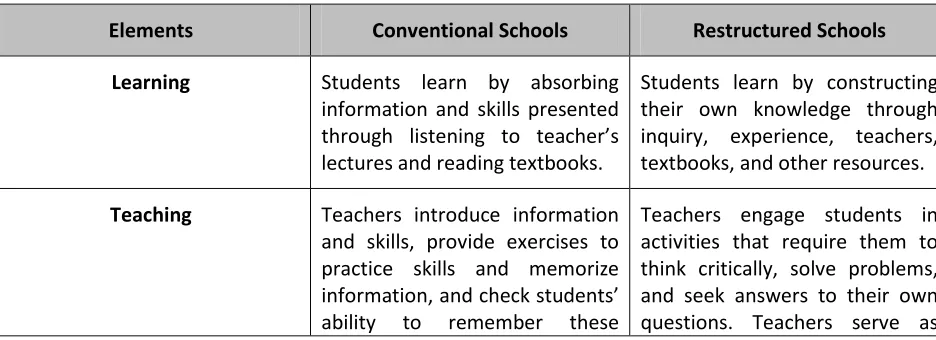
[image:2.612.71.539.551.721.2]learn autonomously). Table 1 below describes some of changes expected in schools.
Table 1. Educational Transformation and Recommended Changes (Knapp and Glenn, 1996: 7)
Elements Conventional Schools Restructured Schools
Learning Students learn by absorbing information and skills presented th ough liste i g to tea he ’s lectures and reading textbooks.
Students learn by constructing their own knowledge through inquiry, experience, teachers, textbooks, and other resources.
Teaching Teachers introduce information and skills, provide exercises to practice skills and memorize i fo atio , a d he k stude ts’ ability to remember these
lessons. model learners, mentors, coaches, and resources.
Curriculum Curriculum emphasizes mastery of skills and concepts through a curriculum divided into subject areas. Students are sometimes assigned to upper and lower tracks according to how well they do on specific tests.
Curriculum promotes student inquiry, and is designed to engage students in solving real problems that extend into all subject areas. In-depth knowledge of important concepts is emphasize.
Classrooms Classrooms are primarily isolated setting where teachers deliver information, and students practice skills and answers questions. The focus is on the individual and competition.
Classrooms are multipurpose rooms where learners engaged in research and problem-solving activities related to specific topics of study. The focus is mainly on cooperation and team building.
Assessment Assessment focuses on short answer and essay tests that emphasize the ability to recall information, rather than understand it or apply it in some meaningful way.
Assessment focuses on stude ts’
demonstrations and
performances of their ability to express apply and defend knowledge and skills. Students also have opportunities for self-assessment, and the overall attitude is one of continual improvement and in-depth learning.
Technology Edu atio al te h ologies have traditionally included pencils and paper, chalkboards, textbooks, manipulative, and other resources that help students develop basic skills, concepts, and generalizations.
Schools are demanded and being asked to participate in meeting changes particularly on
rethinking the way they are structured, the curriculum, and instructional strategies. Moreover,
schools should focus more on the skills and a comprehensive understanding stude t’s need for i fo atio a d te h ology’s age, i ludi g higher-level thinking, collaborative problem
solving, and fostering an ability to create and construct new knowledge. Some studies also
contend that learners develop their own understandings based on their own experiences and
observations, which mean that learning by doing by involving, and integrating the role of ICT
into teaching and learning process would be significantly important.
One of the most remarkable changes of the last twenty years has been the incredible advance
in technology. Information and Communication Technologies (ICT) such as personal computers,
video products, internet, and communication devices have changed the world. The implication
is the more schools have the access to these technologies, the greater educators have had
opportunities to discover, investigate, and explore different ways to teach and design
instruction. So what do these mean for the classroom? This paper aims to explore more about
the important concepts about how to restructure classrooms and create an effective
environment for teaching and learning by integrating ICT as the significant role to be
implemented in schools. Furthermore, this paper will discuss about the fact that the emerging
technologies provide the opportunity for educators to move forward far beyond the
conventional or traditional system does, since the appropriate ICT or technologies would help
teachers and students to organize the classroom and create an effective environment for
Role of ICT in Restructuring Classroom
The ideal schools are supposed to support teachers to do more coaching and tutoring than
telling and lecturing. It means that coaching, for example by drill and practice, simulation, or
demonstration would provide an information-rich learning environments where students and
teachers can utilize a variety of technologies to support the materials design, instructional
design, message delivery system, communication of knowledge, and as well as the storage and
retrieval of information. In fact, ICT is one of the significant components in restructuring
classrooms. Means and Olson (1993) contend that technology: (a) Frequently stimulates
teachers and educators to be able to present more complex tasks and material; (b) Tends to
support teachers in becoming coaches rather than dispensers of knowledge; (c) Provides a safe
context for teachers to become learners again and to share their ideas about curriculum and
method; (d) Can motivate students to attempt harder tasks and to pay more attention in
crafting their work; and (e) Adds significance and cultural value to school tasks, particularly the
local values that could bring much more contextual content for students.
In general, ICT provides one or more of three general roles or it could provide all of those three
roles, which are: (1) Provide information: The ICT works and operates as a repository of
information that can be accessed both in linier form, via one-way communication, and
two-ways communication or known as interactive communication where the communication or
technology devices could provide both audiences with direct and/or indirect feedbacks as they
required; (2) Develop knowledge and skills, such as interactive computer programs where
students could access all learning content and materials used for developing knowledge and
knowledge, produce some formulas for problems-solving scenario, and finally build and create
their own knowledge capacity. (3) Link different location as some ICT devices provide
individuals to be able to connect with others live, real-time, or maybe delayed such as when
someone uses an electronic network.
Due to the different roles of ICT as it mentioned above, as a consequences, teachers should
make choices in terms of the appropriateness of the technology or ICT devices to meet specific
learning outcomes as the technology has some different attributes. First, the depth and quality
of the amount of information provided which may vary from one to another. Second, different
technologies and their application have direct implications in terms of the manner in which the
classroom is organized. Third, a fact that technology differs on cost and amount of integration
needed to utilize them. Lastly, the nature that technologies way too varies in the flexibility of
use. Therefore, the ability and capability to utilize a particular or certain piece of technology on
a more flexible schedule directly affects teacher selection and use.
Some researchers found that integrating technology into classrooms has direct impact on the
teachers. They firmly believe that teacher teaching with technology would expect more from
their students particularly on taking more care in preparing their work; can present more
complex material and students tasks; believe that students understand more difficult concepts
and skills; can meet the needs of individual students and students differences better; can be
more students-centered rather than teacher-centered in their teaching and learning process;
are more open to multiple and multiframe perspectives on problems and solutions; are more
less time dispensing information and more time helping students learn and gain information
and new knowledge and skills.
However, as teachers begin restructuring the classrooms with ICT, a number of questions need
to consider. Those questions are especially concerning on how technologies can be infused and
blended into teaching and learning process; how students will react to technology, as adapting
to using technology in the classroom could be complicated particularly in terms of different
learning style which is not all students will find the same type of experience with technology
rewarding. Second question concerns to how technologies will affect the concept of knowledge
and change the location of teaching and learning, classrooms, and the relationship with
students. And, how much time is needed and what kind of classroom management problem will
arise when using technologies: planning, executing, organising, and evaluation (Knapp and
Glenn, 1996).
Effective Environment for Integrated Teaching and Learning with ICT
As the amount of technology integrated in teaching and learning process has increased
significantly in schools, the most consideration should be taken in terms of how to create an
effective environment that is conducive to its effective use. In addition, some teachers in
Indonesia context still less competent in operating such technologies to support teaching and
learning, not to mention on how to construct the learning materials using the appropriate
technologies. Therefore, teachers simply cannot be expected to acquire the needed skills to
incorporate and integrate technology into instruction or teaching and learning process without
Means and Olson (1993) have examined some of specific conditions substantially needed for a
technologically favorable teaching and learning environment as follows: First, appropriate
technology must be available. Most of teachers use the technology that is most readily
available. Therefore, the LCD projector and the power point presentation nowadays are the
most commonly used piece of technology in schools, despite the computer or laptop or any
other tools. The more sophisticated implementation or application is the use of online courses
or internet where teachers put or publish some learning materials on the website and students
can access them online. Second, it will take time and practice to integrate technology into
instructional program or teaching and learning process, which means planning and organizing
would be highly important. It is believed that the effective use of technology usually occurs in
classrooms of teachers who had a previous knowledge and experiences using the technology.
This fact is particularly true for teachers who want to use computers and computer-related
technologies such as internet, online courses, etc.
Third, some supports are needed particularly in terms of technical support (internet provider,
computers, computers software, LCD projectors, etc) and experts to assist teachers ulitize the
technologies and provide them with the best source and encouragement. Computer technology
has received the most attention during the last decade. It is proven by the significant
commitments of schools to provide computers with the expectation that students performance
would improve and the quality of teaching and learning process would enhance when ICT is
integrated into classrooms. Moreover, effective computer software programs actively engage
the stude t’s participation and provide them with considerable learner control where the
important for students who have problems with expressing ideas, opinions or even posting
questions). Last but not least, fourth, colleagues and administrators need to support innovation
since mostly as what happened to Indonesian teachers, innovative teachers barely could get
any supports about their exciting and bright ideas to bring such brilliant changes in schools.
Therefore, the innovative teachers should always seek out colleagues or partners who are
interested or have same vision and mission in change and new ways of thinking about teaching
and learning.
Needless to say, the nature of environment and ICT are always changing, it is especially
perceived by the potential users of ICT, i.e., teachers in their classrooms. The characteristics of
the change, its size, complexity, prescriptiveness, and practicality for teachers also served as a
dynamic process. Put positively, the more factors or elements supporting implementation of
ICT (the availability of both technical assistance and technologies) into teaching and learning
process, the more change in practice will be accomplished. As a result, a positive and
conducive learning environment for both teachers and students will be worthy created, despite
providing teachers with workshop or courses specifically on how to deal with the ICTs changes
and integrate them into classrooms; and ensuring that within these courses their
developmental experiences and progress are being made. Equally important, the notion that
teachers will learn and understand best by being coached by other teachers is true; this leaves
the role of the training of trainers also significant.
In summary, the appropriate technology or ICT integrated into classrooms can assist teachers
and students restructure how the classrooms is organized and mainly managed, what type of
topics and learning materials are studied, and how students learn and engage actively in
classroom. In addition, it helps teachers to assess the stude t’s performances comprehensively.
Above of all, the use of ICT brings about all the needed changes are simplisistic. The presence of
new technologies possibly will not change the schools, but technology, if integrated and
blended it into an effective teaching and learning process and practices, can positively help
restructure the classrooms. Inevitably, bringing about changes will not be easy and simple as
schools definitely are complex organizations, and schools have been the subject of reform
effort throughout the history. However, important changes can begin in classrooms, the most
and ultimate critical location of change, not to mention the presence of innovative and
dedicative teachers who always want their students to learn and succeed no matter the
challenges appear so great and vary and the conditions seem so difficult to get compromised.
ICT will not work miracles for teachers, nonetheless, the initial step in restructuring the
classrooms definitely counted and will have some profound and enormous effect.
References
Cohen, Elizabeth G. (1998). Designing groupwork: Strategies nfor the heterogeneous clasroom,
Second Edition. New York: Teachers College Press.
Knapp, R. L. and Glenn, D. Allen. (1996). Restructuring schools with technology. Washington:
Linn, Marcia C. (1986). Establishing a research base for science education: Challenges, trends,
and recommendations. Barkeley, CA: California.
Means, B. and Olson, K. (1993). Supporting school reform with Educational Technology.
Georgia: American Educational Research Association.