MAY 2011
Mainstreaming Urban Resilience
Planning in Indian Cities
MAY 2011
Mainstreaming Urban Resilience
Planning in Indian Cities
© May 2011, The Energy and Resources Institute (TERI), Delhi, India
Suggested Citation:
TERI, 2011. Mainstreaming Urban Resilience Planning in Indian Cities: A Policy Perspective. A Report prepared for the Asian Cities Climate Change Resilience Network (ACCCRN) in India.
For more information
Project Monitoring Cell
T E R I Tel. 2468 2100 or 2468 2111
Darbari Seth Block E-mail [email protected]
IHC Complex, Lodhi Road Fax 2468 2144 or 2468 2145
/FX%FMIJm *OEJBr%FMIJ
India Website www.teriin.org
Disclaimer:
This publication was prepared with support from the Rockefeller Foundation as part of the Asian Cities Climate Change Resilience Network (ACCCRN). The ACCCRN aims to catalyse attention, funding, and action on building climate change resilience for poor and vulnerable people in cities by creating robust models and methodolo-gies for assessing and addressing risk, by actively engaging with and analysing 10 cities in Asia. The ACCCRN programme engages local level and national organizations in India, Indonesia, Thailand, and Vietnam, and was conceived and launched by The Rockefeller Foundation in 2008.
TERI was appointed as the National Policy Adviser to the ACCCRN in India in 2009. This synthesis review was prepared from TERI’s study on the urban development policy environment in India, and the needs and require-ments for integrating resilience planning in Indian cities. The report also draws from TERI’s experiences from vari-ous city advisory committee meetings that were held under the ACCCRN’s Phase I in India, and mostly reflect the experiences from consultations in the cities of Gorakhpur and Indore. The synthesis also includes views and suggestions that were received during two roundtable meetings organized by TERI involving policy makers and funding organizations working on similar themes in India.
1. CONCEPT 1
1.1 Vulnerability, adaptive capacity, and resilience 1 1.2 Impact of climate change on urban areas 1
1.3 The challenge of resilience in urban cities 2
2. PROJECT RATIONALE AND APPROACH 2
2.1 Objectives and rationale 2
2.2 Approach 2
3. URBAN RESILIENCE PLANNING 3
3.1 Spheres of urban planning in India 3 3.2 Multi-tiered governance structure 5
4. MAINSTREAMING RESILIENCE PLANNING
IN INDIAN CITIES 6
4.1 Responding to uncertainty and long
time-scales 6
4.2 Entry points for mainstreaming resilience
planning in urban India 7
4.2.1 National level 7
4.2.2 State level 12
4.2.3 City level 13
4.2.4 Vulnerability assessment in ACCCRN cities 14
4.2.5 Climate risk screening 14
5. WAY FORWARD 15
Bibliography 17
Contents
The current world urban population is 3.6 billion. In the future, city populations will further grow exponentially. Most of this rapid growth is expected in Asia and Africa. Due to this rapid population growth and large-scale de-velopmental and economic investments, cities are at high risk to the impacts of climate change. Many cities have thus started planning for specific adaptation and mitigation strategies and plans with a view to build long-term resilience to climate change impacts. Studying urban resilience forms an interesting case in context because not only are cities huge emitters and consumers of energy but they are also going to be maximally impacted as they contain large populations and are areas of large-scale economic investments. The Asian Cities Climate Change Resilience Network (ACCCRN) is part of the Rockefeller Foundation’s Climate Change Resilience Initiative. It aims to shape and substantiate strategies to help vulnerable urban communities cope with the impacts of climate change by creating robust action models of climate change resilience.
The report, ‘Mainstreaming Resilience Planning in Indian Cities’ is a result of TERI’s contribution to the overall goal of ACCCRN. The report discusses the components of resilience planning in an urban environment.
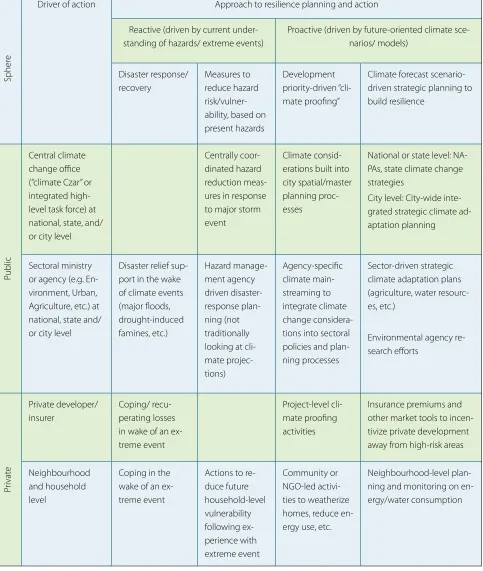
It begins by presenting concepts of mainstreaming, urban vulnerability, and resilience, thus placing the concep-tual understanding of resilience within the current policy context and institutional structure in Indian cities. The various spheres of urban planning in India have been adapted from a previous work of TERI on building city ad-aptation framework for Indian cities (TERI, 2009b). The activities of public and private players have been clubbed as ‘proactive’ and ‘reactive’ to indicate whether actions are being carried out in advance of anticipated impacts or in response to actual climate impacts.
The report further attempts to provide a review of policies and programmes that are functional at the na-tional, state, and city level and that offer potential entry points for mainstreaming resilience into urban develop-ment and planning. While some of these policies and programmes explicitly address climate concerns, others do so indirectly and offer co-benefits.
The last section follows a discussion format and presents possible steps that can be undertaken for develop-ing a city-wise strategy.
We are grateful to the Institute for Social and Environment Transition (ISET) for sub granting this study to TERI, and providing support and advice all throughout the duration of the study. Of particular mention is the sup-port from Mr Shashikant Chopde and Mr Dilip Singh of ISET who helped shape the direction of this synthesis review. The synthesis benefited greatly by TERI’s involvement in the city advisory committee meetings and we are thankful to Gorakhpur Environment Action Group (GEAG) and TARU Leading Edge (TARU) for providing us with the opportunity to become active members of various meetings that were taking place during that time in these cities. We are particularly thankful to Dr Cristina Rumbaitis Del Rio for her constant involvement and sup-port to TERI during the course of this study. We are thankful to various policy makers and researchers who were consulted for the study for their valuable inputs and insights.
Project team
Ms Sreeja Nair
Dr Divya Sharma
Dr Sanjay Tomar
Ms Suruchi Bhadwal
1
Mainstreaming Urban Resilience Planning in Indian Cities: A Policy Perspective
1. Concept
1.1 Vulnerability, adaptive capacity, and resilience
Policymakers and developmental planners have increasingly become interested in understanding the concepts of resilience, vulnerability, and adaptation to enable proactive and better informed responses to urban disasters. (Dayton-Johnson, 2004).
Vulnerability to a climatic stressor is essentially a composite of exposure, degree of sensitivity to the stressor, and the ability of the exposed system to cope with the stressor. As the conditions in cities across the world dif-fer in terms of exposure, sensitivity, and adaptive capacity, these differential vulnerabilities will need differential policy responses.
While some schools of thought consider resilience as the main component of adaptive capacity, others view adaptive capacity as a key determinant of vulnerability or both, resilience and adaptive capacity, under the aegis of vulnerability. According to the UNISDR terminology on disaster risk reduction (2009), resilience can be defined as:
The ability of a system, community, or society exposed to hazards to
resist, absorb, accommodate to, and recover from the effects of a hazard
in a timely and efficient manner, including through the preservation and
restoration of its essential basic structures and functions.
1.2 Impact of climate change on urban areas
Cities across the world, due to their rapid population growth and large-scale developmental and economic in-vestments, are at high risk to the impacts of climate change. The world population is projected to rise to 9.3 bil-lion by 2050. The population living in urban areas is projected to increase from 3.6 bilbil-lion in 2011 to 6.3 bilbil-lion by 2050 (World Urbanisation
Prospects, 20111). Most of this rapid growth will take place in the urban areas of Asia and Africa. The urban population will increase by 1.4 billion in Asia and by 0.9 billion in Africa. Though mega-cities will con-tinue to grow, the bulk of this population expansion is ex-pected to be in medium (pop-ulation between 1–5 million) and small cities (population < 500,000). This would result in
1 World Population Prospects: The 2011 Revision, Highlights. (United Nations publication, ESA/P/WP/224). http://esa.un.org/unup/pdf/WUP2011_High-lights.pdf
Sea Level Rise (SLR) and Extreme events<Box>
2 Mainstreaming Urban Resilience Planning in Indian Cities: A Policy Perspective
an increase in dependency on urban services, economic opportunities, resources, and infrastructure. In India, while cities such as Mumbai, Bangalore, Ahmedabad, and Chennai have substantial developmental investments, medium and small towns are grappling to deal with population growth and competition for resources due to inadequate infrastructure and financial resources. It is projected that by the 2060s nearly 500 million people will be added to an estimated 7,000 and 12,000 urban settlements in India (McGrahanan et al., 2007).
1.3 The challenge of resilience in urban cities
A major challenge for cities facing rapid population growth is to maintain environmental sustainability. A re-view of a large body of literature indicates that some factors that make cities sustainable include the presence of robust urban infrastructure, good governance and legal
frame-work, participatory approaches for multi-stakeholder interac-tions, and replicability of best practices (TERI, 2009a).
Given the nature of inter-linkages of services within an urban environment and consequently the highly connected nature of risks, policies relating to urban resilience and sustainability essen-tially need to address multiple sectors and dimensions (Nijkamp
and Finco, 2000). This includes, for example, land use planning, energy management, ecosystem services, hous-ing and transport, water supply and sanitation, health services, and waste management, inter alia.
2. Project Rationale and Approach
The Expert Meeting on Human Settlement, Water, Energy, and Transport Infrastructure: Mitigation and Adapta-tion Strategies as part of the Thirtieth Session of the IPCC (held from 21–23 April 2009) for the Fifth Assessment Report (AR5) emphasized that the AR5 will explore the specific role of urban planning for adaptation and mitiga-tion. In this light, initiatives such as ACCCRN are very timely to inform the AR5 research with a regional perspec-tive from Asia.
2.1 Objectives and rationale
Within the overall goal of the ACCCRN, TERI’s role envisaged a review of relevant policies and programmes of the Government of India to identify entry points for mainstreaming climate change resilience by assessing cur-rent and future needs. The rationale is to identify linkages between developmental needs and challenges, and climate adaptation, mitigation, and risk reduction efforts. Furthermore, such a policy review seeks to position ac-tivities at the city level so that they are consistent with, and contribute to, emerging national policies related to urban areas and in the process enable the cities to develop their own programmes to access relevant sources of funding from the government or international agencies.
2.2 Approach
To achieve the project objectives, a literature review was conducted to understand how different cities glob-ally and in India have attempted to mainstream urban resilience into urban development. The literature review has also been supported by direct interactions with a number of researchers, policymakers, and urban planners
Urban resilience
can be defined3
Mainstreaming Urban Resilience Planning in Indian Cities: A Policy Perspective
working in the field of climate change impacts, vulnerability and adaptation, urban development, and planning. This report has also gained immensely from the city-level consultations and interactions with city officials and other stakeholders from Gorakhpur, Surat, and Indore.
3. Urban Resilience Planning
Risks posed by changes in climatic variables can exacerbate the multitude of pressures that some of the cities in India already face in the form of rapid economic growth, inadequate infrastructure, social amenities, and resourc-es such as land and water (TERI, 2009a). The city of Mumbai is an example of massive land reclamation from the sea to meet the demands for space consequent to the rise in population and economic growth. Apart from the climatic risks faced by the city, the drastic landscape alteration in Mumbai has put the ecosystems lying between the high tide and low tide lines at high risk (Srivastava, 2002). Hence, it is important to develop urban resilience plans considering the multiple stresses faced by the cities in order to make them sustainable (TERI, 2009b). Basic services including water (management, supply, and resources), solid waste management, transport and other infrastructure, energy, health, and education are some of the critical areas of intervention while trying to build resilience in cities. Land-use planning, structural systems, infrastructure, communication systems, population, and governance are particularly important.
Aggregating and summarizing the findings from the extensive review of literature on climate adaptation, resilience efforts, urban risks, and development, we find:
Resilience is multi-sectoral: Policies need to be integrated within on-going decision-making and plan-ning processes in critical sectors
Resilience is an incremental process: Planning should emphasize mechanisms for on-going learning, evaluation, and adjustment of strategies based on observed impacts of climate changes
Resilience includes not only “hard infrastructural investments” but also “soft” actions to strengthen the adaptive capacity of populations and sectors
Resilience should be framed in line with local and regional developmental priorities, and focus on the most vulnerable sectors
Resilience planning should involve stakeholder groups in a collaborative way. It is a multi-sectoral ap-proach, operating at various levels of institutional set-up
Mainstreaming resilience planning needs to be guided by policies and legislative framework or by the rules of law to help integration with development activities at each level.
Resilience planning should be based on detailed region-specific vulnerability analysis to capture vulner-ability in its varied dimensions (for example biophysical, social, technological, etc.)
3.1 Spheres of urban planning in India
-4 Mainstreaming Urban Resilience Planning in Indian Cities: A Policy Perspective
nition, all “proactive” activities are strategic to some extent, but the table attempts to distinguish between efforts in which climate change considerations are explicitly driving the creation of strategic plans and policies versus efforts to “climate-proof” on-going policies and programmes.
Table 1: Contextualizing adaptation within institutional and theoretical frameworks
Spher
e
Driver of action Approach to resilience planning and action
Reactive (driven by current under-standing of hazards/ extreme events)
Proactive (driven by future-oriented climate sce-narios/ models) driven strategic planning to build resilience level task force) at national, state, and/
National or state level: NA-PAs, state climate change strategies other market tools to incen-tivize private development ning and monitoring on en-ergy/water consumption
5
Mainstreaming Urban Resilience Planning in Indian Cities: A Policy Perspective
3.2 Multi-tiered governance structure
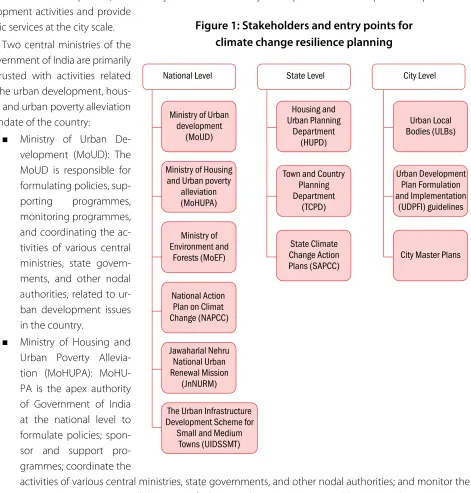
The Indian polity has a federal structure under which national-level policies are decided by the Government of India which also allocates resources to the state governments through various centrally sponsored schemes, provides finances through national financial institutions, and supports various external assistance programmes for urban development and housing in the country. City governments undeniably play central role in planning for urban climate adaptation, with direct jurisdiction over many urban policies that drive public and private de-velopment activities and provide
basic services at the city scale.
Two central ministries of the Government of India are primarily entrusted with activities related to the urban development, hous-ing, and urban poverty alleviation mandate of the country: tivities of various central ministries, state govern-ments, and other nodal authorities, related to ur-ban development issues in the country.
Ministry of Housing and Urban Poverty Allevia-tion (MoHUPA): MoHU-PA is the apex authority of Government of India at the national level to formulate policies; spon-sor and support pro-grammes; coordinate the
activities of various central ministries, state governments, and other nodal authorities; and monitor the programmes concerning all the issues of urban employment, poverty, and housing in the country.
The central ministries are followed by state departments concerning urban development, housing, trans-port, tourism, etc. The urban local bodies fall under the State Urban Development Departments. Besides this two-tier structure, numerous other actors within and around a city also have a role in planning for and facilitat-ing adjustment to climate change (See Figure 1).
Ministry of Urban
National Level State Level City Level
6 Mainstreaming Urban Resilience Planning in Indian Cities: A Policy Perspective
4. Mainstreaming Resilience Planning
in Indian Cities
The World Summit on Sustainable Development in Johannesburg, 2002, highlighted the concept of integration of climate policy and the developmental planning process. In cognizance of the large-scale risks posed by cli-mate change to cities, it is imperative that policy initiatives integrate or ‘mainstream’ resilience planning in urban development of the cities.
In India and across the world, Disaster Risk Reduction (DRR) has often taken a “reactive” approach of relief and rehabilitation soon after the occurrence of a calamity or disaster. Integration of disaster risk management along with developmental efforts offers an opportunity for better preparedness by taking a “proactive” approach towards DRR.
This section will discuss the various tools and methodologies that allow decision-makers and policy planners to mainstream resil-ience planning into the policy-making and planning process, which are the entry points for mainstreaming urban resilience within poli-cies and programmes at the national, state, and city level, supple-mented with examples from literature and from the three ACCCRN cities — Surat, Indore, and Gorakhpur. Having an integrated view to-wards climate resilience planning is essential, because in an urban
environment, climate risks may only be one of the several factors defining poverty levels, well-being, economic growth, and development (Tanner et al., 2007).
4.1 Responding to uncertainty and long time-scales
In recent years, responding to the impacts of climate change on the society, economy, and the environment at large has emerged as a defining challenge for policy-makers. This is particularly because of uncertainty in quan-tification of the regional impacts of climate change, as well as with regard to the time-scales over which some of these impacts are likely to be fully manifested and understood. For example, Sea Level Rise (SLR) is a gradual process unlike flash floods and cyclones, and regional SLR projections face several uncertainties.
In light of climate change, for an urban environment a new layer of uncertainty is added. An urban envi-ronment faces a number of uncertainties, primarily because of the rapidly changing variables such as socio-economic and demographic indicators, land-use patterns, resource demand and utilization patterns, lifestyle changes, policy and regulatory reforms, etc. Hence, policies that are directed towards building and enhancing resilience in the urban systems need to be able to capture this complexity and dynamicity to enable resilience in the long-term. A TERI study brings forth the concept of “Adaptive Policies”, i.e., “policies that are designed to operate under complex, dynamic, and uncertain conditions” (Swanson and Bhadwal, 2009). Given a specific con-text (depending on geographic scale, sector, issue, etc.), policies are crafted to respond effectively to a range of anticipated and unanticipated changes.
7
Mainstreaming Urban Resilience Planning in Indian Cities: A Policy Perspective
4.2 Entry points for mainstreaming resilience planning in
urban India
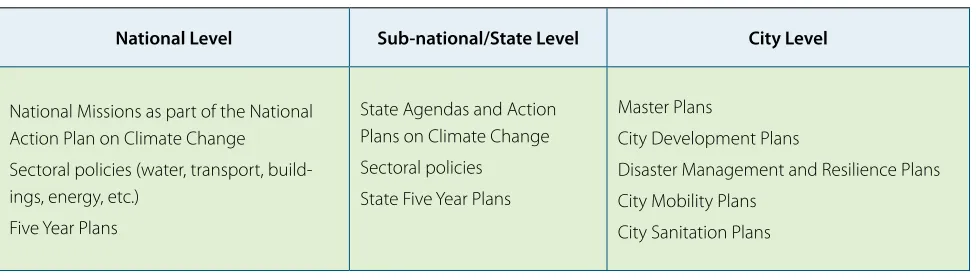
Given the federal structure of policymaking and planning process in India, and existence of several agencies and stakeholders working on similar policy issues there can be multiple entry points for mainstreaming resilience planning in India. Within government plans and policies, the entry points are listed in Table 2.
Table 2: Entry points for mainstreaming resilience at various levels of government
National Level Sub-national/State Level City Level
National Missions as part of the National Action Plan on Climate Change
Sectoral policies (water, transport, build-ings, energy, etc.)
Five Year Plans
State Agendas and Action Plans on Climate Change
Sectoral policies
State Five Year Plans
Master Plans
City Development Plans
Disaster Management and Resilience Plans
City Mobility Plans
City Sanitation Plans
There are also several international donor agencies and developmental aid organizations and national and international Non-Governmental Organizations (NGOs) and research institutes that can enable incorporation of resilience planning in their activities. This can be done by:
Climate risk-screening of the programme portfolio
Resilience planning for cities
4.2.1 National level
Mainstreaming resilience planning into urban development may happen within the ambit of current policies and programmes (climate proofing) and in some cases through new policies and programmes that support ad-aptation and mitigation actions in cities. India’s National Action Plan on Climate Change (NAPCC) was released on 30 June 2008 and it outlines the national priorities for adaptation and mitigation research and policy strate-gies, through eight National Missions. The following Missions under the NAPCC offer direct and indirect oppor-tunities for urban resilience planning.
National Action Plan on Climate Change
National Mission on Sustainable Habitats (NMSH)
At the national level, the Mission recommends having a national urban policy that incorporates incen-tives and disincenincen-tives that encourage and support sustainable habitat. The mission document rec-ommends that the state should prepare dynamic plans with provision for review every five years as proposed under the National Urban Housing Policy 2007.
8 Mainstreaming Urban Resilience Planning in Indian Cities: A Policy Perspective
At the city level, the Mission recommends preparation of city Master Plans considering sustainable de-velopment norms, to be mandated for all cities. The Mission also recommends enforcement of Urban Development Plans Formulation and Implementation (UDPFI) guidelines. Sustainable urban design should be achieved through zonal development plans/area specific plan, implementation, and enforce-ment of developenforce-ment control regulations and building bye-laws.
National Solar Mission
The National Solar Mission (NSM) aims to achieve an installed capacity of 20,000 MW by 2020. For cities across India, this is a huge opportunity to address energy security concerns while also contributing to mitigation efforts.
National Mission on Enhanced Energy Efficiency
This Mission mandates specific energy consumption decreases in large energy-consuming industries, with a system for companies to trade energy-savings certificates, energy incentives, including reduced taxes on ener-gy-efficient appliances. In addition, demand-side management programmes in the commercial and domestic sectors are proposed.
National Water Mission
Specific action under the Mission as relevant for urban resilience include management of surface water resourc-es, management and regulation of groundwater resourcresourc-es, upgradation of storage structures for fresh water, enhanced drainage systems for wastewater and conservation of wetlands.
National Mission for Green India
This Mission aims for the expansion of forest cover from 23–33% of the country’s land, along with conservation of biodiversity. Several urban areas in India have the opportunity to promote urban forestry and maintain and/or increase urban green spaces both from a mitigation as well as adaptation perspective.
National Mission on Strategic Knowledge for Climate Change
The plan envisions a new Climate Science Research Fund, improved climate modelling, and increased interna-tional collaboration. It also encourages private sector initiatives to develop adaptation and mitigation technolo-gies through venture capital funds. In the urban context, specific strategies that can support resilience include building a time-series database for specific climate and climate- dependent variables.
Other National Policies and Plans
9
Mainstreaming Urban Resilience Planning in Indian Cities: A Policy Perspective
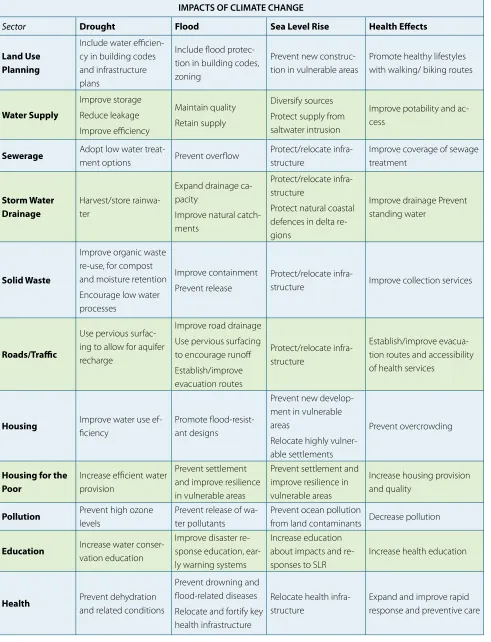
Table 3: Sectoral responses in various impact scenarios
IMPACTS OF CLIMATE CHANGE
Sector Drought Flood Sea Level Rise Health Effects
Land Use Planning
Include water effi cien-cy in building codes and infrastructure plans
Include flood protec-tion in building codes, zoning
Prevent new construc-tion in vulnerable areas
Promote healthy lifestyles with walking/ biking routes
Water Supply
Sewerage Adopt low water
treat-ment options Prevent overflow
Protect/relocate infra-structure
Improve coverage of sewage treatment ing to allow for aquifer recharge tion routes and accessibility of health services
Housing Improve water use
ef-ficiency
Increase efficient water provision
Pollution Prevent high ozone
levels
Prevent release of wa-ter pollutants
Prevent ocean pollution
from land contaminants Decrease pollution
Education Increase water conser-Relocate and fortify key health infrastructure
Relocate health infra-structure
10 Mainstreaming Urban Resilience Planning in Indian Cities: A Policy Perspective
IMPACTS OF CLIMATE CHANGE
Sector Drought Flood Sea Level Rise Health Effects
Recreation/ Open space
Employ water-efficient landscaping and main-tenance techniques
Encourage tree plant-ing to reduce urban heat island
Increase water reten-tion capacity in open space
Manage flood-prone areas as green space to prevent settlement
Manage low-lying coastal areas as green space to prevent
settle-Improve financial re-silience through effi -ciency measures
Flood-proof invest-ments
Protect or reconsider investments
Ensure resilient health fi -nances
Public Transport
Reduce water use for vehicle/system clean-mote equal access to mobil-ity options
Factor into commercial and industrial policy
Insurance Protect against loss of
livelihood
Protect citizens from loss of assets
Protect citizens from loss of assets
Expand access to healthcare for all citizens
Source: TERI (2009b).
As indicated in Table 2, climate change is a crosscutting issue that manifests its impacts at different spatial scales and across different sectors. Apart from the NAPCC, several sectoral policies address various dimensions of urban development and planning and offer entry points for mainstreaming resilience planning. These sectoral policies and programmes are discussed ahead.
Urban Infrastructure Development
The Jawaharlal Nehru National Urban Renewal Mission (JNNURM) focuses on 65 selected cites over the period 2005–20122 and has the primary objective of creating economically productive, e
fficient, equitable, and respon-sive cities. JNNURM has two Sub-Missions/ components, as under:
Sub-Mission I — Urban Infrastructure and Governance: It aims to encourage reforms and fast-track planned development of identified cities. The focus is on efficiency in urban infrastructure and service delivery mechanisms, community participation, and accountability of ULBs/Parastatal agencies towards citizens, preparation of City Development Plans, release, and leveraging of funds.
Sub-Mission II — Basic Services to the Urban Poor: It focuses on ensuring the availability of the basic ser-vices to the urban poor and integrated development of slums through projects on providing shelter, basic services, and other related civic amenities.3
11
Mainstreaming Urban Resilience Planning in Indian Cities: A Policy Perspective
The Urban Infrastructure Development Scheme for Small and Medium Towns aims at improving the urban infrastructure of towns and cities in a planned manner. It focuses on improving infrastructural facilities and cre-ating public infrastructure and quality oriented services in cities and towns, enhancing public–private partner-ship for infrastructural development and promoting in-tegrated development of towns and cities.4 The state
government has the power to designate any existing institution as nodal agency for implementation of the scheme.5
Buildings
The Energy Conservation Act, 2001, established the Bu-reau of Energy Efficiency (BEE). The BEE co-ordinates with designated consumers, agencies and other
or-ganizations and recognizes, identifies, and utilizes the existing resources and infrastructure, in performing the functions assigned to it. The BEE has also formulated the Energy Conservation Building Code (ECBC) which is a voluntary code that provides the minimum requirements for energy efficient design and construction of build-ings.
The solar buildings programme of the Ministry of New Renewable Energy (MNRE) is working towards ex-panding the use of dependable, cost-effective renewable energy in the buildings sector.6 In addition, building
certifications like Green Rating for Integrated Habitat Assessment (GRIHA)7 and Leadership in Energy and
Envi-ronmental Design (LEEDS)8 encourage green building construction.
Disaster management
Disaster management planning in India is positioned both at the central and state level with the help of institu-tions like national and state disaster management authorities. Following major disasters such as the Orissa super-cyclone (1999), the Gujarat earthquake (2001), and tsunami (2006), there were massive investments into relief and rehabilitation and proactive disaster risk reduction, leading to the constitution of the National Disaster Man-agement Authority (NDMA) in 2005 (after the Disaster ManMan-agement Bill of 2005 was passed) under the Ministry of Home Affairs (Revi, 2008). With this, disaster management in India shifted its focus to early warning systems and forecasting of extreme weather events. The NDMA enabled the involvement of the developmental sectors in disaster management and aided in the setting of Disaster Mitigation Funds and creation of the National Insti-tute for Disaster Management (NIDM) that trained planners, trainers, communities for disaster risk reduction and management.
4 The Urban Development Minister Mr Kamal Nath stated that in the next phase of JnNURM, there would be enhanced focus on the Nagar Palikas and Nagar Panchayats i.e. on smaller towns and cities.
5 Retrieved from http://www.cmao.nic.in/Resources/JNNURM/Guidelines/UIDSSMT-%20GUIDELINES.pdf, last accessed on 29 January 2010 6 Retrieved from http://www.nrel.gov/docs/fy99osti/24427.pdf , last accessed on 15 January, 2010
7 A Green building design evaluation system for Inida, developed by TERI 8 A US certification for green buildings
12 Mainstreaming Urban Resilience Planning in Indian Cities: A Policy Perspective
Municipal Solid Waste Management
Management of municipal solid waste (MSW) is one the major issues in Indian cities and towns. The problem is aggravated during floods and monsoons leading to clogged drains overflow of sewage and storm water, and outbreak of diseases. In addition, the landfill sites existing in India lack proper designing and hence there is an uncontrolled release of GHGs such as methane from waste dumps and landfills. At present, MSW Management and Handling Rules, 2000 apply to all municipal authorities responsible for collection, segregation, storage, trans-portation processing, and disposal of MSW. However, there is a need to revise these rules to factor in climatic considerations.
Transport
The objective of the National Urban Transport policy 2006 is to ensure safe, affordable, and sustainable mobility for the residents of cities. The policy emphasizes on integrated land use and transport planning, improving ac-cess to markets and commercial ventures, and equitable allocation of road space with a focus on commuters.
Urban housing
The national urban housing and habitat policy 2007 aims at ensuring equitable and affordable access to land and shelter to city residents. The policy emphasizes on coordination between diverse stakeholders including the private sector, cooperative and the industrial sector for labour housing, and services sector for employee hous-ing.
4.2.2 State level
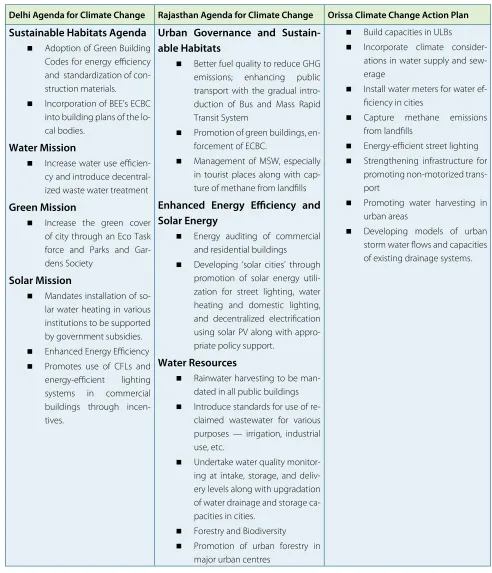
Following the NAPCC, states in India have been issued a direc-tive from the centre to prepare their State Climate Change Ac-tion Plans (SAPCC). The first step towards preparation of a SAPCC is to identify state-specific risks and impacts and prioritize areas for research and policy action in response to current and future vulnerabilities and projected impacts of climate change. States of Delhi and Rajasthan are among the first to initiate the process by developing a State Climate Change Agenda that sets out the key risks and impacts of climate change on the state and accordingly lists priorities for research and policy action related to adaptation and mitigation. The State of Rajasthan combined the preparation of the Climate Change Agenda (CCA) along with the State
Envi-ronment Policy. Orissa is the first state in India to have put forth a SAPCC. These State Agendas and Action Plans provide a good example of, and an opportunity for integration of urban resilience at a sub-national level, within identified priority areas of the state. Some key points are listed in Table 4.
13
Mainstreaming Urban Resilience Planning in Indian Cities: A Policy Perspective
Table 4: State Action Plans on Climate Change
Delhi Agenda for Climate Change Rajasthan Agenda for Climate Change Orissa Climate Change Action Plan
Sustainable Habitats Agenda
Adoption of Green Building Codes for energy efficiency and standardization of con-struction materials.
Incorporation of BEE’s ECBC into building plans of the lo-cal bodies. of city through an Eco Task force and Parks and Gar-dens Society
Solar Mission
Mandates installation of so-lar water heating in various institutions to be supported by government subsidies.
Enhanced Energy Efficiency
Promotes use of CFLs and energy-efficient lighting systems in commercial buildings through incen-tives.
Urban Governance and Sustain-able Habitats
Better fuel quality to reduce GHG emissions; enhancing public transport with the gradual intro-duction of Bus and Mass Rapid Transit System
Promotion of green buildings, en-forcement of ECBC.
Management of MSW, especially in tourist places along with cap-ture of methane from landfills
Enhanced Energy Efficiency and Solar Energy
Energy auditing of commercial and residential buildings
Developing ‘solar cities’ through promotion of solar energy utili-zation for street lighting, water heating and domestic lighting, and decentralized electrification using solar PV along with appro-priate policy support.
Water Resources
Rainwater harvesting to be man-dated in all public buildings
Introduce standards for use of re-claimed wastewater for various purposes — irrigation, industrial use, etc.
Undertake water quality monitor-ing at intake, storage, and deliv-ery levels along with upgradation of water drainage and storage ca-pacities in cities.
Forestry and Biodiversity
Promotion of urban forestry in major urban centres
Build capacities in ULBs
Incorporate climate consider-ations in water supply and sew-erage
Install water meters for water
ef-ficiency in cities
Capture methane emissions from landfills
Energy-efficient street lighting
Strengthening infrastructure for promoting non-motorized trans-port
Promoting water harvesting in urban areas
Developing models of urban storm water flows and capacities of existing drainage systems.
4.2.3 City level
14 Mainstreaming Urban Resilience Planning in Indian Cities: A Policy Perspective
Plan NYC- New York (2007) are few examples where city governments have developed adaptation and mitiga-tion strategies and plans bearing in mind, the long-term resilience of the city. In India, town planning is an im-portant entry point for mainstreaming urban resilience. Review of several planning documents is required in order to identify options and strategies towards urban resilience. These include:
Town and country planning act and zoning regulations
Development control rules and building bye-laws
District planning manual of the Planning Commission
National building codes
Urban Development Plan Formulation and Implementation (UDPFI) guidelines
City master plans
At the city level, budgetary challenges and lack of fiscal autonomy still exist as bulk of the finances still rest with the Central and state governments and not with city governments.
4.2.4 Vulnerability assessment in ACCCRN cities
The vulnerability assessments have been conducted in three cities of India (Surat, Indore, and Gorakhpur). As part of the ACCCRN programme, these cities have already developed their resilience strategies. While in Gora-khpur, the vulnerability assessment was based on large-scale consultations, stakeholder perceptions, direct field observations, and primary and secondary data analysis; in Surat and Indore, the vulnerability assessments were captured based on the creation of specific indices through GIS-based sampling and aggregation and validated through stakeholder interactions. These indices related to education, socio-economic variables, and access to urban services and infrastructure, inter alia.
The Gorakhpur resilience strategy follows an integrated approach that addresses institutional, behavioural, social, and technical issues. The strategy emphasizes effective implementation of master plans while building in climate concerns into these plans that are statuary documents meant to guide the growth and development of a city. The strategy advocates utilizing targeted interventions that build knowledge, provide demonstrated examples to assist development, and build the capacity of organizations. The Surat and Indore Resilience Strate-gies are structured around four main principles: (i) build on current and planned initiatives; (ii) demonstrate re-silience-building projects to leverage further action, multi-sectoral information generation, and shelf of projects; and (iv) build synergy with state- and national-level institutions. All these three cities acknowledge the need to mainstream resilience strategy into city development processes and to locate synergies at state and national level leveraging the required funds from here to carry on resilience-building strategies.
4.2.5 Climate risk screening
Another method of mainstreaming risk reduction and resilience planning is through climate risk screening. This climate risk screening process is also known as ORCHID (Opportunities and Risk from Climate Change and Di-sasters). It is an approach for reducing climatic risks to developmental objectives and integrating adaptation op-tions within developmental programmes at the national and sub-national levels (Tanner et al., 2007). The steps involved in a climate risk screening include:
Assessment of current and future impacts of climate change on developmental objectives of a project/ policy;
15
Mainstreaming Urban Resilience Planning in Indian Cities: A Policy Perspective
Identify potential entry points to integrate climate risk management strategies into the developmental project/policy ambit
Prioritization of the selected strategies based on multiple established criteria
Conducting cost-benefit analyses of the selected strategies.
4.2.6 Examples of Climate Risk Screening
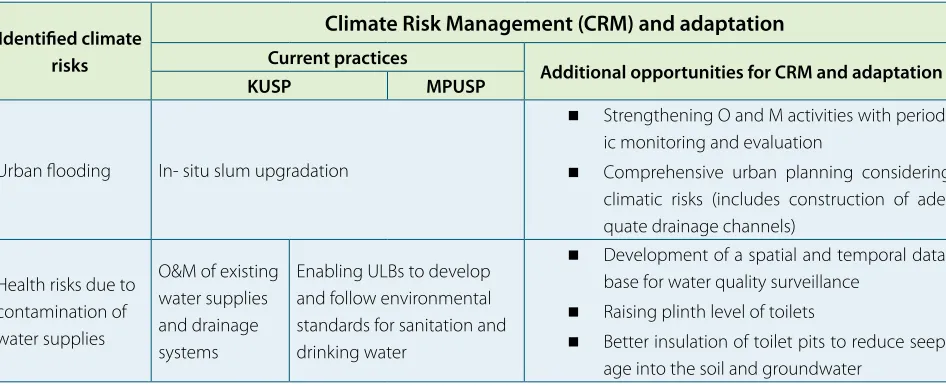
This approach was applied to the Urban Service for the Poor programme of DFID-India in two states of India — West Bengal and Madhya Pradesh. The Kolkata Urban Services for the Poor (KUSP) and Madhya Pradesh Urban Services for the Poor (MPUSP) strengthen governance at the level of the state and urban local bodies. They also support infrastructure improvements to ensure affordability of and access to basic services by the poor. The
climate risks to the objectives of KUSP and MPUSP were identified as water logging and flooding due to an in-crease in high precipitation events, consequently impacting urban drainage, waste management, water supply and sanitation, and community health services. The existing measures being addressed within the programme portfolio and additional opportunities for managing future climate risks are highlighted in Table 5.
Table 5: Climate Risk Screening Conducted for Urban Services for the Poor Programmes in India
Identified climate risks
Climate Risk Management (CRM) and adaptation
Current practices
Additional opportunities for CRM and adaptation
KUSP MPUSP
Urban flooding In- situ slum upgradation
Strengthening O and M activities with period-ic monitoring and evaluation
Comprehensive urban planning considering climatic risks (includes construction of ade-quate drainage channels)
Health risks due to contamination of water supplies
O&M of existing water supplies and drainage systems
Enabling ULBs to develop and follow environmental standards for sanitation and drinking water
Development of a spatial and temporal data-base for water quality surveillance
Raising plinth level of toilets
Better insulation of toilet pits to reduce seep-age into the soil and groundwater
Source: (TERI, 2007, Chapter 3)
5. Way Forward
The concept of resilience finds its roots in ecological sciences hence its applicability to social sciences field finds different interpretations.
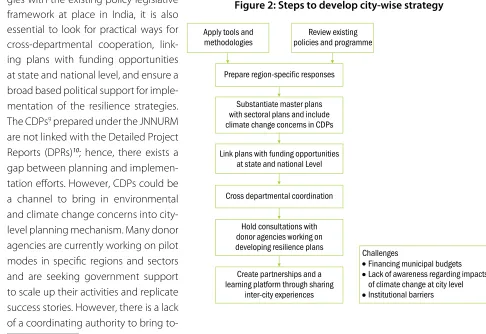
Given the number of cities in India, out of which about 50 are million plus cities, there is a need to act fast towards building resilience within the Indian cities. To achieve the same, there is a need to build capacity of ur-ban centres to measure their vulnerabilities and develop their own resilience plan. Some steps have been high-lighted in Figure 2.
pro-16 Mainstreaming Urban Resilience Planning in Indian Cities: A Policy Perspective
grammes to develop responses best suited to a region/community. Master plans are essentially land-use plans in India. These should be substantiated with sectoral plans so that each sec-tors’ development is in synergy with other and integrated development could be achieved. The Town Coun-try and Planning Organisation (TCPO) is now promoting regional develop-ment planning to be decentralized at the micro-zonation levels. However, at this stage there is a great need for capacity building of TCPO officials to take this forward so that the cities take up all the functions delegated to them under the 74th Amendment Act.
Besides looking at the syner-gies with the existing policy legislative framework at place in India, it is also essential to look for practical ways for cross-departmental cooperation, link-ing plans with fundlink-ing opportunities at state and national level, and ensure a broad based political support for imple-mentation of the resilience strategies. The CDPs9 prepared under the JNNURM
are not linked with the Detailed Project Reports (DPRs)10; hence, there exists a gap between planning and implemen-tation efforts. However, CDPs could be a channel to bring in environmental and climate change concerns into city-level planning mechanism. Many donor agencies are currently working on pilot modes in specific regions and sectors and are seeking government support to scale up their activities and replicate success stories. However, there is a lack of a coordinating authority to bring
to-9 Each ULB that is seeking assistance from the JNNURM is required to prepare a City Development Plan that shall include strategy to implement reforms, city-level improvements and an investment plan to address the infrastructure needs in a sustainable manner.
10 Projects that apply for funding under the JnNURM programme are required to prepare and submit a Detailed Project Report (DPR).
As part of the ACCCRN study, a half-day roundtable on ‘Exploring Partnerships’ was conducted on 27 October 2010 to get insights into the priorities of different donor agencies working in the area of urban development and resilience in India. During the roundtable discussions, various donor representatives presented on how resilience currently features in their urban development portfolio, and plans for upscaling current efforts or starting new initiatives.
A policy roundtable on ‘Sharing Knowledge and Scaling Up Action on Urban Resilience in India’ was held on 10 March 2011. It was discussed that there is a need to upscale the activities carried out under ACCCRN programme to other cities as well. This programme takes into consideration various sectors and their overlaps while planning for resilience. It was discussed that there is a need to link resilience planning exercise and resilience strategy development at a city level.
Substantiate master plans with sectoral plans and include climate change concerns in CDPs
Hold consultations with Lack of awareness regarding impacts of climate change at city level Institutional barriers Link plans with funding opportunities
at state and national Level Apply tools and
17
Mainstreaming Urban Resilience Planning in Indian Cities: A Policy Perspective
gether these diverse groups. ACCCRN aims to bring in more stakeholders and create an independent learning platform.
Communicating experiences amongst cities is an essential and effective way to initiate adaptation actions within cities and to enable sharing of best practices.
There are also some key challenges in institutionalizing climate adaptation and mitigation in an overall re-silience framework. A major focus needs to be on awareness generation, capacity building, and training of city level officials to understand climate risks for their city. The vertical linkages, i.e., from city level to the national level and horizontal linkages i.e. between municipalities and ULBs at the city level need to be strengthened to address institutional barriers to the implementation of selected adaptation and mitigation strategies.
Bibliography
Alberti M, Marzluff J, Shulenberger E, Bradley G, Ryan C, and Zumbrunnen C. 2003. Integrating Hu-mans into Ecology: Opportunities and Challenges for Studying Urban Ecosystems. Ecosystems Bioscience 53(12): 1169–1179
Carter T R, Parry M L, Harasawa H, and Nishioka S. 1994. IPCC Technical Guidelines for Assessing Cli-mate Change Impacts and Adaptations. London
Craig R K. 2009. A Public Health Perspective on Sea-level Rise: Starting Points for Climate Change Adaptation. Widener Law Review 15(2). Details available at <http://ssrn.com/abstract=1119563>
Dayton-Johnson J. 2004. Natural Disasters and Adaptive Capacity (Working paper no. 237). Details available at <www.oecd.org/dataoecd/30/63/33845215.pdf>
Eriksen S E H, Næss L O, Klein R J T, Hammill A, Robledo C, O’Brien K. 2005. Portfolio Screening for Mainstreaming Adaptation to Climate Change. Paper submitted at the International Conference onClimate or Development, Hamburg, Germany, 28–29 October 2005, organized by the Hamburg In-stitute of International Economics
Feenstra J, Burton I, Smith J, and Tol (eds). 1998. Handbook on Methods for Climate Change Impact Assessment and Adaptation Strategies. Nairobi: UNEP; Amsterdam: Institute for Environment Stud-ies, Vrije University
Government of India (GoI). 2004. Initial National Communications to the United Framework Con-vention on Climate Change. New Delhi: Ministry of Environment and Forests, Government of India
International Panel for Climate Change (IPCC). 2007. Summary for Policymakers. In Climate Change 2007: Impacts, Adaptation and Vulnerability, pp. 7 – 22, edited by M L Parry, O F Canziani, J P Palutikof, P J van der Linden, and C E Hanson. UK: Cambridge University Press, Cambridge [Contribution of Working Group II to the Fourth Assessment Report of the Intergovernmental Panel on Climate Change]
2001. Synthesis Report: Summary for Policymakers. In Climate Change 2001, UK: Cambridge Uni-versity Press, Cambridge [Assessment of Working Groups I, II, and III to the Third Assessment Report of the Intergovernmental Panel on Climate Change]
18 Mainstreaming Urban Resilience Planning in Indian Cities: A Policy Perspective
Klein R J T, Nicholls R J, and Mumura N. 1999. Coastal Adaptation to Climate Change: Can the IPCC Technical Guidelines Be Applied? Mitigation and Adaptation Strategies for Global Change 4: 239–252
McGrahanan G, Deborah B, and Bridget A. 2007. The Rising Tide: Assessing the Risks of Climate Change and Human Settlements in Low Elevation Coastal Zones. Environment and Urbanization
19(1): 17–37
Nijkamp P and Finco A. 2000. Evaluation of Complex Resilience Strategies for Sustainable Cities. In Il Governo del Territorio: Complessità e Cambiamento, edited by P Gejo, pp 119–141. Padova: CESET
Prasad N, Ranghieri F, Shah F, Trohanis Z, Kessler E, and Sinha R. 2009. Climate Resilient Cities: A Primer on Reducing Vulnerabilities to Disasters. Washington DC: The World Bank. pp. 186
Revi A. 2008. Climate Change Risk: An Adaptation and Mitigation Agenda for Indian cities. Envi-ronment and Urbanisation 20(1): 207-229.
Smith J B, R J T Klein, and Huq S. 2003. Climate Change, Adaptive Capacity and Development. Lon-don: Imperial College Press. pp. viii+347
Srivastava S. 2002. Dynamics of Coastal Regimes. In the National Seminar on Creeks, Estuaries and Mangroves Pollution and Conservation, Thane, India, 28-30 November 2002, BN Bandodkar College of Science, Thane
Swanson D and Bhadwal S. 2009. Creating Adaptive Policies: A Guide for Policymaking in an Uncer-tain World. New Delhi: SAGE; Ottawa: IDRC
Tanner T M, Nair S, Bhattacharjya S, Srivastava S K, Sarthi P P, Sehgal M, and Kull D. 2007 ORCHID: Cli-mate Risk Screening in DFID India. Synthesis Report. Details available at: <http://www.ids.ac.uk/ UserFiles/File/poverty_team/climate_change/ORCHID_SR.pdf>
Tanner T M, Nair S, Bhattacharjya S, Srivastava S K, Sarthi P P, Sehgal M, and Kull D. 2007. Climate Resilient and Sustainable Urban Development. New Delhi: TERI, Chapter 3: Disaster Risk Reduction (DRR) and Adaptation
TERI. 2006. GREEN (Growth with Resource Enhancement of Environment and Nature) India 2047 Renewed: Looking Back to Change Track. New Delhi: TERI Press. pp. 173
TERI. 2009a. An Exploration of Sustainability in the Provision of Urban Basic Services. New Delhi: TERI Press
Farrel, Leanne et al. 2009b, “Towards a city adaptation framework for Indian cities – a concept note”, un-published report, TERI, New Delhi.
United Nations International Strategy for Disaster Reduction (UNISDR). 2009. UNISDR Terminology on Disaster Risk Reduction. Details available at: <http://www.unisdr.org/preventionweb/fi les/7817_UNIS-DRTerminologyEnglish.pdf>
Vogel C, Moser S C, Kasperson R E, and Dabelko G D. 2007. Linking Vulnerability, Adaptation, and Resilience Science to Practice: Pathways, Players, and Partnerships. Global Environmental Change 17(3–4): 349–364
Wardekker J A, et al. 2009. Operationalising a Resilience Approach to Adapting an Urban Delta to Uncertain Climate Changes. Journal of Technological Forecast and Social Change, 77(6): 987-998.