Full Terms & Conditions of access and use can be found at
http://www.tandfonline.com/action/journalInformation?journalCode=vjeb20
Download by: [Universitas Maritim Raja Ali Haji] Date: 11 January 2016, At: 20:59
Journal of Education for Business
ISSN: 0883-2323 (Print) 1940-3356 (Online) Journal homepage: http://www.tandfonline.com/loi/vjeb20
Understanding Students’ Attitudes About Group
Work: What Does This Suggest for Instructors of
Business?
Melanie Beth Marks & Abigail H. O’Connor
To cite this article: Melanie Beth Marks & Abigail H. O’Connor (2013) Understanding Students’ Attitudes About Group Work: What Does This Suggest for Instructors of Business?, Journal of Education for Business, 88:3, 147-158, DOI: 10.1080/08832323.2012.664579
To link to this article: http://dx.doi.org/10.1080/08832323.2012.664579
Published online: 20 Feb 2013.
Submit your article to this journal
Article views: 410
View related articles
ISSN: 0883-2323 print / 1940-3356 online DOI: 10.1080/08832323.2012.664579
Understanding Students’ Attitudes About Group
Work: What Does This Suggest for Instructors
of Business?
Melanie Beth Marks and Abigail H. O’Connor
Longwood University, Farmville, Virginia, USAA survey was administered to college students to gain insight into their attitudes about class-room group work. Students responded that group work is generally a positive experience; however, they do not necessarily prefer it to individual assignments. Students’ responses also indicated concerns about instructors’ motivations for using group work, management of the process (or lack thereof) by instructors, free riding by teammates, and being accountable for the work of others. When comparing business and nonbusiness majors, some interesting, sta-tistically significant differences are found. For example, business majors are more willing to be held accountable for the work of others and are more willing to terminate group members.
Keywords: classroom, cooperative learning, groups, students, survey, teams
Learning to work in a team environment is an important ele-ment of any business school curriculum—it forces students to focus on communication skills and project management approaches while highlighting the importance of a good work ethic. Teams combine people with different backgrounds and areas of expertise, applying each member’s strengths. The result is that teams can create solutions that may not be ac-complished without the full effort of the team (Katzenbach & Smith, 2005). Nevertheless, collaboration can be frustrat-ing as well as fruitful. Students may have different ability levels, creating a source of stress for those who feel they are more capable, and group members may have different work ethics. Students also have trouble coordinating sched-ules and may not enjoy being with particular group members. Depending on the situation and how the process is managed, the outcome of group work might not be better than if team members worked individually.
Our own experience is that students are often resistant to group work, possibly due to perceptions of its effectiveness, their past experiences, or their assumptions of instructors’ motives. We set out to learn more about the potential biases students have with respect to group work through a survey administered to undergraduate students. Our purpose was
Correspondence should be addressed to Melanie Beth Marks, Longwood University, College of Business and Economics, 201 High Street, Farmville, VA 23909, USA. E-mail: [email protected]
twofold. First, we wished to gain more insight into students’ attitudes about group work. Specifically, how do they think it should be designed, do they feel it is a valuable activity, and what are their perceptions about professors’ motivations for using group work? Second, we wished to see if responses of business majors differed from nonbusiness majors in or-der to determine the implications for us as instructors of business.
The article proceeds as follows: we outline the related literature, present an overview of the survey and charac-terize the respondents. Then, we present a detailed anal-ysis of survey results. Last, we offer a conclusion and discussion.
LITERATURE REVIEW
Cooperative Learning
Group work in the classroom is a form of cooperative learn-ing, a technique that requires students to work together collaboratively and goes beyond mere active learning ap-proaches in which students learn by doing. By working to-gether toward a common goal, students develop more/better ideas and solutions, transfer learning across areas, spend more time on task, and are (together) actively involved in their learning. Because students are required to work with others, cooperative learning can help them build better re-lationships, leading to stronger interactions and contributing
to higher self esteem (Johnson & Johnson, 1999). Over the past decade, cooperative learning has achieved greater accep-tance and its use in the university classroom has increased (Johnson, Johnson, & Smith, 2007).
Do Students Prefer to Work in Groups?
While the potential benefits of group work are well doc-umented, do students like it? The answer is not so clear-cut. Phipps, Phipps, Kask, and Higgins (2001) concluded that while students have positive perceptions of some of the techniques of cooperative learning (individual accountabil-ity, interpersonal elements, small group skills, and group processing), they generally do not think it positively in-fluences learning or increases study time. Machemer and Crawford (2007) explored three common teaching tech-niques (traditional teacher-centered learning, active ing where students learn by doing, and cooperative learn-ing) and concluded that students liked whichever technique they felt would help them achieve the highest grade. They valued cooperative techniques the least, however, and they did not like being responsible to a group. Schultz, Wilson, and Hess (2010) collected from students written answers to an open-ended question about their preferences for group work. Students identified some of the benefits of group work to be a better product (more minds with more ideas), im-proved learning opportunities (learning from others), reduced workloads (work spread across more people), and collec-tive security (tasks seemed less overwhelming when working together). But students also shared their concerns about giv-ing up full control over their grades, free ridgiv-ing by others, and experiencing difficulties in setting up group meeting times. Bacon (2005) employed an experimental approach where groups of two undergraduate students in a consumer behavior course were compared with students who worked independently on an identical project. Follow-up survey re-sponses indicated that students preferred to work individu-ally and those who worked alone thought working in groups would have resulted in more work, not less. Hillyard, Gille-spie, and Littig (2010) conducted survey-based research with undergraduate students and learned that bad group expe-riences led to long-lasting, negative attitudes about group work.
Are Attitudes About Group Work Related to Academic Success?
It does appear that students’ attitudes about group work are related to academic performance. Chapman and Van Auken (2001) found that the more academically successful students (higher grade point averages [GPAs]) tended to have less positive attitudes about group work. Students who were less academically successful (lower GPAs), on the other hand, had more positive attitudes about group work. Shaw, Duffy, and Stark (2000) also found this negative relationship be-tween a student’s preference for group work and GPA. Su
(2007) looked at individual student ability (students were ranked from low to high based on their grade point averages and grouped into high, medium, and low individual ability tertiles) relative to the ability of the rest of the team. Not surprisingly, students categorized as having a low level of individual ability had stronger preferences for team work when they were matched with students whose abilities were higher than their own. Combining students categorized as having medium individual ability or high individual ability with teams of medium or high performing members, how-ever, did not change (positively or negatively) the prefer-ences for team work. Rassuli and Manzer (2005) surveyed students in principles of economics courses who participated in cooperative learning activities built into the curriculum. An initial survey was used to divide the population into those who felt that their mastery of course content had in-creased and those who did not (eliminating neutral respon-ders). Students who felt they had better mastered material had better attitudes about the class as a result of coopera-tive learning activities, citing improvement in performance, problem-solving skills, and ability to understand and artic-ulate economic concepts. Students who felt their mastery decreased did not have a better attitude about the course and they indicated a preference for less group work and more lecture.
What Internal Factors Affect Attitudes About Group Work?
Because group work requires students to communicate and interact with others, it seems logical that communication styles and personality might influence attitudes and percep-tions. Myers et al. (2009) found that students’ perceptions of the attributes of group work are linked to their own personal-ities and communication traits. In their study, undergraduate students were asked to rate themselves with respect to four personal attributes (tolerance for ambiguity, tolerance for disagreement, conversational sensitivity, and cognitive flexi-bility). The authors concluded that students were more likely to identify positive attributes of group work if they reported a greater ability to handle the potential for conflict between members, less discomfort with ambiguity, greater conversa-tional abilities spanning multiple dimensions including com-prehending what is said and how it is said, and more mental flexibility and open-mindedness. Students who were less able to cope with group work (not liking ambiguity and disagree-ment) and who were not flexible thinkers were more likely to identify negative attributes of group work, regardless of possessing conversational abilities.
Amato and Amato (2005) studied the relationship be-tween students’ communication styles and their perceptions of the team learning experience. Student groups were de-signed based on results of a Myers-Briggs Type indicator. Some students were put into groups with others who had compatible types (based on Yeakley two-way dyad scores)
in order to create an ease of communication (the compatible team treatment). Others were placed with students who did not have compatible types, so the same ease of communica-tion was not expected (the complementary team treatment). The authors found that in an introductory economics class, compatible groups were more positive about the team ex-perience. But in a marketing strategy class the reverse was true—complementary groups viewed the team experience more favorably. The authors suggested that this outcome could be tied to experience. The economics students were new to team work and may have found it easier to commu-nicate with team members who were similar. The marketing strategy students had more experience with teamwork and were more likely to understand and take advantage of the benefits associated with the diversity offered by complemen-tary teams.
Gottschall and Garc´ıa-Bayonas (2008) studied differences in attitudes toward group work among mathematics majors (light users of group work), education majors (heavy users), and business administration majors (medium users). While all three majors shared the same primary likes and dislikes related to group work, the authors found that business majors identified more negative aspects to group work. Education majors had the most positive overall attitudes.
Kaenzig, Hyatt, and Anderson (2007) concluded that gen-der has a role in shaping students’ attitudes. In their study, women indicated more negative experiences with group work, citing feelings of being taken advantage of, pressure to offer favorable peer reviews, and responsibility for more of the secretarial tasks. In Chapman and Van Auken’s (2001) previously discussed study, however, there were no differ-ences in attitudes related to gender (or ethnicity). In an older study, Freeman (1996) found that female master of busi-ness administration (MBA) students got along with other group members better than their male counterparts and that they were more satisfied with the overall performance of the group. Female MBA students also reported more learning as a result of the group setting than men and a stronger feeling that team members could use each other to increase their own competence.
Do Project Design Factors Influence Attitudes?
Many of the factors that shape students’ attitudes about group work are related to the design of the project, something that can be influenced by the instructor. The surveys of Chapman and Van Auken (2001) revealed that students had a more positive attitude about group work and its benefits when the instructor was more active, helped the students understand group dynamics, used more group management techniques, and employed various evaluation methods (peer evaluations, meeting reports, and observation). Hijzen, Boekaerts, and Vedder (2007) studied effective and ineffective cooperative learning teams at a secondary vocational school in the Nether-lands and found that the ineffective teams (those highly
unsat-isfied with their quality of cooperative learning) complained about the guidance offered by teachers (e.g., instructions un-clear, not enough guidance offered, teachers not providing help when needed). Pfaff and Huddleston (2003) measured attitudes of senior undergraduate students who had recently experienced team work. Students in groups that did not ex-perience shirking and that used peer evaluations rated the experience more favorably. Likewise, when more time was allotted in class to work on the project and when students thought that the team work load was fair, they rated the expe-rience more favorably. Some of these same issues were noted in the previously discussed work of Schultz et al. (2010). Student responses to open-ended questions communicated concerns about shirking by others, the influence that oth-ers would have on their grades, and difficulties with setting meeting times.
Interestingly, the degree of homogeneity/heterogeneity in group membership does not appear to have a strong influence on attitudes about group work. Winter, Waner, and Neal-Mansfield (2008) studied teams of business majors that were homogeneously or heterogeneously grouped with respect to specific business disciplines (accounting, finance, market-ing) to see if students’ perceptions of teamwork in these two types of teams differed. They found that, in both types of groups, students fairly distributed the work load, experienced minimal conflicts, and worked together effectively. Teams grouped by discipline, however, found it easier to express ideas and they developed friendships more easily (although the authors admit it might be due to having other classes to-gether and similar interests). Anderson (2005) studied groups of three students who participated in a four-week simulation. Anderson hypothesized that groups that were more cohesive (easily work together), less heterogeneous (less diversity in ideas), and more interdependent (work better with others than alone) would generate greater affect for the group project. Re-sults suggested that cohesiveness and interdependence did in-crease affect. Heterogeneity, on the other hand, did not impact students’ levels of affect, suggesting that the author’s con-cern that diversity of ideas would result in greater conflict was unfounded.
There is no real consensus about whether or not students prefer to work individually or in teams—the results are truly mixed. Some of the research suggests that students do per-ceive the benefits of group work. They understand that it can enhance and increase learning, and lead to a better product. And when these benefits are received, students view group work more favorably. Other studies suggest that there is a large focus on the potential costs—unequal workloads, free riding by teammates, and difficulties coordinating in a group setting. When students experience these costs, they (under-standably) have a negative attitude about group work that can be long-lasting. Some studies point to personality traits and conversational abilities of the individuals that influence the affect they have for group work. Other studies point to academic achievement as being an important factor, as well
as students’ perceptions about their own learning and their performance on the assignment. There are even contradic-tory studies on the impact of gender on attitudes about group work.
What we take away from the literature is that there are no definitive answers. Students come to the table with their own set of experiences and their own attitudes about group work. As instructors, we must be in-tune with students’ atti-tudes and perceptions of group work, understand how these attitudes relate to and influence team performance, and re-alize the role that we play in shaping them. This requires that we know more about the attitudes and perceptions of our students.
MOTIVATION AND METHOD
The idea for this study came out of an unfortunate experi-ence that ignited a dialogue within our business school. In the fall of 2008, one of the authors brought honor board charges against an unprecedentedly large number of students who had submitted group projects containing plagiarized sections. In each group, just one individual wrote the plagiarized section, but the group was ultimately responsible for the overall prod-uct. This led to conversations with students and discourse (sometimes heated) between colleagues. What struck us was that there was no consensus in opinions to key questions:
• Should students be accountable for each other’s work in a group setting?
• What is a professor’s responsibility related to providing students training on how to work effectively in teams?
• What is the best way to organize group work?
• Is group work even an effective strategy?
Armed with anecdotal information based on our own expe-riences (good and bad), the stories shared by students about their experiences (mostly negative) in other classes, and the comments from colleagues, we compiled a list of issues. We also armed ourselves with knowledge about best practices for group work, as identified in the literature. Not surprisingly, many of the concerns expressed by students and colleagues directly tied into best practices. For example, the literature suggests that free riding is limited by use of peer reviews. But how would students feel about trusting others in a peer review process? And should this information be used in grad-ing? The dialogue with students and faculty and the resulting laundry list of issues and concerns became the basis for the survey employed in this study.
Survey Design
We developed the survey to address five broad questions:
• What are students’ preferences for how classroom group work should be organized?
• What are students’ feelings about the value of classroom group work?
• What are students’ perceptions about professors’ motiva-tion for using group work?
• What are students’ experiences with classroom group work?
• What are students’ overall opinions of classroom group work?
As faculty members in a business school, we also are in-terested in knowing whether business majors differ in their responses from nonbusiness majors. We saved the questions related to students’ experiences for another study, allowing us to focus solely on students’ attitudes about group work in this article. We also defer an analysis of attitudes as they relate to gender to a later investigation.
The survey instrument contained 73 questions divided into five sections. Twenty-nine questions relating specifi-cally to students’ experiences are not evaluated in this article and eight questions were used to collect demographic infor-mation. The remaining questions asked students about their preferences for how group work should be organized, their perceptions about faculty motives, and their overall impres-sions about the value of group work. All questions employed a 5-point Likert-type scale that ranged from 1 (strongly agree) to 5 (strongly disagree).
For efficiency, specific questions will be provided when results are detailed subsequently. The language that appears in tables reflects the exact wording employed in the survey. We have retained the original question numbers to reveal the order in which questions were asked. (The survey is available upon request.)
Prior to finalizing the survey, a small sample of stu-dents reviewed the instrument. We conducted cognitive in-terviews to obtain answers to the following questions: (a) Are any questions unclear?; (b) Are there any questions for which an acceptable answer does not exist?; (c) Are there any topics related to group work that should have been included but are not?; and (d) How long did the survey take to complete? Based on those interviews we deemed the instrument acceptable, however, a minor change was made to the wording of one question. Responses from stu-dents involved in the cognitive interviews were not included in the dataset. A colleague with substantial expertise on survey techniques provided guidance on administering the instrument.
Demographics of Survey Samples
In spring 2009, we administered the survey to students at our university, a mid-sized state institution that prides itself on a low teacher–student ratio and high quality instruction. Because we wanted to survey upperclassmen, we targeted upper level business courses as well as a 400-level English class required for all students.
TABLE 1
Demographic Makeup of Students Surveyed
Pooled Business Nonbusiness
Number of observations 411.00 153.00 258.00 % Juniors 45.00 16.30 62.00 % Seniors 55.20 83.60 38.00 % Full-time work experience 21.30 26.10 18.60
% Men 40.00 62.10 27.10
Average age (years) 21.35 21.33 21.18 Average grade point average
(4-point scale)
3.00 2.82 3.04
% with three group experiences 0.882 0.928 0.767
We administered surveys in the classroom setting to eight business classes (average enrollment of 22.4 students) and 19 English classes (average enrollment of 19.1 students). The response rate (relative to enrollment) was 85% in business and 71% in English. It should be noted that some students appeared in both a business class and an English class, but they were asked to complete the survey only once. Because business classes received the surveys several days before English classes received them, this reduced the response rate in the English classes (some students had already completed the survey). After culling incomplete surveys, we ended up with 411 responses.
Table 1 details the demographic breakdown for the over-all dataset and for the business and nonbusiness samples. Of the 411 students, 37.2% indicated that their major was housed in the College of Business & Economics. The re-maining 62.8% indicated majors housed in the College of Liberal Arts & Sciences or in the College of Education & Human Services. Interestingly, the business sample reflected a greater proportion of seniors, but average age is almost the same when comparing business and nonbusiness (we only found students over the age of 27 years in nonbusiness
dis-ciplines). The business sample reflected a greater proportion of males, students with full-time work experience, and lower self-reported grade point averages. Over 88% of the students surveyed indicated that they had had three group work ex-periences (reported by 93% of business students and 77% of nonbusiness students). Everyone had had at least one group experience.
It is likely that nonbusiness courses generated the expe-riences of nonbusiness majors. At our institution, there are very few nonbusiness curricula that require business courses, and generally those that do are limited to introductory sub-jects (most often economics) that do not use group work. It is also likely that the experiences of business majors come mainly from their business classes. Students studying busi-ness take general education courses that do not employ much group work (e.g., mathematics, history, English). Business courses, however, often employ group work; business ma-jors also have relatively few electives for courses outside of business.
RESULTS
Part 1: Students’ Perception of Motivation for Group Work
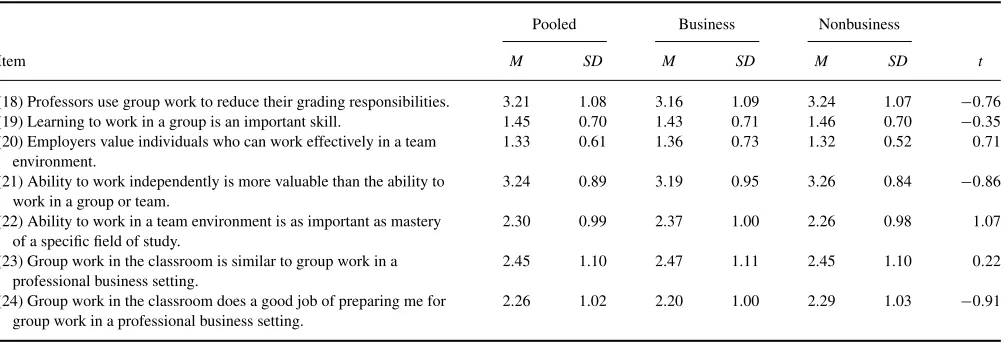
A fundamental issue that might impact the success of group work is students’ perceptions of why faculty members use it. Table 2 includes questions that addressed potential motives for using teamwork. Items ranged from teamwork being a way to reduce professor grading to being a strategy for job preparation. Question means are reported for the full dataset, for business students, and for nonbusiness students in the tables (and in parentheses in discussions) based on the scale described above. We also reportttests for differences in the business and nonbusiness sample means.
TABLE 2
Students’ Perception of Motivation: Test for Difference in Mean Responses
Pooled Business Nonbusiness
Item M SD M SD M SD t
(18) Professors use group work to reduce their grading responsibilities. 3.21 1.08 3.16 1.09 3.24 1.07 −0.76 (19) Learning to work in a group is an important skill. 1.45 0.70 1.43 0.71 1.46 0.70 −0.35 (20) Employers value individuals who can work effectively in a team
environment.
1.33 0.61 1.36 0.73 1.32 0.52 0.71
(21) Ability to work independently is more valuable than the ability to work in a group or team.
3.24 0.89 3.19 0.95 3.26 0.84 −0.86
(22) Ability to work in a team environment is as important as mastery of a specific field of study.
2.30 0.99 2.37 1.00 2.26 0.98 1.07
(23) Group work in the classroom is similar to group work in a professional business setting.
2.45 1.10 2.47 1.11 2.45 1.10 0.22
(24) Group work in the classroom does a good job of preparing me for group work in a professional business setting.
2.26 1.02 2.20 1.00 2.29 1.03 −0.91
Note.Tests performed under the assumption of equal variances. The results are the same if assuming unequal variances.
We were relieved to find that students generally perceived group work to be important. In items 19 and 20, the mean response fell between strongly agree and mildly agree when evaluating if learning to work in a group is an important skill (M =1.45,SD=0.70) and one valued by employers (M = 1.33, SD = 0.61). Students were closer to neutral in their mean response when asked in item 21 if ability to work independently is more valuable than the ability to work in a group (M=3.24,SD=0.89). The mean response fell between neutral and mildly agree for items 22–24, that it is as important as mastery of a specific field of study (M=2.30,
SD = 0.99), that it is similar to what they will see in the business setting (M =2.45,SD=1.10), and that it is good preparation for group work on the job (M=2.26,SD=1.02). Results ofttests show no significant differences between the mean responses of business majors and nonbusiness majors for any of the seven questions.
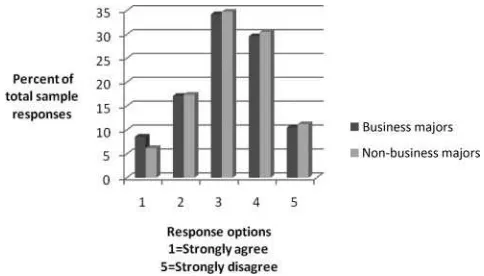
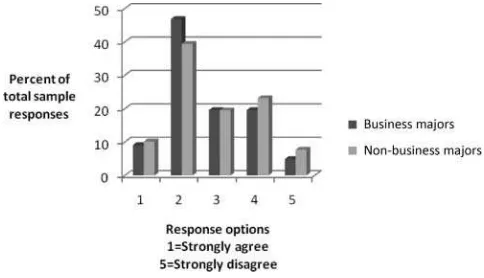
We can conclude that students come to the table already appreciating the benefits of having group work experience. As long as they feel instructors are employing group work to promote these benefits, we should have some level of student support. The results from item 18, however, suggest an area of concern. In this item, we asked students to indicate their level of agreement with the statement Professors use group work to reduce their grading responsibilities. The mean re-sponse of 3.21 (SD=1.08) suggests students were somewhat close to neutral in their opinions. The data are more alarming when looking at the distribution of responses, as illustrated in Figure 1. Note that because the sizes of the business and nonbusiness samples are unequal, the data are expressed in terms of percentage of respondents and not the number of respondents (true for all graphs presented).
Over 25% of business majors and over 23% of nonbusi-ness majors agreed (either strongly or mildly) that group work is used to reduce faculty workloads. Just over 34% of each group answered neutrally. Only 41% of students felt that professors do not use group work to reduce their grad-ing. Professors may have this student perception as a hurdle to overcome if group assignments are to be received well.
FIGURE 1 Distribution of responses: professors use group work to reduce grading (item 18).
We need to do a better job of motivating why particular as-signments lend themselves to a team arrangement, focusing on the benefits of collaboration and the brain storming pro-cess. It is necessary to be careful not to use group work if collaboration does not really enhance the learning process, improve the end product, or provide some other benefit.
Part 2: Questions Addressing Student Preferences
It is not surprising to learn that students have their own views on how group work should be organized. We collected responses for 17 questions addressing size and composition of groups, leadership, peer reviews, grading, accountability, member termination, and upfront education by instructors. We asked students to respond using the same scale employed in the previously discussed questions.
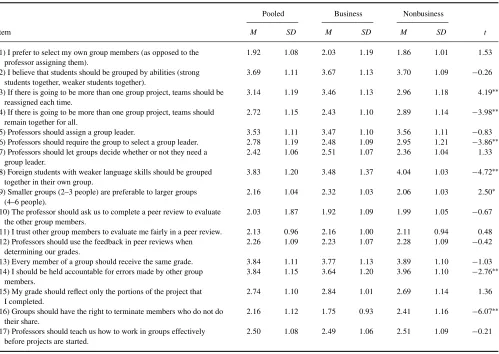
Table 3 reports survey results for the pooled dataset, the business sample, and the nonbusiness sample. The follow-ing discussion is based on mean responses and we analyzed particularly interesting results more fully. We provide the re-sults ofttests for differences in means for the business and nonbusiness samples.
Pooled results in item 1 show that students were interested in selecting their own group members (M =1.92, SD =
1.08). In item 2, the mean response fell between neutral and mildly disagree when students considered the idea of grouping students by abilities (M =3.69,SD =1.11). We expected that students with higher GPAs would be more in favor of homogenous groupings because they would be placed with others who were academically successful. For a similar reason, we expected lower GPA students to be less in favor of this homogeneous grouping. Surprisingly, there was little evidence of this relationship. As it turned out, GPA and a preference for grouping by ability were very weakly correlated (.030).
Items 3 and 4 are aimed at determining students’ pref-erences for keeping groups intact for repeated assignments. The question was asked in two opposite ways. When asked their attitudes about reassigning groups between assignments (item 3), students’ mean response was 3.14 (SD=1.19; close to neutral but leaning just slightly toward mildly disagree with being reassigned). When asked their attitudes about keeping groups intact for repeated assignments (item 4), stu-dents’ mean response was 2.72 (SD=1.15; leaning slightly toward mildly agree with keeping groups together). The re-sults on these two items are similar but are not perfect mirror images of each other (keep in mind a 1 for question 3 is comparable to a 5 for question 4); both results suggest a mean response close to neutral but leaning just slightly to-ward wanting to keep groups intact. Also note that the two items can be combined after inverting one set of responses to generate a composite mean response. In this case it is 3.21 and would be interpreted in the same manner as ques-tion 3. Interestingly, business majors show more reluctance
TABLE 3
Students’ Preferences: Test for Difference in Mean Responses
Pooled Business Nonbusiness
Item M SD M SD M SD t
(1) I prefer to select my own group members (as opposed to the professor assigning them).
1.92 1.08 2.03 1.19 1.86 1.01 1.53
(2) I believe that students should be grouped by abilities (strong students together, weaker students together).
3.69 1.11 3.67 1.13 3.70 1.09 −0.26
(3) If there is going to be more than one group project, teams should be reassigned each time.
3.14 1.19 3.46 1.13 2.96 1.18 4.19∗∗
(4) If there is going to be more than one group project, teams should remain together for all.
2.72 1.15 2.43 1.10 2.89 1.14 −3.98∗∗
(5) Professors should assign a group leader. 3.53 1.11 3.47 1.10 3.56 1.11 −0.83 (6) Professors should require the group to select a group leader. 2.78 1.19 2.48 1.09 2.95 1.21 −3.86∗∗ (7) Professors should let groups decide whether or not they need a
group leader.
2.42 1.06 2.51 1.07 2.36 1.04 1.33
(8) Foreign students with weaker language skills should be grouped together in their own group.
3.83 1.20 3.48 1.37 4.04 1.03 −4.72∗∗
(9) Smaller groups (2–3 people) are preferable to larger groups (4–6 people).
2.16 1.04 2.32 1.03 2.06 1.03 2.50∗
(10) The professor should ask us to complete a peer review to evaluate the other group members.
2.03 1.87 1.92 1.09 1.99 1.05 −0.67
(11) I trust other group members to evaluate me fairly in a peer review. 2.13 0.96 2.16 1.00 2.11 0.94 0.48 (12) Professors should use the feedback in peer reviews when
determining our grades.
2.26 1.09 2.23 1.07 2.28 1.09 −0.42
(13) Every member of a group should receive the same grade. 3.84 1.11 3.77 1.13 3.89 1.10 −1.03 (14) I should be held accountable for errors made by other group
members.
3.84 1.15 3.64 1.20 3.96 1.10 −2.76∗∗
(15) My grade should reflect only the portions of the project that I completed.
2.74 1.10 2.84 1.01 2.69 1.14 1.36
(16) Groups should have the right to terminate members who do not do their share.
2.16 1.12 1.75 0.93 2.41 1.16 −6.07∗∗
(17) Professors should teach us how to work in groups effectively before projects are started.
2.50 1.08 2.49 1.06 2.51 1.09 −0.21
Note. Tests performed under the assumption of equal variances. The results are the same if assuming unequal variances. ∗p<.05.∗∗p<.01.
than nonbusiness majors to being reassigned when items 3 and 4 are explored separately, for item 3,t=4.19, for item 4, t = −3.98, ps <.01. Results in items 5 and 6 showed
less disagreement with requiring the group to pick a leader (M=2.78,SD=1.19) than the professor assigning a leader (M =3.53,SD =1.11). While the preferences associated with any designation of a leader were not strong, business majors were marginally more agreeable to being told to se-lect a group leader by the professor (for business:M=2.48,
SD=1.09; for nonbusiness:M=2.95,SD=1.21;p<.01).
Students’ mean response fell between neutral and mildly disagree for item 8 concerning grouping English as a second language students with weaker language skills together (M=
3.83, SD = 1.20). Nonbusiness majors showed more dis-agreement than business majors with the idea of segregating foreign students in this way (4.04 [SD=1.03] vs. 3.48 [SD=
1.37]),t= −4.72,p<.01. In item 9, students mildly agreed
that smaller groups of 2–3 people are preferable (M=2.16,
SD=1.04) with nonbusiness majors showing more support for smaller groups than business majors,t=2.50,p<.05.
Grading is an issue that resonates with students, and it is one that requires a lot of thought on the part of professors who use group work. When evaluating the product of group work, should professors grade the team as a whole? Or, should they factor in some individual component so that grades are not always identical for all members? And if so, on what basis should they grade an individual’s contribution? In this survey, students do indicate some desire to be judged on their own merits. In item 13, students’ mean response fell between neutral and mildly disagree related to the idea of group members receiving the same grade on a group project (M=3.84,SD=1.11). This is consistent with the results of item 15 where responses fell in between neutral and mildly agree related to the idea of being graded only on the portions of the work completed by the individual (M =2.74,SD=
1.10).
For professors who do want some individual account-ability, peer reviews in which students evaluate each other are an option. Student responses showed some support for peer review processes. In items 10 and 11, students’ mean
FIGURE 2 Distribution of responses: should professors use peer reviews in grading (item 12).
responses fell close to mildly agree when asked if profes-sors should require students to do peer reviews (M =2.03,
SD=1.87) and if they trusted other students to judge them fairly (M=2.13,SD=0.96). In item 12, students’ mean re-sponse fell in between neutral and mildly agree when asked if professors should use peer review feedback in grading (M
= 2.26, SD = 1.09). In fact, 68% of all students agreed (strongly or mildly) that peer reviews should be incorporated into grading and only 15% of students disagreed (strongly or mildly). Figure 2 illustrates the distribution of responses for item 12 and it should be noted that the distribution is similar when comparing business and nonbusiness majors.
Furthermore, whether students had experienced a peer re-view process was not a driving factor in student responses to this question. There was a .179 correlation between having experienced peer reviews and agreeing that others could be trusted in a peer review process. And there was a .165 corre-lation between having experienced peer reviews and agreeing that peer reviews should factor into grading.
Peer reviews have their benefits. They can create an in-centive that reduces shirking, especially when students are informed upfront that a peer review will take place. But it is important to balance this individual accountability with the group accountability. Ultimately, teams must be respon-sible for the quality of the end product. Our own experience is that students have a hard time appreciating this level of accountability and survey results offer concurring evidence. In item 14, we asked students to indicate their level of sup-port to the statement I should be held accountable for errors made by other group members. The mean response was 3.84 (SD=1.15) with 67% of all students reporting that they dis-agree (strongly or mildly) with being held accountable in this way. More than half of the students who disagreed indicated that they strongly disagreed. Some interesting differences between business and nonbusiness students are evident in Figure 3.
When comparing the mean responses of business majors (M = 3.64,SD =1.20) versus nonbusiness majors (M =
3.96,SD=1.10), business majors were, on average, in less
FIGURE 3 Distribution of responses: should students be accountable for errors of others (item 14).
disagreement with being held accountable for the work of others, t= −2.76,p <.01. It turns out that 21% of
busi-ness majors indicated agreement (strong or mild) with being held accountable for the mistakes of others. The proportion of nonbusiness majors who responded in the same way was only 12%. We question whether this is a result of selec-tion bias related to choice of major or whether the business school better communicated expectations for teams (possi-bly through class content related to teams or through visiting practitioners who reinforced the idea of effective teamwork). This is an interesting area for further research. Regardless of the reason, the result suggests that business faculty may have less of a battle to face when employing evaluation approaches that make the entire team responsible for the quality of the end product.
There are important reasons why faculty members may want to hold an entire team responsible for the quality of its product. But how do we handle a situation in which a particular individual’s behavior detracts from the process and the end product? Peer reviews can be used to punish an individual student, but all team members will be penalized if the end product suffers. Thus, some professors implement a termination policy and we admit to using such a policy ourselves. Our own experience is that students are willing to terminate others in order to protect the quality of their group work. Interestingly, survey results were consistent with our own observations. Item 16 asked students to indicate their level of agreement with the statement “Groups should have the right to terminate members who do not do their share.” The mean response was 2.16 (SD=1.12), indicating mild agreement. But as Figure 4 illustrates, this was somewhat driven by the population of business majors who showed more agreement with termination,t= −6.07,p<.01.
Over 45% of business majors strongly agreed with having the right to terminate a group member. Only 24% of non-business majors gave this same response. When combining strongly agree and agree it turned out that 86% of business students agreed with termination, compared with 62% for nonbusiness majors. The variance in answers addressing the
FIGURE 4 Distribution of responses: groups should have the right to terminate members (item 16).
right to terminate group members, however, was higher for business majors, indicating less agreement among business students surveyed.
We fully expected that students who had experienced oth-ers shirking would be more in favor of having the right to terminate others. This relationship was confirmed to a de-gree, with a correlation of .179. We also expected higher achieving students (measured by GPA) to be more in favor of termination, since these students may be protective of their good grades and may be less likely to shirk. Instead, we found a correlation of−.010 between GPA and attitude about termination.
While peer reviews and termination policies may help improve individual accountability to the group, an important concern may be that students need to be taught how to work in a team setting. We included item 17 to gauge student reaction to having professors teach about effective team work before initiating group projects (M=2.50,SD=1.08). It turns out that 52% of all students supported the idea and less than 17%
of students did not. This is an idea that we will be exploring more in our own classrooms.
Part 3: Students’ General Assessments of Group Work
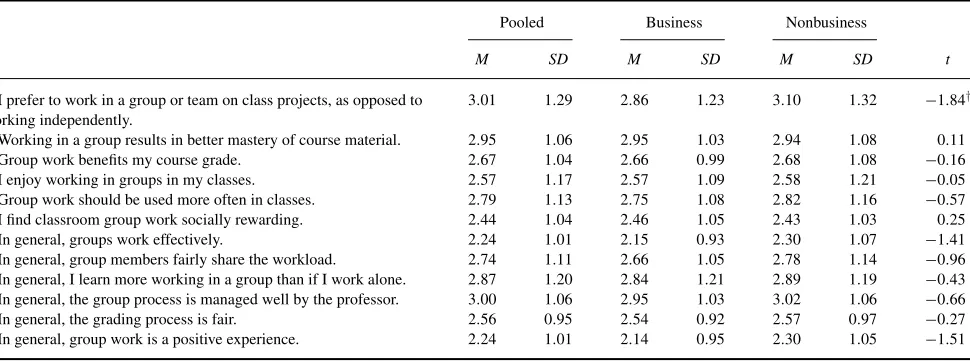
We asked students to provide their general assessment of working in a team environment based on 12 items. The ques-tions employed the same scale as described above. Table 4 reports the mean of responses for the entire dataset and then the business and nonbusiness samples.
Item 54 asked students to indicate whether they preferred to work in teams or groups (as opposed to working inde-pendently). The average response for both business and non-business majors was just below and just above neutral (2.86 [SD =1.23] vs. 3.10 [SD = 1.32]),t = −1.84,p <.10.
Figure 5 shows business majors’ responses skewed more in favor of group work than the sample of nonbusiness majors. The percentage of business majors illustrating a preference (either strongly or mildly agreeing with the statement) for working in teams was 45% and for nonbusiness majors was 37%. On the other end of the distribution, nonbusiness ma-jors indicated a stronger preference for working individually than did business majors (42% vs. 29%).
It was our assumption that high achieving students would be less inclined to work in groups (and vice versa). Results show this to a degree. There was a .220 correlation between GPA and the question asking for preference related to work-ing in a group (note that higher GPA correlated with not wanting to work in a group). Interestingly, mean responses ranged between neutral to mildly agree for questions address-ing whether group work resulted in better mastery of material (item 55:M=2.95,SD=1.06), whether they learned more in a group setting (item 62: M = 2.87, SD = 1.20), and
TABLE 4
Students’ Overall Evaluation of Group Work: Test for Differences in Mean Responses
Pooled Business Nonbusiness
Item M SD M SD M SD t
(54) I prefer to work in a group or team on class projects, as opposed to working independently.
3.01 1.29 2.86 1.23 3.10 1.32 −1.84†
(55) Working in a group results in better mastery of course material. 2.95 1.06 2.95 1.03 2.94 1.08 0.11 (56) Group work benefits my course grade. 2.67 1.04 2.66 0.99 2.68 1.08 −0.16 (57) I enjoy working in groups in my classes. 2.57 1.17 2.57 1.09 2.58 1.21 −0.05 (58) Group work should be used more often in classes. 2.79 1.13 2.75 1.08 2.82 1.16 −0.57 (59) I find classroom group work socially rewarding. 2.44 1.04 2.46 1.05 2.43 1.03 0.25 (60) In general, groups work effectively. 2.24 1.01 2.15 0.93 2.30 1.07 −1.41 (61) In general, group members fairly share the workload. 2.74 1.11 2.66 1.05 2.78 1.14 −0.96 (62) In general, I learn more working in a group than if I work alone. 2.87 1.20 2.84 1.21 2.89 1.19 −0.43 (63) In general, the group process is managed well by the professor. 3.00 1.06 2.95 1.03 3.02 1.06 −0.66 (64) In general, the grading process is fair. 2.56 0.95 2.54 0.92 2.57 0.97 −0.27 (65) In general, group work is a positive experience. 2.24 1.01 2.14 0.95 2.30 1.05 −1.51
Note.Tests performed under the assumption of equal variances. The results are the same if assuming unequal variances.
†p<.10.
FIGURE 5 Distribution of responses: I prefer to work in a team (item 54).
whether group work should be used more in the classroom (item 58:M=2.79,SD=1.13).
A series of questions attempted to capture a general atti-tude related to desirability and effectiveness of group work. The mean response was in between neutral and mildly agree for group work: benefitting grades (item 56:M=2.67,SD=
1.04), being enjoyable (item 57:M=2.57,SD=1.17), be-ing socially rewardbe-ing (item 59:M=2.44,SD=1.04), and involving a fair grading process (item 64:M=2.56,SD=
0.95). Not surprisingly, these items were highly correlated with the preferences for working in groups indicated in item 54. Stronger preferences for working in groups (as opposed to independently) had a correlation of .760 with group work being enjoyable, a correlation of .630 with group work ben-efiting students’ grades, and a correlation of .520 correlation with group working being socially rewarding.
Students’ mean response fell between neutral and mildly agree for item 61, which asked if group members fairly share the workload (M =2.74,SD =1.11). The distribution of responses illustrated in Figure 6 is quite telling.
Fifty-six percent of business students and 49% of nonbusi-ness students agreed (strongly or mildly) with the statement that workloads are shared fairly, leaving 24% of business ma-jors and 31% of nonbusiness mama-jors who indicated (strongly
FIGURE 6 Distribution of responses: group members fairly share the workload (item 61).
or mildly) that this is not the case. There was a correlation of.150 between feeling that groups do not share workloads fairly and wanting required peer reviews. There was a cor-relation of .510 between feeling that groups do not share workloads fairly and feeling that professors do not manage group work well.
One result worth highlighting is item 63—whether the process was well managed by the professor. The mean result was 3.00 (SD=1.06), showing neutrality in average opinion. The distribution of responses illustrated in Figure 7 gives cause for concern.
Only 32% of all respondents agreed (strongly or mildly) that group work was managed well by professors. The same percentage of students indicated that they disagreed (strongly or mildly), suggesting that they felt group work was not well managed. Clearly there is great room for improve-ment in how we, as instructors, manage group work in the classroom, whether we provide clearer instructions, better monitor group performance during the course of the activ-ity, or work harder to prevent shirking. The results suggest an area of further investigation aimed at learning how stu-dents perceive the team process to be best managed by their professors.
Despite the areas of concern indicated in some of the pre-vious questions, students’ mean responses were favorable for questions asking if groups work effectively (item 60:M =
2.24,SD=1.01) and if group work is a positive experience (item 65:M=2.24,SD=1.01). Of the entire sample, 71% of students reported that they felt groups work effectively (only 13% disagreed); 68% reported that group work has been a positive experience (only 11% disagreed). Furthermore, there were no statistically significant differences in mean re-sponses for any questions in this section when comparing business and nonbusiness students. So, while the two groups of students sometimes had different ideas about the specifics of group work, their overall assessments of group work were similar and relatively favorable. Average responses, how-ever, suggest that neither favored group work over working independently.
FIGURE 7 Distribution of responses: group process is managed well by the professor (item 63).
DISCUSSION AND CONCLUSION
We started this research project with the premise that knowl-edge of students’ perceptions and attitudes about group work would enable us to motivate and design cooperative learn-ing activities better. Results suggest that students generally understand the motivation for group work—they see it as an important skill that is valued by employers. Nevertheless, they are not convinced that instructors are primarily moti-vated by this when making decisions to assign group work. Instead, results show that many students believe professors use group activities to reduce their grading responsibilities.
Students indicated preferences for how group work is or-ganized by professors. They showed some interest in being able to select their own groups, but they were not in favor of grouping students by abilities. Surprisingly, there was little correlation between GPA and interest in grouping by abili-ties. We had expected higher achieving students to be more interested in these types of homogeneous groupings (and lower achieving students less interested), but we found no strong relationship. If a group leader was required, students were more in favor of being able to pick the individual as op-posed to the instructor assigning a leader. Students preferred smaller groups (2–3 members) to larger groups (4 or more members), with nonbusiness majors showing more support for smaller groups than business majors.
Regarding issues related to grading, students were con-cerned with being held accountable for the errors made by others, although business majors were more willing than non-business majors to be held responsible. Students generally leaned toward wanting an individual grade as opposed to a uniform group grade. They showed substantial support for the use of peer reviews and their incorporation into the grad-ing process, with students indicatgrad-ing that they trusted others to judge them fairly. They generally supported the right to terminate group members who shirked, with business majors showing stronger support than nonbusiness majors. Inter-estingly, we expected a highly positive correlation between grade point average and supporting the right to terminate other members, under the assumption that high achieving students are more protective of their grades. We did not find this to be the case. In addition, having experienced shirking by others in a group had a weak correlation with support for the right to terminate others. While peer reviews and termination can reduce shirking, the real issue may be that students do not know how to work together effectively, with training being the best solution. Survey respondents showed mild support for having professors teach about effective team practices prior to the start of a group project.
In general, there was no consensus concerning a prefer-ence for group work. Some students showed a preferprefer-ence for group work and similar proportions of students showed a preference for working independently. We also expected a strong correlation between students’ grade point averages and a desire to work independently. Instead we found a weak
correlation. Students who indicated a preference for work-ing in groups also felt that it benefited their grade, that it was enjoyable, and that it was socially rewarding. Students also generally indicated that workloads were shared fairly by team members. While students did not show an over-whelming preference for working in groups, they generally reported that group work is a positive experience and that groups work effectively. There were no significant differ-ences between business and nonbusiness students when it came to these summary questions.
Understanding our students’ attitudes and perceptions re-garding group work provides insight that can help educators develop more effective cooperative assignments. As instruc-tors of business, we see a need for our students to understand and master cooperative learning techniques so they can use the strength of synergy to develop a better product, enhance their own learning, and prepare for the realities of how they will be expected to work in the business setting. And by tak-ing student attitudes into consideration when we design and use group activities, we should be able to influence positively our students’ responses to group work in order to achieve greater learning and better outcomes. At the same time, we must balance a desire to satisfy students’ preferences with our own goals and objectives for student learning.
One particularly important point for all instructors is that we have to choose carefully when cooperative learning will be utilized, and we should clearly explain why a particular assignment lends itself to a cooperative approach. Instruc-tors should design group assignments so that they require collaboration and synergistic thinking for their successful completion. If students could complete the work just as suc-cessfully (and perhaps efficiently) by themselves, then it may not be a useful time to employ the cooperative approach.
It is not surprising that students want to select their own teammates and choose their own group leader when one is required. When this preference is consistent with our own objectives, we might improve student buy-in by using self-selection for creating teams. We might, however, have rea-sons for designing teams in a particular way, perhaps to cre-ate teams with diverse backgrounds (for example, not having all of the finance students in one group and the marketing students in another). It might make sense for us to explain the composition of groups when they are designed by us as instructors. Furthermore, when possible and only when consistent with our teaching objectives, we might try to ac-commodate the students by assigning smaller group sizes.
We were not surprised to learn that students have clear preferences and attitudes related to grading. Students do not want to feel that their own grade may be jeopardized by the lack of work ethic or abilities of teammates. The purpose of a cooperative assignment, however, is to pull together the strengths of teammates in order to create a result that is better than what would be produced individually. This requires that teams be held accountable for their overall product, regard-less of each individual’s contribution. This is where finding
the appropriate balance may prove difficult. Therefore, we suggest using a combination of inputs to determine each stu-dent’s grade. Grading the overall product as a whole sends the message that the team is accountable for the quality of its work. The results of this research, however, show that students are supportive of the use of peer evaluations—they trust others to evaluate them fairly and they want peer eval-uations factored into the individual member’s grade. There-fore, professors might consider a hybrid grade that is based on the output of the group while also considering each stu-dent’s contribution to the team. In this sense, it is a win-win. Students may feel more comfortable when there is a penalty for shirking and the group outcome is still a major focus. Professors might also consider a termination policy, because students are supportive of that approach as well. Our own experiences suggest that termination policies should have clear ground rules about when and how they are to be applied.
REFERENCES
Amato, C. H., & Amato, L. H. (2005). Enhancing student team effec-tiveness: Application of Myers-Briggs personality assessment in busi-ness courses.Journal of Marketing Education,27, 41–51. doi:10.1177/ 0273475304273350
Anderson, J. R. (2005). The relationship between student perceptions of team dynamics and simulation game outcomes: An individual-level analysis. Journal of Education for Business,81, 85–90. doi:10.3200/ JOEB.81.2.85-90
Bacon, D. R. (2005). The effect of group projects on content-related learning. Journal of Management Education, 29, 248–267. doi:10.1177/1052562904263729
Chapman, K. J., & Van Auken, S. (2001). Creating positive group project experiences: An examination of the role of the instructor on students’ per-ceptions of group projects.Journal of Marketing Education,23, 117–127. doi:10.1177/0273475301232005
Freeman, K. A. (1996). Attitudes toward work in project groups as pre-dictors of academic performance.Small Group Research,27, 265–282. doi:10.1177/1046496496272004
Gottschall, H., & Garc´ıa-Bayonas, M. (2008). Student attitudes toward group work among undergraduates in business administration, education and mathematics.Educational Research Quarterly,32, 3–28.
Hijzen, D., Boekaerts, M., & Vedder, P. (2007). Exploring the links between students’ engagement in cooperative learning, their goal preferences and appraisals of instructional conditions in the classroom. Learning and Instruction,17, 673–687. doi:10.1016/j.learninstruc.2007.09.020 Hillyard, C., Gillespie, D., & Littig, P. (2010). University students’ attitudes
about learning in small groups after frequent participation.Active Learn-ing in Higher Education,11, 9–20. doi:10.1177/1469787409355867 Johnson, D. W., & Johnson, R. T. (1999). Making cooperative learning work.
Theory Into Practice,38, 67–73. doi:10.1080/00405849909543834 Johnson, D. W., Johnson, R. T., & Smith, K. (2007). The state of
coop-erative learning in postsecondary and professional settings.Educational Psychology Review,19, 15–29. doi:10.1007/s10648-006-9038-8 Kaenzig, R., Hyatt, E., & Anderson, S. (2007). Gender differences in college
of business educational experiences.Journal of Education for Business,
83, 95–100. doi:10.3200/JOEB.83.2.95-100
Katzenbach, J. R., & Smith, D. K. (2005). The discipline of teams.Harvard Business Review,83, 162–171.
Machemer, P. L., & Crawford, P. (2007). Student perceptions of active learn-ing in a large cross-disciplinary classroom.Active Learning in Higher Education,8, 9–30. doi:10.1177/1469787407074008
Myers, S. A., Bogdan, L. M., Eidsness, M. A., Johnson, A. N., Schoo, M. E., Smith, N. A.,. . .Zachery, B. A. (2009). Taking a trait approach to understanding college students’ perceptions of group work.College Student Journal,43, 822–831.
Pfaff, E., & Huddleston, P. (2003). Does it matter if I hate teamwork? What impacts student attitudes toward teamwork.Journal of Marketing Education,25, 37–45. doi:10.1177/0273475302250571
Phipps, M., Phipps, C., Kask, S., & Higgins, S. (2001). University students’ perceptions of cooperative learning: Implications for administrators and instructors.Journal of Experiential Education,24, 14–21.
Rassuli, A., & Manzer, J. P. (2005). “Teach us to learn”: Multivariate anal-ysis of perception of success in team learning.Journal of Education for Business,81, 21–27. doi:10.3200/JOEB.81.1.21-28
Schultz, J. L., Wilson, J. R., & Hess, K. C. (2010). Team-based classroom pedagogy reframed: The student perspective.American Journal of Busi-ness Education,3(7), 17–24.
Shaw, J. D., Duffy, M. K., & Stark, E. M. (2000). Interdependence and preference for group work: Main and congruence effects on the satisfac-tion and performance of group members.Journal of Management,26, 259–279. doi:10.1177/014920630002600205
Su, A. Y.-L. (2007). The impact of individual ability, favorable team member scores, and student perception of course importance on student prefer-ence of team-based learning and grading methods.Adolescence,42(168), 805–826.
Winter, J. K., Waner, K. K., & Neal-Mansfield, J. C. (2008). Team cli-mate and productivity for similar majors versus mixed majors.Journal of Education for Business,83, 265–269. doi:10.3200/JOEB.83.5.265-269