The Interactional Styles Used by Male and Female Chairpersons
in Petra Christian University Student Executive Board Meetings
Cinantya, A. 1 and Tedjaatmadja, H. M.2
1,2 English Department, Faculty of Letters, Petra Christian University,
Siwalankerto 121 – 131, Surabaya 60236, East Java, Indonesia E-mails: [email protected], [email protected]2
Abstract:
This study examines the interactional styles related to the role of chairperson used by two female and two male chairpersons in the SEB-PCU meetings. There are three main theories used: interactional styles, gender, and chairpersons and their roles in a meeting. The method used is qualitative approach focusing on the process and the data. The findings reveal that both feminine and masculine interactional styles were used by the chairpersons. The masculine interactional styles were employed to play the roles of chairpersons. The use of interactional styles between female and male chairpersons differs in its ratio although the same linguistic clue was used for the same device. Here, conciliatory feature was not produced by the male chairpersons whereas referentially oriented feature was produced frequently by chairpersons. Overall, it proves that females use more feminine interactional styles while males use more masculine interactional styles. Thus, gender and power play an important role in meeting.
Key words: Interactional styles, feminine, masculine, gender, chairperson, meeting
There are many ineffective and inefficient meetings just because people do not understand each other and the core of what they try to discuss. It is necessary to know people’s communication styles, for later we will keep dealing with people and their various communication styles and we may do meetings, so that we can adjust ourselves. In a contextual setting such as meeting in an organization, people also have some kind of particular communication styles. Petra Christian University Students Executive Board (SEB-PCU) meetings are unique in their own way. Compared to other meetings, SEB-PCU meetings are different in terms of participant, topic, and purpose. SEB-PCU meetings are attended by university students and they often discuss issues of events focusing on reporting and discussing. The role of a chairperson is important in SEB-PCU meeting. A chairperson is responsible for leading the meeting, setting the agenda (Rothwell, 2010, p.263), making all the meeting members involved, and keeping the discussion on track. Each chairperson has different ways of leading meetings which leads to different interactional styles.
According to Holmes (2006) and Baxter (2010), females and males use different interactional styles in conversations. Females who want to display themselves as appreciative individuals use more facilitative and collaborative interactional styles while males who want to show power produce more direct and competitive interactional styles. Based on Holmes and Baxter’s descriptions above, we can expect that in SEB-PCU meetings female chairpersons will use more feminine interactional styles, while male chairpersons will use more masculine interactional styles. Thus, it is interesting to investigate the use of interactional styles and to find if there are some differences and/or similarities in the use of interactional styles related to the roles of chairpersons. There were two male and two female SEB-PCU chairpersons’ interactional styles analyzed. Still, the meetings were carefully selected based on the similarity of purpose of the meeting, the participants attending the meeting, the topic discussed, the time allotment of the meeting, and the gender of the chairpersons.
repeated particular body manners. Here, gender also shows identity which can be identified through linguistic choices. Holmes (2006) provides widely cited features of feminine and masculine interactional styles as explained below:
A. Feminine Interactional Styles
Females focus on relationship and connection and they usually use the following features of feminine interactional styles:
1) Facilitative: females use facilitative devices, such as tag questions (isn’t it? haven’t they?) and pragmatic particles (you see, you know) that encourage the addressee’s participation in the conversation (Holmes, 2006, p.7). Such feminine interactional styles enhance others’ self-worth as people are given credit and praise for their good work. Facilitative devices involve words which avoid the affirmation of one’s own superiority, and compliment people appropriately (Baxter, 2010, p.70)
2) Supportive feedback: females use supportive feedback in a form of minimal responses (mm, yeah) (Holmes, 2006, p.7) as a sign that the listener indeed pays attention to the speaker. These minimal responses are one of the examples of a supportive elicitation produced by female participants I really like your comment on…could you expand a little on the Thai data? What do you think is going on in Table 2? (Baxter, 2010, p.65)
3) Conciliatory: females use epistemic modals (might, could) and pragmatic articles (perhaps, sort of) to soften and hedge request and statements (Holmes, 2006, p.7). Also, Holmes (p.145) implicitly suggests that the use of conciliatory devices tend to overcome hostility. Consequently, it is automatically related to the use of conflict avoidance which is also considered to be a stereotypically feminine response to conflict. Women basically steer over conflict and redirect the discussion to anticipate problems by using tentative discourse (p.145) 4) Indirect: females use indirect strategies by using interrogatives (could you reach that files?)
and mitigating directives rather than imperatives (pass the file) in giving directives (p.7). As once mentioned before, females tend to avoid confronting people, especially other women, in a direct and aggressive way. However, it doesn’t mean that females have no aggression or competitiveness at all. Females may feel the same as males do in many contexts, but females have been socialized to disguise it (Baxter, 2010, p.58)
5) Collaborative: females use collaborative devices involving openness of feelings, supportive social relationships, the integration of private and work life by more democratic and non-hierarchical structures (Holmes, 2006, p.10). Females here produce speech features, such as overlaps (simultaneous or jointly produced talk), personal and inclusive pronouns (we, us, our), agreeing, and acknowledging the previous speakers (Baxter, 2010, p.59)
6) Person/process-oriented: females use reward to motivate people, concerning their level of performance, and show self-interest by using open-ended questions, egalitarian decision making, etc. (p.59)
7) Affectively oriented: females use ‘personal’ features emphasizing more on confession, expression of feelings, anecdote, and mirroring of experiences. This self-disclosure is signed by the use of hedges, fillers, pause, and hesitations (Baxter 2010, p.59). According to Holmes (2006, p.75), this form of affectively oriented is more or less similar to what is recognized as person-oriented for both are included in one bigger term named relational practice. In relational practice, an orientation to the ‘face needs’ of others, including the need to feel valuable and to feel that their autonomy be respected, does exist.
B. Masculine Interactional Styles
Males focus on self and separateness and they more likely use several features of masculine interactional styles:
1) Competitive: males use taboo, swearing, insults, threats, verbs of action, force, violence, and fewer amount of compliment to show competitiveness (Baxter, 2010, p.61). As stated by Maltz and Borker (1982 as cited in Baxter, 2010, p.60), this competitiveness exists since primary life goal of males is to compete with other males in order to enhance their authority, and to impress both males and females
3) Confrontational: males emphasize on competitive-confrontational discourse and powerful-assertive talk by using ‘aggravated’ directions and phrases (give me the pliers, get off my steps), and declaratives sentences. This confrontational interactional style is also showed when people are arguing, challenging, doing monologues, and controlling topics
4) Direct: males use imperative and ‘need’ statements in giving directives, as said by Holmes (p.37). The listed elicitations as follow are the kinds of directives in which the speaker says his point directly without any consideration of the listener’s feeling: check that out, ring the applicants and say…, go right through this, send them back to us, I need these by ten, I need to see that
5) Autonomous: males use authoritative statements in order to show authority (Baxter, 2010, p.92)
6) Task/outcome-oriented: males use taking over and taking control acts and single-person leadership which are committed on the organizational goals and objectives, being competitive, logical, rational, decisive and efficient (p.61). The following speeches are usually used: what’s
the answer?, let’s get on with it, this is how to solve it
7) Referentially oriented: males use informative speech, which is factual and transactional, in public formal contexts for males count them as opportunities for display. Such transactional feature is being reliant on power, position, and formal authority. Using the transactional style, males avoid any emotions and self-disclosure and apply more discourse markers (right, OK, so, now).
To support this main theory, there are two other theories from Paltridge (2008), Benwell and Stokoe (2006), Holmes and Stubbe (2003), and Rothwell (2010). A first supporting theory, Weatherall (2002, p.102) suggests that gender is not only matter of natural and inevitable consequence of one’s sex but it is also considered to be a “part of routine, ongoing work every day, mundane, social interaction”; that is “the product of social practice” (Eckert and McConnell-Ginet, 2003, p.5 as cited in Paltridge, 2008, p.32). Related to gender, there is a way to construct gender in the society. By showing particular linguistic features and styles in our conversation, we can deliver our identities. A person may have several identities in which one identity can be more important than the others at different points in time (Swann et al., 2004: 140-1 as cited in Paltridge, 2008, p.38). For example, a woman may have an identity as a mother, as someone’s partner, and as an office worker. For that reason, she displays her identities including the way she uses language and the way she interacts with other people. Furthermore, people’s identities are something that are continually constructed and reconstructed as people interact with each other. In this way, identity can be recognized by other people and made of two way construction (Swann et al., 2004: 140-1 as cited in Paltridge, 2008, p.39).
The last supporting theory for this study argues the chairpersons and their roles in a meeting. Holmes and Stubbe (2003) discuss that meeting management is a dynamic process which involves all members of the meeting to play a part. What is important in the meeting management is seniority, a part when someone, the chair of the meeting, whose power can influence the content, style, general structure, direction of the meeting. Focusing on the power of a chairperson, there are some “meeting management strategies” to do:
1) Calling a meeting for specific purposes: as cited in Rothwell (2010, p.262), a chair should not call a meeting unless there is no good alternative. If a meeting’s objectives may be accomplished without a meeting in group, it is better not to call a meeting. Hold a meeting only if a quick response is required, group participant is needed, participants are prepared to discuss the issues, and key players can be present
2) Contacting all participants: according to Rothwell (p.263), a chairperson better informs purpose of the meeting, place and time of the meeting, materials of the meeting, if any, participants should bring to the meeting. This information may be in the form of memo or e-mail. In addition about the time of the meeting, it is important also to designate time allotment for every discussion item in advance
utterances which signal the agenda setting: what I’d like to do is…, I’ve got a couple of
things…, I just wanted to finish off where we got to yesterday, …and that’s what this meeting is
about
4) Summarizing progress: a chairperson can manage the meeting by summarizing at regular intervals. The following statements are devices which can be used for this purpose (Holmes and Stubbe, 2003, p.73): okay we’re going to confirm the policies, okay so we’ve dealt with that, right so we can confirm those recommendations
5) Keeping the discussion on track: Holmes and Stubbe (p.73) also say that a chair is responsible for ensuring the meeting agenda is covered completely in the time which has been set. A chairperson may take back participants to the agenda during or after digression by signaling discourse markers such as right, so, anyway, okay, to get back to the point, and getting back on track to show the wish to move the discussion along and to ensure participants thoroughly cover a topic (p.74)
6) Reaching a decision: to reach decisions is the final goal of a meeting. The clearest strategy for managing the decision-making process, according to Holmes and Stubbe (p.75), is to simply state the preferred decision. However, sometimes there are some incompatible viewpoints or disagreements, a chairperson may use two main alternative strategies: (i) making an independent statement or (ii) choosing decision which is negotiated previously.
METHODS
This research uses qualitative approach and includes the general characteristics. My research takes place in the meeting setting where the meeting talk took place in its natural setting. In the meeting, I, as a researcher, analyzed the data which are in form of utterances. Furthermore, my research uses small sample size in order to focus more on the process of analyzing the product. Later, the result of my research is the product of my subjective interpretation after collecting and examining the data.
My research basically investigates the interactional styles used by two female and two male chairpersons when they were chairing meetings. Although I chose only four chairpersons as my respondents, I carefully selected them so that later they were indeed comparable to be deeply investigated and might represent the chairpersons generally in SEB-PCU. I chose chairpersons if they came from the same position as the heads of the committee and had the same educational background with the age ranges from 19-22 years old. Here, I chose meetings which fulfilled the criteria as follow: 1) led by head of the committees, 2) attended by the Executive Body (BPH) and coordinators, 3) 30-40 minutes in length, and 4) approved by the heads of the committees. Consequently, the variable that was different among the meetings was nothing but gender. Put it simple, the source of the data for this study is utterances produced by four chairpersons recorded in the meetings. The data of this research then are interactional styles.
FINDINGS AND DISCUSSION
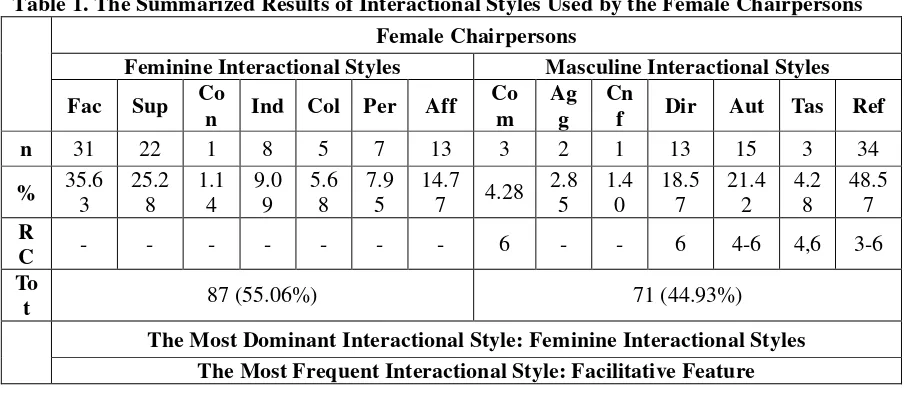
Table 1 shows the result of the observation of the interactional styles used by the female chairpersons.
Table 1. The Summarized Results of Interactional Styles Used by the Female Chairpersons Female Chairpersons
The Most Dominant Interactional Style: Feminine Interactional Styles The Most Frequent Interactional Style: Facilitative Feature
Note:
FEMININE interactional styles MASCULINE interactional styles
Fac = Facilitative Com = Competitive
Sup = Supportive feedback Agg = Aggressive interruption
Con = Conciliatory Cnf = Confrontational
Ind = Indirect Dir = Direct
Col = Collaborative Aut = Autonomous
Per = Person/process-oriented Tas = Task/outcome-oriented Aff = Affective oriented Ref = Referentially oriented n = the number of occurrence of each interactional style % = the percentage of each interactional style
RC = roles of chairpersons (see “meeting management strategies”)
Tot = the total frequency of all interactional styles
From the table above, it is clear that both FC used feminine interactional styles as well as masculine interactional styles. All 14 interactional styles were used by FC. Looking at the table, FC in fact used feminine interactional styles more. It is listed that the frequency of the feminine interactional styles is 87 or 55.06% which is higher compared to the frequency of masculine interactional styles, 71 or 44.93%. It is found that the use of feminine interactional styles involves the three most dominant features: facilitative feature (31 or 35.63%), supportive feedback feature (22 or 25.28%), and affectively oriented feature (13 or 14.77%).
Female chairpersons exposed themselves as facilitative, supportive, and affectively oriented meeting leaders. In the meeting, they encouraged other meeting members to speak more and share their ideas openly. Doing so, they then supported members by producing minimal responses to show that they acknowledged members’ speak and listened well. Furthermore, female chairpersons was also being affectively oriented in which they emphasized more on fulfilling members’ “face” needs and respecting members’ autonomy.
In the use of interactional styles by female chairpersons, I found the ratio to be 1.2:1. It is clear that the 0.2 gap in the ratio shows that female chairpersons uttered the feminine interactional styles in a mostly-balanced number to masculine interactional styles they produced even if feminine interactional styles were still dominantly used.
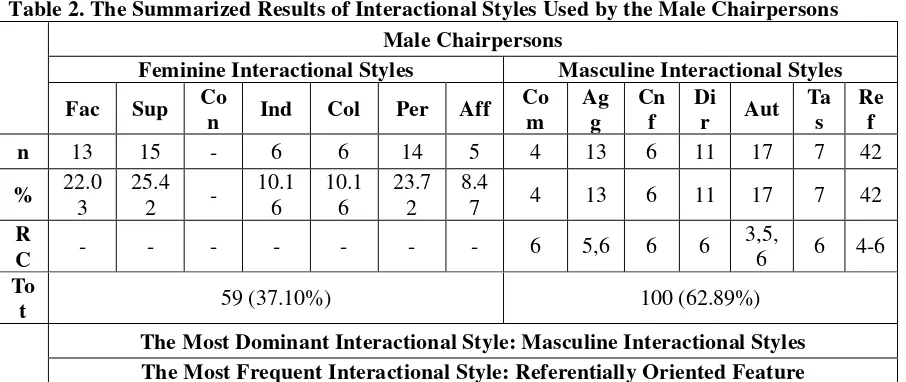
Table 2. The Summarized Results of Interactional Styles Used by the Male Chairpersons
The Most Dominant Interactional Style: Masculine Interactional Styles The Most Frequent Interactional Style: Referentially Oriented Feature
From the table above, it is clear that both MC used feminine interactional styles as well as masculine interactional styles; however, they dominantly used the masculine interactional styles. It is seen in the table that the frequency of the masculine interactional styles is 100 (62.89%) compared to the feminine interactional styles whose frequency is 59 (37.10%). The use of masculine interactional styles consists of four most dominant features: referentially oriented feature (42 or 42%), autonomous feature (17 or 17%), aggressive interruptions feature (13 or 13%), and direct feature (11 or 11%).
Male chairpersons exposed themselves as referentially oriented, autonomous, aggressive, and direct meeting leaders. In the meeting, they presented more factual information which helped them to avoid personal feelings. Supporting this feature, they used authoritative statements especially in keeping the discussion on track and reaching a decision when boldness as chairpersons was needed. Additionally, male chairpersons here used aggressive interruptions to interrupt previous speaker by confirming the topic discussed fast. It was expected that the discussion would move fast according to the agenda and unnecessary talk might be cut. Lastly, they produced imperative and “need” statements to be more direct in giving orders. In other words, male chairpersons had no hesitation in telling members what to do and showing disagreements.
In the use of interactional styles by male chairpersons, I found the ratio to be 1:1.7. The 0.7 gap in the ratio of interactional styles used by the male chairpersons making the ratio almost reaches point 2 shows that male chairpersons used masculine interactional styles way more frequent compared to feminine interactional styles.
Another interesting finding is there is one feature of feminine interactional styles, conciliatory feature, which was not used by male chairpersons at all in the meetings. There is a possibility that the reasons why male chairpersons did not use this feature are because they wanted to show more power and authority as men and did not want to look weak or unassertive. As a result, they intentionally did not try both to avoid problems and to divert discussion.
chairpersons used the word ya, kan, and nggak or the combination of both or all of them as tag question to express facilitative feature, the word kita as personal and inclusive pronoun to express collaborative feature, and mostly the word lah ya and tolong as mitigating directive to express indirect feature.
CONCLUSION AND SUGGESTIONS
Based on the observation done, it is found that gender differences do occur in communication styles. Here, the four chairpersons of SEB-PCU have the power and authority as chairpersons; hence, they may speak and behave themselves based on such power and authority. Related to gender and power as chairpersons, language provides the amount of power someone possesses and becomes more than a communication tool only. Moreover, gender, power, and interactional styles are all interconnected. Males who might see meetings as a stage to perform their power as chairpersons talked and revealed their authority more. On the other hand, females who saw meetings as an opportunity to build communication tried to be more supportive and empathetic listeners; yet, they also managed to show that they were the ones holding the control over the meetings.
Nevertheless, this kind of study may need better development in the future. I wish that this study can give insights for the readers regarding how gender, power, and language are interrelated and can be used in varied ways to reach what expected. Especially for readers who are chairpersons themselves, I hope this study may help them to be more aware in choosing the most appropriate interactional styles to use in chairing a meeting. It means that chairpersons should use both interactional styles to be more effective and efficient meeting leaders in a variety of contexts. Especially for readers who are or are about to be meeting participants, I hope that this study may help them to adjust themselves with the intention that they can be good communication partners for the chairperson as well as for other meeting participants. I hope that more research on a similar topic with more number of participants or different age group could be carried out in the future.
REFERENCES
Baxter, J. (2010). The language of female leadership. London: Palgrave Macmillan.
Benwell, B., & Stokoe, E. (2006). Discourse and identity. Edinburgh: Edinburgh University Press. Holmes, J. (2006). Gendered talk at work. Oxford: Blackwell.
Holmes, J., & Stubbe, M. (2003). Power and politeness in the workplace: A sociolinguistic analysis
of talk at work. London: Longman.
Rothwell, J. D. (2010). In mixed company: Communicating in small groups and teams (7th ed.). Wadsworth: Cengage Learning.
Swann, J., Deumert, A., Lillis, T., & Mesthrie, R. (2004). A dictionary of sociolinguistics. Edinburgh: Edinburgh University Press.