THE LINGUISTIC BEHIND A CHARACTER ASSASSINATION
A CASE STUDY ON THE RUMOR ‘NOHIJAB POLICY FOR BUMN EMPLOYEE’
Prihantoro Universitas Diponegoro email: [email protected]
Abstract
This paper presents a discourse analysis of noveil/hijabpolicytexts that gave a negative image to current BUMN minister. Primary data source is obtained from DE tweets and NS news article on the topic of nohijab policy. The data is analyzed by Pan and Kosicki’s framing model studied comprehensively by Borah (2011) and other relevant resources. The analysis shows that the negative image to BUMN Minister roots from Bare Noun (BN) shift from indefinite to generic that is the source of generalization. Visual marking (by boldfaced, red marks), quotation preferences and other emphasis to muslim related attributes seemed to be bydesign foregrounding method to create negative image to one person, which can be the base to doubt the originality of supporting documents uploaded by DE. Reference is made by exophoric relations (not written in the text), butt readers can simply discover the reference by relating the discourse structure to existing realities and information.
Keywords: Bare Noun (BN), genericdefiniteindefinite, ambiguity, foregrounding, hijab
BAHASA DI BALIK PEMBUNUHAN KARAKTER
STUDI KASUS RUMOR LARANGAN HIJAB BAGI PEGAWAI BUMN Abstrak
Dalam paper ini disajikan analisis wacana mengenai larangan hijab yang memberikan stigma negatif pada mentri BUMN saat ini. Sumber data berasal dari cuitan DE, dan artikel surat kabar NS yang mengutip DE. Data dalam paper ini dianalisis dengan model framing Pan dan Kosicki yang dikaji oleh Borah (2011) dan teori lain yang relevan. Analisis menunjukan bahwa citra negatif berawal dari cuitan DE dimana terjadi pergeseran struktur nomina bare noun dari indefinit menjadi generik, yang menghasilkan sebuah generalisasi yang salah (sesat pikir). Penanda visual (huruf tebal, tanda merah) dan pemilihan kutipa serta penekanan lainnya terlihat seperti foregrounding yang diarahkan pada pencitraan negatif orang tertentu, dan menjadi dasar untuk meragukan keaslian dokumen yang diupload DE. Referensi dilakukan secara eksoforis (tidak tertulis di teks) namun pembaca tidak kesulitan karena menghubungkan struktur wacana dengan informasi yang ada
Kata kunci: Bare Noun, generikdefinitindefinit, ambiguitas, foregrounding, hijab.
INTRODUCTION
In the middle of December 2014, a malicious rumor about recent Indonesian minister of BUMN (State Owned Enterprises), Rini Soemarmo (RS) was circulating among mass and social media
that she had issued a regulation that banned BUMN employee to wear hijab. Hijab, or
jilbab, is a veillike outfit that is an attribute of female muslim.
media. People sharing the rumor link their statuses or comments to an online article published by a smallscale newspaper, Non Stop (NS). NS created the image of BUMN minister as an antiIslam and claim the validity of their news from a tweet under the account name of DE, which is affiliated to an opposition party.
Although it is proven to be a prevaricated news, what needs further examination is how some people at that period of time easily believe the rumor to be true. The answer is twofold: the way the texts interrelated and presented by the author, and the lesscritical reading by the reader.
Linguistics here plays a central role, as it might be the source of fallacies[ CITATION Hur12 \l 1033 ]. On one side, linguistics is not to blame solely as it only projects author’s rhetoric and intent. On the other side, authors may also recreate realities in different ways. Some information is backgrounded, while some others are foregrounded. Sometimes, information is not presented completely and texts might be organized in a way that assassinates one’s character. At this point, readers cannot just rely on texts and author’s honesty anymore.
This research significance is to make people aware that reading texts critically is important: both on the linguistic structures and situational contexts. Texts, realities, and author intents are one integrated entity. Taking a text for granted, without critically reviewing it might lead readers to false conclusion(s).
The texts I analyze here are: 1) NS article concerning nohijab policy by the Minister of BUMN (December 16, 2014), 2) the summary of DE’s tweets which focus on this rumor, and 3) the document that DE claimed to support her arguments. The tweets may be consisting of her solely,
along with uploaded photo, or with responds from her followers. A series of analysis in this paper will show how NS and some readers took the inference wrongly under the influence of the discourse structure built by the authors of the texts. The description will relate the discourse structure by the concept of genericity, definiteness, framing and markedness.
I here argue that reasons for the wrong inference may happen is the discourse structure of the texts, which is represented by 1) the narrative structure of NS article and DE’s tweets, 2) the shift of BUMN from indefinite to generic, and 3) the antiislam markings as shown by the use of negative prosody words, graphical markings, and quotation preference.
As one of my points is about how readers generalize from details on the texts, I believe it is important to review the concepts of genericity and definiteness, and how they apply in Indonesian[ CITATION Chu001 \l 1033 ]. Bare noun is mostly known to represent genericity, as in English and some other languages. In English, an article might be used to mark definiteness. However, article is a linguistic device that is not present in Indonesian language. See (1) and its gloss in English:
(1) Presiden telah menaikkan harga BBM
President have raise price oil
‘the President has raised the oil price’
As Porter (2005) suggested, In English, article ‘the’ must be present when the referent is definite. In (1) presiden refers to only one particular president. See the VP ‘raised the oil price’, which does not apply to all presidents.
Now, observe the same bare noun
definite [+DEF], while presiden in (2) is generic [+GEN].
(2) Presiden memimpin sebuah negara
President lead one country ‘President leads a country’
In (2), presiden is generic as the VP ‘leads a country’ holds true for all presidents. On the contrary, VP in (1) might hold true only for some presidents (the one(s) who raised the oil price); it does not apply to all presidents. The question now is, how can a bare noun be definite in Indonesian? How can Indonesian speakers distinguish that presiden is definite in (1) and generic in (2)?
The answer is the relevant contexts and the background knowledge of the readers. When readers are faced with sentence in (1), for instance a headline, they process the linguistic structure; and when faced with ambiguities, they will confirm the meaning of the bare noun with realities and their background knowledge. For instance, I have the knowledge that President Jokowi (Joko Widodo, The 7th and current president of
Indonesia ) announced that the government
officially reduced the subsidy for the oil price. This information will validate my decision to determine the bare noun in (1) as definite. When this information is present, readers will always try to relate this to the event happening in the shortest timeframe. This is parallel to the findings of some studies that people will psychologically relate events that happen closely in time as one sequence. See Mulyana (2008) and Koffka (2013).
When encountering (1), I will not refer to the previous president SBY (Susilo Bambang Yudhono) although he also did an exactly same thing. This is because, it happened weigh more distance in the past.
Instead, I will refer to the current president, Jokowi as it is shorter in distance.
This implies that bare noun in Indonesian is processed covertly with high context. See [ CITATION Chu001 \l 1033 ]. The same phenomenon also applies in Malay [ CITATION Car00 \l 1033 ] and Javanese[ CITATION Asm08 \l 1033 ], where null subject or bare noun can also be definite with proper discourse context.). This is quite different from languages like English when definiteness is processed with lowcontext (overt linguistic marker).
The consequence of the highcontext processing is that it relies heavily on the realities and speakerreader knowledge where the knowledge may vary from person to person. This spot may lead to different interpretations among readers. Say, when I am not aware of the information that recent Indonesian president, Jokowi, has raised the oil price, I might resort the bare noun presiden to indefinite, and then raise a question; ‘which president?’ or ‘is this president Jokowi?’ or ‘is this the previous president?’ when I understand the bare noun definitely.
(3) Presiden telah menaikan harga BBM
Presiden have raised price oil ‘a President has raised the oil price’
A bare noun in Indonesian, depending on the context, might be generic, definite or indefinite. However, often a false deduction can happen even with a clear definite marker. This often involves ideology, which is part of readers’ knowledge. Consider (4):
(4) The terrorist is an Arab (5) All Arabs are terrorists
a person in particular. The predicate ‘an Arab’ describes his/her nationality. However, people with an antiarab ideology often jump to the conclusion that all Arabs are terrorists (5) without any prior critical reading. The decision might also happen as the person is always exposed to the visual markings showing only terrorists from Arabic/middle east countries. The decision might be different when people were exposed to multinational terrorists news, with the appearance that resembles Caucasians, Africans or East Asians, for example. Therefore, to understand a text objectively, the linguistic of the text solely is not sufficient.
Now, I will review how markedness can also contribute to the data I discuss here. However, I want to make myself clear first that markedness here is defined by pragmatics or discourse studies [ CITATION Tra02 \l 1033 ] because it is also a widely used term in other subfields of linguistics such as phonology, morphology and syntax[ CITATION Eck86 \l 1033 ] . The term marking here is equal to foregrounding that is used in semiotics or framing analysis model. See Borah (2011).
One function of marking is to show that it is against the stereotype. The phrase ‘female doctor’ might be uncommon in the past as most doctors were male. Therefore, marking a doctor as female was necessary; otherwise, people will jump to the conclusion that the doctor is a male. These days, of course people would just say doctor to refer to both male and female doctors.
Another function of marking is for emphasis or focus (Sinclair, 2003). When someone goes to a hospital to see an OB/GYN specialist, in the registrar, she might ask the nurse ‘can I have a female doctor to examine me? There, doctor is marked by ‘female’ not because the doctor
is male in stereotype, but to emphasis her preference, for instance, to examine her private reproduction organ. Marking can also be performed by graphics such as highlight, boldfaced fonts or italic. In the paper, I will show later how DE marked the text with Islamic attributes like jilbab ‘hijab’ and jenggot ‘beard’. In communication studies, this approach is known as framing analysis. In this research, I applied Pan and Kosicki’s model as studied by Borah (2011).
METHODOLOGY
The procedure of data collection and analysis are as follow:
a) Downloading DE tweets and NS article that concern nohijab policy rumor as primary source of data.
b) Downloading supporting documents (news articles that quote DE tweets, responses to DE tweets, images etc) c) Investigating the bare noun structures of
DE tweets in terms of genericity and definiteness
d) Identifying the noun structures that mislead readers to nohijab policy generalization.
e) Identifying discourse structures and markings/foregrounding on the discourse that lead to creation of the negative image
My analysis focuses on how NS organized its article such as the preference of the headline, subheadline, quotation, and the content of the article. As for the tweets, I analyzed both the tweets and the supporting documents. In analyzing the discourse structure, I describe the grounds for my arguments that
2) the negative evaluation was prescribed by both DE tweets and NS article under the preference of negative prosody/polarity words or lexicogrammar construction and also the discourse structure,
3) the markedness and foregrounding on the supporting documents creates the impression that BUMNs recruitment avoid ‘good muslims’ and welcome ‘people with criminal mark’.
I also explored how DE’s responsive tweets after NS news discovered to be fake resembles ‘test the water’ protocol[ CITATION Bur08 \l 1033 ].
FINDINGS AND DISCUSSION
Findings and discussions are divided into two subsections 1) DE tweets, and 2) NS Headlines and articles.
DE’s Initial Tweet: The Source of the Problem
Sharing fake news on social media (facebook, twitter, personal blog) is not a new phenomenon as studied by Marchi (2012). In her study, she concludes that sharing artificial information is a form of rejection to the objectivity of journalistic products. Either reading from social media or journalistic product, by the end, It is the reader who has to be critical by not taking for granted of what is presented.
In this subsection, I present DE tweets, which are the sources of the problem. The data is presented with the support of image(s). See her first tweet, which is also quoted by NS:
(6) Kriteria rekrutmen sebuah BUMN per 2014
‘Recruitment Criteria of a BUMN per 2014’
She claimed that the picture she uploaded is an assessment sheet for a series of a BUMN recruitment test, although many still doubt the originality of this document.
In (6), BUMN is not definite but indefinite. It is marked by sebuah ‘one’, which is an indefinite quantifier in Indonesian. The consequence of using indefinite quantifier (not only in Indonesian but also in English) is the raise of suspicion, as it mentions one among many, but does not specify it. Imagine when you hear ‘there is a traitor among those ten people’. You will start to check on each person, and make a guess of who the traitor is. However, your guess can be wrong. It also applies here. The suspicion may resort people to infer wrong BUMN.
Graphical Marking and the Shift to Generic Noun
boldfacing or color marking on certain lexical items is the application of framing that works on graphic level.
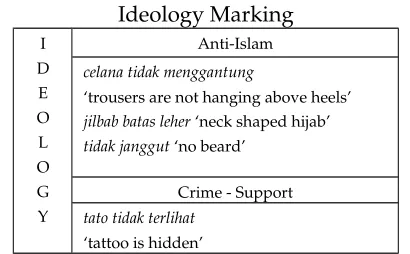
The boldfaced requirements lead to restraining attributes that signify a good male/female muslim. The negation is shown by grammatical or lexicalized negator. See underlined as in jilbab batas leher ‘hijab’s must not cover the neck’ and
tidak janggut ‘no beard’. DE also marked
larangan jilbab syar’i by red marks. Above the nobeard policy, a phrase is not fully boldfaced. It says celana tidak menggantung
‘trousers must not be above the heel’. See picture 1.
Picture 1. A More Complete Fragment of the so called Assessment Sheet
The
strategy is to use negation to modify noun. Here we see hijab, which is positive in meaning, and also janggut ‘beard’ (neutral in meaning). The polarity becomes negative when negation tidak ‘not’ is used to modify the words.
The use of negation, both grammatical or lexicalized, as well as the marking, is orchestrated to make muslim readers believe that the BUMN is not on the muslim side (Muslim is majority in Indonesia).
The term jilbab batas leher ‘hijab must not cover the neck’. The question that we need to ask is what constitute a good hijab?
A body and head cover that still shows the body shape (except face and hands), including the neck, is not hijab. Therefore, there is no such thing as jilbab syari (jilbab
marked by syar’I ‘rules’) as she highlighted even though this term is widely used to refer to good hijab.
The term jilbab syar’i is coined as some muslim females use a hijablike outfit that still shows their body texture such as breasts, thigh, buttocks etc.
As for beard, there are some hadits
(prophet’s words) which suggest male muslims to grow it. Some still debate whether this must be understood literally or contextually. The same thing goes for the trousers’ rule.
While DE’s comment on assessment sheet applied indefinite quantifier, DE failed to maintain her consistency on her next tweet:
(7) Saudaraku yg berjenggot. Nggak usah repotrepot daftar jadi pegawai pemerintah/BUMN ya. Tidak bakal diterima!
‘brothers with beard. Do not waste your time applying for civil servants or BUMN employee. You will definitely be rejected’
Fundamentally, DE shifted the noun from indefinite to generic; from one BUMN to all BUMN and all government institution or pegawai pemerintah ‘civil servants’ (See picture 2 and table 2). This implies that she gradually shifts from accusing one particular BUMN to all BUMNs and all government institutions as well.
While creating the image of antiislam, DE polished herself as proIslam by the use kinship address that implies ingroup identity[ CITATION Bro87 \l 1033 ]. The ideological claim, certain lexical items or phrases might be emphasized. DE here employed Islamic ideology to strengthen his generalization. See how the text creates BUMN’s negative image by the ideological [SINGLE SUBJECT] +
[MULTIPLE SUBJECTS]
+
[INDEFINITE] +
[GENERIC] +
Some prophet’s sayings recommend male muslims to grow beard and use trousers that do not cover heels (still debatable whether should be understood literally or contextually). Islam also requires that female wear hijab that does not show her body shape (except face and palm),
celana tidak menggantung ‘trousers are not hanging above heels’, and tidak janggut ‘no beard’ for male. hadits
While the previous foregrounding applies on what is forbidden, another foregrounding is on what is allowed. Besides the image of avoiding ‘good muslim’ to be BUMN employees, another image that it tries to create is BUMN prefers an individual of negative traits. Consider another line that it marked with boldfaced; rejects ‘good muslim’. The graphical markings are amplified by her own tweet:
rejected!’ with punctuation mark to emphasize a stress [ CITATION Cry06 \l 1033 ].
(8) Bertato boleh. Jilbab syar’I gak boleh
‘you may have tattoes. But a proper hijab is prohibited.
My suspicion that this document is fabricated goes stronger by the inconsistent diction or word choice. First, only one among all details here is written by nominalization kerapihan, where the normally used is the adjective rapih with no simulfix. This is quite inconsistent with the other details. Second, I also identified features of informal language such as contraction tdk (for tidak ‘no’) and word choice cowok ‘young male’. The silliest one is the inconsistence of using reference word for male. On one detail, it uses lakilaki while on the other, it uses cowok. The word cowok
is the informal form of lakilaki or lelaki.
‘To Test the Water’
According to Cambridge American Idiom Dictionary (2003), the phrase ‘to test the water’ means to float an idea; you propose something to understand how people might respond. In politic and communication [ CITATION Bur08 \l 1033 ], this term means to spread a thought about evaluation or about ‘to do something’ where it has future aspects. If the majority is silent, then the rumors will come true. However, if there are many rejections, then the ones who ‘test the water’ will respond to it evasively, saying that it is only a plan or
thought. The evasive movement is usually by saying that ‘this is only a plan, this is only a draft, this is not the final decision’.
(9) Sudah percaya kalau selama ini bukan ‘test the water’?
Now are you convinced that for all this time it is not ‘test the water’?
DE is questioning whether people believe that ‘this’ is ‘test the water’, after she presented the rumor in sequence. ‘This’ here refers to government policy. We can reveal DE’s intent by means of speech act. In speech act, a particular speech act is not bound to a particular form [ CITATION All12 \l 1033 ]. Even though in surface the form is a question, but it actually suggests more. This is a yes/no question (where yes is the expected answer), but it is actually a statement that the nohijab policy is not on the stage of testing the water anymore, but it is real and final.
One aspect about testing the water is ‘playing save’. This seems to be her step, when some people start questioning the evidence. The news went viral and people were getting more and more suspicious. Some start questioning DE’s version of BUMN assessment sheet as it resembles the requirement for storekeepers in Alfamart and Indomaret, some franchised convenient stores in Indonesia. See her next tweet :
(10)Saya
‘I respect all government officials, including the ministers, particularly the one I honor, Bu Rini’
The news went viral and finally DE made her clarification about her tweet. In (10) she mentioned that she respects all government officials (marked by quantifier
segenap ‘all’), and she marked them specifically by para mentri ‘the ministers’ and more specifically ‘Bu Rini’, who is the minister of BUMN.
It is interesting that she used the term clause saya muliakan ‘I honor’. The clause here, introduces the object in a more specific detail. Mulia is an evaluative adjective to mention that the entity [+HUMAN] receiving this evaluation is honorable/noble; in other words, this is positive evaluation that came after the rumor be proven to be completely unfounded. By making it a verb (attaching suffix –kan), the agent who performs this act also acknowledges that the entity is honorable. Here, she foregrounds her attitude toward the minister. But actually, this is only a background before her actual evasive movement:
(11)Saya TIDAK PERNAH menyebut MENTRI manapun dalam tweet saya. Bisa dicek.
‘I HAVE NEVER mentioned any specific MINISTER in my tweets. Check it.’
(12)Untuk Koran NonStop, saya tidak pernah berhubungan dengan Koran ini.
‘for NonStop newspaper, I have never been in contact with this newspaper’
In (11) she uppercased tidak pernah
‘NEVER’ and menteri ‘MINISTER’. In netizen communication, this mark is equal to shouting and never used unless very important [ CITATION Cry06 \l 1033 ]. She says she has not mentioned any minister responsible for this act.
Implying a reference might be performed in different ways. It might be textual via anaphoric or cataphoric relation. However, people can make reference, even when the reference is not mentioned at all in the text, which is called exophoric relations[ CITATION Huaty \l 1033 ]. Unlike other referencing methods where the reference is mentioned in the text, exophora works on the contextual level, where text, readers’ background knowledge and realities are equally important to interrelate.
In (12) she also confirmed that she has never been in contact with the newspaper, which is a clear violation of journalism ethics[ CITATION Fro14 \l 1033 ] for NS. We will discuss this later, and focus on DE’s intent here.
When a text is created, the intent of an author is a determinant on how the text takes shape, as applied in a study by Diaz (2011) There are several possible intents. First is that she was sincere and honest with pure noble intention, and aimed only on a BUMN. But this is hard to believe as she, in her retweet generalized to all BUMNs and all government institutions (picture 2). The second one, she targeted all BUMNs and all government institutions. This is another possible interpretation.
the minister’s boss, who is the president of Indonesia. However, as she mentioned BUMN, then it unfortunately narrowed down to the minister of BUMN only. The generalization was not as completely as she was expecting. In this case, she was stacked in the middle. For this reason, she has no other choice but to do evasive scenario, which follows the same pattern of ‘test the water’. Check the organization as shown in figure 1:
Figure 1. The Organization of ‘test the water’
A rumor is spread with an ambiguous interpretation
> The rumor went viral > People took wrong generalization/negatively
> It is widely published in the media > Confirmation
If true
> Keep provoking
If not
> do evasive movement.
NS Headline
As I have commented previously, the rumor begins with DE’s tweet and several online media (some have removed the links now). However, it became more viral as it became the headline of a local newspaper. See (13), which is the headline of a small scale newspaper ‘NON STOP’ December the 16th 2014 (http://www.nonstop
online.com/2014/12/astagamenteribumn larangwanitapakaijilbabkekantor).
If we refer to DE tweets as in 11 and 12, it is clear that at least two among many journalism ethics [ CITATION Fro14 \l 1033 ] are violated: confirmation and cover both
sides. There is no contact/clarification from DE and none also from the minister of BUMN, where these should have been done before the news is published. Nevertheless, NS put the article with provocative headline:
(13)Astaga, Mentri BUMN Larang Wanita Pakai Jilbab ke Kantor
‘Oh My God, The Minister of BUMN banned females with hijab to go to the office’
(14)Astaga
‘oh my god’
The word form astaga is an interjection, which is one of the markers of expressive speech act [ CITATION All12 \l 1033 ]. The term expressive is used as this speech act represents the feeling of the speaker (or writer in this case). The semantic prosody of
astaga is mostly negative.
This word is common among muslims. A muslim will say astaghfirullah (from Arabic) to respond to a surprise in which he/she believes that it is something negative. The word astaga might probably derive from this [ CITATION Jon07 \l 1033 ]. The use of this arabicloanword creates the atmosphere of ideological similarity between NS and muslim readers, which Brown & Levinson (1987) refer as sharing common ground. It gives the impression that NS sympathized over muslims.
Syntactically, the effect of the use of this word is not on the level of word or phrase, but the whole sentence.
(15)Mentri BUMN Larang
Minister BUMN forbid
selectional restriction, where semantic fields of the lexical items must be parallel to avoid anomaly on combinatory (phrase/sentence) level[ CITATION Mol12 \l 1033 ]. Here the agent is Mentri BUMN.
Unlike English, definiteness in Indonesian is not marked by article[ CITATION Wij12 \l 1033 ]. The bare noun in Indonesian may suggest genericity or definiteness. Thus, Mentri
BUMN might be generic or definite. When generic, it does not refer to any particular person. But the VP larang wanita berjilbab pergi ke kantor ‘banned female with hijab to go to the office’ indicates that this is not the common thing a minister does; hence, the NP mentri BUMN is definite. The minister (mentri) here, of course, is the agent that is syntactically responsible for the verb phrase. In short, this minister is the one to blame for any of the negative impact. We need sentence semantic to determine the semantic prosody of larang here, but actually the verb larang itself has the feature of lexicalized negation.
When appear in isolation, the connotation of larang is usually negative. we can see how the agent (RS) receives multiple negative evaluations from the exclamation
astaga and the verb larang. I here follow Fairclough (2013), who believes that authors often use evaluation languages to transfer their thoughts and ideologies.
(16)Wanita Memakai Hijab Pergi ke Kantor
Female wear Hijab go to office
The headline, as overall, suggests anti muslim thought, addressed to the minister of BUMN.
A relative clause in (16) is introduced by the verb larang. This is a clause embedded to the verb larang as its object (grammatically). In its syntaxsemantic role, this clause is the theme, where it is the entity affected by the action of the agent. The subject of this embedded clause is
wanita memakai hijab ‘female to wear hijab’. Wearing hijab is something obligatory for female muslims. However, this action is negated by larang which makes the prosody negative.
In conclusion, the minister forbids something, which is believed by muslims to be the words of Allah (muslim’s god). The message is now clear: the minister defies muslim god’s law. As for linguistic perspective, the phrase pergi ke kantor has multiple interpretations.
Syntax here is often the source of structural ambiguity[ CITATION Hur12 \l 1033 ]. But in newspaper headlines, this is a common phenomena as some language elements are omitted[ CITATION Mar14 \l 1033 ]. However, most readers will always generalize for the reasons that 1) bare noun of kantor allows generic interpretation, 2) situational contexts which involve the content of the article, and existing ideologies.
The verb phrase pergi ke kantor ‘go to the office’ here seems to require more contextual interpretation. The verb phrase is composed of the verb pergi ‘to go’, and prepositional phrase ke kantor (the preposition ke is followed by a goal kantor
‘office’). The problem here the cotext does not suggest whether kantor is generic or definite. When kantor is defined in generic terms, she forbids any female wearing hijab
travel is to a place called ‘kantor’, then it is forbidden. So, is it definite? When we say that kantor here is definite, another question shall arise. Is it the office that is owned by the females with hijab? Is it the office where they work? Where they want to pick up someone? Different possibilities may arise as a result of the ambiguity.
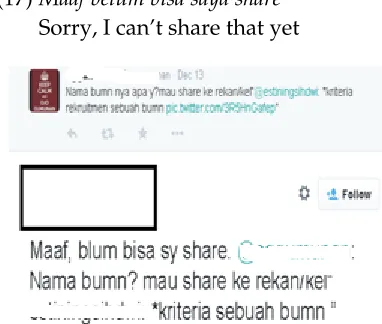
As it has been commented previously, DE shifted BUMN from indefinite even generalized to all government institutions. In between, someone asked about which BUMN she meant. This implies that someone realized the indefiniteness and to end suspicion, DE must make it definite by stating the name of the BUMN. However, DE refused to answer (17) and even generalized to all government institution. When asked to verify the BUMN she referred, DE refused vaguely, making people more suspicious.
(17)Maaf belum bisa saya share
Sorry, I can’t share that yet
Some dedicated reporter question the quality of the article as it does not comply to some fundamental principles of journalism documented by Frost (2014) such as ‘cover both sides’ or ‘verification’. The article was written one side (see DE’s disclaimer on 11 that NS had no contact with her), and it does not mention any effort of requesting confirmation either from the user of DE account or from the BUMN official.
Most readers, however, are having no difficulty in determining to whom the anti islam image is addressed, soon after they are exposed to the content of the article (or obtaining the information from other resources) and making exophoric reference to the realities outside the text[ CITATION Huaty \l 1033 ]. Up to this point, it is clear that the article published by NS is not a good journalistic product.
The next subsection describes that discourse structure of the news article used by NS to convince readers that the news they fabricated is true.
The Narrative Structure of NS Article
What might lead people to believe the news article of NS is true as its narrative structure, or so called framing model as proposed by Pan and Kosicki (see Borah, 2011). It connects the rumor of the minister of BUMN that forbids hijab, with the previously existing news, where the Minister of Education, Anies Baswedan (AB) has also been claimed to forbid muslim students pray in school. One of the religious preachers, Yusuf Mansur (YM), who is known for his business, believed this rumor to be true and even attacked AB on twitter. But later he apologized to AB as the rumor was also proven to be completely unfounded.
(http://www.muslimedianews.com/2014/ 12/ustadzyusufmansurakuisalah dan.html ).
Table 1. The Discourse Structure of No Hijab Policy Rumor by NS
Headline > Claiming
Astaga, Menteri BUMN Larang Wanita Pakai Jilbab ke Kantor
subheadline > supporting [] trait, opposing [+] trait
Pria Berjenggot Panjang Juga Dilarang.Yang Bertato Malah Diperbolehkan
connecting to facbricated [] news, focusing on responses from public figures > claiming previously fabricated news to be true
Doa Di Sekolah Pernah Dilarang
> elaborating another fake news
Selain jilbab, Menteri kebudayaan, Pendidikan Dasar dan Menengah Atas, Anies Baswedan juga sempat ingin mengatur doa pembuka di sekolah sekolah.
> quoting responses from well known religious leader
Sontak pernyataan Anies langsung mendapat reaksi keras. Salah satunya adalah Ustadz Yusuf Mansyur. . support for people with negative traits (tattoo) and opposes people with positive traits in Islam (beard & hijab). Tattoo here is negative in prosody as people often relates this to crime[ CITATION Bar99 \l 1033 ], whereas the origin of tattoo itself is to mark criminals[ CITATION Cap97 \l 1033 ]:
framing model as discussed by Borah, (2011)
(20)Psikolog lulusan Universitas Gajah Mada (UGM) ini, menyuarakan keprihatinannya
The UGM graduated psychologist expressed her concern.
(21)Postingan larangan berjibab di kantor BUMN ini menarik perhatian putra Amien Rais, Hanafi Rais.
This nohijab policy in BUMN news has attracted the son of Amin Rais, Hanafi Rais, to comment
(22) “katanya Ketua Komisi I DPR RI Mohammad Hanafi Rais, kemarin.
Said the head of Commission 1 of the house of the representatives, Mohammad Hanafi Rais yesterday.
(23)Pelarangan memakai Jilbab syar’i di kantor BUMN membuat geram sejumlah ulama. Salah satunya adalah Ustadz Agus Darmawan
.
The nohijab policy has upset some religious leaders. One of them is Ustadz
Darmawan
(24)Habib Selon menilai larangan tersebut sangat melecehkan agama Islam.
Habib
Selon believes that the rule harasses Islam
(25)Aktivis wanita dari NU Pusat, Yana Lathiva mengatakan, peraturan tersebut tidak relevan diterapkan di Indonesia yang masyarakatnya mayoritas beragama Islam.
A woman activist from NU, Yana Lathiya believed that the rule is not relevant to apply in Indonesia where the majority of the people are muslims.
(26)Salah satunya adalah Ustadz Yusuf Mansyur
One of them is Ustadz Yusuf Mansyur
The preference of proper names, and how they appear with title or addresses, is one crucial importance in the critical reading of a text [ CITATION Hop14 \l 1033 ].
Proper names here are almost always followed by a title, for instance religious leader (such as ustadz and habib), to mark in group (muslim) identity. Hanafi Rais, a politician, is described in two ways. First as the son of Amin Rais. Amin Rais was once the leader of Partai Amanat Nasional (PAN) one of the big and modern Islamic parties in Indonesia. Besides the son as a known politican, his position as a senator is also mentioned to amplify his role as a prominent figure. His complete name is mentioned here, Muhammad, to establish his Islamic identity.
In (25), the rumor has the support from a woman activist from NU (Nahdatul Ulama), which is a large Muslim society in Indonesia. DE’s profession as a psychologist is also mentioned in (20). Readers may get the impression that this is an honest and professional statement. As a plus, it also mentions her academic background from UGM, one of the best universities in Indonesia.
Some words with negative evaluation are also addressed to RS or AB. These words are inherently negative, like melarang
‘to forbid’, konyol/adaada saja ‘ridiculous’,
kecewa ‘dissapointed’. Some other words are negated by explicit negative marker such as
tidak boleh ‘not allowed’, tidak berpendidikan
Each content ends with an evaluative prediction for the future, which is of course also negative; such as ‘sooner the government will regulate the size of pants that you have to wear’, ‘call for prayers will be forbidden for muslim as Masjid (muslim prayer house) well as using loud speakers’.
The presence of the comments from prominent figures here makes narrative structure very convincing, but unfortunately used to support lies. In short, the discourse structure here has lead the readers to believe that government, as represented by the ministers (RS and AB), is antiislam.
CONCLUSION
The series of DE’s actions presented here is exactly the same as ‘test the water scenario’. DE proposed the BUMN recruitment issue to see how people respond to it. NS then took her tweets as a solid evidence (along with what DE claimed to be an assessment sheet for a BUMN recruitment test) for its headline without any confirmation either to the minister of BUMN or to DE (according to DE’s claim).
Some readers, which got provoked to condemn the minister of BUMN, were driven by the antiislam documents she uploaded. Under my evaluation, the document is very odd in terms of its discourse structure. The specific marking seemed to be unnatural or be bydesign.
Up to now, DE cannot show the original version of the assessment sheet (if it does exist). Therefore, no wonder many doubt the originality of the document. Soon after the ministry officially refuted this issue, DE then claimed that NS and others who have condemned RS as the minister of BUMN have interpreted her tweets wrongly.
So what is the reason for this wrong generalization to take place? I believe that
the wrong generalization is the effect that DE wanted. The linguistic configuration of her series of tweets, which I presented here, has shown that she shifted BUMN from indefinite noun to generic and she even widened the coverage not only to all BUMNs but also to all government institutions. It became more provocative as she also highlighted the acceptance of persons with negative traits (tattoo) instead of positive ones (good muslim traits). DE’s clarification about her tweets is much about the details; that she never mentioned any name, that she never contacted NS. But of course the reference can easily be deduced exophorically. However, her inconsistency has shown that we deserve to question her intent and the authenticity of the document.
One issue that has to be explored further is about ideology. People with the same ingroup identity as DE seemed to be easily provoked; they agreed to her tweets without any critical reading. It is possible that they follow DE’s narrative design without careful investigation, as they fully believe of the person behind twitter account of DE who claimed sharing the same in group identity. For this reason, we have to be careful in responding a news although it somehow ‘attacks’ our ideology. Being critical is a must, regardless of the media. We have witnessed how NS has failed to apply standard journalism ethics.
Acknowledgements
their patience when I was working on this selffunded research.
References
Asmaramurthi, W. (2008). Tak and Kok in Javanese. Utrecht: Utrecht Institute of Linguistics.
Barker, J. (1999). The tattoo and the fingerprint: Crime and security in an Indonesian city (Doctoral dissertation, Faculty of the Graduate School of Cornell University). Cornell: Cornell University.
Borah, P. (2011). Conceptual issues in framing theory: A systematic examination of a decade's literature. Journal of communication, 61(2), 246 263.
Brown, P., & Levinson, S.C. (1987). Politness: Some Universals in Language Use. Cambridge: Cambridge University Press.
Caplan, J. (1997). Speaking scars': the tattoo in popular practice and medicolegal debate in nineteenthcentury Europe. In History Workshop Journal 44, 107 42.
Carson, J. (2000). The semantics of number in Malay noun phrases. Master s‟
thesis. Calgary: University of Calgary. Center, C. L. (2003). Cambridge Dictionary
of American Idioms. Cambridge: Cambridge University Press.
Chung, S. (2000). On reference to kinds in Indonesian. Natural Language Semantics 8 (2), 157171.
Crystal, D. (2006). Language and the Internet. Cambridge: Cambridge University Press.
Diaz, M.A. (2011). Manipulation of Teenagers Through Advertising: A Critical Discourse Approach. . Revista de Lingüística y Lenguas Aplicadas, 6(1), 2538.
Eckman, F.R., Moravcsik, E.A., & Wirth, J. R. (1986). Markedness. New York: Springer.
Fairclough, N. (2013). Critical Discourse Analysis: The Critical Study of Language (2nd Edition). Amsterdam/Philadephia: Routledge. Frost, C. (2014). Journalism ethics and
regulation. Philadelphia: Routledge. Grice, P.H. (1975). Logic and Conversation.
In P. Cole, & J. Morgan, Syntax and Semantics 3: Speech Act (pp. 4158). Cambridge: Cambridge University Press.
Hopper, P. (2014). The Emergence of Proper Names in Discourse. In H.G. Davis, & T.J. Taylor, Redefining Linguistics (pp. 149162). New York: Routledge. Huang, Y. (2006). Anaphora, cataphora,
exophora, logophoricity. In D. Crystal, Encyclopedia of Language & Linguistics (Second Edition) . New York: Elsevier Ltd.
Hurley, P. (2012). A Concise Introduction to Logic: 11th Edition. San Diego: Wadsworth Cengage Learning.
Jones, R. (2007). LoanWords in Indonesian and Malay. Leiden: KITLV Press. Marchi, R. (2012). With Facebook, blogs,
and fake news, teens reject journalistic “objectivity”. Journal of Communication Inquiry, 36(3), 24626. Marcoci, S. (2014). Some Typical Linguistic Features of English Newspaper Headlines. Linguistic and Philosophical Investigations, (13), 708 714.
Molinaro, N., Carreiras, M., & Duñabeitia, J.A. (2012). Semantic combinatorial processing of nonanomalous expressions. Neuroimage, 59(4), 3488 3501.
Sinclair, J. (2003). Reading Concordance. London: Pearson & Longman.
Sperber, D., & Wilson, D. (2006). Relevance: Communication and Cognition (2nd Edition). London: Blackwell.
Tran, G.Q. (2002). Pragmatic and Discourse Markedness Hypothesis. Conference of the Australian Linguistic Society available (pp. 98109). Melbourne: Australian Linguistics Society.
Wijaya, D. (2012). Teaching English Generic Nouns: The Exploration Of The Generic Idea In English And Indonesian And The Applications Of Explicit Instruction In Classroom. JELT Indonesia Vol 8 (2), 98115. Wodak, R. (1989). Language, Power and